
Life, 1913-02-06 · page 27 of 48
Life — February 6, 1913 — page 27: what you’re looking at
What you’re looking at
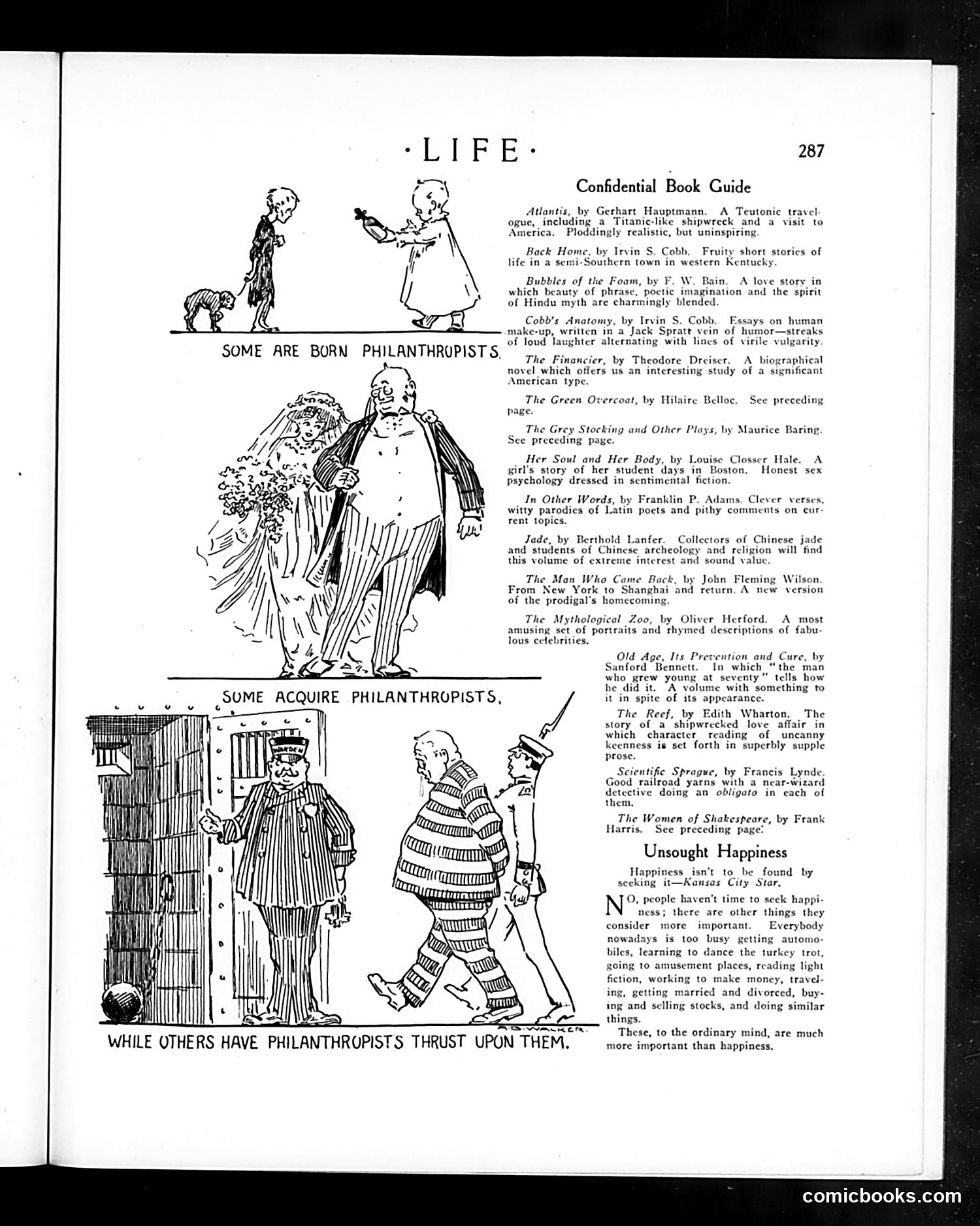
This page contains three interconnected cartoons mocking involuntary philanthropy. The captions suggest three categories: "Some Are Born Philanthropists" (depicting a naturally generous person), "Some Acquire Philanthropists" (showing wealthy individuals being solicited), and "While Others Have Philanthropists Thrust Upon Them" (depicting someone forced into charitable giving). The satire targets the social pressure and obligation surrounding philanthropy in the early 1900s—particularly how wealthy Americans faced constant demands to donate to causes, whether they wished to or not. The cartoons suggest that philanthropy wasn't always a matter of genuine choice or altruism, but rather social coercion and expectation placed upon the affluent. The accompanying essay "Unsought Happiness" reinforces this theme, arguing that modern people are too preoccupied with material pursuits (automobiles, entertainment, stocks) to seek genuine happiness—implying that forced charitable obligations further distract from meaningful living.
📄 Transcribed text from this page (OCR, searchable)
Machine-transcribed from the original scan — historical spelling and the odd misread are preserved.
287 Confidential Book Guide Atlantis, by Gerhart Hauptmann. A Teutonic travel ogue, including a Titanic-like shipwreck and a visit to America. Ploddingly realistic, but uninspiring Back Home, by Irvin S. Cobb. Fruity short stories of life in a semi-Southern town in western Kentucky. Bubbles of the Foam, by F. W. Bain. A love story in which beauty of phrase, poctic imagination and the spirit of Hindu myth are charmingly blended. Cobb's Anatomy, by Irvin S. Cobb. Essays on human make-up, written in'a Jack Spratt vein of humor—streaks of loud laughter alternating with lines of virile vulgarity The Financier, by Theodore Dreiser. A biographical " novel which offers us an interesting study of a significant American type. The Green Overcoat, by Hilaire Belloc, See preceding page. The Grey Stocking and Other Plays, by Maurice Baring ¢ preceding page. Her Soul and Her Body, by Louise Closser Hale. A girl’s story of her student days in Boston, Honest’ sex psychology dressed in sentimental fiction. In Other Words, by Franklin P. Adams. Clever verses witty parodies of Latin poets and pithy comments on ct rent topics. Jade, by Berthold Lanfer. Collectors of Chinese jade and students of Chinese archeology and religion will find this volume of extreme interest and sound valuc The Man Who Came Back, by John Fleming Wilson. From New York to Shanghai and return. A new version of the prodigal’s homecoming. The Mythological Zoo, by Oliver Hertford. A most amusing set of portraits and rhymed descriptions of fabu lous celebrities. tention and Cure, by Sanford Bennett. In which “the man who grew young eventy ” tells how he did it. “A volume with something to it in spite of its appearance. The Reef, by Edith Wharton. The story of a ‘shipwrecked love affair in il = which character reading of uncanny keenness is set forth in superbly supple ED Prose. Scientific Sprague, by Francis Lynde vA Good railroad yarns with a near-wizard Ty a ) Pres detective doing an obligato in each of i \ AN q them. kr any is The Women of Shakespeare, by Frank Lm A\ Harris. See preceding page? (mm) Unsought Happiness Cr is Happiness isn’t tobe found by Gm a my seakiog it—Kansas City Star, ” O, people haven't time to seek happi- ness} there are other things they consider more important. erybody nowadays is too busy getting automo- biles, learning to dance the turkey trot, going to amusement places, reading light fiction, working to make money, travel- ing, getting married and divorced, buy- ing and selling stocks, and doing similar things. These, to the ordinary mind, are much WHILE OTHERS HAVE PHILANTHROPISTS THRUST UPON THEM. more important than happiness. comicbooks.com