
Life, 1913-02-06 · page 22 of 48
Life — February 6, 1913 — page 22: what you’re looking at
What you’re looking at
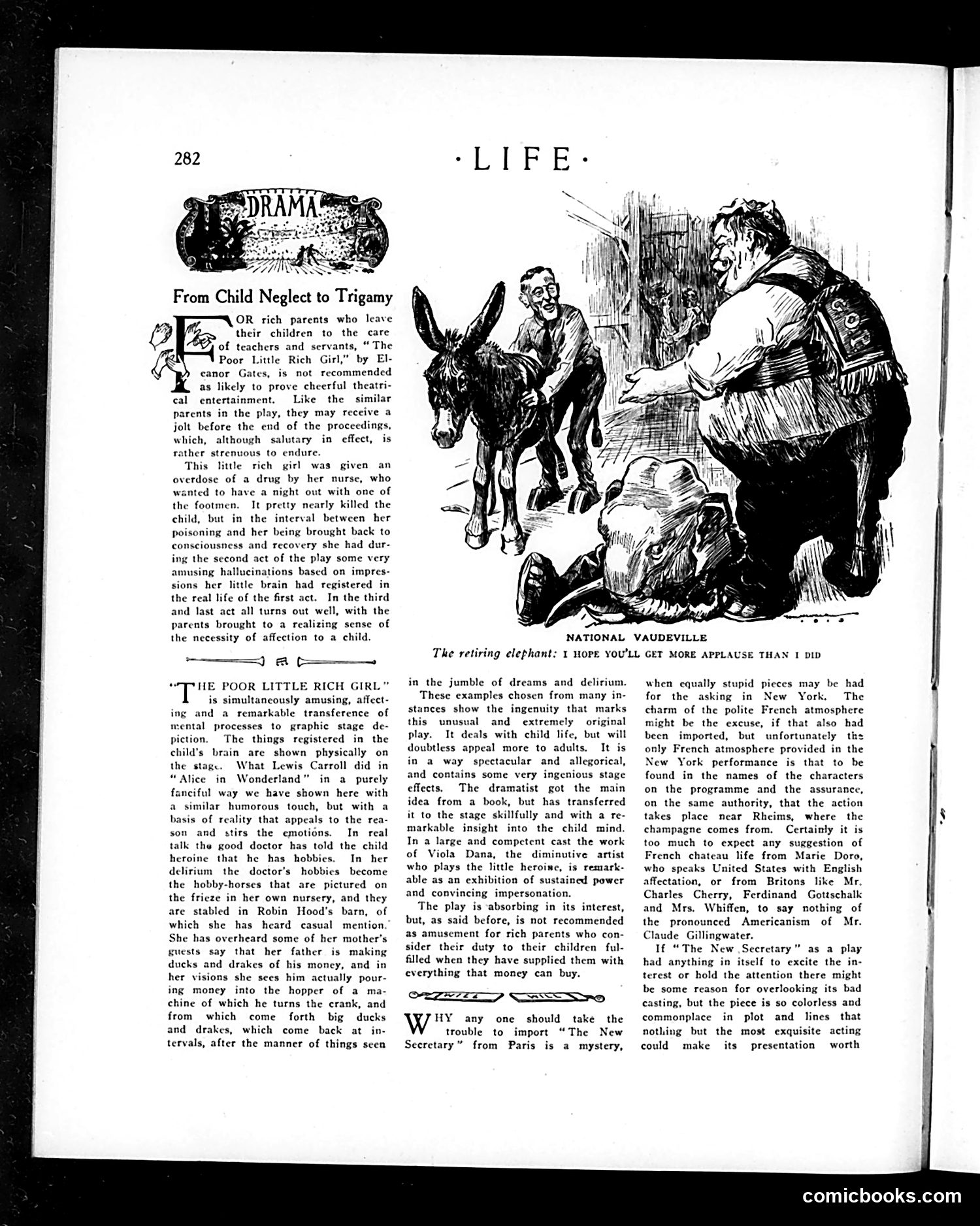
This page reviews **"The Poor Little Rich Girl,"** a stage play about child neglect among the wealthy. The satire targets rich parents who delegate childcare to servants and teachers, then face consequences when their negligence nearly kills their daughter through a nurse's drug overdose. The accompanying illustration labeled "National Vaudeville" shows an elephant addressing another performer, likely satirizing theatrical ego and competition for applause—a secondary jab at show business vanity. The play's innovation, per the critic, is depicting the child's drug-induced hallucinations through stagecraft: her father's financial recklessness becomes literal "ducks and drakes" (money wasted), and a doctor's hobbies become hobby-horses. This visual translation mirrors Lewis Carroll's *Alice in Wonderland*. The review is mixed—praising the theatrical ingenuity and lead actress Viola Dana's performance, but concluding the play serves as uncomfortable moral instruction for negligent wealthy parents, hardly "cheerful entertainment."
📄 Transcribed text from this page (OCR, searchable)
Machine-transcribed from the original scan — historical spelling and the odd misread are preserved.
From Child Neglect to Trigamy OR rich parents who leave their children to the care of teachers and servants, “ The Poor Little Rich Girl,” by El- cs, is not recommended as likely to prove cheerful theatri- cal entertainment. Like the similar parents in the play, they may receive a jolt before the end of the proceedings, which, although salutary in effect, is rather strenuous to endure. This little rich girl was given an overdose of a drug by her nurse, who wanted to have a night out with one of the footmen. It pretty nearly killed the child, but in the interval between her poisoning and her being brought back to consciousness and recovery she had dur- ing the second act of the play some very amusing hallucinations based on impres- sions her little brain had registered in the real life of the first act. In the third and last act all turns out well, with the parents brought to a realizing sense of the necessity of affection to a child. —~) At HE POOR LITTLE RICH GIRL” is simultaneously amusing, affect- ing and a remarkable transference of mental processes to graphic stage de- piction. The things registered in the child's brain are shown physically on the stage. What Lewis Carroll did in “Alice in Wonderland” in a purely fanciful way we have shown here with a similar humorous touch, but with a basis of reality that appeals to the rea- son and stirs the emotions. In real talk the good doctor has told the child heroine that he has hobbies. In her delirium the doctor's hobbies become the hobby-horses that are pictured on the frieze in her own nursery, and they are stabled in Robin Hood's barn, of which she has heard casual mention. She has overheard some of her mother’s guests say that her father is making ducks and drakes of his money, and in her visions she sees him actually pour- ing money into the hopper of a ma- chine of which he turns the crank, and from which come forth big ducks and drakes, which come back at in- tervals, after the manner of things secn NATIONAL VAUDEVILLE The retiring elephant: 1 WOPE YOU'LL GET MORE APPLAUSE THAN I DID in the jumble of dreams and delirium. These examples chosen from many in- stances show the ingenuity that marks this unusual and extremely original play. It deals with child life, but will doubtless appeal more to adults. It is in a way spectacular and allegorical, and contains some very ingenious stage effects. The dramatist got the main idea from a book, but has transferred it to the stage skillfully and with a re- markable insight into the child mind. In a large and competent cast the work of Viola Dana, the diminutive artist who plays the little heroine, is remark- able as an exhibition of sustained power and convincing impersonation. The play is absorbing in its interest, but, as said before, is not recommended as amusement for rich parents who con- sider their duty to their children ful- filled when they have supplied them with everything that money can buy. OFZ SSS HY any one should take the trouble to import “The New Secretary” from Paris is a mystery, when equally stupid pieces may be had for the asking in New York, The charm of the polite French atmosphere might be the excuse, if that also had been imported, but unfortunately ths only French atmosphere provided in the New York performance is that to be found in the names of the characters on the programme and the assurance, on the same authority, that the action takes place near Rhcims, where the champagne comes from. Certainly it is too much to expect any suggestion of French chateau life from Marie Doro, who speaks United States with English affectation, or from Britons like Mr. Charles Cherry, Ferdinand Gottschalk and Mrs. Whiffen, to say nothing of the pronounced Americanism of Mr. Claude Gillingwater. If “The New Seerctary” as a play had anything in itself to excite the in- terest or hold the attention there might be some reason for overlooking its bad casting, but the piece is so colorless and commonplace in plot and lines that nothing but the most exquisite acting could make its presentation worth comicbooks.com -