
Life, 1913-02-06 · page 10 of 48
Life — February 6, 1913 — page 10: what you’re looking at
What you’re looking at
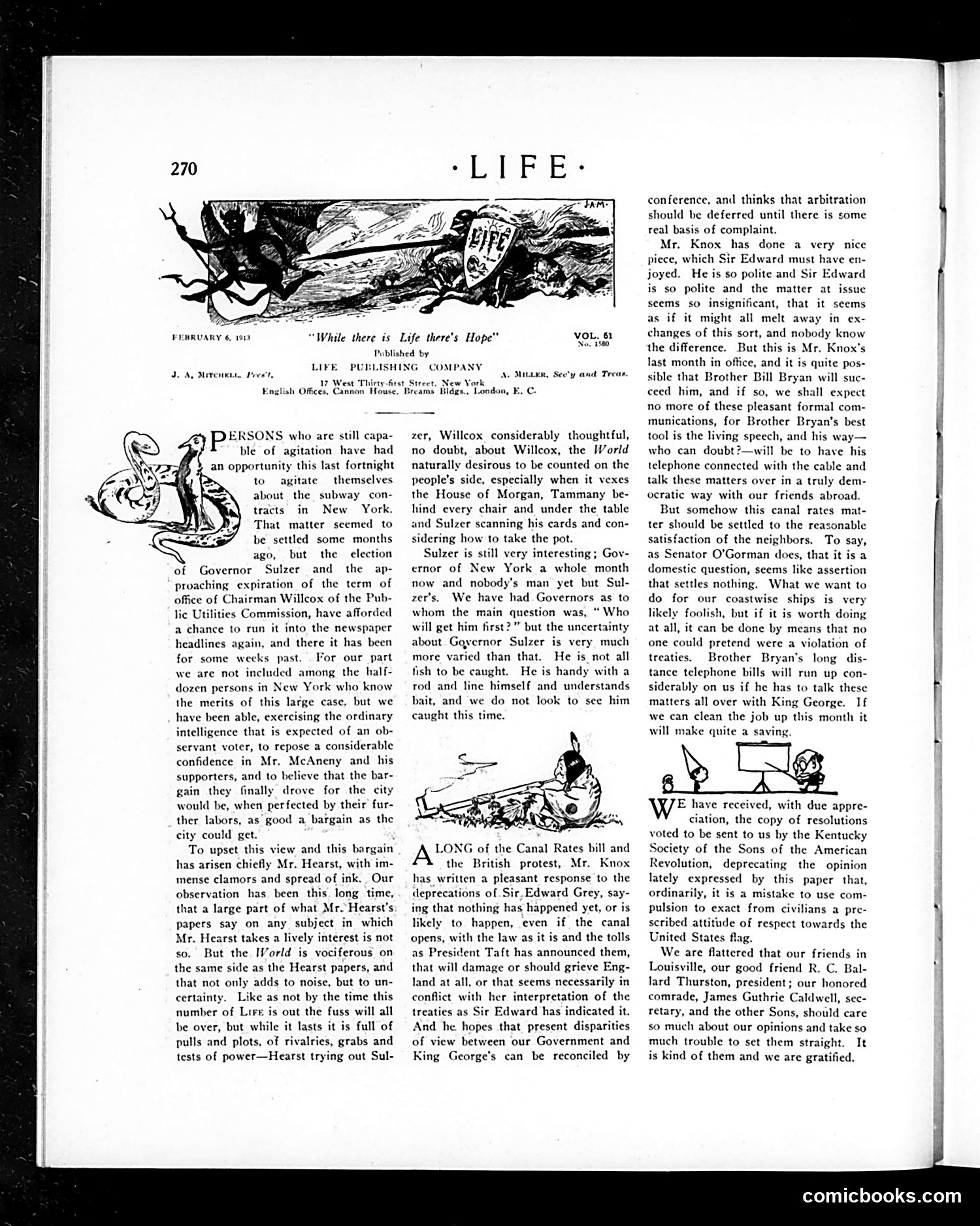
This February 6, 1913 page discusses Governor Sulzer of New York and the **Subways Contracts controversy**. The editorial criticizes Sulzer's handling of disputes between the city and contractors, suggesting he's being manipulated by Chairman Wilcox of the Public Utilities Commission. The cartoons appear to satirize the complex negotiations: one shows a figure struggling with entangled rope or pipes (likely representing the tangled subway contracts), another depicts someone in a boat, possibly illustrating being "lost" in bureaucratic complications. The text reveals tension between labor interests, business concerns, and political maneuvering during New York's early subway system expansion—a major issue where Governor Sulzer faced criticism for failing to decisively resolve contract disputes that affected workers and the city's infrastructure development.
📄 Transcribed text from this page (OCR, searchable)
Machine-transcribed from the original scan — historical spelling and the odd misread are preserved.
FEBRUARY 6, 1913 “While there is Life there's Hope” VOL. 61 No. 1880 Published by LIFE PUL J. A, MerenKtt. Breet, ISHING COMPANY A. Mitte, See'y and Treas, 17 West Thirty-first Street, New Vork English Offices, Cannon House, Bream: a PERSONS who are still capa- ble of agitation have had an opportunity this last fortnight to agitate themselves about the subway con- tracts in New York. That matter seemed to be settled some months ago, but the election of Governor Sulzer and the ap- proaching expiration of the term of office of Chairman Willcox of the Pub- lic Utilities Commission, have afforded a chance to run it into the newspaper headlines again, and there it has been for some weeks past. For our part we are not included among the half- dozen persons in New York who know the merits of this large case, but we have been able, exercising the ordinary intelligence that is expected of an ob- servant voter, to repose a considerable confidence in Mr. McAneny and his supporters, and to believe that the bar- gain they finally drove for the city would be, when perfected by their fur- ther labors, as good a bargain as the city could get. To upset this view and this bargain has arisen chiefly Mr. Hearst, with im- mense clamors and spread of ink. Our observation has. been this long time, that a large part of what Mr. Hearst's papers say on any subject in which Mr. Hearst takes a lively interest is not so. But the MWorld is vociferous on the same side as the Hearst papers, and that not only adds to noise, but to un- certainty. Like as not by the time this number of Lire is out the fuss will all be over, but while it lasts it is full of pulls and plots, of rivalries, grabs and tests of power—Hearst trying out Sul- jdgs., London, E. C. zer, Willcox considerably thoughtful, no doubt, about Willcox, the World naturally desirous to be counted on the people's side, especially when it vexes the House of Morgan, Tammany be- hind every chair and under the table and Sulzer scanning his cards and con- sidering how to take the pot. Sulzer is still very interesting ; Gov- ernor of New York a whole month now and nobody's man yet but Sul- zer’s. We have had Governors as to whom the main question was, “ Who will get him first?” but the uncertainty about Governor Sulzer is very much more varied than that. He is not all fish to be caught. He is handy with a rod and line himself and understands bait, and we do not look to see him caught this time. LONG of the Canal Rates bill and the British protest, Mr. Knox has written a pleasant response to the deprecations of Sir,Edward Grey, say- ing that nothing has happened yet, or is likely to happen, even if the canal opens, with the law as it is and the tolls as President Taft has announced them, that will damage or should grieve Eng- land at all, or that seems necessarily in conflict with her interpretation of the treaties as Sir Edward has indicated it. And he hopes that present disparities of view between our Government and King George's can be reconciled by conference, and thinks that arbitration should be deferred until there is some real basis of complaint. Mr. Knox has done a very nice piece, which Sir Edward must have en- joyed. He is so polite and Sir Edward is so polite and the matter at issue seems so insignificant, that it seems as if it might all melt away in ex- changes of this sort, and nobody know the difference. But this is Mr. Knox's last month in office, and it is quite pos- sible that Brother Bill Bryan will suc- ceed him, and if so, we shall expect no more of these pleasant formal com- munications, for Brother Bryan's best tool is the living speech, and his way— who can doubt?—will be to have his telephone connected with the cable and talk these matters over in a truly dem- ocratic way with our friends abroad. But somehow this canal rates mat- ter should be settled to the reasonable satisfaction of the neighbors. To say, as Senator O'Gorman does, that it is a domestic question, seems like assertion that settles nothing. What we want to do for our coastwise ships is very likely foolish, but if it is worth doing at all, it can be done by means that no one could pretend were a violation of treaties. Brother Bryan's long dis- tance telephone bills will run up con- siderably on us if he has to talk these matters all over with King George. If we can clean the job up this month it will make quite a saving E have received, with due appre- ciation, the copy of resolutions voted to be sent to us by the Kentucky Society of the Sons of the American Revolution, deprecating the opinion lately expressed by this paper that, ordinarily, it is a mistake to use com- pulsion to exact from civilians a pre- scribed attitude of respect towards the United States flag. We are flattered that our friends in Louisville, our good friend R. C. Bal- lard Thurston, president; our honored comrade, James Guthrie Caldwell, sec- retary, and the other Sons, should care so much about our opinions and take so much trouble to set them straight. It is kind of them and we are gratified. _ comicbooks.com