
Life, 1913-02-06 · page 16 of 48
Life — February 6, 1913 — page 16: what you’re looking at
What you’re looking at
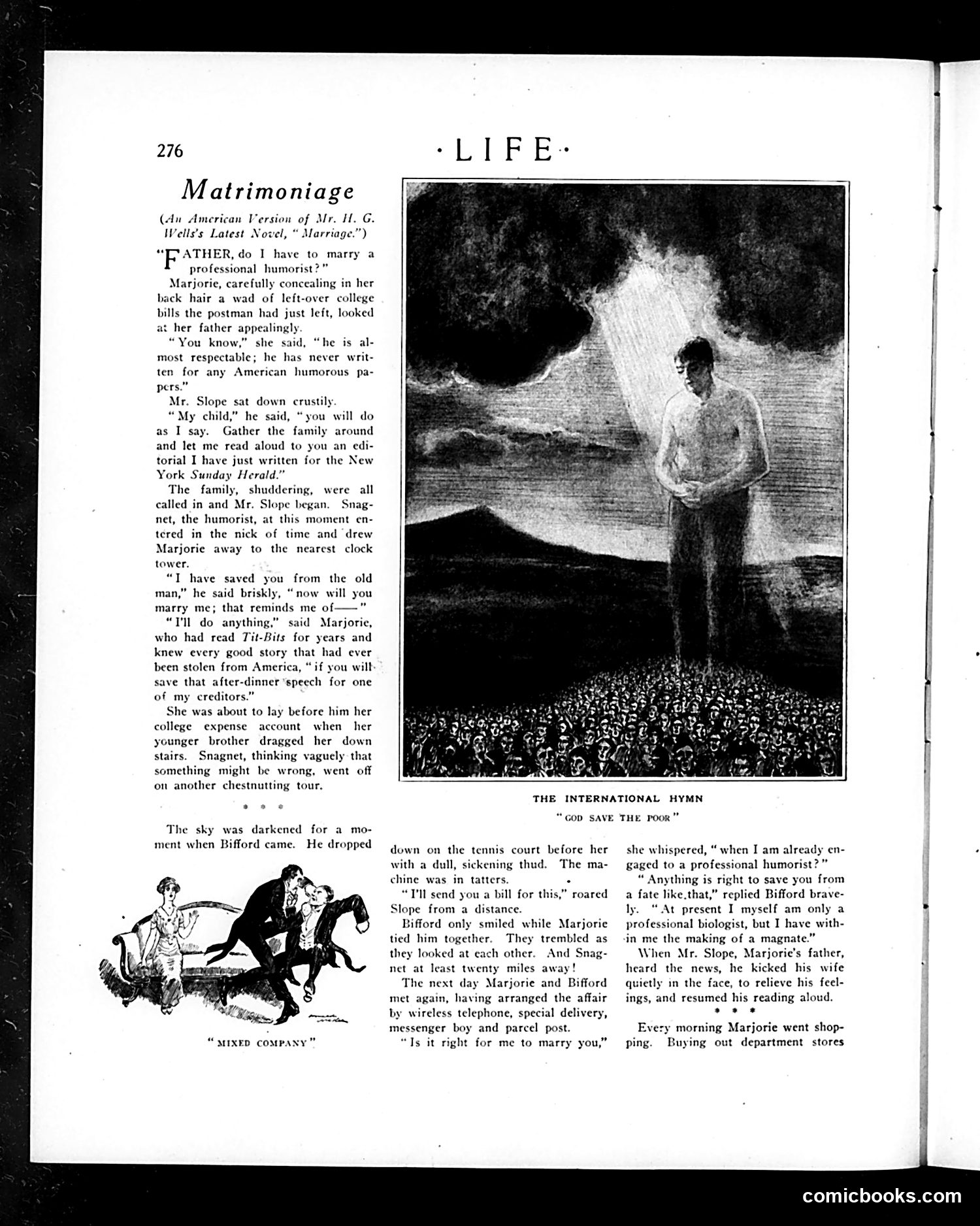
This story parodies H.G. Wells's novel *Marriage*, satirizing early 20th-century romantic conventions and professional pretension. **The setup**: Marjorie's father, Mr. Slope (an editor), wants her to marry Snagnet, a professional humorist. Marjorie reluctantly agrees, though she's actually attracted to Bifford, a "professional biologist" who crashes his airplane onto her tennis court. **The satire targets**: - The absurdity of marrying based on professional status rather than genuine feeling - Humorists and writers as shallow, self-aggrandizing figures (Snagnet constantly interrupts with jokes) - The period's obsession with career credentials as marriage material - Marjorie's pragmatism: she agrees to anything if it saves her from debt **The crude humor**: Mr. Slope's violent "relief" at learning the news (kicking his wife) typifies the crude comedy of the era, treating domestic violence as a punchline. The accompanying cartoon "Mixed Company" (lower left) appears to show chaotic social interaction, reinforcing the story's theme of matrimonial confusion.
📄 Transcribed text from this page (OCR, searchable)
Machine-transcribed from the original scan — historical spelling and the odd misread are preserved.
276 Matrimoniage (An American Version of Mr. H. G. Wells's Latest Novel, “ Marriage.”) ATHER, do I have to marry a professional humorist Marjorie, carefully concealing in her back hair a wad of left-over college bills the postman had just left, looked at her father appealingly “You know,” she said, “he is al- most respectable; he has never writ- ten for any American humorous pa- pers.” Mr. Slope sat down crustily. “My child,” he said, “you will do as I say. Gather the family around and let me read aloud to you an edi- torial I have just written for the New York Sunday Herald.” The family, shuddering, were all called in and Mr. Slope began. Snag- net, the humorist, at this moment en- tered in the nick of time and drew Marjorie away to the nearest clock tower. “T have saved you from the old man,” he said briskly, “now will you marry mc; that reminds me of —" “Tl do anythin; said Marjorie, who had read Tit-Bits for years and knew every good story that had ever been stolen from America, “if you wilt save that after-dinner ‘speech for one of my creditors.” She was about to lay before him her college expense account when her younger brother dragged her down stairs. Snagnet, thinking vaguely that something might be wrong, went off on another chestnutting tour, 2° The sky was darkened for a mo- ment when Bifford came. He dropped THE INTERNATIONAL HYMN “GOD SAVE THE Poor” down on the tennis court before her with a dull, sickening thud. The ma- chine was in tatters. : nd you a bill for this,” roared om a distance. smiled while Marjorie tied him together. They trembled as they looked at each other. And Snag- net at least twenty miles away! The next day Marjorie and Bifford met again, having arranged the affair by wireless telephone, special delivery, messenger boy and parcel post. “Is it right for me to marry you,” she whispered, “when I am already en- gaged to a professional humorist?” “ Anything is right to save you from a fate like.that,” replied Bifford bra ly. “At present I myself am only a professional biologist, but I have with- in me the making of a magnate.” When Mr. Slope, Marjorie's father, heard the news, he kicked his wife quietly in the face, to relieve his feel- ings, and resumed his reading aloud. oes Every morning Marjorie went shop- ping. Buying out department stores comicbooks.com .