
Life, 1913-02-06 · page 33 of 48
Life — February 6, 1913 — page 33: what you’re looking at
What you’re looking at
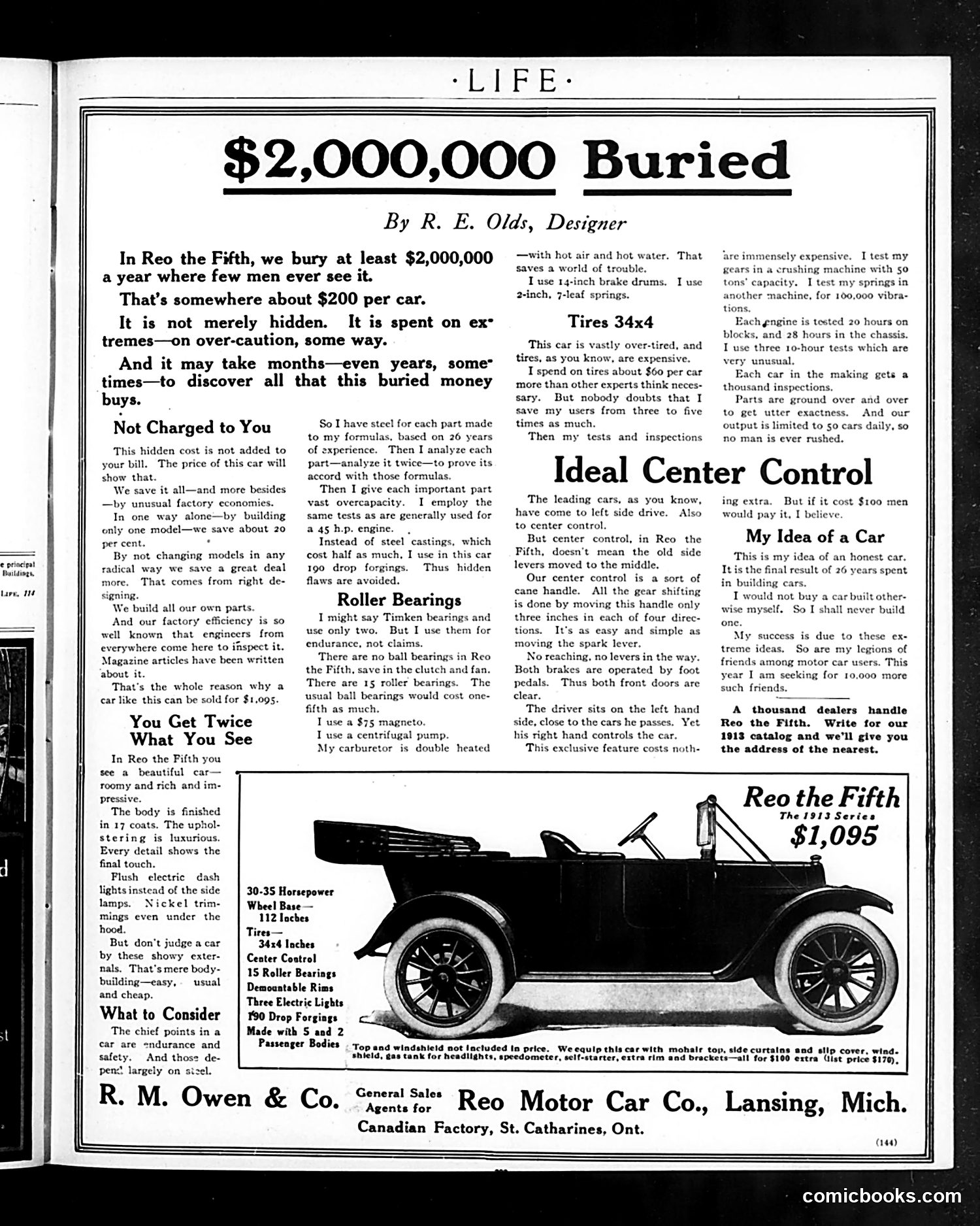
This is primarily a **car advertisement**, not satire or political commentary. R.E. Olds, designer of the Reo automobile, is making a straightforward pitch for the "Reo the Fifth" (priced at $1,095 in 1913). The article's central claim: the car contains "$2,000,000 buried" annually—hidden manufacturing costs not charged to buyers. Olds argues his factory's efficiency (building only one model, manufacturing own parts, conducting extensive testing) allows him to absorb quality expenses that competitors pass to customers. The "buried money" refers to over-engineering details invisible to buyers: 190 drop forgings instead of cheaper castings, 15 roller bearings, 17 paint coats, redundant testing protocols. Olds emphasizes durability and safety over flashy externals—arguing customers get "twice what you see." This reflects early 1900s automotive marketing: competing on engineering excellence and manufacturing innovation rather than style or speed.
📄 Transcribed text from this page (OCR, searchable)
Machine-transcribed from the original scan — historical spelling and the odd misread are preserved.
€ priocipal Butldiogs, Lave, 4 $2,000,000 Buried By R. E. Olds, Designer In Reo the Fifth, we bury at least $2,000,000 a year where few men ever see it. That’s somewhere about $200 per car. It is not merely hidden. It is spent on ex- tremes—on over-caution, some way. And it may take months—even years, some" times—to discover all that this buried money buys. Not Charged to You This hidden cost is not added to your bill. The price of this car will show that. We save it all—and more besides —by unusual factory economies. In one way alone—by building only one model—we save about 20 per cent. : By not changing models in any radical way we save a great deal more. That comes from right de- signing. We build all our own parts. And our factory efficiency is so well known that engineers from everywhere come here to inspect it. Magazine articles have been written about it. That's the whole reason why a car like this can be sold for $1,095. You Get Twice What You See In Reo the Fifth you see a beautiful car— roomy and rich and im- pressive. The body is finished in 17 coats. The uphol- stering is luxurious. Every detail shows the final touch. Flush electric dash lights instead of the side lamps. Nickel trim- mings even under the hood. Tires— But don’t judge a car by these showy exter- nals. That's mere body- building—easy, usual and cheap. What to Consider The chief points in a car are <ndurance and safety. And thos: de- pens’ largely on sizel. R. M. Owen & Co. So I have steel for each part made to my formulas, based on 26 years of experience. Then I analyze each part—analyze it twice—to prove its accord with those formulas. Then I give each important part vast overcapacity. I employ the same tests as are generally used for a 45 h.p. engine. Instead of steel castings, which cost half as much, I use in this car 190 drop forgings. Thus hidden flaws are avoided. Roller Bearings I might say Timken bearings and use only two. But I use them for endurance, not claims. There are no ball bearings in Reo the Fifth, save in the clutch and fan. There are 15 roller bearings. The usual ball bearings would cost one- fifth as n I use a $75 magneto. I use a centrifugal pump. My carburetor is double heated 30-35 Horsepower Wheel Base — 112 Toches 3434 Inches Center Control 15 Roller Bearii Demoantable Rims Three Electric Lights 190 Drop Forgings Made with S an Passenger Bodies top shiek General Sales Agents for 4 windshield not lactud k for headlight: —with hot air and hot water. That saves a world of trouble. LT use 14-inch brake drums. I use 2-inch, 7-leaf springs. Tires 34x4 This car is vastly over-tired, and tires, as you know, are expensive, I spend on tires about $60 per car more than other experts think neces- sary. But nobody doubts that I save my users from three to five times as much. Then my tests and inspections ‘are immensely I test my gears in a crushing machine with 50 I test my springs in ine, for 100,000 vibra- ach engine is tested 20 hours on blocks, and 28 hours in the chassis. I use three 10-hour tests which are very unusua Each car in the making gets a thousand inspections, Parts are ground over and over to get utter exactness. And our output is limited to 50 cars daily, so no man is ever rushed. Ideal Center Control The leading cars, as you know, have come to left side drive. Also to center control. But center control, in Reo the Fifth, doesn’t mean the old side levers moved to the middle. Our center control is a sort of cane handle. All the gear shifting is done by moving this handle only three inches in each of four direc- tions. It's as easy and simple as moving the spark lever. No reaching, no levers in the way. Both brakes are operated by foot pedals. Thus both front doors are clear. ‘The driver sits on the left hand side, close to the cars he passes. Yet his right hand controls the car. This exclusive feature costs noth- led In price. Weequip this car with mohair toy speedometer, sel! Canadian Factory, St. Catharines, Ont. ing extra. But if it cost $100 men would pay it, I believe. My Idea of a Car ‘This is my idea of an honest car. It is the final result of 26 years spent in building cars. I would not buy a other- wise myself. So I shall never build one. My success is due to these ex- treme ideas. So are my legions of friends among motor car users. This year I am seeking for 10,000 more such friends. A thousand dealers handle Reo the Fifth. Write for our 1913 catalog and we'll give you the address of the nearest. Reo the Fifth The 1913 Series ad stip cover, wind. xtra (ist price $170), Reo Motor Car Co., Lansing, Mich. (aay comicbooks.com