
Life, 1913-02-06 · page 17 of 48
Life — February 6, 1913 — page 17: what you’re looking at
What you’re looking at
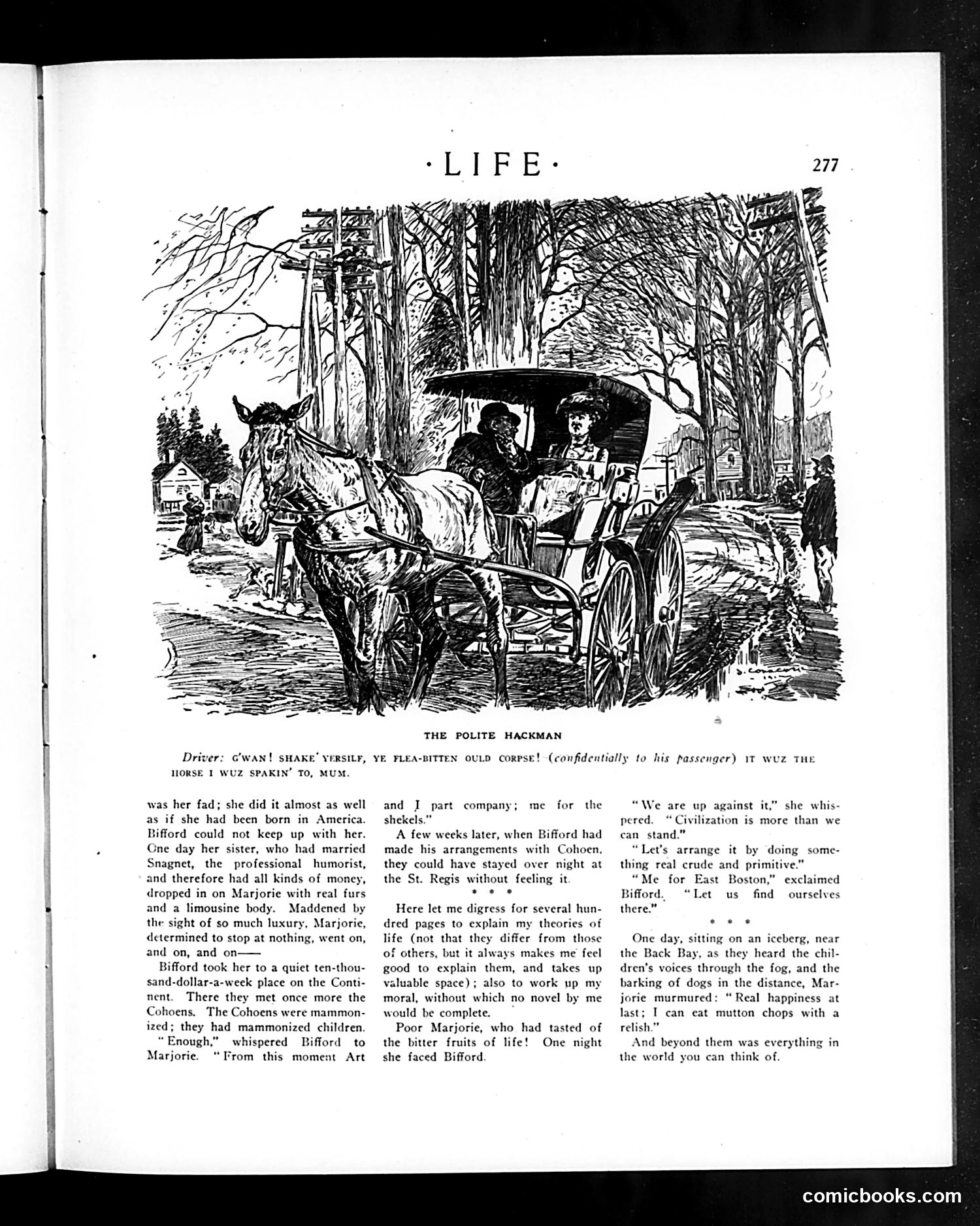
This cartoon satirizes Irish immigrant taxi drivers in early 1900s America. The humor relies on ethnic stereotyping: an Irish "hackman" (cab driver) with a thick accent insults his horse as a "flea-bitten ould corpse," then apologetically explains to his passenger (a refined woman) that he was actually addressing the *horse*, not her—implying working-class Irish men couldn't distinguish between animals and people, or lacked basic courtesy. The accompanying story excerpt appears unrelated, detailing a character named Marjorie pursuing wealth and luxury before seeking "primitive" happiness. Together, the page uses class and ethnic humor typical of Life magazine's satirical approach to American social hierarchies of the period.
📄 Transcribed text from this page (OCR, searchable)
Machine-transcribed from the original scan — historical spelling and the odd misread are preserved.
om 7 ™ Te er w. fa. THE POLITE HACKMAN Driver: G'WAN! SHAKE’ YERSILF, YE FLEA-BITTEN OULD Corpse! (confidentially to his passenger) 1t wuz THE MORSE 1 WU SPAKIN’ TO, MUM. was her fad; she did it almost as well as if she had been born in America. Bifford could not keep up with her. Gne day her sister, who had married Snagnet, the professional humorist, and therefore had all kinds of money, dropped in on Marjorie with real furs and a limousine body. Maddened by the sight of so much luxury, Marjorie, determined to stop at nothing, went on, and on, and on— Bifford took her to a quiet ten-thou- sand-dollar-a-week place on the Conti- nent. There they met once more the Cohoens. The Cohoens were mammon- ized; they had mammonized children. nough,” whispered Bifford to Marjorie. “From this moment Art and I part company; me for the A few weeks later, when Bifford had made his arrangements with Cohoen, they could have stayed over night at the St. Regis without feeling it see Here let me digress for several hun- dred pages to explain my theories of life (not that they differ from those of others, but it always makes me feel good to explain them, and takes up valuable space); also to work up my moral, without which no novel by me would be complete. Poor Marjorie, who had tasted of the bitter fruits of life! One night she faced Bifford “We are up against it,” she whis- pered. “Civilization is more than we can stand.” “Let's arrange it by doing some- thing real crude and primitive.” “Me for East Boston,” exclaimed Bifford, “Let us find ourselves there.” One day, sitting on an iceberg, near the Back Bay, as they heard the chil- dren's voices through the fog, and the barking of dogs in the distance, Mar- jorie murmured: “Real happiness at last; I can eat mutton chops with a relish.” And beyond them was everything in the world you can think of. comicbooks.com