
Life, 1913-02-06 · page 20 of 48
Life — February 6, 1913 — page 20: what you’re looking at
What you’re looking at
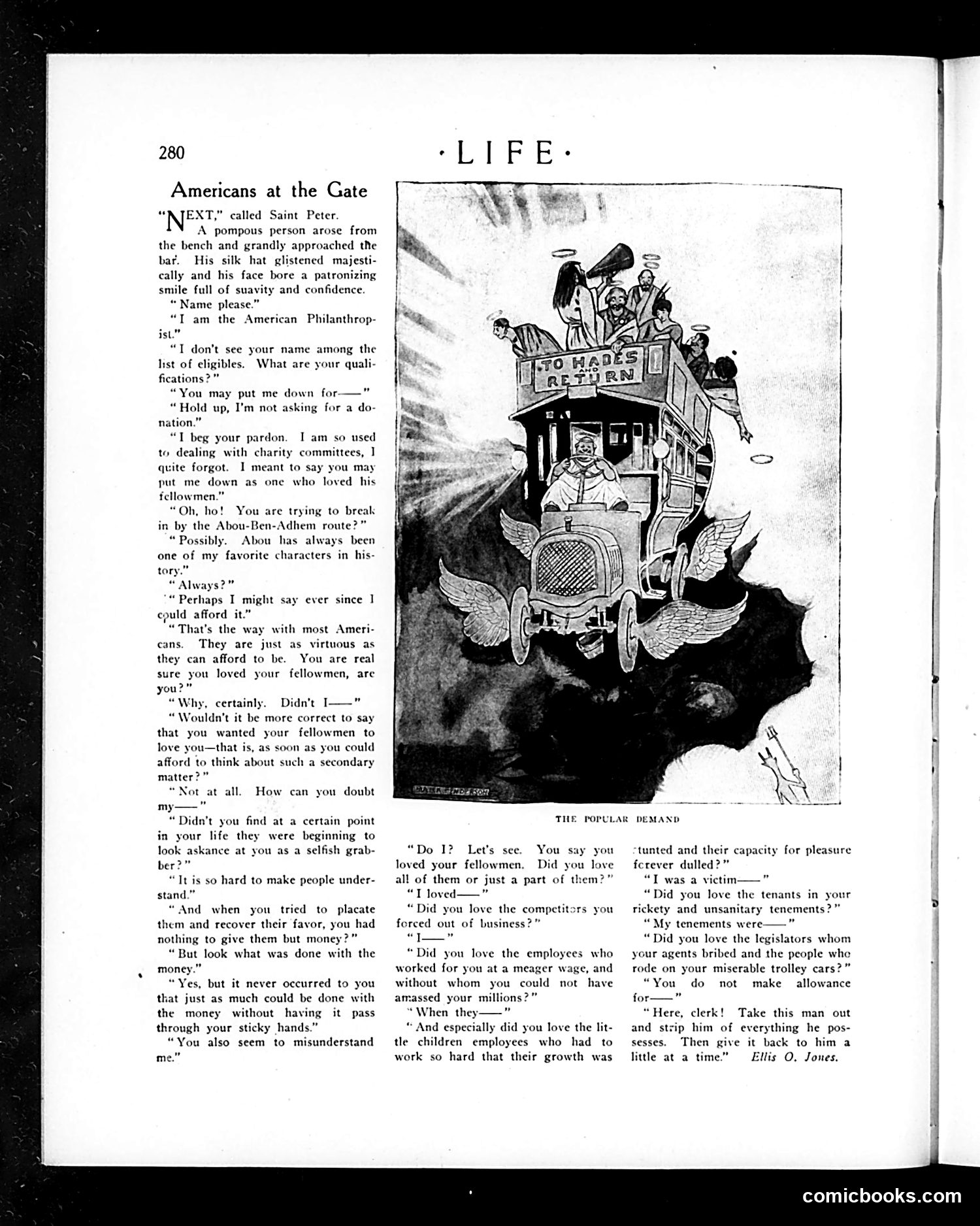
This cartoon depicts Saint Peter interrogating a wealthy American philanthropist at Heaven's gates. The satire attacks the moral bankruptcy of industrial-era wealth accumulation masked by charitable giving. The philanthropist claims to have "loved his fellowmen," but Saint Peter systematically exposes his hypocrisy: he loved competitors only after forcing them into bankruptcy, employees only after exploiting them at subsistence wages, child laborers whose development he stunted, tenants in squalid housing, and legislators he bribed. The philanthropist's charity is revealed as self-serving reputation-laundering—he only became "virtuous" once wealthy enough to afford it. The punchline strips him of his ill-gotten gains and returns them "a little at a time," suggesting moral restitution. This reflects Progressive-era criticism of Gilded Age robber barons whose philanthropic facades couldn't obscure their exploitation and corruption.
📄 Transcribed text from this page (OCR, searchable)
Machine-transcribed from the original scan — historical spelling and the odd misread are preserved.
280 Americans at the Gate “ATEXT,” called Saint Peter. A pompous person arose from the bench and grandly approached the bar. His silk hat glistened majesti- cally and his face bore a patronizing smile full of suavity and confidence. “ Name please.” “IT am the American Philanthrop- ist.” “T don't see your name among the list of eligibles. What are your quali- fications?” “You may put me down for— “Hold up, I'm not asking for a do- nation.” “T beg your pardon. to dealing with charity committees, 1 quite forgot. I meant to say you may put me down as one who loved his fcllowmen.” “Oh, ho! You are trying to break in by the Abou-Ben-Adhem route?” “Possibly. Abou has always been one of my favorite characters in his- tory.” “ Always?” “Perhaps I might say ever since I cpuld afford it.” “That's the way with most Ameri- cans. They are just as virtuous as they can afford to be. You are real sure you loved your fellowmen, arc you?" “Why, certainly. Didn't I—" “Wouldn't it be more correct to say that you wanted your fellowmen to love you—that is, as soon as you could afford to think about such a secondary matter?” “Not at all I am so used How can you doubt my—" “Didn't you find at a certain point in your life they were be look askance at you as a selfish grab- ber?” “Tt is so hard to make people under- stand.” “And when you tried to placate them and recover their favor, you had nothing to give them but money?” “But look what was done with the money.” “Yes, but it never occurred to you fat just as much could be done with the money without having it pass through your sticky hands.” “You also seem to misunderstand THE “Do 1? Let’s see. You say you loved your fellowmen. Did you love all of them or just a part of them?” “T loved —” “Did you love the competitors you forced out of business?” “Did you love the employees who worked for you at a meager wage, and without whom you could not have amassed your millions?” When they — And especially did you love the lit- tle children employees who had to work so hard that their growth was POPULAR DEMAND tunted and their capacity for pleasure fcrever dulled?” “T was a victim——” “Did you love the tenants in your rickety and unsanitary tenements?” “My tenements were——” “Did you love the legislators whom your agents bribed and the people whe rode on your miserable trolley cars?” “You do not make allowance for——" “Here, clerk! Take this man out and strip him of everything he pos- Then give it back to him a Ellis O, Jones. sesses. little at a time.” comicbooks.com