
A complete issue · 48 pages · 1912
Life — October 24, 1912
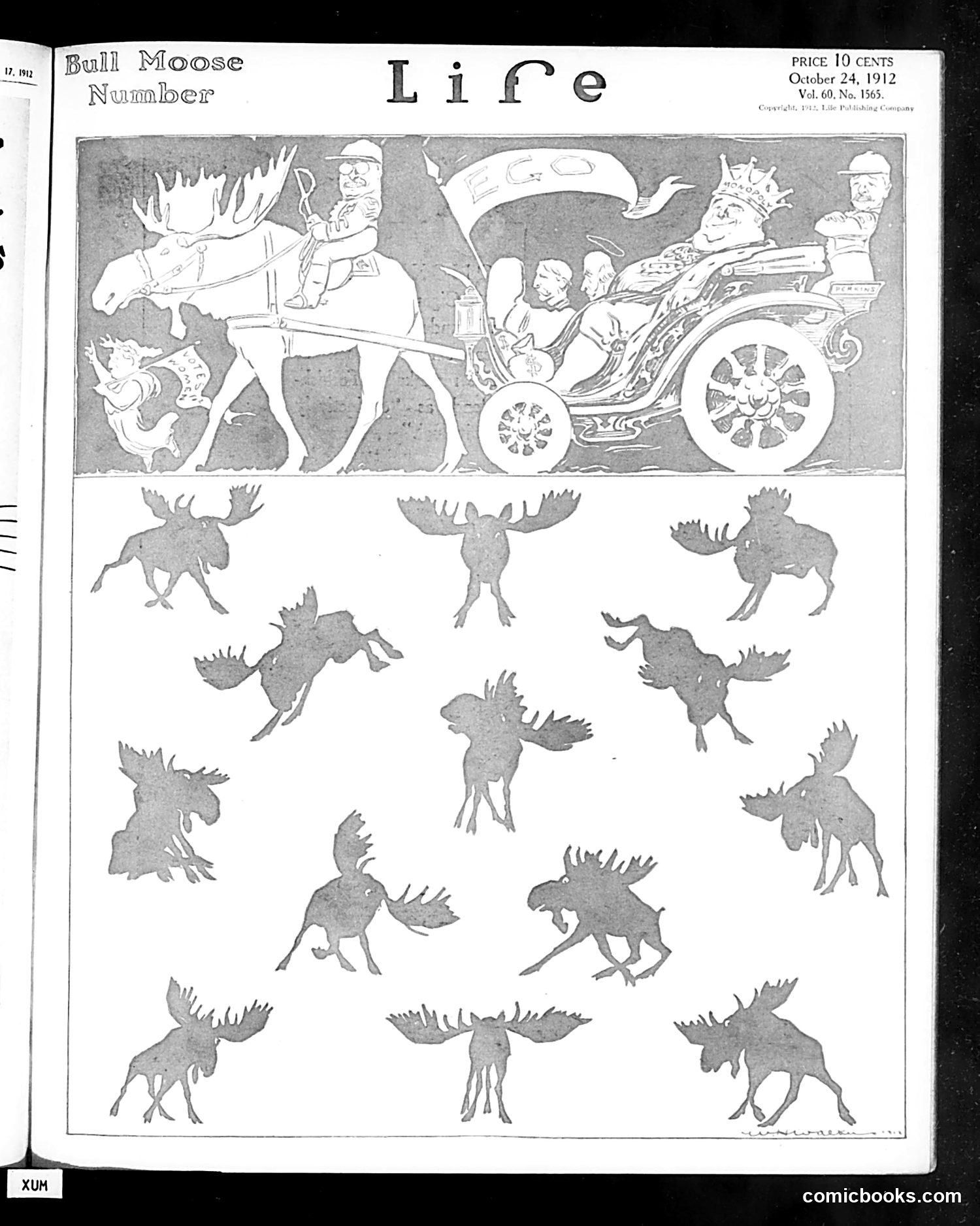
This is a satirical cover featuring the "Bull Moose" party—Theodore Roosevelt's 1912 Progressive Party challenge to incumbent William Howard Taft and Democrat Woodrow Wilson. The top illustration shows a moose pulling an ornate carriage with caricatured figures, likely representing Roosevelt's campaign and supporters. The bottom section displays numerous moose in various comical poses and positions. The satire appears to mock Roosevelt's third-party candidacy and his supporters as wild, chaotic, and ridiculous—the "bull moose" serving as both Roosevelt's chosen symbol and a metaphor for the perceived folly of his insurgent campaign splitting the Republican vote. The multiplied moose emphasize the sense of absurdity surrounding this unprecedented political movement.
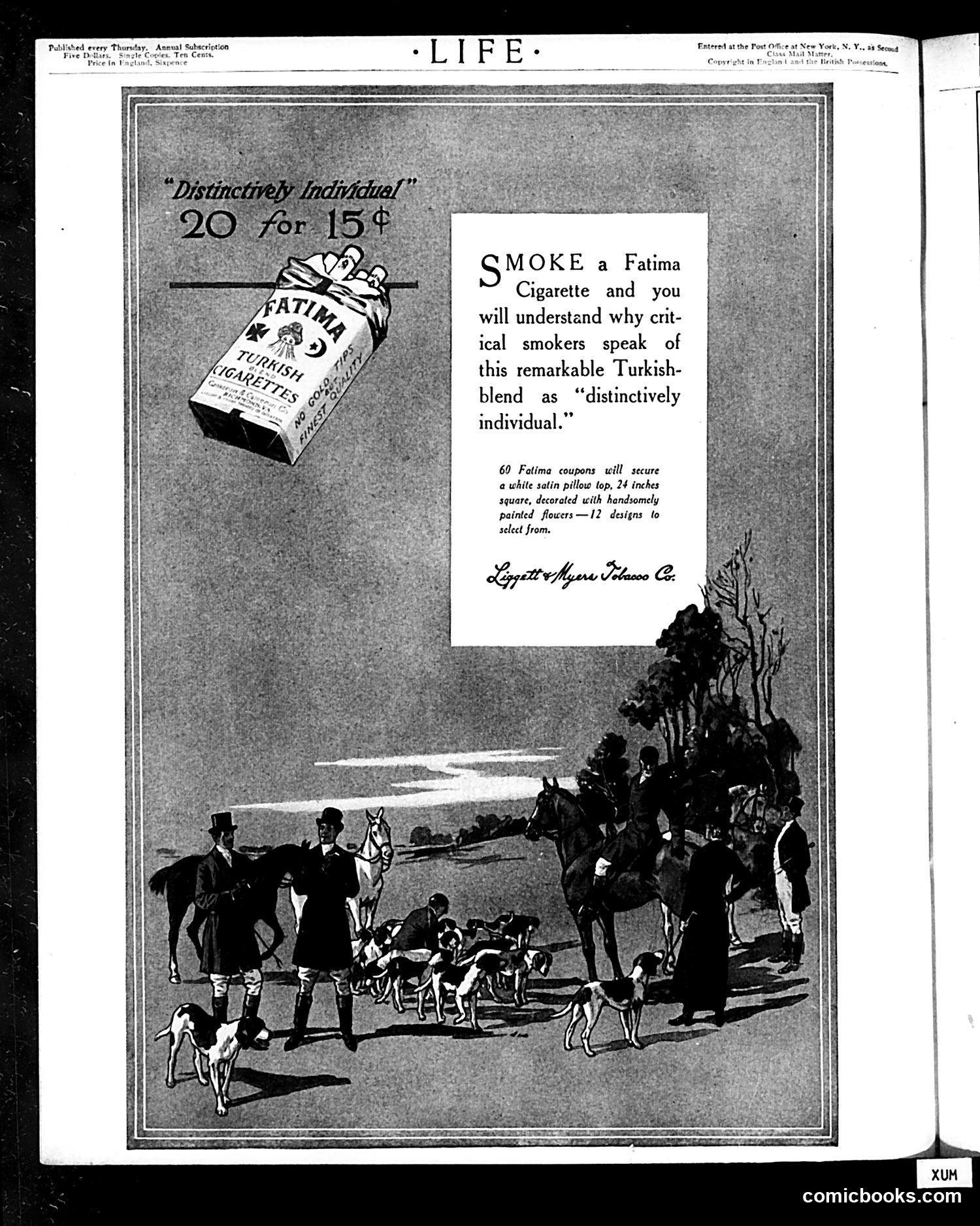
This page is primarily an **advertisement for Fatima Turkish-blend cigarettes**, not a political cartoon. The ad promotes Fatima cigarettes as "distinctly individual," priced "20 for 15¢." The main visual shows a fox hunt scene with well-dressed gentlemen, horses, and hunting dogs—imagery associated with upper-class leisure and refinement. This aspirational setting suggests that smoking Fatima cigarettes conveys sophistication and individuality to "critical smokers." The smaller text mentions a promotional offer: 60 Fatima coupons could be redeemed for a white satin pillow with hand-painted flowers in 12 designs. There is no political satire here—it's a straightforward commercial advertisement using class signaling and lifestyle imagery typical of early 20th-century cigarette marketing.
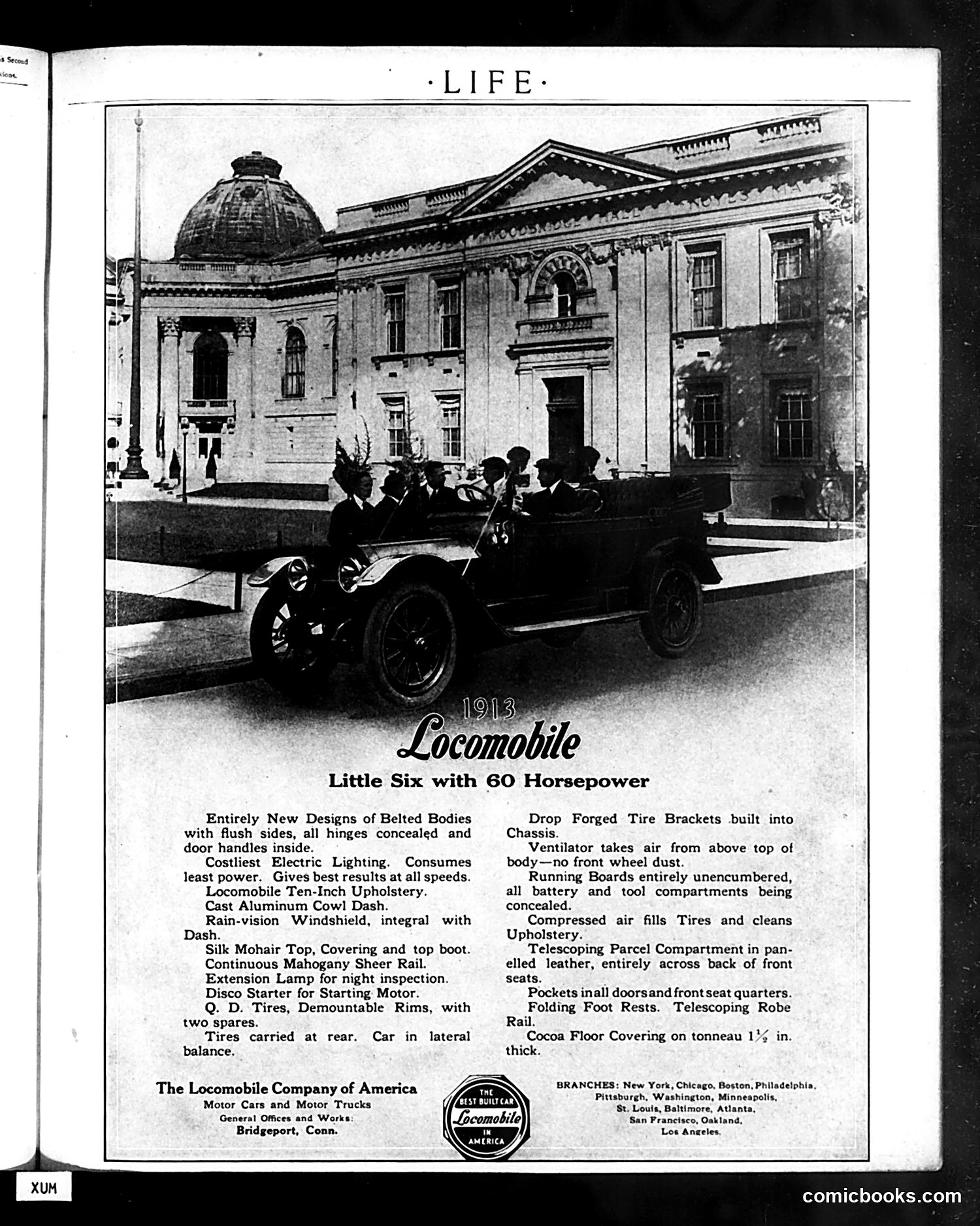
This is **not a cartoon or satirical content**—it's a straightforward **automobile advertisement** for the 1913 Locomobile "Little Six" with 60 horsepower. The image shows the car positioned in front of an elegant neoclassical building (appears to be a government or civic structure), with well-dressed passengers aboard. The advertisement emphasizes luxury features: silk mohair top, aluminum dash, electric lighting, and refined upholstery details. This is typical early-1900s automobile marketing, targeting affluent buyers by associating the vehicle with prestige, comfort, and technological advancement. There is no satire or political commentary present—merely product promotion from the Locomobile Company of America, based in Bridgeport, Connecticut.
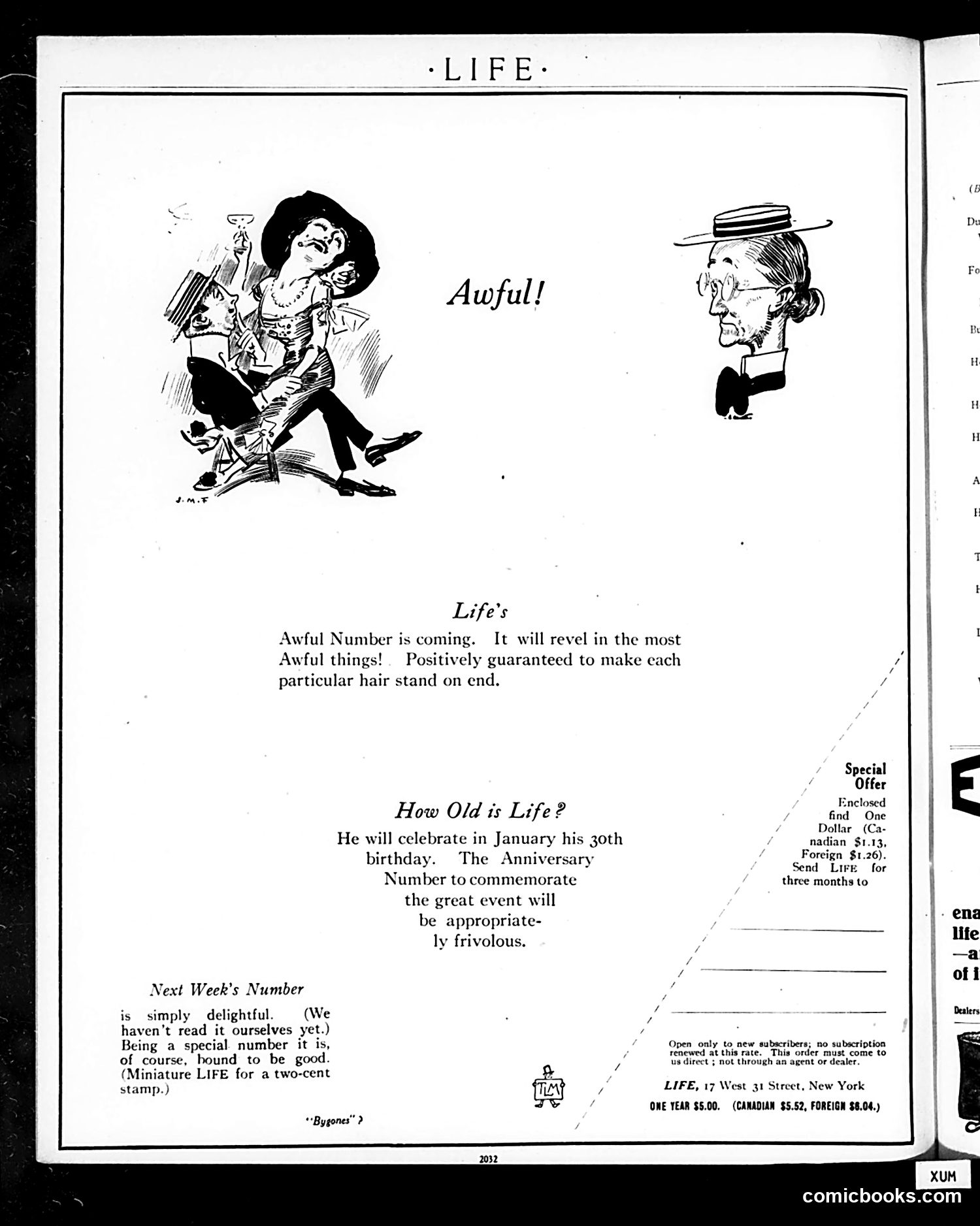
This page promotes Life magazine's upcoming "Awful Number," featuring two cartoons mocking a disheveled figure on the left (appearing overwrought and theatrical) contrasted with a stern observer on the right. The humor relies on visual caricature—the left figure's exaggerated distress suggests incompetence or mismanagement. The text announces Life will "level in the most Awful things" and mentions celebrating someone's 30th birthday in January with "appropriately frivolous" commemoration. Without additional context, the specific political figure or event referenced remains unclear, though the tone suggests satirizing public incompetence or failed leadership typical of Life's editorial approach. The page also advertises subscription rates and notes next week's number as "simply delightful."
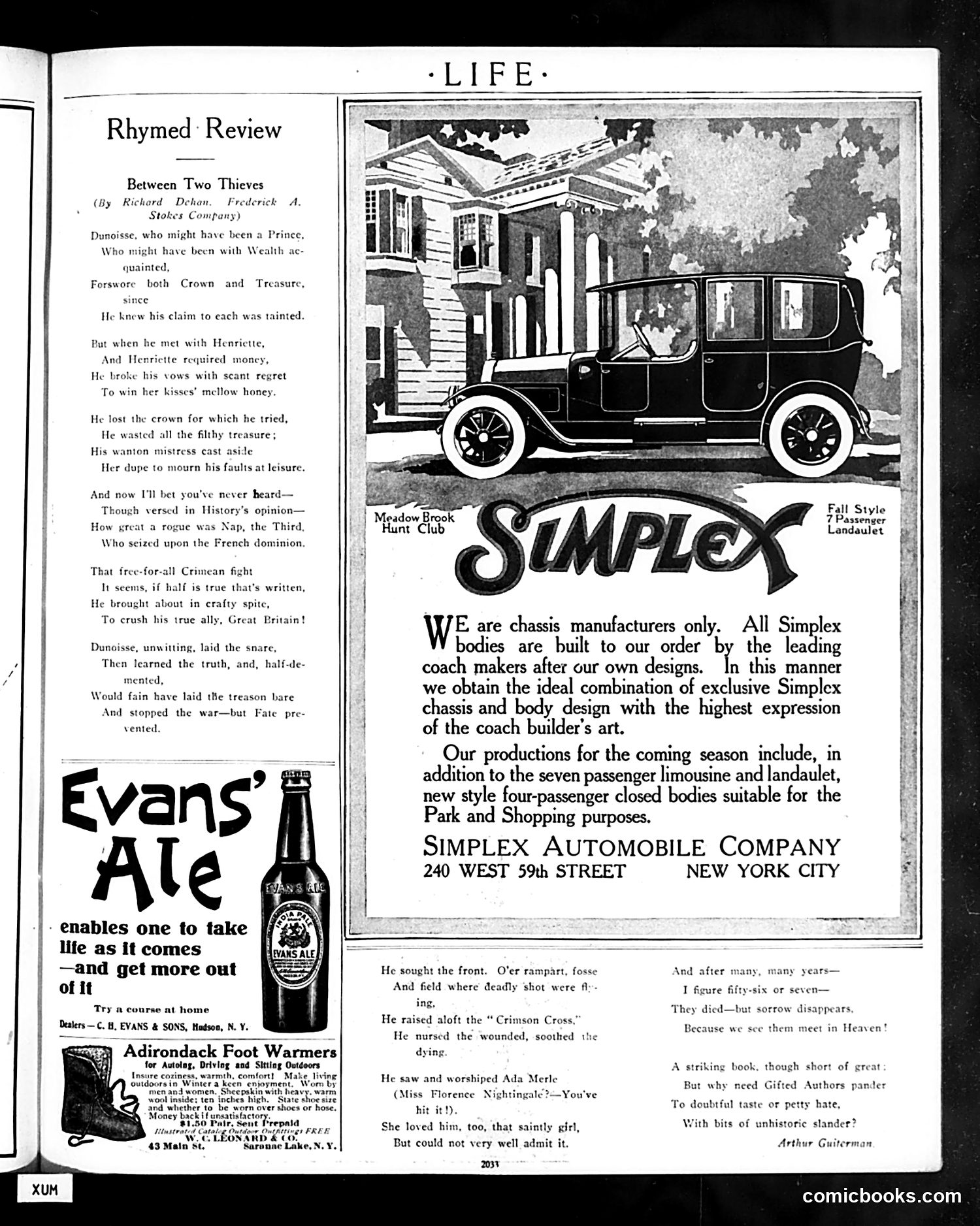
This page is primarily **advertising**, not political satire. The main content features: 1. **"Rhymed Review: Between Two Thieves"** — a poem by Richard Dekan (Stokes Company) referencing historical figures. It appears to allude to medieval or early modern conflicts, though the specific reference is unclear from the text alone. 2. **Major advertisements** dominate the page: - **Simplex Automobile Company** — promoting new passenger vehicle designs - **Evans' Ale** — encouraging home consumption - **Adirondack Foot Warmers** — winter footwear product The page reflects typical 1920s-era Life magazine content: mixing light literary pieces with consumer advertising. The poem's historical allusions and the automobile advertisement suggest this targets an educated, middle-class readership interested in both culture and modern conveniences.
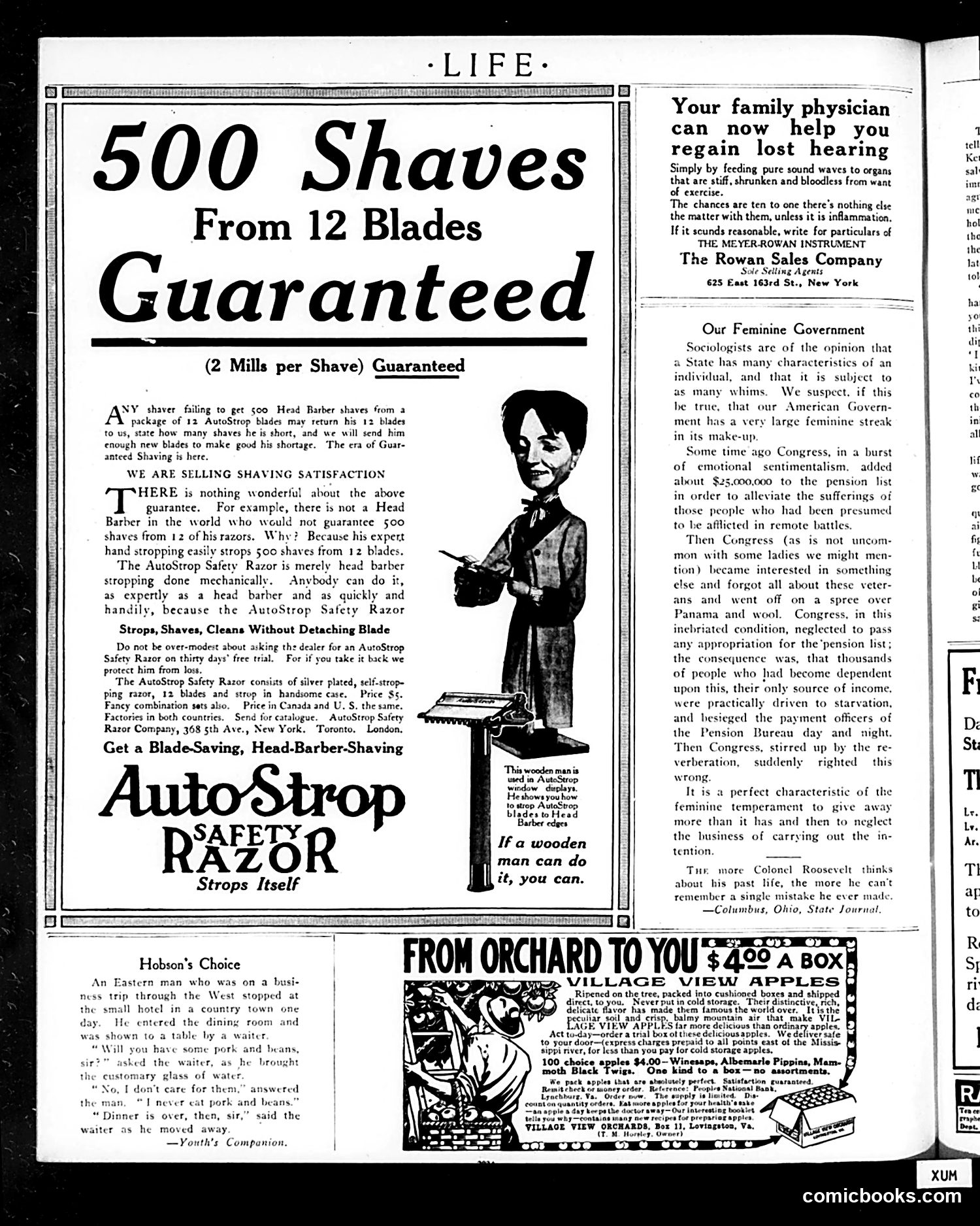
This page is primarily **advertising** (AutoStrop razors, apples), but includes a political satire column titled "Our Feminine Government." The piece mocks what it calls a "feminine streak" in American government, specifically criticizing Congress for approving a $25 million pension allocation while neglecting other social welfare issues. The satire suggests Congress is emotionally driven and inconsistent—it champions one cause passionately while ignoring broader hardship. The column references a specific Congressional action regarding pensions for people in "remote lands" and suggests this reflects stereotypically "feminine" sentimentality rather than rational governance. The piece uses gender stereotypes to criticize perceived governmental inefficiency and selective compassion. The date and specific Congress referenced are unclear from visible text.
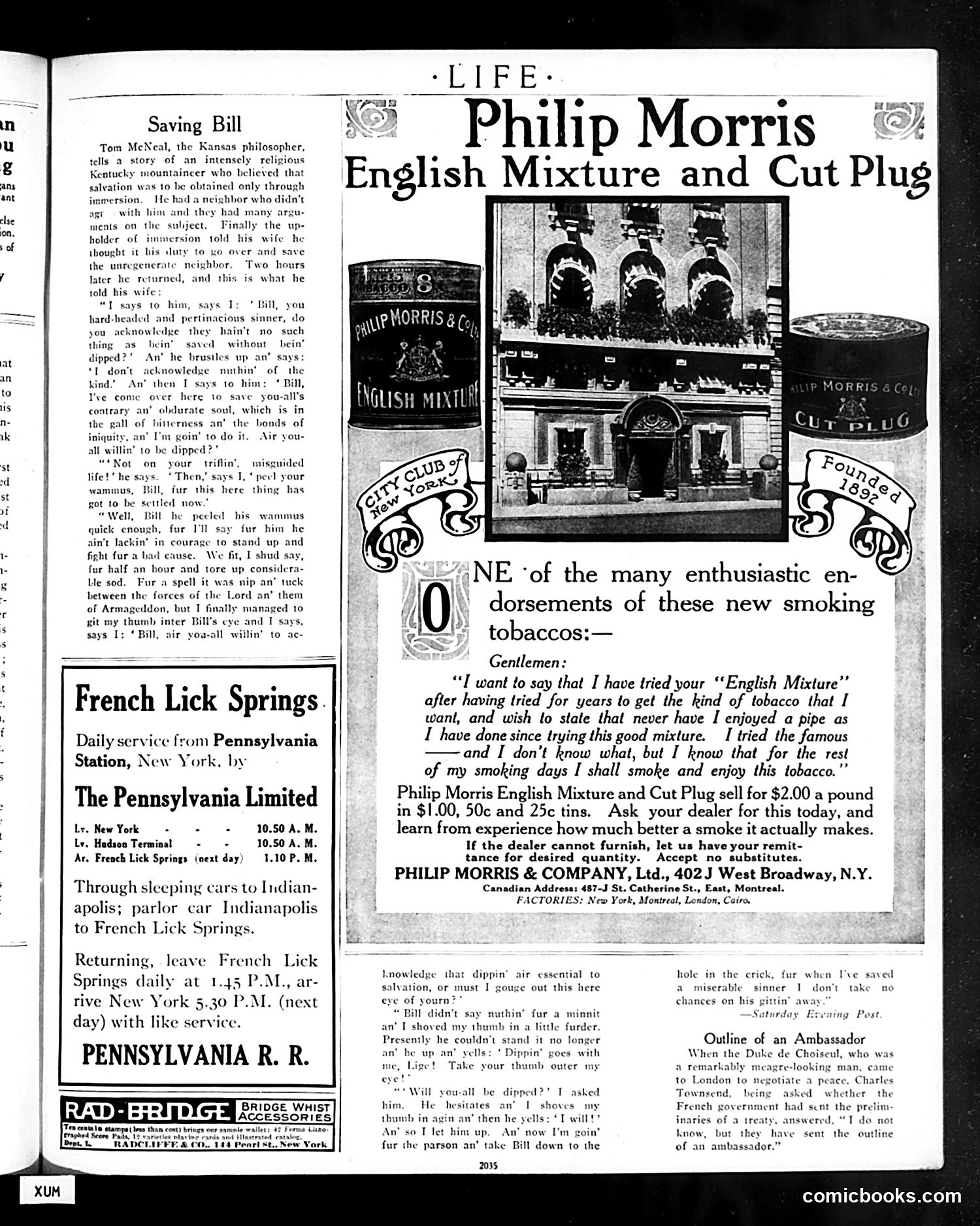
This page is primarily **advertising**, not satire or political commentary. The dominant content is a full-page advertisement for Philip Morris English Mixture and Cut Plug tobacco products, featuring product images and an endorsement letter from a satisfied customer praising the tobacco quality. The page also contains smaller ads for French Lick Springs railway service and a bridge whist game. The only narrative content is a brief humorous story titled "Saving Bill" about a Kansas philosopher and religious mountain climber debating salvation, followed by "Outline of an Ambassador" — a short anecdote about the Duke of Cleveland. No political cartoons or social satire appear on this page. It represents Life magazine's revenue model: entertainment content subsidizing tobacco and travel advertising.
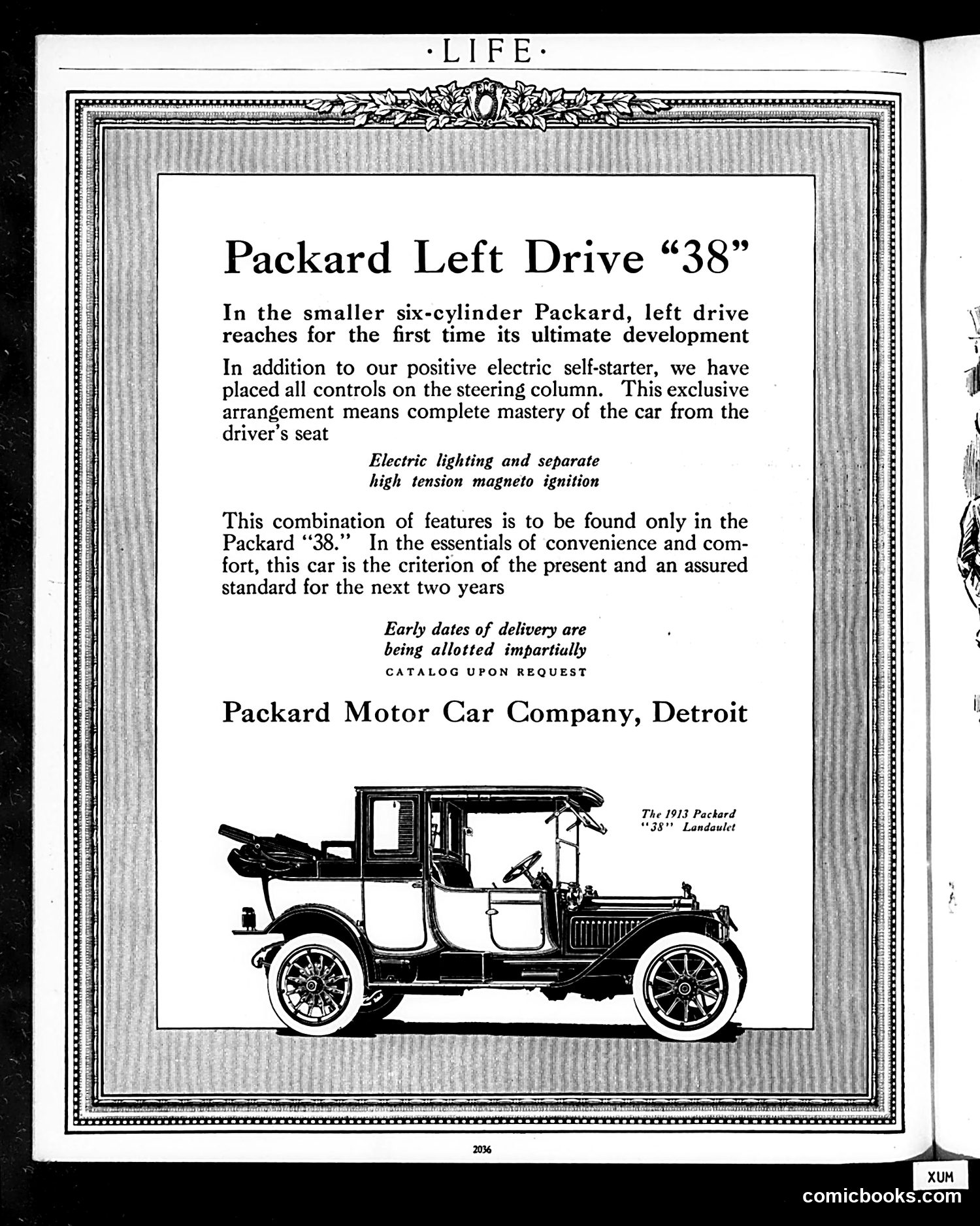
This page is **not a cartoon or satirical content** — it is a **straightforward automobile advertisement** from *Life* magazine. The ad promotes the **1913 Packard "38" automobile**, a six-cylinder vehicle made by the Packard Motor Car Company of Detroit. Key selling points highlighted include: - Left-hand drive (a relatively new feature at the time) - Controls mounted on the steering column - Electric self-starter and lighting - High-tension magneto ignition The text emphasizes convenience and comfort as standards that will define cars for "the next two years." An illustration shows the vehicle's side profile. This is typical **early automotive advertising**, not satire. It reflects genuine technological advances of the 1910s era that modern readers might find quaint.
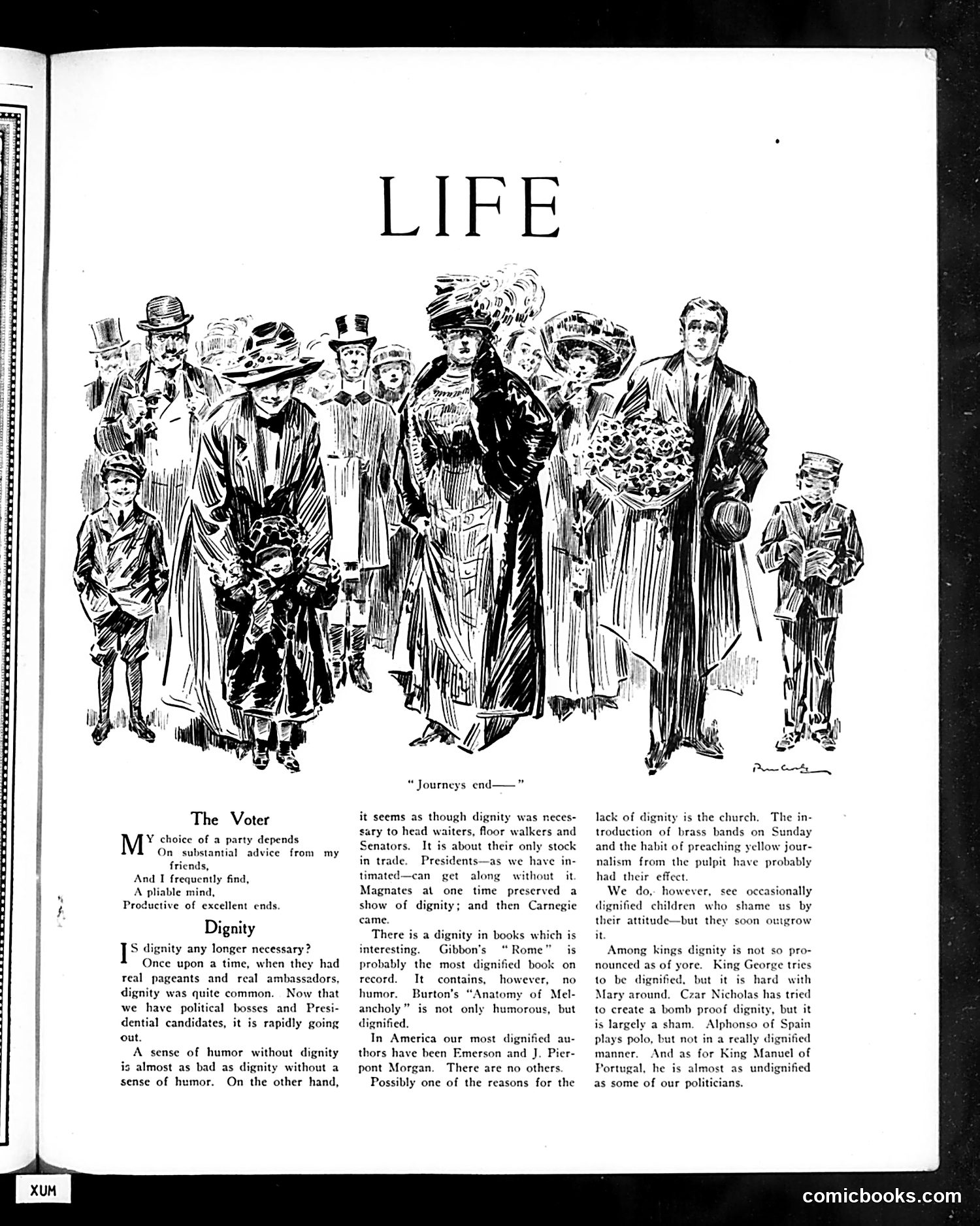
This is a *Life* magazine article on "Dignity" featuring an illustration titled "Journeys end—" showing a diverse cross-section of American society: politicians, socialites, working-class people, and children. The article critiques the lack of dignity in American public life. It argues that while historical figures like Emerson and J. Pierpont Morgan possessed dignity, contemporary politicians and society lack it. The text specifically ridicules yellow journalism in religious contexts and compares unfavorably American politicians to European royalty (King George, King Manuel of Portugal). The cartoon illustrates this theme: various social types are presented without clear hierarchy or distinction, suggesting modern America has democratized dignity away—everyone looks equally undignified.
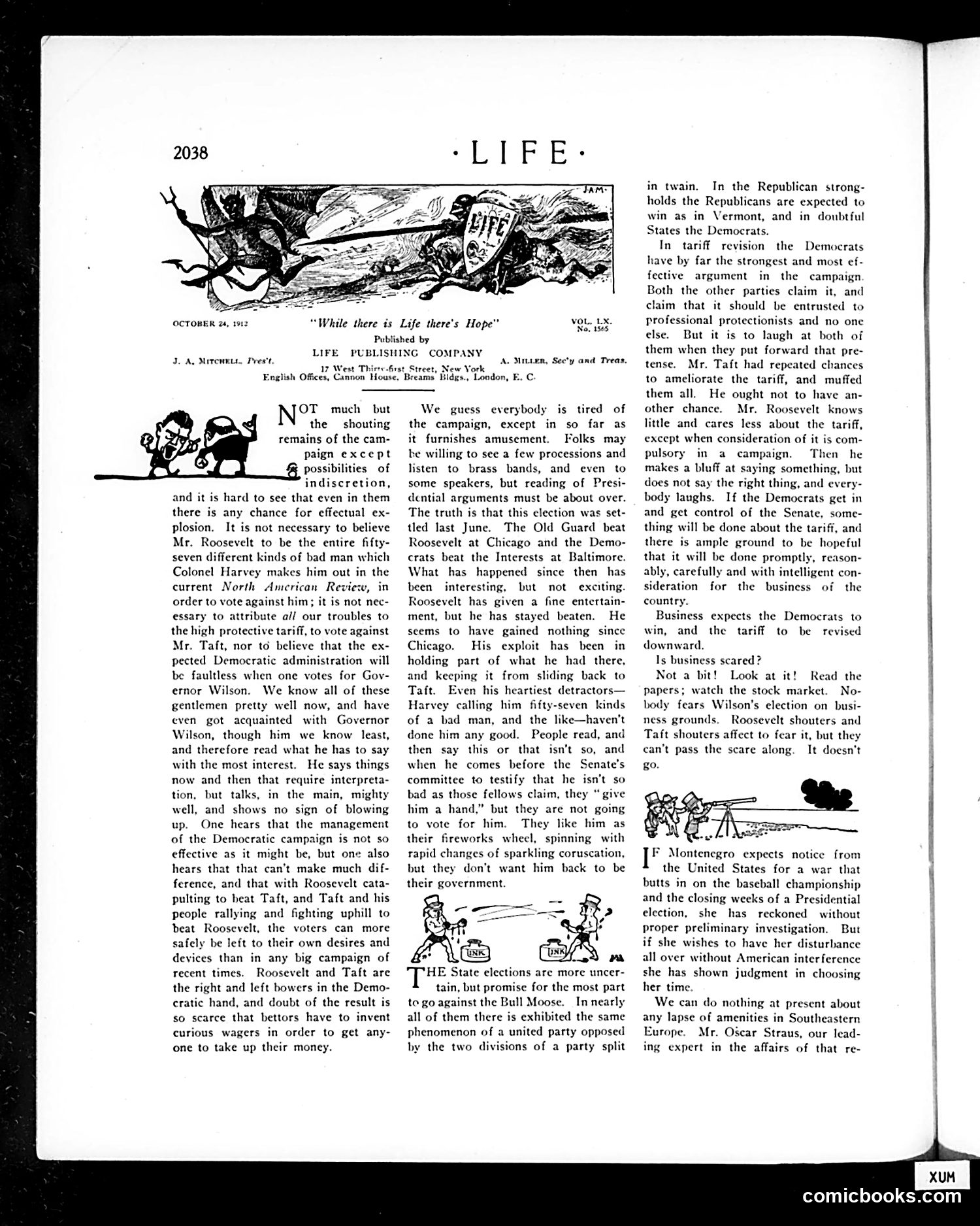
This page discusses the 1912 U.S. presidential election during its final weeks. The text criticizes both major parties' campaign strategies while defending Roosevelt's integrity against Democratic attacks calling him a "bad man." The cartoon at top depicts what appears to be a seasoned political operator (likely representing a campaign manager or party operative) conducting orchestrated campaign activities—suggested by the conducting gesture and figures below. The bottom cartoon shows two figures labeled with ballot boxes, illustrating uncertainty about state election outcomes. The article argues Roosevelt has been unfairly attacked, that business fears Wilson's election, and that Democratic scaremongering about Roosevelt won't persuade voters. It references specific figures like Harvey and Taft while discussing campaign tactics and voter concerns about tariff policy.
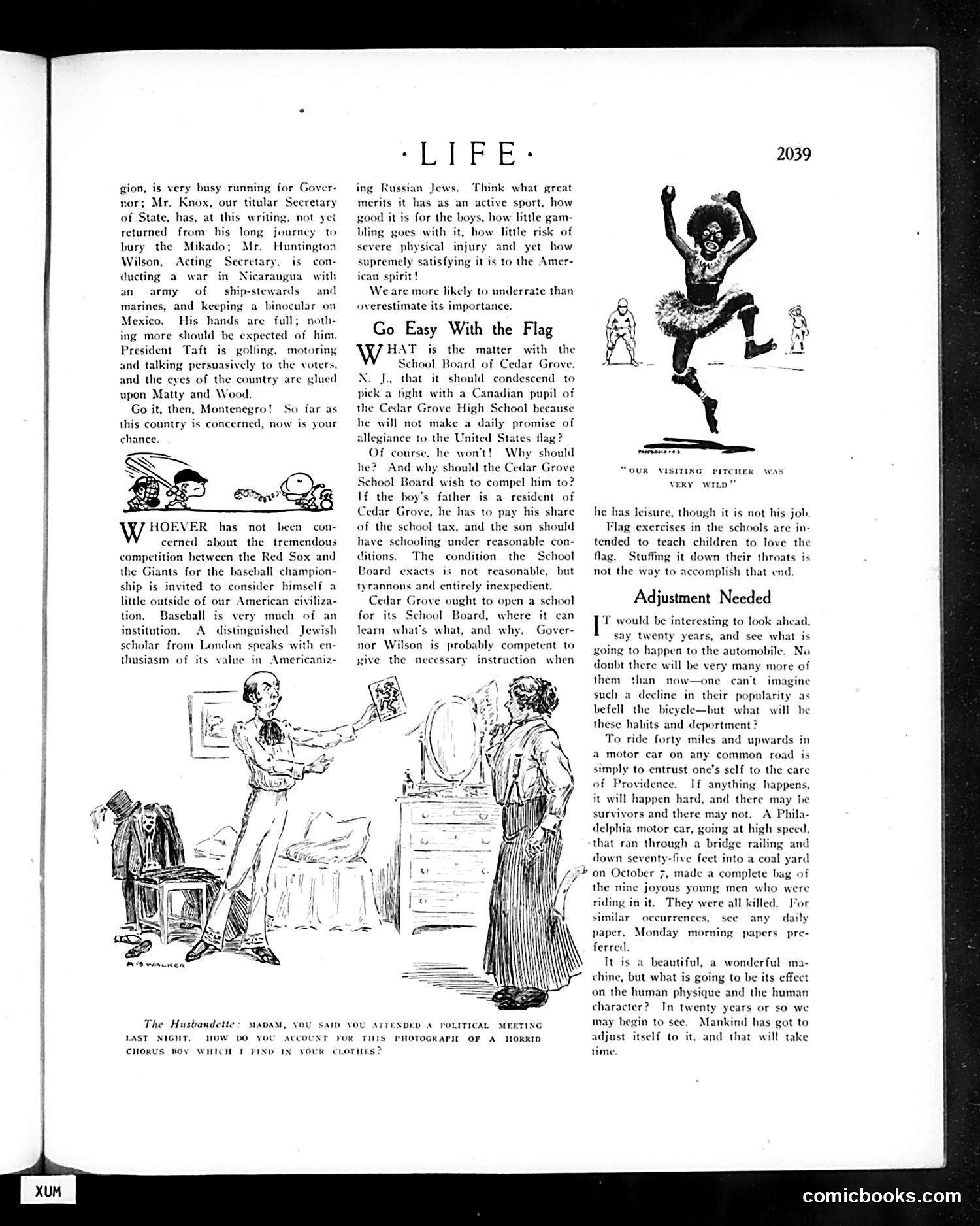
This page contains three distinct editorial cartoons and commentary on early 20th-century American social issues. **Top cartoon**: Shows a baseball player mid-leap, celebrating "Our Visiting Pitcher Was Very Wild." The accompanying text discusses whether Russian Jewish immigrants should be compelled to pledge allegiance to the U.S. flag—a contentious assimilation debate of the era. **Middle cartoon**: Titled "The Husbandcutte," depicts a domestic scene where a wife confronts her husband about attending a political meeting while wearing what she calls a "horrid chorus boy" costume, satirizing men's political engagement and fashion choices. **"Adjustment Needed"**: Discusses automobiles' growing dangers, citing a recent bridge accident killing nine young men. It predicts society must adapt to this new technology's risks. These pieces reflect Progressive-era anxieties: immigration, political participation, and technological change.
This is a poem by Arthur Guiterman satirizing Theodore Roosevelt's "Bull Moose" Progressive Party campaign. The verse mocks Roosevelt as a defiant political outsider who refuses party conventions and challenges establishment figures (references to Penrose, Archfield, Hillis, and Barnes—likely Republican leaders). The satire ridicules Roosevelt's combative nature, comparing him to various animals (camel, deer, locomotive, hot potato). It attacks his supporters—writers, artists, and socialists—for uncritically backing him as a novelty "sensation." The poem suggests Roosevelt's candidacy is ultimately futile ("Meteor already waxing pale"), destined to fade despite initial excitement. The tone is dismissive, portraying the Bull Moose movement as chaotic disruption rather than serious politics.
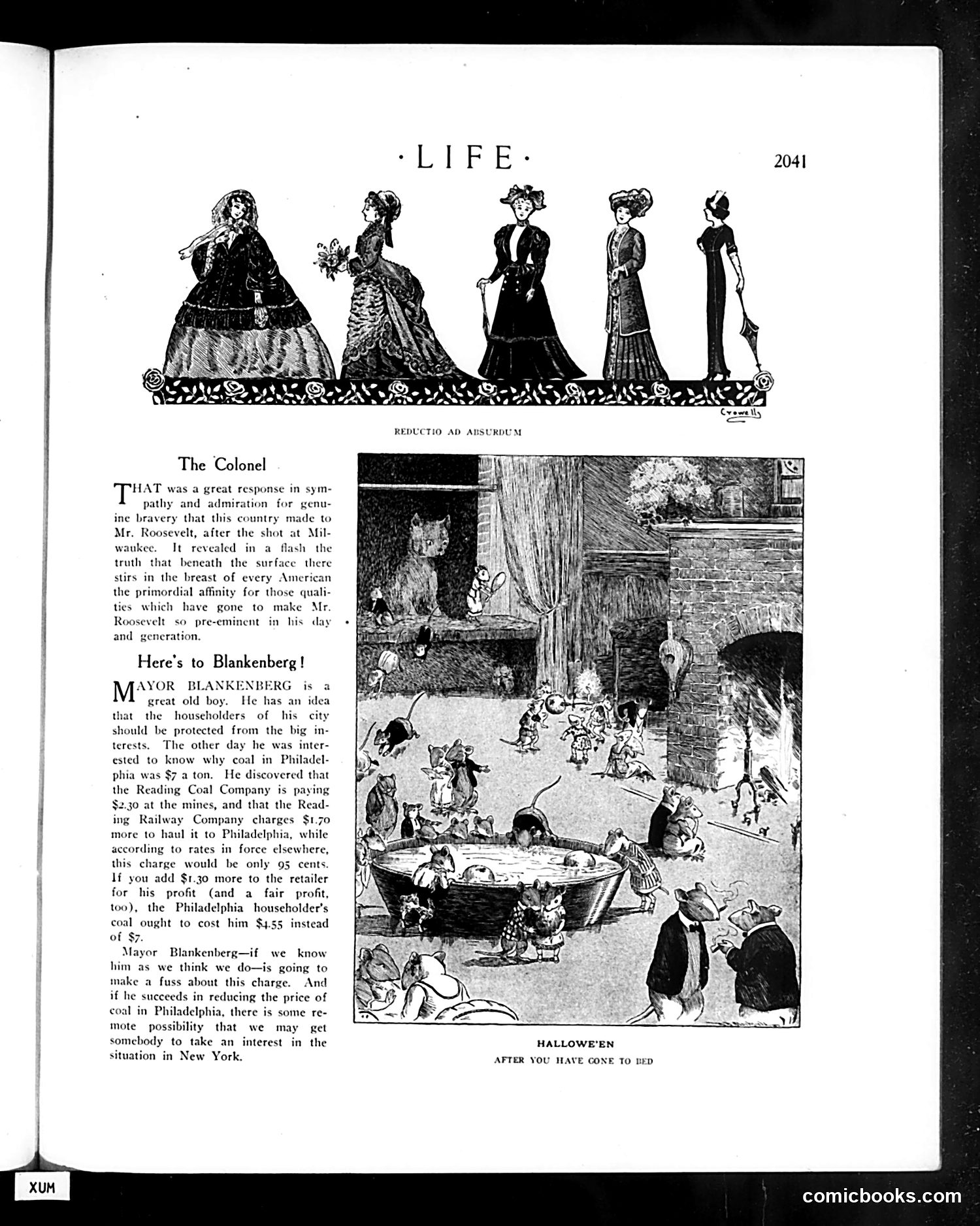
This page contains two distinct pieces: **"The Colonel"** is a brief satirical article praising Roosevelt's bravery following an assassination attempt in Milwaukee, celebrating the "primordial affinity" of Americans for such courageous qualities. **"Here's to Blankenberg!"** is the main satire, mocking Mayor Blankenberg of Philadelphia for investigating coal pricing. The piece ridicules his effort to reduce household coal costs by exposing that the Reading Coal Company charges $2.30 per ton at mines but $5 in Philadelphia. Blankenberg discovered markup schemes involving railroad surcharges. The satirist dismisses the mayor's consumer-protection initiative as naive meddling that might embarrass New York interests. The accompanying illustration titled **"Hallow'en After You Have Gone to Bed"** shows children in Halloween costumes playing in water, appearing unrelated to the text above it.
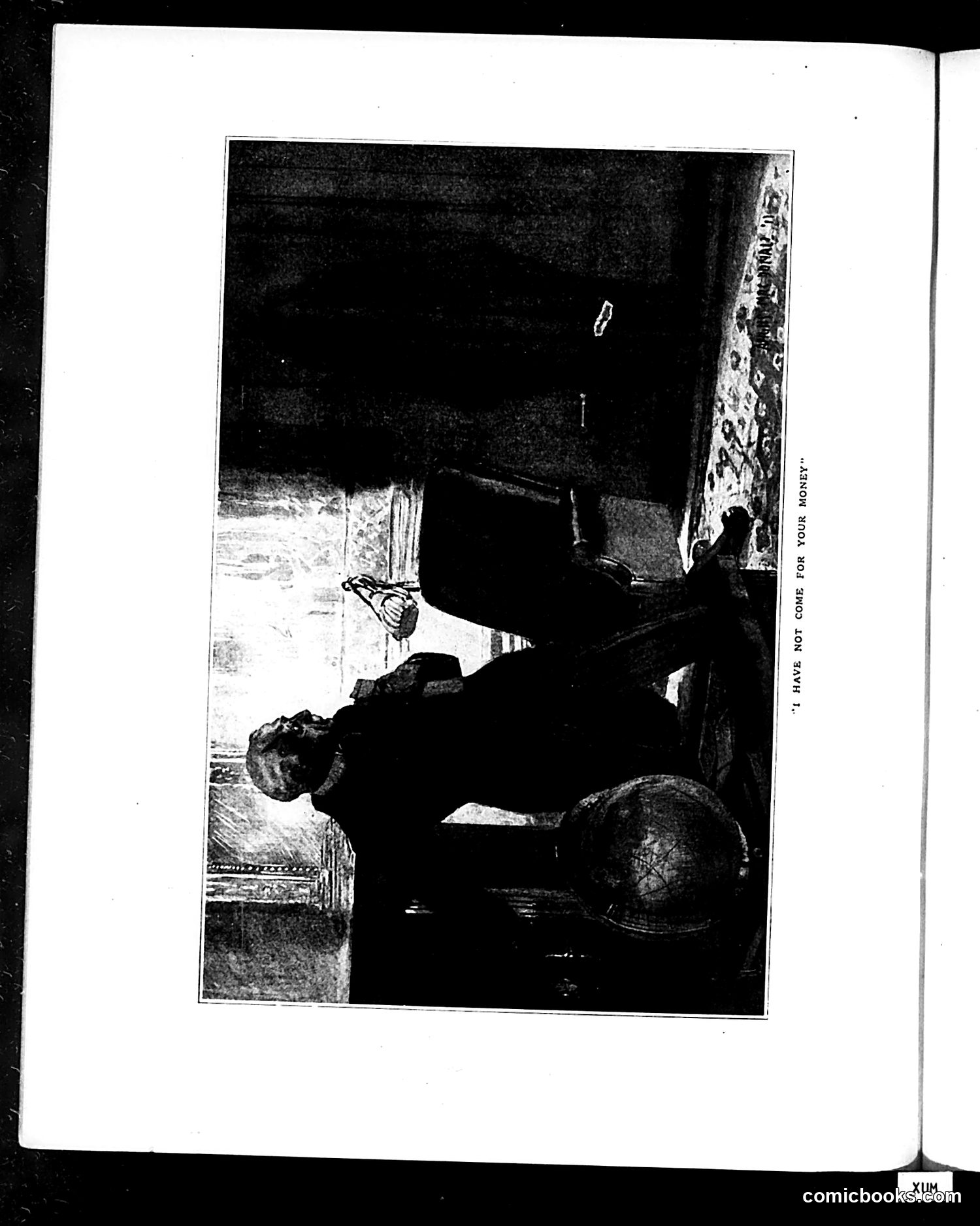
The image shows a black and white photograph of a person in what appears to be a domestic interior space. The caption reads "I HAVE NOT COME FOR YOUR BOOKS" (oriented vertically on the right side). The photograph itself is difficult to interpret with certainty due to image quality and contrast. It appears to show someone in period clothing in a modest interior, possibly depicting a historical scene or social commentary. Without additional context about the specific issue of *Life* magazine this appeared in, or clearer visibility of identifying details, I cannot confidently explain the political or social reference the cartoon/photo was meant to convey or identify any specific historical figures or events being satirized. The cryptic caption suggests some kind of social commentary, but determining the exact subject and satirical point requires publication date information not provided here.
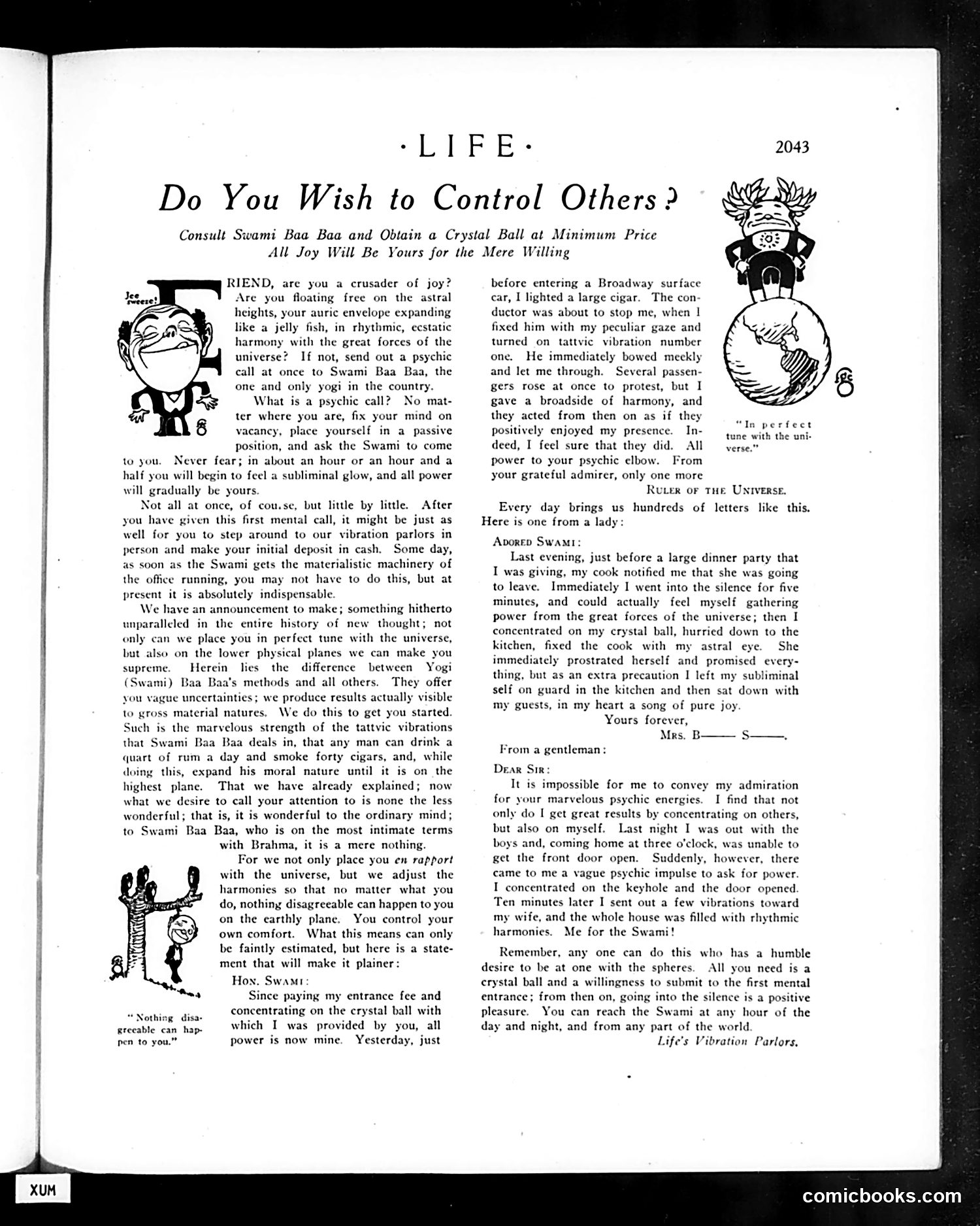
This is a mockery of the "New Thought" spiritual movement popular in early 20th-century America—a pseudo-mystical belief system promising mind-over-matter control through meditation, "vibrations," and psychic powers. The satire targets: **The Scam**: "Swami Baa Baa" (a deliberately absurd name) offers crystal balls and psychic consultations for cash, claiming to align customers with "universal forces" and grant them supernatural control over others and circumstances. **The Absurdity**: Testimonials claim the powers allow drinking a quart of rum daily while "expanding moral nature," or using "tattvic vibrations" to hypnotize a streetcar conductor into allowing a passenger to smoke. The comedian describes controlling a cook through concentrated willpower. **The Target**: Life ridicules wealthy, credulous people seeking spiritual shortcuts to power and comfort, mocking both the charlatans selling these services and the gullible clients willing to pay for them. The cartoon's grotesque illustrations of the "Swami" emphasize the fraud being perpetrated on the spiritually desperate.
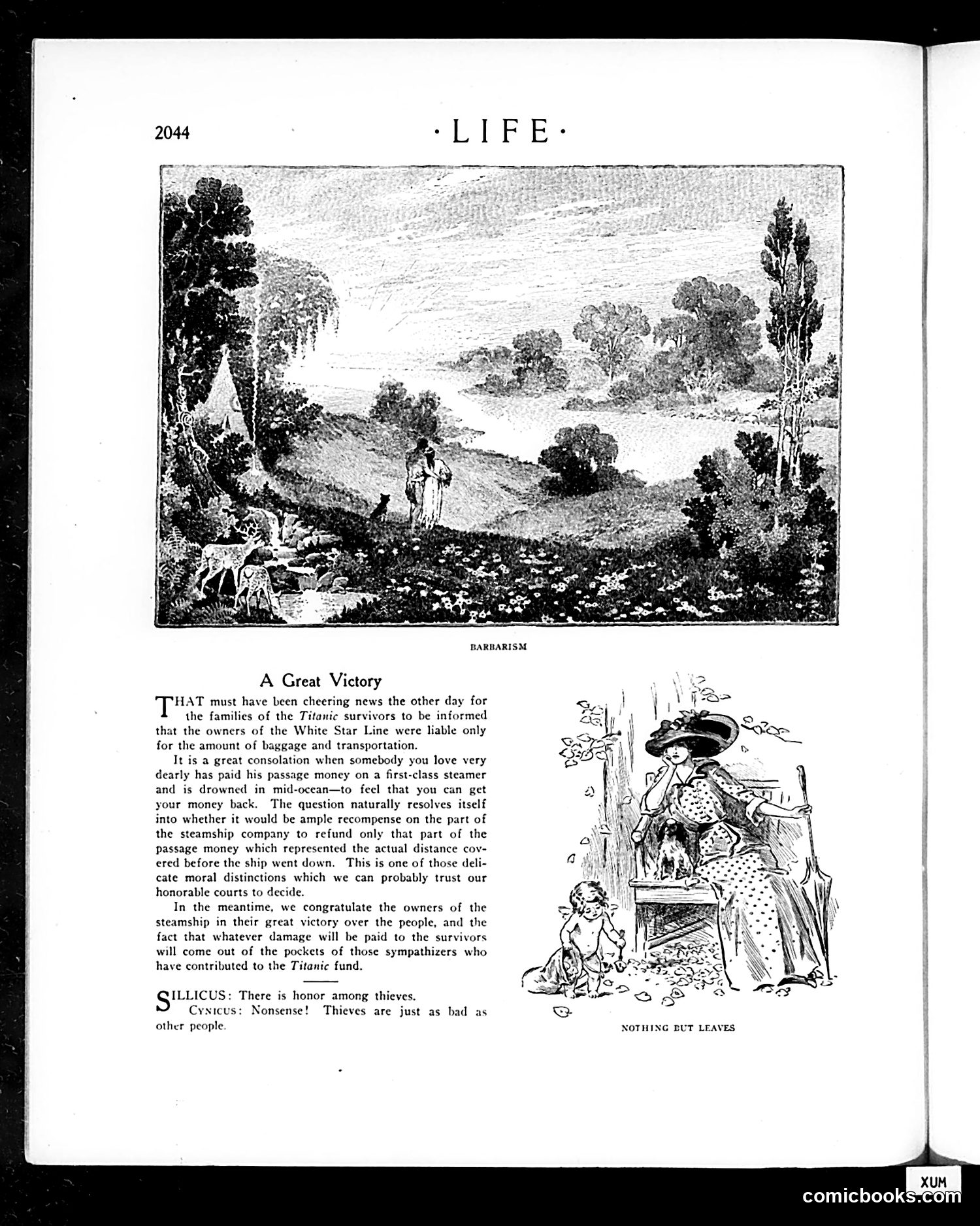
This page satirizes the legal outcome following the 1912 Titanic sinking. The article mocks the White Star Line's "great victory"—a court ruling limiting their liability to only the cost of passage and baggage, despite over 1,500 deaths. Life's satire is bitterly ironic: families who lost loved ones on a first-class steamer can only recover their ticket price. The piece ridicules this "delicate moral distinction" as a legal loophole that prioritizes corporate profits over human tragedy, suggesting courts will likely uphold this injustice. The final section features a classical dialogue between "Sillicus" and "Cysicus" debating whether honor exists among thieves—implying the steamship company and courts are morally equivalent to criminals. The bottom illustration titled "Nothing But Leaves" appears unrelated or offers visual commentary on emptiness/loss.
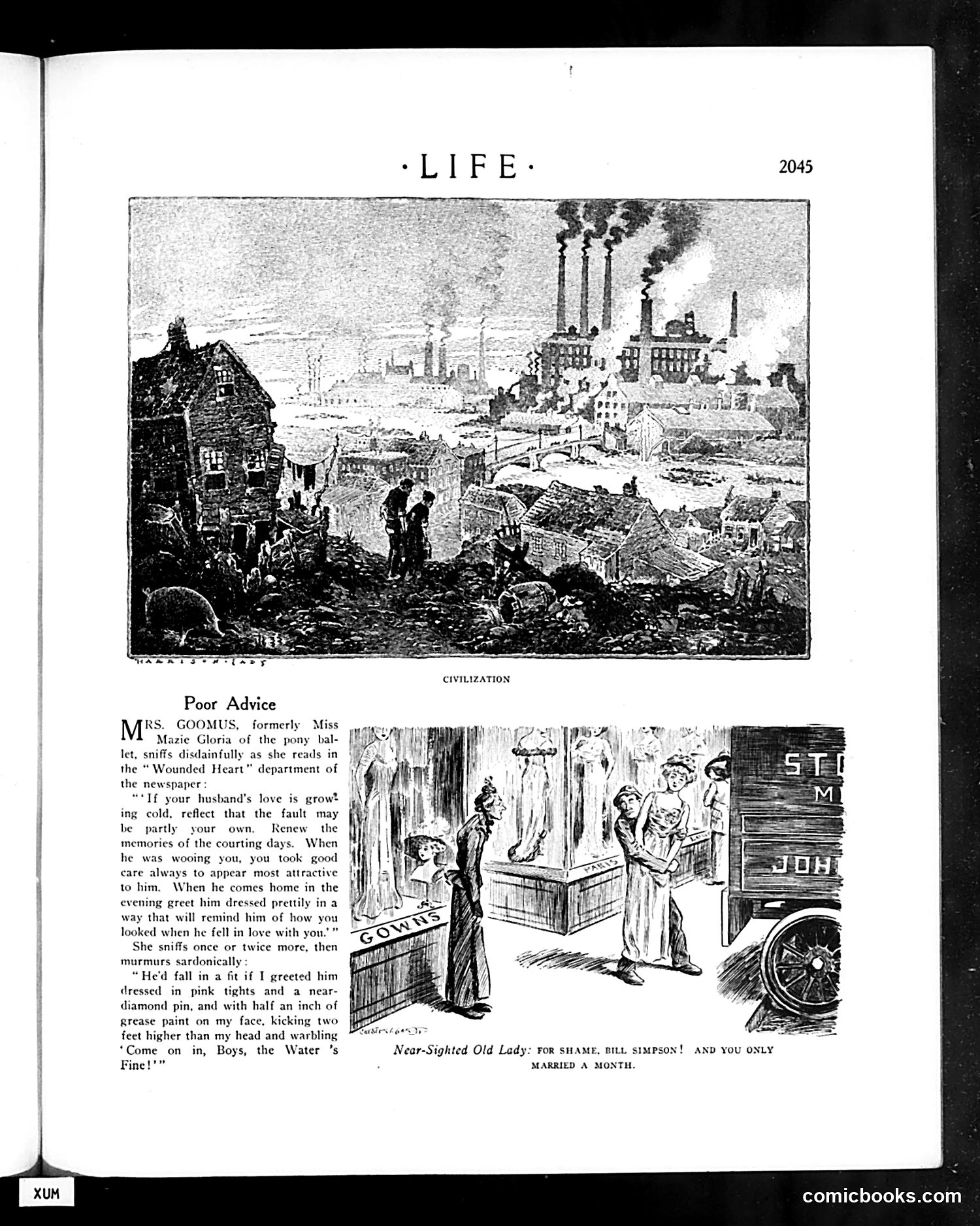
This page satirizes advice columns offering relationship guidance to wives. Mrs. Goomus, a former chorus girl (pony ballet dancer), reads conventional wisdom urging women to maintain their appearance and romantic appeal to prevent husbands' affection from cooling. She responds mockingly: her husband fell in love with her as a performer in pink tights, heavy stage makeup, and high kicks—yet the advice column implicitly suggests she should return to that persona while being a respectable housewife. The satire exposes the absurdity: advice columnists ignore that husbands often *married* women precisely to move away from such theatrical displays. The separate cartoon below satirizes a near-sighted elderly woman surprised by a newlywed's infidelity, shaming "Bill Simpson" for marrying only a month ago before apparently straying. Both pieces mock shallow relationship dynamics and the hypocrisy of social expectations around courtship versus marriage.
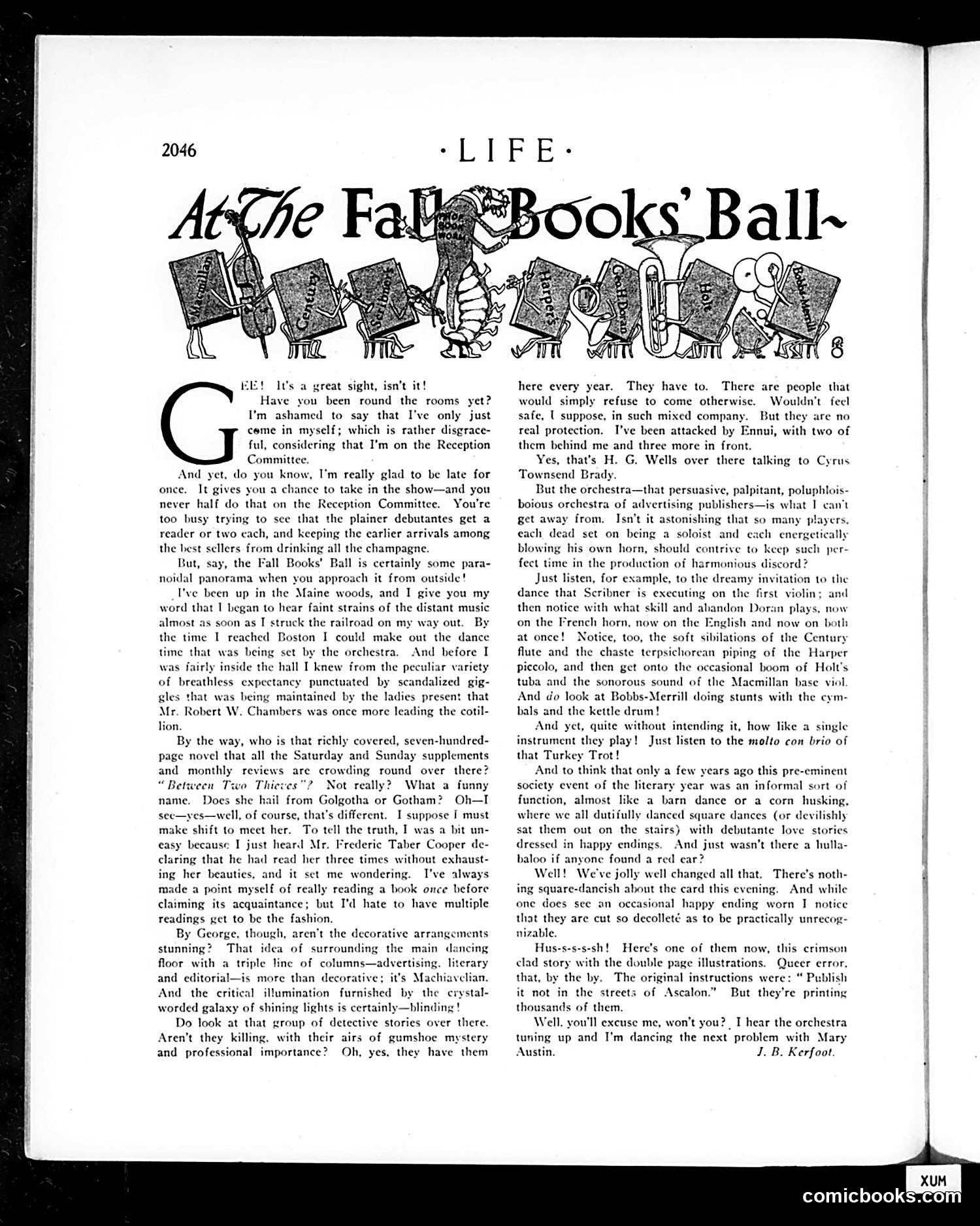
This is a satirical piece about a social event celebrating newly published books, where literary works and publishing companies are personified as attendees and musicians. The humor operates on two levels: **The Social Commentary:** The narrator criticizes the artificial nature of literary society—people pretending enthusiasm for books they haven't read, the obligatory attendance of "detective stories" (considered lowbrow) for safety reasons, and the performative nature of book promotion. **The Publishing Industry Satire:** Major publishers of the era—Scribner, Doran, Century, Harper, Holt, and Macmillan—are depicted as orchestra members, each "blowing his own horn" (self-promoting) while supposedly creating harmonious discord. The critique suggests publishers prioritize individual promotion over genuine literary merit. References to H.G. Wells and Cyrus Townsend Brady (both popular contemporary authors) add period specificity. The mockery of Frederic Taber Cooper's literary criticism and the title "Between Two Thieves" (a real contemporary novel) ground the satire in specific literary culture of the time.
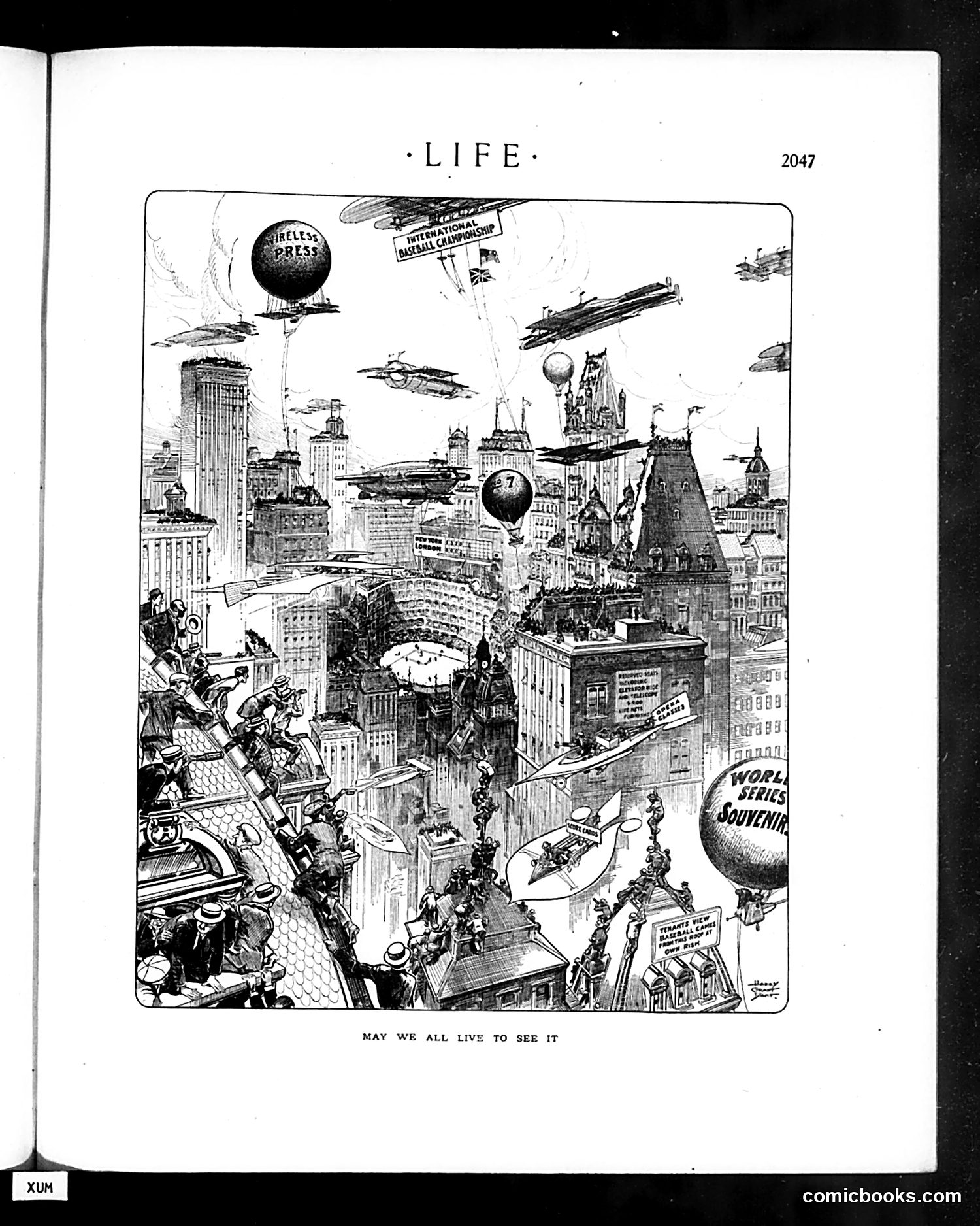
This page from *Life* magazine presents a futuristic vision of a crowded cityscape filled with aviation and airships. The illustration depicts a densely packed urban skyline with tall buildings, multiple aircraft and dirigibles flying overhead, and crowds of people below. Several spherical balloons or airships labeled with text are visible—one marked "WIRELESS PRESS" and another appearing to reference "WORLD SERIES SOUVENIR." The caption "MAY WE ALL LIVE TO SEE IT" suggests this is speculative satire about future urban life, likely mocking contemporary anxieties about technological progress, overcrowding, and modernization. The chaotic composition—with overlapping aircraft, competing advertising balloons, and masses of humanity—satirizes concerns that rapid industrialization and new technologies would create an overwhelming, cluttered future. The work appears to be early 20th-century commentary on progress and progress-anxiety.
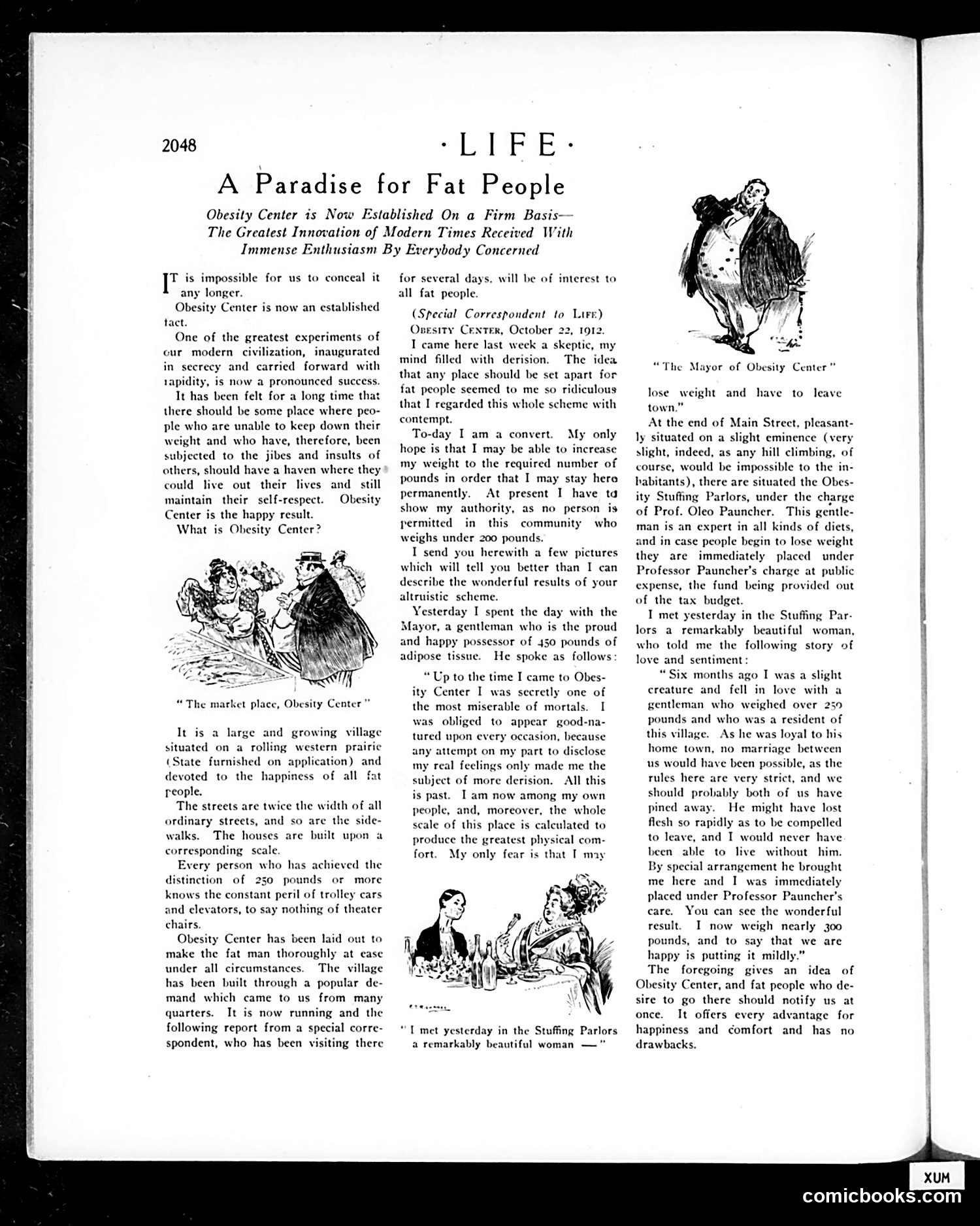
This 1912 *Life* magazine article satirizes the era's obsession with medical "innovations" and exclusive communities for specific demographics. The "Obesity Center" is a fictional utopian village designed entirely for overweight people—with oversized streets, furniture, and buildings to accommodate them. The satire works on multiple levels: it mocks the pseudoscientific promises of modern medicine, the segregation impulse of Progressive Era thinking, and society's cruel treatment of fat people. The irony is sharp—presented as a utopian "paradise," the Center actually traps residents (the Mayor fears losing weight would mean exile) and includes a "Stuffing Parlors" under "Prof. Oleo Pauncher" (a joke name: *oleo* is margarine, *Pauncher* suggests a large belly) to force-feed people back to weight requirements. The accompanying sketches show exaggerated caricatures of obese figures in everyday situations, using visual humor typical of the era. The piece ultimately ridicules both the schemes targeting fat people and society's narrow standards of acceptability.
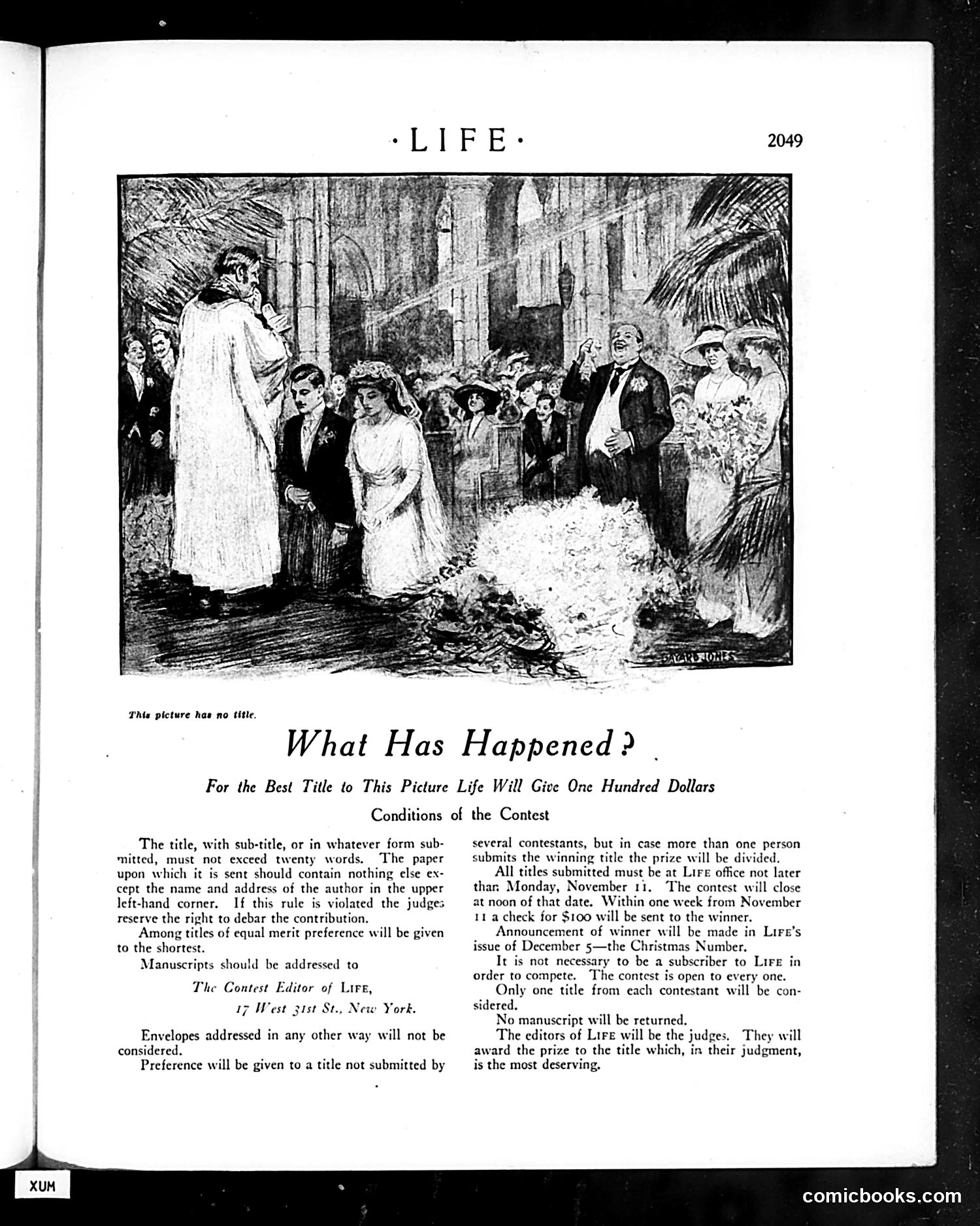
This page presents a **titling contest** rather than a completed cartoon. The untitled illustration depicts a religious ceremony—likely a wedding or funeral—in a grand cathedral with a priest in white vestments addressing a gathered crowd. The scene appears formal and solemn, with well-dressed attendees in early 20th-century attire. Life magazine is challenging readers to supply the best caption, offering $100 (substantial money at the time) to the winner. The contest deadline is November 11, with winners announced in the December 5 Christmas issue. The satire's point is unclear without knowing the intended joke, but Life's strategy here was common: crowdsourcing witty titles from readers while generating engagement. The image's ambiguity—what exactly is "happening"?—is the puzzle readers were meant to solve with clever, concise captions (maximum twenty words).
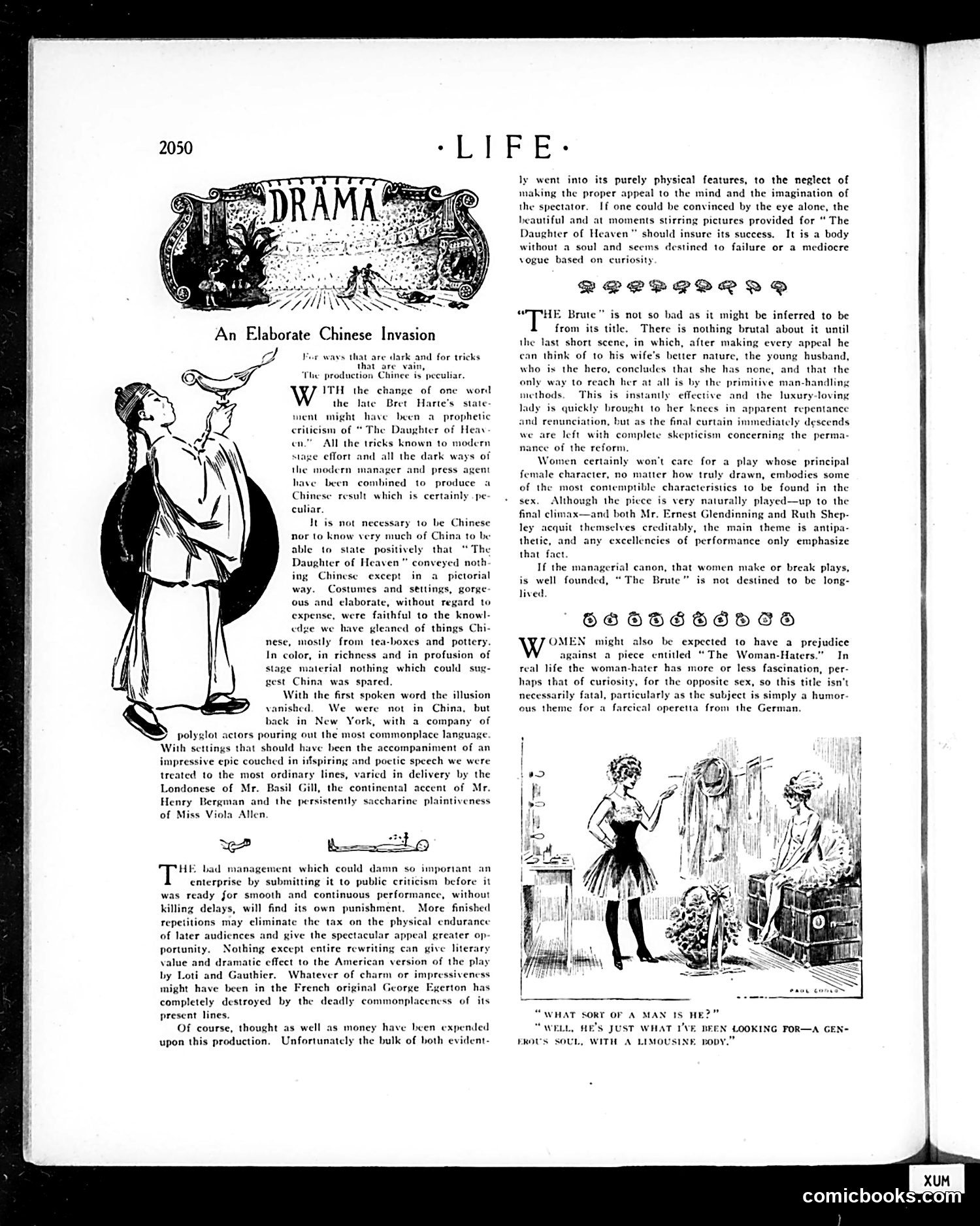
This is a **theater review** from *Life* magazine critiquing a Broadway production of "The Daughter of Heaven," a play based on French work by Loti and Gauthier. The reviewer's central complaint: the production is **all spectacle, no substance**. While the costumes, sets, and visual staging authentically captured Chinese aesthetics (the reviewer notes they're based on "tea-boxes and pottery"), the moment actors opened their mouths, the illusion collapsed. The dialogue was mundane English delivered with various accents (British actor Basil Gill, continental Henry Bergman, saccharine Viola Allen), utterly destroying any sense of place or drama. The reviewer sardonically notes the production is "a body without a soul"—destined for failure despite its expensive visual trappings. The second review criticizes "The Brute," a play where the female lead embodies "contemptible characteristics," ultimately beaten into submission, which female theatergoers would understandably reject. Both reviews exemplify *Life*'s role as cultural arbiter, using sharp wit to critique both artistic pretension and morally objectionable storytelling.
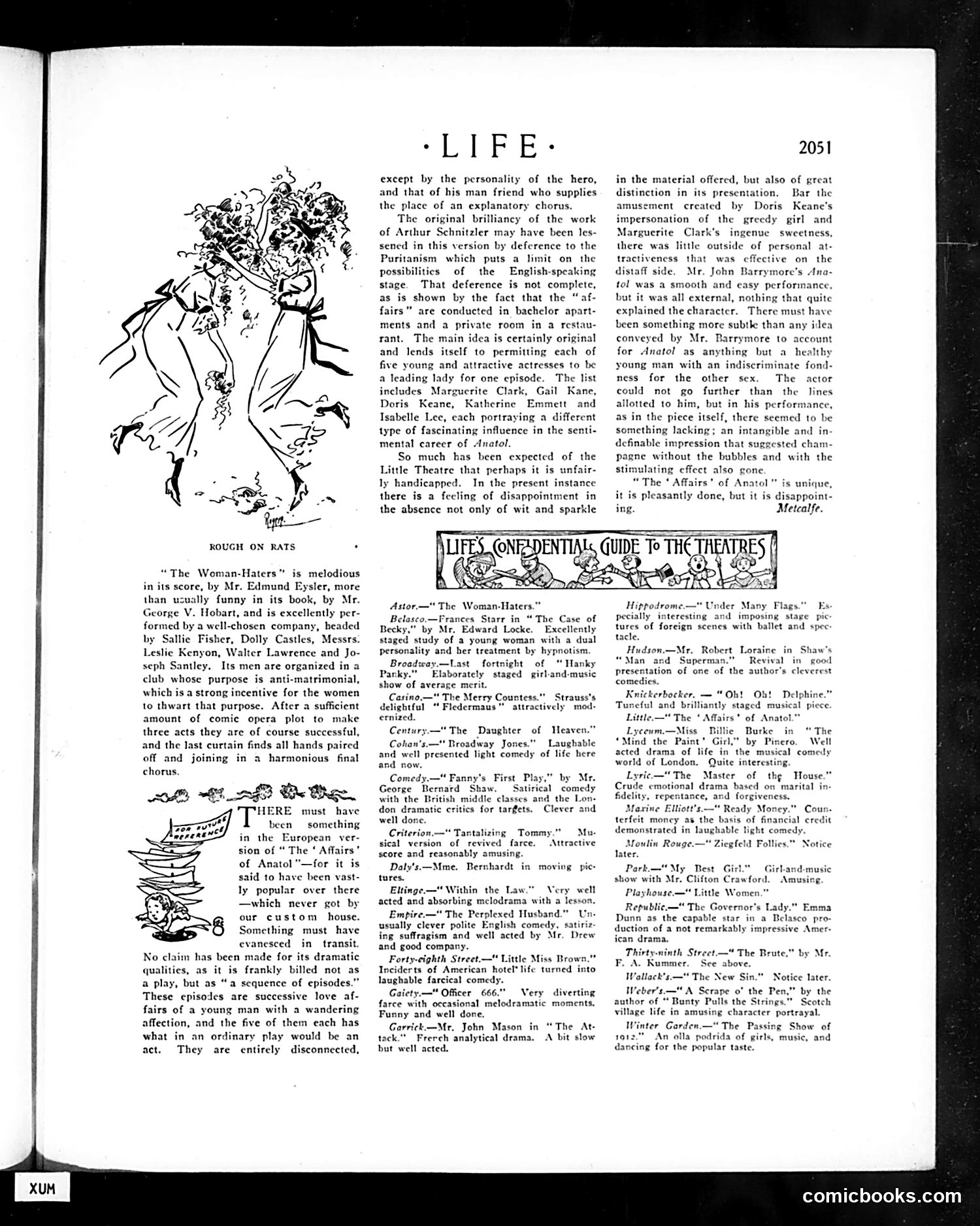
This page from *Life* magazine reviews theatrical productions, not political cartoons. The small illustration labeled "Rough on Rats" depicts a stylized rat or rodent figure—likely a visual pun on the review's title rather than political satire. The page primarily contains theater critiques of Broadway shows: "The Woman-Haters" (a comic opera), "The Affairs of Anatol" (a romantic drama), and others. The "Rough on Rats" heading appears to mockingly reference the show being reviewed, suggesting something crude or unpolished ("rough"). The substantive critique addresses "The Affairs of Anatol," starring John Barrymore. The reviewer criticizes the adaptation of Arthur Schnitzler's original work, suggesting it was sanitized for American "Puritanism" and lacks the wit and depth of the European version. The review praises actress Doris Keane's performance but finds Barrymore's portrayal superficial—merely "smooth and easy" rather than revealing psychological complexity.
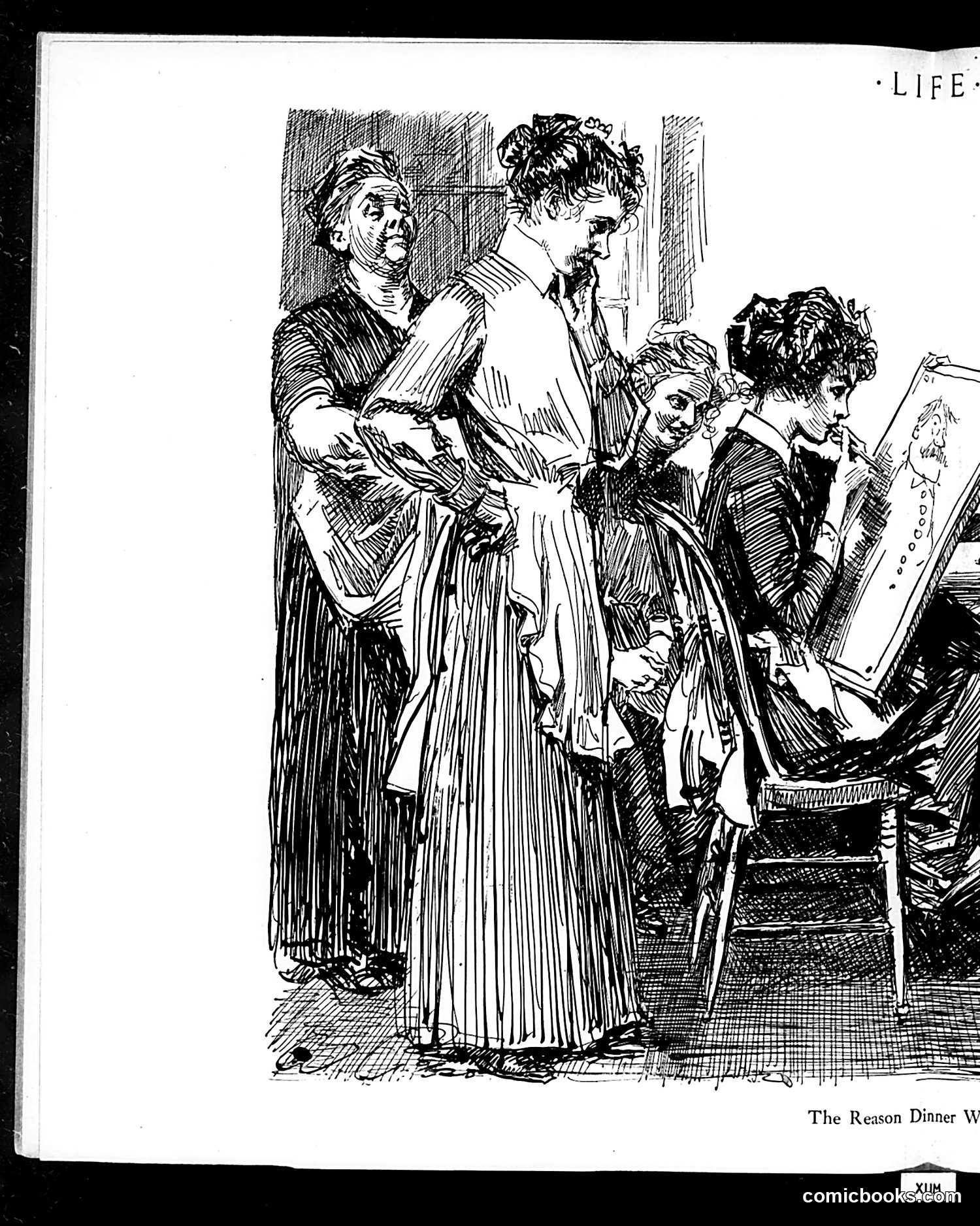
This page from *Life* magazine shows a sketch titled "The Reason Dinner W[as]..." (text cut off). The illustration depicts a formal indoor scene with five figures: a man in dark clothing on the left, a central figure in a long white dress, and three women in dark jackets on the right, one holding what appears to be a drawing or document. The incomplete caption prevents certain identification of the specific satire or social commentary intended. However, the formal dress and staged indoor setting suggest this mocks some social event or dinner party, likely critiquing etiquette, class dynamics, or gender relations of the era. Without the complete caption and publication date, the precise target and satirical point remain unclear. The artistic style suggests early-to-mid 20th century execution.
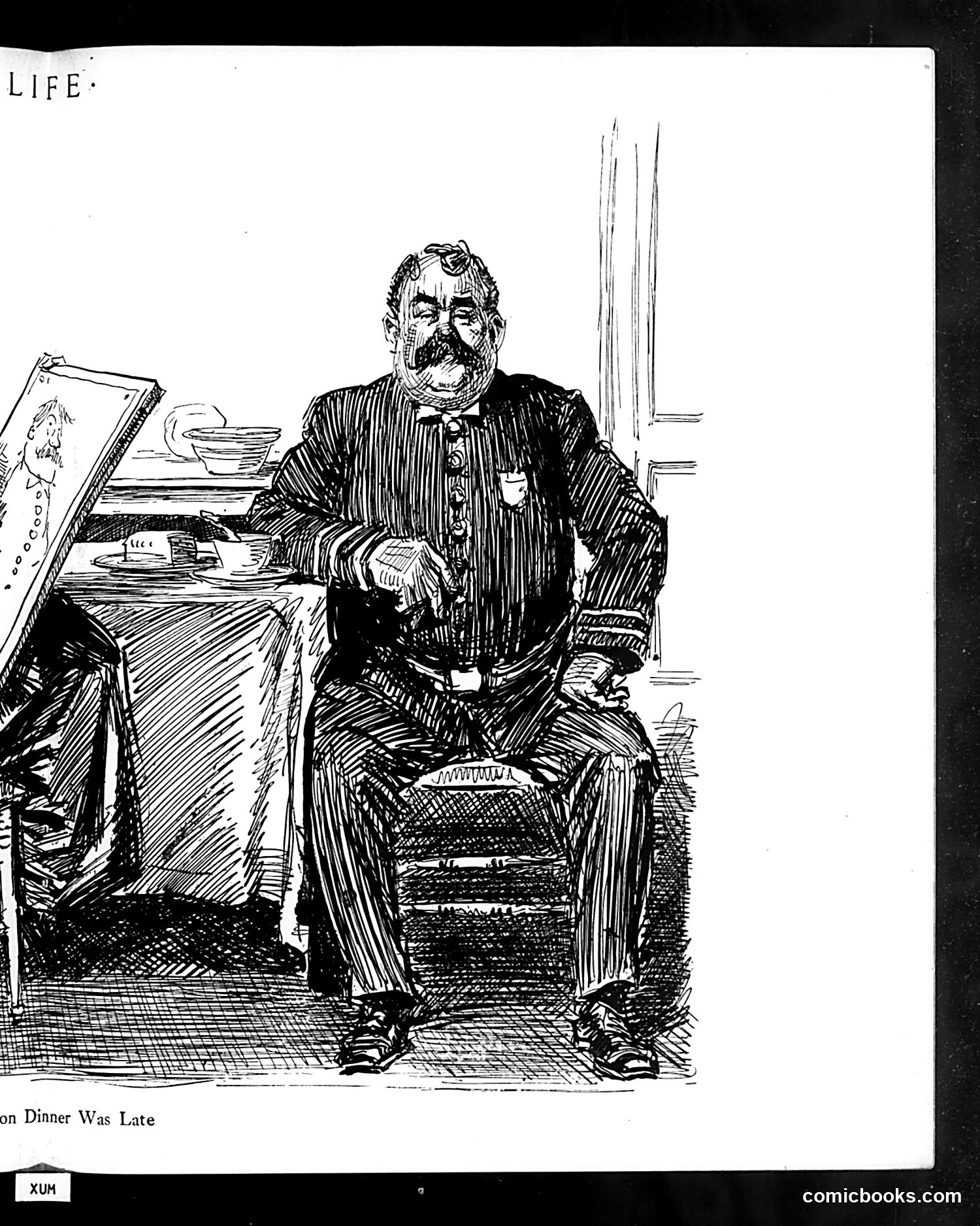
This appears to be a satirical cartoon from *Life* magazine showing a military or government official—identifiable by his formal uniform with buttons and insignia—seated at a desk in what seems to be an office or quarters. The incomplete caption reads "on Dinner Was Late," suggesting the cartoon comments on domestic inconvenience or disruption affecting someone of authority. The satire likely plays on the contrast between this man's official importance (conveyed through his formal dress and military bearing) and his being subjected to a mundane household annoyance—a late dinner. The joke appears to mock either the self-importance of officials or the absurdity of allowing trivial domestic matters to affect one's composure. Without the full caption or date, the specific target remains unclear.
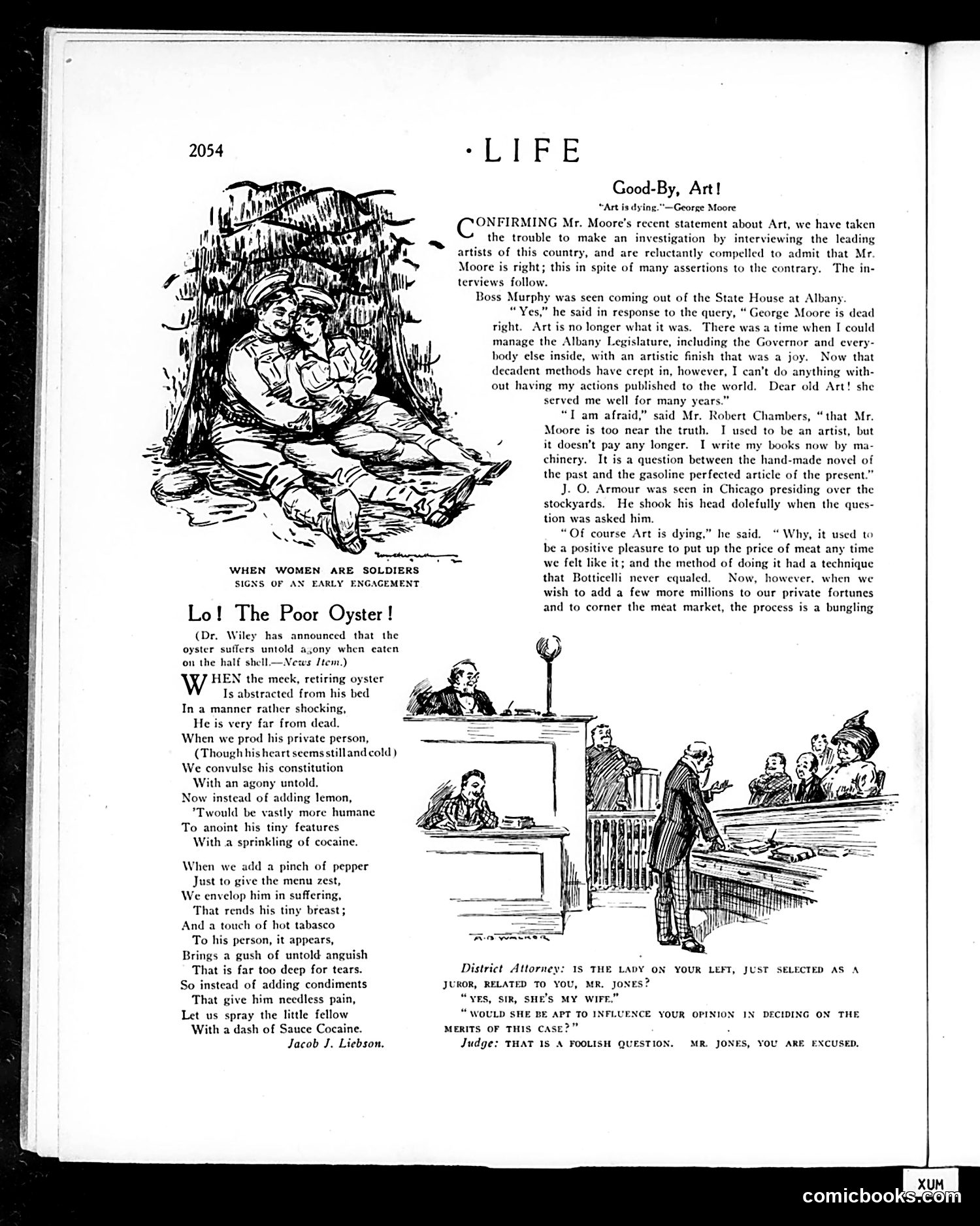
This page satirizes the decline of "Art" in American life by having prominent figures lament that craftsmanship and aesthetic principles have been replaced by commercialism and efficiency. **The interviews mock:** - **Boss Murphy** (likely referring to Tammany Hall political machine boss): Once manipulated government "artistically" in secret; now his corrupt actions get published, exposing his methods - **Robert Chambers** (novelist): Now writes "by machinery" rather than by hand, prioritizing speed over craft - **J.O. Armour** (meatpacking magnate): Once took "artistic" pleasure in price-fixing; now it's merely mechanical profit-seeking The satire argues that American capitalism has stripped away any pretense of artistry or craftsmanship from politics, literature, and business—replacing elegance with crude, purely mercenary methods. The oyster poem below offers comic relief on a related theme: modern convenience (adding spices to raw oysters) causes suffering; the satirist jokingly suggests anesthetizing the victim instead.
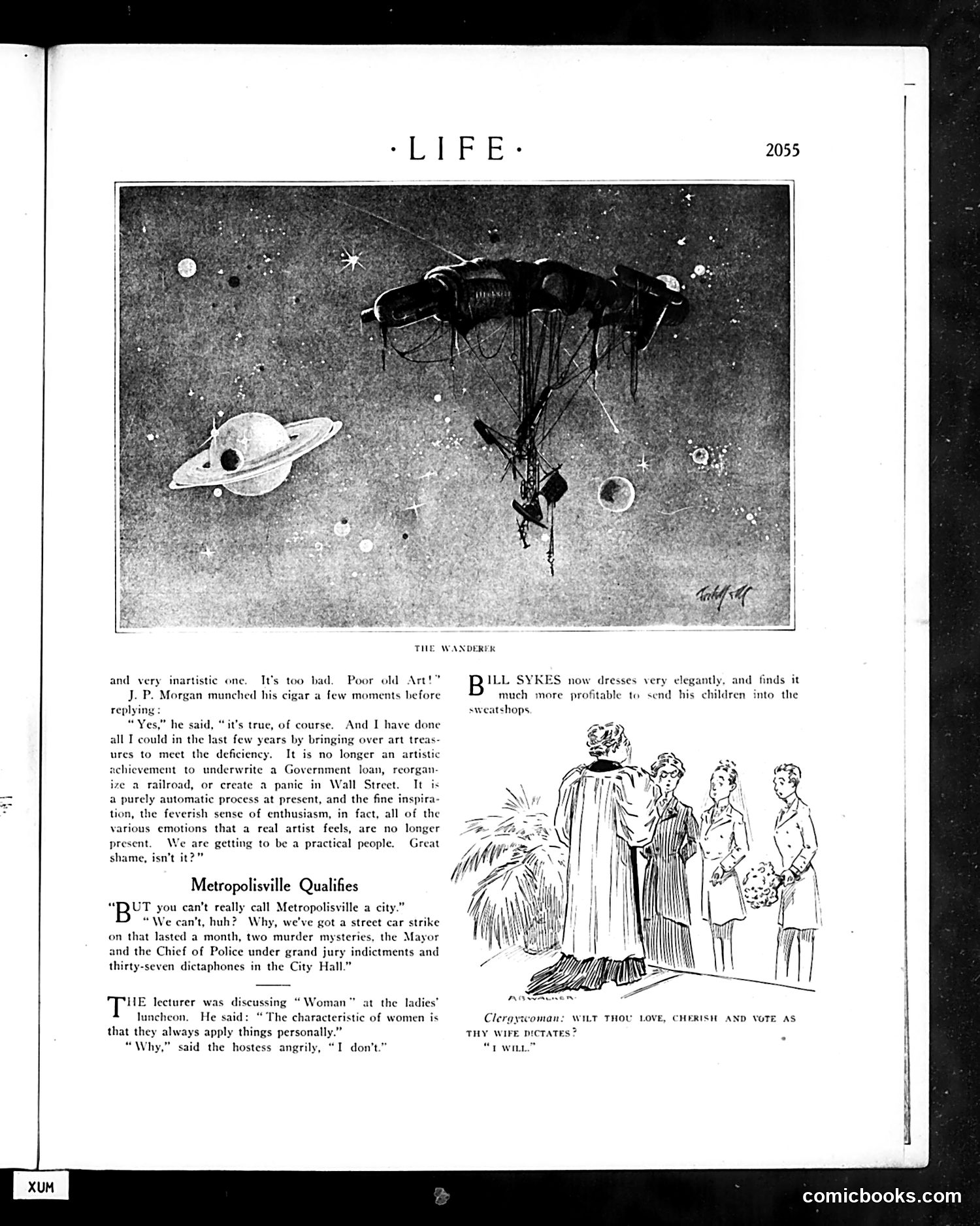
**Top Cartoon ("The Wanderer"):** A surrealist/science-fiction illustration showing an alien spacecraft visiting planets. The artistic merit suggests commentary on modern life's growing disconnection from art and inspiration. **Text Discussion:** A conversation (likely featuring J.P. Morgan, the famous banker and art collector) laments that American life has become purely practical and commercial. Morgan notes that even impressive financial feats—underwriting loans, reorganizing railroads—no longer inspire genuine artistic enthusiasm. The satire targets wealthy industrialists' prioritization of profit over cultural refinement. **"Metropolisville Qualifies":** Satirizes small-town aspirations to big-city status. The town claims legitimacy because it has scandals (murder mysteries, official corruption, labor strikes, dictaphones in City Hall)—suggesting these are markers of "civilization" rather than genuine urban development. **Bottom Cartoon:** A domestic joke about women's suffrage, depicting a wife demanding her husband "cherish and vote as she dictates"—mocking fears that granting women voting rights would threaten male authority in marriage.
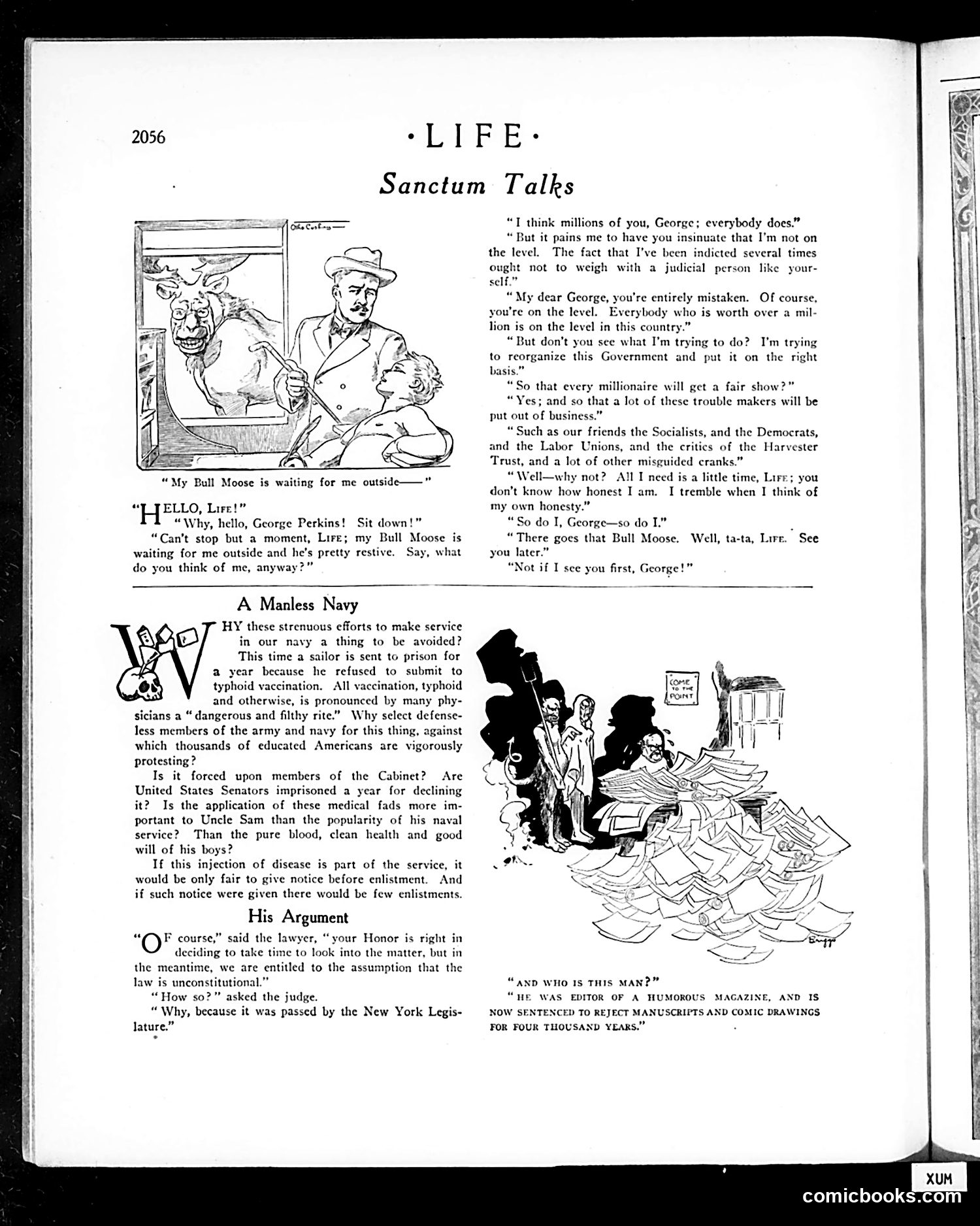
This page satirizes wealthy industrialists and progressive politics circa 1912. "George Perkins" (a real JP Morgan associate) visits Life's editor, claiming to reorganize government "on the right basis"—ensuring millionaires get "a fair show" while eliminating Socialists, Democrats, Labor Unions, and critics of the Harvester Trust. The satire mocks his self-righteousness about honesty while transparently serving the wealthy. The "Bull Moose" reference alludes to Theodore Roosevelt's Progressive Party (1912), which some saw as controlled by big business figures like Perkins. "A Manless Navy" criticizes forced typhoid vaccination in the military, arguing it's unjustly imposed only on sailors and soldiers, not Cabinet members or Senators—highlighting class-based double standards. "His Argument" jokes about a lawyer claiming laws are unconstitutional simply because New York's legislature passed them—mocking anti-government rhetoric.
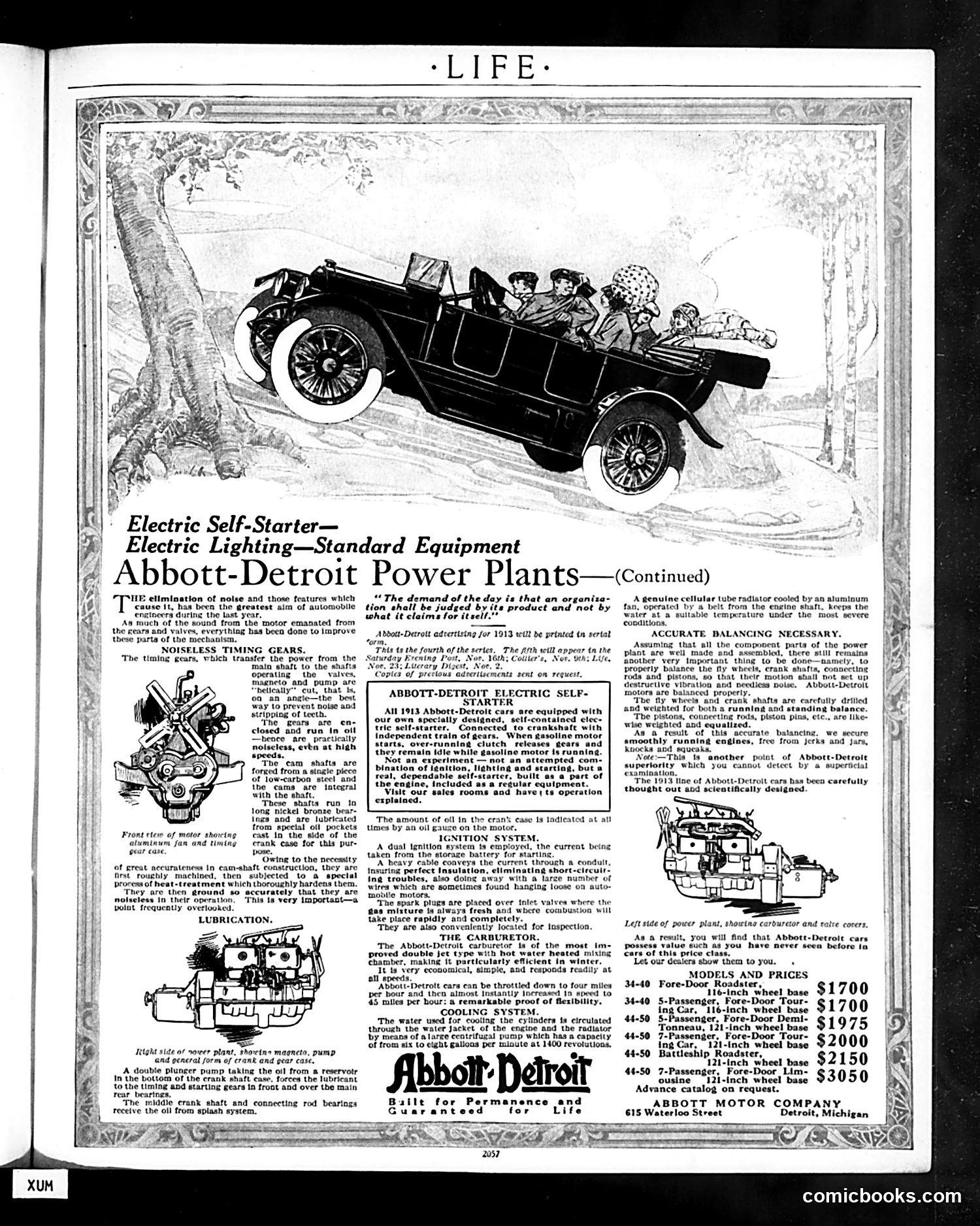
This is primarily **automobile advertising**, not political satire. The page promotes the 1913 Abbott-Detroit motorcar, emphasizing its innovative "electric self-starter"—a major technological advancement that eliminated the dangerous hand-crank starting method. The illustration shows a family enjoying a leisurely automobile ride, representing the comfort and convenience this new technology promised. The detailed technical text describes engineering improvements: noiseless timing gears, reliable lubrication systems, and electric ignition. The quote "an organization shall be judged by its product and not by what it claims for itself" reflects early 1900s advertising philosophy—letting mechanical specifications speak for themselves. For modern readers: this represents how automobiles transitioned from mechanical novelties to practical family vehicles. The self-starter made cars accessible to women and non-mechanically-inclined drivers who previously couldn't operate hand-crank engines. This was genuinely revolutionary consumer technology, not satire.
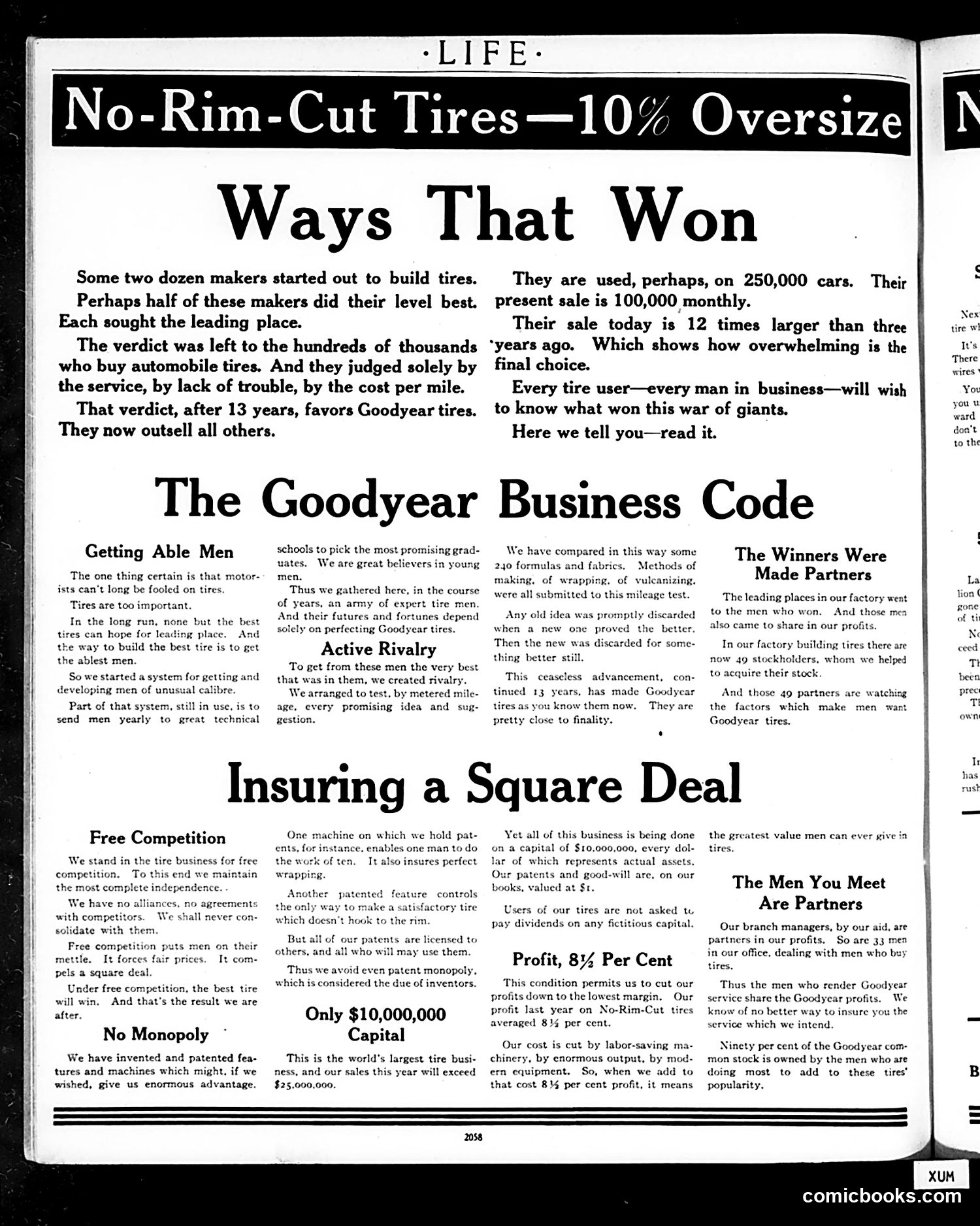
This is **corporate advertising**, not satire or political commentary. Goodyear presents itself as the market winner in tire manufacturing through a narrative of meritocratic competition and ethical business practices. The key claims are: **The Competition Story**: Among ~24 tire makers, Goodyear won consumer preference over 13 years through superior service and cost—not monopoly or trickery. **The Business Philosophy**: Goodyear emphasizes hiring talented men, encouraging internal innovation through rivalry, and sharing profits with employees (49 factory stockholders, 33 office partners). They license their patents to competitors, avoiding monopolistic control. **The Financial Claim**: Operating on only $10 million capital while generating $25+ million in sales, Goodyear takes modest 8½% profit margins, positioning themselves as fair and efficient rather than exploitative. For modern readers, this reads as sophisticated corporate PR—establishing brand legitimacy through claims of meritocracy, transparency, and profit-sharing. Whether these claims were accurate is historically debatable, but the advertisement explicitly argues that ethical business *and* market dominance are compatible.
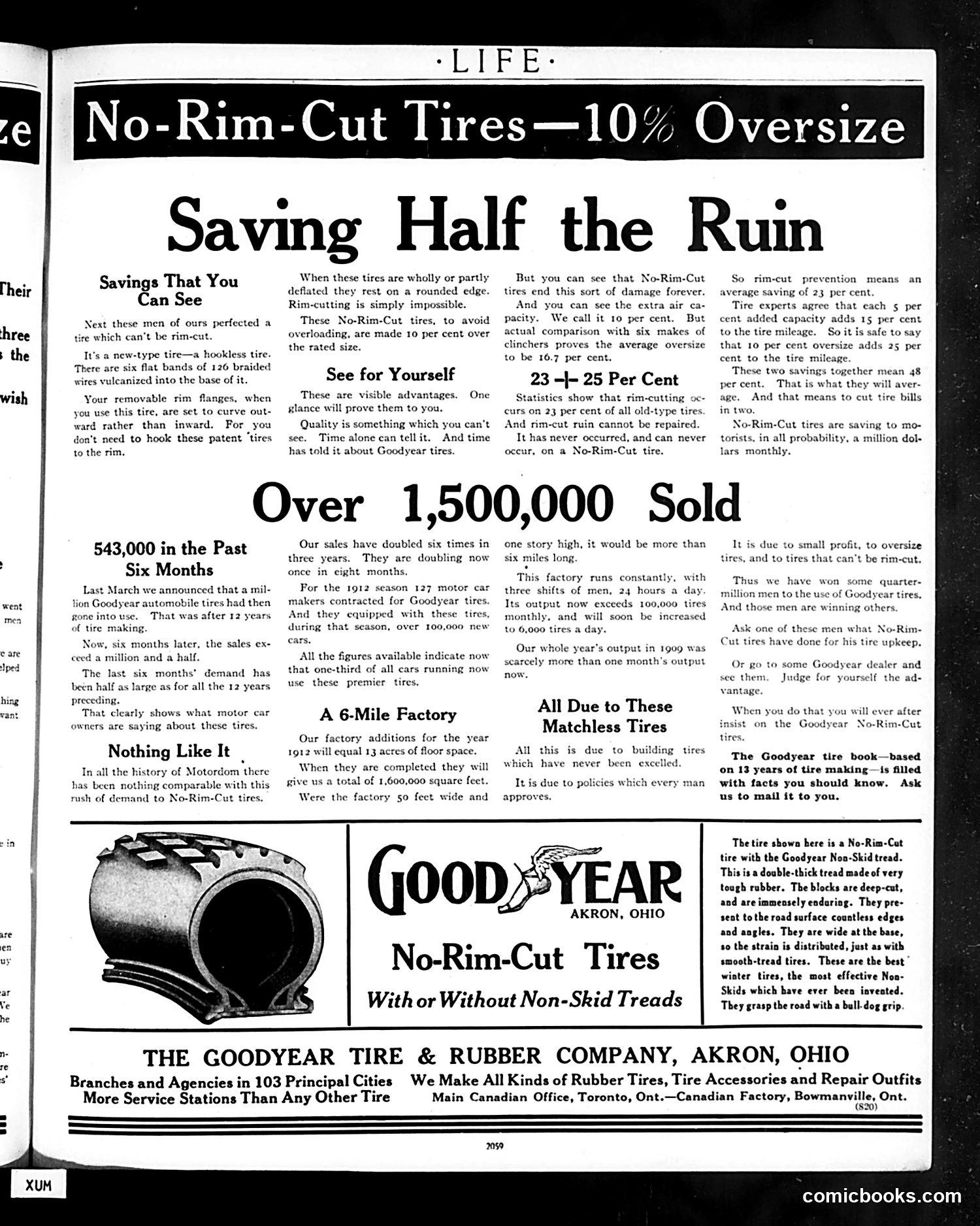
This is **not a cartoon or satire**—it's a straightforward **product advertisement** for Goodyear's No-Rim-Cut tires, published in *Life* magazine circa 1912. The page promotes a new tire design featuring a rounded edge that prevents "rim-cutting" (damage from tire deflation against wheel rims), a common problem with earlier tires. The ad emphasizes that the tire is 10% oversized, claims it adds 25% to tire lifespan, and reports over 1.5 million units sold in six months. Key selling points include: - **Durability**: Rim damage "simply impossible" - **Efficiency**: 10% larger air capacity - **Factory scale**: A newly expanded 6-mile-long factory operating 24/7 - **Adoption**: 127 automakers specified these tires for 1912 models The rhetoric celebrates industrial achievement and consumer savings—reflecting early 1900s optimism about manufacturing and mass production. There is no political satire; this is corporate marketing emphasizing innovation, scale, and market dominance.
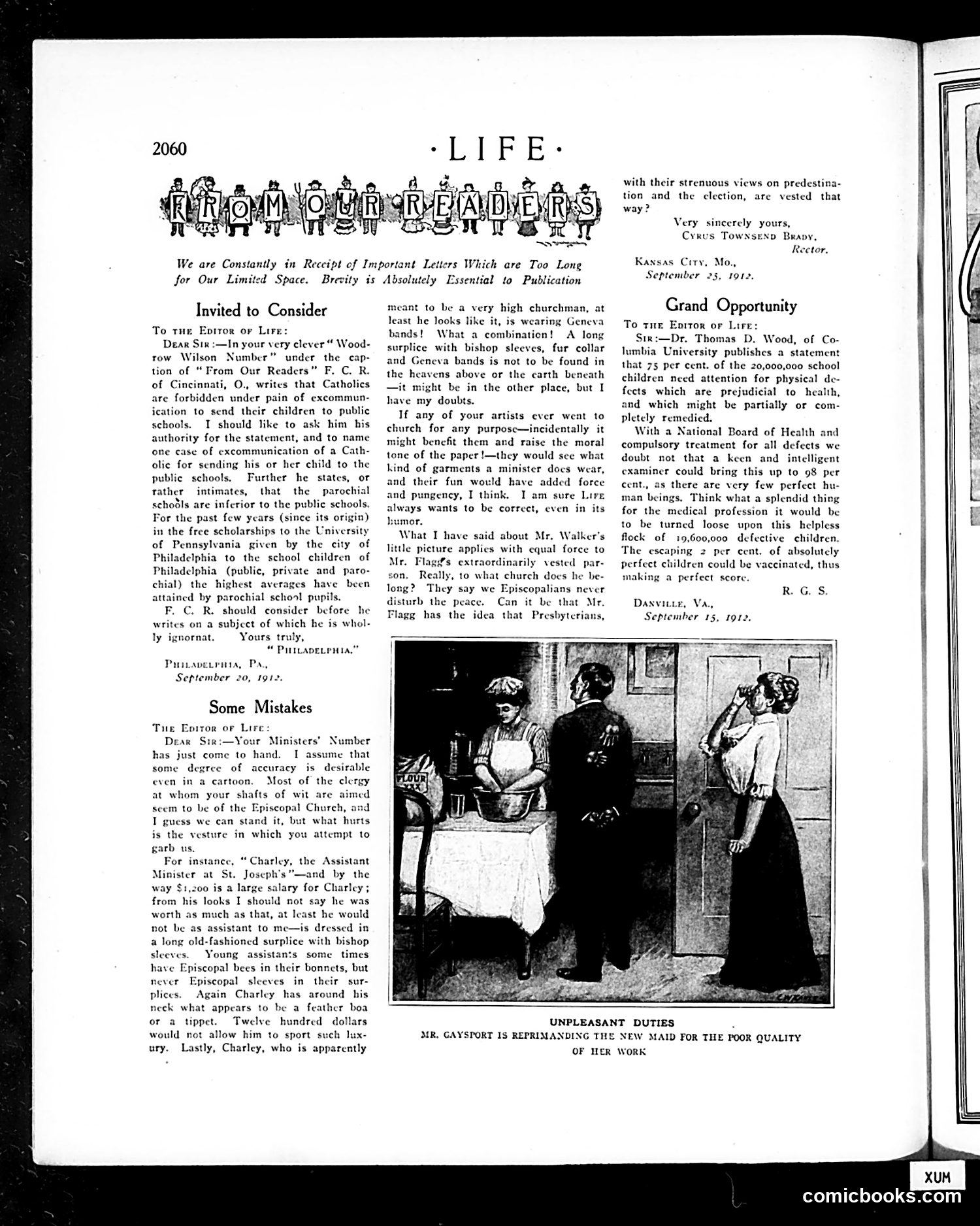
The page primarily contains readers' letters (the "From Our Readers" section) responding to Life's satirical coverage of clergy. The cartoon at bottom illustrates one complaint: artist James Montgomery Flagg drew a poorly-researched minister character wearing wildly inaccurate ecclesiastical garb—combining a long surplice, bishop sleeves, a fur collar, and Geneva bands, an impossible combination never seen in actual churches. The letter writers (particularly a Pennsylvania rector) are humorously chastising Life's artists for sloppy religious details. The cartoonists apparently haven't observed actual church services, so their satire of clergy loses force through factual errors. One writer mocks "Charley, the Assistant Minister" as absurdly overdressed for a modest salary. **The joke**: Life's satirists were ridiculing clergy appearance and doctrine (particularly targeting "high church" Episcopalians versus Presbyterians), but undermined their own mockery through ignorant costume design—the very thing they meant to mock becomes absurdly inaccurate.
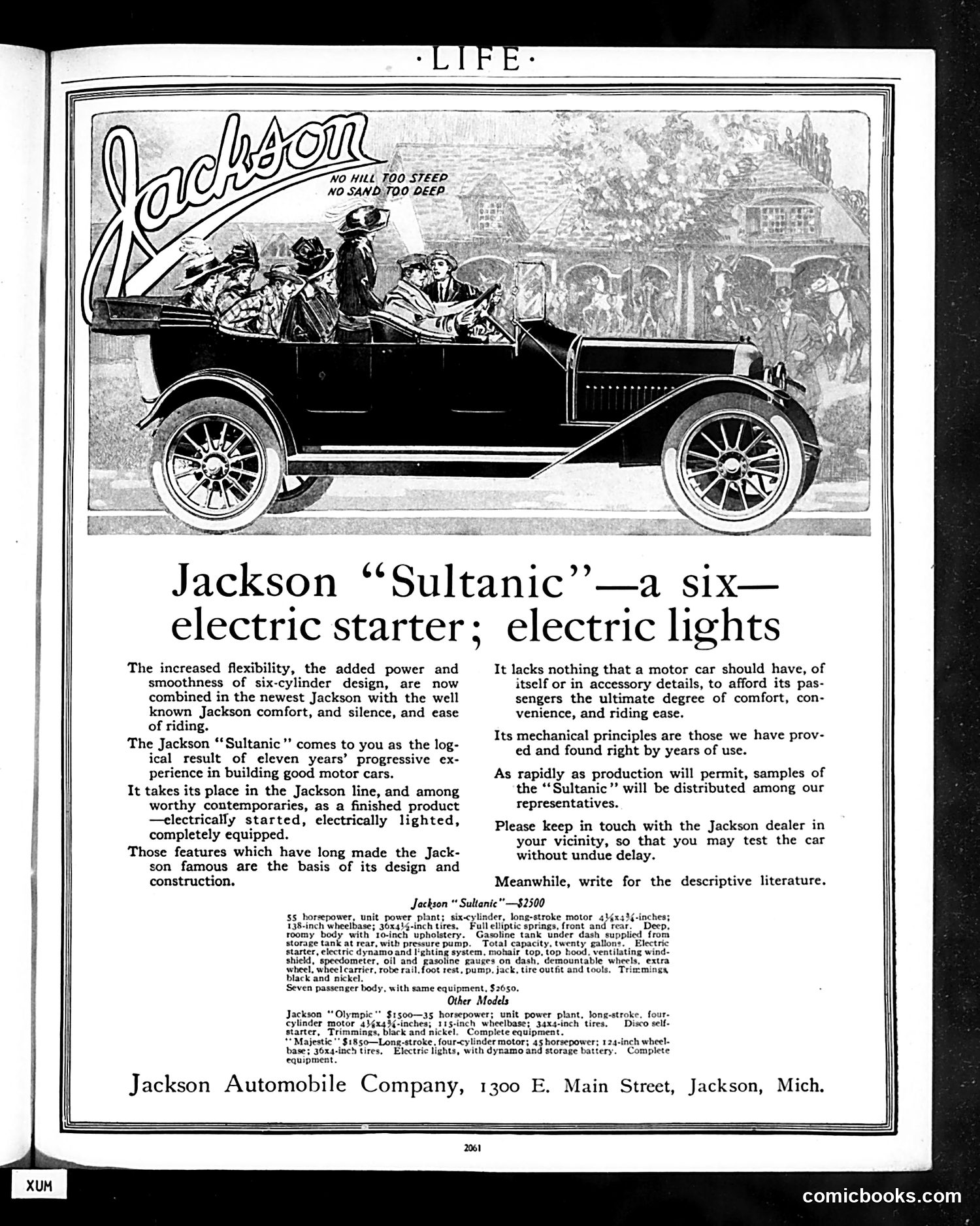
This is primarily a **product advertisement**, not political satire. The page promotes Jackson Automobile Company's new "Sultanic" model, a luxury six-cylinder automobile priced at $2500. The illustration shows well-dressed passengers in an open touring car with the tagline "NO HILL TOO STEEP / NO SAND TOO DEEP"—advertising claims about the vehicle's capability and reliability. The image emphasizes comfort, modern features (electric starter and lights were significant innovations), and social status. The satirical element, if any, is subtle: Life magazine's typical approach was gentle mockery of consumer culture and advertising claims. The exaggerated confidence in the car's capabilities ("no hill too steep") may gently poke fun at automobile manufacturers' grandiose marketing language. This represents early-20th-century automobile advertising during the industry's rapid expansion and the transition from novelty to mass-market commodity.
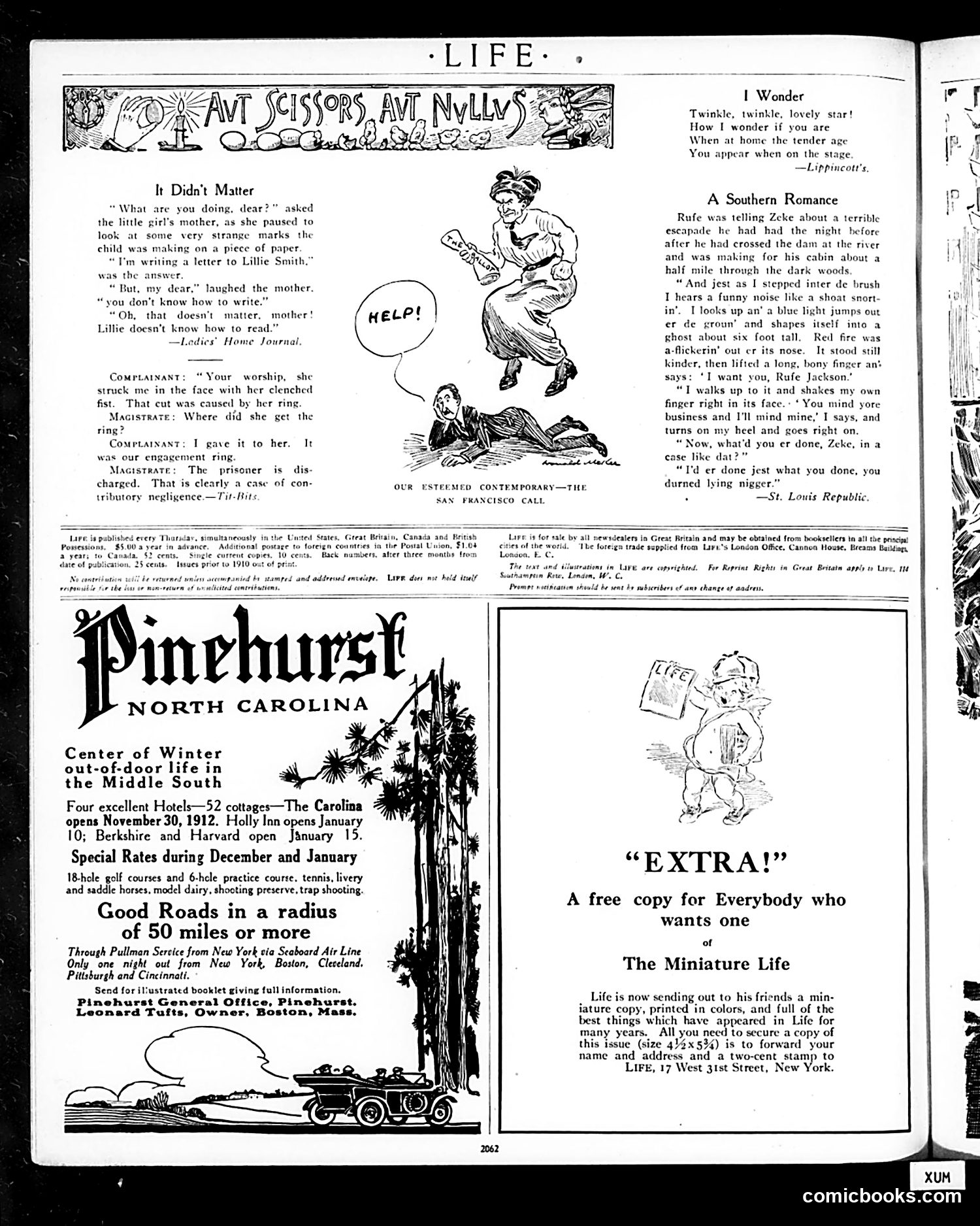
This page contains three distinct humor pieces typical of early 1900s American satire: 1. **"It Didn't Matter"**: A gentle joke about a child writing an illegible letter to a friend, with the punchline that it doesn't matter since the recipient can't read anyway. Simple domestic humor. 2. **"Our Esteemed Contemporary"**: A legal anecdote where a man strikes his fiancée with a ring he gave her. The magistrate dismisses the case as "contributory negligence"—she caused her own injury by accepting the ring. Dark satire on legal absurdity and gender dynamics. 3. **"A Southern Romance"**: A racist dialect story featuring "Rufe" and "Zeke" discussing a supernatural encounter. The punchline uses a racial slur, reflecting the deeply prejudiced humor common in mainstream American publications of this era. The page also includes advertisements for Pinehurst, North Carolina resort amenities and a promotional offer for a miniature version of *Life* magazine itself.
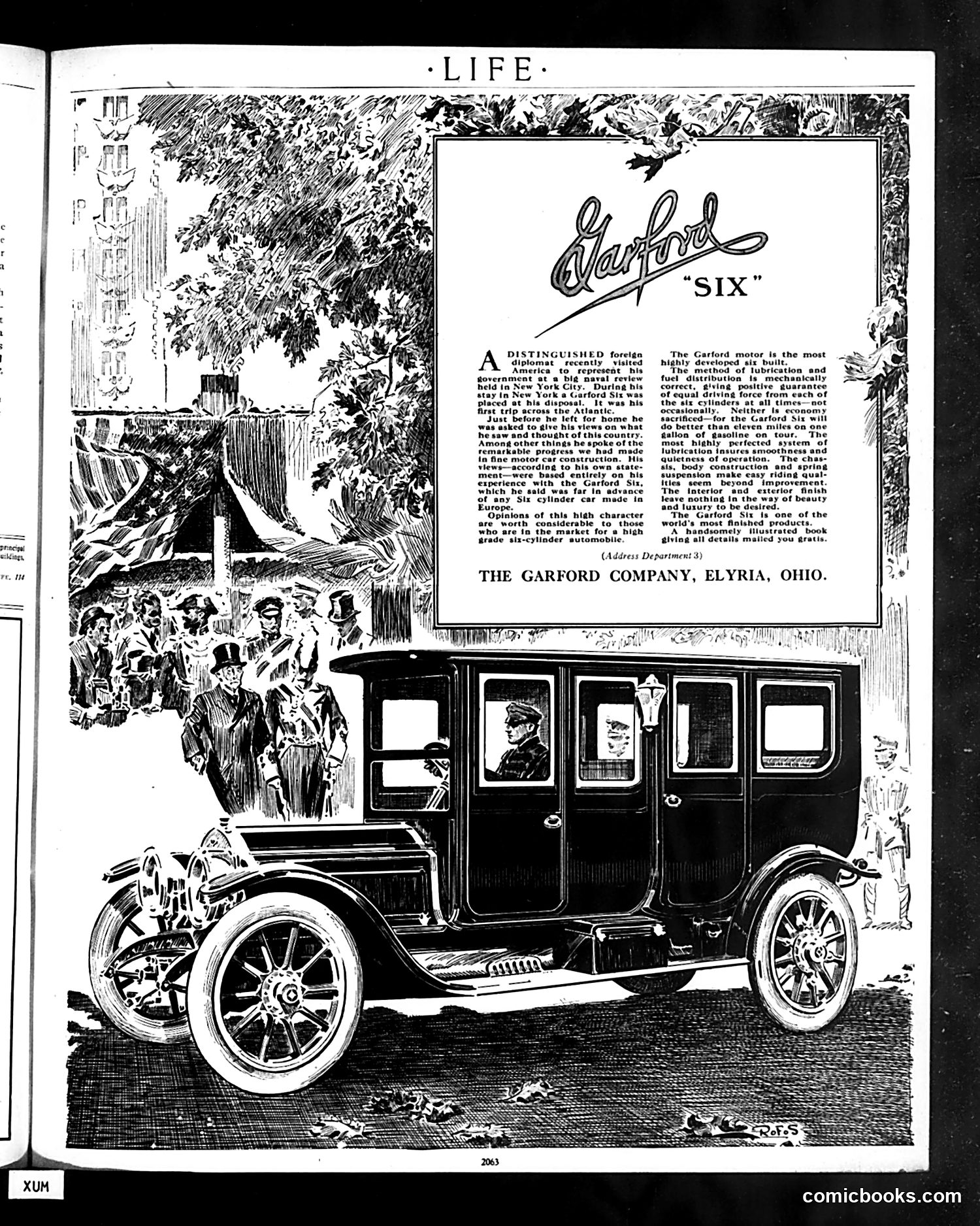
This is primarily **automobile advertising**, not political satire. The page features a Garford Six motor car advertisement in Life magazine. The content uses a diplomatic angle to market the vehicle: A foreign diplomat visiting America for a naval review in New York supposedly praised the Garford Six as superior to European six-cylinder cars. The ad leverages his authority as a distinguished foreign official to endorse American automotive engineering. The illustration shows the car itself—a formal sedan with multiple windows typical of early 1900s design. The decorative border artwork depicts crowds and figures, likely representing the naval review or New York setting mentioned in the text. The satire (if any exists) is subtle and **commercial rather than political**—it's a common advertising tactic of the era: using celebrity or expert endorsement to boost credibility. The "distinguished foreign diplomat" serves as a testimonial figure, though his identity isn't specified in the visible text.
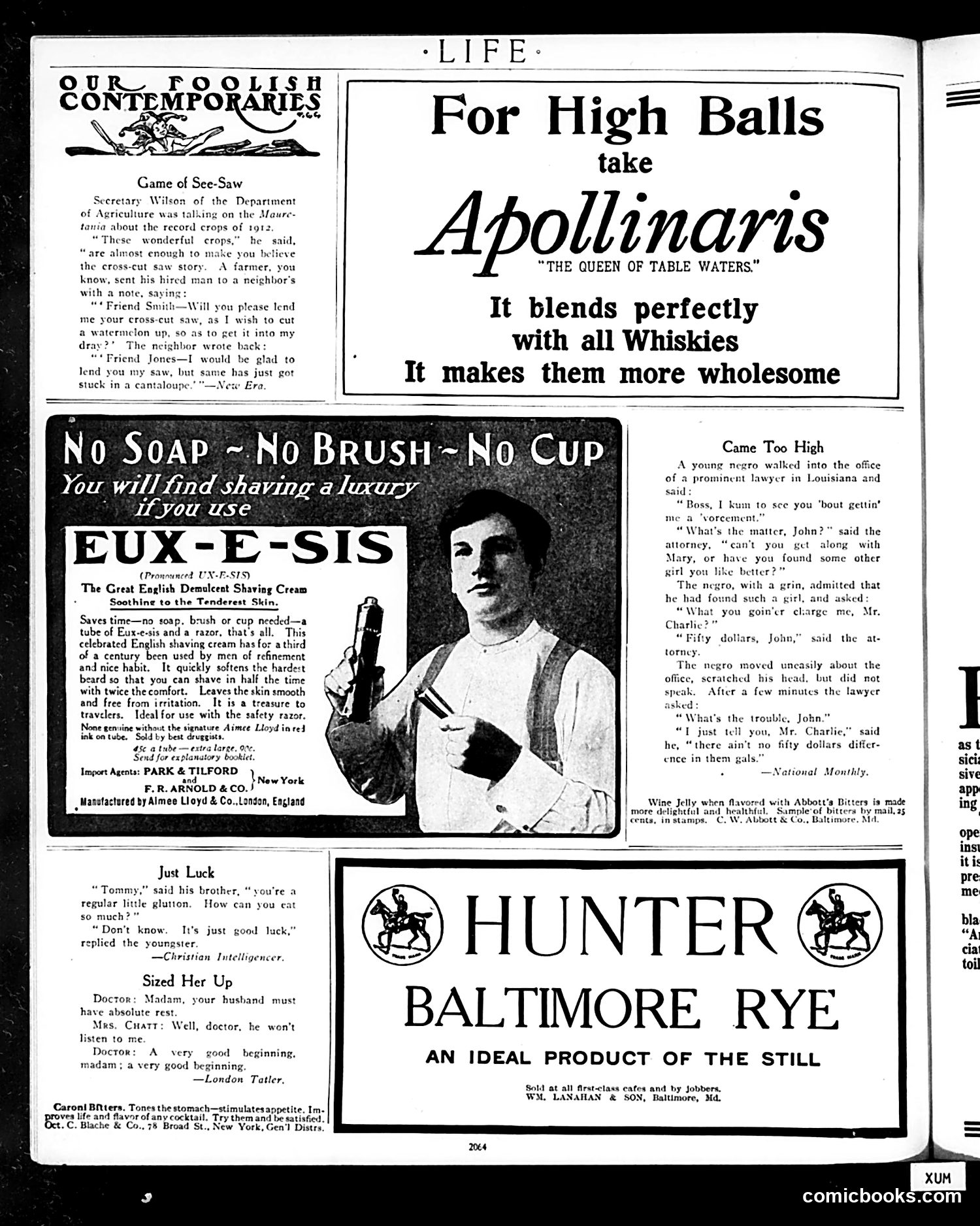
This page is primarily **advertising**, typical of early 1900s Life magazine. The content includes: **"Came Too High"** is a brief joke about a Black man seeking divorce from a lawyer. It relies on dialect humor and stereotypes common to the era—depicting the man as financially unsophisticated (shocked at a $50 fee) and using exaggerated speech patterns. Modern readers would recognize this as reflecting the racial caricature humor that was mainstream in popular publications of that period. **The "Game of See-Saw"** anecdote at top-left is unrelated political humor: Secretary Wilson (of Agriculture) tells a joke about a farmer's absurd request to borrow a saw to cut a watermelon—it's a shaggy-dog joke with no real satirical point. The remainder consists of product advertisements for shaving cream (Eux-e-sis), whiskey-based tonics, mineral water (Apollinaris), and rye whiskey—all standard early-20th-century magazine advertising positioning luxury goods to male readers.
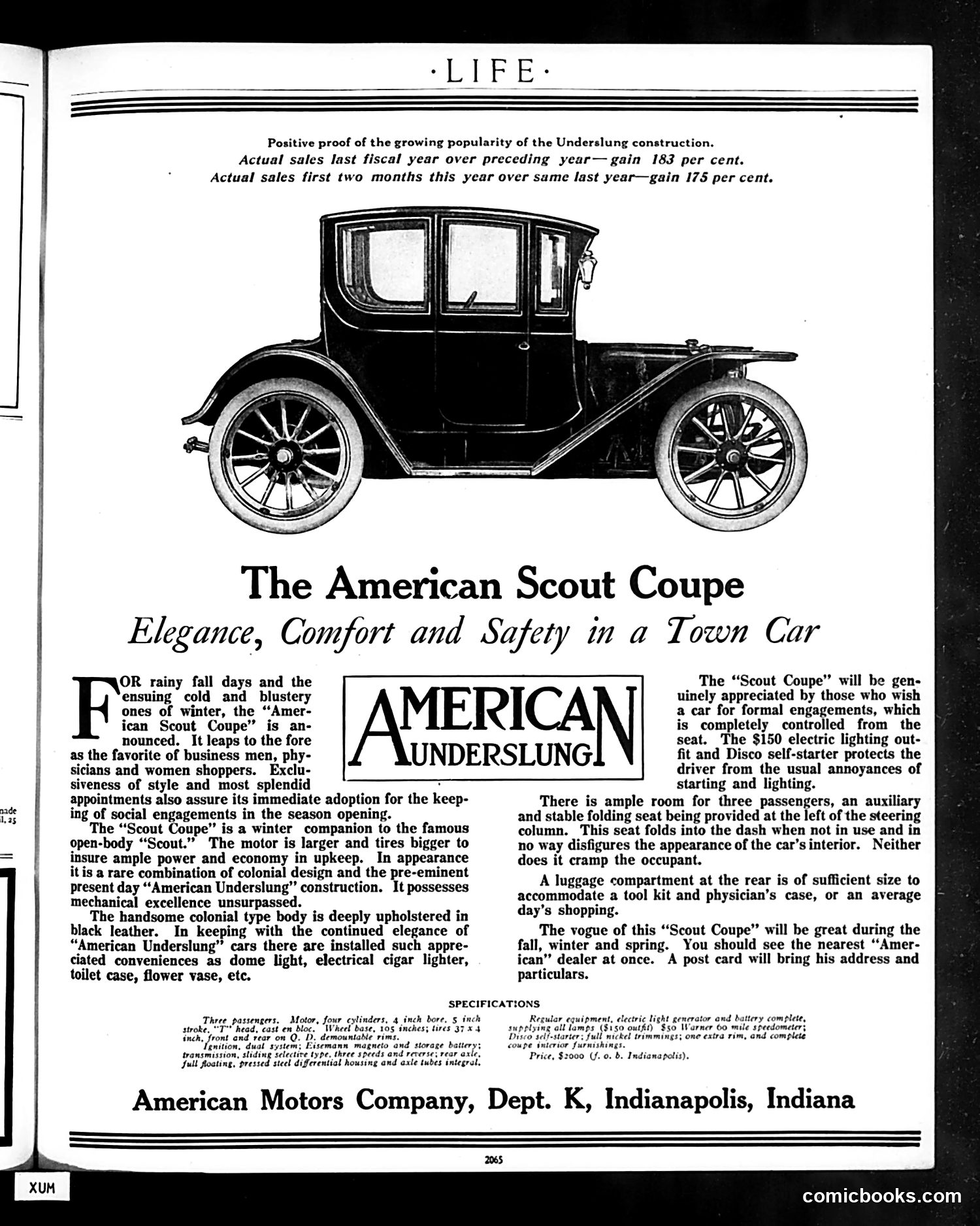
This is **not a cartoon or satire**, but a straightforward automobile advertisement from Life magazine—which, despite its satirical reputation, regularly published advertising. The page promotes the American Scout Coupe, a enclosed winter car variant of the open-body "Scout." The advertisement emphasizes luxury features appealing to affluent buyers: business men, physicians, and women shoppers. It highlights "elegance," comfort, and modern conveniences (electric starter, dome light, cigar lighter) designed for formal social occasions. The opening text boasts sales figures (183% and 175% gains) to establish market success and desirability. The car's "colonial design" combined with "American Underslung" construction (the company's signature low-slung chassis) supposedly offered both classic aesthetic and mechanical superiority. At $2,000, this was a premium vehicle marketed to the wealthy during the early automobile era.
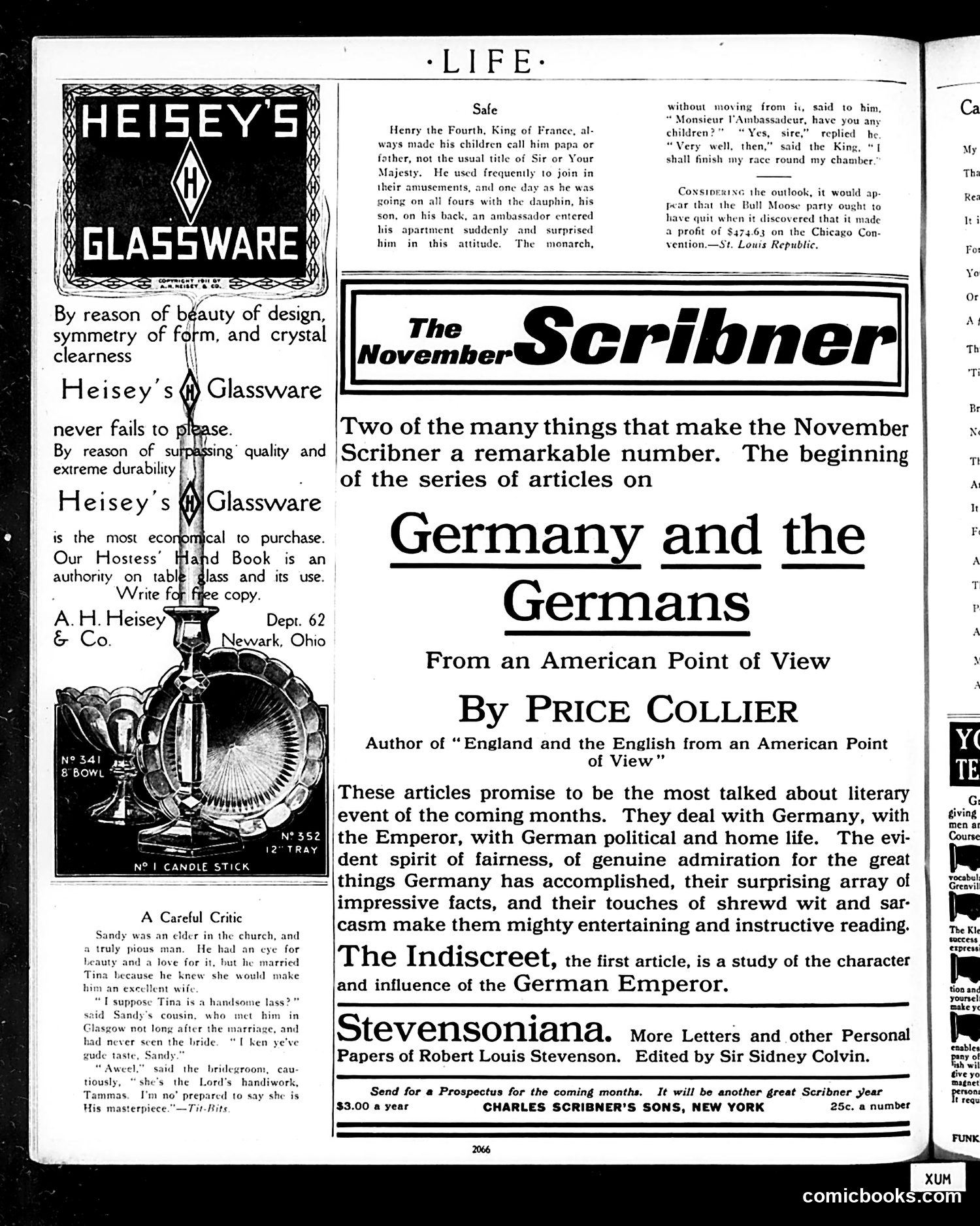
This page is primarily **advertising and literary announcements** rather than satirical cartoons. The left side features a **Heisey's Glassware advertisement** with a humorous anecdote ("A Careful Critic") about a Scottish church elder named Sandy who, when asked if his bride Tina is handsome, replies she's "the Lord's handiwork" but he's "no' prepared to say she is His masterpiece"—a joke about backhanded compliments. The center contains two brief **satirical items**: one mocking King Henry IV's undignified crawling with his son, and another criticizing the **Bull Moose party** (Theodore Roosevelt's 1912 Progressive Party) for profiting $474.63 from a Chicago convention—suggesting the party should have quit while ahead. The right side announces **The Scribner** magazine's November issue, promoting Price Collier's article series "Germany and the Germans: From an American Point of View," emphasizing fair treatment of German accomplishments alongside wit and sarcasm—likely reflecting pre-WWI American curiosity about Germany.
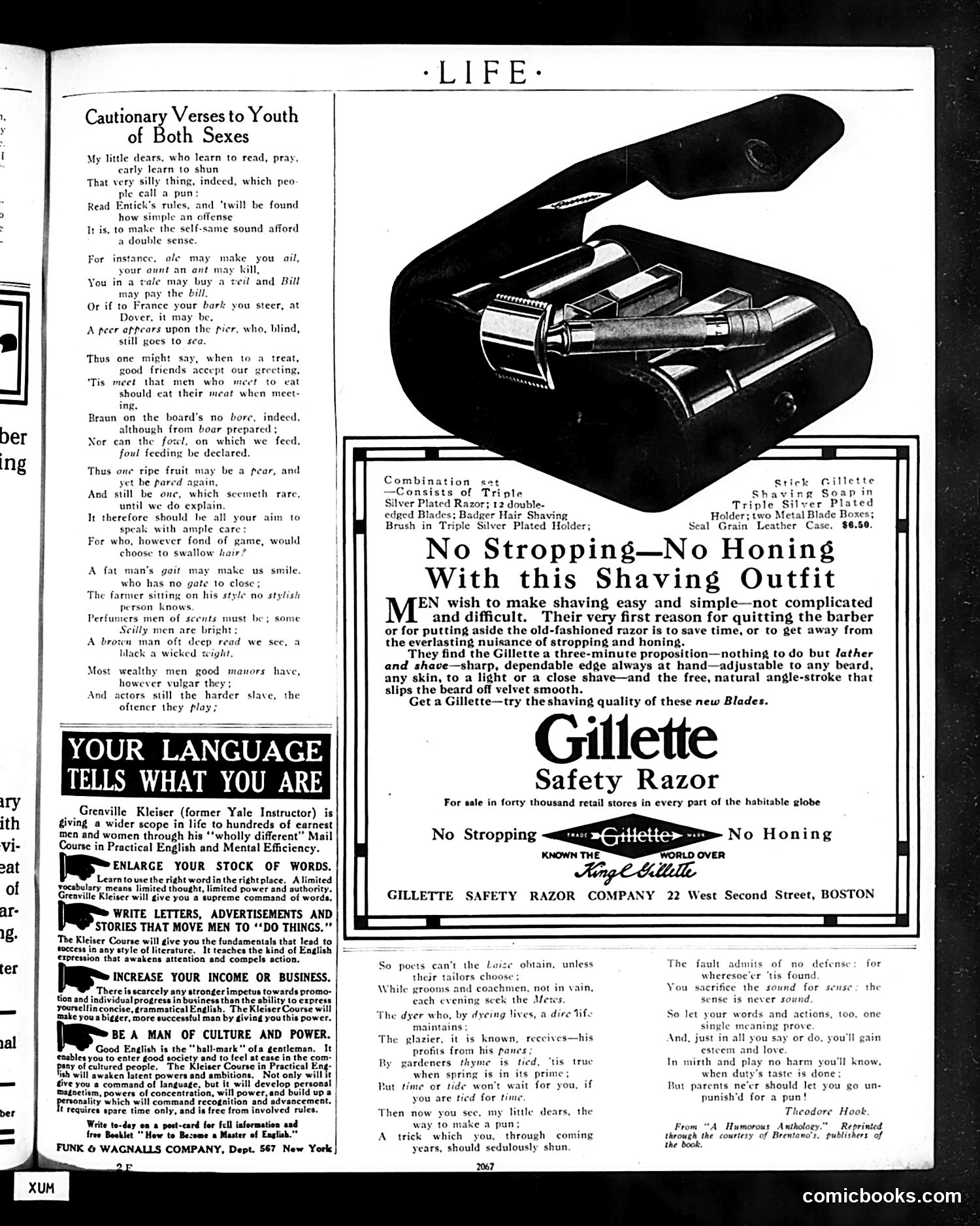
This page combines satirical poetry with early advertising, typical of Life magazine's format. **The Poetry Section ("Cautionary Verses to Youth"):** A humorous mock-serious warning against puns—wordplay exploiting identical sounds with different meanings (ale/ail, meat/meet, etc.). The poem satirizes overly pedantic English instruction by treating puns as moral failings worthy of solemn caution. It's gentle satire on stuffy Victorian language rules. **The Advertisements:** Two commercial pitches occupy the right side: 1. **Grenville Kleiser's Mail Course**: Promotes self-improvement through better English, promising business success, social advancement, and personal power—typical early-20th-century "self-made man" messaging. 2. **Gillette Safety Razor**: The dominant ad emphasizes convenience—"No Stropping, No Honing"—marketing a modern innovation that eliminated tedious grooming steps. The product image shows the complete kit. Both ads reflect period anxieties about self-improvement and modernity, while the poetry gently mocks the linguistic pretension that the ads simultaneously exploit.
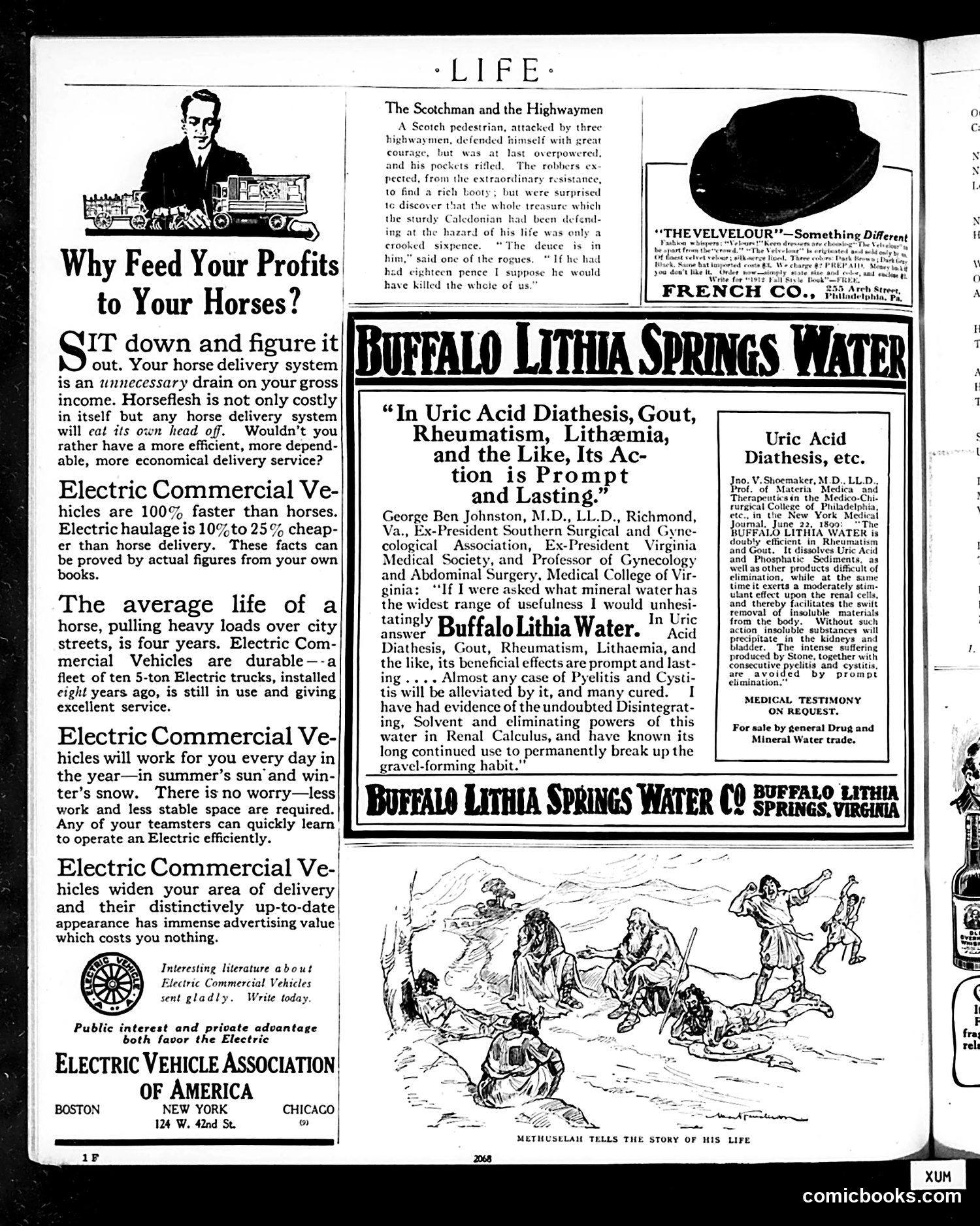
This page showcases early 20th-century advertising combined with a humorous anecdote. The dominant left column promotes **Electric Commercial Vehicles** as replacements for horse-drawn delivery systems—a cutting-edge technological pitch emphasizing cost savings (10-25% cheaper), durability (a 10-year-old fleet still operational), and reliability. This reflects the period's enthusiasm for electrification as progress. A brief story titled "The Scotchman and the Highwaymen" delivers an ethnic stereotype joke: three robbers attack a Scottish pedestrian, expecting riches but finding nearly nothing. One robber remarks the Scot would have killed them all for eighteen pence—a joke about Scottish frugality/stinginess. This reflects common period caricatures. The page also features ads for **Buffalo Lithia Springs Water**, claiming medical benefits for gout and urinary conditions, supported by doctor testimonials—typical of unregulated health product marketing of the era. The lower illustration depicts a biblical or classical scene (unclear which), captioned "Methuselah tells the story of his life."
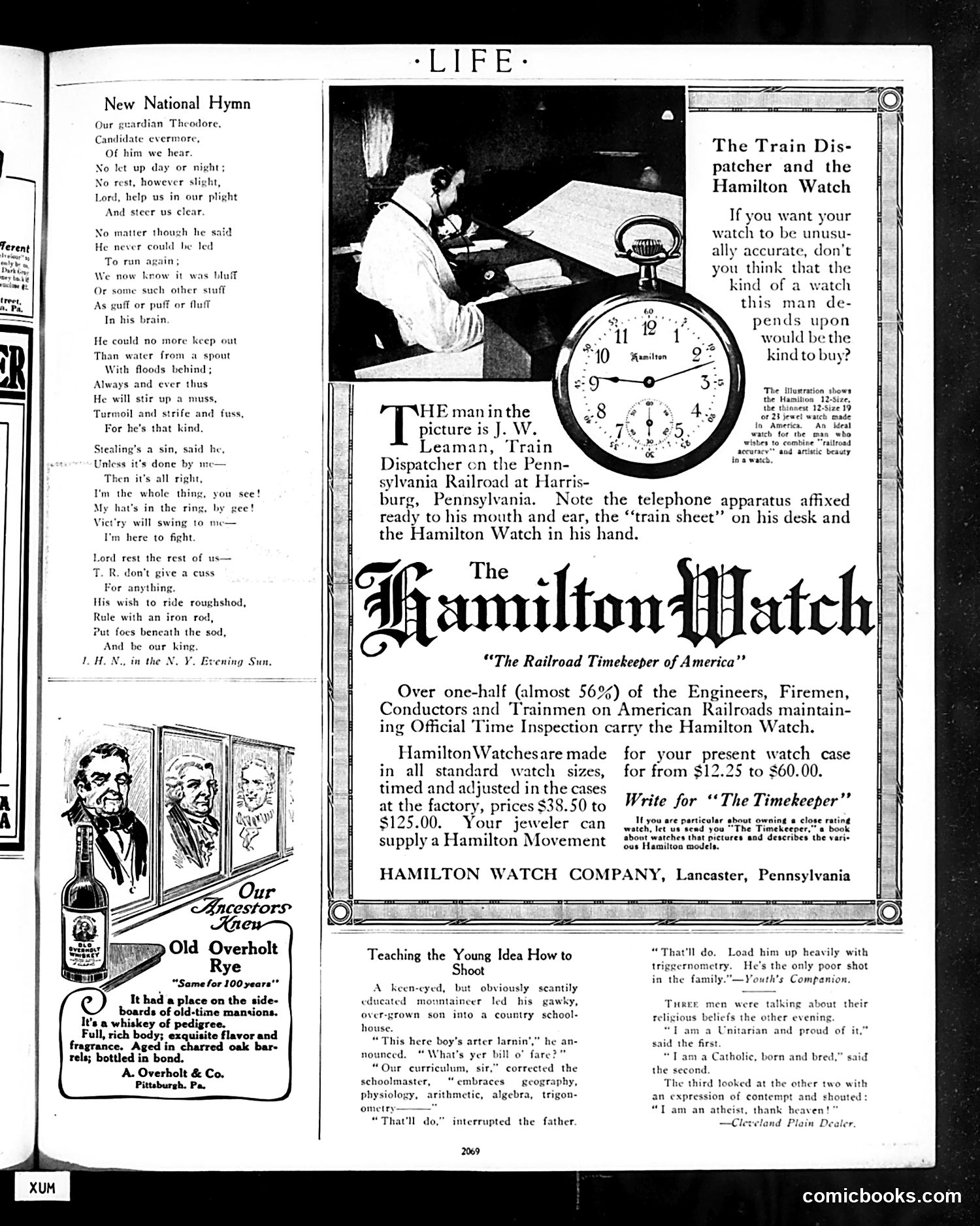
This page primarily features **political satire targeting Theodore Roosevelt**. The "New National Hymn" poem mocks Roosevelt's repeated claims he wouldn't run for president again, sarcastically suggesting his denials were "bluff" and that he can't resist stirring up political turmoil. The verse ridicules his domineering personality ("Rule with an iron rod") and his apparent disregard for others' concerns ("don't give a cuss"). This satirizes Roosevelt's actual political maneuvering around 1912 when he broke with his successor Taft to run again as a Progressive candidate—contradicting his earlier pledge not to seek another term. The page also includes period advertisements (Hamilton Watch, Old Overholt whiskey) and unrelated humor pieces about rural education and religious beliefs, which were typical Life magazine filler content. The Roosevelt satire would resonate with contemporary readers familiar with his political drama but requires modern context to fully understand the specific grievances.
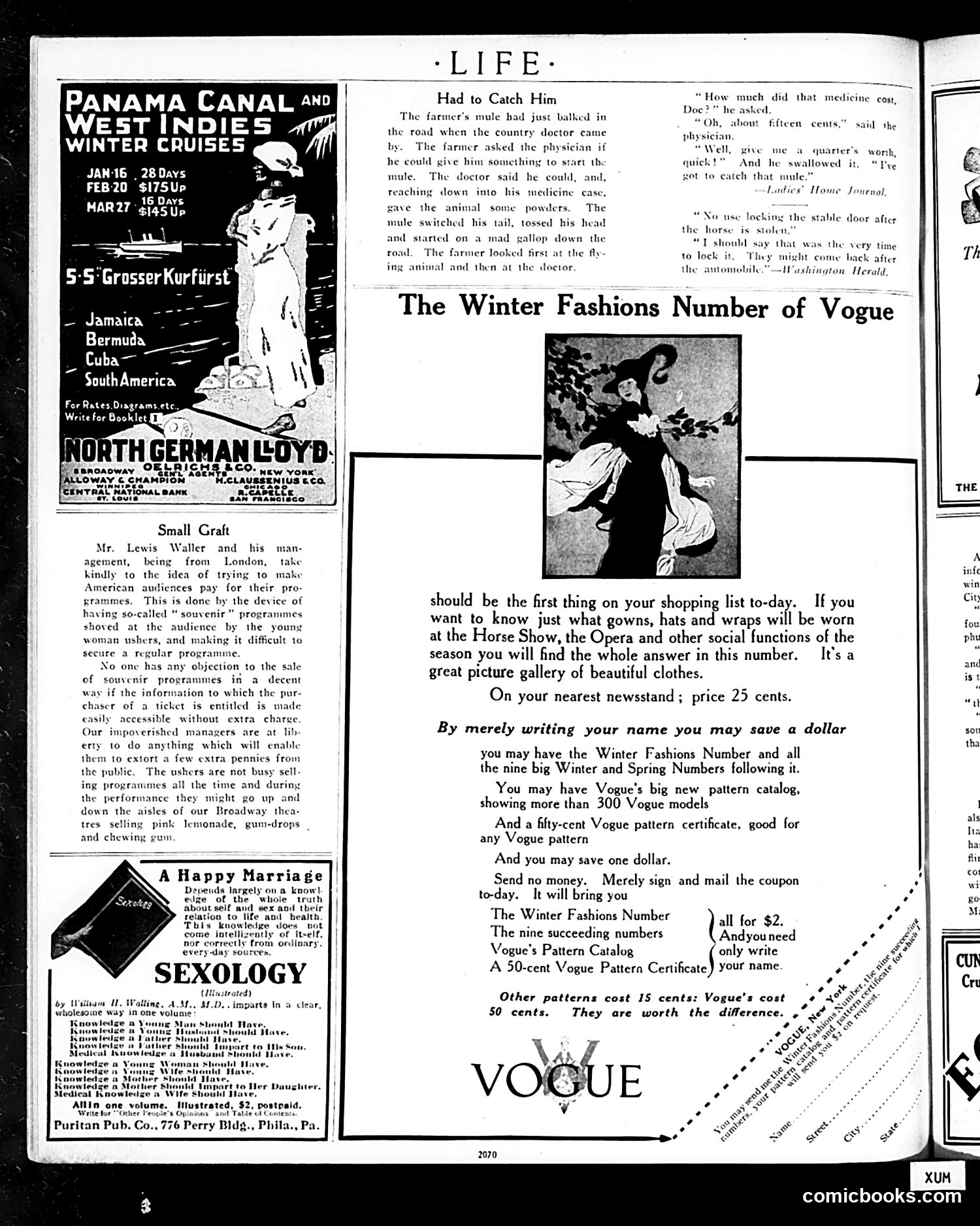
This page is primarily **advertising with one brief humorous anecdote**. The small text piece "Had to Catch Him" is a joke about a farmer whose mule won't move. A country doctor gives the animal powders, which causes the mule to bolt wildly down the road. The farmer then complains to the doctor about the cost. The joke's punchline—comparing the situation to "locking the stable door after the horse is stolen"—appears to be an editorial jab at ineffective problem-solving, though the connection is unclear from the image alone. The "Small Graft" article critiques theater managers and ushers in London and American productions who exploit audiences by selling "souvenir" programs at inflated prices, rather than providing the standard program information freely with ticket purchase. It's social satire about petty commercial exploitation of theatergoers. The remainder consists of advertisements for cruise lines, books on marriage and sexuality, and prominently, **Vogue magazine's Winter Fashions issue**—a direct marketing appeal offering discounts and bonuses for subscriptions.
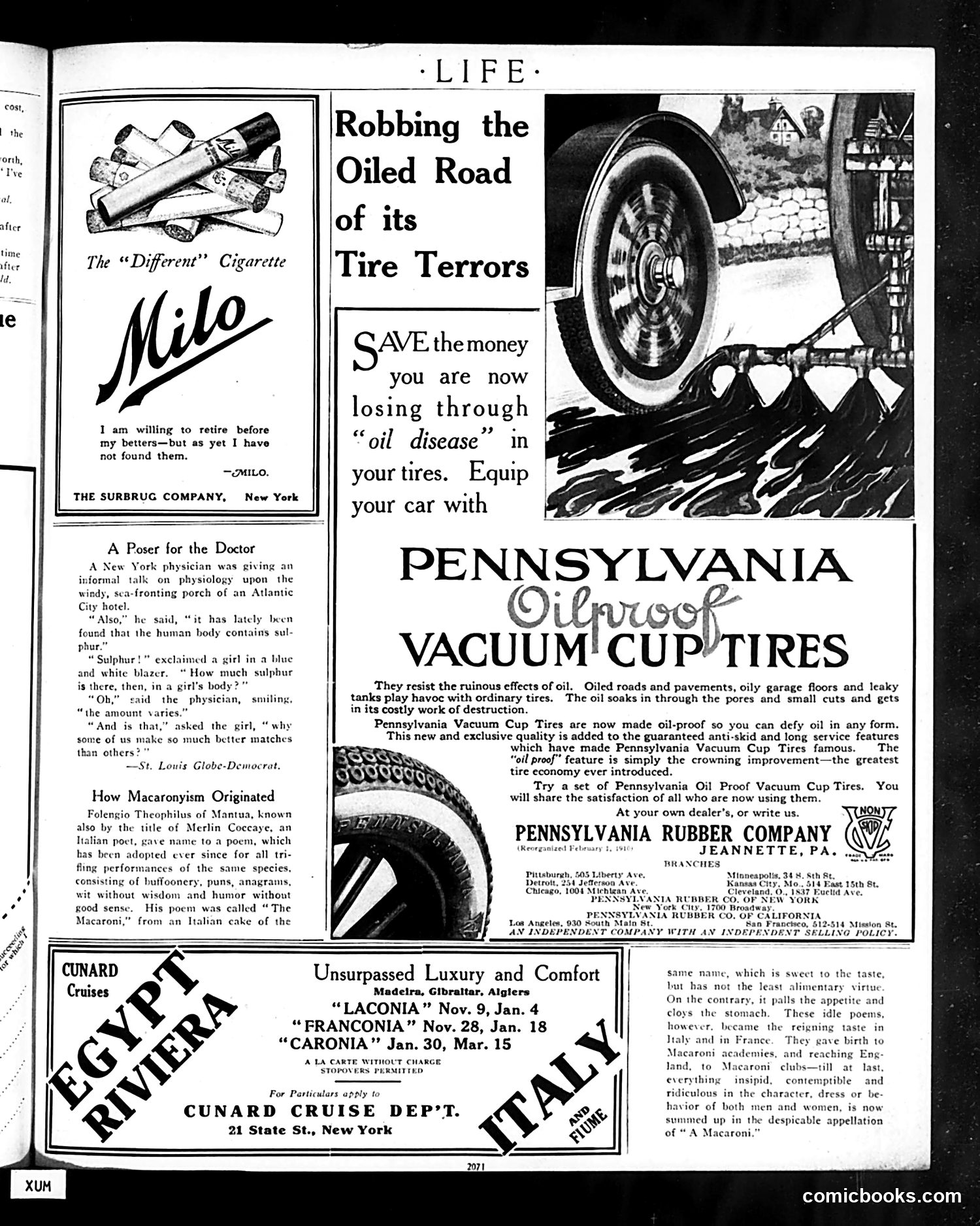
This page is primarily **advertising mixed with light humor content**, typical of Life magazine's format. The main advertisement promotes **Pennsylvania Vacuum Cup Tires**, claiming they resist oil damage—a genuine problem for early automobiles on newly oiled roads. The pitch addresses a real concern: oil-soaked pavements damaged tires by seeping into pores and cuts, causing expensive failure. The "oil-proof" tire was presented as a technological solution to this specific automotive hazard of the era. The surrounding content includes minor jokes and historical essays (on macaronyism's etymology, a physician's quip about sulphur in bodies). **The satirical point**: The ad's dramatic language—"Tire Terrors," "oil disease"—humorously exaggerates a genuine mechanical problem into an almost medical catastrophe, using fear-based marketing typical of early 20th-century advertising. The tire solution is positioned as protection against a very real but mundane problem of the automobile age. Also visible: Cunard cruise ship ads, reflecting this publication's affluent readership.
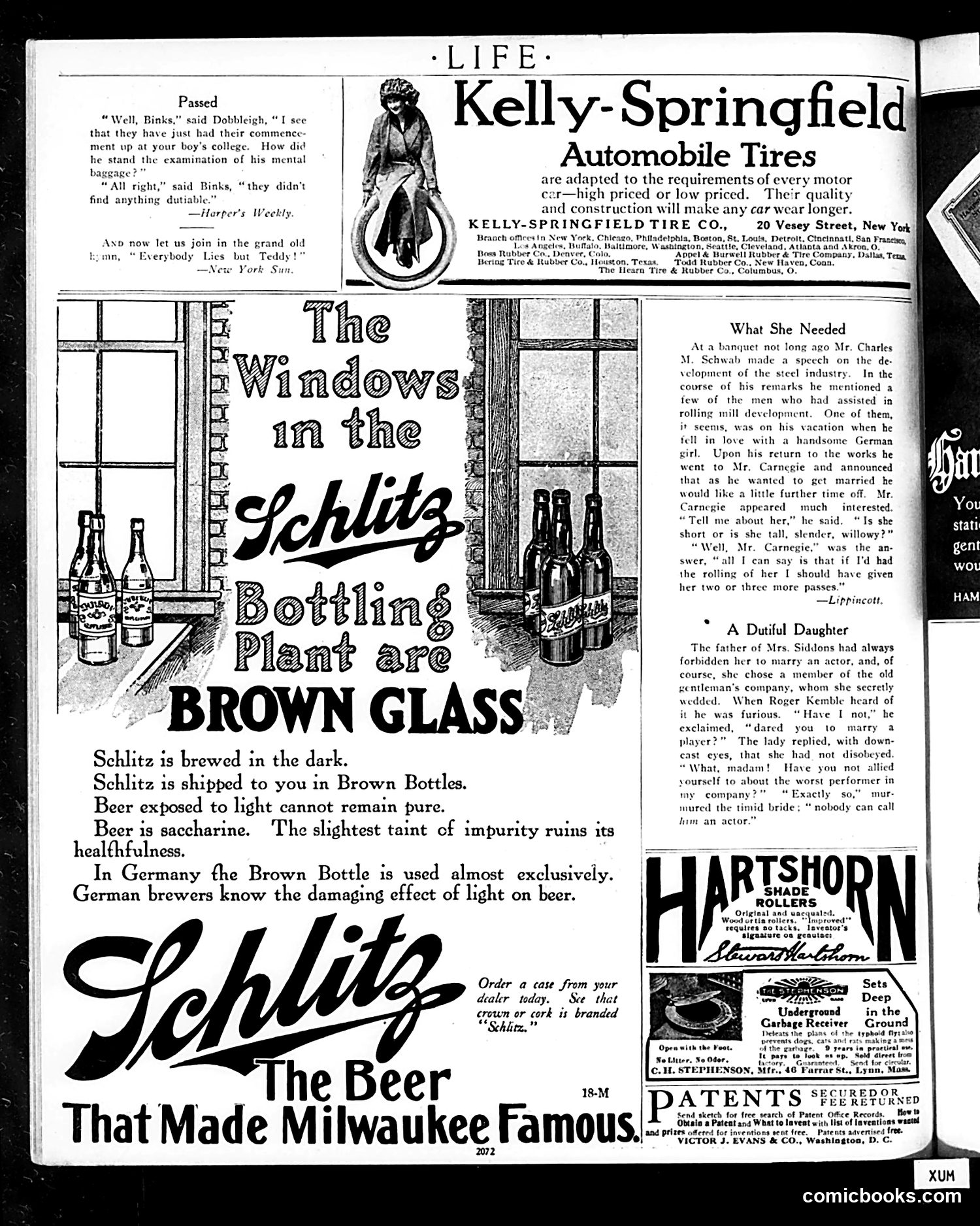
This page is primarily **advertising**, not satire or editorial cartooning. It contains four major commercial advertisements: 1. **Kelly-Springfield Automobile Tires** — promoting tire quality across price points 2. **Schlitz Beer** — emphasizing brown bottle protection; argues light damages beer quality, citing German brewing practices 3. **Hartshorn Shade Rollers** — window shade hardware advertisement 4. **Patents Office Services** — legal/patent filing services The page also includes three brief **humorous anecdotes** (likely from *Harper's Weekly*): - A joke about college commencement and customs duties - A steel industry story where a worker requests time off to marry, implying he'll need "rolling" practice - A theater anecdote about actress Mrs. Siddons marrying an actor despite her father's objection These aren't cartoons but short comic prose pieces—typical filler content for early 20th-century magazines. The humor is gentle, domestic, and relies on wordplay rather than social criticism.
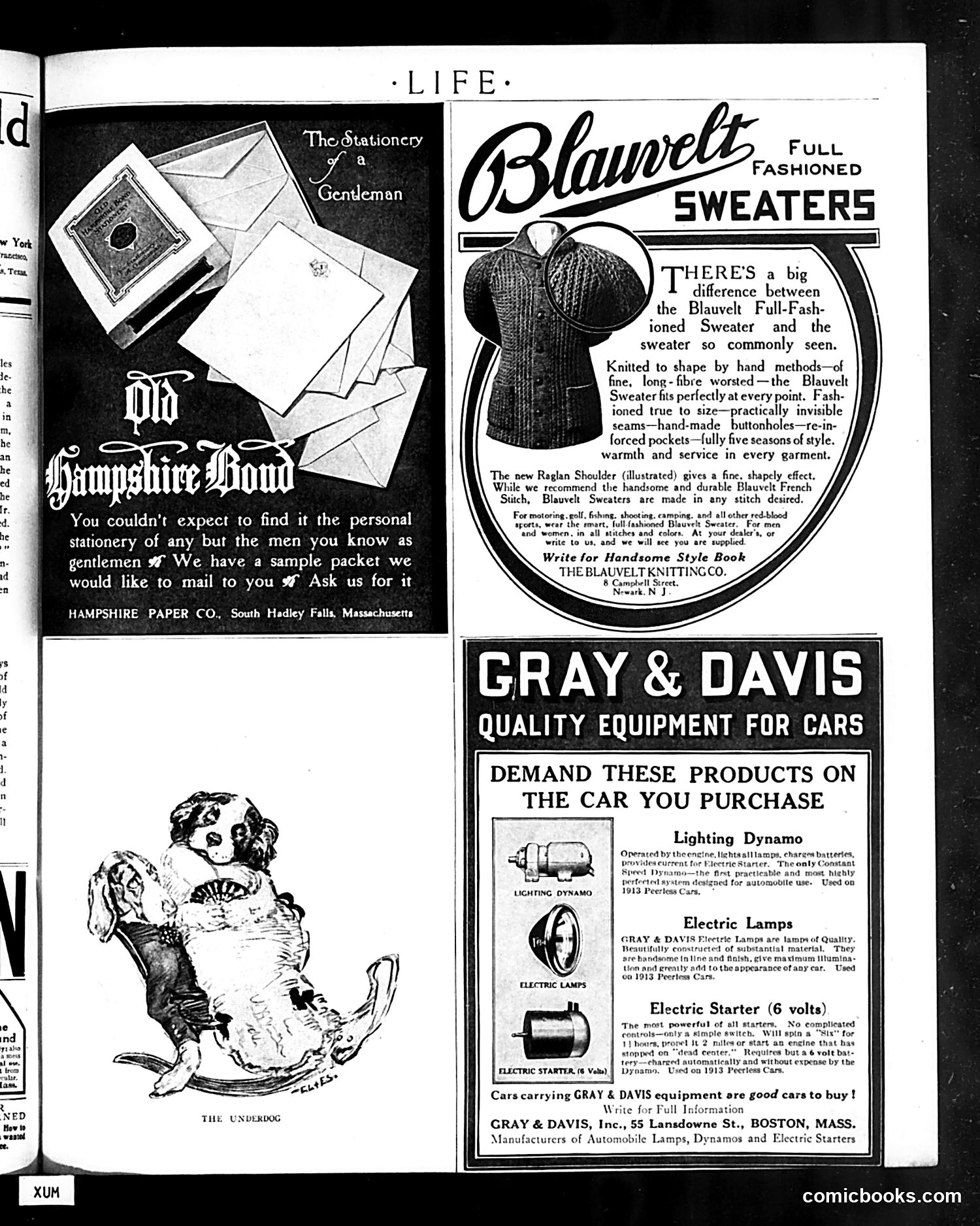
This page consists primarily of **advertisements**, not editorial satire. The only cartoon element is "The Underdog"—a small illustration of a dog (likely a boxer or bulldog) being kicked or knocked down, which appears to be a generic humorous illustration, possibly commenting on misfortune or comeuppance. The ads showcase early 1910s consumer goods: Hampshire Paper's gentlemen's stationery (emphasizing class status), Blauvelt sweaters (marketed for sports and outdoor activities), and Gray & Davis automobile electrical equipment (dynamos, lamps, starters). These ads reflect the era's focus on quality goods for middle-to-upper-class buyers and the rapid adoption of motorcar technology. There is no evident political commentary. The page represents Life magazine functioning as a vehicles for lifestyle advertising rather than satire during this period.
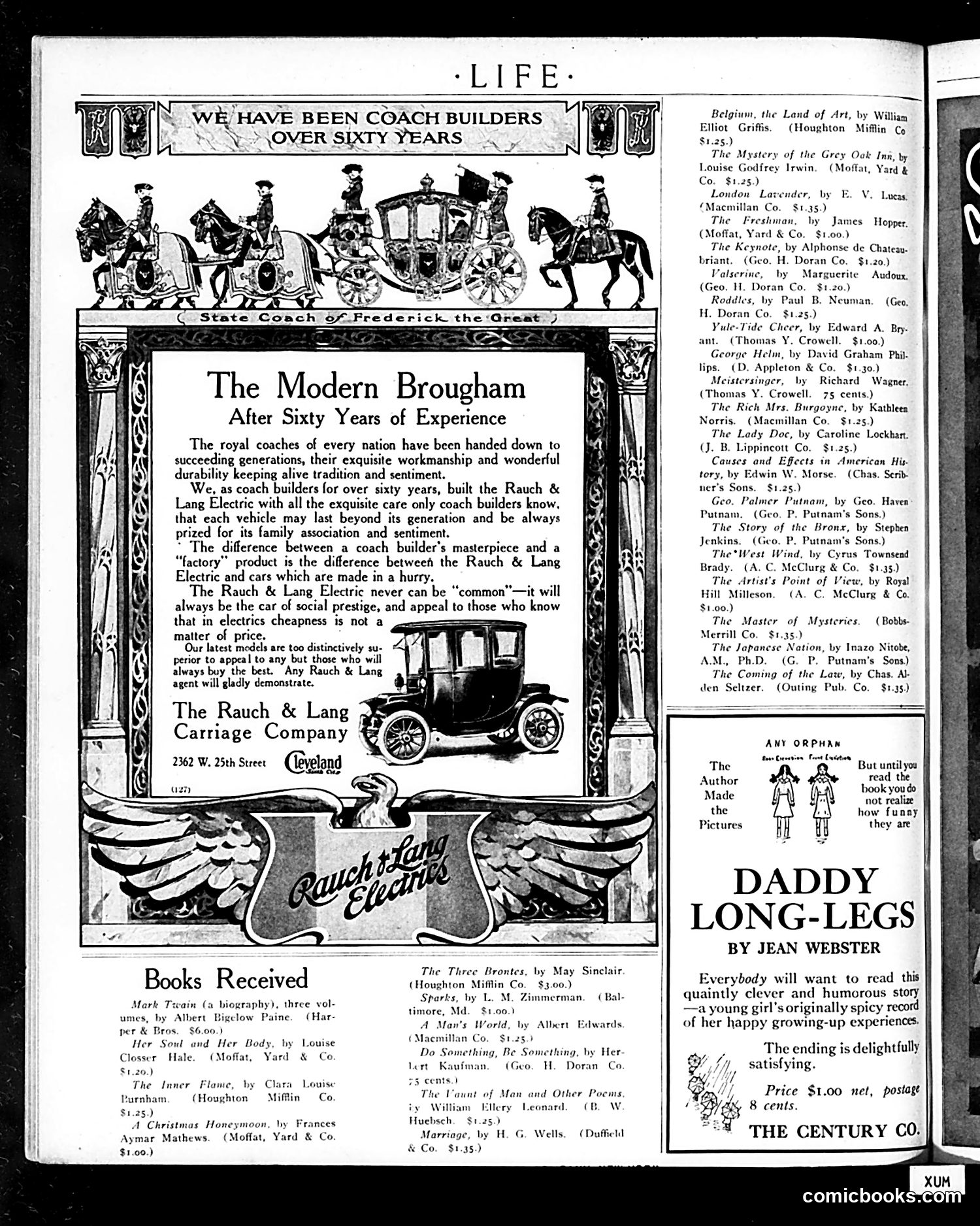
This page is primarily **advertising and book reviews**, not political satire. The main content is a luxury car advertisement for the **Rauch & Lang Electric Company** (Cleveland), marketing their high-end electric brougham carriage. The ad emphasizes sixty years of coach-building tradition and craftsmanship, positioning the vehicle as a status symbol for the wealthy ("social prestige"). The key sales pitch: their cars aren't mass-produced "factory" products but handcrafted masterpieces worthy of family heirlooms. The "State Coach of Frederick the Great" illustration at top reinforces this heritage appeal—linking the modern electric carriage to royal tradition. The right column lists recently published books with prices ($1.00-$6.00), and advertises **"Daddy Long-Legs"** by Jean Webster, a popular contemporary novel about a young orphan girl. There is **no political cartoon or satire** on this page. It represents Life magazine's revenue model: mixing editorial content with premium advertising for affluent readers.
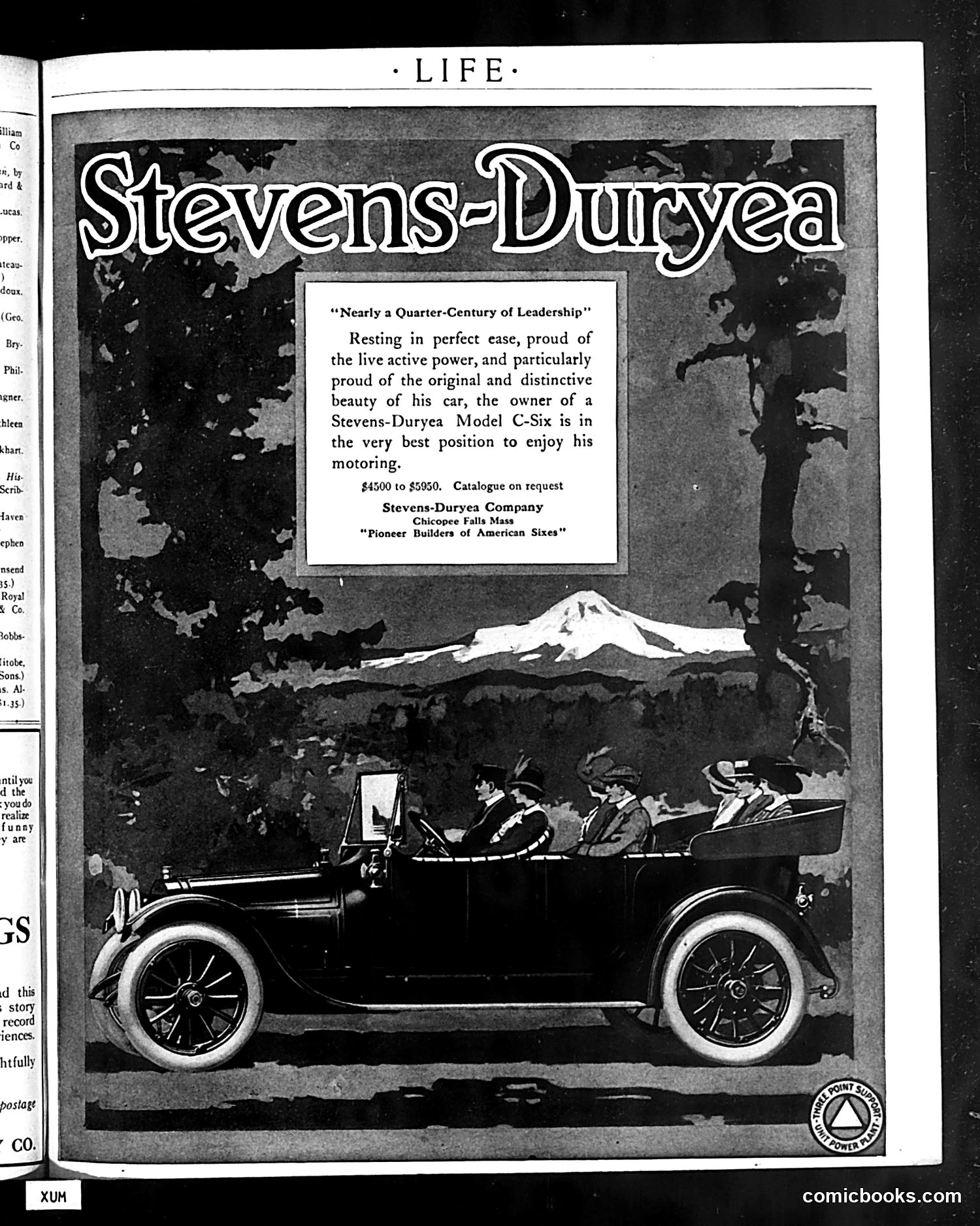
This is a **car advertisement**, not political satire. It promotes the Stevens-Duryea Model C-Six automobile, positioned as a luxury vehicle from Chicopee Falls, Massachusetts. The ad emphasizes the car's "nearly a quarter-century of leadership" and appeals to buyers' pride in owning an "original and distinctive" automobile. The scenic illustration shows five well-dressed passengers enjoying a leisurely drive past a snow-capped mountain, suggesting comfort, reliability, and status. The price range ($4,500–$5,950) indicates this was an expensive vehicle for the era. There is no political cartoon or satire present on this page—it is straightforward commercial advertising typical of early 20th-century *Life* magazine.
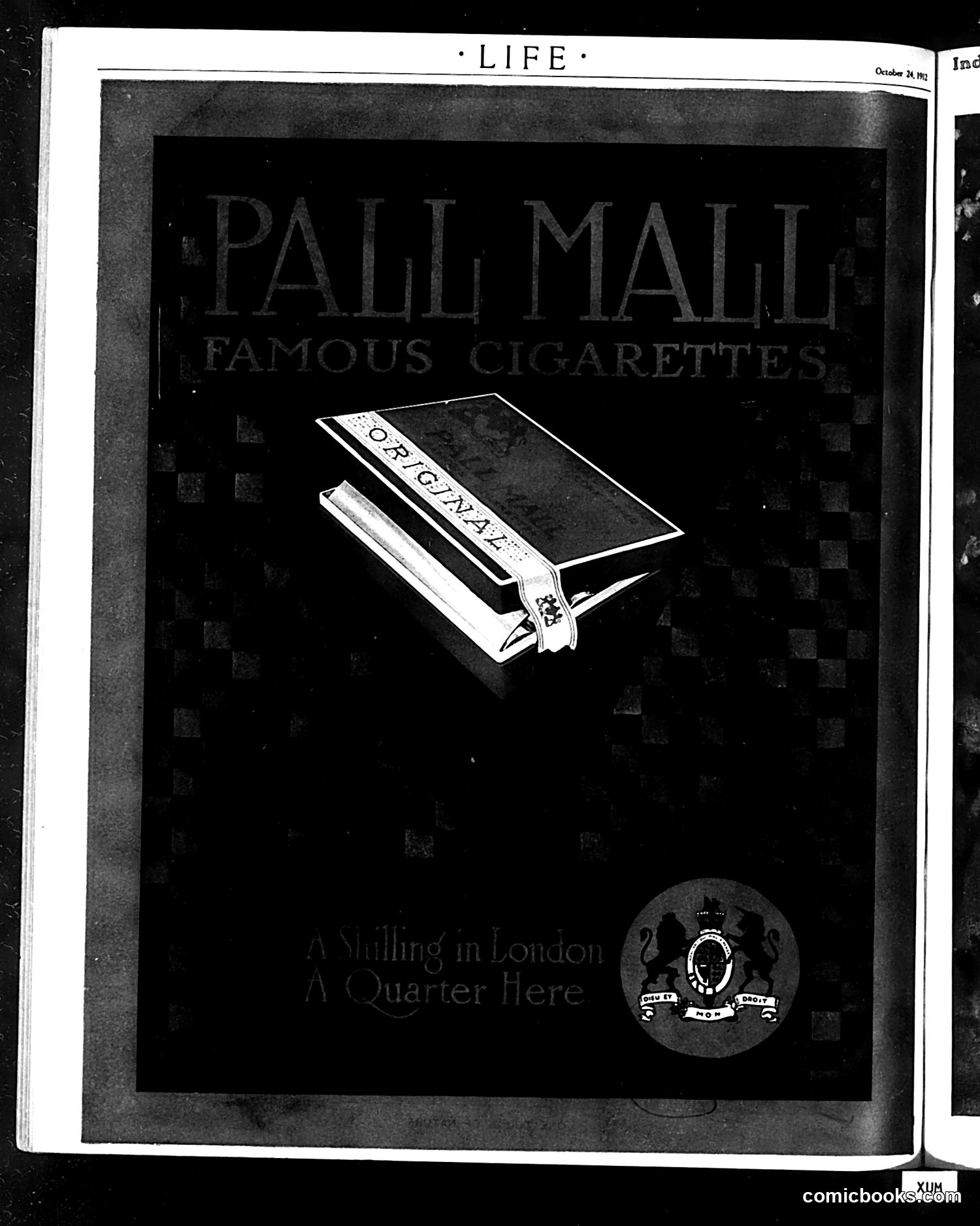
This is a full-page advertisement for Pall Mall cigarettes from Life magazine (dated October 24, 1925, visible in header). The ad features a pack of Pall Mall cigarettes against a dark background with the tagline "A Shilling in London / A Quarter Here" at the bottom. The advertisement emphasizes the cigarettes' international prestige and affordability in America. The pricing comparison to British currency suggests Pall Mall positioned itself as a sophisticated, globally-recognized luxury product accessible to American consumers at a reasonable price point. The circular logo in the lower right contains heraldic imagery, reinforcing claims of quality and Old World credentials during an era when such associations were marketing assets.