
Life, 1912-10-24 · page 22 of 48
Life — October 24, 1912 — page 22: what you’re looking at
What you’re looking at
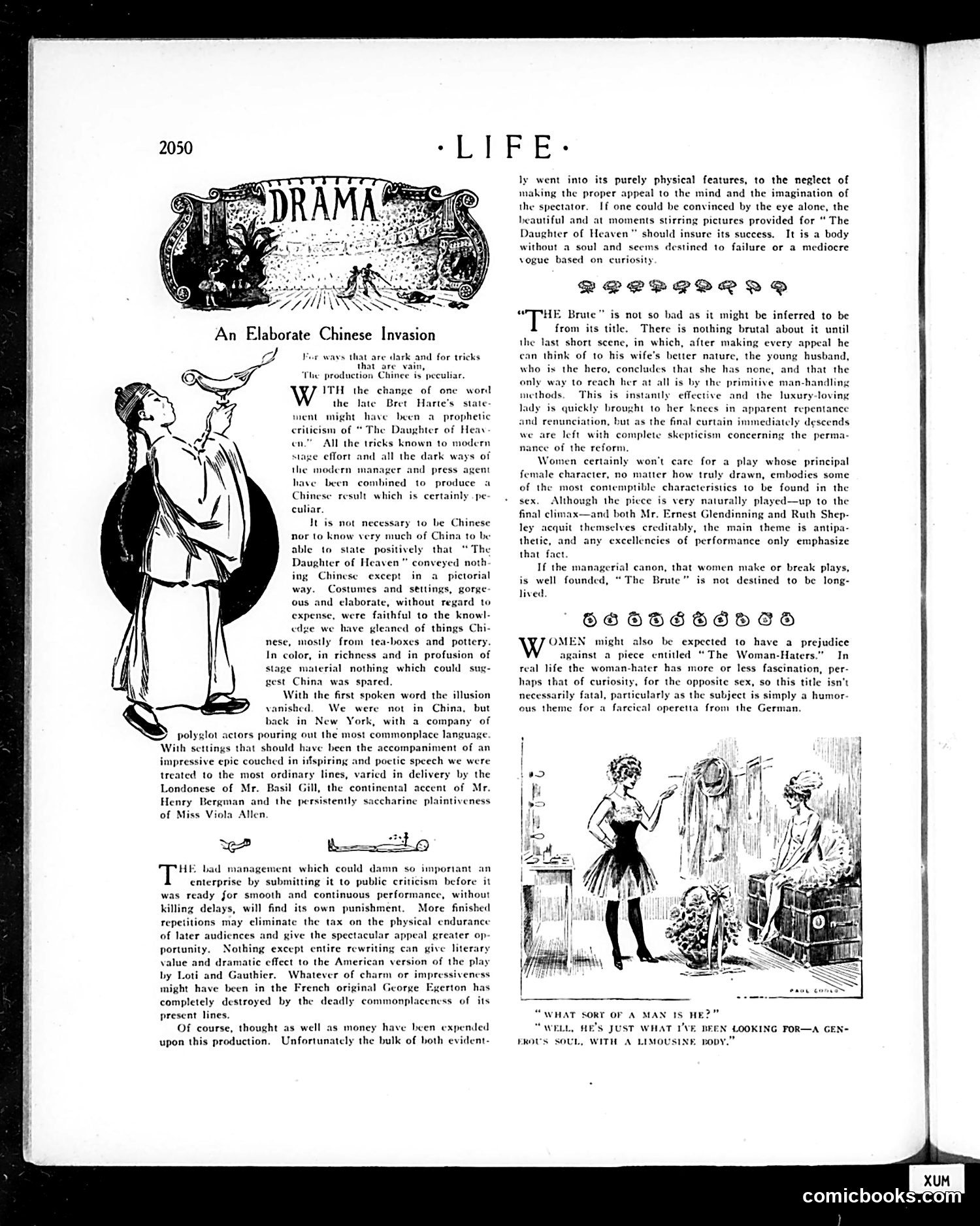
This is a **theater review** from *Life* magazine critiquing a Broadway production of "The Daughter of Heaven," a play based on French work by Loti and Gauthier. The reviewer's central complaint: the production is **all spectacle, no substance**. While the costumes, sets, and visual staging authentically captured Chinese aesthetics (the reviewer notes they're based on "tea-boxes and pottery"), the moment actors opened their mouths, the illusion collapsed. The dialogue was mundane English delivered with various accents (British actor Basil Gill, continental Henry Bergman, saccharine Viola Allen), utterly destroying any sense of place or drama. The reviewer sardonically notes the production is "a body without a soul"—destined for failure despite its expensive visual trappings. The second review criticizes "The Brute," a play where the female lead embodies "contemptible characteristics," ultimately beaten into submission, which female theatergoers would understandably reject. Both reviews exemplify *Life*'s role as cultural arbiter, using sharp wit to critique both artistic pretension and morally objectionable storytelling.
📄 Transcribed text from this page (OCR, searchable)
Machine-transcribed from the original scan — historical spelling and the odd misread are preserved.
‘L/P E* For ways that are dark and for tricks that are vain, ‘The production Chine is'peculiar, ITH the change of one wort the late Bret Harte’s state- ment might have been a_ prophetic criticism of “The Daughter of Heay en.” All the tricks known to modern stage effort and all the dark ways of the modern manager and press agent have been combined to produce a Chinese result which is certainly .pe culiar. It is not necessary 10 be Chinese nor to know very much of China to be able to state positively that“ The Daughter of Heaven” conveyed noth ing Chinese except in a_ pictorial Costumes and settings, gorge ous and elaborate, without regard to expense, were faithful to the know!- edge we have gleaned of things C nese, mostly from tea-boxes and pottery. In color, in richness and in profusion of erial nothing which could sug- gest China was spared. With the first spoken word the illusion vanished. We were not in China, but back in New York, with a company of polyglot actors pouring out the most commonplace language With settings that should have been the accompaniment of an impressive epic couched in infspiring and poctic speech we were treated to the most ordinary lines, varied in delivery by the Londonese of Mr. Basil Gill, the continental accent of Mr. Henry Bergman and the persistently saccharine plaintiveness of Miss Viola Allen od pets HE bad management which could damn so important an enterprise by submitting it to public criticism before it was ready for smooth and continuous performance, without killing delays, will find its own punishment. More finished repetitions may climinate the tax on the physical endurance of later audiences and give the spectacular appeal greater op- portunity. Nothing except entire rewriting can give literary value and dramatic effect to the American version of the play by Loti and Gauthier. Whatever of charm or impressivencss might have been in the French original George Exerton has completely destroyed by the deadly commonplacencss of its present lines. Of course, thought as well as money have been expended upon this production. Unfortunately the bulk of hoth evident- ly went into its purely physical features, to the neglect of imaking the proper appeal to the mind and the imagination of the spectator. If one could be convinced by the eye alone, the beautiful and at moments stirring pictures provided for “ The Daughter of Heaven” should insure its success. It is a body without a soul and seems destined to failure or a mediocre vogue based on curiosity RQSPAGQLRVS “CHE Brute” is not so bad as it might be inferred to be from its title, There is nothing brutal about it until the last short scene, in which, after making every appeal he can think of to his wife's better nature, the young husband, who is the hero, concludes that she has none, and that the only way to reach her at all is by the primitive man-handling methods. This is instantly effective and the luxury-loving is quickly brought to her knees in apparent repentance and renunciation, but as the final curtain immediately descends c left. with complete skepticism concerning the pert nance of the reform. Women certainly won't care for a play whose principal female character, no matter how truly drawn, embodies some of the most contemptible characteristics 10 be found in the sex. Although the piece is very naturally played—up to the final climax—and both Mr. Ernest Glendinning and Ruth Shep- ley acquit themselves creditably, the main theme is anti thetic, and any excellencies of performance only emphasize that fact If the managerial canon, that women make or break plays, is well founded, “The Brute” is not destined to be long- lived 66 GEE6BSDGS Woes might also be expected to have a prejudice sta piece entitled “The Woman-Haters.” In real life the woman-hater has more or less fascination, per- haps that of curiosity, for the opposite sex, so this title isn't necessarily fatal, particularly as the subject is simply a humor- ous theme for a farcical operetta from the German. “WHAT SORT OF A MAN 1S HE?” WH HE'S JUST WHAT I'VE REEN LOOKING FOR—A GEN- FROUS SOUL, WITH A LIMOUSINE popy.” comicbook $.co