
Life, 1912-10-24 · page 23 of 48
Life — October 24, 1912 — page 23: what you’re looking at
What you’re looking at
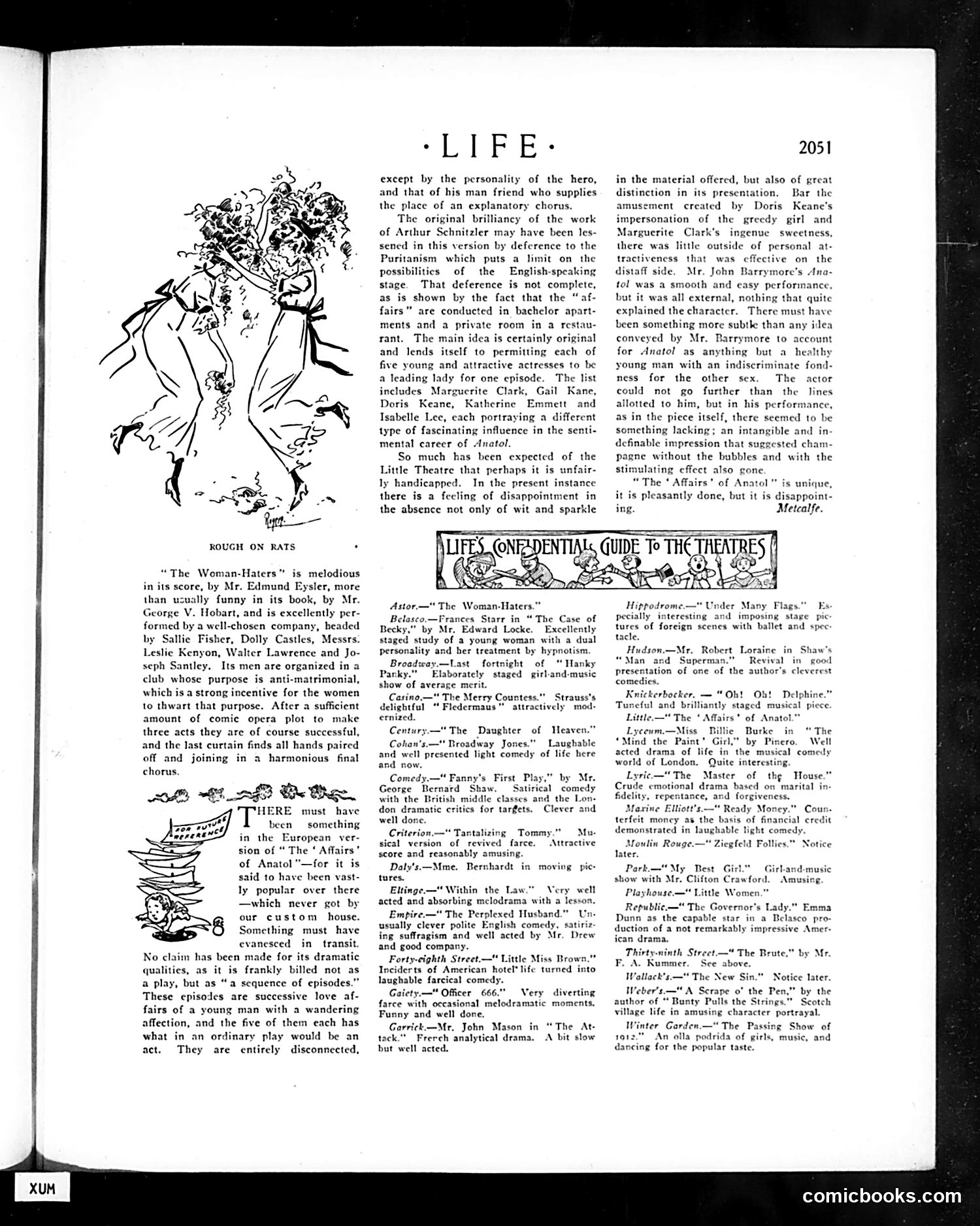
This page from *Life* magazine reviews theatrical productions, not political cartoons. The small illustration labeled "Rough on Rats" depicts a stylized rat or rodent figure—likely a visual pun on the review's title rather than political satire. The page primarily contains theater critiques of Broadway shows: "The Woman-Haters" (a comic opera), "The Affairs of Anatol" (a romantic drama), and others. The "Rough on Rats" heading appears to mockingly reference the show being reviewed, suggesting something crude or unpolished ("rough"). The substantive critique addresses "The Affairs of Anatol," starring John Barrymore. The reviewer criticizes the adaptation of Arthur Schnitzler's original work, suggesting it was sanitized for American "Puritanism" and lacks the wit and depth of the European version. The review praises actress Doris Keane's performance but finds Barrymore's portrayal superficial—merely "smooth and easy" rather than revealing psychological complexity.
📄 Transcribed text from this page (OCR, searchable)
Machine-transcribed from the original scan — historical spelling and the odd misread are preserved.
ROUGH ON RATS . “The Woman-Haters” is melodious in its score, by Mr. Edmund Eysler, more than usually funny in its book, by Mr. George V. Hobart, and is excellently per- formed by a well-chosen company, headed by Sallie Fisher, Dolly Castles, Messrs. Leslie Kenyon, Walter Lawrence and Jo- seph Santley, Its men are organized in a club whose purpose is anti-matrimonial, which isa strong incentive for the women to thwart that purpose. After a sufficient amount of comic opera plot to make three acts they are of course successful, and the last curtain finds all hands paired off and joining in a harmonious final chorus. been must have something in the European ver- sion of “ The ‘ Affairs’ of Anatol"—for it is said to have been vast- ly popular over there —which never got by our custom house. Something must have evanesced in transit. No claim has been made for its dramatic qualities, as it is frankly billed not as a play, but as “a sequence of episodes.” These episodes are successive love af- fairs of a young man with a wandering affection, and the five of them each has what in an ordinary play would be an act. They are entirely disconnected, »*LIFE: except by the personality of the hero, and that of his man friend who supplies the place of an explanatory chorus. The original brilliancy of the work of Arthur Schnitzler may have been les- sened in this version by deference to the Puritanism which puts a limit on the possibilitics of the English-speaking stage. That deference is not complete, as is shown by the fact that the “af- fairs” are conducted in bachelor apart- ments and a private room in a restau- rant. The main idea is certainly original and lends itself to permitting each of five young and attractive actresses to be a leading lady for one episode. The includes Marguerite Clark, Gail Kane, Doris Keane, Katherine Emmett and Isabelle Lee, cach portraying a different type of fascinating influence in the senti- mental career of Anatol. So much has been expected of the Little Theatre that perhaps it is unfair- ly handicapped. In the present instance there is a feeling of disappointment in the absence not only of wit and sparkle 2051 in the material offered, but also of great distinction in its presentation, Bar the amusement created by Doris Keane's impersonation of the greedy girl and Marguerite Clark's sweetness, there was little outside of personal a tractiveness that effective on the distaff side. Mr. John Barrymore's Ana- tol was a smooth and easy performance, but it was all external, nothing that quite explained the character. There must have been something more subtle than any idea conveyed by Mr. Barrymore to account for Anatol as anything but a healthy young man with an indiscriminate fond- ness for the other sex. The actor could not go further than the lines allotted to him, but in his performance, as in the piece itself, there seemed to be something lacking; an intangible and in definable impression that suggested cham- pagne without the bubbles and with the stimulating effect also gone. “The * Affairs" of Anatol" is unique, it is pleasantly done, but it is disappoint- ing. Metcalfe. ingenue was Astor—" The Woman-Haters.” Belasco.—Frances Starr in “The Case of Becky,” by Mr, Edward Locke. Excellently staged study of a young woman with a dual personality and her treatment by hypnotism. Broadway.—Uast fortnight of “Hanky Panky.” Elaborately staged girl-and-music show of average merit. Casino.—" The Merry Countess.” Strauss's delightful“ Fledermaus" attractively mod- ernized. Century—"The Daughter of Cohan’s.—" Broadway Jones.” and well presented light comedy of and now. Comedy.— Fanny's First Play,” by Mr. George Bernard Shaw. irical_comedy with the British middle classes and the Lon- don dramatic critics for tarfets. Clever and well done. Criterion.—" Tantalizing Tommy.” Mu- sical version of revived farce. Attractive score and reasonably amusing Daly's.—Mme. Berhardt in tures. Eltinge. —" Within the Law.” Very well acted and absorbing melodrama with a lesson. Empire.—" The Perplexed Husband.” Un- usually clever polite English comedy, satiriz ing suffragism and well acted by Mr. Drew and good company. Forty-cighth Street. Little Miss Brown.” Inciderts of American hotel* life turned into laughable farcical comedy. Gaiety. —" Officer 66 Very farce with occasional melodramatic Funny and well done. Garrick.—Mr. John Mason in ‘The At- tock." Frerch analytical drama. A bit slow but well acted. Heaven.” Laughable ife here moving pic- diverting oments, Hippodrome —" Under Many Flags.” Es. peciall, eresting and imposing stage pic: tures of foreign scenes with ballet and spec- tacle, Hudson.—Mr, Robert Loraine in Shaw's “Man upermas Revival in good presentation of one of the author's cleverest comedies, kerbocker. — “Oh! Oh! Delph eful and brilliantly staged musical Little.—" The * Affairs’ of Anatol.” Lyceum.—Miss Billie Burke in “The ‘Mind the Paint’ Girl,” by ero. Well acted drama of life in the musical comedy world of London. Quite interesting. Lyric —"The Master of the House.” Crude emotional drama based on marital in- fidelity, repentance, and forgiveness. 3 Ready Money.” Cou: Marine Elliott's.— terfeit money as the basis of financial cred! demonstrated in laughable light comedy. Moulin Rouge.—" Ziegfeld Follies." Notice later. Park.—"My Best Girl." Girland-musie show with Mr. Clifton Crawford. Amusing. Playhouse—" Little Women.” Republic. —" The Governor's Lady.” Emma Dunn as the capable star in a Belasco pro- duction of a not remarkably impressive Amer- ican drama. Thirty-ninth Street. F. A. Kummer. See Wallack’s.—" The New Sin.” Weber's." A Scrape 0” the Pen,” by author of “Bunty Pulls the Strings.” Scot village life in amusing character portrayal Winter Garden.—" The Pas: 1012." An olla podrida of girls, dancing for the popular taste. The Brute,” by Mr. bove. Notice later. comicbooks.com