
Life, 1912-10-24 · page 26 of 48
Life — October 24, 1912 — page 26: what you’re looking at
What you’re looking at
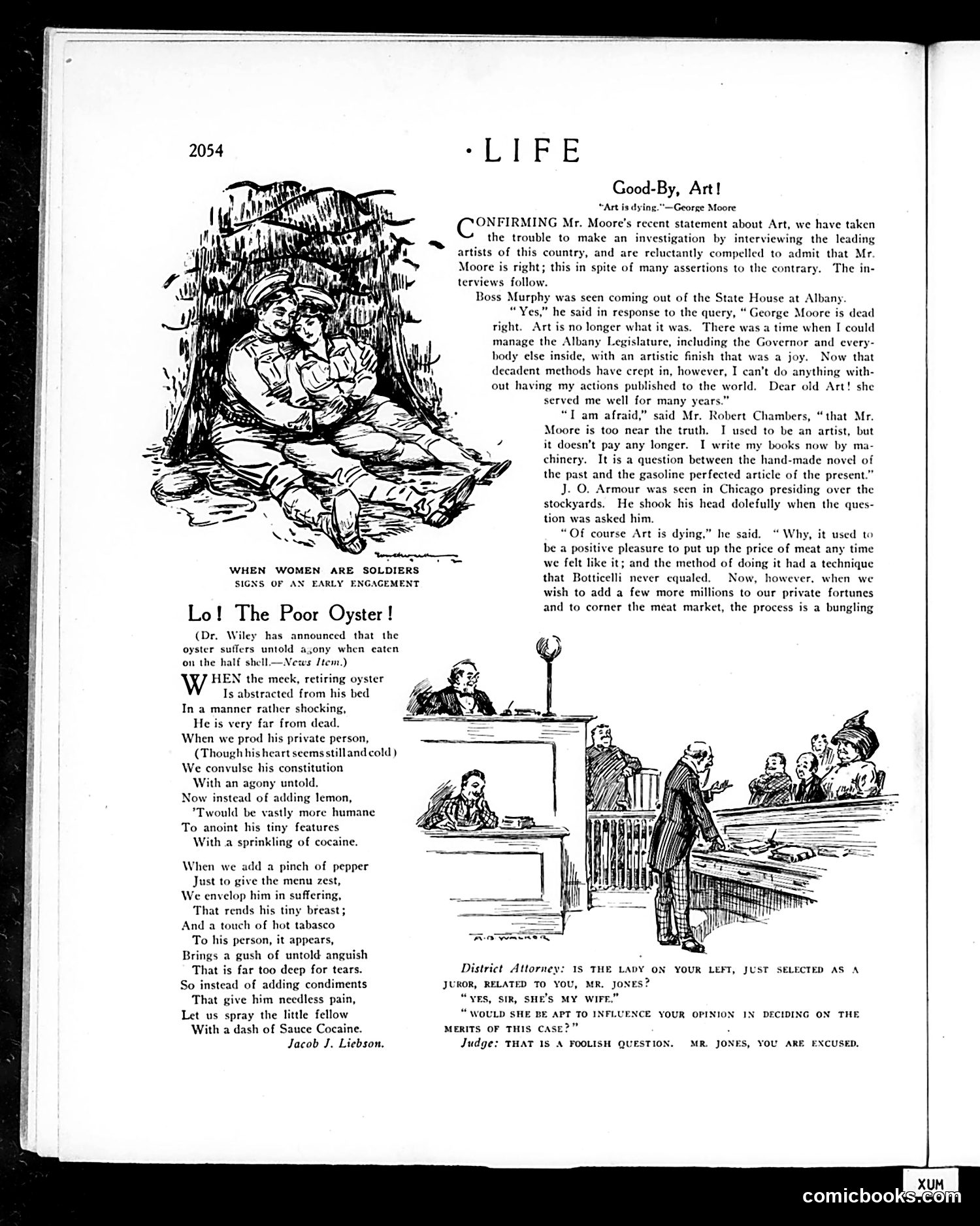
This page satirizes the decline of "Art" in American life by having prominent figures lament that craftsmanship and aesthetic principles have been replaced by commercialism and efficiency. **The interviews mock:** - **Boss Murphy** (likely referring to Tammany Hall political machine boss): Once manipulated government "artistically" in secret; now his corrupt actions get published, exposing his methods - **Robert Chambers** (novelist): Now writes "by machinery" rather than by hand, prioritizing speed over craft - **J.O. Armour** (meatpacking magnate): Once took "artistic" pleasure in price-fixing; now it's merely mechanical profit-seeking The satire argues that American capitalism has stripped away any pretense of artistry or craftsmanship from politics, literature, and business—replacing elegance with crude, purely mercenary methods. The oyster poem below offers comic relief on a related theme: modern convenience (adding spices to raw oysters) causes suffering; the satirist jokingly suggests anesthetizing the victim instead.
📄 Transcribed text from this page (OCR, searchable)
Machine-transcribed from the original scan — historical spelling and the odd misread are preserved.
‘LPPE Good-By, Art! “Art is dying.""—George Moore ONFIRMING Mr. Moore's recent statement about Art, we have taken the trouble to make an investigation by interviewing the leading artists of this country, and are reluctantly compelled to admit that Mr. Moore is right; this in spite of many assertions to the contrary. The in- terviews follow. Boss Murphy was scen coming out of the State House at Albany. “Yes,” he said in response to the query, “ George Moore is dead right. Art is no longer what it was. There was a time when I could manage the Albany Legislature, including the Governor and every- body else inside, with an artistic finish that was a joy. Now that decadent methods have crept in, however, I can’t do anything with- out having my actions published to the world. Dear old Art! she served me well for many years.” “Tam afraid,” said Mr. Robert Chambers, “that Mr. Moore is too near the truth. I used to be an artist, but it doesn’t pay any longer. I write my books now by ma- chinery. It is a question between the hand-made novel of the past and the gasoline perfected article of the present.” J. O. Armour was seen in Chicago presiding over the stockyards. He shook his head dolefully when the ques- tion was asked him. “Of course Art is dying,” he said. WI it used to be a positive pleasure to put up the price of meat any time NS os: we felt like it; and the method of doing it had a technique WHEN WOMEN ARE SOLDIERS . A + SIGNS OF AN EARLY ENGAGEMENT that Botticelli never equaled. | Now, however, when we wish to add a few more millions to our private fortunes Lo ! The Poor Oyster ! and to corner the meat market, the process is a bungling (Dr. Wiley has announced that the y oyster suffers untold ajony when eaten on the half shell—News Item.) HEN the meck, retiring oyster Is abstracted from his bed In a manner rather shocking, He is very far from dead. When we prod his private person, (Though his heart seems stilland cold) We convulse his constitution With an agony untold, w instead of adding lemon, ’Twould be vastly more humane To anoint his tiny features With a sprinkling of cocaine. When we add a pinch of pepper Just to give the menu zest, We envelop him in suffering, That rends his tiny breast; And a touch of hot tabasco To his person, it appears, Brings a gush of untold anguish That is far too deep for tears. So instead of adding condiments That give him needless pain, “YES, SIR, SHE'S MY WIFF. Let us spray the little fellow “WOULD SHE BE APT TO INFLUENCE YOUR OPINION IN DECIDING ON THE With a dash of Sauce Cocaine. MERITS OF THIS CASE?” : Jacob J. Liebson. Judge: THAT 18 A FOOLISH QUESTION. MR. JONES, YOU ARE EXCUSED. comicbooeoe