
Life, 1912-10-24 · page 18 of 48
Life — October 24, 1912 — page 18: what you’re looking at
What you’re looking at
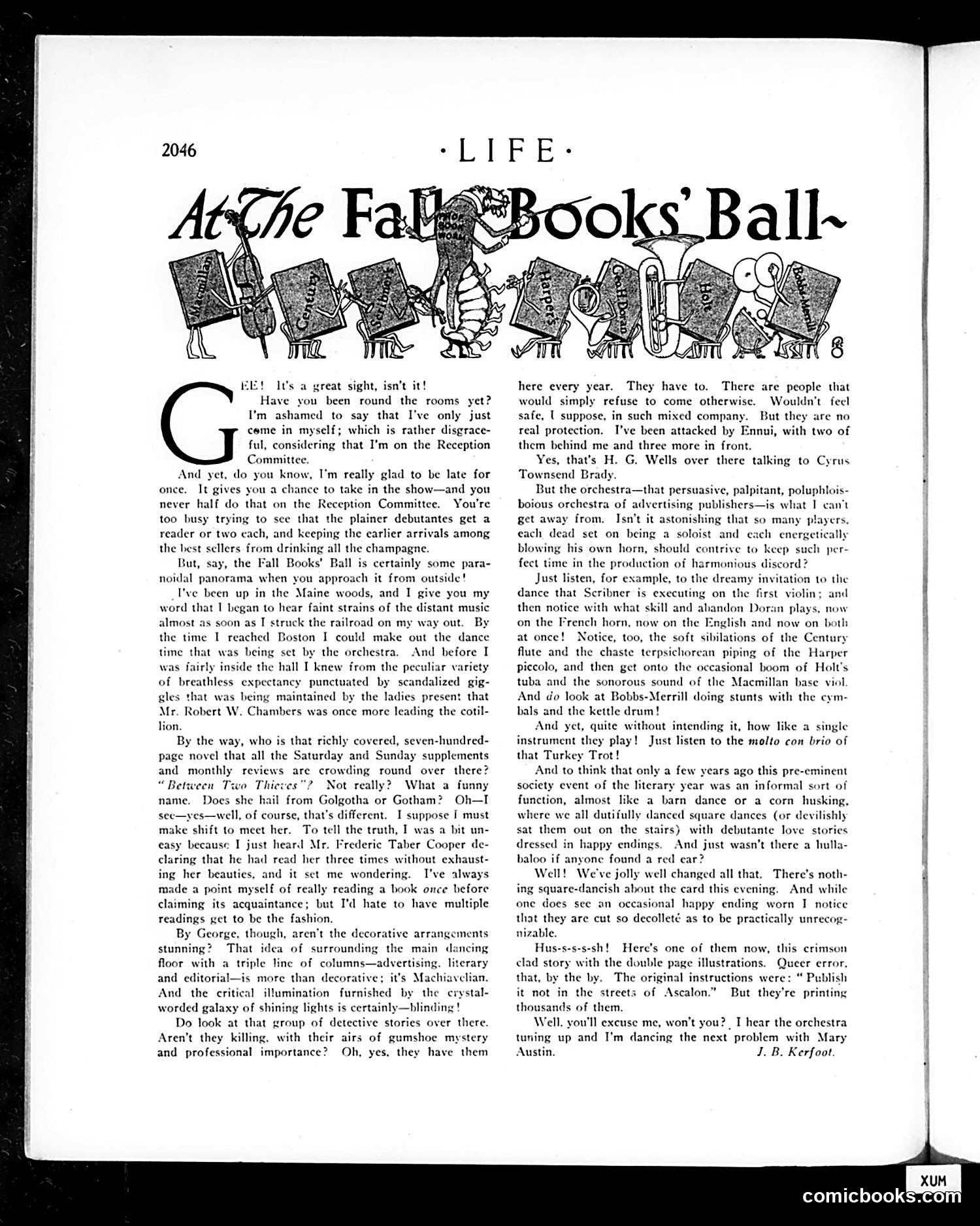
This is a satirical piece about a social event celebrating newly published books, where literary works and publishing companies are personified as attendees and musicians. The humor operates on two levels: **The Social Commentary:** The narrator criticizes the artificial nature of literary society—people pretending enthusiasm for books they haven't read, the obligatory attendance of "detective stories" (considered lowbrow) for safety reasons, and the performative nature of book promotion. **The Publishing Industry Satire:** Major publishers of the era—Scribner, Doran, Century, Harper, Holt, and Macmillan—are depicted as orchestra members, each "blowing his own horn" (self-promoting) while supposedly creating harmonious discord. The critique suggests publishers prioritize individual promotion over genuine literary merit. References to H.G. Wells and Cyrus Townsend Brady (both popular contemporary authors) add period specificity. The mockery of Frederic Taber Cooper's literary criticism and the title "Between Two Thieves" (a real contemporary novel) ground the satire in specific literary culture of the time.
📄 Transcribed text from this page (OCR, searchable)
Machine-transcribed from the original scan — historical spelling and the odd misread are preserved.
! It’s a great sight, isn’t it! Have you been round the rooms yet? I’m ashamed to say that I've only just come in myself; which is rather disgrace- ful, considering that I'm on the Reception Committee. And yet, do you know, I'm really glad to be late for once. It gives you a chance to take in the show—and you never half do that on the Reception Committee. You're too busy trying to sce that the plainer debutantes get a reader or two cach, and keeping the earlier arrivals among the hest sellers from drinking all the champagne. But, say, the Fall Books’ Ball is certainly some para- noidal panorama when you approach it from outside! I've been up in the Maine woods, and I give you my word that I began to hear faint strains of the distant music almost as soon as I struck the railroad on my way out. By the time I reached Boston I could make out the dance time that was being set by the orchestra. And before I was fairly inside the hall I knew from the peculiar variety of breathless expectancy punctuated by scandalized gig- gles that was being maintained by the ladies present that Mr. Robert W. Chambers was once more leading the cotil- lion. By the way, who is that richly covered, seven-hundred- page novel that all the Saturday and Sunday supplements and monthly reviews are crowding round over there? “Between T Thieves”? Not really? What a funny name. Does she hail from Golgotha or Gotham? Oh—I st s—well, of course, that’s different. I suppose i must make shift to mect her. To tell the truth, I was a bit un- easy because I just heard Mr. Frederic Taber Cooper de- claring that he had read her three times without exhaust- ing her beauties, and it set me wondering. I've always made a point myself of really reading a book once before claiming its acquaintance; but I'd hate to have multiple readings get to be the fashion. By George, though, aren't the decorative arrangements stunning? That idea of surrounding the main dancing floor with a triple line of columns—advertising. rary and editorial—is more than decorative; it’s Machiavclian. And the criti illumination furnished by the al- worded galaxy of shining lights is certainly—blindin Do look at that group of detective stories over there. Aren't they killing. with their airs of gumshoe mystery and professional importance? Oh, yes, they have them here every year. They have to. There are people that would simply refuse to come otherwise. Wouldn't feel safe, ( suppose, in such mixed company. But they are no real protection. I’ve been attacked by Ennui, with two of them behind me and three more in front. Yes, that’s H. G. Wells over there talking to Cyrus Townsend Brady. But the orchestra—that persuasive, palpitant, poluphlois- boious orchestra of advertising publishers—is what I can't get away from. Isn't it astonishing that so many players, each dead set on being a soloist and each energetically blowing his own horn, should contrive to keep such per- fect time in the production of harmonious discor Just listen, for example, to the dreamy invitation to the dance that Scribner is executing on the first violin; and then notice with what skill and abandon Doran plays, now on the French horn, now on the English and now on both at once! Notice, too, the soft sibilations of the Century flute and the chaste terpsichorean piping of the Harper Piccolo, and then get onto the occasional boom of Holt’s tuba and the sonorous sound of the Macmillan base viol And do look at Bobbs-Merrill doing stunts with the cym- bals and the kettle drum! And yet, quite without intending it, how like a single instrument they play! Just listen to the molto con brio of that Turkey Trot! And to think that only a few years ago this pre-eminent society event of the literary year was an informal sort of function, almost like a barn dance or a corn husking, where we all dutifully danced square dances (or devilishly sat them out on the stairs) with debutante love stories dressed in happy endings. And just wasn’t there a hulla- baloo if anyone found a red ear? Well! We've jolly well changed all that. There’s noth- ing square-dancish about the card this evening. And while one does see an occasional happy ending worn I notice that they are cut so decolleté as to be practically unrecog- nizable. Hus-s-s-s-sh! Here’s one of them now, this crimson clad story with the double page illustrations. Queer error, that, by the by. The original instructions were: “ Publish it not in the streets of Ascalon.” But they're printing thousands of them. Well, you'll excuse me, won't you? | I hear the orchestra tuning up and I'm dancing the next problem with Mary Austin. J.B. Kerfoot. comicbook =e $.cO