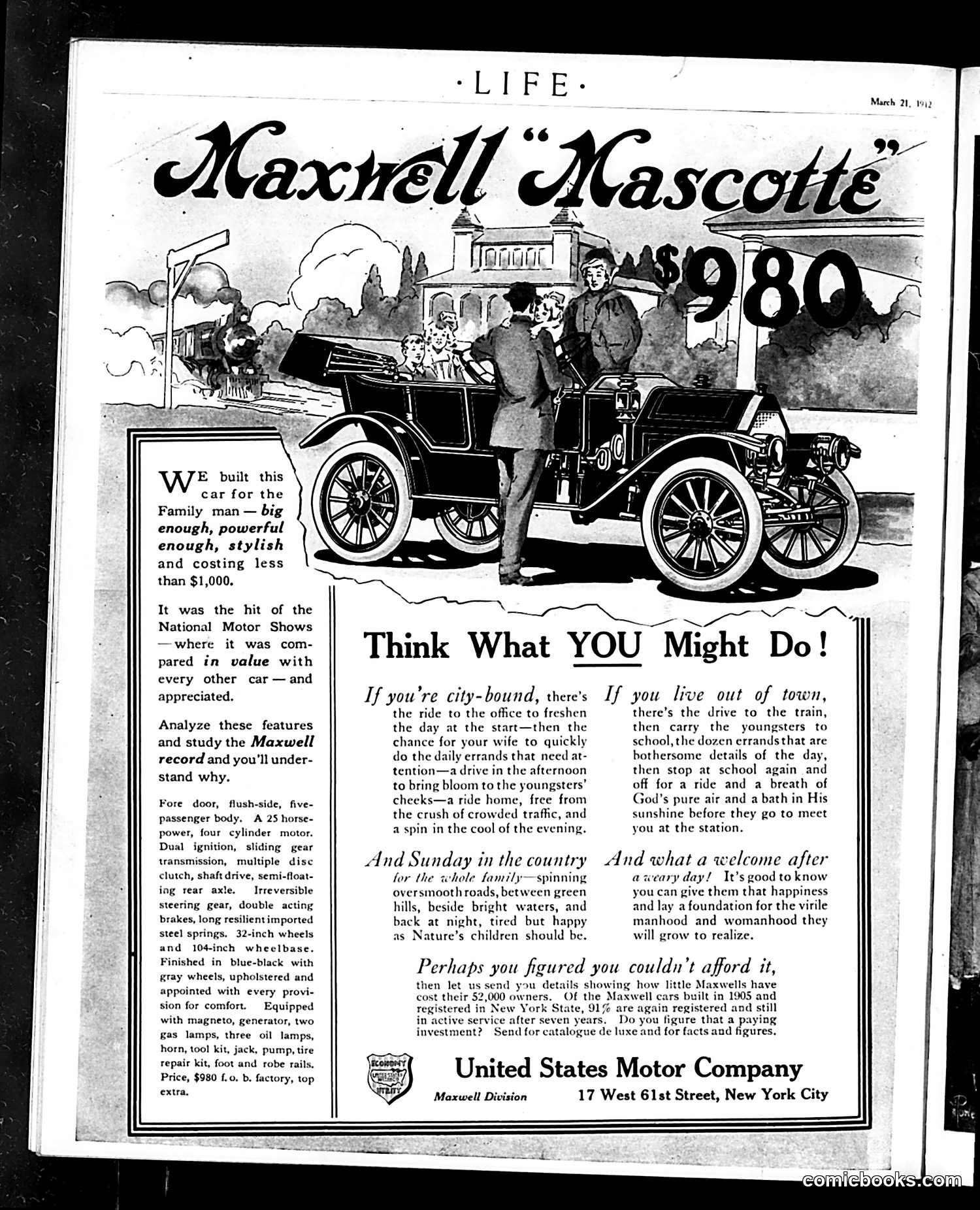
A complete issue · 52 pages · 1912
Life — March 21, 1912
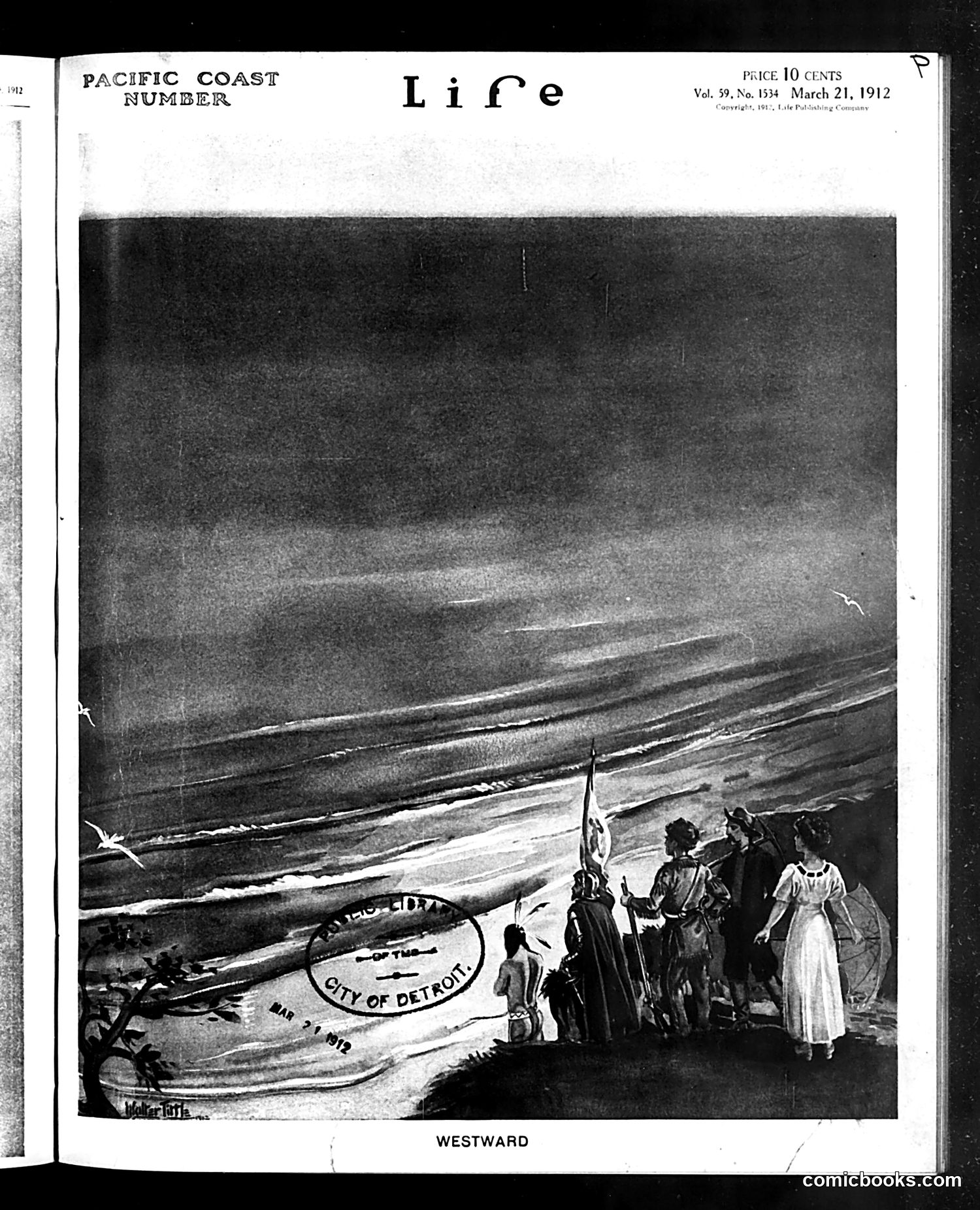
This appears to be a satirical illustration depicting westward expansion or emigration. The image shows a group of figures standing before what looks like a damaged or wrecked ship labeled "City of Detroit" (visible on the hull). The figures include what appear to be working-class people and women in period dress, gazing toward an expansive landscape. The satire likely comments on American westward movement, possibly referencing the allure of the West as a destination for European immigrants and displaced persons. The wrecked ship may symbolize broken dreams or the hazardous journey westward. The title "Westward" reinforces this theme of movement and opportunity-seeking that characterized early-20th-century American attitudes toward western expansion and settlement.
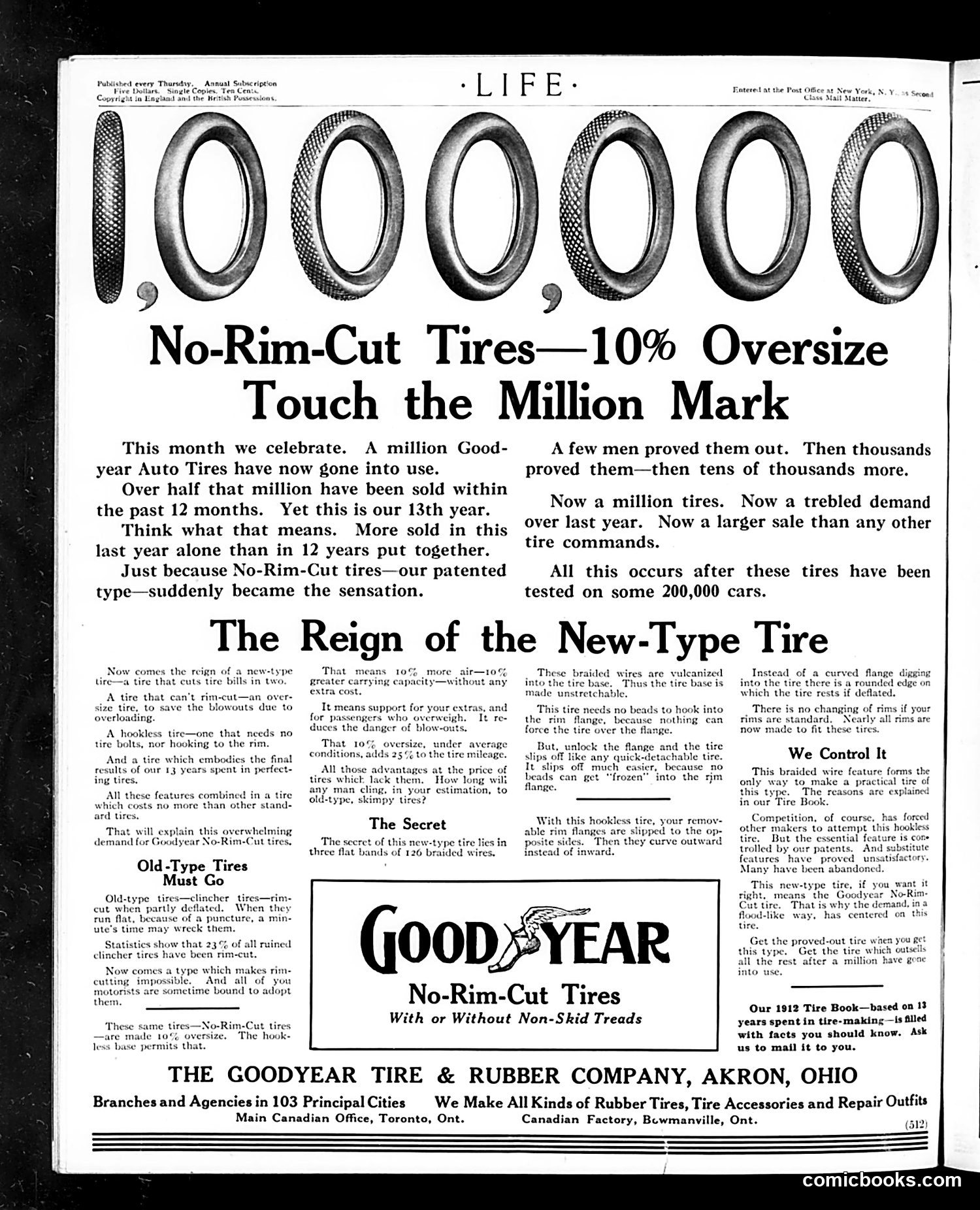
This page is **primarily an advertisement**, not satire or political commentary. It's a Goodyear Tire & Rubber Company ad from *Life* magazine celebrating their No-Rim-Cut Tires reaching one million sales. The ad emphasizes the tire's innovative "no-rim-cut" design—a technical feature preventing blowouts by avoiding contact with wheel rims. The text contrasts this "new-type tire" against outdated "old-type tires" that frequently failed. The only visual element is the Goodyear logo with their distinctive winged shoe symbol. Rather than satire, this represents early 20th-century advertising strategy: using *Life's* prestige publication to tout industrial innovation as a consumer achievement worth celebrating nationally.
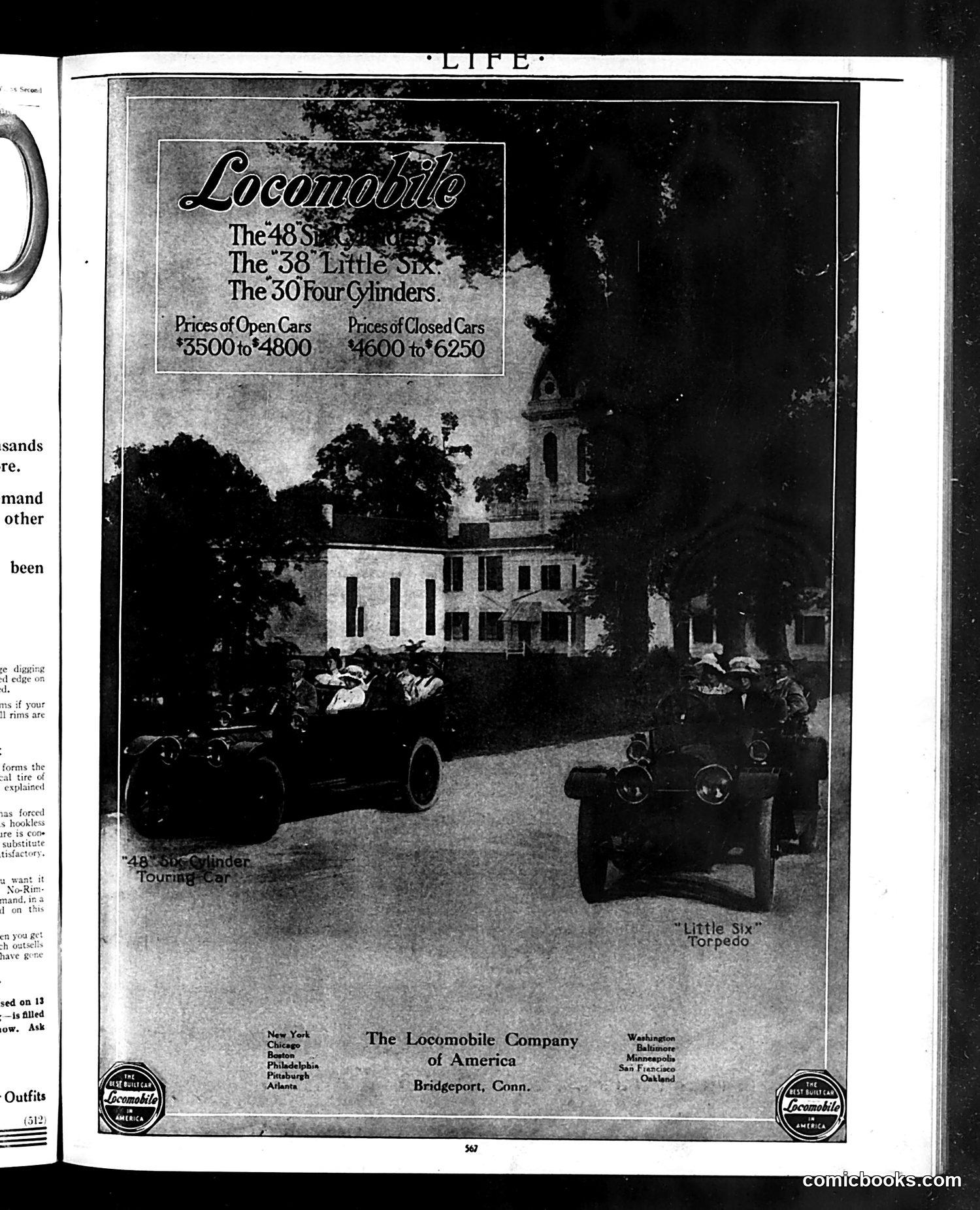
This page is primarily **advertising, not political satire**. It's a Locomobile Company advertisement from *Life* magazine promoting three automobile models: - The 48 Six-Cylinder - The 38 Little Six - The 30 Four-Cylinders The ad features a period photograph showing two early automobiles parked in front of a classical building, with prices listed for open and closed car versions ($3,500–$6,250 range). The imagery emphasizes luxury and respectability—the formal architecture and well-dressed setting suggest these were premium vehicles for affluent buyers. The company's offices listed (New York, Chicago, Boston, etc.) underscore its national prominence. This represents typical early-20th-century automotive marketing positioning cars as status symbols rather than practical transportation.
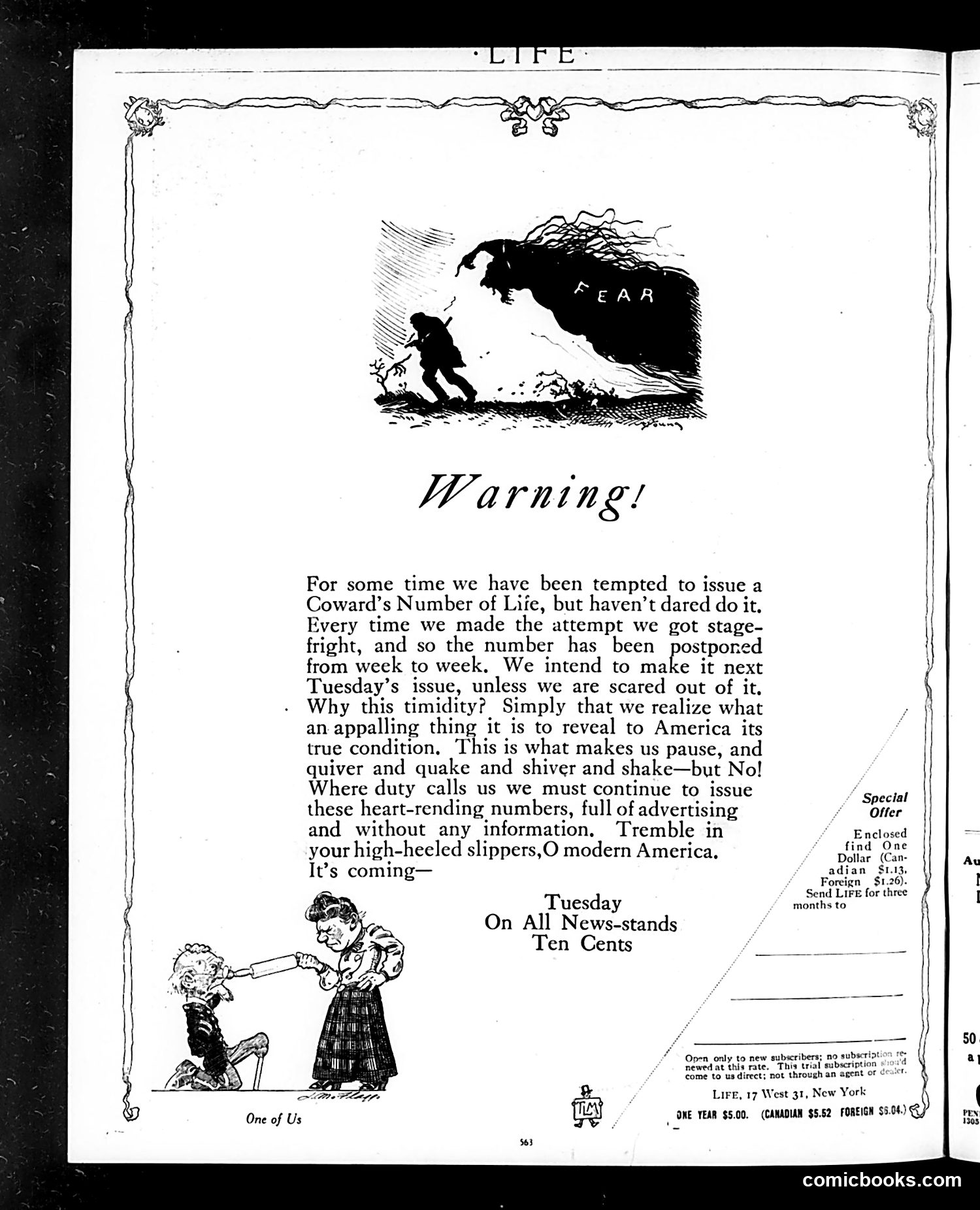
This page contains a satirical advertisement for Life magazine's "Coward's Number," scheduled for Tuesday publication. The advertisement uses dark humor to promote a special issue about fear in America. The top illustration shows a silhouetted figure cowering before a large dark shape labeled "FEAR," warning of something ominous approaching. Below, another cartoon depicts what appears to be physical confrontation or violence ("One of Us"), likely illustrating societal conflict or unrest. The text mocks Life's own hesitation to publish this feared issue, sarcastically suggesting that despite trembling at the prospect, duty compels them to reveal "America's true condition." The tone is self-aware—Life positions itself as reluctantly but bravely confronting uncomfortable national realities through satire and advertising. The advertisement promises this provocative issue will appear Tuesday on newsstands for ten cents.
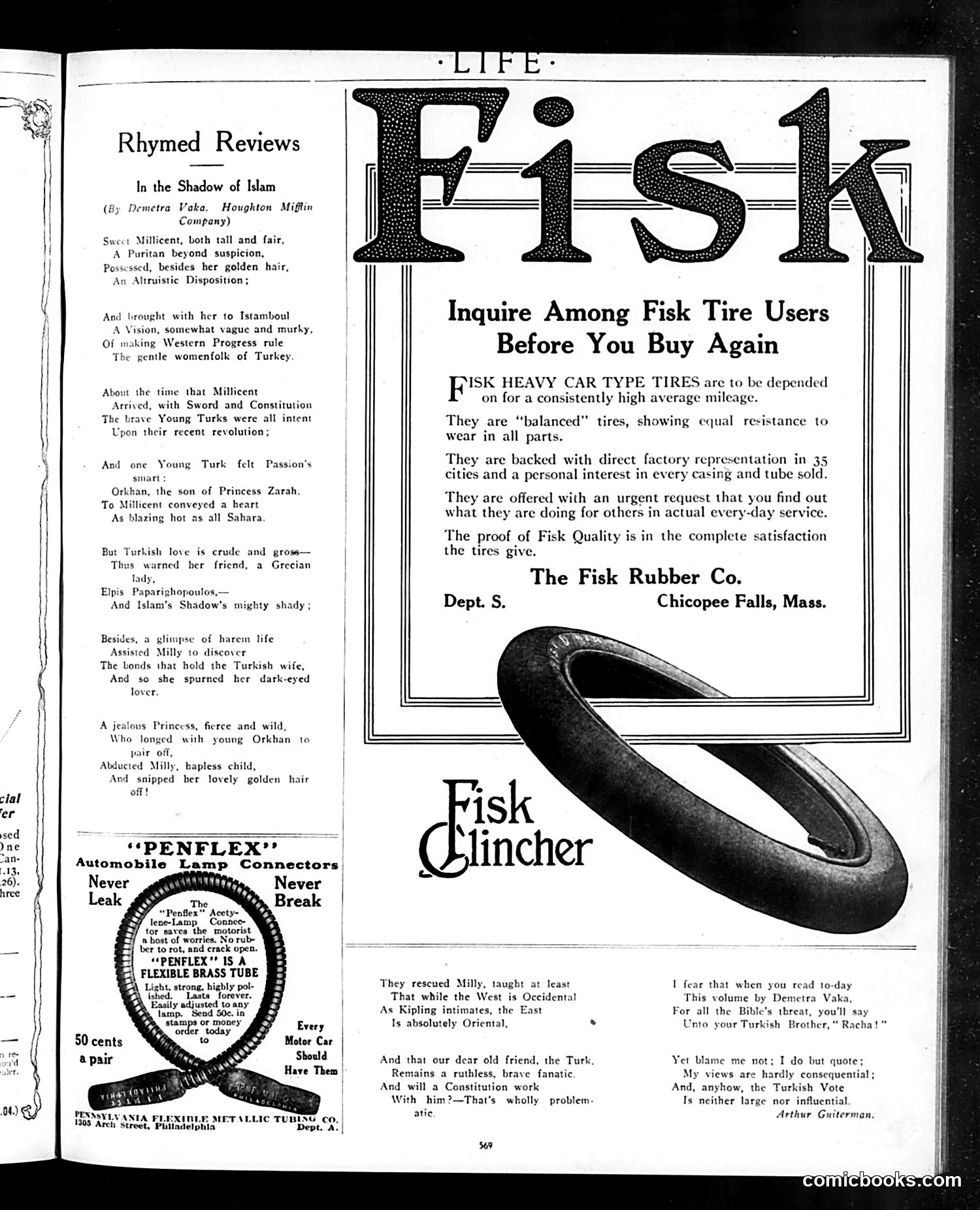
This page contains **primarily advertisements** rather than political satire or editorial cartoons. The left column features a **book review in verse** of "In the Shadow of Islam" by Demetra Vaka, satirizing an orientalist narrative about a Turkish woman named Millicent and romantic entanglements in Constantinople. The satirical poem mocks the book's melodramatic plot and Western stereotypes about the exotic East. The right page is dominated by **commercial advertisements**: Fisk tire company promotes "Heavy Car Type Tires" with testimonials, and Penflex advertises automobile connectors ("Never Leak, Never Break"). A smaller ad at bottom appears to reference a Turkish character ("Turk," "Constitution") in what seems a **comedic advertisement** context, though the specifics are unclear from this excerpt. The page reflects early 20th-century American magazine content blending literary commentary with commercial promotion.
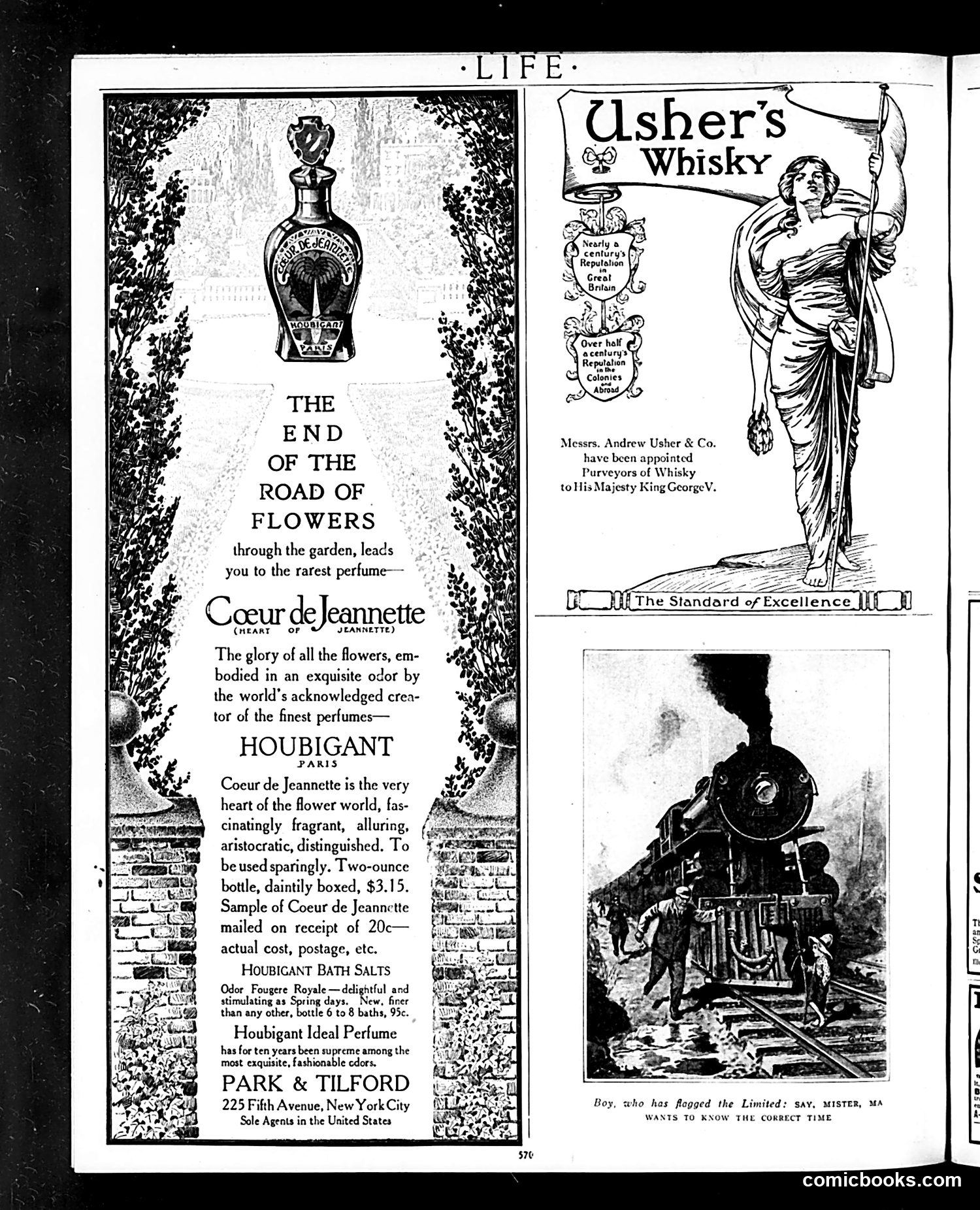
This page contains primarily **advertisements rather than political cartoons**. The left side advertises Houbigant's "Coeur de Jeannette" perfume from Paris, emphasizing its luxurious floral fragrance. The right side features two ads: Usher's Whisky (appointed purveyor to King George V) and a railway advertisement showing a steam locomotive with the caption "Boy, who has flagged the Limited: say, mister, ma wants to know the correct time." The railway ad appears to be a humorous vignette about a boy stopping a train, but lacks clear satirical political content. The page reflects early 20th-century consumer advertising focused on luxury goods and transportation.
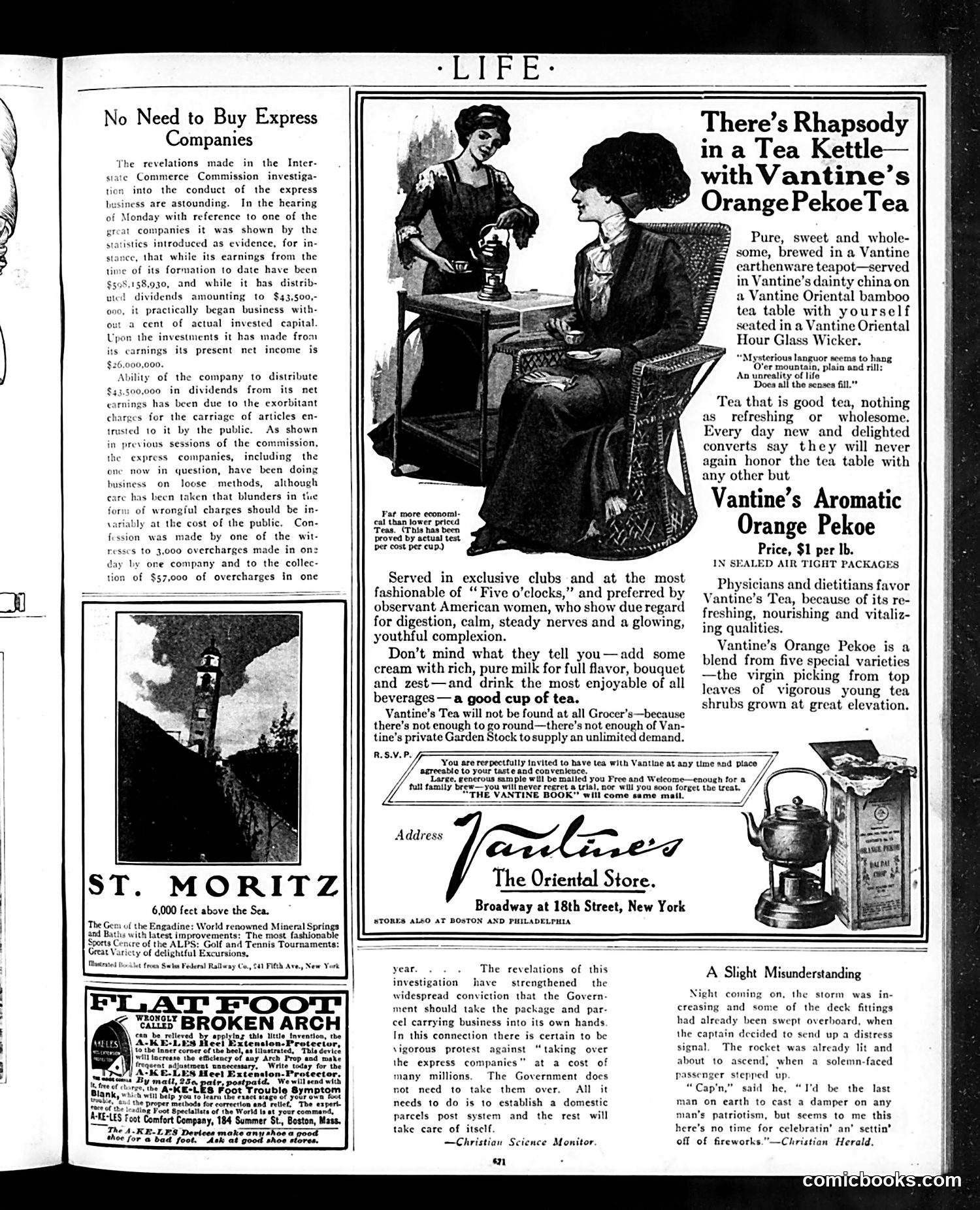
This page contains **primarily advertisements** rather than political cartoons. The main content includes: 1. **"No Need to Buy Express Companies"** - An article about Interstate Commerce Commission investigation into express company conduct and dividends, suggesting government regulation could make private express services unnecessary. 2. **Vantines Tea Advertisement** - A large ad for "Vantine's Aromatic Orange Pekoe Tea" positioned as an exclusive, luxurious beverage for affluent Americans. 3. **St. Moritz and Ft. Laramie advertisements** - Tourism and resort promotions. The page reflects early 20th-century concerns about corporate monopolies and government regulation, juxtaposed with luxury consumer marketing aimed at wealthy readers. There are no clear political cartoons or satirical illustrations present.
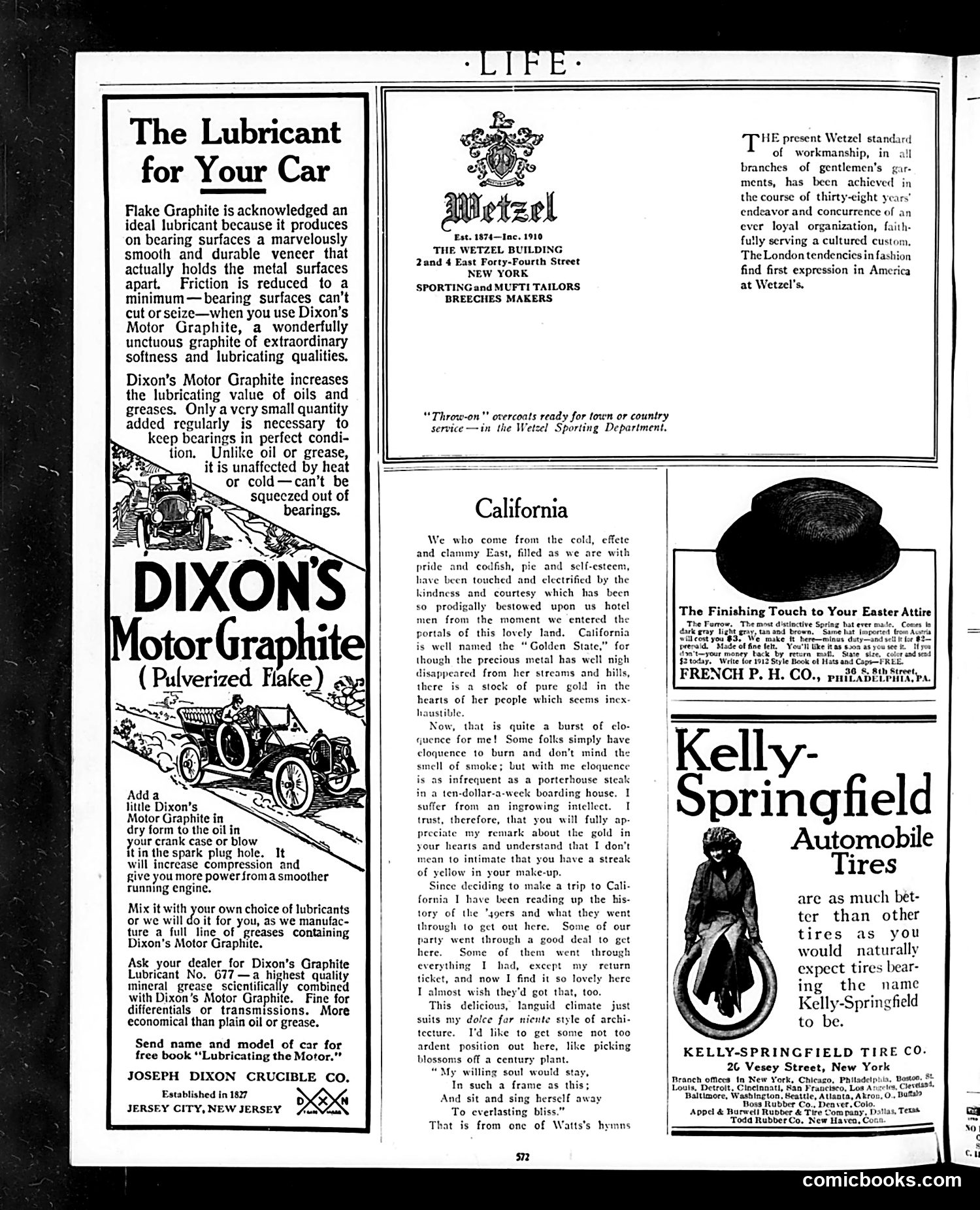
This page consists entirely of **advertisements**, not editorial content or cartoons. There is no political satire or social commentary to analyze. The ads promote three products: 1. **Dixon's Motor Graphite** (left)—a lubricant using flake graphite, marketed to car owners to reduce friction and improve engine performance. 2. **Wetzel** (center-right)—a New York tailor specializing in sporting and military clothing, emphasizing their 38-year reputation and recent London success. 3. **Kelly-Springfield Automobile Tires** (right)—featuring a woman on a motorcycle, promoting tire quality and durability. All advertisements are straightforward product promotions typical of early-20th-century Life magazine issues, with no satirical intent or political messaging visible.
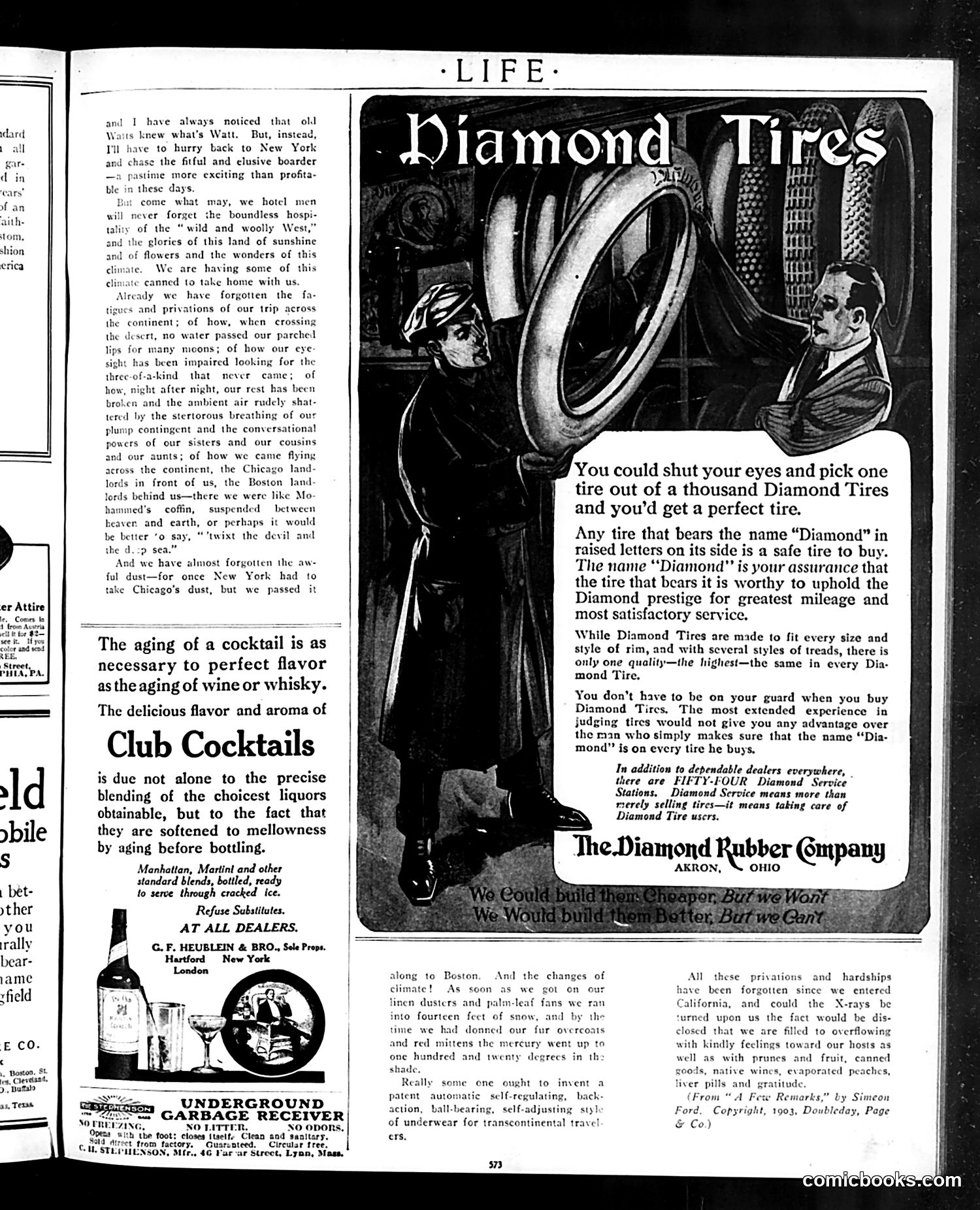
This page is primarily a **commercial advertisement** for Diamond Tires, not political satire. The illustration shows a man examining automobile tires with the headline "You could shut your eyes and pick one tire out of a thousand Diamond Tires and you'd get a perfect tire." The ad copy emphasizes quality consistency and brand reliability—the name "Diamond" itself serves as an assurance of product excellence. The accompanying text about cocktails and spirits in the lower left is an unrelated advertisement for Club Cocktails. There is **no political cartoon or social satire** on this page. It represents typical early 20th-century magazine advertising using dramatic imagery and hyperbolic claims to market consumer goods to readers.
This is **not a cartoon or satirical content**—it is a **full-page advertisement** for the Packard Motor Car Company's "Dominant Six" automobile model, published in *Life* magazine. The ad promotes the car's technical specifications and performance claims, including acceleration, hill-climbing ability, quiet operation, and ease of handling. It emphasizes luxury features like smooth starting/stopping and turning radius. The marketing strategy includes testimonial language ("Ask the man who owns one") and references the car's growing market presence (over 1,000 on the road by 1912). The ad offers a catalog upon request and mentions Packard's Detroit manufacturing facility. This represents early automotive advertising emphasizing both mechanical innovation and luxury appeal to wealthy consumers.
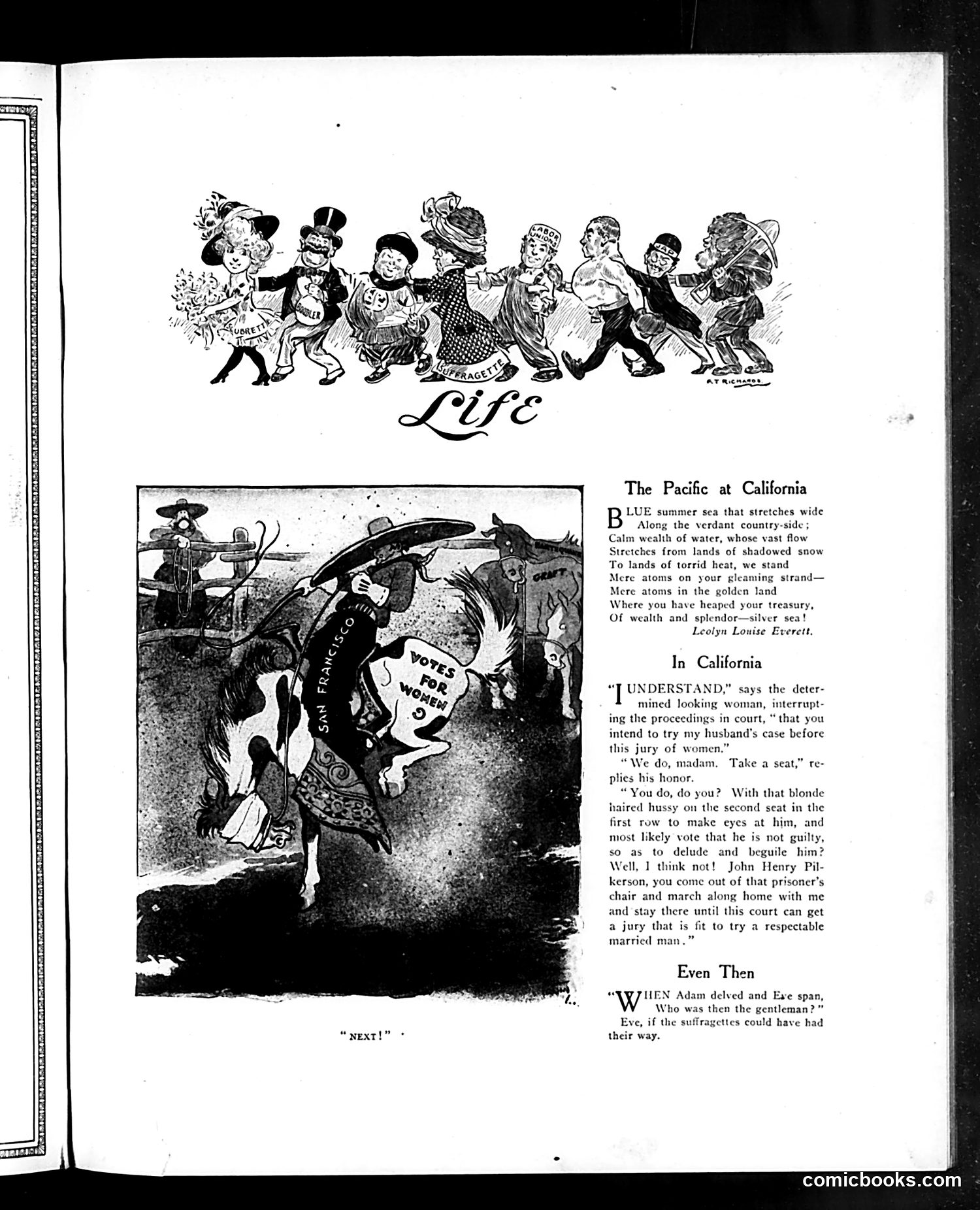
This page contains satirical content about women's suffrage. The top illustration shows a procession of caricatured suffragettes, labeled "Life," suggesting the magazine's commentary on the movement. The main cartoon depicts a woman ("San Francisco") labeled "Vote for Women" being kicked or thrown by what appears to be a masculine authority figure, with "Next!" written below—satirizing opposition to women's voting rights on the West Coast. The accompanying text sections ("The Pacific at California," "In California," "Even Then") appear to be satirical commentary mocking women's suffrage advocates, particularly regarding a court case involving a woman named Eve and references to "John Henry Pilkerson." The overall message ridicules the suffrage movement through exaggeration and mockery of both the cause and its supporters.
This page discusses Colonel Roosevelt's political positioning during what appears to be a pre-election period. The text examines whether Roosevelt will run for president again, noting he previously stated he wouldn't six months prior. The article argues that Roosevelt, as an "unrivaled precipitator" in politics, has created confusion among various political groups—progressive Republicans, conservatives, and others—by not clearly stating his intentions. The piece suggests that once elected, a president must faithfully execute the office's duties rather than pursue personal reform agendas. The cartoons (illustrations visible on the page) appear to satirize political maneuvering and uncertainty, though specific details are difficult to discern from the image quality. The overall tone critiques Roosevelt's apparent political ambiguity and its disruptive effects.
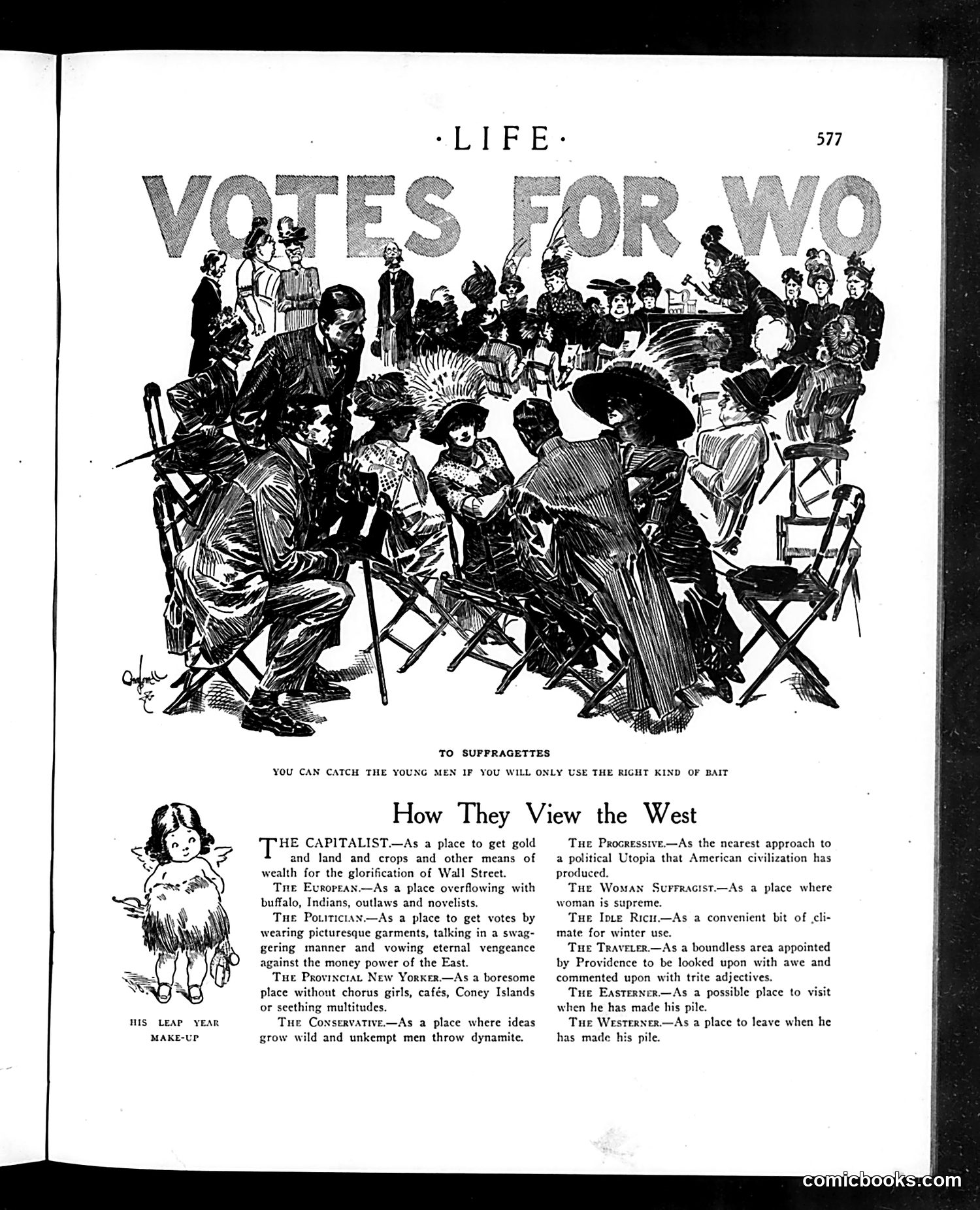
This page satirizes the women's suffrage movement through a gathering of various political stereotypes. The headline "To Suffragettes: You Can Catch the Young Men If You Will Only Use the Right Kind of Bait" frames women voters as manipulative. The central illustration depicts diverse character types gathered around discussing "How They View the West"—including a Capitalist, Edgeless New Yorker, Politician, Provincial New Yorker, Conservative, Progressive, Woman Suffragist, Idle Rich, Traveler, Easterner, and Westerner. Each receives mocking descriptions of their supposed worldview. The small figure labeled "His Leap Year Make-Up" adds crude commentary on gender roles. The satire mocks both suffragettes and various American social types, treating women's political participation as ridiculous rather than legitimate democratic aspiration.
This is a poem celebrating San Francisco's famous fog, not a political cartoon. The piece personifies the fog as a character central to the city's identity and charm. The poem references literary figures who wrote about San Francisco—notably Kipling and Bret Harte—critiquing Harte's portrayal of the city as "indifferent, serene" while celebrating the fog's more dynamic, transformative qualities. It invokes local landmarks (Hyde Street, Yerba Buena's Isle) and San Francisco's distinctive character. The final stanza invokes Robert Louis Stevenson, suggesting the fog embodies adventure and mystery. Essentially, this is romantic, nostalgic verse about San Francisco's fog as an essential element of the city's soul and literary mystique.
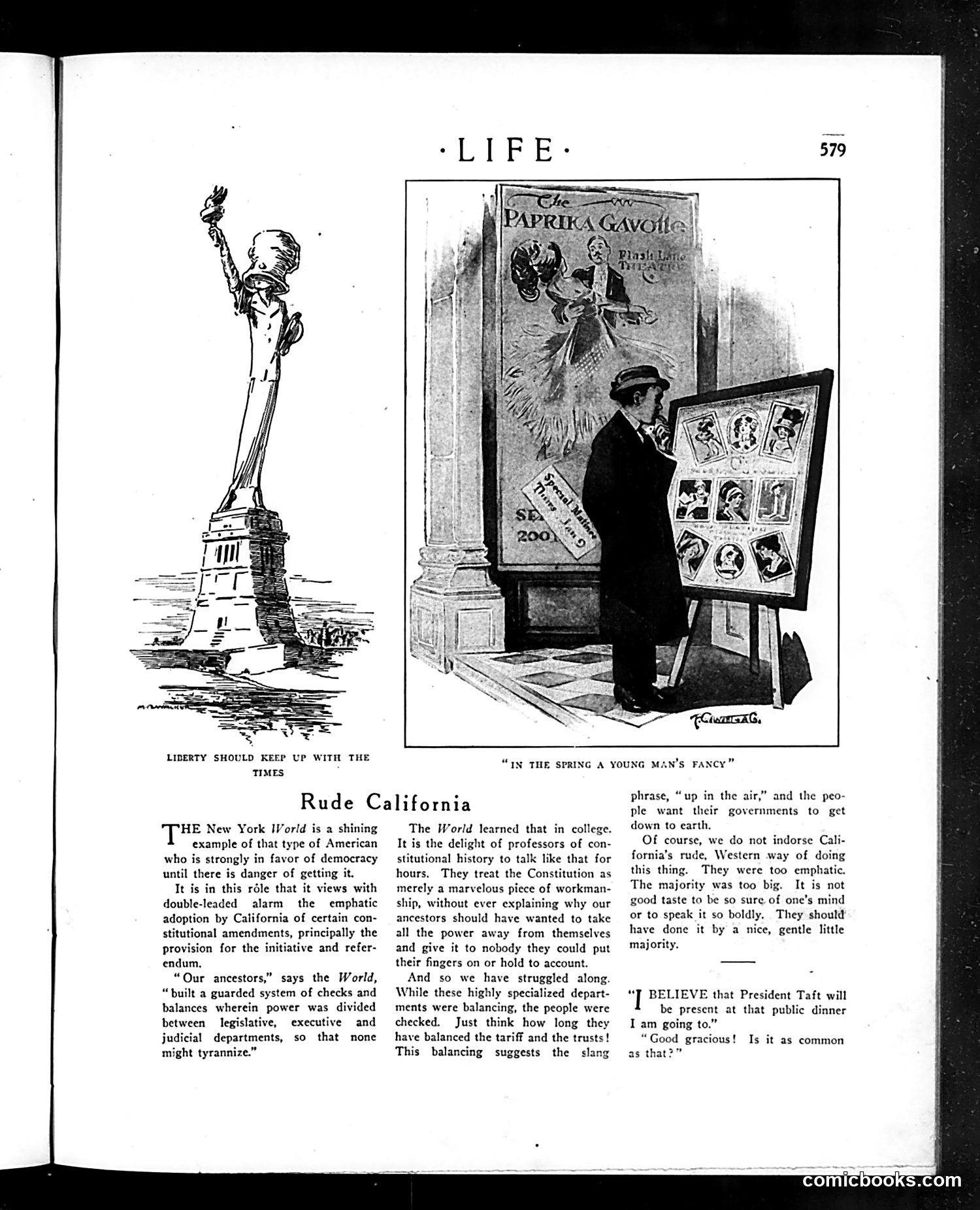
This page mocks the *New York World* newspaper's opposition to California's adoption of direct democracy measures (initiative and referendum). The article sarcastically critiques the *World*'s defense of the Founders' system of checks and balances, arguing that while elegant in theory, this system has merely allowed special interests to block reform—specifically regarding tariffs and trusts. The left cartoon shows the Statue of Liberty, captioned "Liberty Should Keep Up With the Times," suggesting democratic institutions must evolve. The right cartoon depicts a theater poster for "The Paprika Gauche" with a man displaying promotional images—likely satirizing California's supposedly crude, aggressive approach to democratic reform compared to the *World*'s preference for genteel restraint. The article concludes sarcastically that California should have pursued reform with "nice, gentle" modesty rather than overwhelming popular support, mocking the hypocrisy of privileging decorum over genuine democratic will.
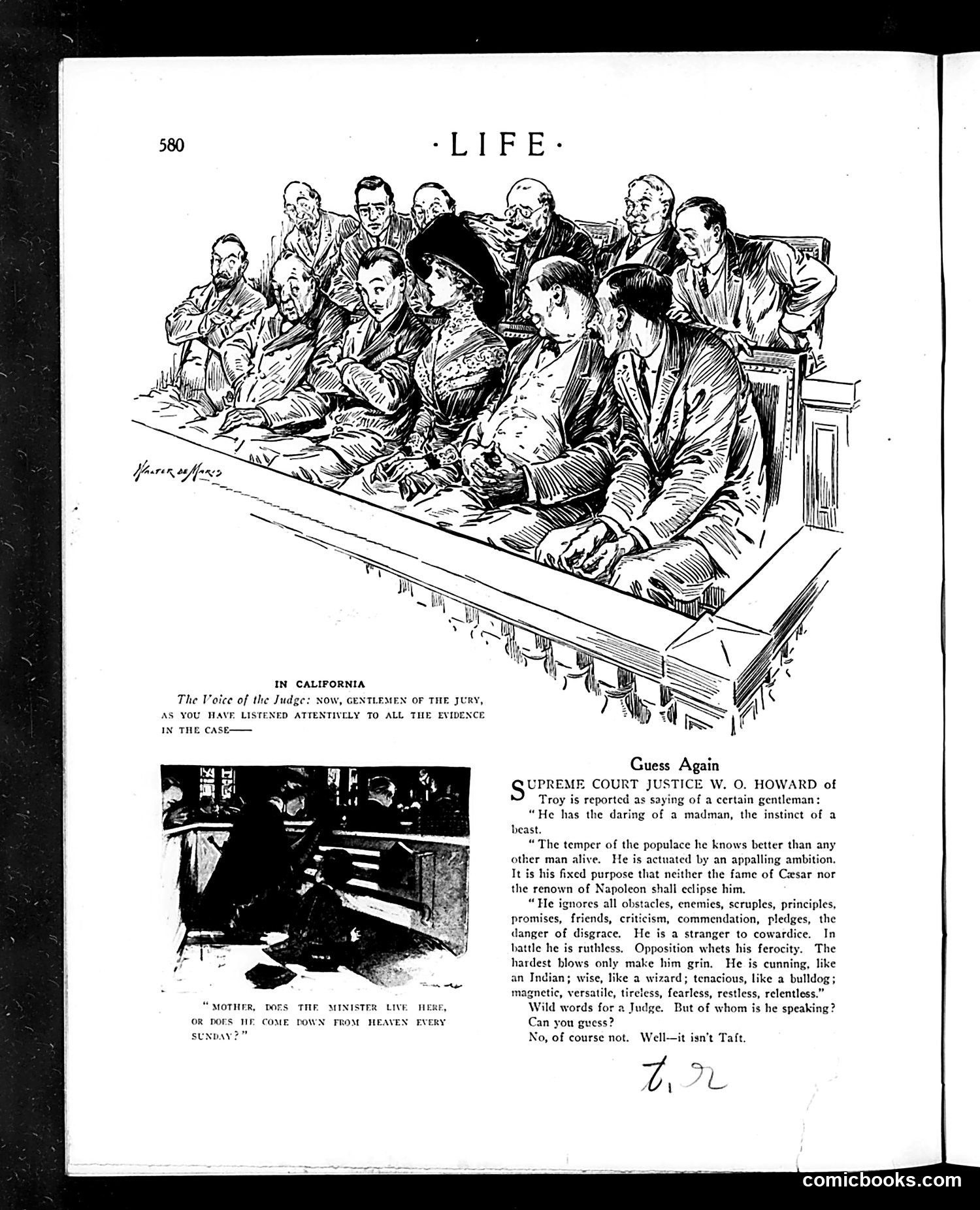
This page contains political satire about early 20th-century American leadership. The main feature, "Guess Again," presents Supreme Court Justice W.O. Howard's scathing description of an ambitious, ruthless leader—comparing him to Caesar and Napoleon, praising his cunning and ferocity while criticizing his disregard for principles. The punchline reveals the target: **not President Taft**. This suggests the description actually applies to another prominent political figure of the era (likely Theodore Roosevelt or another contemporary politician), making the joke a veiled criticism delivered through misdirection. The top cartoon depicts a jury trial in California, while the bottom image shows a child's naive question about a minister—separate humorous vignettes typical of Life's satirical format. The satire mocks both the ambitious politician being described and implicitly criticizes Taft by suggesting someone *else* better fits this unflattering portrait.
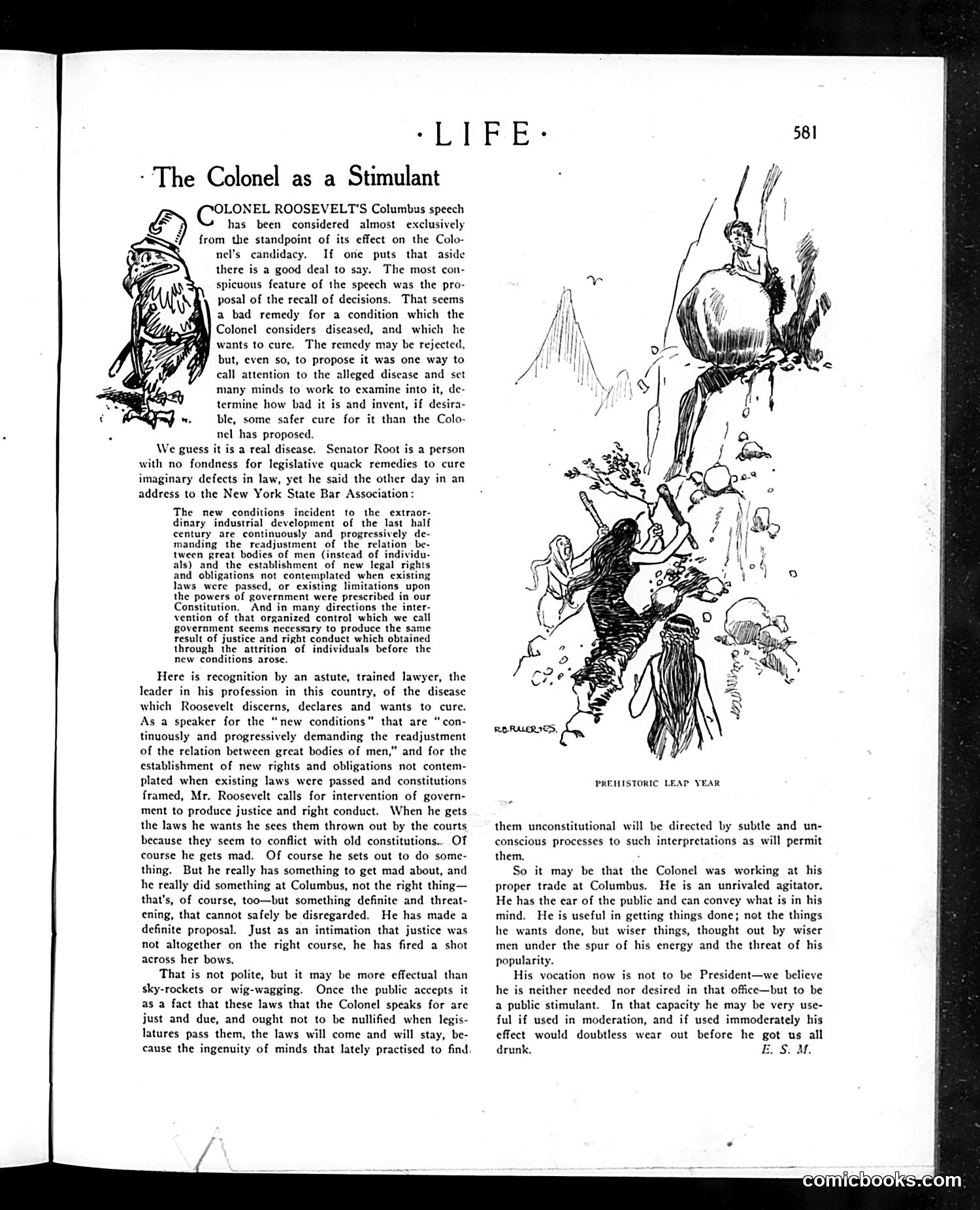
This article analyzes Theodore Roosevelt's Columbus speech, which proposed "recall of decisions"—allowing voters to overturn court rulings. The accompanying cartoon, titled "Prehistoric Leap Year," depicts figures climbing a large rock formation, illustrating Roosevelt as an agitator pushing society forward. The text argues Roosevelt's true value isn't his specific proposals but his ability to stimulate public discussion about real problems: industrial development has created social conditions the Constitution didn't anticipate, yet courts repeatedly strike down reform legislation as unconstitutional. The author (E.S.M.) contends Roosevelt functions as a "public stimulant"—his provocative proposals may fail, but they force the public and lawmakers to confront genuine injustices and eventually craft better solutions. The piece treats Roosevelt not as a serious presidential candidate but as a useful agitator whose energy drives progressive change, even if indirectly.
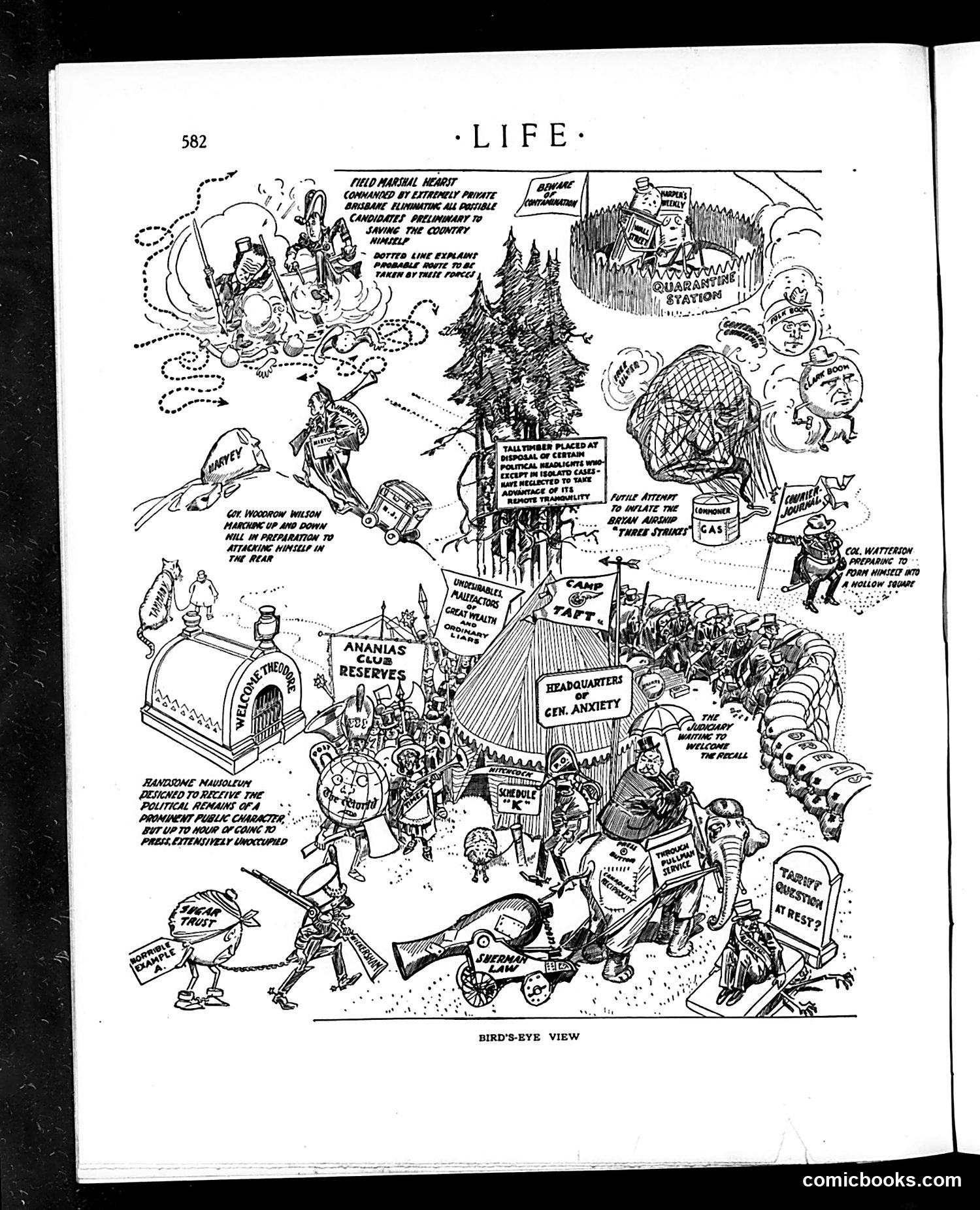
This is a satirical "bird's-eye view" map depicting American military and political operations, likely from WWI or the interwar period. The cartoon shows various labeled stations and activities including "Headquarters Gen. Anxiety," "Quarantine Station," and references to figures like "Col. Watterston" and "Gen. Wilson." The satire appears to mock government bureaucracy and military inefficiency—depicting anxiety, uncertainty, and confusion at command levels. References to "reserves" and military preparations suggest commentary on war preparedness or demobilization policies. The cartoon criticizes political leadership's handling of national security through exaggerated portrayal of overlapping jurisdictions, conflicting directives, and general chaos at administrative centers. Specific figure identifications and the exact historical moment remain unclear from visible text alone.
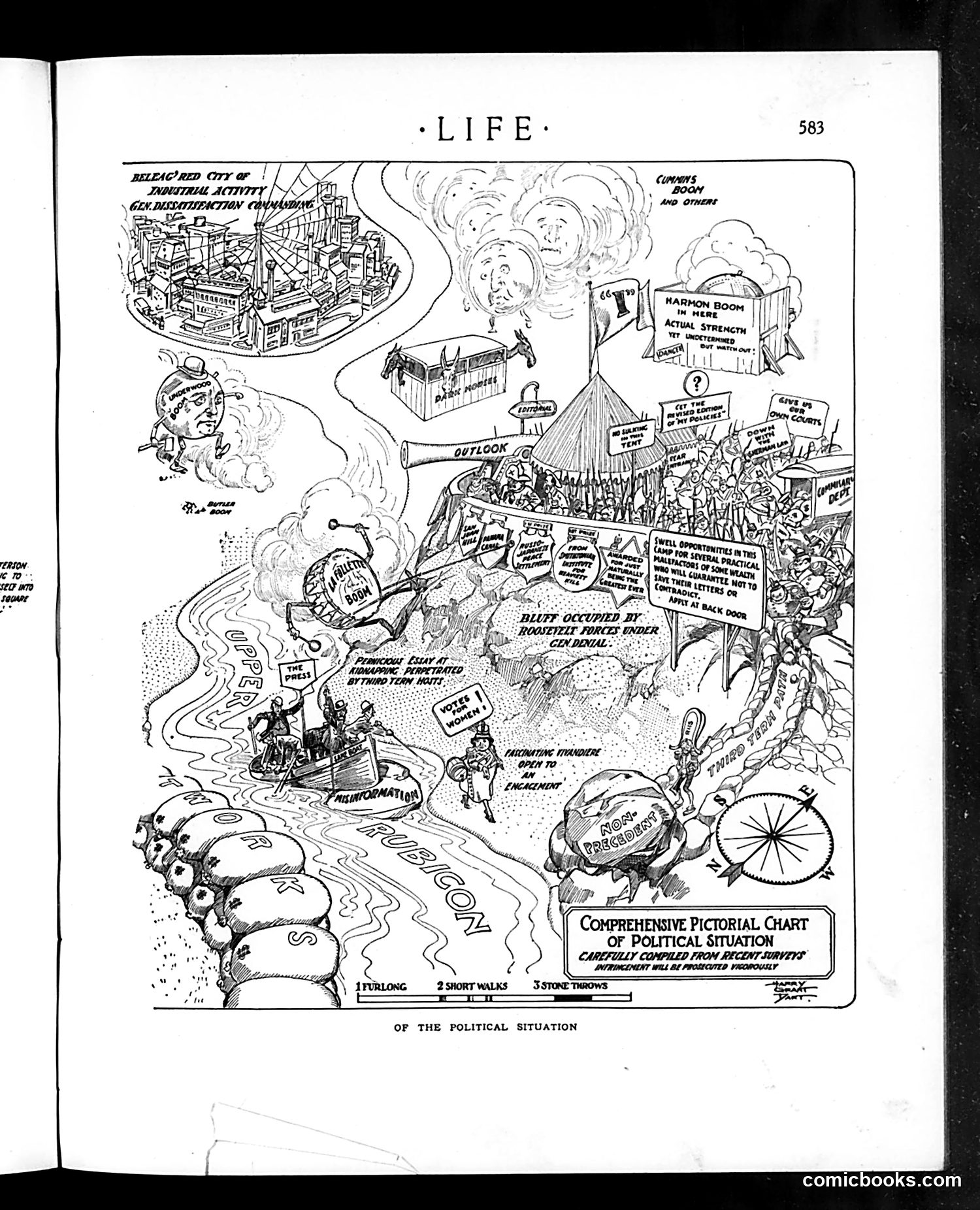
This is a satirical "Comprehensive Pictorial Chart of Political Situation" presenting the political landscape as a chaotic, surreal landscape. The cartoon features: - A **relieved city** at top representing industrial/political establishment - A **"balloon occupied by Roosevelt Force under Gen. [?]"** suggesting FDR's administration - Various labeled figures and groups scattered across terrain with signs indicating different political factions and their positions - **Pollution/smoke imagery** suggesting corruption or industrial problems - A measurement scale at bottom ("Furling," "Short Walks," "Stone Throws") mocking the attempt to measure political distance The satire suggests the political situation is incomprehensible chaos rather than rational organization. The elaborate, absurdist map format parodies serious political analysis while depicting competing interests, industrial interests, and government positions as a bewildering jumble. This likely dates to the New Deal era, satirizing Roosevelt's administration and the fractured political responses to it.
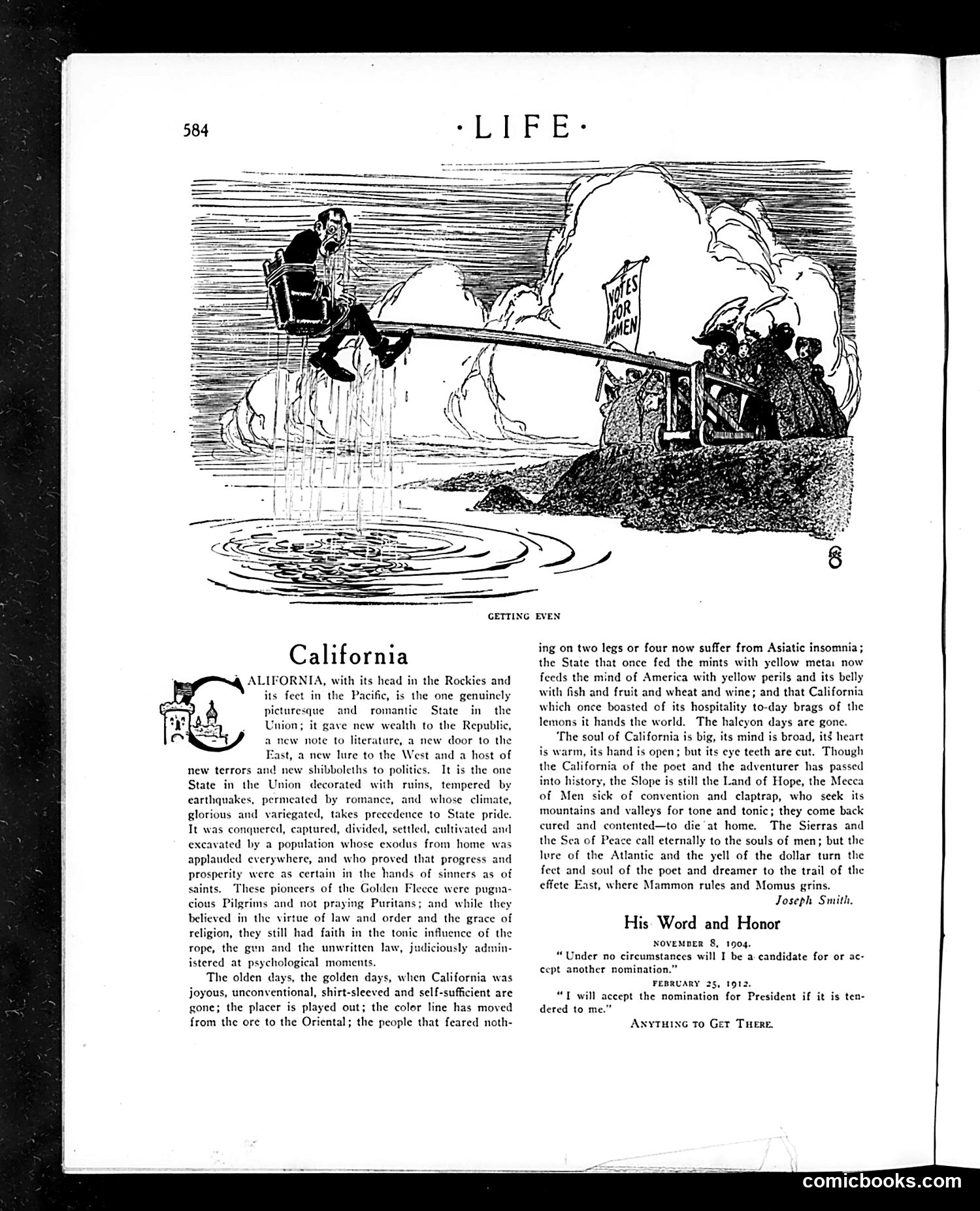
The cartoon titled "Getting Even" depicts a figure on the left (appearing to be a political leader, likely President Theodore Roosevelt based on the 1904-1912 dates) balanced precariously on a seesaw or plank. On the right side, a group of people push down with a sign reading "VOTES FOR WOMEN." The satire targets **political flip-flopping**. The accompanying text juxtaposes two contradictory statements: Roosevelt's 1904 declaration that he would never accept another nomination versus his 1912 statement accepting the presidential nomination. The subtitle "Anything to Get There" emphasizes his supposed hypocrisy. The "Getting Even" caption suggests the cartoon blames women voters (or suffragists) for "evening the score"—using their voting power to expose or punish his inconsistency. This reflects early-1910s debates over women's suffrage and its potential political consequences.
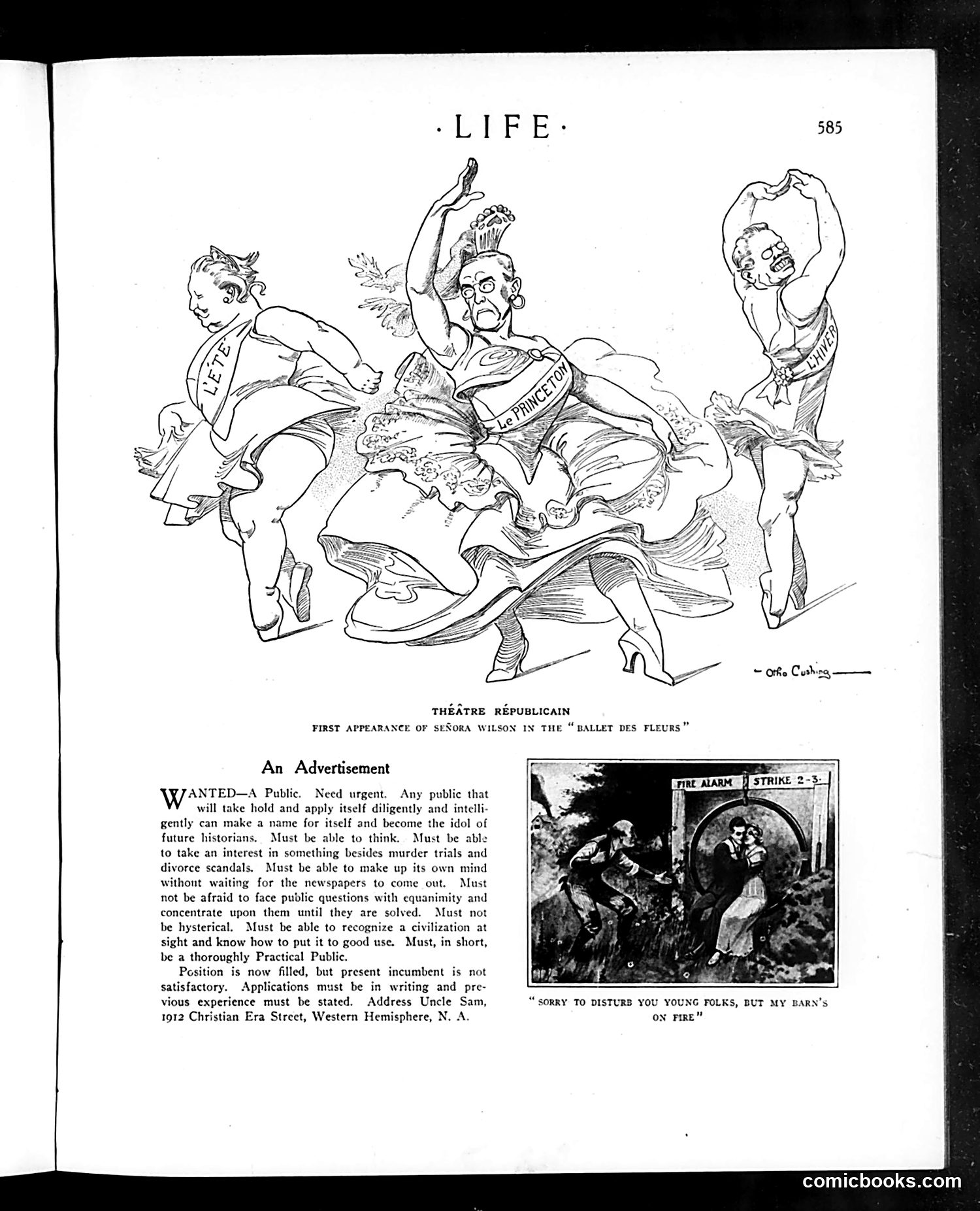
The top cartoon satirizes the theatrical debut of Señora Wilson (likely the wife of President Woodrow Wilson) in a French ballet. The central figure, dressed ornately and gesturing dramatically, appears to be a caricatured male performer or politician, flanked by exaggerated supporting figures. The satire likely mocks the incongruity of highbrow European theatrical pretensions amid American political concerns. The advertisement below is satirical social commentary. It "wants" an intelligent, independent-thinking public—one capable of serious civic engagement rather than obsessing over scandal and sensationalism. Signed by "Uncle Sam," it sardonically claims the current public is unsatisfactory and seeks applications for a replacement. The joke critiques American public discourse as shallow and distracted, unable to focus on substantive issues. The bottom illustration shows a man interrupting young couples with news of his barn fire—likely a visual pun about urgent, overlooked domestic crises amid frivolous social activities.
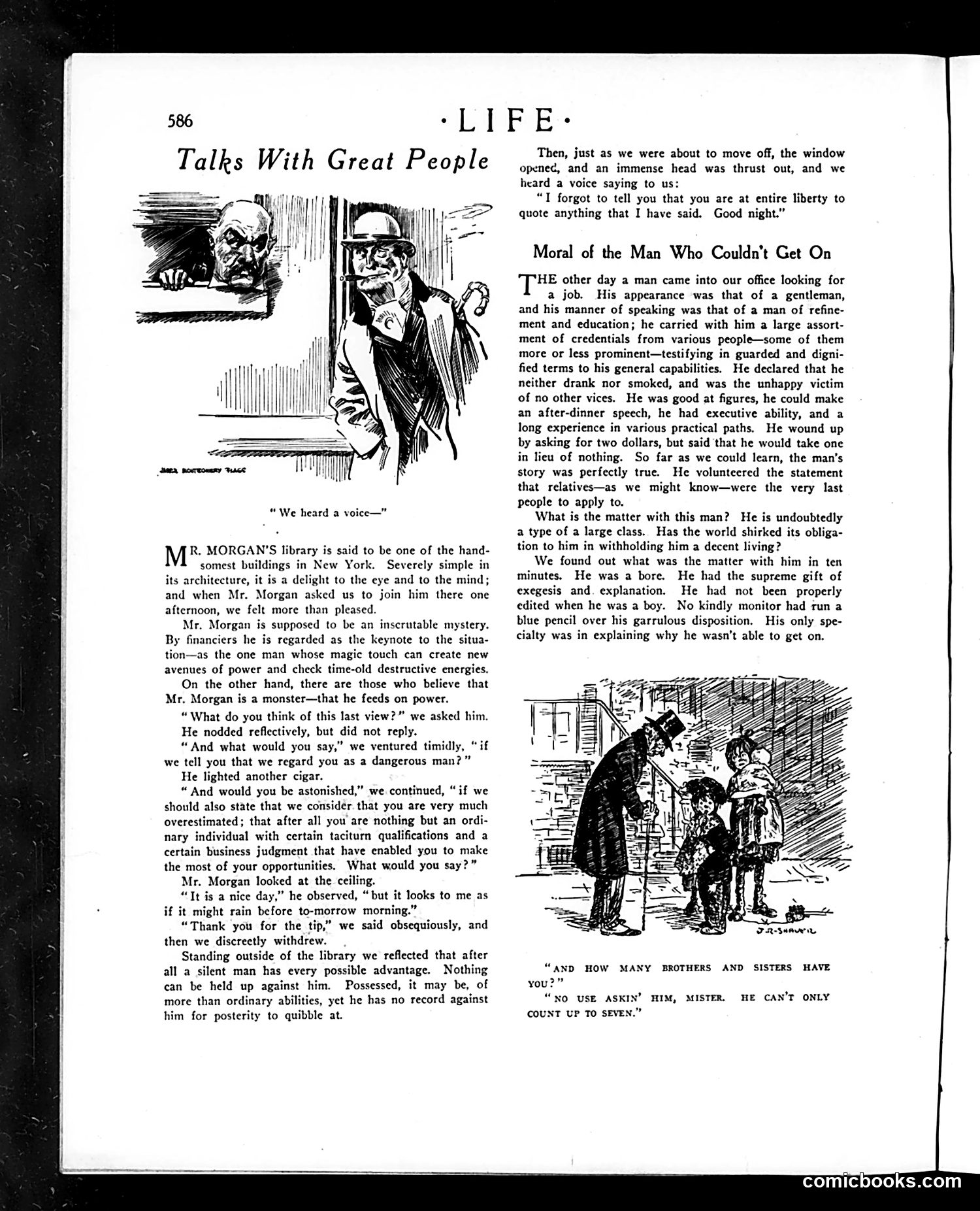
This page contains two satirical pieces about prominent figures and social types. **"Talks With Great People"** mocks **J.P. Morgan**, the powerful financier. The satire highlights Morgan's famous taciturnity—when pressed with provocative questions about being "dangerous" and "overestimated," he deflects with banalities about weather. The joke's moral: a silent man escapes public scrutiny because he leaves no record to criticize. Morgan's final comment about being "at entire liberty to quote" anything he said is ironic, since he said nothing substantive. **"Moral of the Man Who Couldn't Get On"** depicts a job applicant with impeccable credentials who cannot find employment. The twist: he's a *bore*. His fatal flaw is excessive explanation and verbosity—he wasn't "edited" as a boy. The accompanying cartoon jokes that he talks so much he "can't only count up to seven" when asked about siblings, suggesting his garrulousness prevents him from even basic communication. Both pieces satirize different aspects of American character: Morgan's calculated silence versus the job-seeker's uncontrolled verbosity—each a social liability.
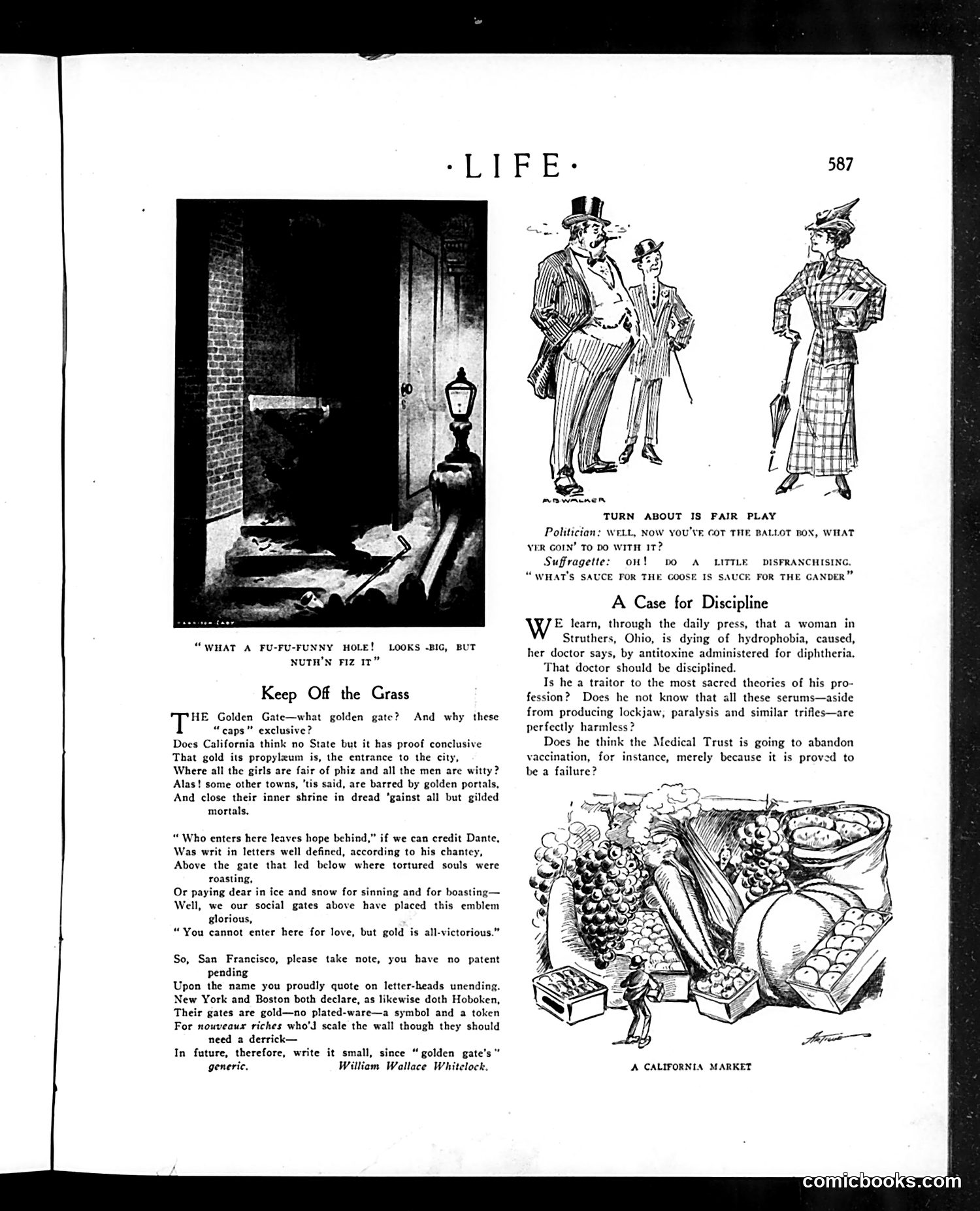
This page contains three satirical pieces typical of early 20th-century American humor: **"Keep Off the Grass"** by William Wallace Whitelock mocks San Francisco's pride in the Golden Gate as its exclusive symbol of grandeur. The satire argues that other cities (New York, Boston, Hoboken) have equally "golden" exclusivity for the wealthy. Whitelock suggests San Francisco has no monopoly on using "golden gate" as a metaphor for wealth-based social exclusion—it's become generic. **"Turn About Is Fair Play"** shows a politician confronting a newly enfranchised suffragette. The joke plays on the phrase "what's sauce for the goose is sauce for the gander": now that women have the ballot, the politician nervously asks what they'll do with it. The suffragette's retort about "disfranchising" suggests women might strip voting rights from men—turning the tables on male political dominance. **"A Case for Discipline"** sarcastically defends a doctor who administered antitoxin for diphtheria to a woman who died of hydrophobia. The piece mockingly asks whether the "Medical Trust" will abandon vaccination merely because it fails—clearly criticizing medical establishment arrogance and resistance to accountability.
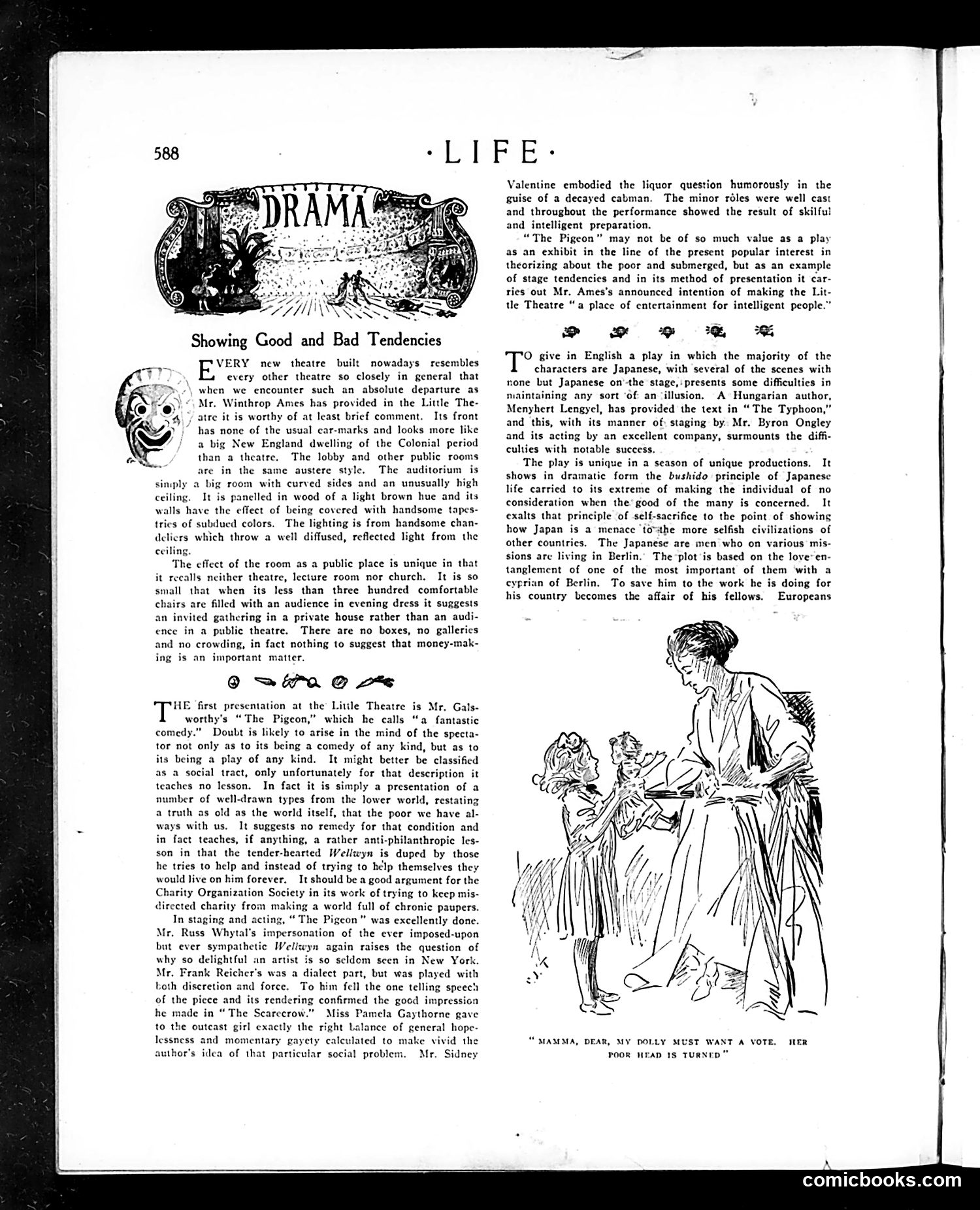
This page reviews Mr. Winthrop Ames's Little Theatre and its inaugural production of John Galsworthy's play "The Pigeon." **The Theater's Innovation:** The text praises the Little Theatre's distinctive design—styled like a Colonial house rather than a typical theater, without boxes, galleries, or ostentatious features. This reflects Ames's stated goal of creating "a place of entertainment for intelligent people." **The Play's Social Commentary:** "The Pigeon" presents working-class characters and explores poverty through the character Wellwyn, a well-meaning man repeatedly deceived by those he tries to help. The reviewer notes the play offers no solutions and ironically argues it actually supports the Charity Organization Society's position—that indiscriminate charity creates chronic dependence rather than solving poverty. **The Satire:** The page satirizes sentimental philanthropic impulses by suggesting Galsworthy's sympathetic portrayal of poverty inadvertently demonstrates why paternalistic charity fails. The illustrated caption reinforces this: a poor woman demands her daughter get a vote, suggesting the real solution is political power, not charity.
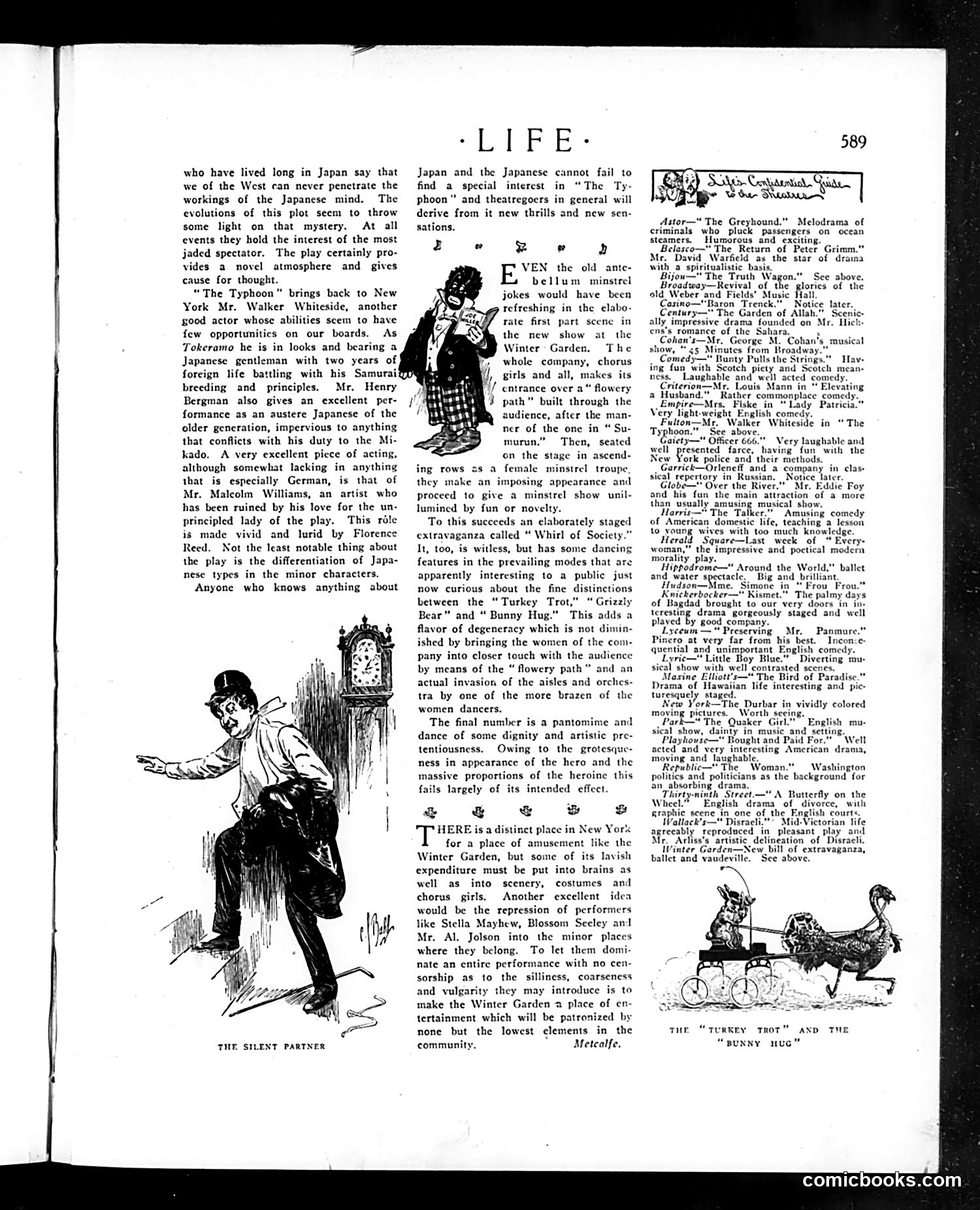
This page reviews theatrical productions, primarily critiquing the Winter Garden show. The main cartoon, "The Silent Partner," depicts a man in formal dress observing a woman—likely satirizing romantic or financial entanglements in theater. The text attacks the Winter Garden's production for relying on spectacle over substance. It praises "The Typhoon," a play featuring Japanese characters that differentiates between types, and actor Walker Whiteside's performance. However, it harshly criticizes the Winter Garden's "Whirl of Society" extravaganza as witless, calling out performers Stella Mayhew, Blossom Seeley, and Al Jolson for introducing "silliness, coarseness and vulgarity." The reviewer (Metcalfe) argues the theater wastes money on scenery and chorus girls while neglecting intelligent content, claiming this attracts "none but the lowest elements in the community"—reflecting era-typical class anxieties about popular entertainment and respectability.
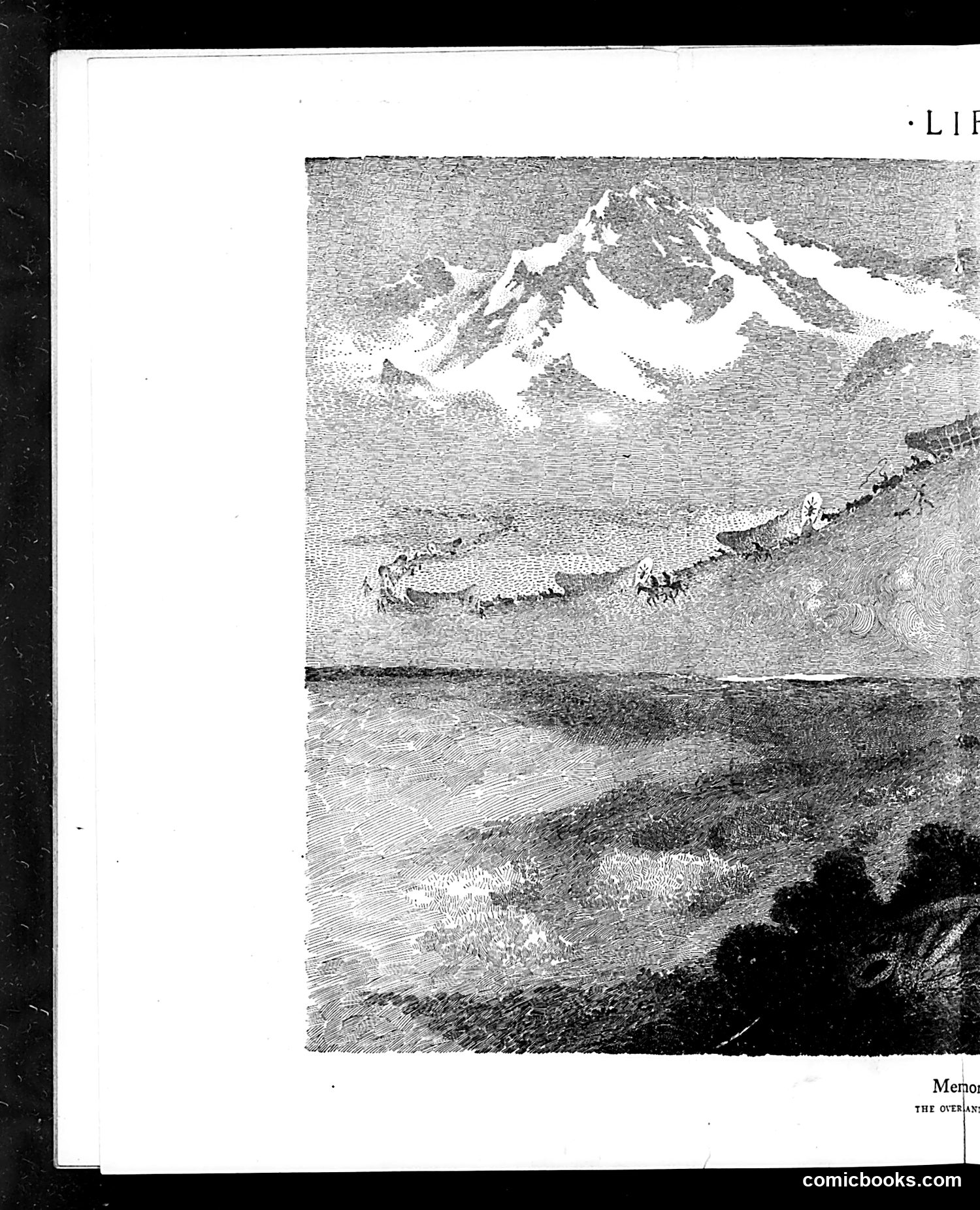
This page appears to be from Life magazine and contains a single engraving-style illustration depicting a snow-capped mountain in the background with what looks like a caravan or line of travelers/pack animals moving across a mountainous terrain in the foreground. The style suggests a 19th-century woodcut or engraving. The OCR text is largely illegible or incomplete ("Menor," "THE OVERIA"), making it difficult to determine the specific satirical or political meaning. Without clearer caption text or context identifying the mountain, the travelers, or the intended commentary, I cannot confidently explain what this cartoon references or satirizes for a modern reader. The image alone doesn't provide sufficient visual clues to identify specific historical figures or events being lampooned.
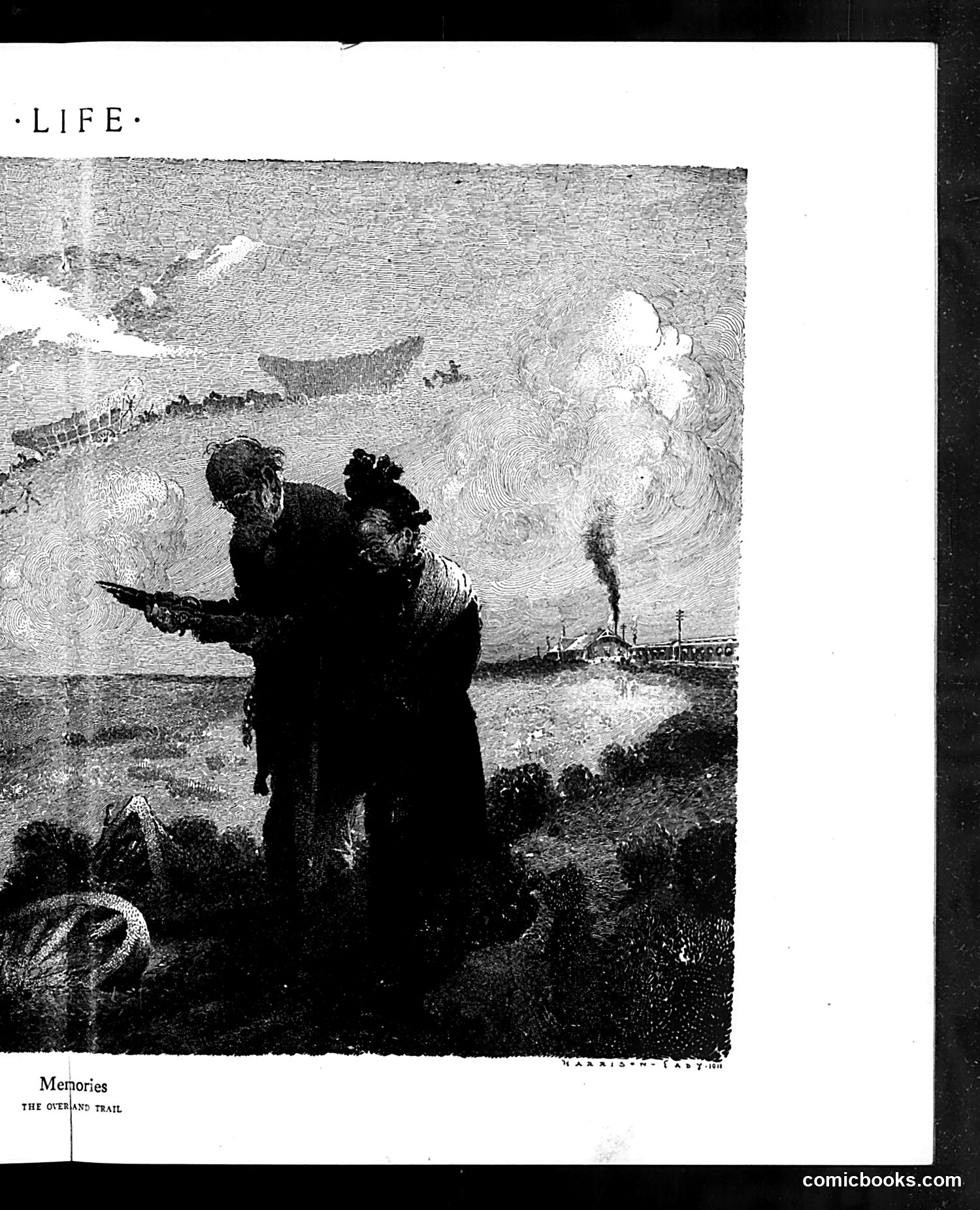
This page from *Life* magazine shows an illustration titled "Memories: The Overland Trail." Two figures in period dress stand on a hillside overlooking a steamship on water, with a caravan visible in the distance. The man points outward while the woman looks on. The image appears to be nostalgic commentary on American westward expansion and the historical "Overland Trail"—the pioneering route settlers used to reach the West. The title suggests this is romanticizing that era as a cherished memory. The juxtaposition of the modern steamship with the older caravan imagery may be satirizing how Americans idealize the frontier period, or contrasting past and present methods of travel and progress. The specific satirical intent remains unclear without additional context about the publication date or accompanying text.
This page from *Life* magazine presents a humorous essay on armchair travel—experiencing distant places through books rather than actual journeys. The author contrasts "perambulatory" (physical) travel with "static" travel via literature, joking that both require visiting booking offices or bookstores where staff are unhelpful and prone to discontinuing advertised services. The satire targets the frustrations of travel planning while celebrating books as superior companions for exploration. The piece recommends *The Surgeon's Log* by J. Johnston Abraham—an actual account by a London doctor who worked as ship's surgeon—as ideal for "loitering through the East" with engaging commentary. The "Confidential Book Guide" section that follows recommends contemporary travel narratives and adventure novels, positioning reading as a practical, economical, and socially enjoyable alternative to expensive foreign travel. The humor appeals to readers unable or unwilling to undertake lengthy voyages.
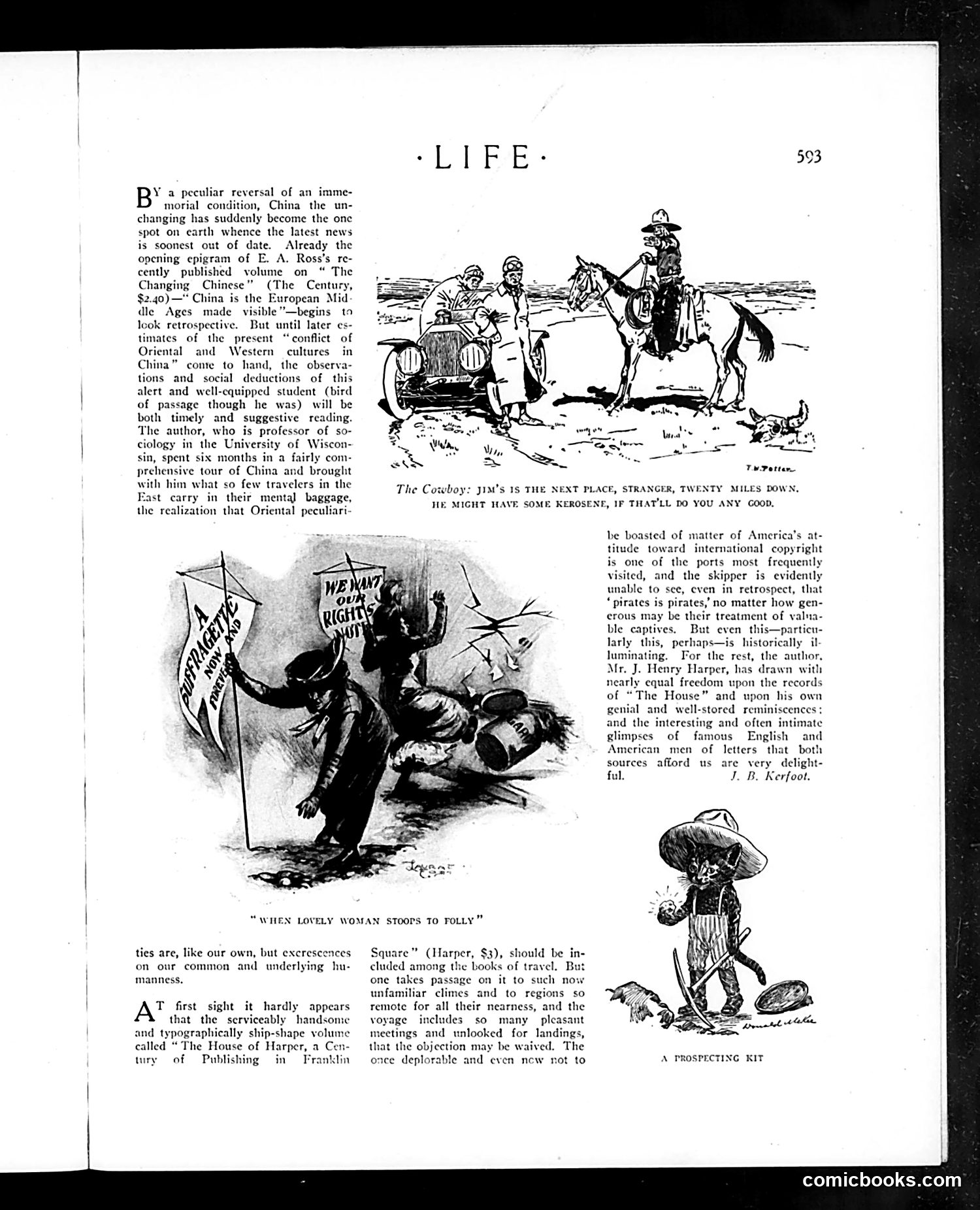
This page reviews books about China and publishing history. The key cartoons illustrate contrasting themes: **"The Cowboy"** depicts an American frontier character encountering Chinese travelers—likely satirizing the collision of Western and Eastern cultures that E.A. Ross's book "The Changing Chinese" examines. **"When Lovely Woman Stoops to Folly"** appears to reference the moral/social commentary tradition, possibly critiquing behavior or hypocrisy. **"A Prospecting Kit"** shows a figure with mining equipment, likely a humorous aside about frontier ambition or resource-seeking. The text discusses Ross's sociology book arguing that Chinese peculiarities reflect universal human nature beneath surface differences—a progressive viewpoint for the era. It also reviews "The House of Harper," a publishing history that apparently addresses America's controversial piracy of international copyrights, which the reviewer notes remains "historically illuminating" as a moral blind spot.
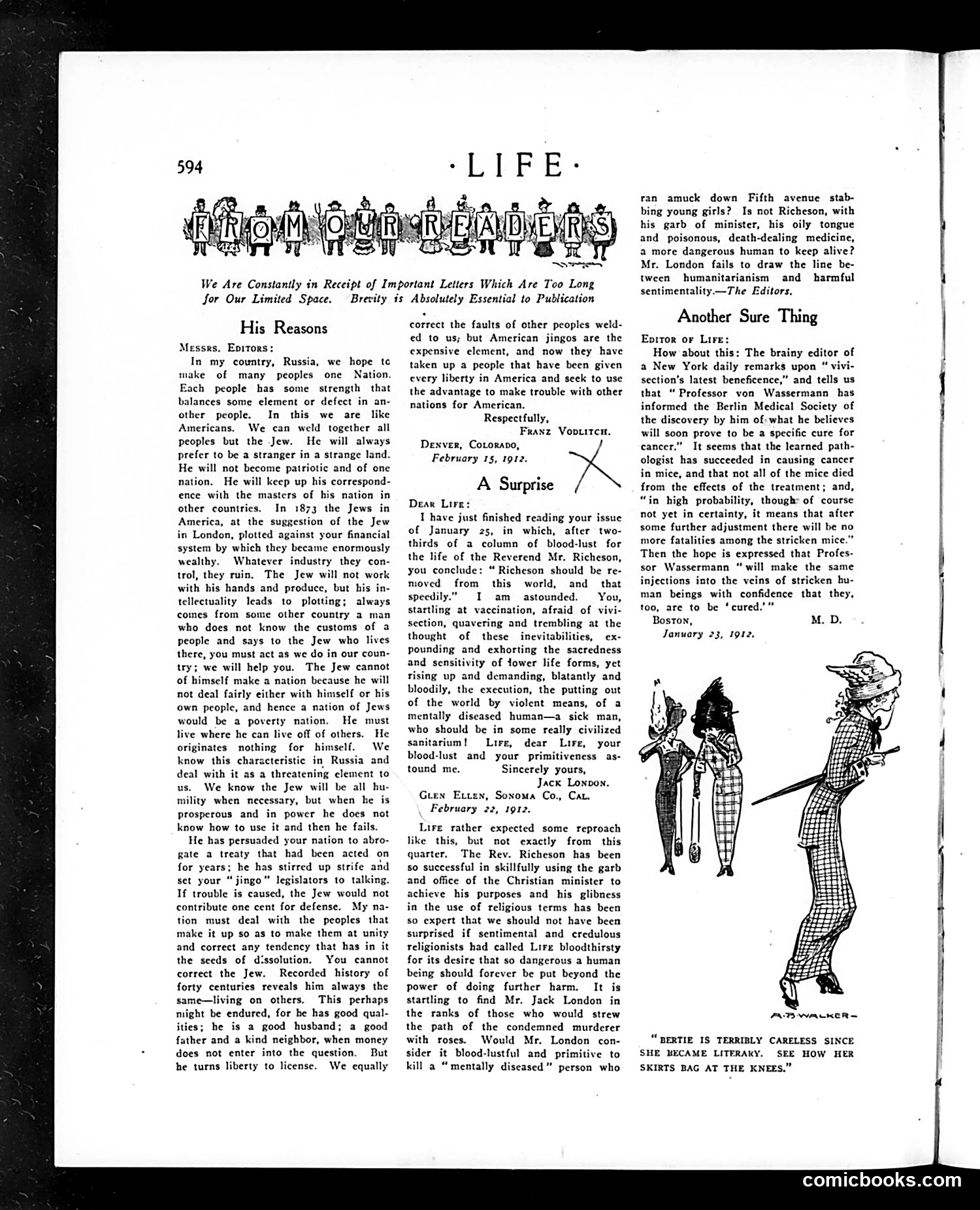
This page features readers' letters to *Life* magazine's editors, showcasing early 20th-century social debates. **"His Reasons"** is a virulently antisemitic letter from a Russian correspondent claiming Jews are inherently unpatriotic, parasitic, and incapable of building nations. He accuses American Jews of financial conspiracy and disloyalty, reflecting widespread prejudices of the era that blamed Jewish immigrants for social problems. **"A Surprise"** critiques *Life*'s apparent hypocrisy: the magazine had published bloodthirsty calls for executing Reverend Richeson (apparently involved in a crime), yet typically championed animal welfare and opposed capital punishment. Jack London points out this contradiction between their stated principles and violent rhetoric. The accompanying cartoon depicts a woman in fashionable dress with exaggerated posture—likely satirizing "Bertie," illustrating contemporary debates about women's fashion and social behavior that *Life* regularly mocked. The page illustrates how *Life* functioned as a forum for competing social viewpoints, from overt bigotry to more nuanced criticism of hypocrisy.
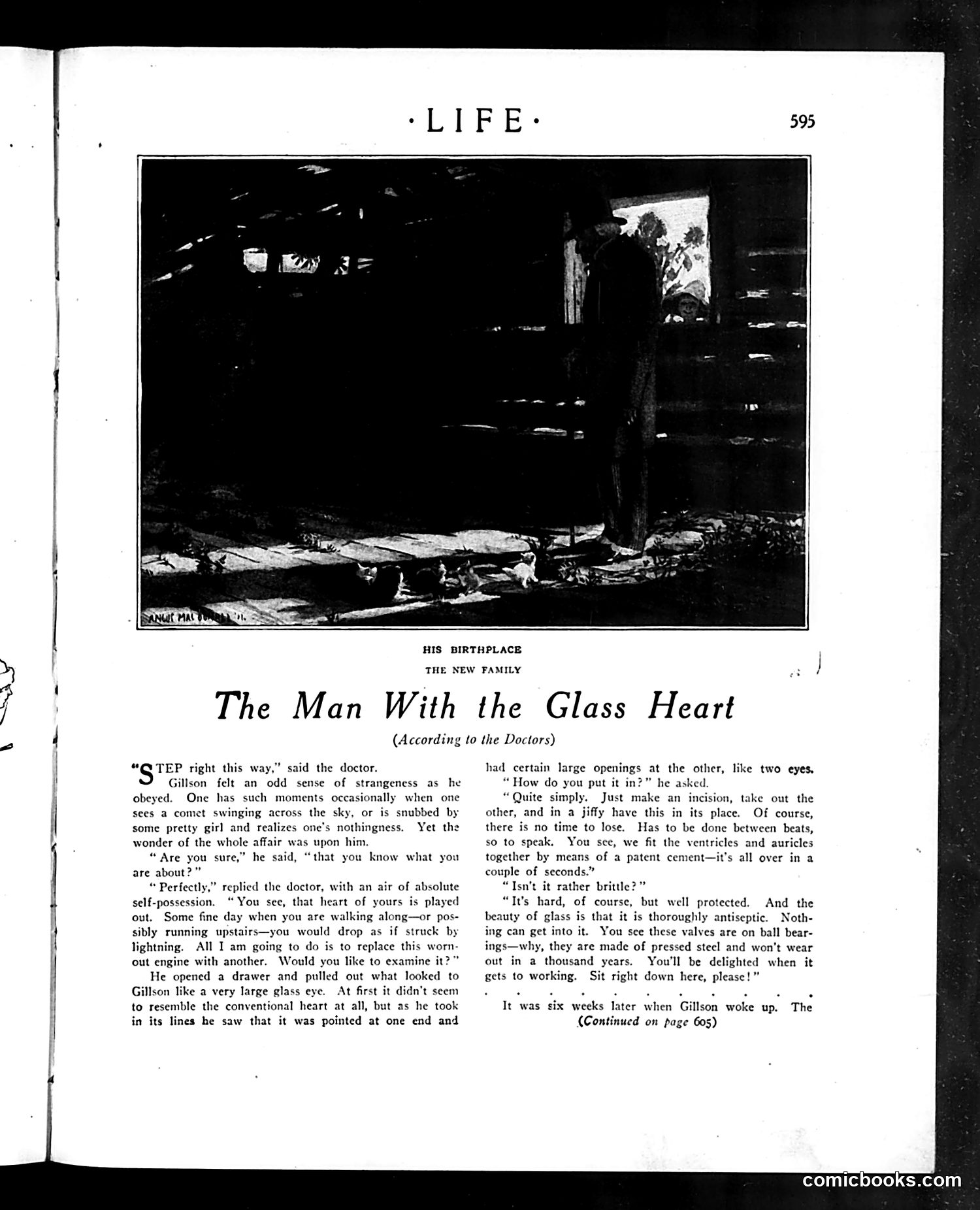
This is the opening of a science fiction story satirizing early 20th-century medical optimism and technological faith. A doctor persuades patient Gillson to replace his failing heart with a mechanical glass one, describing it with absurd confidence—claiming it's "thoroughly antiseptic," has "ball bearing" valves, and won't wear out for a thousand years. The satire targets the era's belief that modern medicine could mechanically "fix" human bodies like machines. The glass heart itself—transparent, fragile, pointlike—is comedic: the doctor describes it as resembling "a very large glass eye," highlighting the absurdity of replacing an organ with something so obviously unsuitable. The story's subtitle "(According to the Doctors)" suggests doctors' inflated claims about what surgery could achieve. The narrative presents their certainty as darkly comic, promising instant transformation despite the obvious risks of replacing a vital organ mid-heartbeat.
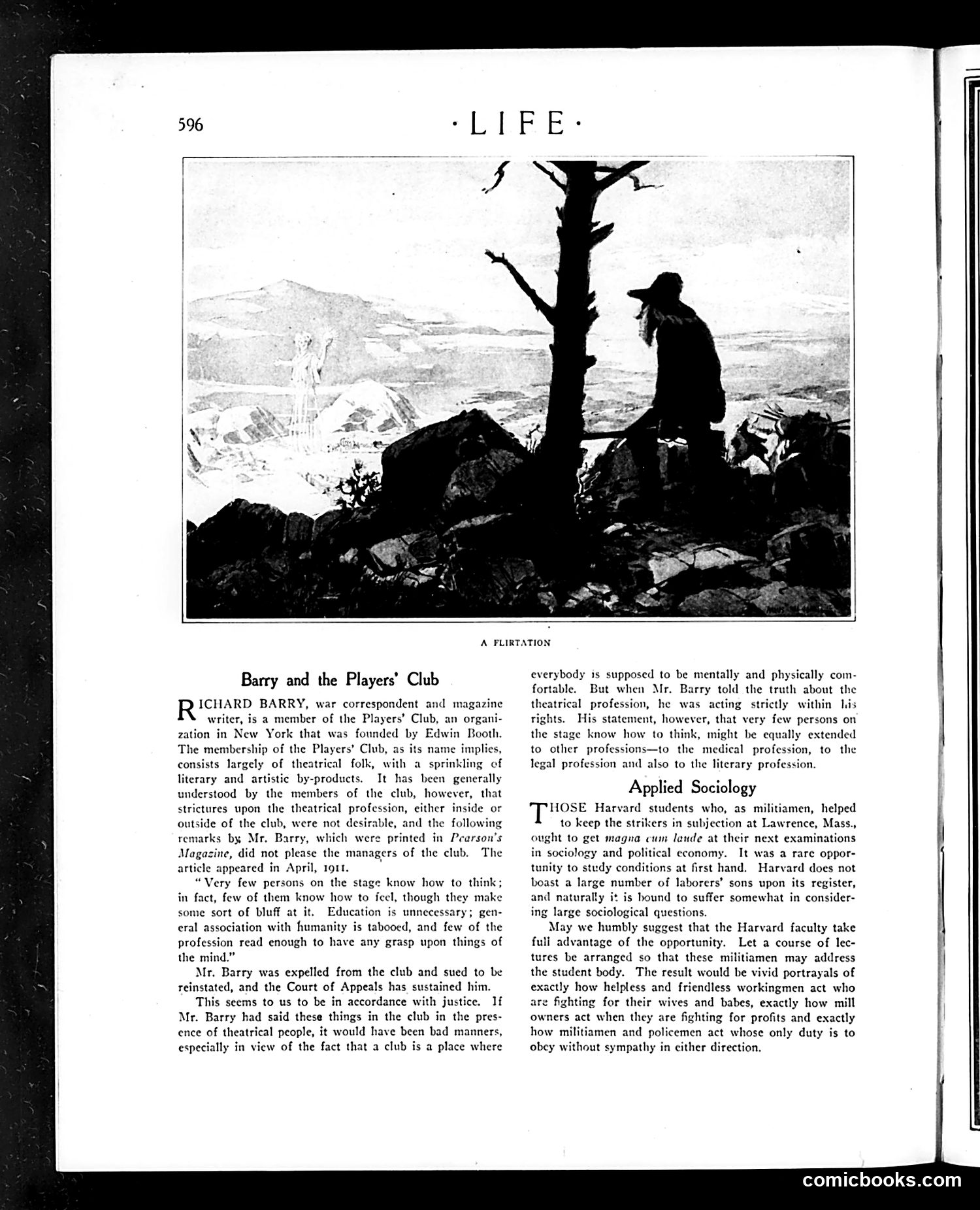
This page contains two satirical editorials from *Life* magazine, likely from 1911. **"Barry and the Players' Club"**: Richard Barry, a war correspondent, was expelled from the exclusive Players' Club (a Manhattan theater club founded by actor Edwin Booth) after publishing an article in *Pearson's Magazine* claiming stage actors lack intelligence and education. The editorial supports Barry's reinstatement by the Court of Appeals, arguing that while insulting members *within* the club would be rude, speaking truth publicly is a protected right. The writer sarcastically notes Barry's criticism could equally apply to doctors, lawyers, and writers. **"Applied Sociology"**: This section mocks Harvard students who served as militiamen during the 1912 Lawrence textile strike, suppressing workers' protests. *Life* sarcastically suggests they deserved academic honors for this "fieldwork," then ironically proposes having these militiamen lecture fellow students about labor conditions—implying they learned nothing sympathetic about struggling workers' desperation. Both pieces critique establishment institutions (elite clubs, universities) for protecting narrow interests over truth and social understanding.
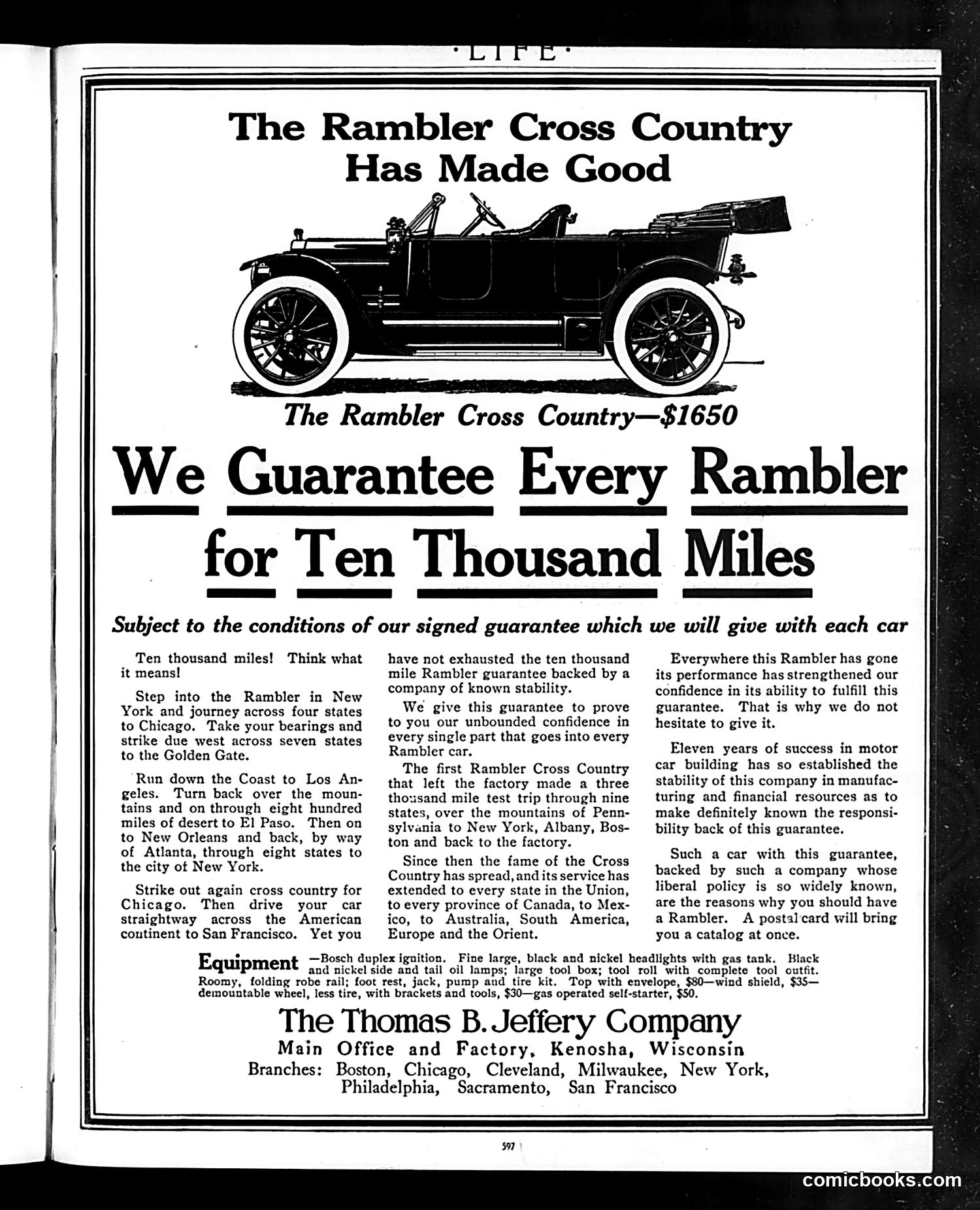
This page is **not a cartoon or satire** — it's a straightforward automobile advertisement from *Life* magazine (likely early 1900s based on the vehicle style and pricing). The ad promotes the Rambler Cross Country automobile ($1650) manufactured by the Thomas B. Jeffery Company of Kenosha, Wisconsin. The central marketing claim is a **10,000-mile guarantee**, which the ad emphasizes through detailed descriptions of hypothetical cross-country driving routes: New York to Chicago to California, down the coast, through deserts to El Paso, to New Orleans, and back. The ad stresses the company's reliability by noting the car has been tested extensively and performs well "everywhere this Rambler has gone" — across all U.S. states, Canadian provinces, Mexico, Australia, South America, Europe, and the Orient. The detailed equipment list (Bosch ignition, headlights, tools, folding canopy, etc.) was standard advertising practice for early automobiles, appealing to buyers concerned about durability and breakdown support for cross-country travel.
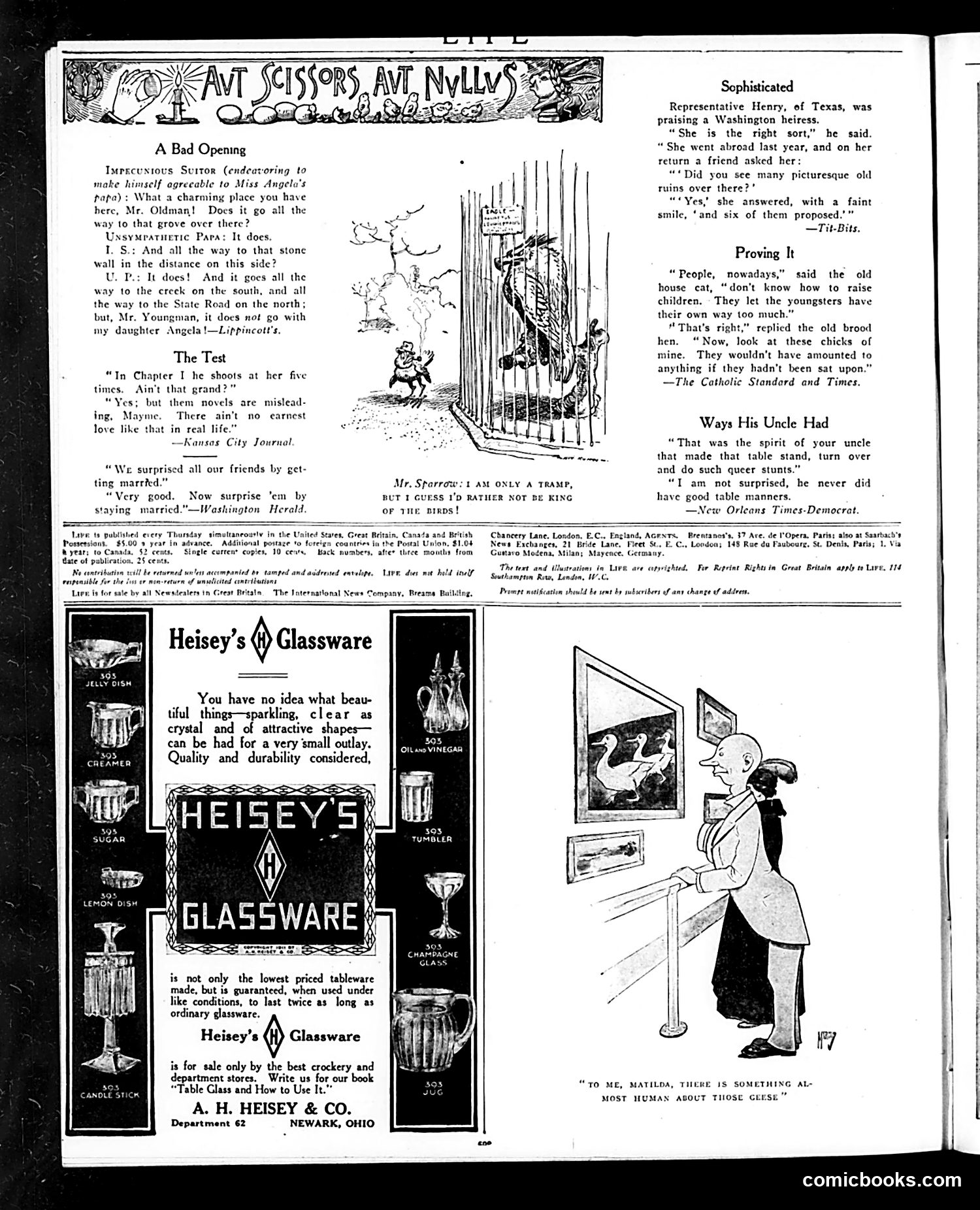
This page contains several short humorous pieces typical of early 20th-century satirical magazines: **"A Bad Opening"** jokes about an awkward suitor trying to impress his girlfriend's father by asking about property boundaries—only to learn the estate "does not go with my daughter." **"The Test"** contrasts novelistic gunplay with real-life romance, suggesting actual love lacks dramatic intensity. **"Sophisticated"** satirizes a wealthy Texas representative praising a heiress who claims European sophistication—her measure of success being marriage proposals rather than cultural experience. **"Proving It"** features animals (cat and hen) debating child-rearing, with the hen defending harsh discipline ("sat upon"). **"Ways His Uncle Had"** suggests a man's poor table manners explain supernatural table-turning tricks. The page is primarily filler content—brief jokes reprinted from other publications. A large advertisement for Heisey's Glassware occupies the lower half, typical of magazine monetization. One cartoon shows a man admiring artwork while commenting on geese's human qualities.
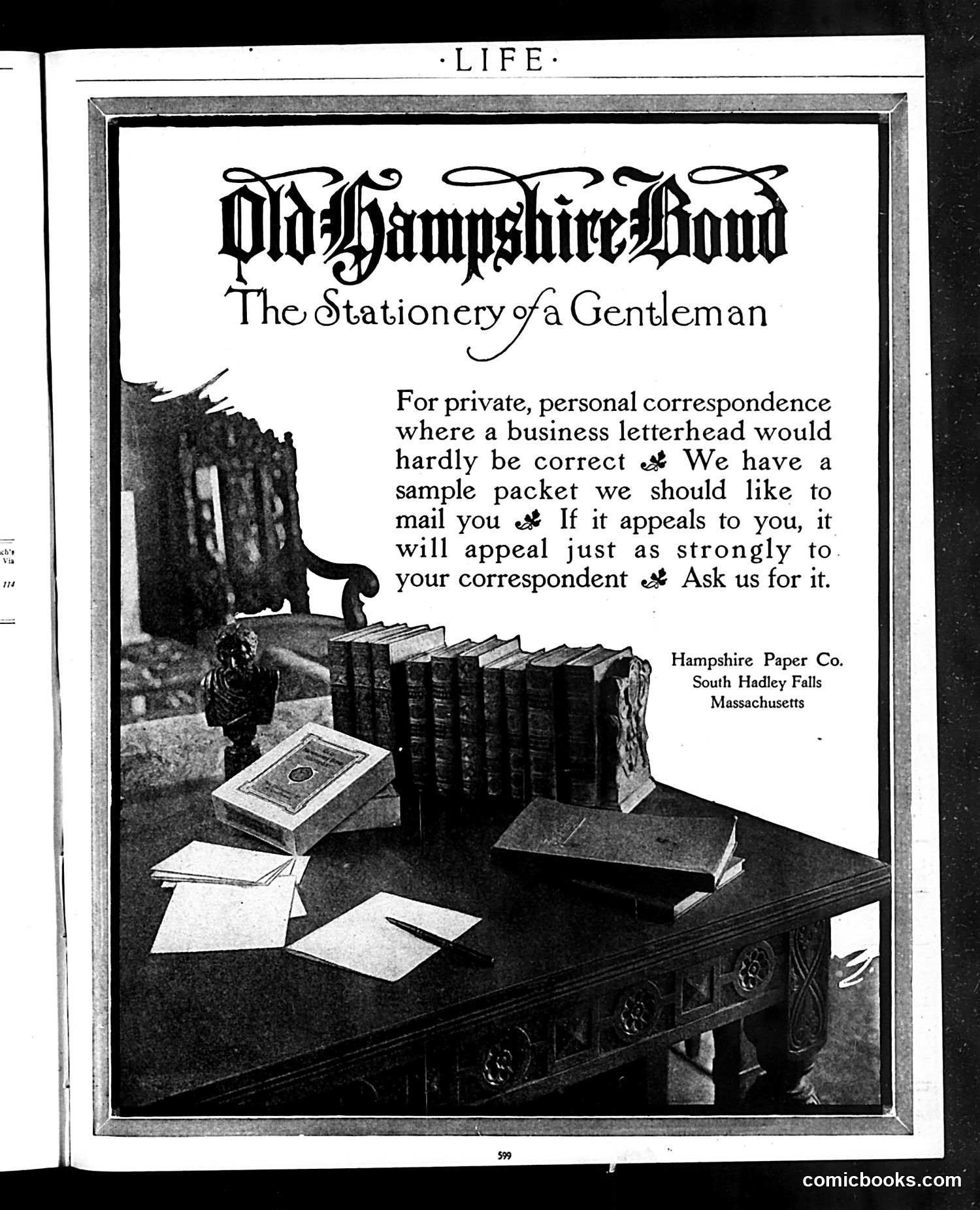
This is a **full-page advertisement**, not satirical content. It promotes "Old Hampshire Bond" stationery from Hampshire Paper Co. (South Hadley Falls, Massachusetts). The ad targets gentlemen seeking appropriate stationery for personal correspondence—distinguished from business letterhead. The image shows an elegant desk with leather-bound books, papers, and writing materials in a study or library setting, establishing a tone of refinement and gentility. The pitch emphasizes that if the stationery appeals to the advertiser's male reader, it will similarly impress his correspondents. The call-to-action invites requests for a sample packet. This reflects early 20th-century marketing that associated quality paper goods with social status and proper etiquette among middle and upper-class men.
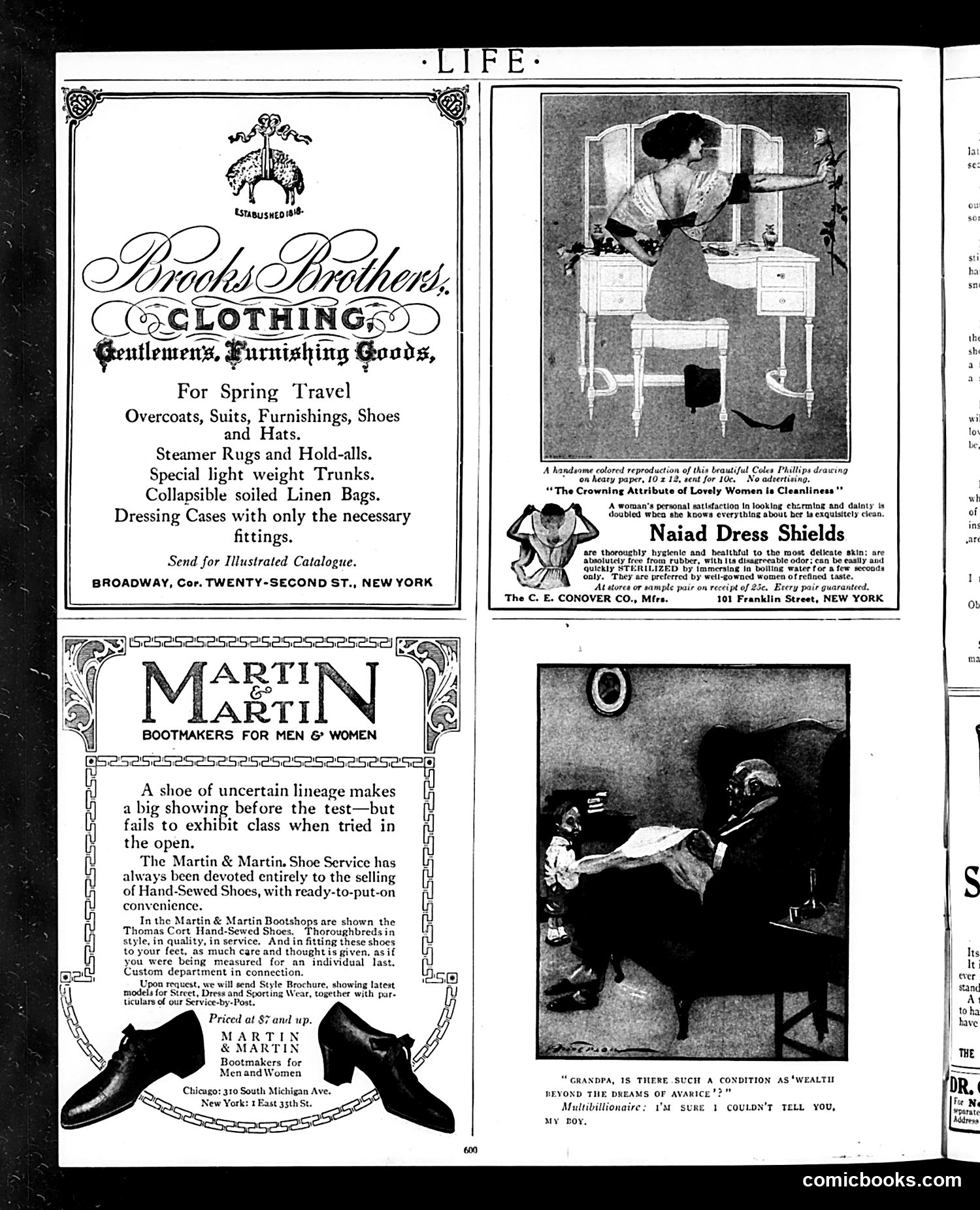
This page is primarily **advertising** with one cartoon at the bottom. The cartoon depicts a conversation between a young boy and an elderly wealthy man (labeled "Multibillionaire"). The child asks whether true wealth beyond avarice exists—a classical philosophical question. The joke is the multibillionaire's response: he admits he couldn't possibly know, implying his own wealth is so vast and consuming that he cannot fathom any limit to desire or accumulation. This satirizes the **Gilded Age/early 20th-century culture of extreme wealth concentration**. The humor targets robber barons and industrial magnates whose fortunes were incomprehensibly large, suggesting that obscene wealth corrupts one's ability to understand moderation or satisfaction. It's social commentary on American materialism and the moral bankruptcy of those whose ambitions exceed all reasonable bounds. The surrounding advertisements (Brooks Brothers, Martin & Martin shoes, Naiad Dress Shields) reflect the page's focus on luxury goods for the wealthy readership.
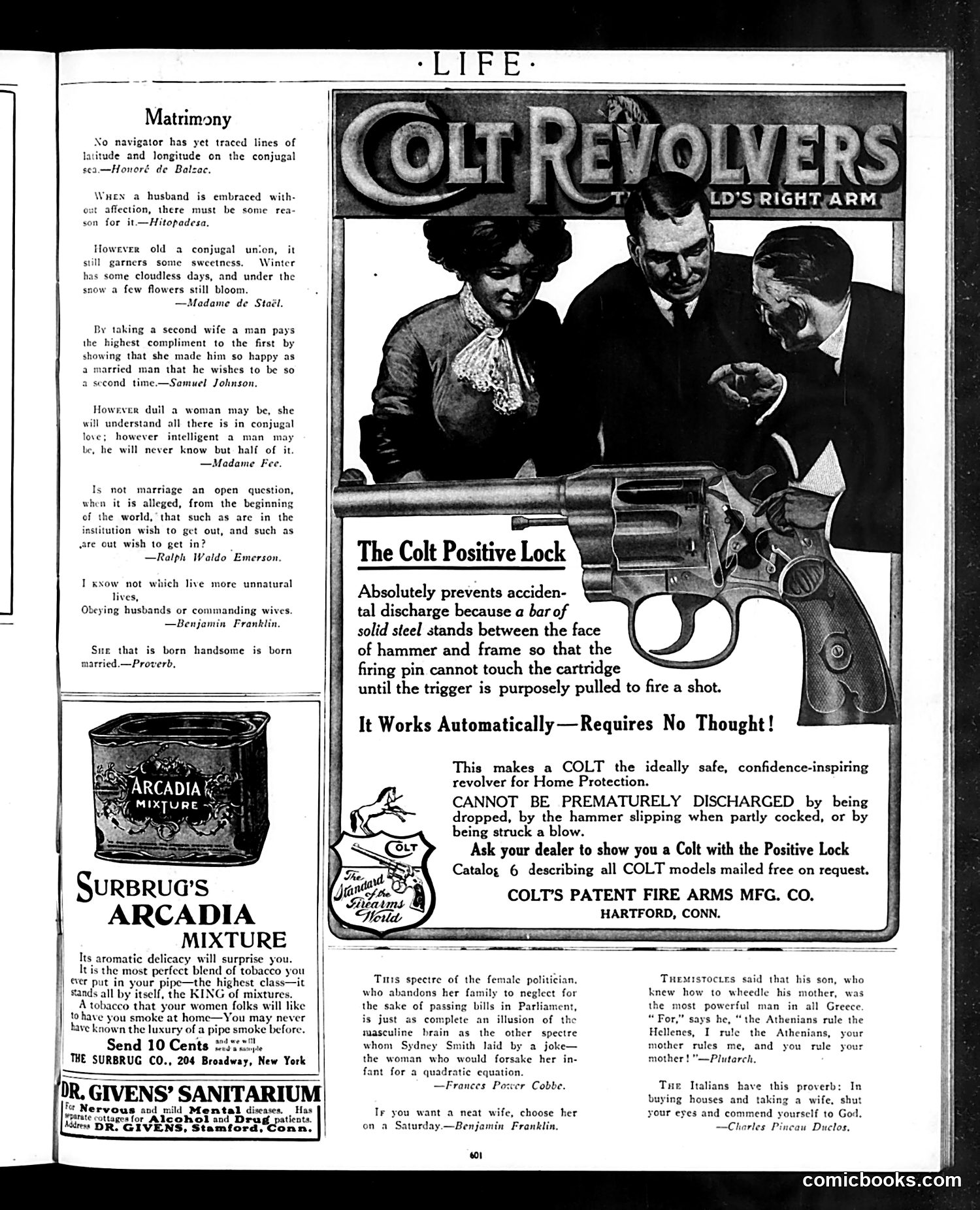
This page mixes satirical commentary on marriage with period advertising. **The "Matrimony" section** presents contradictory quotations about marriage from famous figures—Balzac, Johnson, Emerson, Franklin, and others—creating humor through their conflicting perspectives on conjugal life. The satire is gentle: marriage is simultaneously sweetness and drudgery, a mystery men cannot fully comprehend, and a trap people desperately want to escape or enter. **The advertisements** are period-appropriate: tobacco mixture, a sanitarium for "nervous and mild mental diseases," and notably, a **Colt revolver** marketed as safe for "Home Protection" with a "Positive Lock" preventing accidental discharge—a sales pitch emphasizing the gun won't fire without deliberate trigger-pulling, appealing to anxious householders. The juxtaposition is unintentional rather than satirical—this is simply how Life's pages were organized, mixing editorial content with paying ads. The revolver ad's emphasis on safety reflects early-20th-century concerns about household firearms and accident prevention.
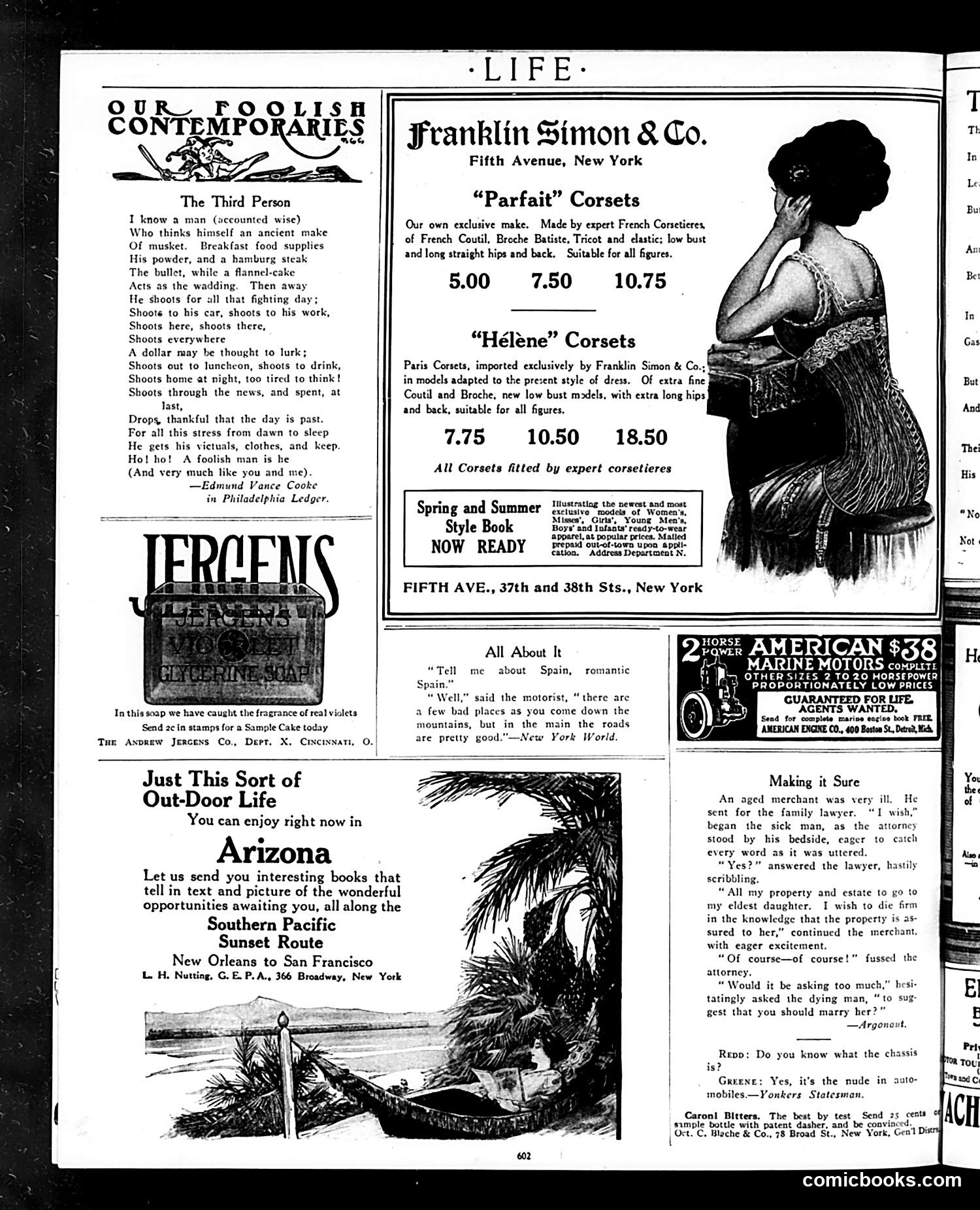
This page is primarily **advertisements and light humor**, not political satire. The main poem, "The Third Person" by Edmund Vance Cooke, satirizes the exhausting modern work life. It describes a man who metaphorically "shoots" (pursues money) from dawn until collapse—at his car, work, lunch, and home—earning only basic survival (food, clothes, shelter). The joke is the poem's ironic closing: calling him a fool "very much like you and me," suggesting this grinding routine was the relatable reality for early-20th-century readers. The page otherwise contains period advertisements for corsets (Franklin Simon & Co.), soap, marine motors, and travel to Arizona and California. There are also brief comic anecdotes about a dying merchant's will, and a joke about car terminology ("chassis" as the "nude" automobile). **No identifiable political figures or events appear.** The satire is social commentary on American work culture, not partisan politics.
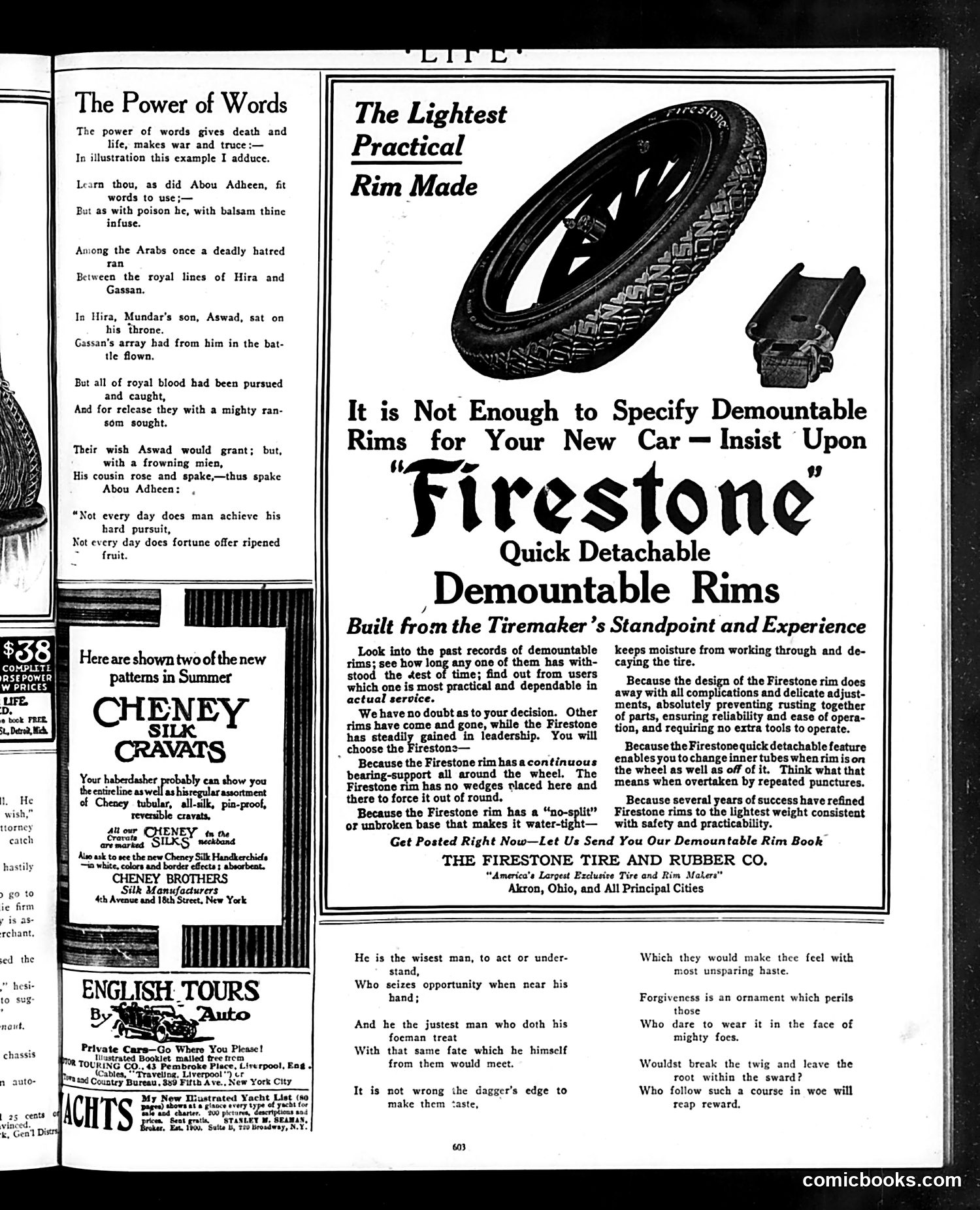
This page mixes editorial content with advertising. The left side presents a poem, "The Power of Words," illustrating an Arab parable about Abou Adheen's wise counsel to a king—essentially arguing that forceful words (like a dagger) are justified against enemies who would use them first. The poem emphasizes pragmatic justice over naive forgiveness. The right side features a substantial Firestone automobile rim advertisement, highlighting technical superiority: continuous bearing support, waterproof design, and quick-detachable features for changing inner tubes. This represents early 1900s automotive marketing, targeting car owners deciding on demountable rims—then a practical concern for vehicles prone to frequent punctures. The juxtaposition is coincidental rather than thematic. The page also includes smaller ads for Cheney cravats, English tours, and yacht rentals, reflecting *Life* magazine's dual function as satirical publication and high-end lifestyle periodical for affluent readers.
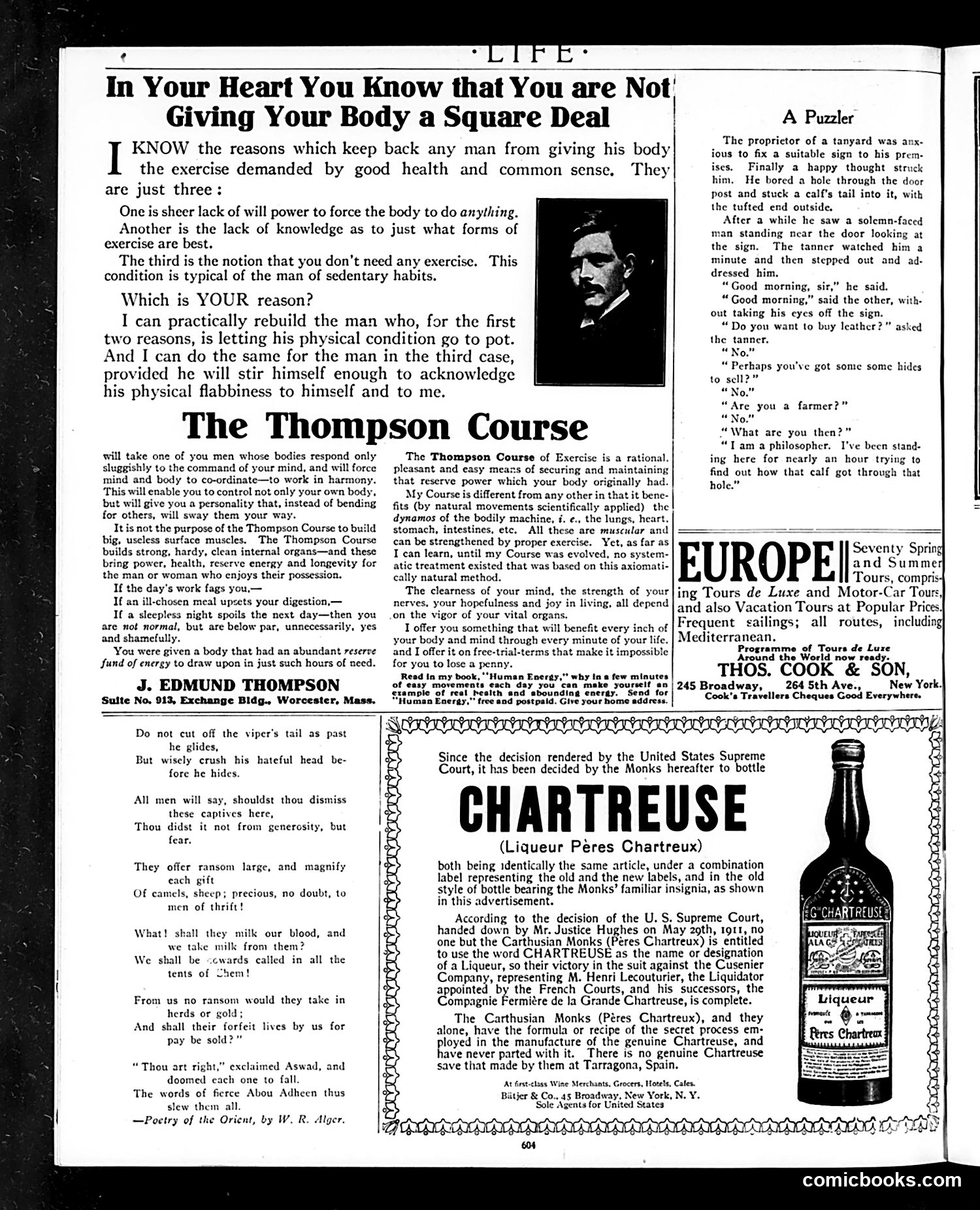
This page contains **early 20th-century health advertising and moral satire**, not political cartoons in the traditional sense. The main content is J. Edmund Thompson's exercise course advertisement, which targets sedentary men by shaming their physical inactivity. Thompson promises to rebuild "flabby" bodies through his systematic exercise program, appealing to masculine pride and vitality—a common sales pitch of the era when office work was expanding. The sidebar story "A Puzzler" is a joke about a tanner who hangs a calf's tail from his shop to advertise leather goods. A philosopher spends an hour trying to logically deduce how the calf fit through the hole—missing the obvious answer. It mocks intellectual pretension and overthinking. The Chartreuse liqueur ad below uses a legal decision about trademark labeling as marketing copy, claiming legitimacy from a Supreme Court ruling. Overall, the page reflects **early Progressive-era anxieties about sedentary modern life** while promoting consumerist solutions through exercise and products.
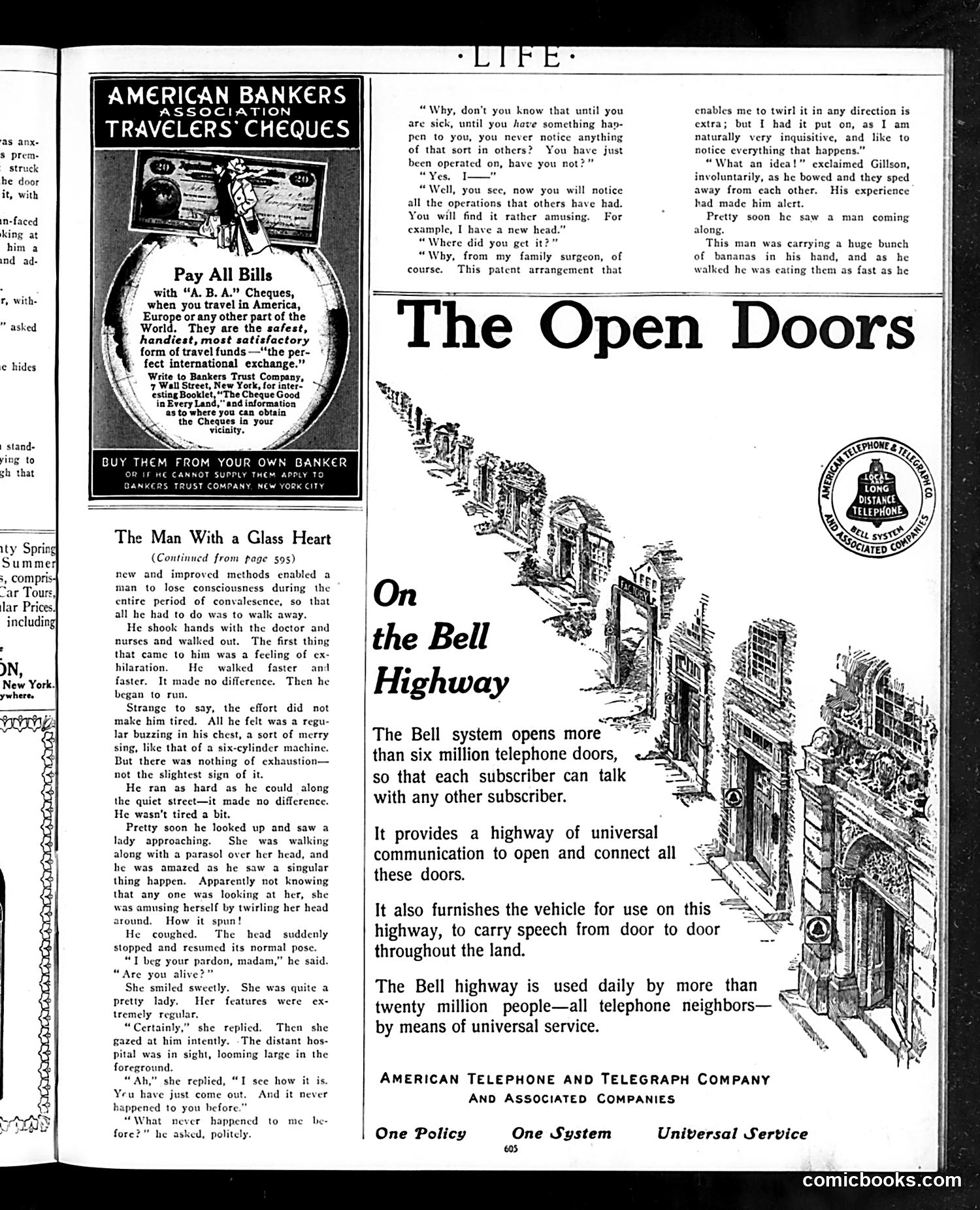
This page contains two distinct elements: a satirical short story and corporate advertising. **"The Man With a Glass Heart"** is a science-fiction satire about a man who undergoes surgery that gives him a transparent chest, allowing him to literally see others' internal organs. The story uses this surreal premise to satirize human curiosity and voyeurism—the protagonist becomes obsessed with observing others' "operations" (surgeries, life changes). It's absurdist social commentary on people's tendency to be nosy and fascinated by others' misfortunes. **"The Open Doors" advertisement** from American Telephone & Telegraph promotes the Bell telephone system using metaphor. The imagery of building facades with open doors symbolizes the accessibility of universal telephone communication—the system connects six million subscribers like doors opening to conversations nationwide. The copy emphasizes that telephone service reaches "twenty million people" daily, positioning AT&T as essential infrastructure enabling universal connection. Both pieces reflect early 20th-century American attitudes: curiosity about technology's transformative power and faith in corporate systems enabling social progress.
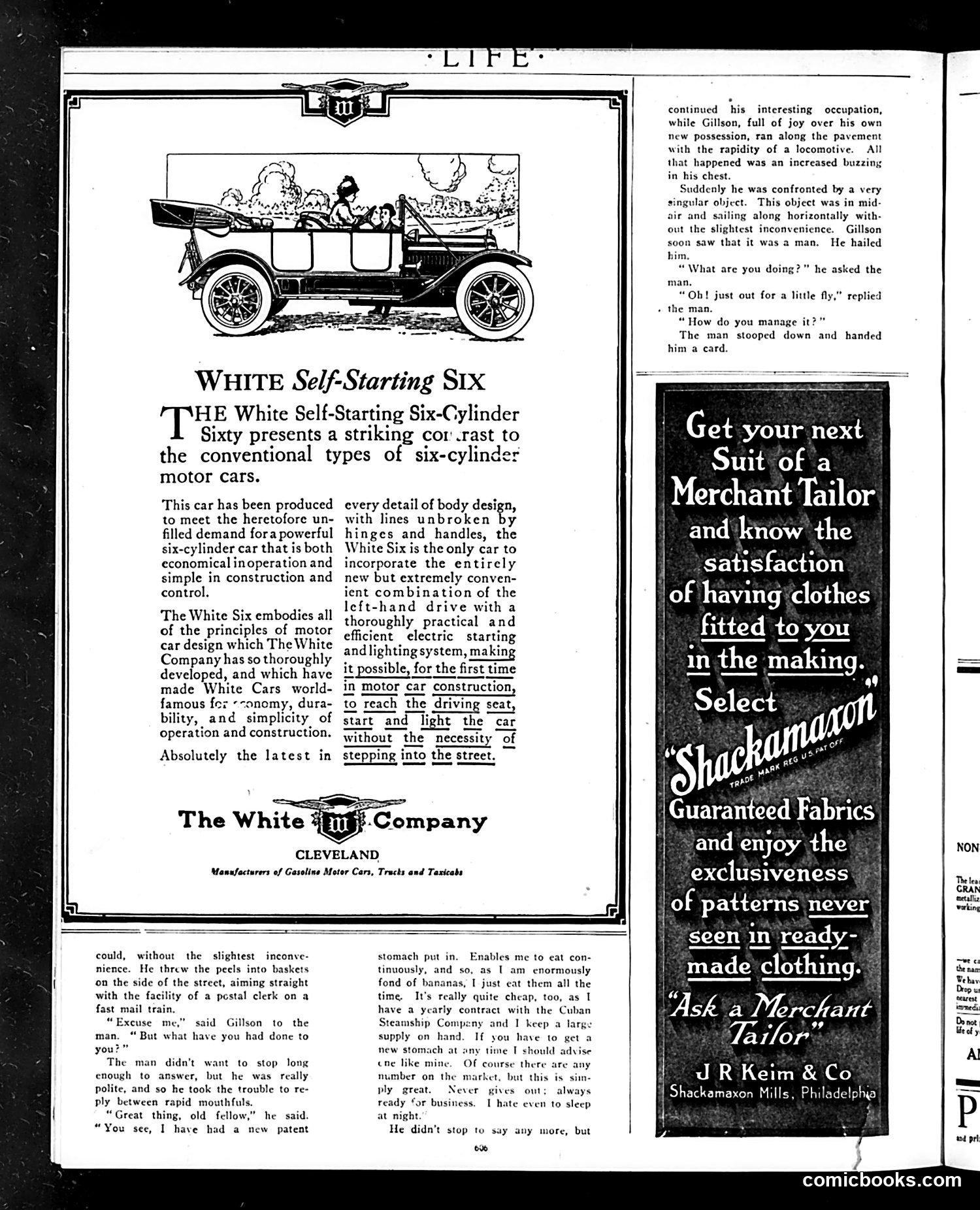
This page contains **two distinct pieces**: a car advertisement and a satirical story. **The White Self-Starting Six Advertisement** promotes a Cleveland automobile emphasizing its innovative features—particularly electric starting and left-hand drive, eliminating the need to crank-start the car from the street. This was cutting-edge technology for the era. **The Satirical Story** (right column) follows a character named Gillson encountering two absurd figures: a man with a "patent stomach" enabling continuous eating, and a flying man with a card. The joke satirizes turn-of-the-century medical and technological hubris—the breathless enthusiasm for new inventions solving human problems through mechanical means. The flying man represents the comedic extreme of this trend. The story mocks the era's faith that technology could fundamentally remake human capabilities and limitations. The humor relies on the contrast between Gillson's excitement over minor automotive advances and these invented "improvements" to the human body itself—exposing the period's sometimes naive optimism about progress.
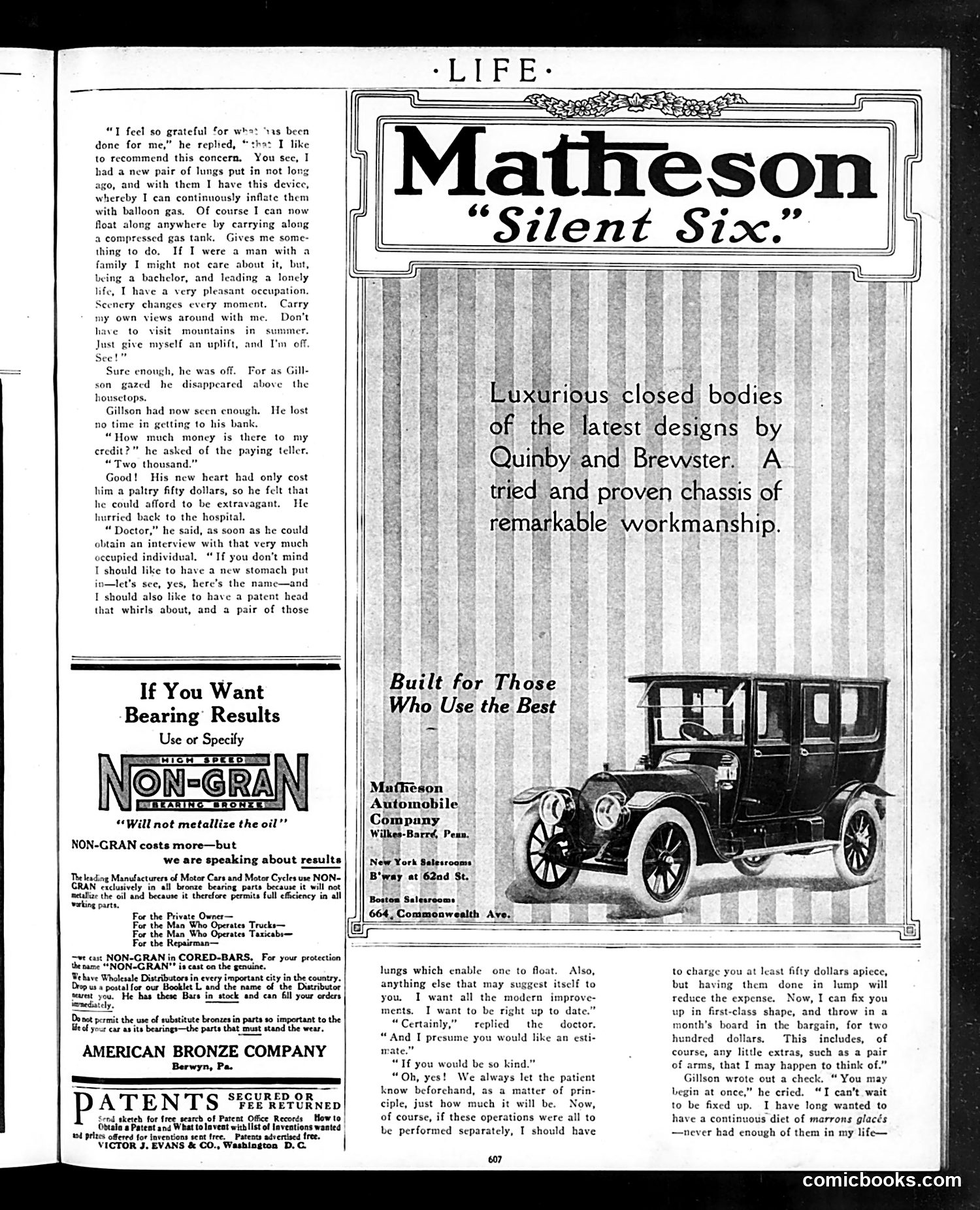
This page satirizes early-20th-century medical optimism and consumer culture's promise of perpetual self-improvement. The narrative follows a man named Gillson who visits a hospital and encounters a patient who has replaced his lungs with an apparatus allowing him to float via compressed gas—treating his body as casually replaceable machinery. The satire escalates when Gillson, inspired and emboldened by his modest bank balance ($2,000), decides to replace his heart, stomach, and head with patent improvements, treating human anatomy like automobile parts. The doctor cheerfully quotes bulk-discount pricing ("fifty dollars apiece"). The joke critiques the era's faith in technological solutions to human existence and the commodification of the body. It also mocks consumerism's logic: having money means one *should* spend it on unnecessary upgrades. The Matheson automobile advertisement below reinforces this—quality goods "for those who use the best"—suggesting the same consumer mentality applied to cars and bodies alike.
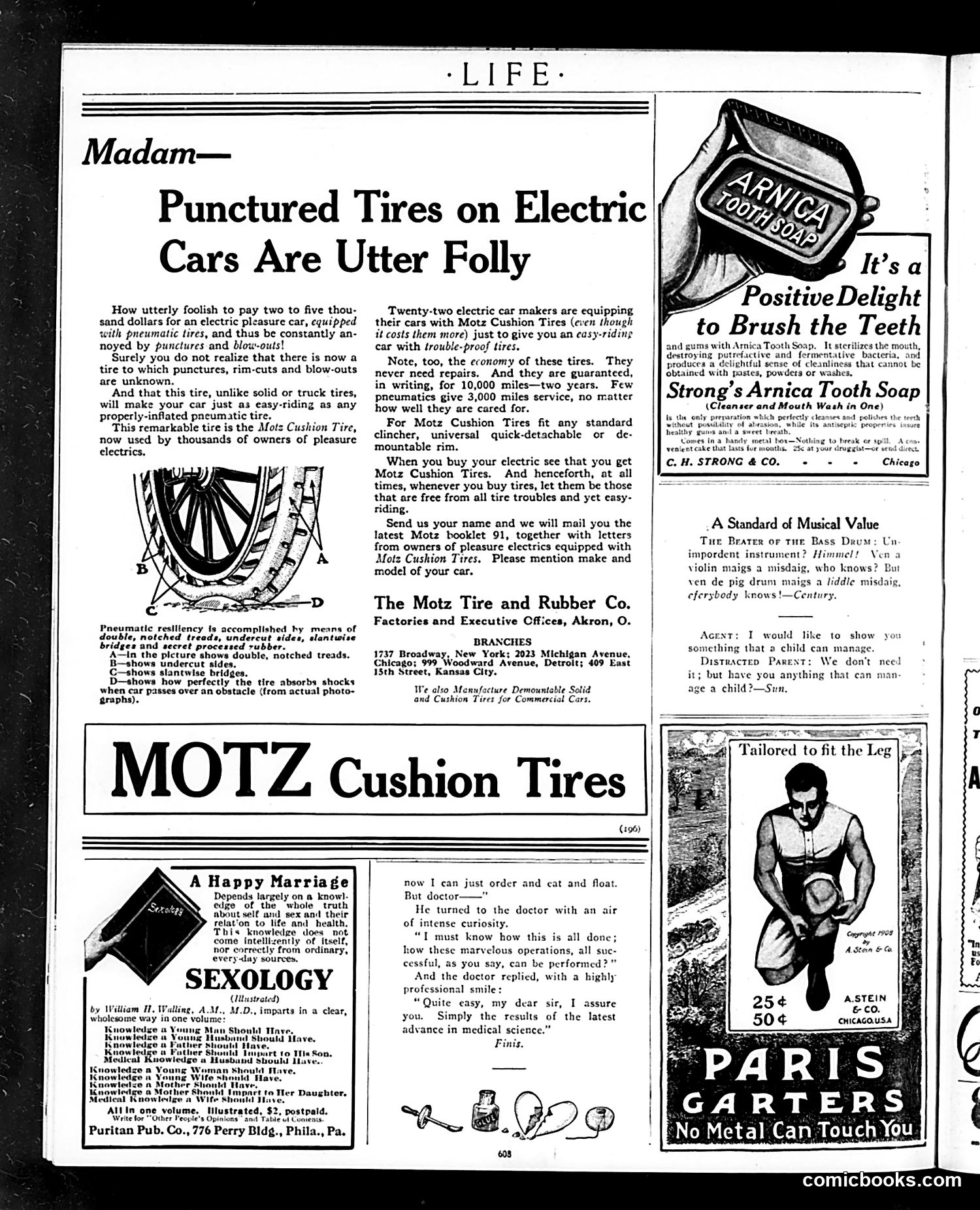
This page is primarily **advertising**, not satire or political commentary. The dominant content is a lengthy advertisement for Motz Cushion Tires, addressing a specific historical context: the early electric automobile market (circa 1910s). **The Motz Tire Appeal:** The ad targets owners of expensive electric cars, which were luxury vehicles prone to puncture problems with pneumatic (air-filled) tires. Motz offered a "cushion tire"—a solid tire with special internal structures (notched treads, undercut sides) designed to absorb shocks while avoiding punctures. The pitch emphasizes reliability and low maintenance for wealthy car owners. **Supporting Content:** Smaller ads include a "Sexology" educational book (addressing marriage/sexual health knowledge—then considered scandalous), Strong's Arnica Tooth Soap, and Paris Garters. **Historical Context:** This reflects an era when electric vehicles were viable luxury alternatives to gasoline cars, before gasoline engines dominated. The tire problem was genuine and significant for early auto adoption. The page contains no political cartoons or satirical commentary—it's straightforward period advertising.
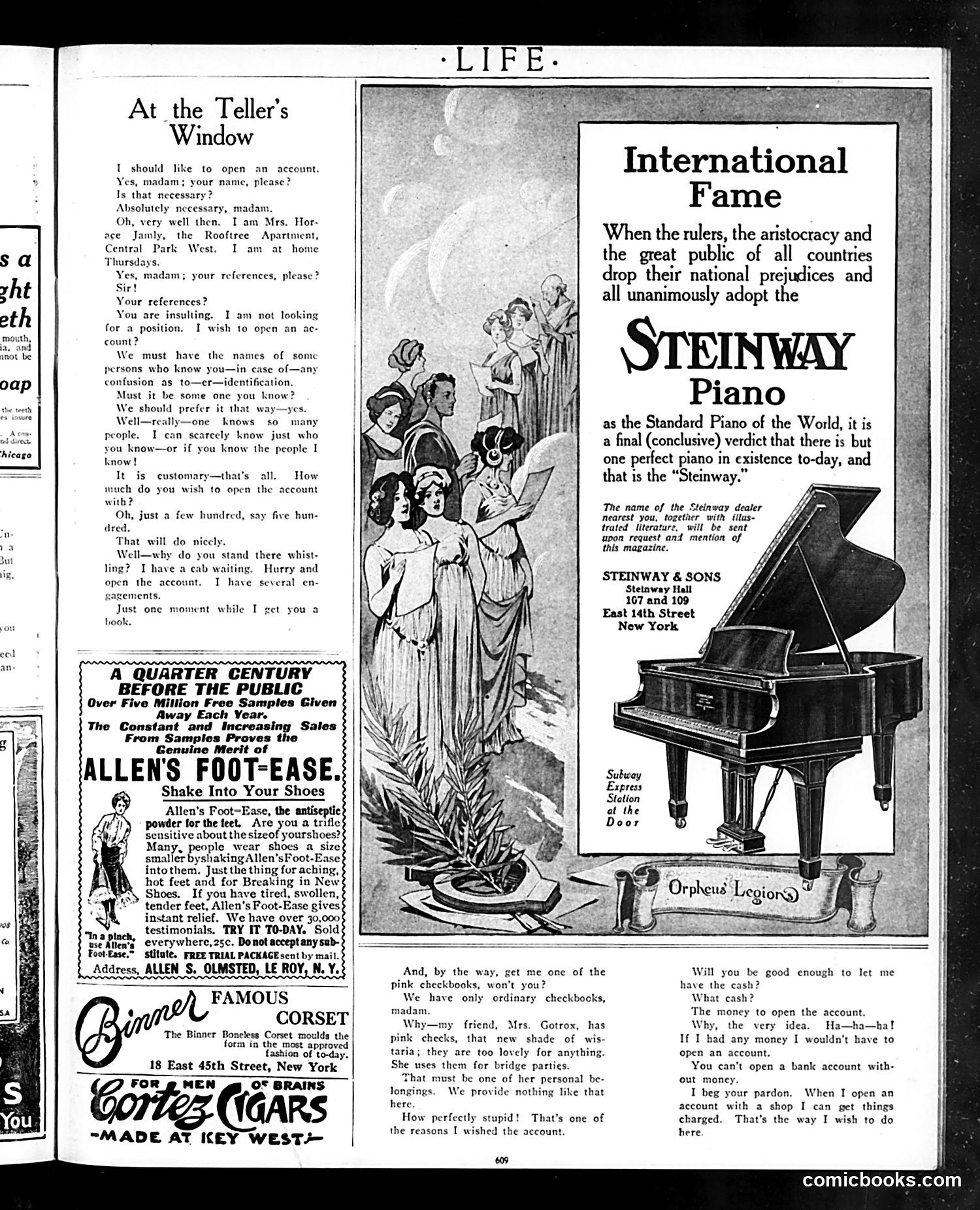
This is a satirical dialogue mocking wealthy, upper-class women's ignorance of banking procedures and entitlement. The cartoon depicts a fashionable woman (identified as "Mrs. Horace Jamly" from the "Rooftree Apartment, Central Park West") attempting to open a bank account but expecting special treatment. The humor targets her absurd assumptions: she's offended by basic identification requirements, impatient with standard procedures, and crucially, expects to open an account *without depositing money*—confusing banking with retail shopping where she can charge purchases. The satire exposes class privilege: wealthy women of this era often had limited financial literacy and assumed their social status exempted them from ordinary rules. Her demands for pink checkbooks (like her society friend Mrs. Gotrox) further emphasize frivolous materialism over substance. The page also contains period advertisements for Steinway pianos, Allen's Foot-Ease powder, Binner corsets, and Cortez cigars.
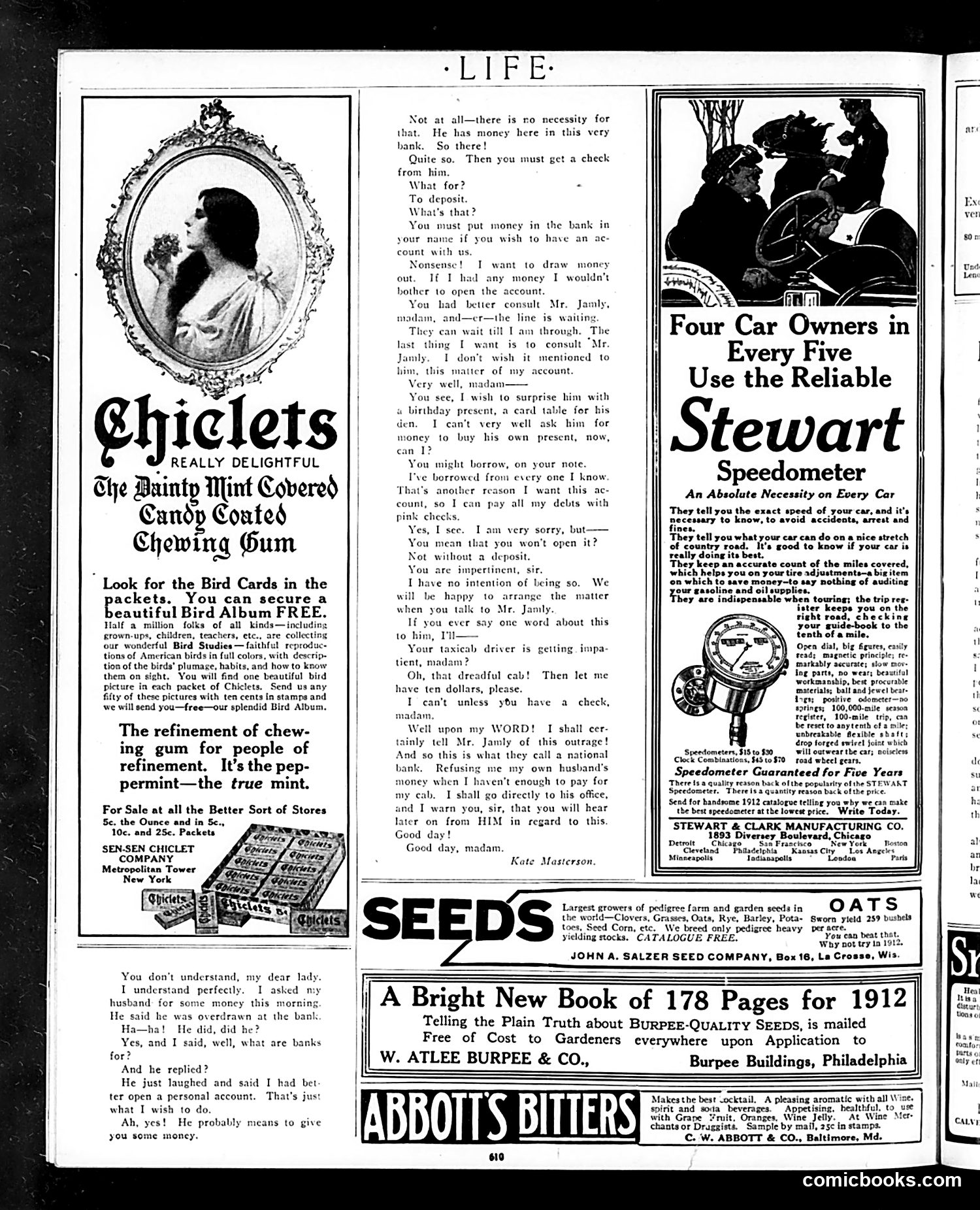
This page contains a **domestic comedy sketch** (center column) satirizing early 20th-century banking practices and marital dynamics. **The Sketch's Point:** A wife attempts to withdraw money from her husband's bank account to buy him a surprise birthday gift, but the bank refuses to let her access "his" money without a deposit or his direct authorization. When she threatens to tell her husband about this "outrage," the banker dismisses her complaint, assuming the husband will back the bank's policies. **The Satire:** The humor targets rigid banking rules that treated married women as financially powerless dependents. A wife cannot even access joint marital funds without her husband's involvement—even when spending *his* money on *him*. The sketch mocks both absurd bureaucracy and the assumption that husbands control all household finances, with the banker confidently expecting the husband's support. **Social Context:** This reflects pre-1920s America when married women had severely limited legal control over property and finances. The joke's absurdity was presumably meant to highlight these restrictive conditions, though modern readers may find it sobering rather than funny. The page also contains period advertisements (Chiclets, seeds, Abbott's Bitters, speedometers).
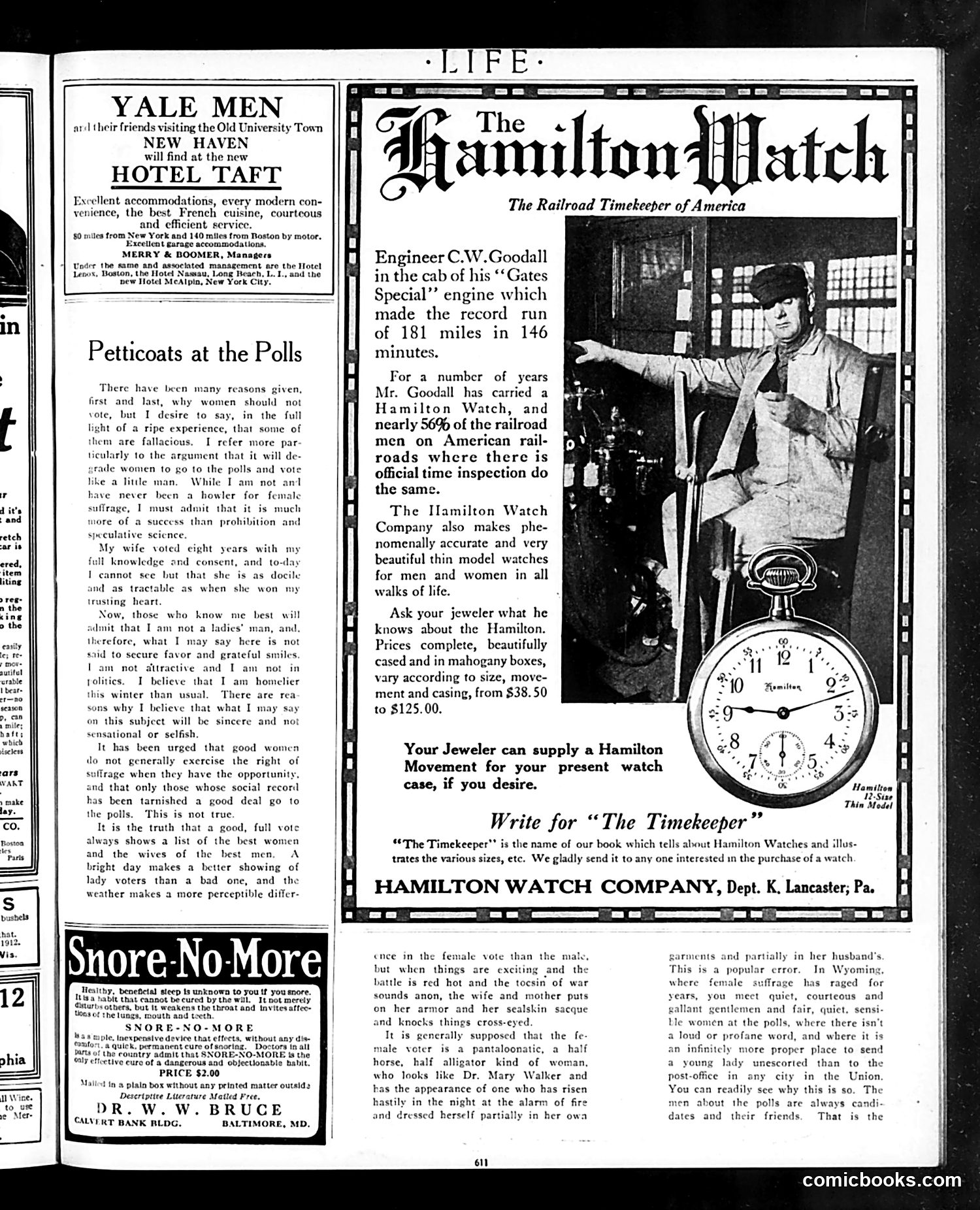
This article argues **in favor of women's voting rights**, contrary to common anti-suffrage claims. The author (appearing to be a male columnist) counters the argument that voting would "degrade women" by citing his own experience: his wife has voted for eight years and remains "tractable" and agreeable. He dismisses the claim that only morally questionable women vote, noting that full voter turnout lists show "the best women" and wives of prominent men participating. He argues that women in Wyoming—where female suffrage had existed for years—remain respectable and engaged citizens, particularly during significant events. The piece is a **pro-suffrage editorial**, written as a rebuttal to contemporary objections that voting was unfeminine or socially corrupting. This reflects the pre-1920 suffrage debate in America. The page is primarily **advertising** (Hamilton watches, Hotel Taft, Snore-No-More remedy), with this opinion piece as filler content.
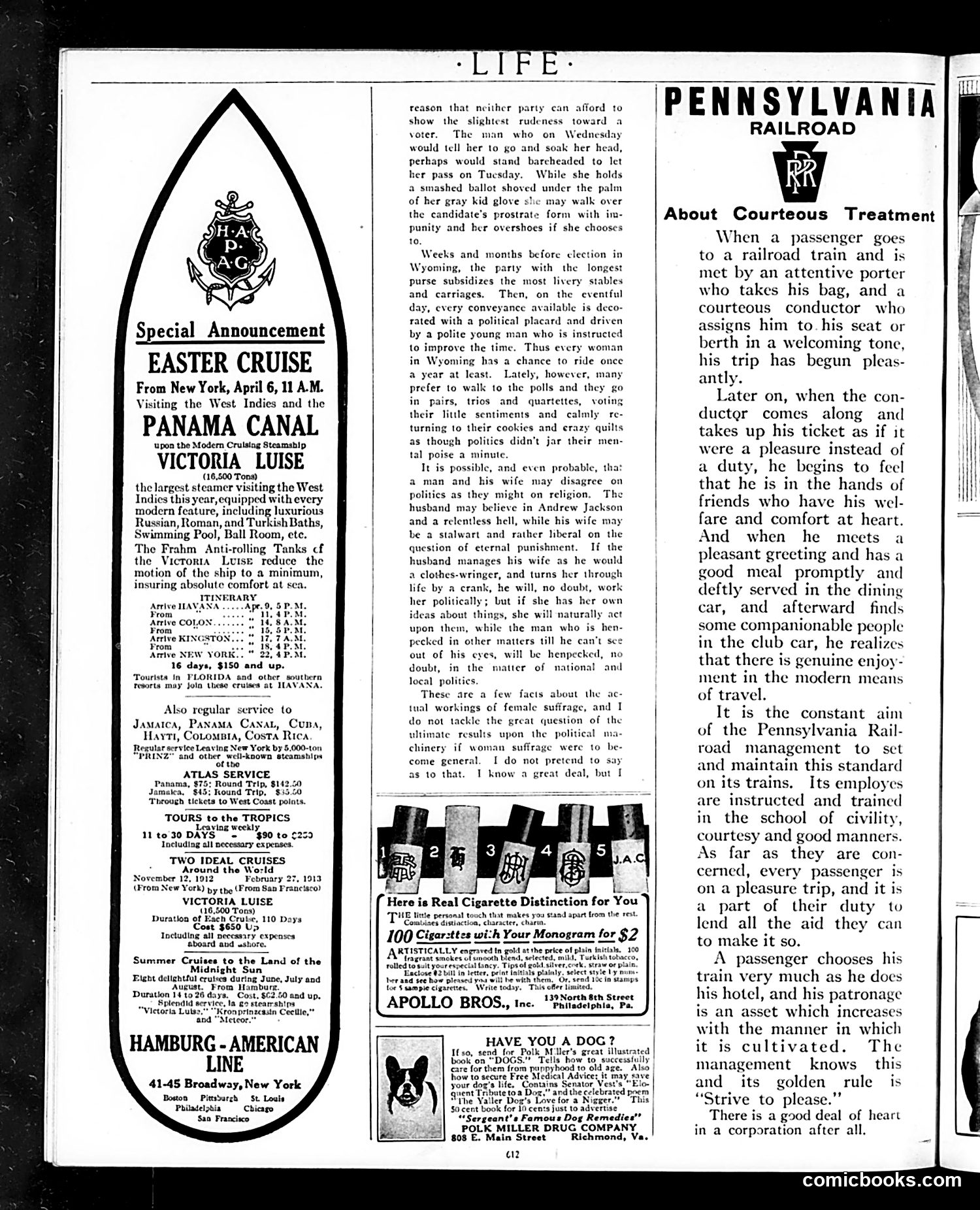
This page is primarily **advertising**, not political satire. The dominant content features cruise ship advertisements (Hamburg-American Line's Victoria Luise and other vessels) promoting Easter cruises to the Panama Canal and Caribbean destinations—luxury travel offerings from 1912-1913. The text article discusses **women's suffrage in Wyoming**, explaining how political parties court female voters with transportation to polls and how married couples might disagree on politics despite disagreeing on religion. It's a factual, somewhat bemused observation rather than satirical commentary. The cigarette and dog-care advertisements at bottom are standard period marketing. **No political cartoons appear on this page.** The content reflects early 20th-century attitudes toward newly enfranchised women voters—treating suffrage as novel and noting practical voting logistics—but this is straightforward journalism, not satire or caricature.
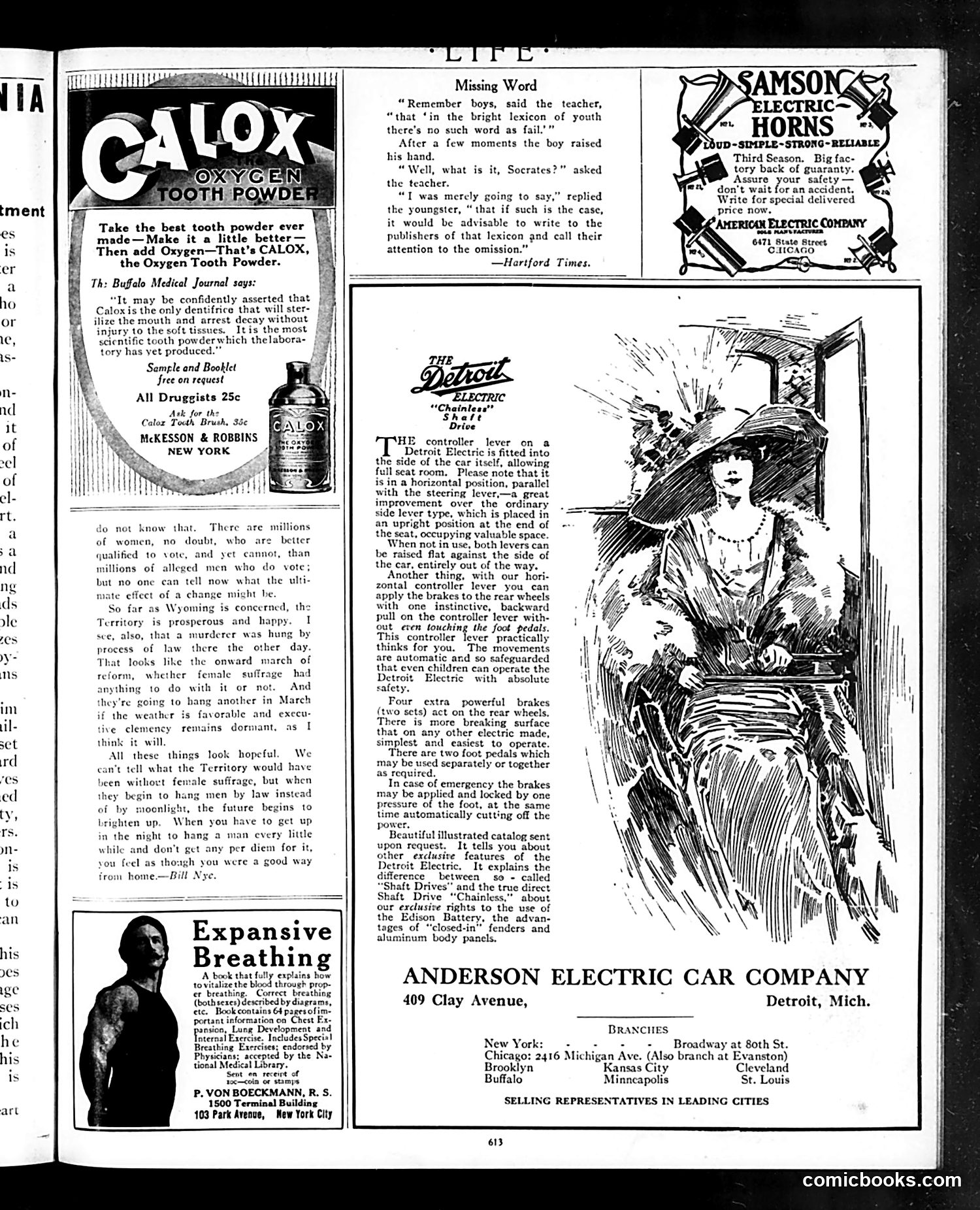
This page is primarily **advertising**, featuring product promotions for tooth powder, automobiles, and self-help books typical of early 20th-century magazines. The notable content includes: **"Missing Word" joke** (center): A schoolroom anecdote where a teacher claims youth's lexicon contains "no such word as fail." A student (named "Socrates" sarcastically) points out the obvious logical problem—if such a word doesn't exist, the dictionary publishers should be notified of the omission. The humor derives from the student's deadpan literalism exposing the teacher's sentimental platitude as nonsense. **Bill Nye commentary** (left): Discusses Wyoming's adoption of female suffrage, observing that hangings and law enforcement continue regardless—suggesting suffrage hasn't dramatically transformed society. The tone is satirical about reform claims. The remainder consists of advertisements: Calox Oxygen Tooth Powder (endorsed by medical authority), Samson Electric Horns, Detroit Electric automobiles, and a breathing exercise book. These reflect period consumer culture and technological optimism.
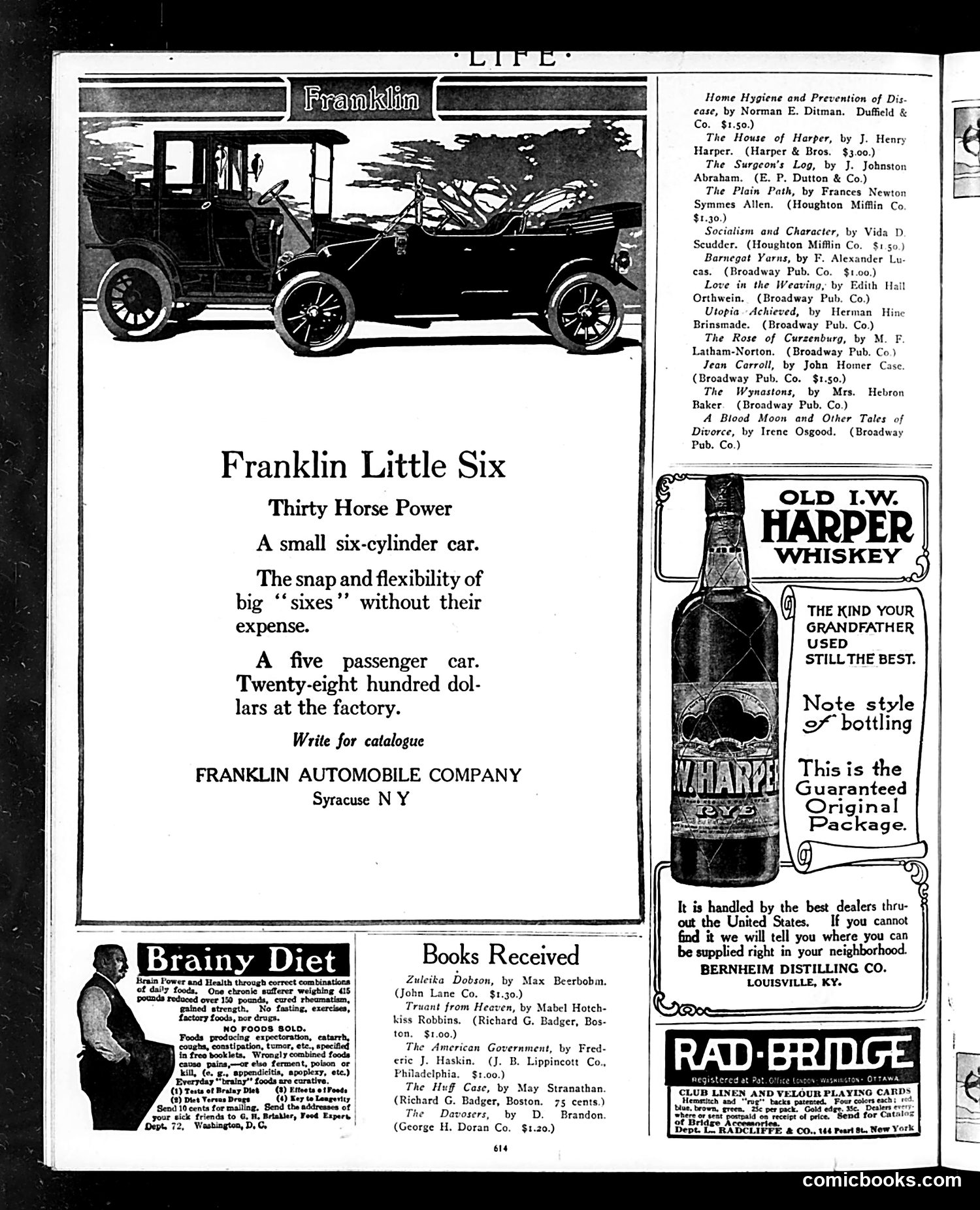
This page is primarily **advertising and book reviews**, not political satire. The main content includes: **Advertisements:** - **Franklin Little Six automobile**: A car manufacturer pitching their "small six-cylinder" vehicle as combining the performance of larger cars at lower cost ($2,800). Located in Syracuse, NY. - **Old I.W. Harper Whiskey**: Emphasizing tradition and guaranteed authenticity of the original package. - **Brainy Diet**: A health food company promoting their product as an alternative to drugs for treating various ailments. - **Rad-Bridge Playing Cards**: A manufacturer advertising club linen and velour cards. **Content:** The "Books Received" section lists newly published titles, mostly novels and non-fiction from early 20th-century publishers. There is **no political cartoon or satire** on this page—it's a typical magazine advertisement and book announcement spread from the era, reflecting consumer products and publishing of that time period.
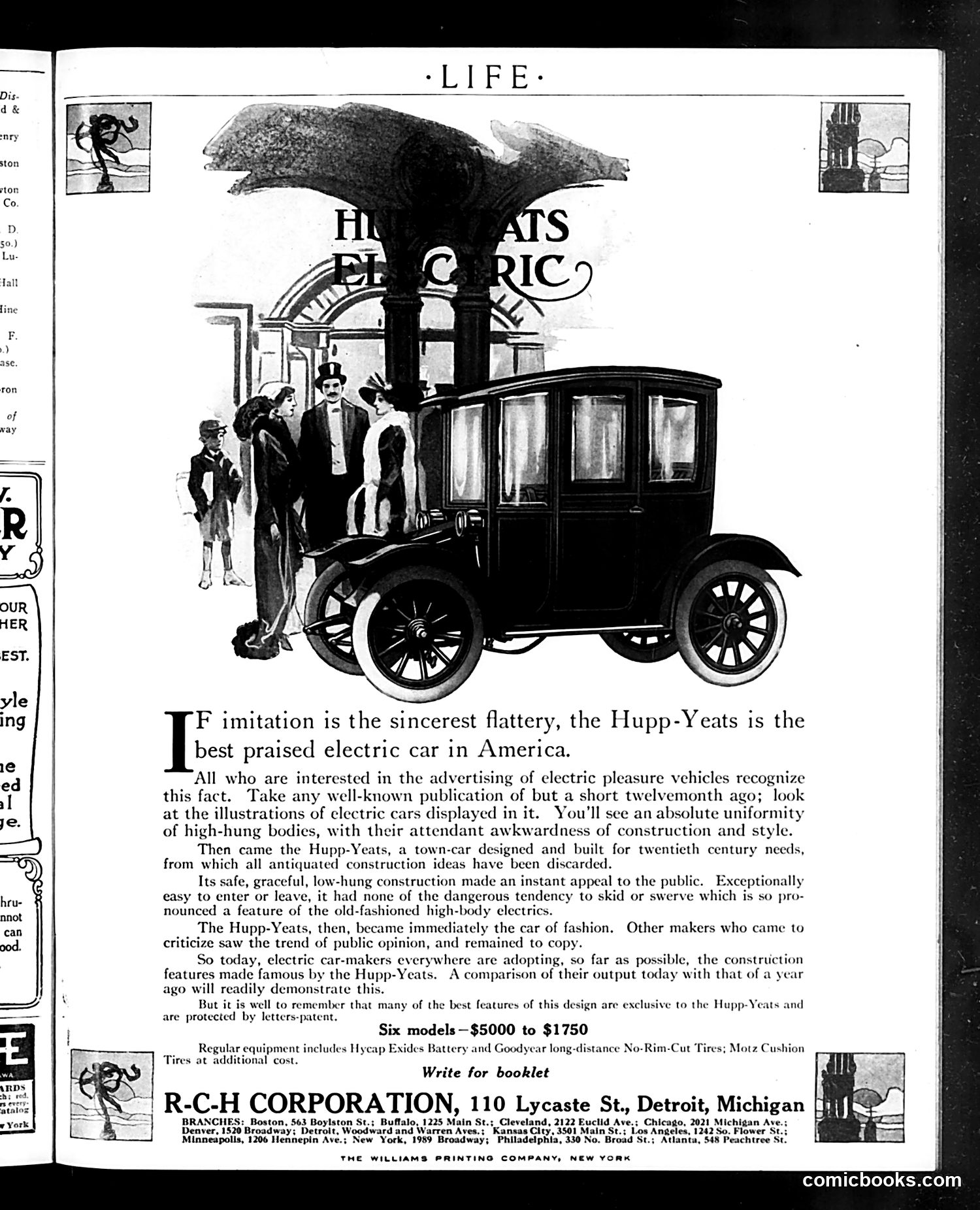
This is primarily a **product advertisement**, not satire or political content. It promotes the Hupp-Yeats electric automobile, manufactured by R-C-H Corporation in Detroit. The ad argues that the Hupp-Yeats has become the market leader by introducing superior design—specifically a lower-slung, safer body style—that competitors have rushed to imitate. The opening line ("imitation is the sincerest flattery") frames this copying as validation of the car's excellence. The illustration shows well-dressed passengers entering the vehicle, emphasizing it as a fashionable, safe choice for "twentieth century needs." The ad highlights technical features: Hycap Exides batteries, Goodyear tires, and patented design elements. This reflects the early 1900s electric car market, when such vehicles competed seriously with gasoline automobiles. No political figures or satirical figures are present—this is straightforward commercial messaging in *Life* magazine's advertising pages.