
Life, 1912-03-21 · page 12 of 52
Life — March 21, 1912 — page 12: what you’re looking at
What you’re looking at
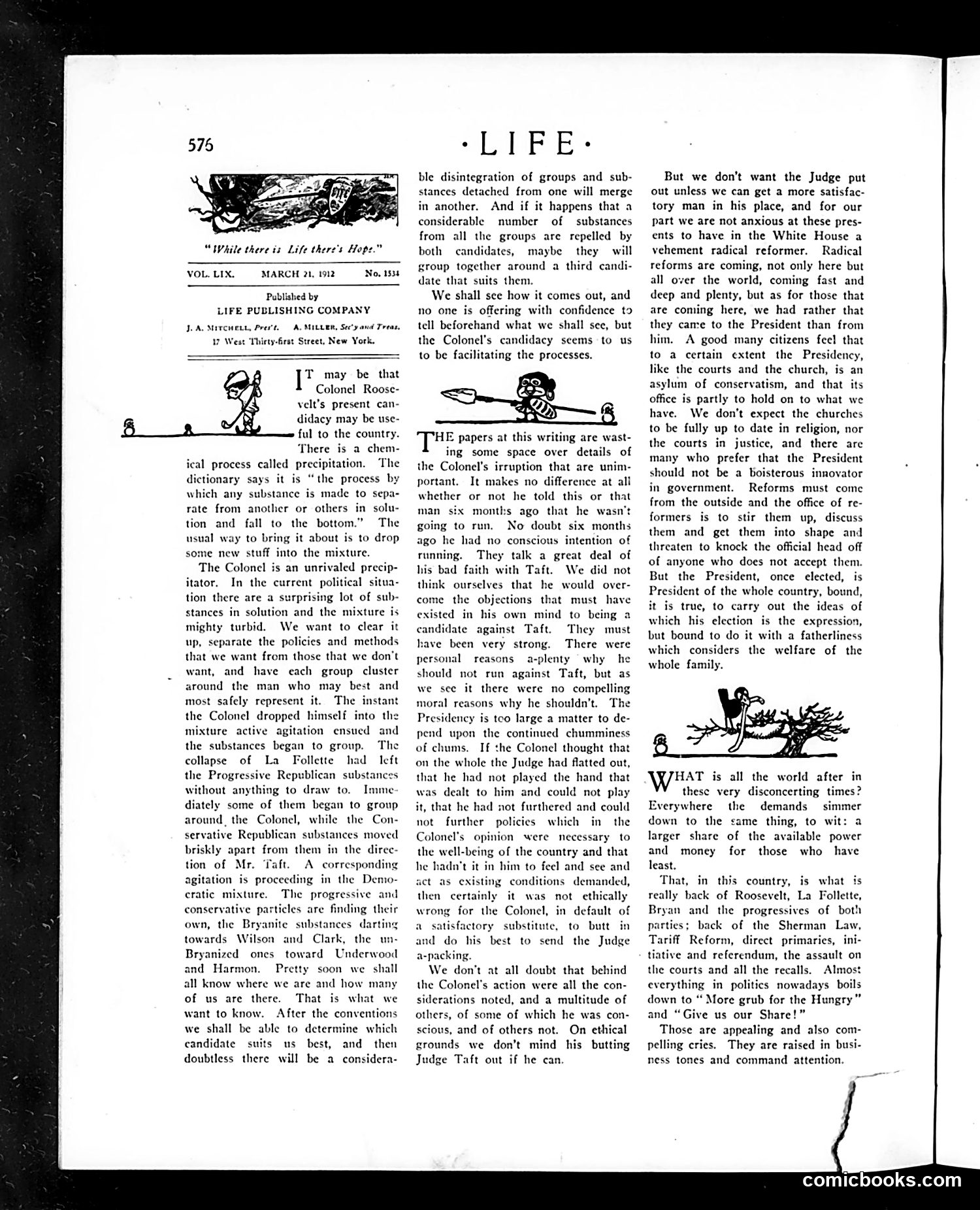
This page discusses Colonel Roosevelt's political positioning during what appears to be a pre-election period. The text examines whether Roosevelt will run for president again, noting he previously stated he wouldn't six months prior. The article argues that Roosevelt, as an "unrivaled precipitator" in politics, has created confusion among various political groups—progressive Republicans, conservatives, and others—by not clearly stating his intentions. The piece suggests that once elected, a president must faithfully execute the office's duties rather than pursue personal reform agendas. The cartoons (illustrations visible on the page) appear to satirize political maneuvering and uncertainty, though specific details are difficult to discern from the image quality. The overall tone critiques Roosevelt's apparent political ambiguity and its disruptive effects.
📄 Transcribed text from this page (OCR, searchable)
Machine-transcribed from the original scan — historical spelling and the odd misread are preserved.
“While there is Life there's Hops.” VOL. LIX. MARCH 21, 1912 No, 1534 Published by LIFE PUBLISHING COMPANY A. MILLER, Sey. Street, New York. JA. Mircwent, Prevt, Treas. A? West Thirty-fi I may be that Colonel Roose- velt’s present can- didacy may be use- ful to the country. There is a chem- ical process called precipitation. The dictionary says it is “the process by which any substance is made to sepa- rate from another or others in solu- tion and fall to the bottom.” The usual way to bring it about is to drop some new stuff into the mixture. The Colonel is an unrivaled precip- itator, In the current political situa- tion there are a surprising lot of sub- stances in solution and the mixture is mighty turbid. We want to clear it up, separate the policies and methods that we want from those that we don’t want, and have each group cluster around the man who may best and most safely represent it. The instant the Colonel dropped himself into the mixture active agitation ensued and the substances began to group. The collapse of La Follette had left the Progressive Republican substances without anything to draw to. Imme diately some of them began to group around, the Colonel, while the Con- servative Republican substances moved briskly apart from them in the diree- tion of Mr. ‘Taft. A corresponding agitation is proceeding in the Demo- cratic mixture. The progressive and conservative particles are finding their own, the Bryanite substances darting towards Wilson and Clark, the un- Bryanized ones toward Underwood and Harmon. Pretty soon we shall all know where we are and how many of us are there. That is what we want to know. After the conventions we shall be able to determine which candidate suits us best, and then doubtless there will be a considera- Se ee ble disintegration of groups and sub- stances detached from one will merge in another, And if it happens that a considerable number of substances from all the groups are repelled by both candidates, maybe they will group together around a third candi- date that suits them. We shall sce how it comes out, and no one is offering with confidence to tell beforehand what we shall see, but the Colonel's candidacy seems to us to be facilitating the processes. HE papers at this writing are wast- ing some space over details of the Colonel's irruption that are unim- portant. It makes no difference at all whether or not he told this or that man six months ago that he wasn’t going to run, No doubt six months ago he had no conscious intention of running. They talk a great deal of his bad faith with Taft. We did not think ourselves that he would over- come the objections that must have existed in his own mind to being a candidate against Taft. They must have been very strong. There were personal reasons a-plenty why he should not run against Taft, but as we see it there were no compelling moral reasons why he shouldn't. The Presidency is too large a matter to de- pend upon the continued chumminess of chums. If the Colonel thought that on the whole the Judge had flatted out, that he had not played the hand that was dealt to him and could not play it, that he had not furthered and could not further policies which in the Colonel's opinion were necessary to the well-being of the country and that he hadn't it in him to feel and see and act as existing conditions demanded, then certainly it was not ethically wrong for the Colonel, in default of a satisfactory substitute, to butt in and do his best to send the Judge a-packing. We don’t at all doubt that behind the Colonel's action were all the con- siderations noted, and a multitude of others, of some of which he was con- scious, and of others not. On ethical grounds we don’t mind his butting Judge Taft out if he can. But we don’t want the Judge put out unless we can get a more satisfac- tory man in his place, and for our part we are not anxious at these pres- ents to have in the White House a vehement radical reformer. Radical reforms are coming, not only here but all over the world, coming fast and deep and plenty, but as for those that are coming here, we had rather that they came to the President than from him. A good many citizens feel that to a certain extent the Presidency, like the courts and the church, is an asylum of conservatism, and that its office is partly to hold on to what we have. We don’t expect the churches to be fully up to date in religion, nor the courts in justice, and there are many who prefer that the President should not be a boisterous innovator in government. Reforms must come from the outside and the office of re- formers is to stir them up, discuss them and get them into shape and threaten to knock the official head off of anyone who does not accept them. But the President, once elected, is President of the whole country, bound, it is true, to carry out the ideas of which his election is the expression, but bound to do it with a fatherliness which considers the welfare of the whole family. HAT is all the world after in these very disconcerting times? Everywhere the demands simmer down to the same thing, to wit: a larger share of the available power and money for those who have least. That, in this country, is what really back of Roosevelt, La Follet Bryan and the progressives of bot! parties; back of the Sherman Law, Tariff Reform, direct primaries, ini tiative and referendum, the assault on the courts and all the recalls. Almo: everything in politics nowadays boils down to “ More grub for the Hungry” and “Give us our Share! Those are appealing and also com- pelling cries. They are raised in busi- ness tones and command attention. comicbooks.com