
Life, 1912-03-21 · page 22 of 52
Life — March 21, 1912 — page 22: what you’re looking at
What you’re looking at
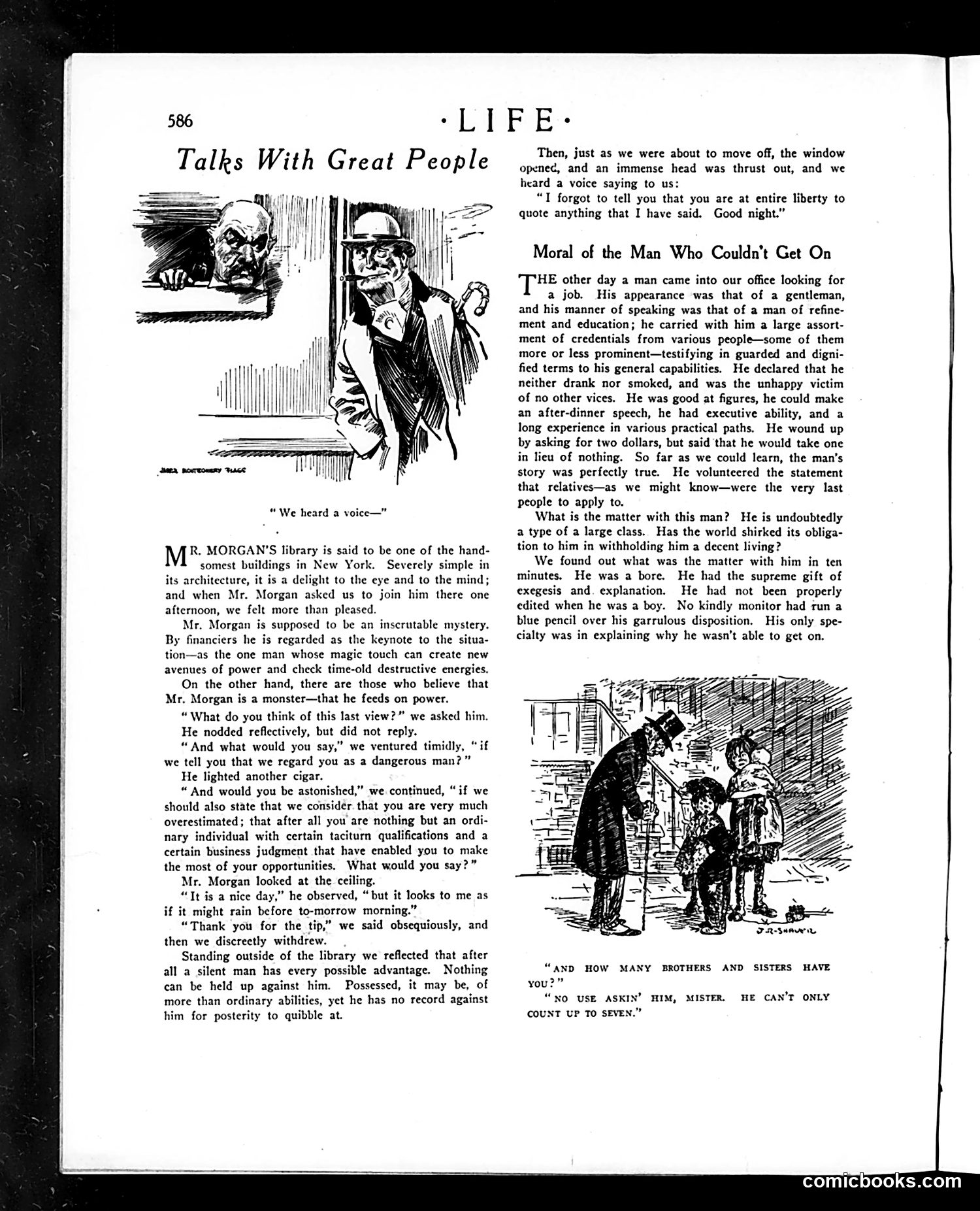
This page contains two satirical pieces about prominent figures and social types. **"Talks With Great People"** mocks **J.P. Morgan**, the powerful financier. The satire highlights Morgan's famous taciturnity—when pressed with provocative questions about being "dangerous" and "overestimated," he deflects with banalities about weather. The joke's moral: a silent man escapes public scrutiny because he leaves no record to criticize. Morgan's final comment about being "at entire liberty to quote" anything he said is ironic, since he said nothing substantive. **"Moral of the Man Who Couldn't Get On"** depicts a job applicant with impeccable credentials who cannot find employment. The twist: he's a *bore*. His fatal flaw is excessive explanation and verbosity—he wasn't "edited" as a boy. The accompanying cartoon jokes that he talks so much he "can't only count up to seven" when asked about siblings, suggesting his garrulousness prevents him from even basic communication. Both pieces satirize different aspects of American character: Morgan's calculated silence versus the job-seeker's uncontrolled verbosity—each a social liability.
📄 Transcribed text from this page (OCR, searchable)
Machine-transcribed from the original scan — historical spelling and the odd misread are preserved.
586 os) cia ola Talks With Great People “We heard a voice—” R. MORGAN'S library is said to be one of the hand- somest buildings in New York. Severely simple in its architecture, it is a delight to the eye and to the mind; and when Mr. Morgan asked us to join him there one afternoon, we felt more than pleased. Mr. Morgan is supposed to be an inscrutable mystery. By financiers he is regarded as the keynote to the situa- tion—as the one man whose magic touch can create new avenues of power and check time-old destructive energies. On the other hand, there are those who believe that Mr. Morgan is a monster—that he feeds on power. “What do you think of this last view?” we asked him. He nodded reflectively, but did not reply. “ And what would you say,” we ventured timidly, “if we tell you that we regard you as a dangerous man?” He lighted another cigar. “ And would you be astonished,” we continued, “if we should also state that we consider. that you are very much overestimated; that after all you are nothing but an ordi- nary individual with certain taciturn qualifications and a certain business judgment that have enabled you to make the most of your opportunities. What would you say?” Mr. Morgan looked at the ceiling. “It is a nice day,” he observed, “but it looks to me as if it might rain before to-morrow morning.” “Thank you for the tip,” we said obsequiously, and then we discreetly withdrew. Standing outside of the library we reflected that after all a silent man has every possible advantage. Nothing can be held up against him. Possessed, it may be, of more than ordinary abilities, yet he has no record against him for posterity to quibble at. Then, just as we were about to move off, the window openec, and an immense head was thrust out, and we heard a voice saying to us: “T forgot to tell you that you are at entire liberty to quote anything that I have said. Good night.” Moral of the Man Who Couldn't Get On TH other day a man came into our office looking for a job. His appearance was that of a gentleman, and his manner of speaking was that of a man of refine- ment and education; he carried with him a large assort- ment of credentials from various people—some of them more or less prominent—testifying in guarded and digni- fied terms to his general capabilities. He declared that he neither drank nor smoked, and was the unhappy victim of no other vices. He was good at figures, he could make an after-dinner speech, he had executive ability, and a long experience in various practical paths. He wound up by asking for two dollars, but said that he would take one in lieu of nothing. So far as we could learn, the man’s story was perfectly true. He volunteered the statement that relatives—as we might know—were the very last people to apply to. What is the matter with this man? He is undoubtedly a type of a large class. Has the world shirked its obliga- tion to him in withholding him a decent living? We found out what was the matter with him in ten minutes. He was a bore. He had the supreme gift of exegesis and. explanation. He had not been properly edited when he was a boy. No kindly monitor had run a blue pencil over his garrulous disposition. His only spe- cialty was in explaining why he wasn’t able to get on. TR-SHM “AND HOW MANY BROTHERS AND SISTERS HAVE you?” NO USE ASKIN’ HIM, MISTER. COUNT UP TO SEVEN.” HE CAN’T ONLY comicbooks.com