
Life, 1912-03-21 · page 25 of 52
Life — March 21, 1912 — page 25: what you’re looking at
What you’re looking at
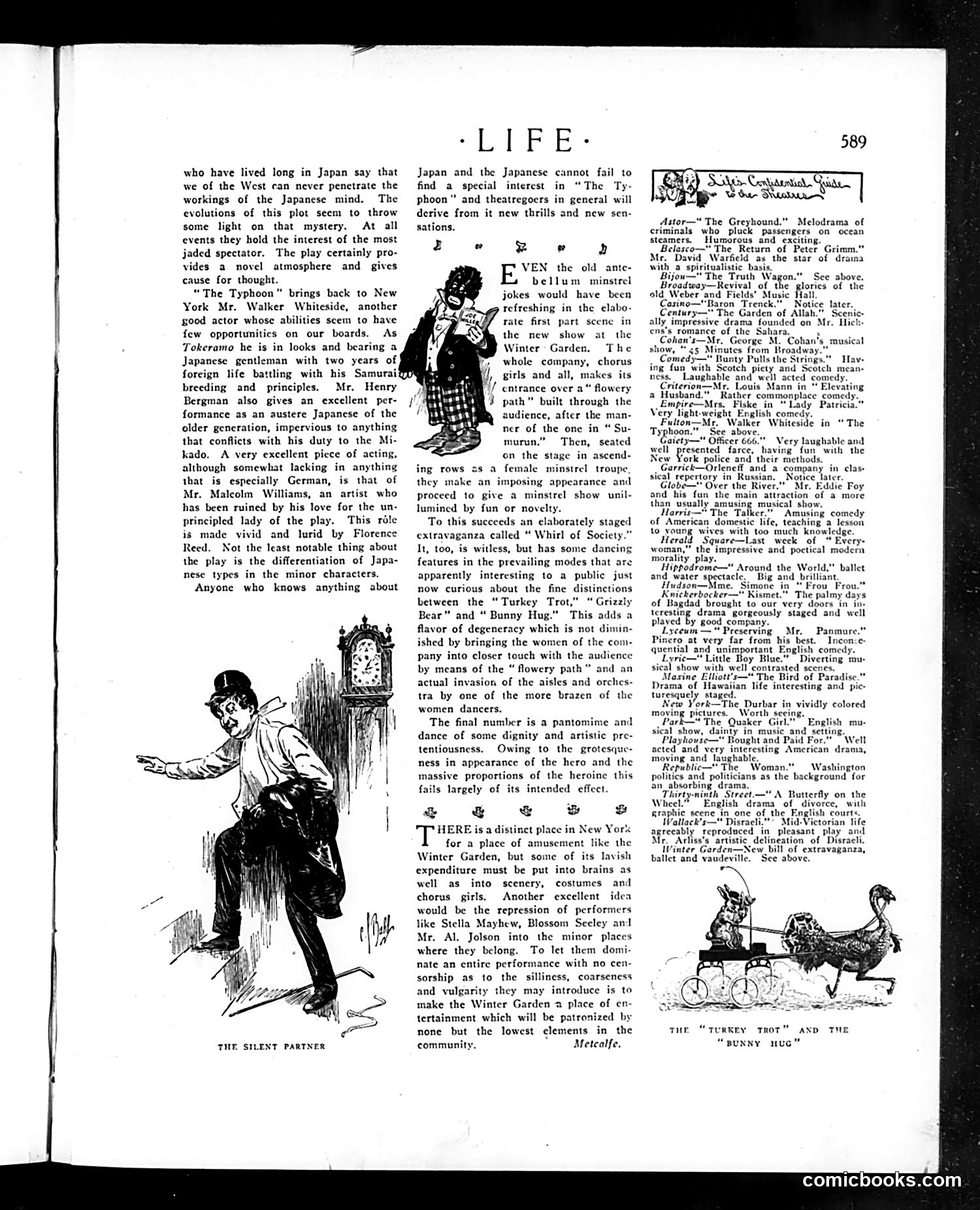
This page reviews theatrical productions, primarily critiquing the Winter Garden show. The main cartoon, "The Silent Partner," depicts a man in formal dress observing a woman—likely satirizing romantic or financial entanglements in theater. The text attacks the Winter Garden's production for relying on spectacle over substance. It praises "The Typhoon," a play featuring Japanese characters that differentiates between types, and actor Walker Whiteside's performance. However, it harshly criticizes the Winter Garden's "Whirl of Society" extravaganza as witless, calling out performers Stella Mayhew, Blossom Seeley, and Al Jolson for introducing "silliness, coarseness and vulgarity." The reviewer (Metcalfe) argues the theater wastes money on scenery and chorus girls while neglecting intelligent content, claiming this attracts "none but the lowest elements in the community"—reflecting era-typical class anxieties about popular entertainment and respectability.
📄 Transcribed text from this page (OCR, searchable)
Machine-transcribed from the original scan — historical spelling and the odd misread are preserved.
who have lived long in Japan say that we of the West can never penetrate the workings of the Japanese mind. The evolutions of this plot seem to throw some light on that mystery. At all events they hold the interest of the most jaded spectator. The play certainly pro- vides a novel atmosphere and gives cause for thought. “The Typhoon” brings back to New York Mr. Walker Whiteside, another 00d actor whose abilities scem to have few opportunitics on our boards. As Tokeramo he is in looks and bearing a Japanese gentleman with two years of foreign life battling with his Samurai: breeding and principles. Mr. Henry Bergman also gives an excellent per- formance as an austere Japanese of the older generation, impervious to anything that conflicts with his duty to the Mi- kado. A very excellent piece of acting, although somewhat lacking in anything that is especially German, is that of Mr. Malcolm Williams, an artist who has been ruined by his love for the un- principled lady of the play. is made vivid and lurid by Florence Reed. Not the least notable thing about the play is the differentiation of Japa- nese types in the minor characters. Anyone who knows anything about THE SILENT PARTNER *LIFE® Japan and the Japanese cannot fail to find a special interest in “The Ty- phoon" and theatregoers in general will derive from it new thrills and new sen- sations. eB ) Es the old ante- bellum minstrel jokes would have been refreshing in the elabo- rate first. part i the new show at the Winter Garden, The whole company, chorus girls and all, makes its entrance over a“ flowery path” built through the audience, after the man- ner of the one in “ Su- murun,” Then, seated on the stage in ascend- ing rows as a female minstrel troupe, they make an imposing appearance and proceed to give a minstrel show unil- lumined by fun or novelty. To this succeeds an elaborately staged extravaganza called “ Whirl of Society.” It, too, is witless, but has some dancing features in the prevailing modes that are apparently interesting to a public just now curious about the fine distinctions between the “Turkey Trot,” “ Grizzly Bear” and “ Bunny Hug.” This adds a flavor of degeneracy which is not dimin- ished by bringing the women of the com- pany into closer touch with the audience by means of the “flowery path” and an actual invasion of the aisles and orches- tra by one of the more brazen of the women dancers. The final number is a pantomime and dance of some dignity and artistic pre- tentiousness. Owing to the grotesque- ness in appearance of the hero and the massive proportions of the heroine this fails largely of its intended effect. & & & m BS HERE isa distinct place in New York for a place of amusement like the Winter Garden, but some of its lavish expenditure must be put into brains as well as into scenery, costumes and chorus girls. Another excellent idea would be the repression of performers like Stella Mayhew, Blossom Seeley and Mr. Al. Jolson into the minor places where they belong. To let them domi- nate an entire performance with no cen- sorship as to the silliness, coarseness and vulgarity they may introduce is to make the Winter Garden a place of en- tertainment which will be patronized by none but the lowest clements in the community, Metcalfe. scene in Astor— The Greyhound.” Melodrama of criminals who pluck passengers on ocean steamers. Humorous and exciting. Belosco—" The Return of Peter Grimm." Mr. David Warfield as the star of drama with a spiritualistic basis, Bijou—" The Truth Wagon.” Sce above. Broadway—Revival of the glories of the old Weber and Fields’ Music Hall Casino—"Baron Trenck.” Notice later. Century—" The Garden of Allah.” Scenic- ally impressive drama founded on Mr. Hich- ens’s romance of the Sahara. Cohan's—Mr. George M. Cob: show, 45 Minutes from Hroadway. _ Comedy— Bunty Pulls the Strings.” Hav- ing fun with Scotch picty and Scotch mear ness. Laughable and well acted comedy. Criterion—Mr. Louis Mann in “ Elevat a Husband.” Rather commonplace comed _Empire—Mrs, Fiske in “Lady Patricia, Very light-weight English comedy. Fulton—Mr, Walker Whiteside in “ The Typhoon.” See above. ‘aiety—" Officer 666."" Very laughable and well presented farce, ‘having fun with the New York police and their methods. _ Garrick—Orleneff and a company sical repertory in Russian. Notice later. Globe—" Over the River.” Mr. Eddie Foy and his fun the main attraction of a more than usually amusing musical show. Harris—* The Talker.” Amusing comedy of American domestic life, teaching a lesson to voung wives with too much knowledge. Herald Square—Last week of “ Every: woman,” the impressive and poctical modern morality. play. Hippodrome—" musical in clase ‘ound the World,” ballet and water spectacl Big and brilliant. Hudson—Mme. ‘ou Frou. Knickerbocker—" Kismet.” The palmy days of Bagdad brought to our very doors in in- teresting drama gorgeously staged and well played by good company. Lyceum —" Preserving Mr, Panmure. Pinero at very far from his best. Inconce- quential and unimportant English’ comedy. Lyric—" Little Boy Blue.” Diverting mu sical show with well contrasted scenes. Maxine Elliott’s—" The Bird of Paradise.” Drama of Hawaiian life interesting and pic- turesquely staged. New York—The Durbar in vividly colored moving pictures. Worth seeing. Park— The Quaker Girl." English mu- sical show, dainty in music and setting. Playhouse—" Bought and Paid For.” Welt acted and very interesting American drama, i d laughable. “The Woman.” Washington politics and politicians as the background for an absorbing drama. ninth Street—" A Butterfly on the English drama of divorce, with graphic scene in one of the English courts Wallack’s—" Disracli.”’ Mid-Victorian life agreeably reproduced in pleasant and Mr. Arliss’s artistic delineation of Disraeli. Winter Garden—New bill of extravaganza, ballet and vaudeville. See above, Turn “TURKEY TROT” BUNNY AND THE uuc” comicbooks.com