
Life, 1912-03-21 · page 17 of 52
Life — March 21, 1912 — page 17: what you’re looking at
What you’re looking at
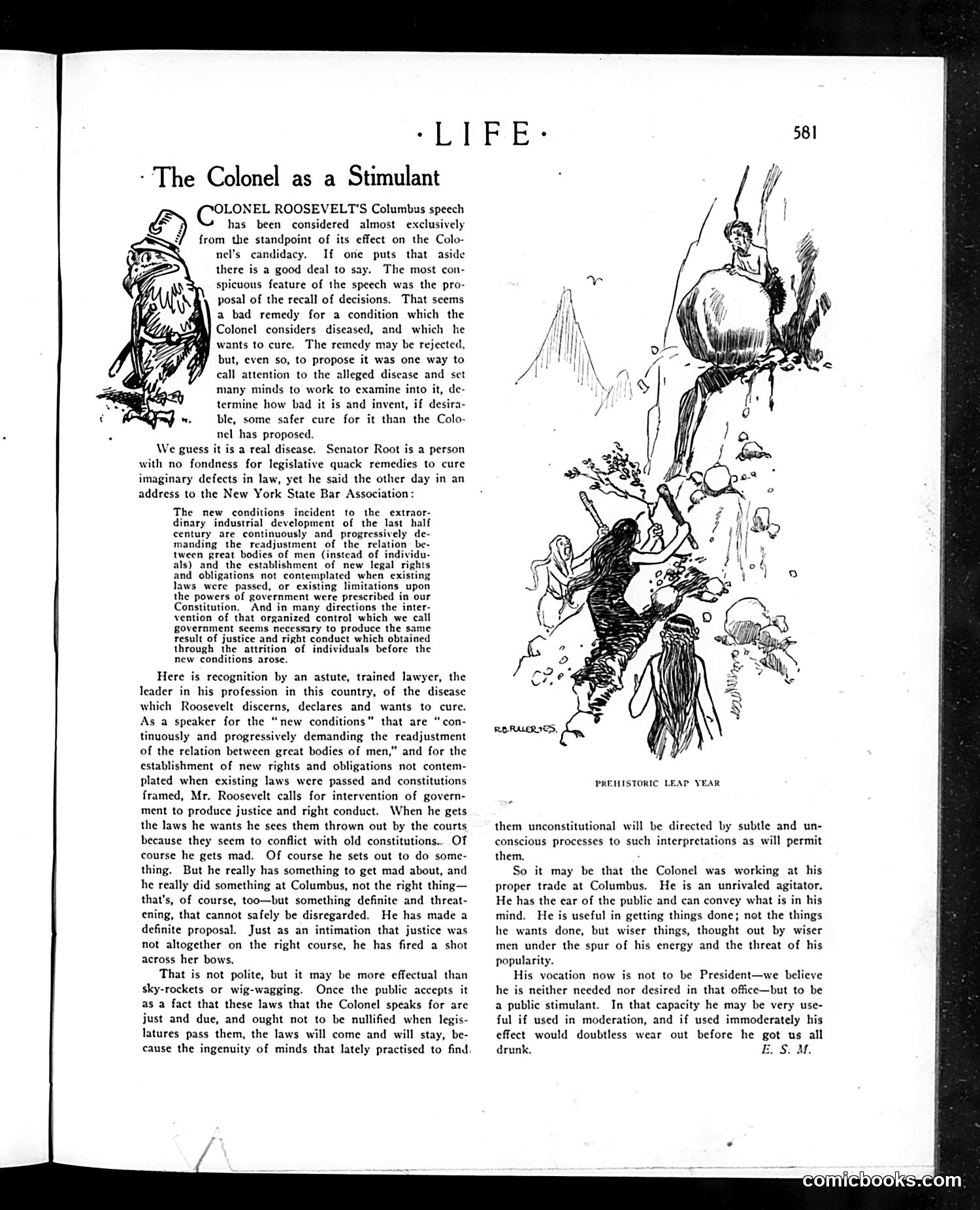
This article analyzes Theodore Roosevelt's Columbus speech, which proposed "recall of decisions"—allowing voters to overturn court rulings. The accompanying cartoon, titled "Prehistoric Leap Year," depicts figures climbing a large rock formation, illustrating Roosevelt as an agitator pushing society forward. The text argues Roosevelt's true value isn't his specific proposals but his ability to stimulate public discussion about real problems: industrial development has created social conditions the Constitution didn't anticipate, yet courts repeatedly strike down reform legislation as unconstitutional. The author (E.S.M.) contends Roosevelt functions as a "public stimulant"—his provocative proposals may fail, but they force the public and lawmakers to confront genuine injustices and eventually craft better solutions. The piece treats Roosevelt not as a serious presidential candidate but as a useful agitator whose energy drives progressive change, even if indirectly.
📄 Transcribed text from this page (OCR, searchable)
Machine-transcribed from the original scan — historical spelling and the odd misread are preserved.
JULIE: - The Colonel as a Stimulant \OLONEL ROOSEVELT'S Columbus speech has been considered almost exclusively from the standpoint of its effect on the Colo- nel’s candidacy. If one puts that aside there is a good deal to say. The most con- spicuous feature of the speech was the pro- posal of the recall of decisions. That seems a bad remedy for a condition which the Colonel considers diseased, and which he wants to cure. The remedy may be rejected, but, even so, to propose it was one way to call attention to the alleged disease and set many minds to work to examine into it, de- termine how bad it is and invent, if desira- ble, some safer cure for it than the Colo- nel has proposed. We guess it is a real disease. Senator Root is a person with no fondness for legislative quack remedies to cure imaginary defects in law, yet he said the other day in an address to the New York State Bar Association: The new conditions incident to the extraor- dinary industrial development of the last half century are continuously and progressively de- manding the readjustment of the relatio tween great bodies of men (instead of ind als) and the establishment of new legal rights and obligations not contemplated when existing laws were passed, or existing limitations upon the powers of government were prescribed in our Constitution. And in many directions the inter- vention of that organized control which we call government seems necessary to produce the same result of justice and right conduct which obtained through the attrition of individuals before the new conditions arose. Here is recognition by an astute, trained lawyer, the leader in his profession in this country, of the disease which Roosevelt discerns, declares and wants to cure. As a speaker for the “new conditions” that are “con- tinuously and progressively demanding the readjustment of the relation between great bodies of men,” and for the establishment of new rights and obligations not contem- plated when existing laws were passed and constitutions framed, Mr. Roosevelt calls for intervention of govern- ment to produce justice and right conduct. When he gets the laws he wants he sees them thrown out by the courts because they seem to conflict with old constitutions. Of course he gets mad. Of course he sets out to do some- thing. But he really has something to get mad about, and he really did something at Columbus, not the right thing— that’s, of course, too—but something definite and threat- ening, that cannot safely be disregarded. He has made a definite proposal. Just as an intimation that justice was not altogether on the right course, he has fired a shot across her bows. That is not polite, but it may be more effectual than sky-rockets or wig-wagging. Once the public accepts it as a fact that these laws that the Colonel speaks for are just and due, and ought not to be nullified when legis- latures pass them, the laws will come and will stay, be- cause the ingenuity of minds that lately practised to find PREHISTORIC LEAP YEAR them unconstitutional will be directed by subtle and un- conscious processes to such interpretations as will permit them. So it may be that the Colonel was working at his proper trade at Columbus. He is an unrivaled agitator. He has the ear of the public and can convey what is in his mind. He is useful in getting things done; not the things he wants done, but wiser things, thought out by wiser men under the spur of his energy and the threat of his popularity His vocation now is not to be President—we believe he is neither needed nor desired in that office—but to be a public stimulant. In that capacity he may be very use- ful if used in moderation, and if used immoderately his effect would doubtless wear out before he got us all drunk. E. S. M.