
Life, 1912-03-21 · page 30 of 52
Life — March 21, 1912 — page 30: what you’re looking at
What you’re looking at
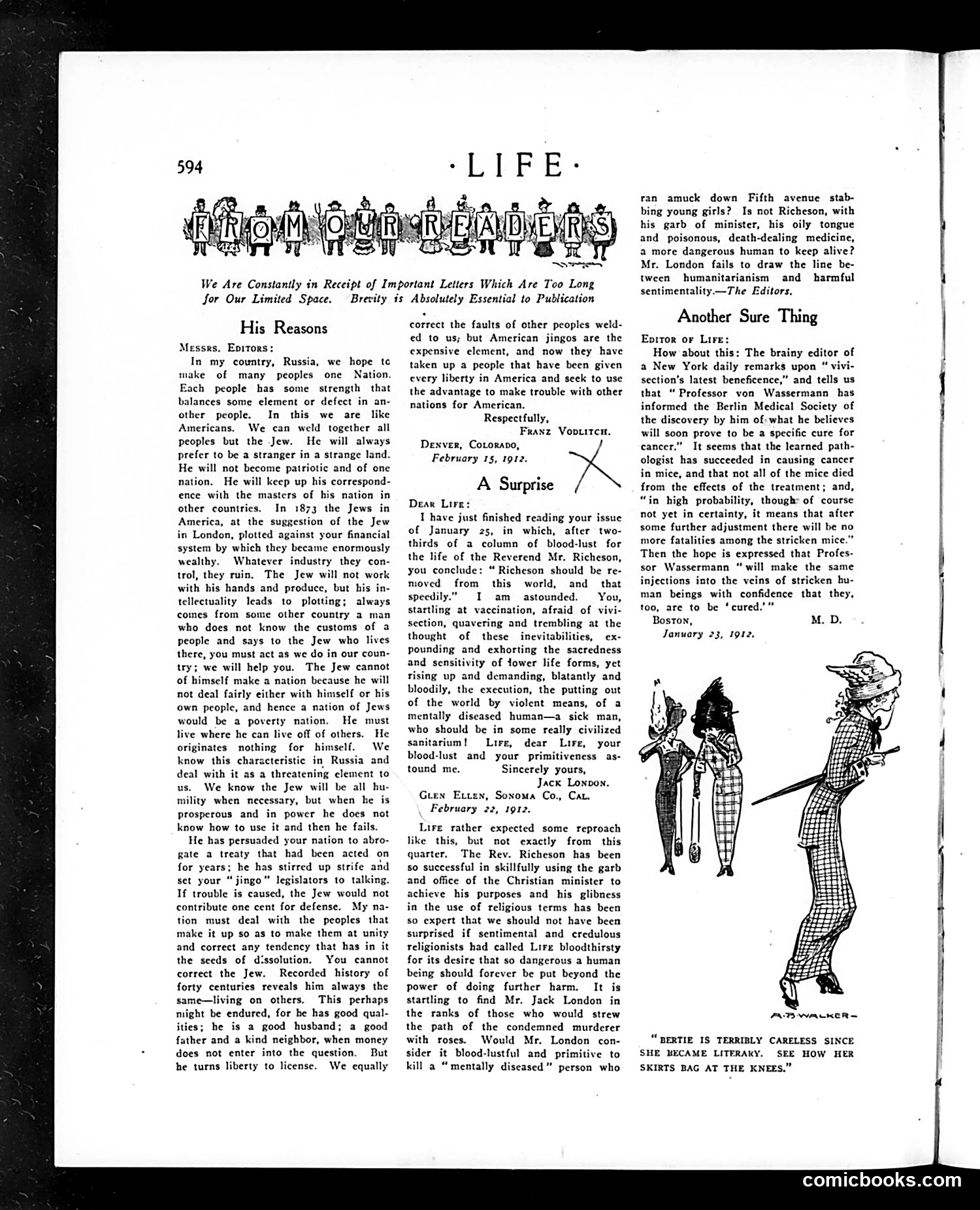
This page features readers' letters to *Life* magazine's editors, showcasing early 20th-century social debates. **"His Reasons"** is a virulently antisemitic letter from a Russian correspondent claiming Jews are inherently unpatriotic, parasitic, and incapable of building nations. He accuses American Jews of financial conspiracy and disloyalty, reflecting widespread prejudices of the era that blamed Jewish immigrants for social problems. **"A Surprise"** critiques *Life*'s apparent hypocrisy: the magazine had published bloodthirsty calls for executing Reverend Richeson (apparently involved in a crime), yet typically championed animal welfare and opposed capital punishment. Jack London points out this contradiction between their stated principles and violent rhetoric. The accompanying cartoon depicts a woman in fashionable dress with exaggerated posture—likely satirizing "Bertie," illustrating contemporary debates about women's fashion and social behavior that *Life* regularly mocked. The page illustrates how *Life* functioned as a forum for competing social viewpoints, from overt bigotry to more nuanced criticism of hypocrisy.
📄 Transcribed text from this page (OCR, searchable)
Machine-transcribed from the original scan — historical spelling and the odd misread are preserved.
We Are Constantly in Receipt of Important Letters Which Are Too Long Jor Our Limited Space. His Reasons Messrs, Epitors: In my country, Russia, we hope te make of many peoples one Nation. Each people has some strength that balances some element or defect in an- other people. In this we are like Americans, We can weld together all peoples but the Jew. He will always prefer to be a stranger in a strange land. He will not become patriotic and of one nation. He will keep up his correspond- ence with the masters of his nation in other countries. In 1873 the Jews in America, at the suggestion of the Jew in London, plotted against your financial system by which they became enormously wealthy. Whatever industry they con- trol, they ruin, The Jew will not work with his hands and produce, but his in- tellectuality leads to plotting; always comes from some other country a man who does not know the customs of a people and says to the Jew who lives there, you must act as we do in our coun- try; we will help you. The Jew cannot of himself make a nation because he will not deal fairly either with himself or his ‘own people, and hence a nation of Jews would be a poverty nation. He must live where he can live off of others. He originates nothing for himself. We know this characteristic in Russia and deal with it as a threatening element to us. We know the Jew will be all hu- mility when necessary, but when he is prosperous and in power he does not know how to use it and then he fails. He has persuaded your nation to abro- gate a treaty that had been acted on for years; he has stirred up strife and set your “ jingo” legislators to talking. If trouble is caused, the Jew would not contribute one cent for defense. My na- tion must deal with the peoples that make it up so as to make them at unity and correct any tendency that has in it the seeds of dissolution, You cannot correct the Jew. Recorded history of forty centuries reveals him always the same—living on others. This perhaps ight be endured, for he has good qual- ities; he is a good husband; a good father and a kind neighbor, when money does not enter into the question. But he turns liberty to license. We equally Brevity is Absolutely Essential to Publication correct the faults of other peoples weld- ed to us; but American jingos are the expensive element, and now they have taken up a people that have been given every liberty in America and seck to use the advantage to make trouble with other nations for American. Respectfully, Franz Voptitc, Dexver, Cotorano, February 15, 1912. A Surprise Dear Lire: T have just finished reading your issue of January 25, in which, after two- thirds of a column of blood-lust for the life of the Reverend Mr. Richeson, you conclude: “Richeson should be re- moved from this world, and that speedily.” I am astounded. You, startling at vaccination, afraid of vivi- section, quavering and trembling at the thought of these inevitabilities, ex- pounding and exhorting the sacredness and sensitivity of dower life forms, yet rising up and demanding, blatantly and bloodily, the execution, the putting out of the world by violent means, of a mentally discased human—a sick man, who should be in some really civilized sanitarium! Lire, dear Lire, your blood-lust and your primitiveness as- tound me. Sincerely yours, Jack Loxvon. Gtx Extex, Soxoata Co, Cat. February 22, 1912. Lire rather expected some reproach like this, but not exactly from this quarter. The Rev. Richeson has been so successful in skillfully using the garb and office of the Christian minister to achieve his purposes and his glibness in the use of religious terms has been so expert that we should not have been surprised if sentimental and credulous religionists had called Lire bloodthirsty for its desire that so dangerous a human being should forever be put beyond the power of doing further harm. It is startling to find Mr. Jack London in the ranks of those who would strew the path of the condemned murderer with roses. Would Mr. London con- sider it blood-lustful and primitive to kill a “mentally diseased” person who ran amuck down Fifth avenue stab- bing young girls? Is not Richeson, with his garb of minister, his oily tongue and poisonous, death-dealing medicine, a more dangerous human to keep alive? Mr. London fails to draw the line be- tween humanitarianism and barmful sentimentality.—The Editors, Another Sure Thing Eprtor oF Lire How about this: The brainy editor of a New York daily remarks upon “ vivi- section's latest beneficence,” and tells us that “Professor von Wassermann has informed the Berlin Medical Society of the discovery by him of. what he believes will soon prove to be a specific cure for cancer.” It seems that the learned path- ologist has succeeded in causing cancer in mice, and that not all of the mice died from the effects of the treatment; and, “jin high probability, though: of course not yet in certainty, it means that after some further adjustment there will be no more fatalities among the stricken mice.” Then the hope is expressed that Profes- sor Wassermann “will make the same injections into the veins of stricken hu- man beings with confidence that they, too, are to be ‘cured.’” Boston, M. D. January 23, 1912. “BERTIE IS TERRIBLY CARELESS SINCE SHE BECAME LITERARY. SEE HOW HER SKIRTS BAG AT THE KNEES.” en comicbooks.com