
Life, 1912-03-21 · page 32 of 52
Life — March 21, 1912 — page 32: what you’re looking at
What you’re looking at
This page contains two satirical editorials from *Life* magazine, likely from 1911. **"Barry and the Players' Club"**: Richard Barry, a war correspondent, was expelled from the exclusive Players' Club (a Manhattan theater club founded by actor Edwin Booth) after publishing an article in *Pearson's Magazine* claiming stage actors lack intelligence and education. The editorial supports Barry's reinstatement by the Court of Appeals, arguing that while insulting members *within* the club would be rude, speaking truth publicly is a protected right. The writer sarcastically notes Barry's criticism could equally apply to doctors, lawyers, and writers. **"Applied Sociology"**: This section mocks Harvard students who served as militiamen during the 1912 Lawrence textile strike, suppressing workers' protests. *Life* sarcastically suggests they deserved academic honors for this "fieldwork," then ironically proposes having these militiamen lecture fellow students about labor conditions—implying they learned nothing sympathetic about struggling workers' desperation. Both pieces critique establishment institutions (elite clubs, universities) for protecting narrow interests over truth and social understanding.
📄 Transcribed text from this page (OCR, searchable)
Machine-transcribed from the original scan — historical spelling and the odd misread are preserved.
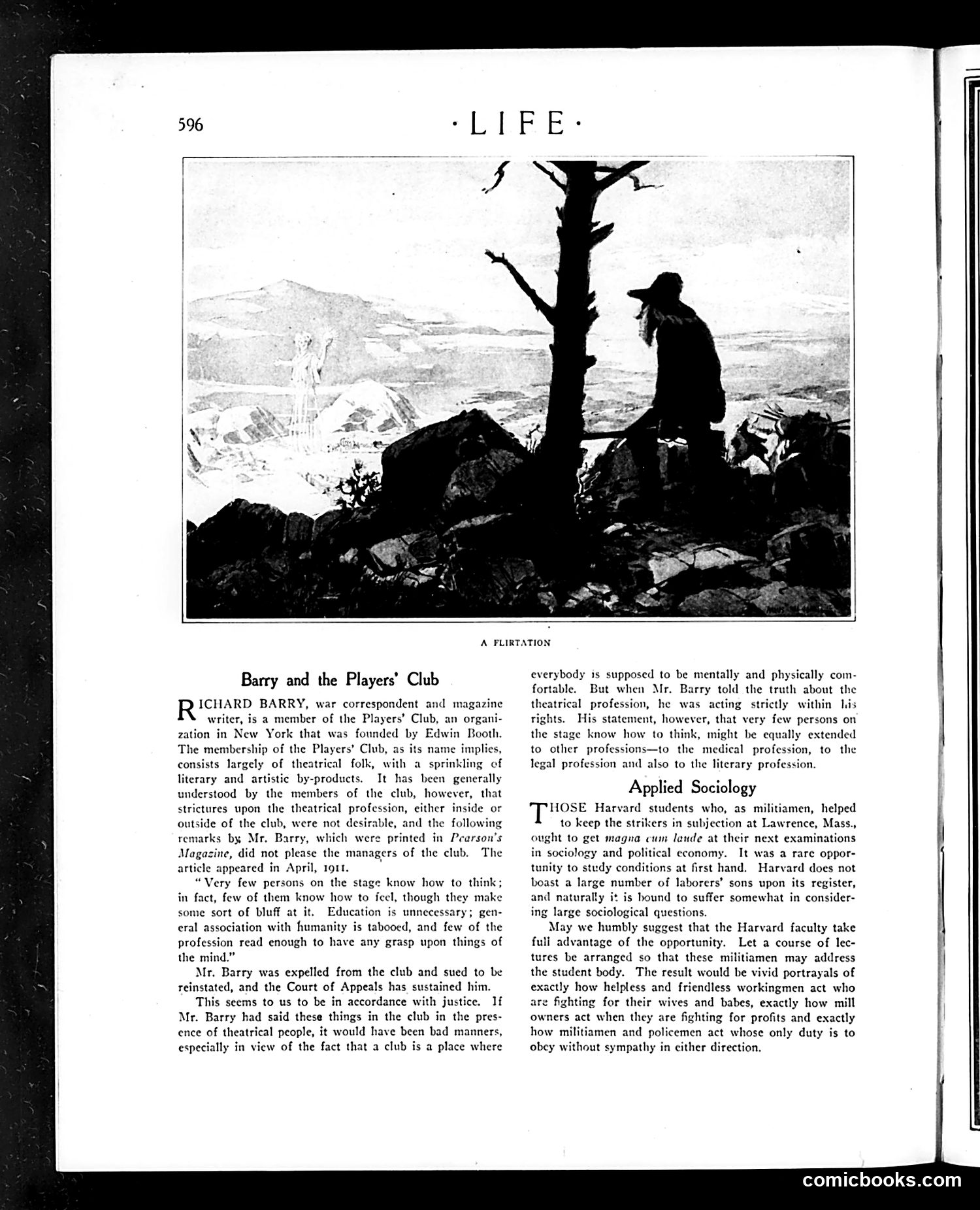
A FLIRTATION Barry and the Players’ Club ICHARD BARRY, war correspondent and magazine writer, is a member of the Players’ Club, an organi- zation in New York that was founded by Edwin Booth. The membership of the Players’ Club, as its name implies, consists largely of theatrical folk, with a sprinkling of literary and artistic by-products. It has been generally understood by the members of the club, however, that strictures upon the theatrical profession, either inside or outside of the club, were not desirable, and the following remarks by Mr. Barry, which were printed in Pearson's Magazine, did not please the managers of the club, The article appeared in April, 1911. “Very few persons on the stage know how to think; in fact, few of them know how to jcel, though they mal some sort of bluff at it. Education is unnecessary; gen- eral association with humanity is tabooed, and few of the profession read enough to have any grasp upon things of the mind.” Mr. Barry was expelled from the club and sued to be reinstated, and the Court of Appeals has sustained him. This seems to us to be in accordance with justice. If Mr. Barry had said these things in the club in the pres- ence of theatrical people, it would have been bad manners, especially in view of the fact that a club is a place where everybody is supposed to be mentally and physically com- fortable. But when Mr. Barry told the truth about the theatrical profession, he was acting strictly within his rights. His statement, however, that very few persons on the stage know how to think, might be equally extended to other professions—to the medical profession, to the legal profession and also to the literary profession. Applied Sociology HOSE Harvard students who, as militiamen, helped to keep the strikers in subjection at Lawrence, Mass., ought to get magna cin laude at their next examinations in sociology and political economy. It was a rare oppor- tunity to study conditions at first hand. Harvard does not boast a large number of laborers’ sons upon its register, and naturally is hound to suffer somewhat in consider- ing large sociological questions. May we humbly suggest that the Harvard faculty take fuli advantage of the opportunity. Let a course of lec- tures be arranged so that these militiamen may address the student body. The result would be vivid portrayals of exactly how helpless and friendless workingmen act who are fighting for their wives and babes, exactly how mill owners act when they are fighting for profits and exactly how militiamen and policemen act whose only duty is to obcy without sympathy in cither direction. comicbooks.com