
Life, 1912-03-21 · page 28 of 52
Life — March 21, 1912 — page 28: what you’re looking at
What you’re looking at
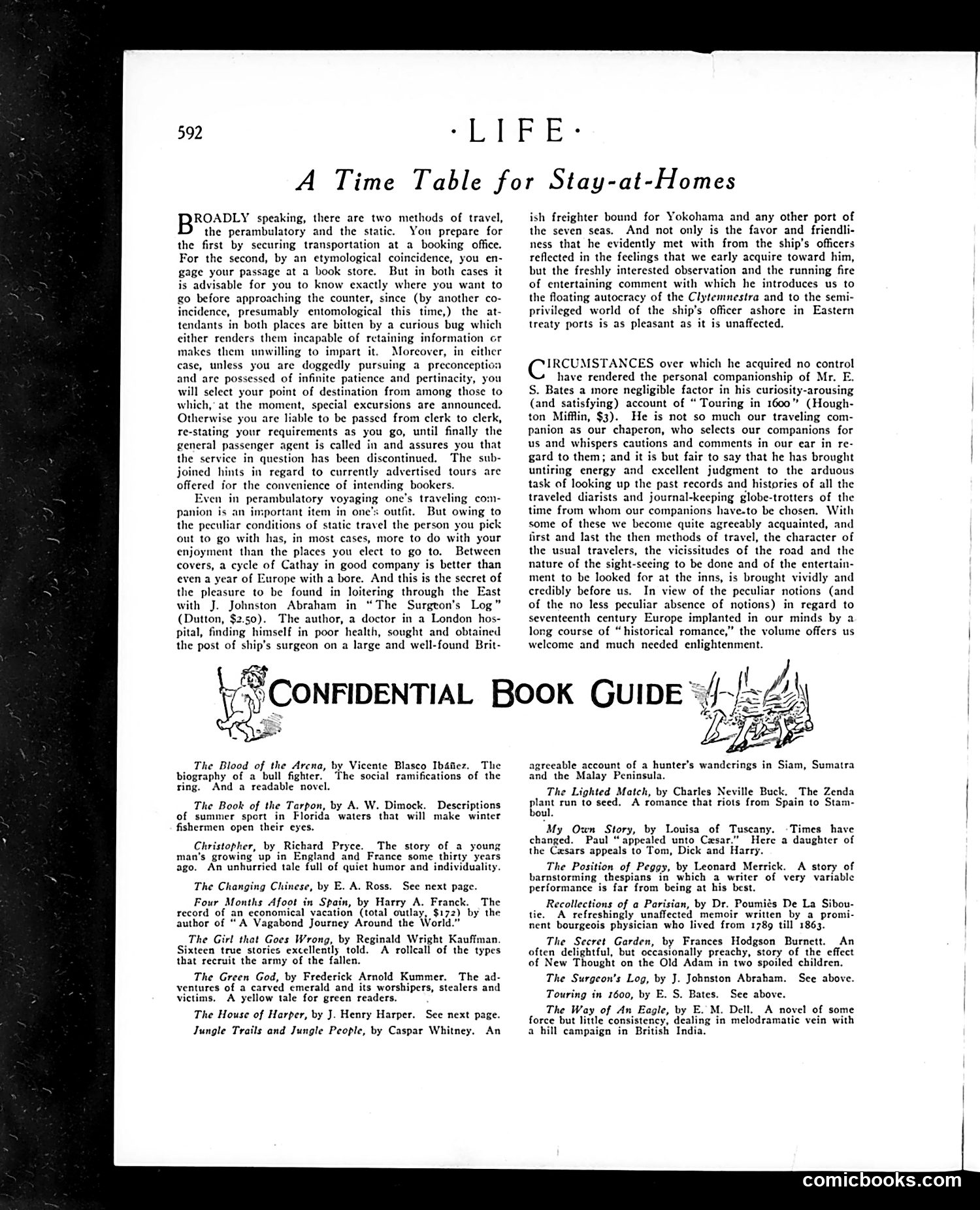
This page from *Life* magazine presents a humorous essay on armchair travel—experiencing distant places through books rather than actual journeys. The author contrasts "perambulatory" (physical) travel with "static" travel via literature, joking that both require visiting booking offices or bookstores where staff are unhelpful and prone to discontinuing advertised services. The satire targets the frustrations of travel planning while celebrating books as superior companions for exploration. The piece recommends *The Surgeon's Log* by J. Johnston Abraham—an actual account by a London doctor who worked as ship's surgeon—as ideal for "loitering through the East" with engaging commentary. The "Confidential Book Guide" section that follows recommends contemporary travel narratives and adventure novels, positioning reading as a practical, economical, and socially enjoyable alternative to expensive foreign travel. The humor appeals to readers unable or unwilling to undertake lengthy voyages.
📄 Transcribed text from this page (OCR, searchable)
Machine-transcribed from the original scan — historical spelling and the odd misread are preserved.
592 =k PEE A Time Table for Stay-at-Homes ROADLY speaking, there are two methods of travel, the perambulatory and the static. You prepare for the first by securing transportation at a booking office. For the second, by an etymological coincidence, you en- gage your passage at a book store. But in both cases it is advisable for you to know exactly where you want to go before approaching the counter, since (by another co- incidence, presumably entomological this time,) the at- tendants in both places are bitten by a curious bug which either renders them incapable of retaining information or makes them unwilling to impart it. Morcover, in cither case, unless you are doggedly pursuing a preconception and are possessed of infinite patience and pertinacity, you will select your point of des ion from among those to which, at the moment, special excursions are announced. Otherwise you are liable to be passed from clerk to clerk, re-stating your requirements as you go, until finally the general passenger agent is called in and assures you that the service in question has been discontinued. The sub- joined hints in regard to currently advertised tours are offered ior the convenience of intending bookers. nin perambulatory voyaging one’s traveling com- panion is an important item in one’s outfit. But owing to the peculiar conditions of static travel the person you pick out to go with has, in most cases, more to do with your enjoyment than the places you elect to go to. Between covers, a cycle of Cathay in good company is better than even a year of Europe with a bore. And this is the secret of the pleasure to be found in loitering through the East with J. Johnston Abraham in “The Surgton’s Log (Dutton, $2.50). The author, a doctor in a London hos- pital, finding himself in poor health, sought and obtained the post of ship’s surgeon on a large and well-found Brit- “CONFIDENTIAL BOOK GUIDE * Abad The Blood of the Arcna, by Vicente Blasco Ibéfier. The biography of a bull fighter. The social ramifications of the ring. And a readable novel. The Book of the Tarpon, by A. W. Dimock. Descriptions of. summer sport in Florida waters that will make winter fishermen open their eyes. Christopher, by Richard Pryce. The story of a young man’s growing’ up in England and France some thirty years ago. An unhurried tale full of quiet humor and individuality. The Changing Chinese, by E. A. Ross. See next page. Four Months Afoot in Spain, by Harry A. Franck. The record of an economical vacation (total outlay, $172) by the author of “A Vagabond Journey Around the World.” The Girl that Goes Wrong, by Reginald Wright Kauffman. Sixteen true stories excellently told. A rollcall of the types that recruit the army of the fallen. The Green God, by Frederick Arnold Kummer. The ad- ventures of a carved emerald and its worshipers, stealers and victims. A yellow tale for green readers. The House of Harper, by J. Henry Harper. See next page. Jungle Trails and Jungle People, by Caspar Whitney. An ish freighter bound for Yokohama and any other port of the seven seas. And not only is the favor and friendli- ness that he evidently met with from the ship's officers reflected in the feelings that we early acquire toward him, but the freshly interested observation and the running fire of entertaining comment with which he introduces us to the floating autocracy of the Clytemnestra and to the semi- privileged world of the ship’s officer ashore in Eastern treaty ports is as pleasant as it is unaffected, IRCUMSTANCES over which he acquired no control have rendered the personal companionship of Mr. E. S. Bates a more negligible factor in his curiosity-arousing (and satisfying) account of “ Touring in 1600” (Hough- ton Mifflin, $3). He is not so much our traveling com- panion as our chaperon, who selects our companions for us and whispers cautions and comments in our ear in re- gard to them; and it is but fair to say that he has brought untiring energy and excellent judgment to the arduous task of looking up the past records and histories of all the traveled diarists and journal-keeping globe-trotters of the time from whom our companions have-to be chosen. With some of these we become quite agreeably acquainted, and first and last the then methods of travel, the character of the usual travelers, the vicissitudes of the road and the nature of the sight-seeing to be done and of the entertain- ment to be looked for at the inns, is brought idly and credibly before us. In view of the peculiar notions (and of the no less peculiar absence of notions) in regard to seventeenth century Europe implanted in our minds by a long course of “historical romance,” the volume offers us welcome and much needed enlightenment. agreeable account of a hunter’s wanderings in Siam, Sumatra and the Malay Peninsula. The Lighted Match, by Charles Neville Buck. The Zenda plant run to seed. A romance that riots from Spain to Stam- boul. My Own Story, by Louisa of Tuscany. Times have changed. Paul “appealed unto Cxsar.” Here a daughter of the Cxsars appeals to Tom, Dick and Harry. The Position of Peggy, by Leonard Merrick. A story of barnstorming thespians in which a writer of very variable performance is far from being at his best. Recollections of a Parisian, by Dr. Poumiés De La Sibou- tie. A refreshingly unaffected memoir written by a promi- nent bourgeois physician who lived from 1789 till 1863. The Secret Garden, by Frances Hodgson Burnett. An often delightful, but occasionally preachy, story of the effect of New Thought on the Old Adam in two spoiled children. The Surgeon's Log, by J. Johnston Abraham. Sce above. Touring in 1600, by E. S. Bates. See above. The Way of An Eagle, by E. M. Dell. A novel of some force but little consistency, dealing in melodramatic vein with a hill campaign in British India. comicbooks.com