
Life, 1912-03-21 · page 24 of 52
Life — March 21, 1912 — page 24: what you’re looking at
What you’re looking at
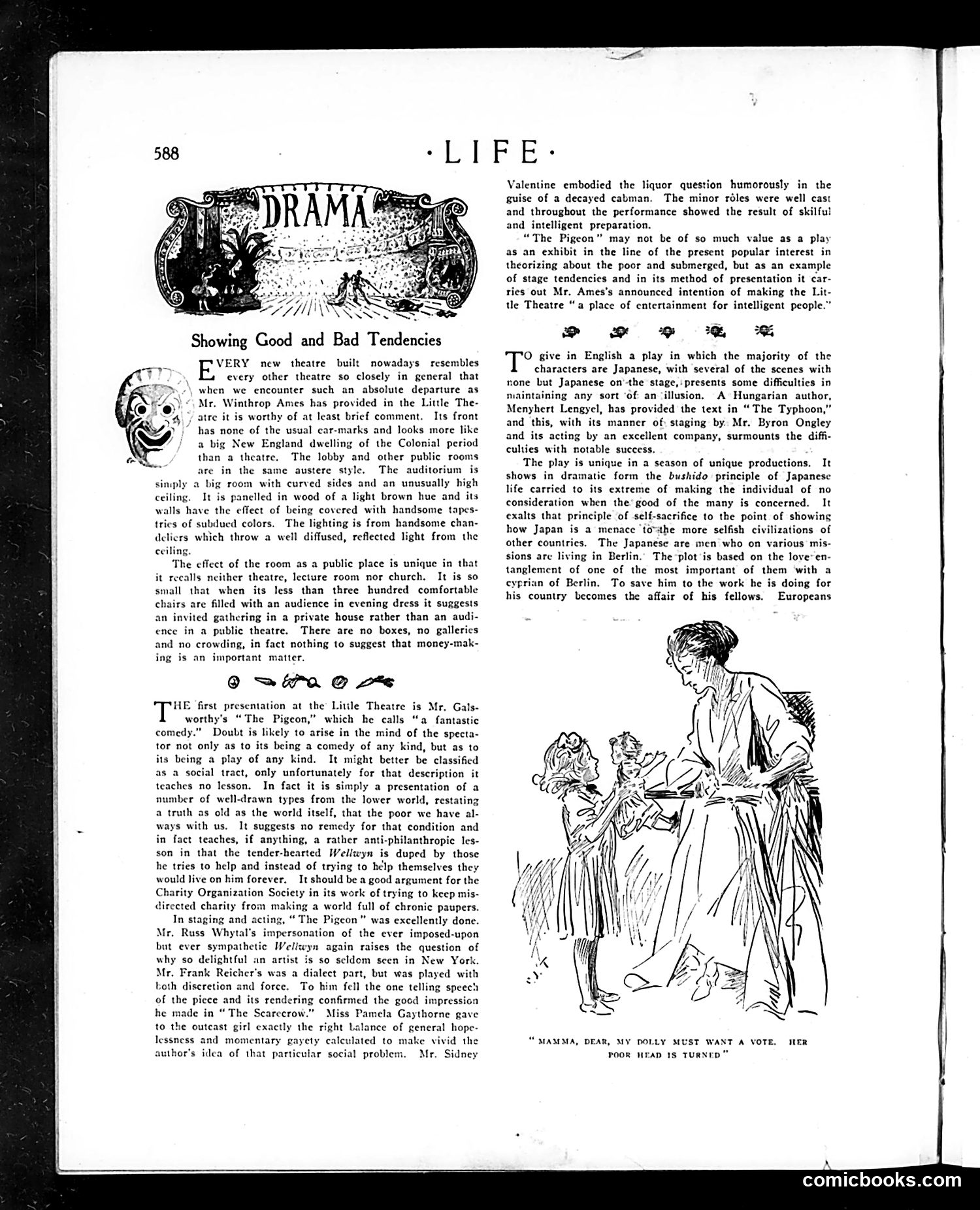
This page reviews Mr. Winthrop Ames's Little Theatre and its inaugural production of John Galsworthy's play "The Pigeon." **The Theater's Innovation:** The text praises the Little Theatre's distinctive design—styled like a Colonial house rather than a typical theater, without boxes, galleries, or ostentatious features. This reflects Ames's stated goal of creating "a place of entertainment for intelligent people." **The Play's Social Commentary:** "The Pigeon" presents working-class characters and explores poverty through the character Wellwyn, a well-meaning man repeatedly deceived by those he tries to help. The reviewer notes the play offers no solutions and ironically argues it actually supports the Charity Organization Society's position—that indiscriminate charity creates chronic dependence rather than solving poverty. **The Satire:** The page satirizes sentimental philanthropic impulses by suggesting Galsworthy's sympathetic portrayal of poverty inadvertently demonstrates why paternalistic charity fails. The illustrated caption reinforces this: a poor woman demands her daughter get a vote, suggesting the real solution is political power, not charity.
📄 Transcribed text from this page (OCR, searchable)
Machine-transcribed from the original scan — historical spelling and the odd misread are preserved.
“LPP E + Showing Good and Bad Tendencies VERY new theatre built nowadays resembles every other theatre so closely in general that when we encounter such an absolute departure as Mr. Winthrop Ames has provided in the Little The- atre it is worthy of at least brief comment. Its front has none of the usual car-marks and looks more like a big New England dwelling of the Colonial period than a theatre, The lobby and other public rooms are in the same austere style. The auditorium is simply a big room with curved sides and an unusually high ceiling. It is panelled in wood of a light brown hue and its walls have the effect of being covered with handsome tapes- tries of subdued colors. The lighting is from handsome chan- dcliers which throw a well diffused, reflected light from the ceiling. The effect of the room as a public place is unique in that it recalls neither theatre, lecture room nor church, It is so small that when its less than three hundred comfortable chairs are filled with an audience in evening dress it suggests an invited gathering in a private house rather than an audi- ence in a public theatre. There are no boxes, no gallerics and no crowding, in fact nothing to suggest that money-mak- ing is an important matter. @ =o @ 2s HE first presentation at the Litile Theatre is Mr. Gals- worthy’s “The Pigeon,” which he calls “a fantastic comedy.” Doubt is likely to arise in the mind of the specta- tor not only as to its being a comedy of any kind, but as to its being a play of any kind. It might better be classified as a social tract, only unfortunately for that description it teaches no lesson. In fact it is simply a presentation of a number of well-drawn types from the lower world, restating a truth as old as the world itself, that the poor we have al- ways with us. It suggests no remedy for that condition and in fact teaches, if anything, a rather anti-philanthropic les- son in that the tender-hearted Wellwyn is duped by those he tries to help and instead of trying to help themselves they would live on him forever. It should be a good argument for the Charity Organization Society in its work of trying to keep mis- directed charity from making a world full of chronic paupers. In staging and acting, “ The Pigeon" was excellently done. Mr. Russ Whytal’s impersonation of the ever imposed-upon but ever sympathetic Wellwyn again raises the question of why so delightful an artist so seldom seen in New York. Mr. Frank Reicher’s was a dialect part, but was played with both discretion and force, To him fell the one telling speech of the picce and its rendering confirmed the good impression he made in “ The Scarecrow.” Miss Pamela Gaythorne gave to the outcast girl exactly the right Lalance of general hope- lessness and momentary gayety calculated to make vivid 1 author's idea of that particular social problem. Mr. Sidney Valentine embodied the liquor question humorously in the guise of a decayed cabman. The minor roles were well cast and throughout the performance showed the result of skilful and intelligent preparation. “The Pigeon” may not be of so much value as a play as an exhibit in the line of the present popular interest in theorizing about the poor and submerged, but as an example of stage tendencies and in its method of presentation it car- ries out Mr. Ames’s announced intention of making the Lit- tle Theatre “a place of entertainment for intelligent people.” PR T° give in English a play in which the majority of the characters are Japanese, with several of the scenes with none but Japanese on'the stage,:presents some difficulties in maintaining any sort ‘of an “illusion. A Hungarian author, Menyhert Lengyel, has provided the text in “The Typhoon,” and this, with its manner of, staging by. Mr. Byron Ongley and its acting by an excellent company, surmounts the diffi- culties with notable success. The play is unique in a season of unique productions. It shows in dramatic form the bushido principle of Japanese life carried to its extreme of making the individual of no consideration when the’ good of the many is concerned. It exalts that principle of self-sacrifice to the point of showing how Japan is a menace to-the more selfish civilizations of other countries. The Japanese are men who on various mis- sions are living in Berlin. The plot is based on the love-en- tanglement of one of the most important of them with a an of Berlin. To save him to the work he is doing for his country becomes the affair of his fellows. Europeans “MAMMA, DEAR, MY POLLY MUST WANT A VOTE. HER POOR HEAD 18 TURNED” A comicbooks.com