
Life, 1912-03-21 · page 29 of 52
Life — March 21, 1912 — page 29: what you’re looking at
What you’re looking at
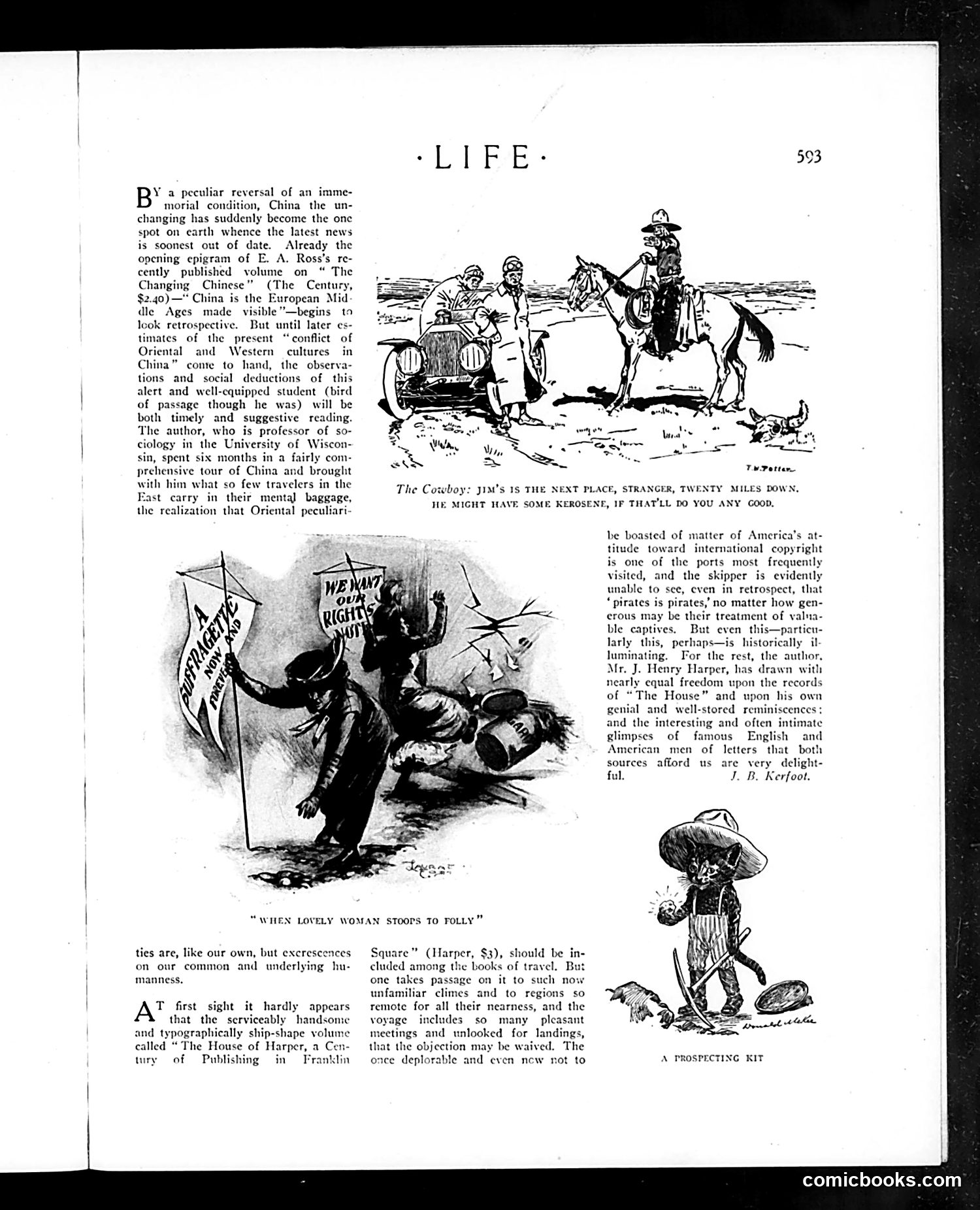
This page reviews books about China and publishing history. The key cartoons illustrate contrasting themes: **"The Cowboy"** depicts an American frontier character encountering Chinese travelers—likely satirizing the collision of Western and Eastern cultures that E.A. Ross's book "The Changing Chinese" examines. **"When Lovely Woman Stoops to Folly"** appears to reference the moral/social commentary tradition, possibly critiquing behavior or hypocrisy. **"A Prospecting Kit"** shows a figure with mining equipment, likely a humorous aside about frontier ambition or resource-seeking. The text discusses Ross's sociology book arguing that Chinese peculiarities reflect universal human nature beneath surface differences—a progressive viewpoint for the era. It also reviews "The House of Harper," a publishing history that apparently addresses America's controversial piracy of international copyrights, which the reviewer notes remains "historically illuminating" as a moral blind spot.
📄 Transcribed text from this page (OCR, searchable)
Machine-transcribed from the original scan — historical spelling and the odd misread are preserved.
Y a peculiar reversal of an imme- morial condition, China the un- changing has suddenly become the one spot on earth whence the latest news is soonest out of date. Already the opening epigram of E. A. Ross's re- cently published volume on “ The Changing Chinese” (The Century, $2.40)—“ China is the European Mid dle Ages made visible”—begins to look retrospective. But until later es- timates of the present “conflict of Oriental and Western cultures in China” conte to hand, the observa- tions and social deductions of this alert and well-cquipped student (bird of passage though he was) will be both timely and suggestive reading. The author, who is professor of so- ciology in the University of Wiscon- sin, spent six months ina fairly com- prehensive tour of China and brought with him what so few travelers in the East carry in their mental baggage, the realization that Oriental peculiari- LI BE The Cowboy: Jim's 15 THE HE MIGHT HAVE SOME “WHEN LOVELY WOMAN STOOPS TO FOLLY” ties are, like our own, but excrescences on our common and underlying hu- manness, T first sight it hardly appears that the serviceably handsome id typographically ship-shape volume called “ The House of Harper, a Cen- tury of Publishing in Franklin Square” (Harper, $3), should be in- cluded among the books of travel, But one takes passage on it to such now unfamiliar climes and to regions so remote for all their nearness, and the voyage includes so many pleasant meetings and unlooked for landings, that the objection may be waived. The once deplorable and even new not to Tw Petter MILES DOWN, coop, CE, STRANGER, TWENTY , IF THAT'LL DO YOU A be boasted of matter of America’s at- titude toward international copyright is one of the ports most frequently visited, and the skipper is evidently unable to see, even in retrospect, that “pirates is pirates,’ no matter how gen- crous may be their treatment of valua- ble captives. But even this—particn- larly this, perhaps—is historically il luminating. For the rest, the author, Mr. J. Henry Harper, has drawn with nearly equal freedom upon the records of “The House” and upon his own genial and well-stored reminiscences ; and the interesting and often intimate glimpses of famous English and American men of letters that both sources afford us are very delight- ful. J. B. Kerfoot. \ PROSPECTING KIT comicbooks.com