
A complete issue · 56 pages · 1911
Life — May 4, 1911
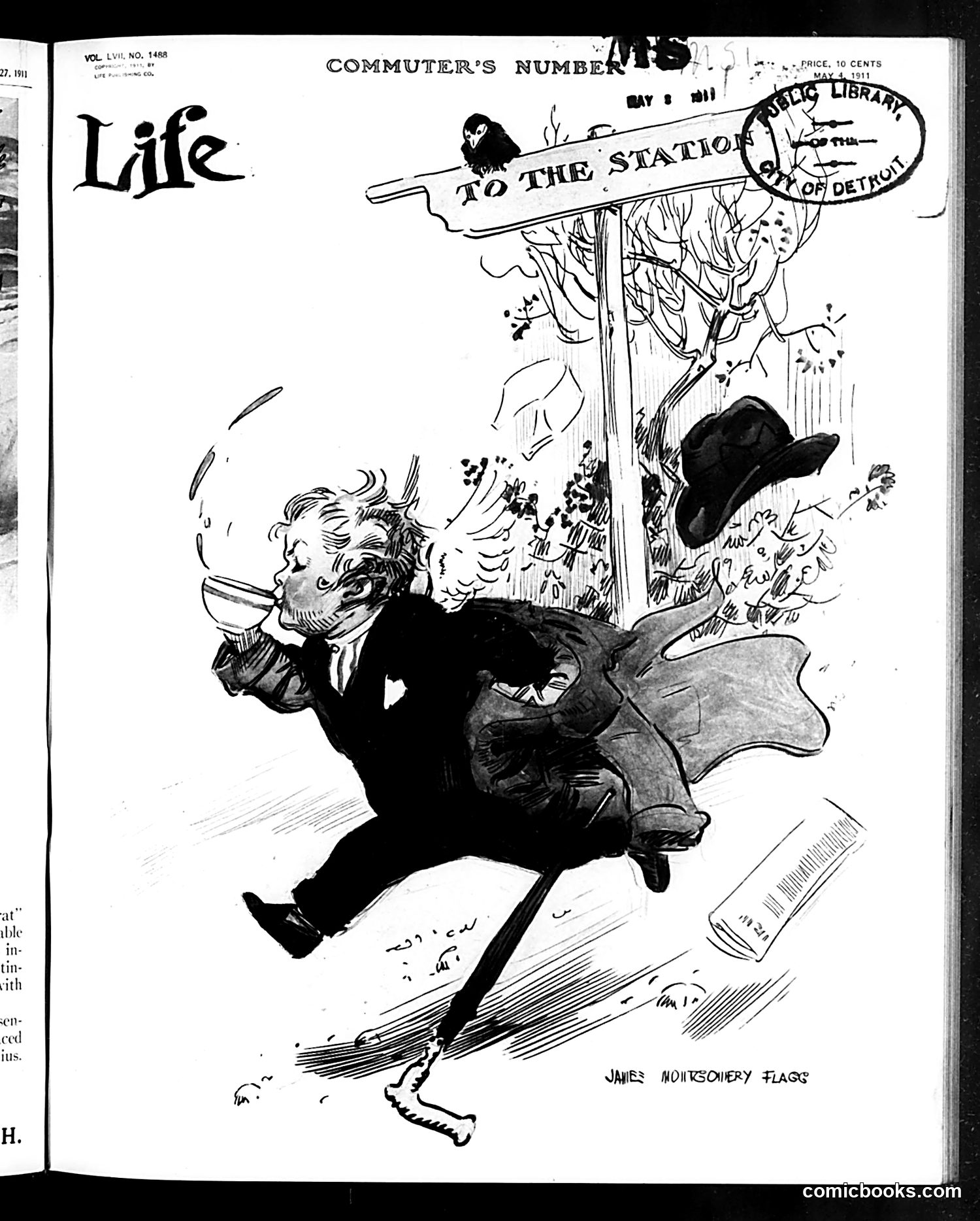
This satirical cartoon by James Montgomery Flagg depicts a man in formal attire frantically rushing toward a train station, his coat and hat flying behind him. The exaggerated style suggests comedic panic or urgency. The title "To the Station" and the man's desperate haste likely reference a contemporary social situation—possibly about commuting, marriage elopement, or fleeing some obligation—common satirical subjects in early 1900s Life magazine. The wild-eyed expression and physical chaos convey the humor of desperate escape or hurried travel. Without additional context about May 1911 events, the specific referent remains unclear, though the cartoon's comedic tone suggests a relatable modern scenario rendered absurdly.
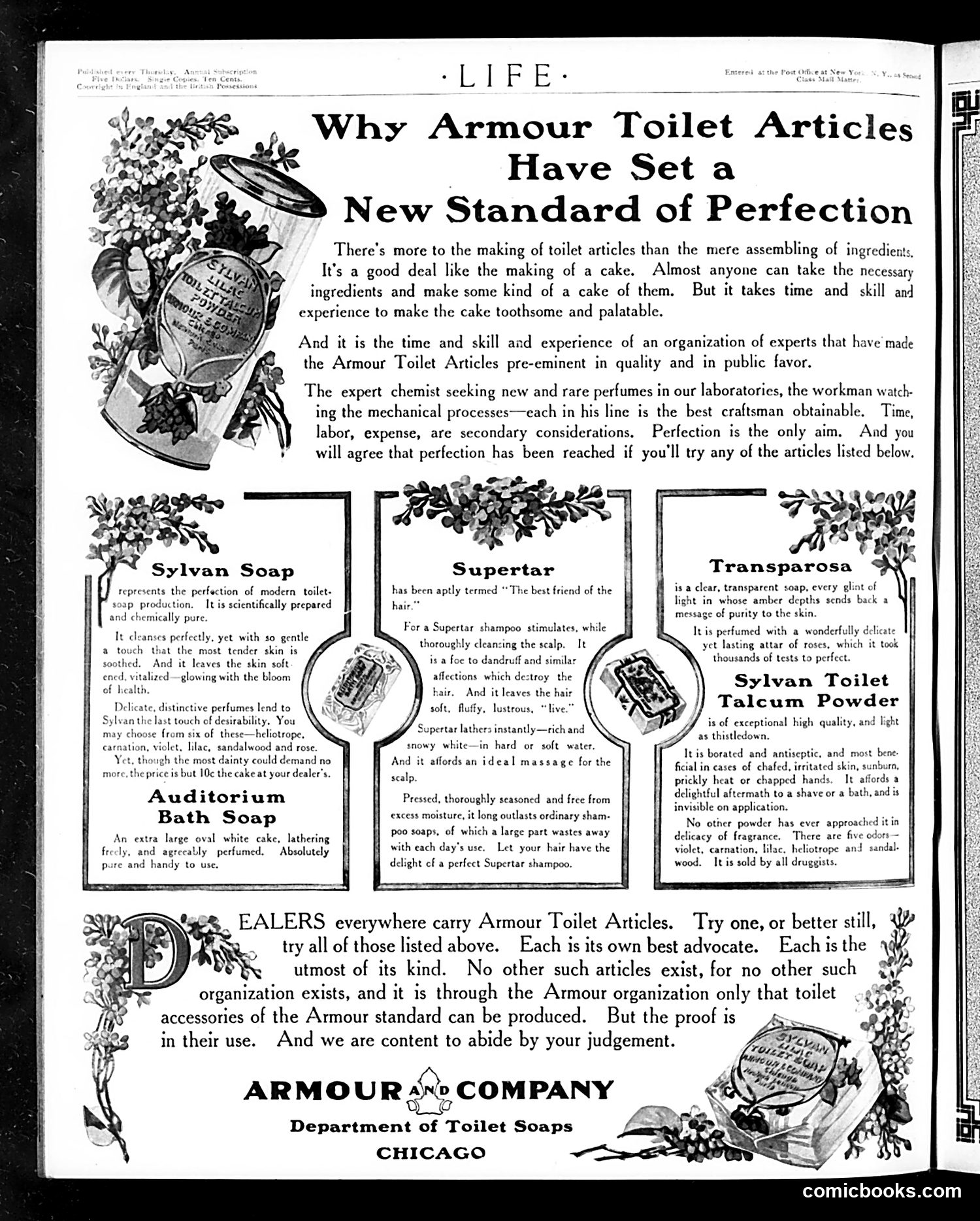
This page is **primarily advertising, not political satire**. It's a full-page advertisement for Armour Company's toilet soap and related products (Sylvan Soap, Supertar shampoo, Transparosa soap, and Sylvan Talcum Powder). The headline uses metaphorical language comparing soap-making to cake-baking to emphasize quality and craftsmanship. The decorative floral illustrations are typical period design elements, not satirical imagery. The advertisement appears in *Life* magazine, which published both satirical content and advertisements. This particular page contains no political commentary or social satire—it's a straightforward product promotion highlighting Armour's "standard of perfection" in toiletries, aimed at early 20th-century consumers.
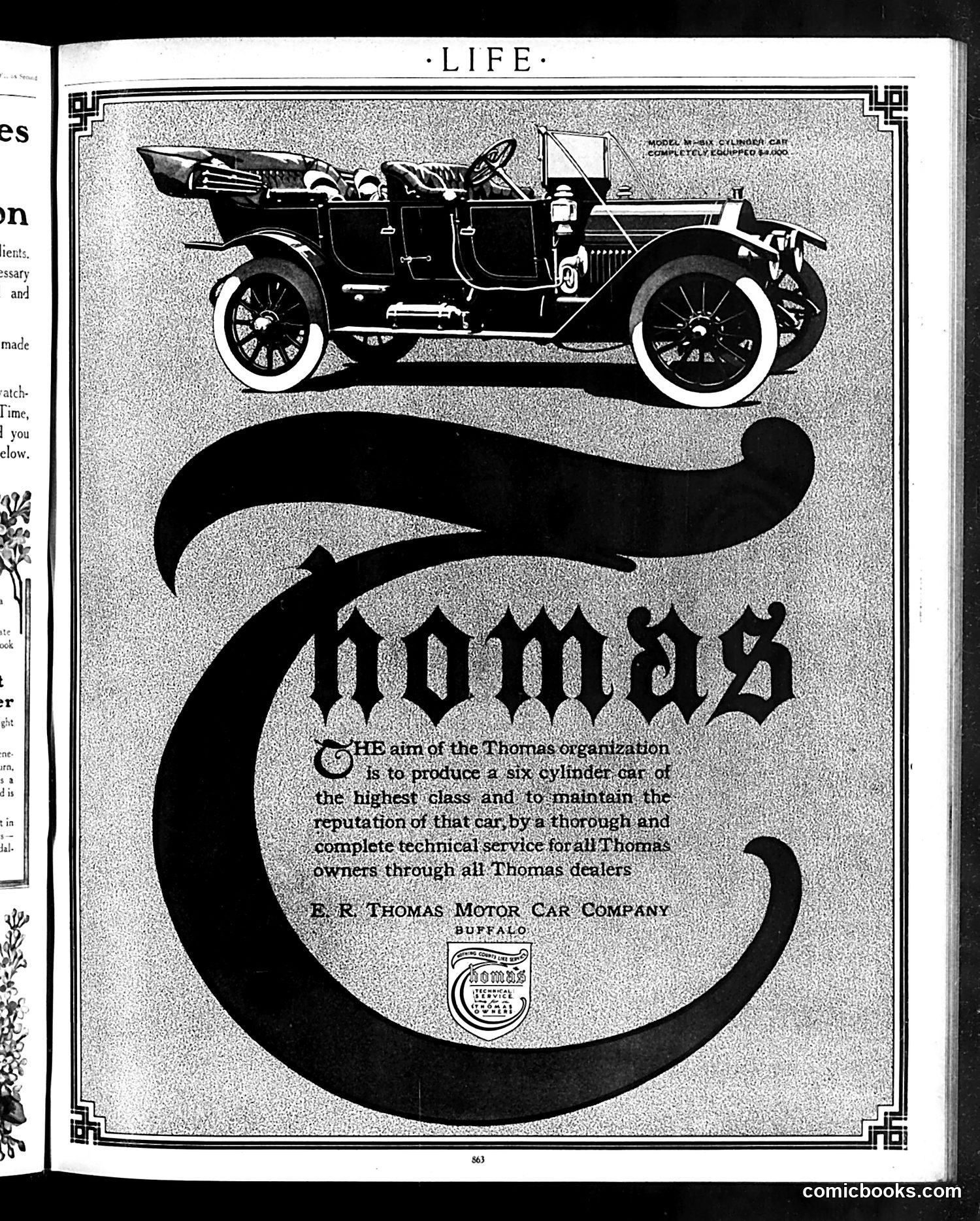
This is primarily a **Thomas Motor Car Company advertisement**, not political satire. The page features a large decorative "6" (referring to the six-cylinder engine) with an early 1900s automobile illustration at top. The ad text states the Thomas organization's aim: "to produce a six cylinder car of the highest class and to maintain the reputation of that car, by a thorough and complete technical service for all Thomas owners through all Thomas dealers." The company was based in Buffalo, New York (E.R. Thomas Motor Car Company). This represents early automotive advertising in *Life* magazine, emphasizing technical superiority and customer service as selling points during the competitive early motorcar era. There is no political or satirical content—it's straightforward product promotion.
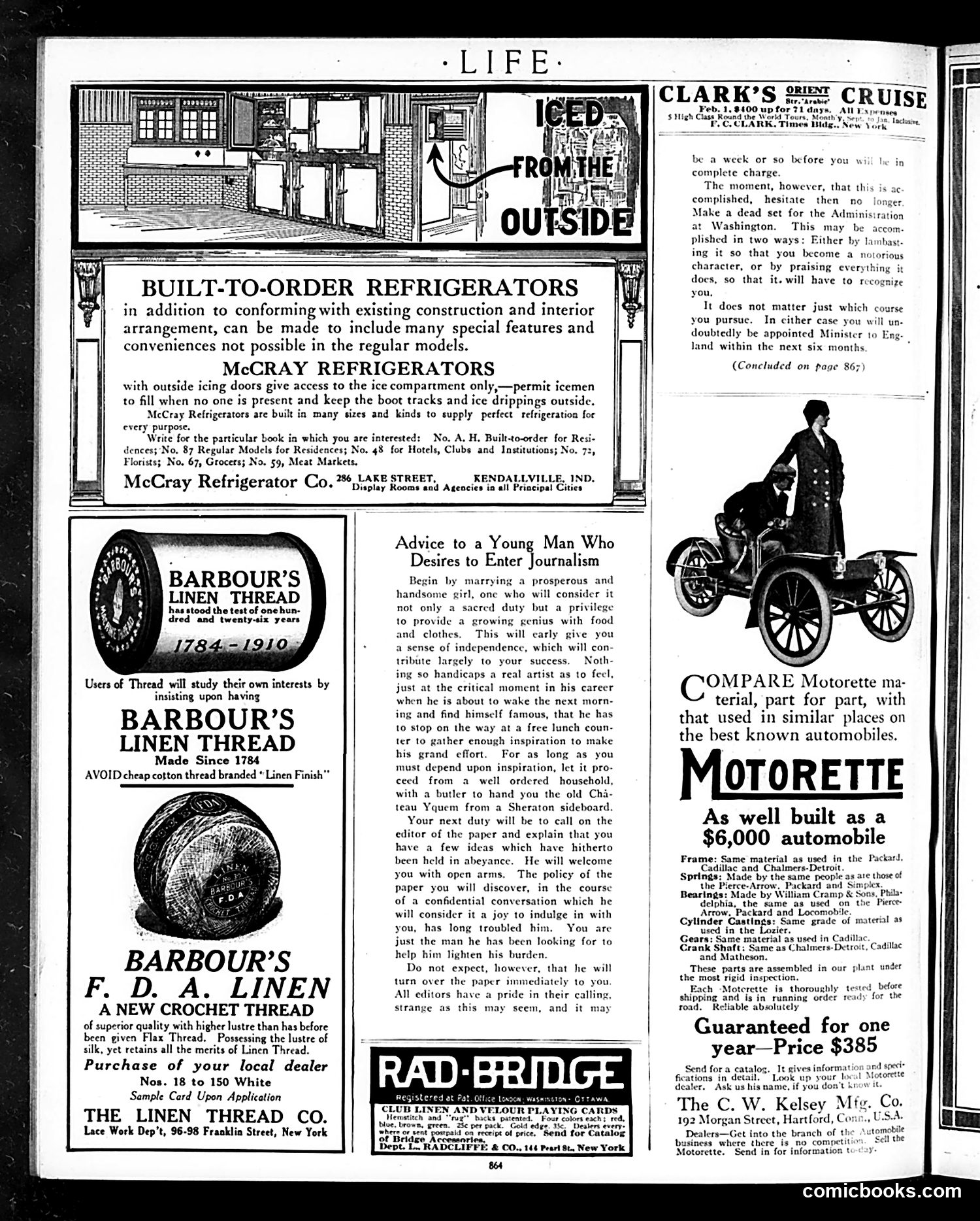
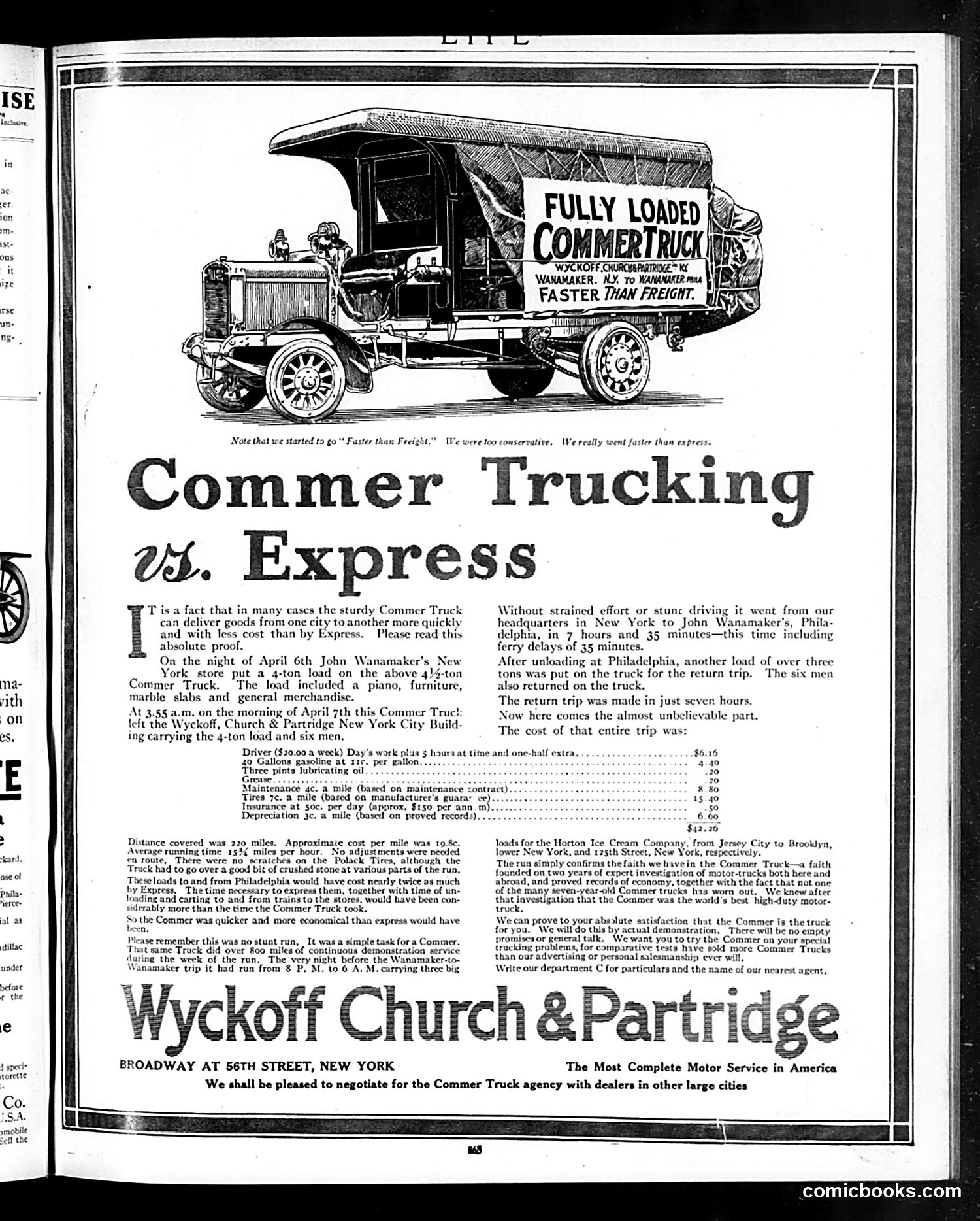
This page is primarily **advertising, not satire or political commentary**. It contains a full-page ad for Wyckoff Church & Partridge, a motor service company in New York. The ad promotes "Commer Trucking vs. Express" — arguing that their Commer trucks deliver freight faster and more economically than traditional express services. The illustration shows a fully-loaded truck with the company name prominently displayed. The body text describes an actual delivery test: a 4-ton load traveled from New York to Philadelphia in 7 hours 33 minutes, with a return trip in 7 hours. A detailed cost breakdown is provided, highlighting the efficiency advantage. This is **commercial advertising from the early automotive era**, demonstrating how motor trucking was displacing railroad express services for freight delivery. There is no political satire present.
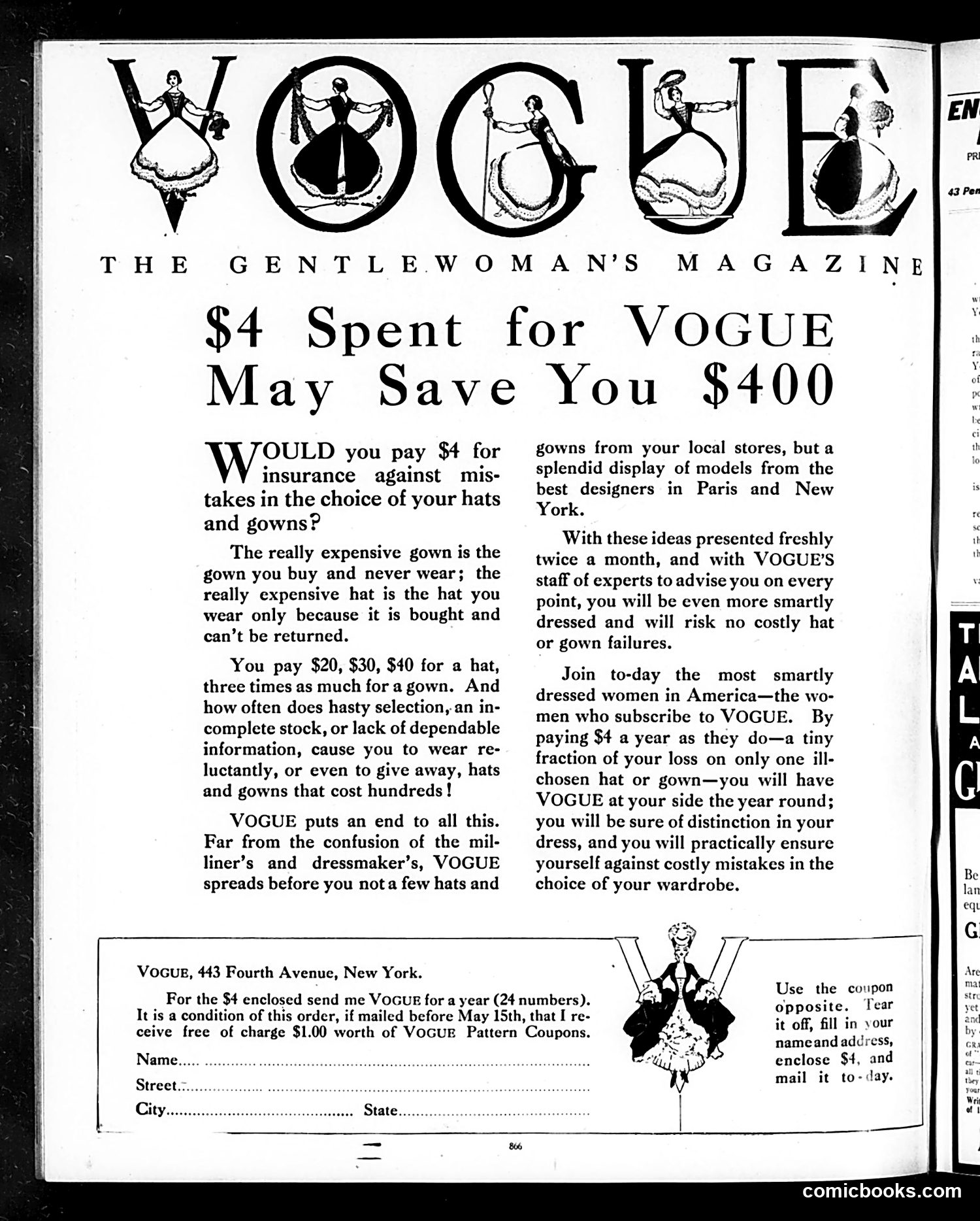
This is **not** a satirical cartoon page, but rather a **straightforward advertisement** for Vogue magazine. The ornate "VOGUE" masthead features stylized illustrations of fashionable women in various poses—typical Art Deco design elements common to early 20th-century fashion magazines. The ad's pitch targets women concerned about expensive clothing mistakes: for $4 per year (24 issues), Vogue promises to provide fashion guidance from "best designers in Paris and New York," helping subscribers avoid costly wardrobe errors. It emphasizes that expensive gowns bought unwisely are wasteful, and Vogue offers "insurance" against such mistakes. The subscription coupon at bottom offers an added incentive: $1 in free pattern coupons if ordered before May 15th. This reflects genuine consumer anxiety about fashion purchases and Vogue's positioning as an expert, trusted advisor for affluent women's clothing choices.
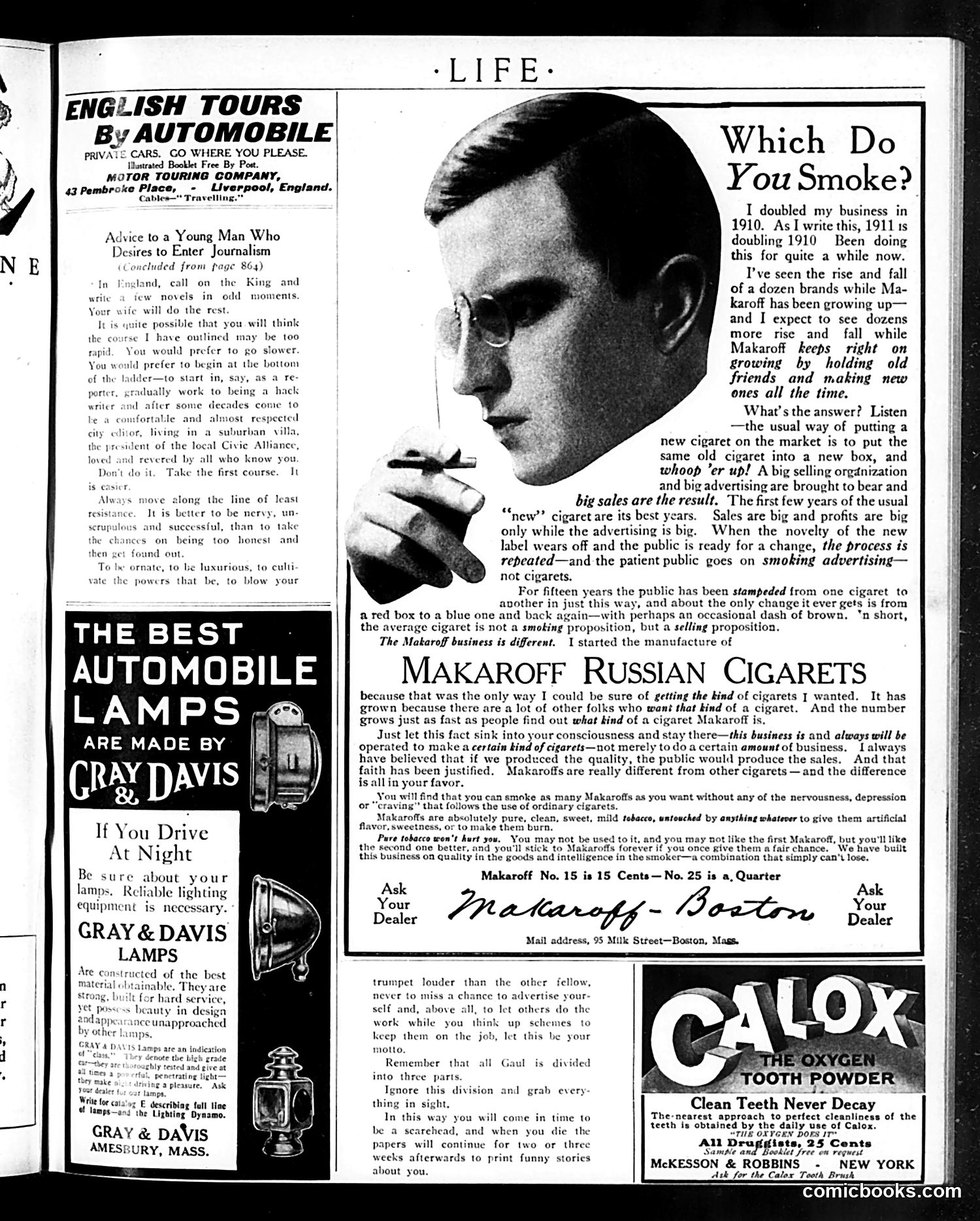
This page is primarily **advertising**, not satire or political commentary. The main feature is a large advertisement for **Makaroff Russian Cigarettes**, featuring a photograph of a man smoking. The ad's text is a first-person testimonial claiming the cigarette manufacturer doubled business between 1910-1911 by maintaining quality while competitors engaged in deceptive marketing practices (switching old cigarettes into new boxes). The advertiser argues Makaroff's success comes from honest business practices and product consistency, not advertising gimmicks. The surrounding ads promote automobile lamps (Gray & Davis) and tooth powder (Calox). There's also unrelated editorial content about journalism advice. The page reflects early 20th-century advertising conventions: testimonials, quality-versus-deception themes, and modest product claims by modern standards.
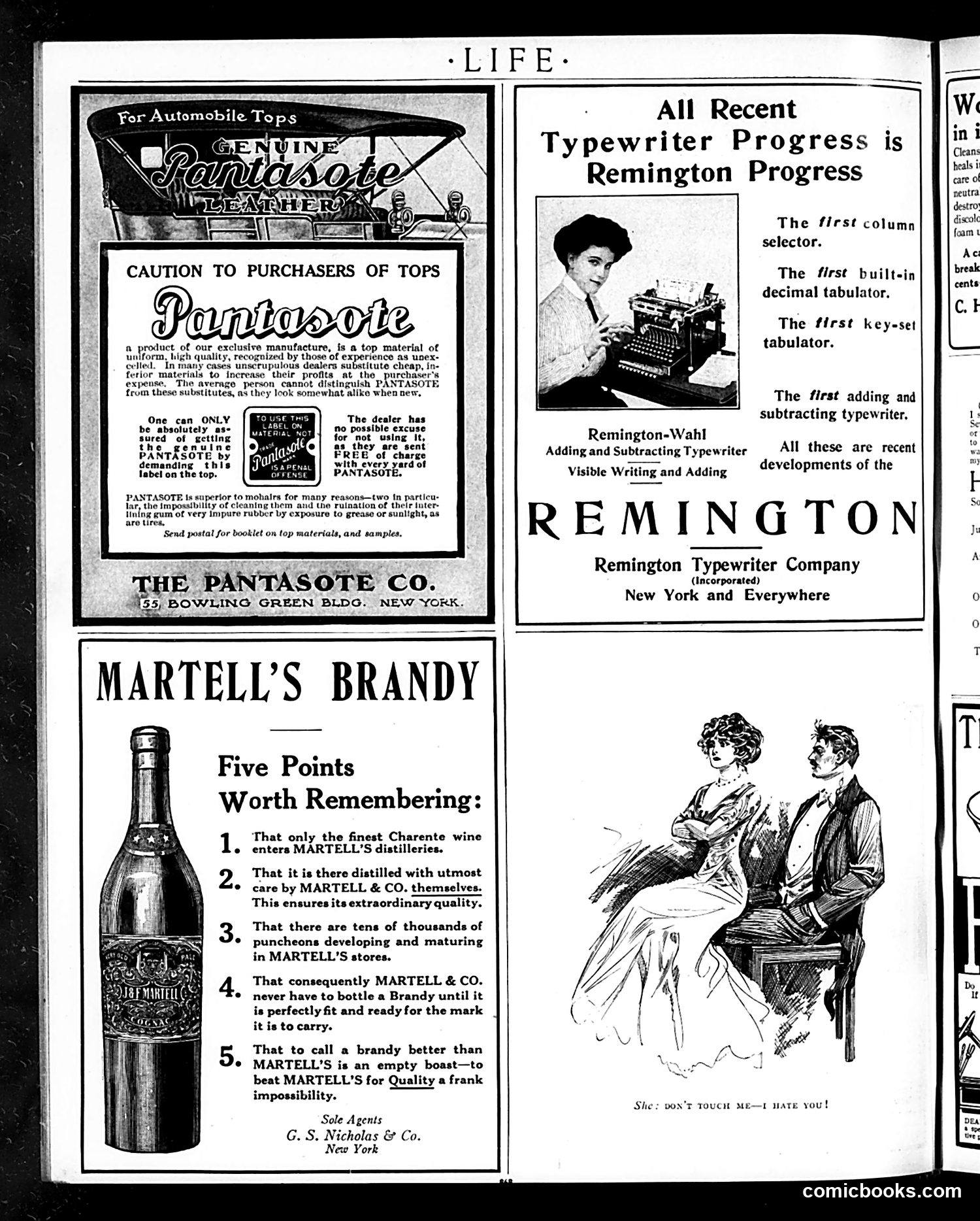
This page is primarily **advertising content** from an early 20th-century issue, not political commentary or satire. The advertisements include: 1. **Pantasote leather** (automobile tops) — warning against counterfeit substitutes 2. **Remington typewriters** — highlighting recent innovations (first column selector, built-in decimal tabulator, key-set tabulator, adding/subtracting function) 3. **Martell's Brandy** — listing five quality assurances about the product's production and aging 4. **A romantic sketch** of a couple with the caption "She: 'Don't touch me—I hate you!'" — a humorous domestic scene There is no identifiable political satire on this page. It represents typical early 1900s magazine advertising and light humor aimed at middle-class readers.
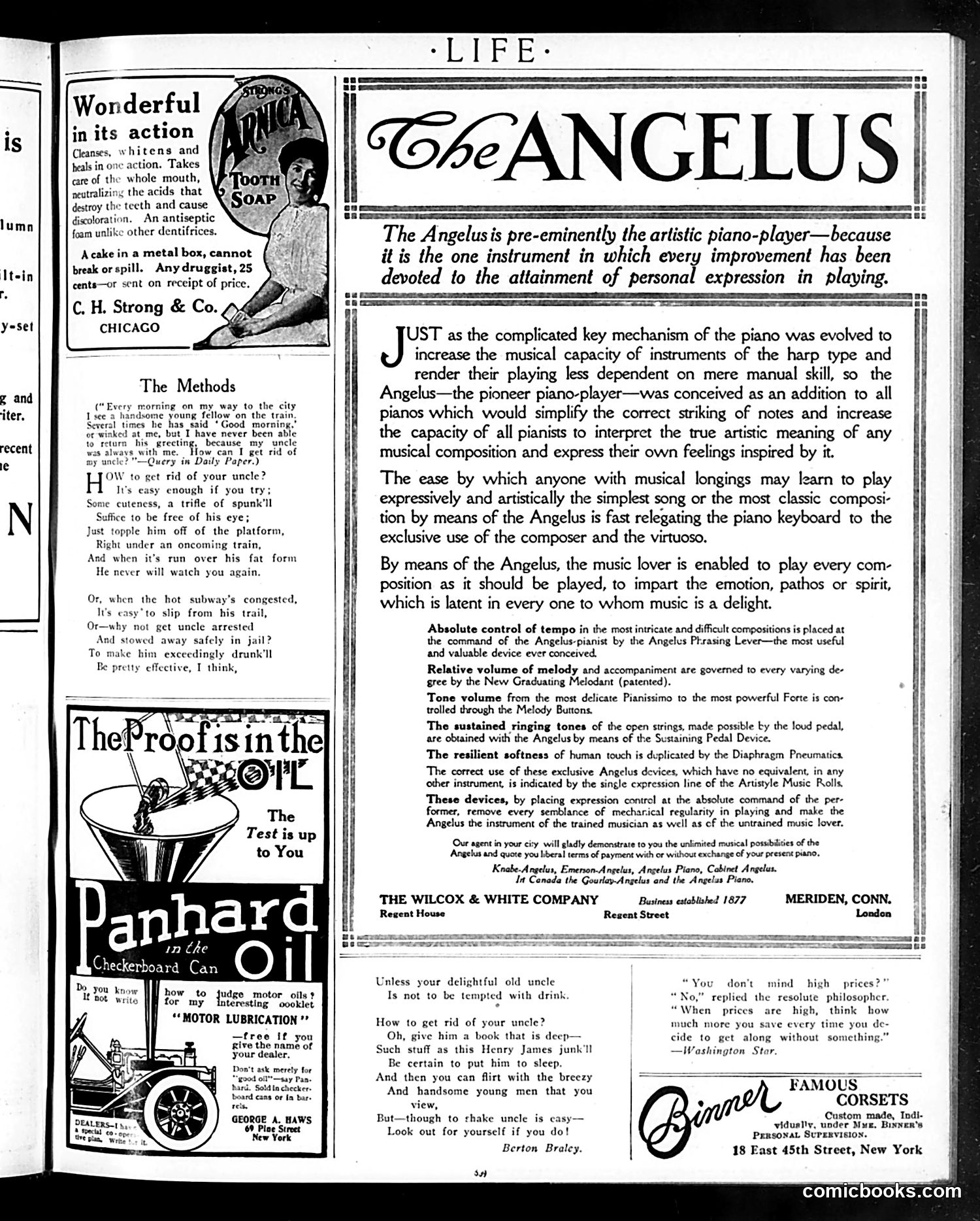
This page is primarily **advertising and promotional content** from an early 20th-century Life magazine. The major elements are: 1. **"The Angelus" piano advertisement** (center/right) - promoting a piano brand claiming superior artistic capability for amateur musicians 2. **"Arnica Tooth Soap"** ad (top left) - promoting dental hygiene product 3. **"Panhard Oil"** advertisement (lower left) - motor oil for cars, with emphasis on "motor lubrication" 4. **"The Methods"** poem (left column) - appears to be satirical verse about social etiquette, discussing how to handle encounters with an uncle 5. **"Birmer Corsets"** ad (bottom right) The page contains **no political cartoons or satire**—it's a standard magazine page combining light humor (the poem) with commercial advertisements typical of early 1900s publications.
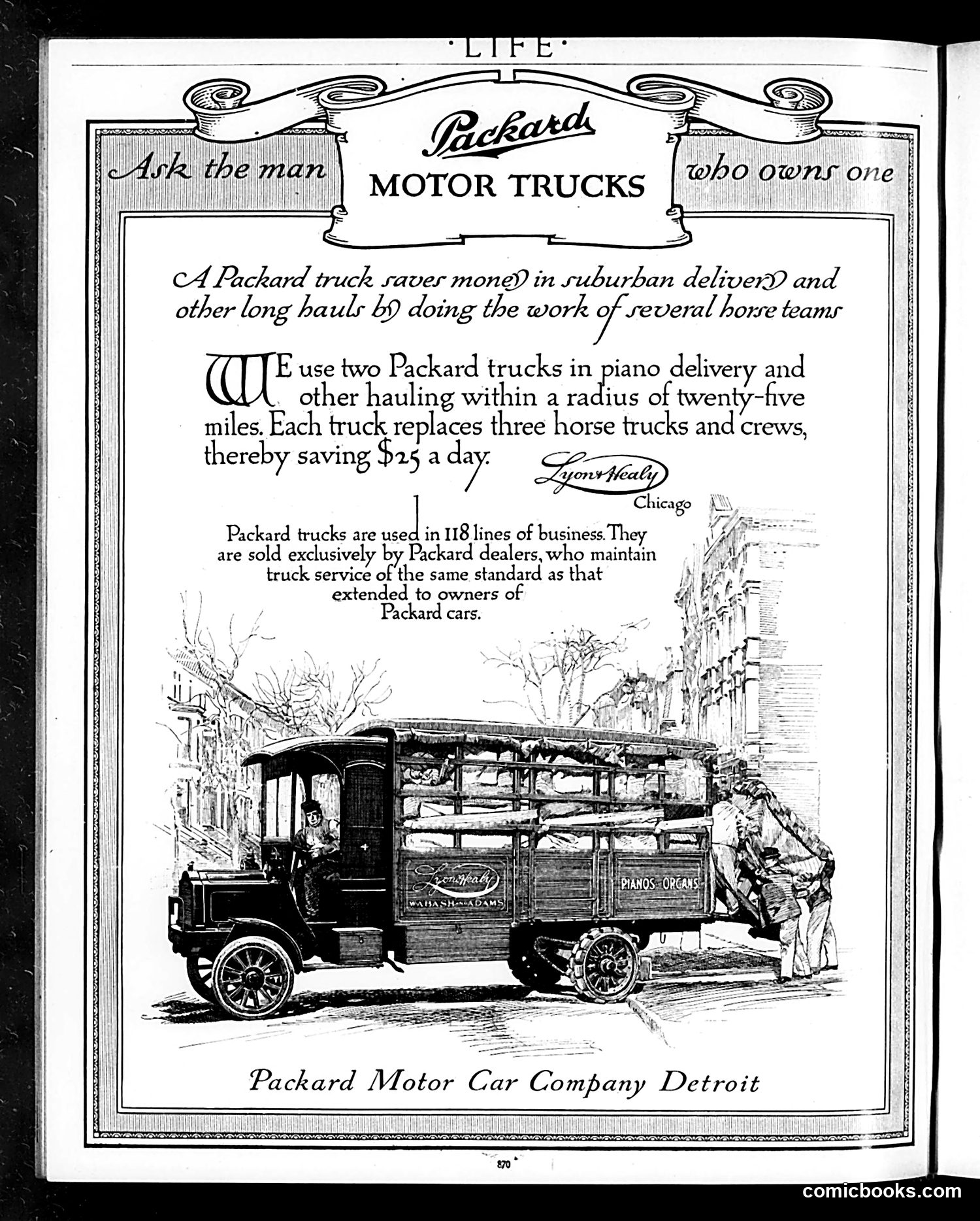
This is a **Packard Motor Trucks advertisement**, not a cartoon or satire. The page presents a testimonial from Lyon Healy (a Chicago music business), claiming their two Packard trucks replace three horse-drawn wagons while saving $25 daily in piano and organ delivery work. The ad emphasizes efficiency gains from motorization—a key selling point in the early automotive era when trucks were still relatively new. The illustration shows a delivery truck loaded with pianos, with a woman gesturing approvingly. The "Ask the man who owns one" framing was Packard's actual advertising slogan, appealing to practical business owners by highlighting real-world cost savings over traditional horse-transport methods. This reflects the broader early 20th-century transition from animal to mechanical power for commerce.
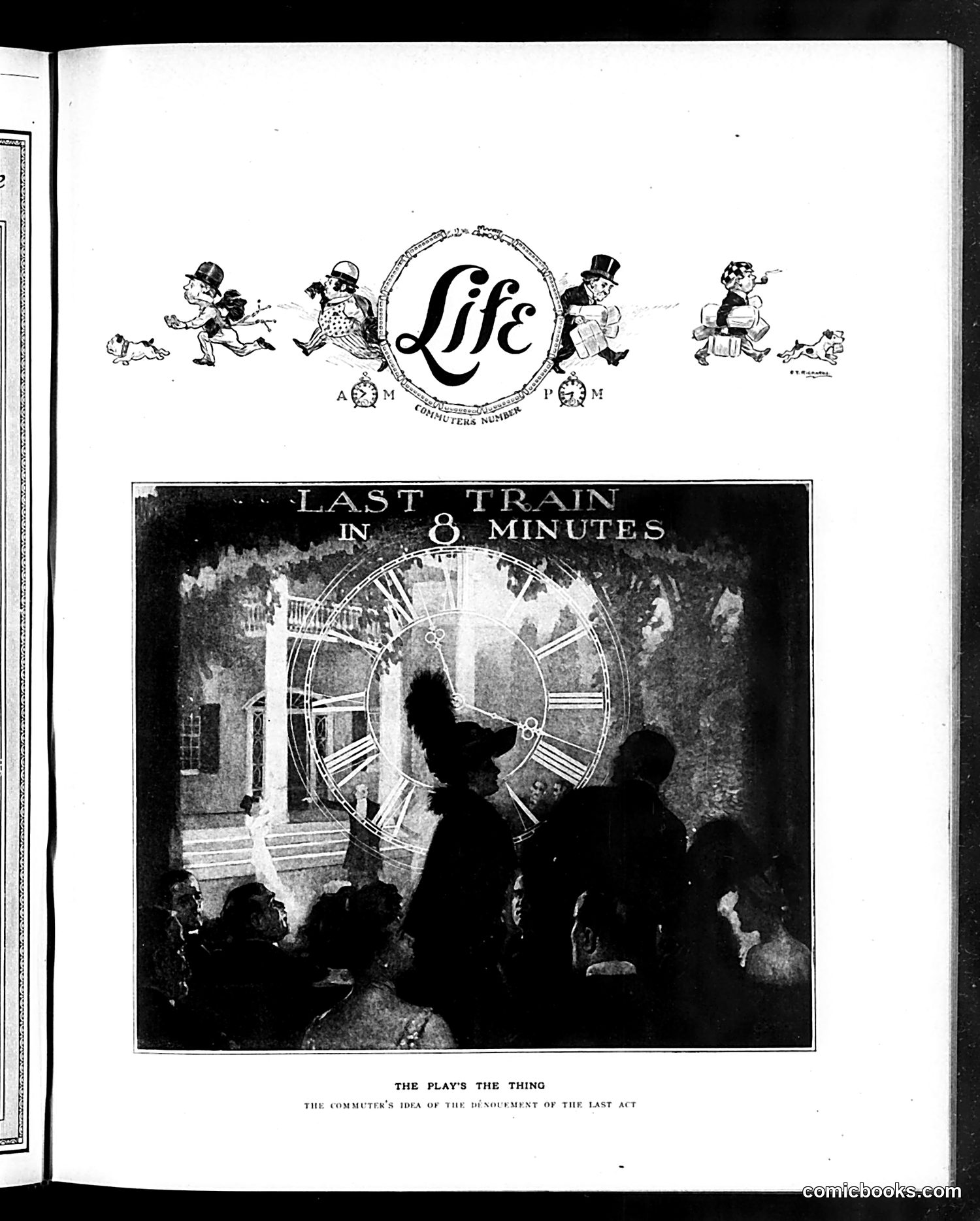
This Life magazine page features a theatrical advertisement. The top displays the iconic Life masthead with decorative cartoon characters. Below is a photograph showing an audience silhouetted against a large clock face, with text reading "LAST TRAIN IN 8 MINUTES." The caption states "THE PLAY'S THE THING" and references "THE COMMUTER'S IDEA OF THE DENOUEMENT OF THE LAST ACT." This is satirical commentary on theatrical attendance among commuters. The joke appears to be that working commuters attending evening theater are primarily concerned with catching their last train home rather than appreciating the play itself. The urgency of the ticking clock represents the tension between cultural leisure and practical transportation schedules—a relatable anxiety for urban commuters of that era.
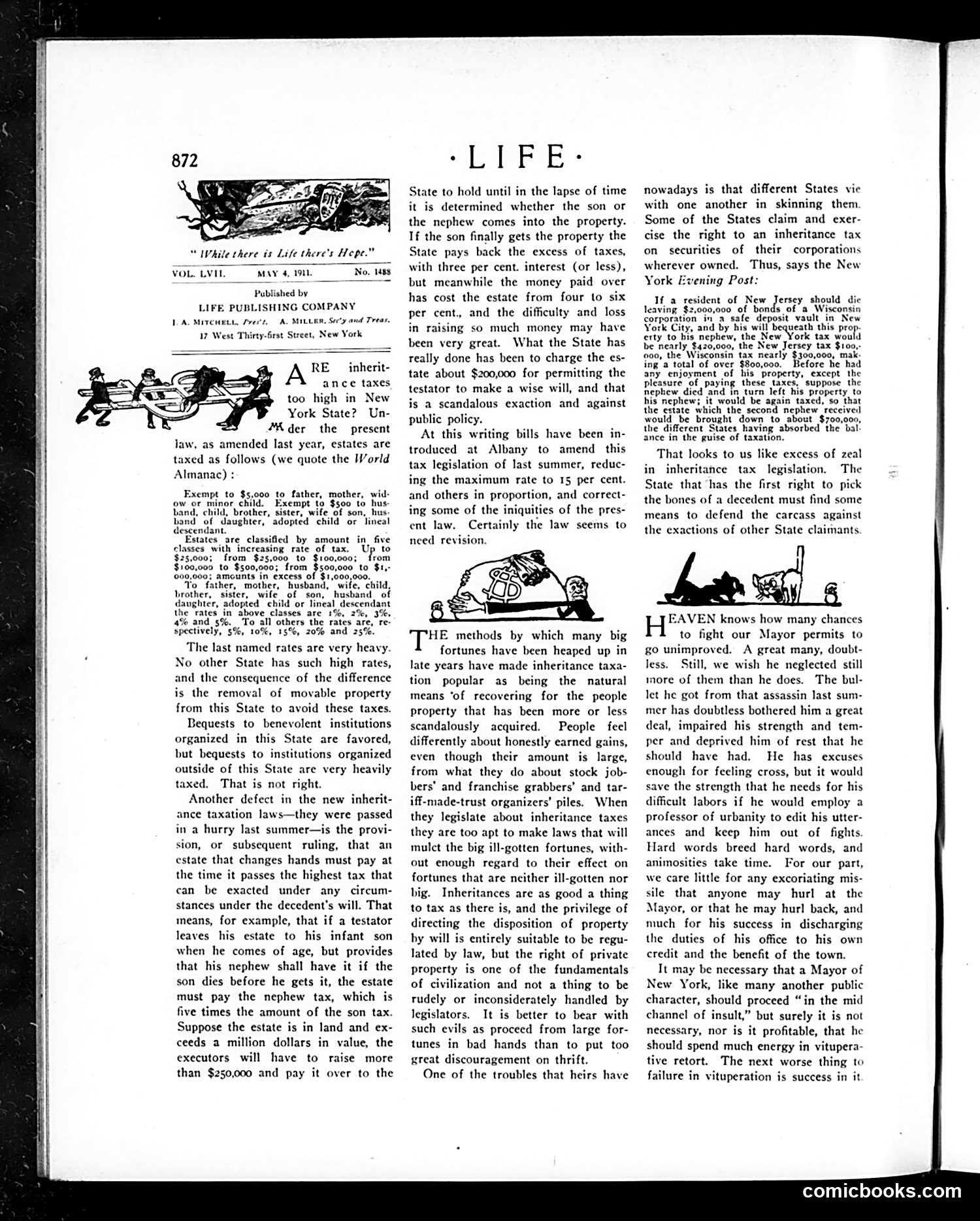
This page discusses inheritance taxation in New York State during the Progressive Era. The article critiques how wealthy estates are taxed at varying rates depending on the heir's relationship to the deceased—ranging from 1% to 5% or higher. The cartoon depicts a figure being crushed or weighed down, likely representing an heir burdened by heavy inheritance taxes. The satire targets what the author sees as excessive and arbitrary state taxation of estates, arguing the system is unfair and discourages productive wealth transfer. The article references a proposed bill at Albany to reduce maximum inheritance tax rates from higher levels to 15 percent, suggesting contemporary debate over whether such taxation serves the public good or unjustly penalizes families and their legacies.
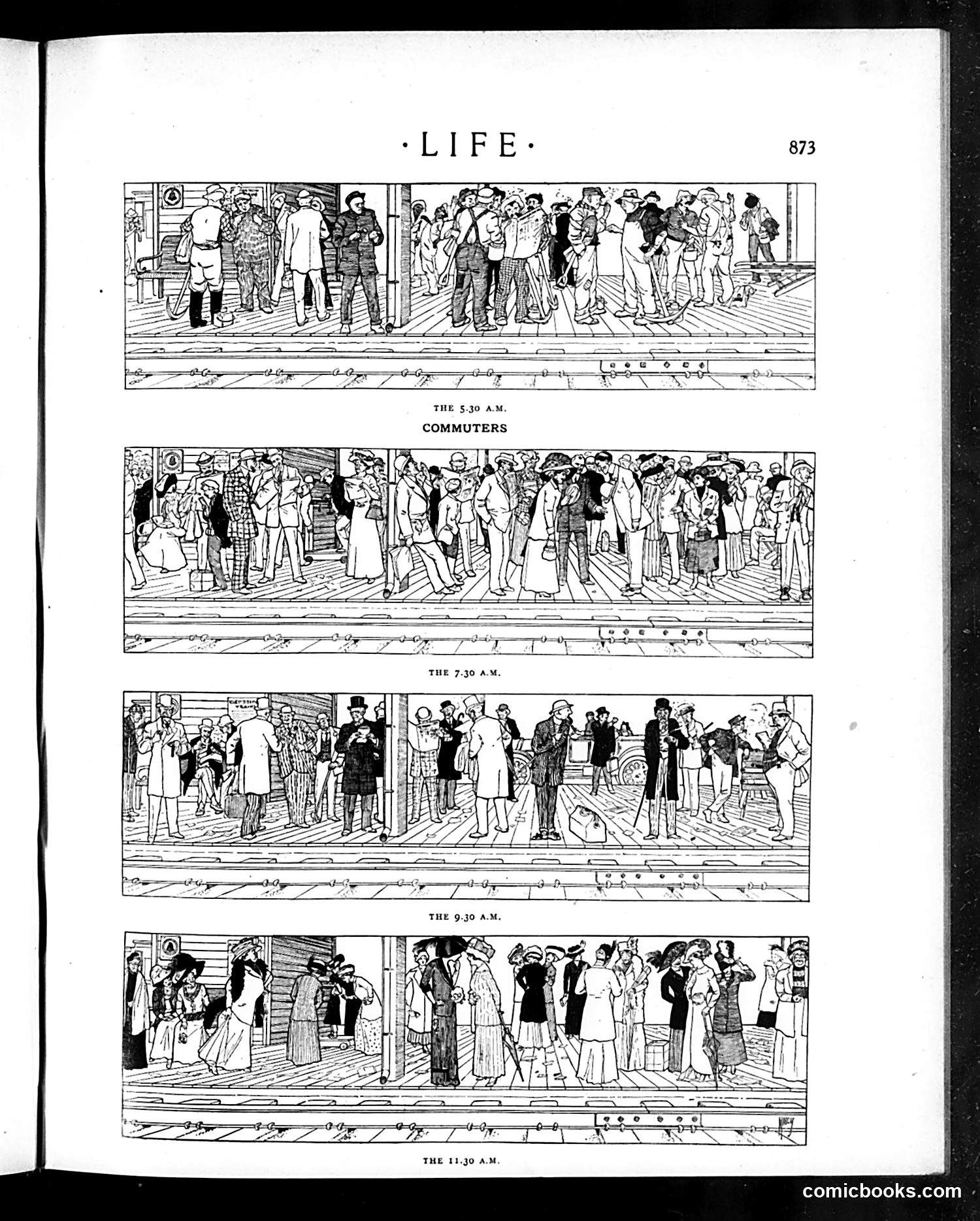
This satirical comic strip documents the increasing density of commuters boarding a train at four different times (5:30 AM, 7:30 AM, 9:30 AM, and 11:30 AM). The humor derives from visual progression: each successive panel shows the platform and train car becoming progressively more crowded with passengers, their clothing and postures reflecting the scramble to board. The satire targets the absurdity of urban commuting culture and rush-hour congestion. By presenting this in sequential panels with precise timestamps, the artist mocks both the repetitive daily grind and the increasing desperation of later arrivals competing for limited space. The comic suggests the universal frustration of commuter rail experiences and crowded public transportation—a relatable complaint for Life magazine's urban readership.
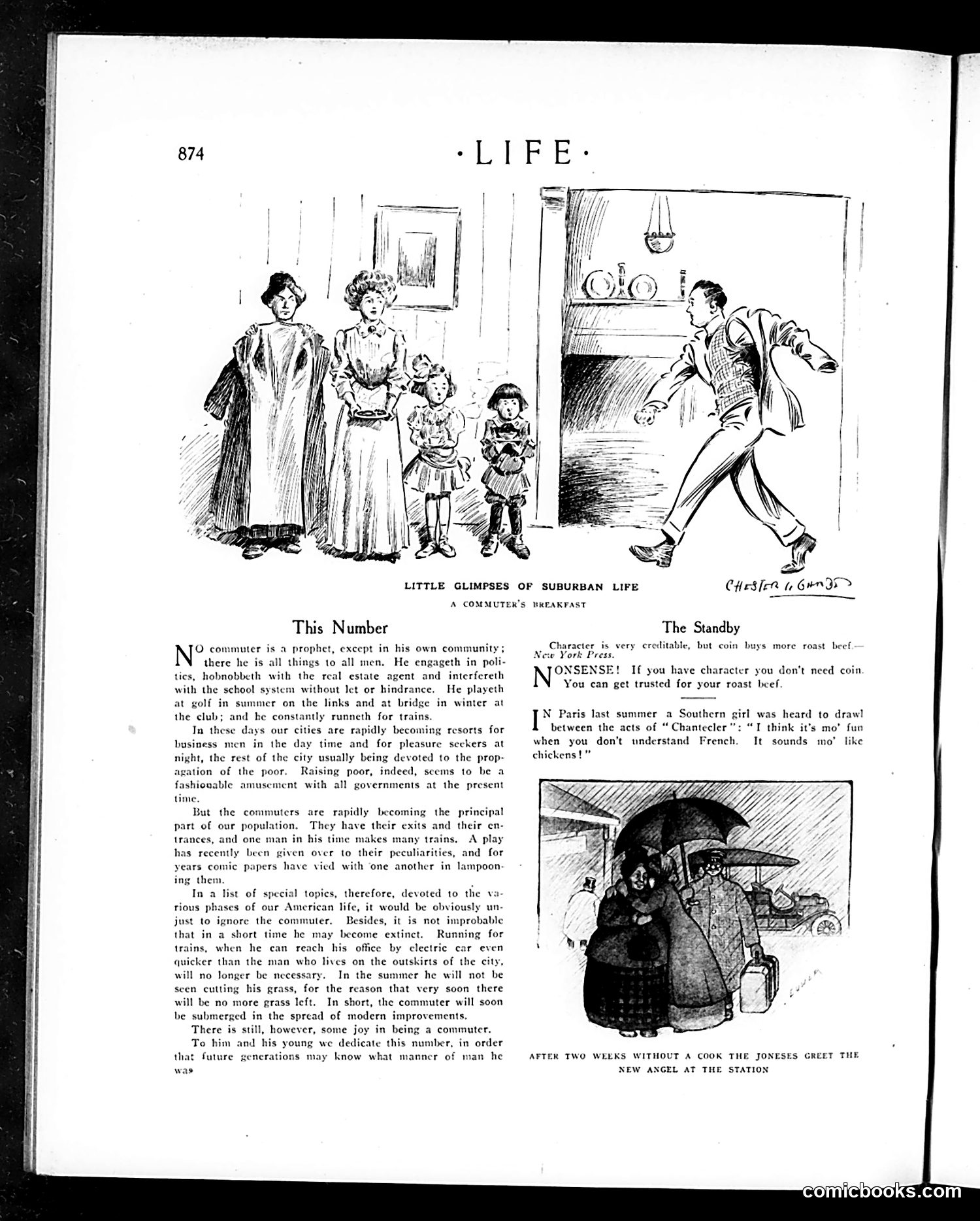
This page satirizes American suburban commuters—a rapidly growing demographic in the early 1900s. The main illustration shows a typical commuter scene: a man rushing out the door while his wife and children wait, depicting the hectic domestic life of someone constantly "running for trains." The editorial text warns that commuters, while becoming central to American life, may soon become extinct due to electric cars and urban sprawl eliminating the need for suburban living. The satire is gentle: commuters are portrayed as self-important in their small communities, juggling golf, bridge, politics, and school board involvement while perpetually chasing trains. The two sidebar jokes mock middle-class pretensions: "The Standby" disputes whether character or money matters more (ultimately endorsing credit), while the bottom cartoon shows a family greeting their new cook—suggesting domestic help's crucial importance to suburban wives managing households. The overall tone is affectionate mockery of an emerging American social class.
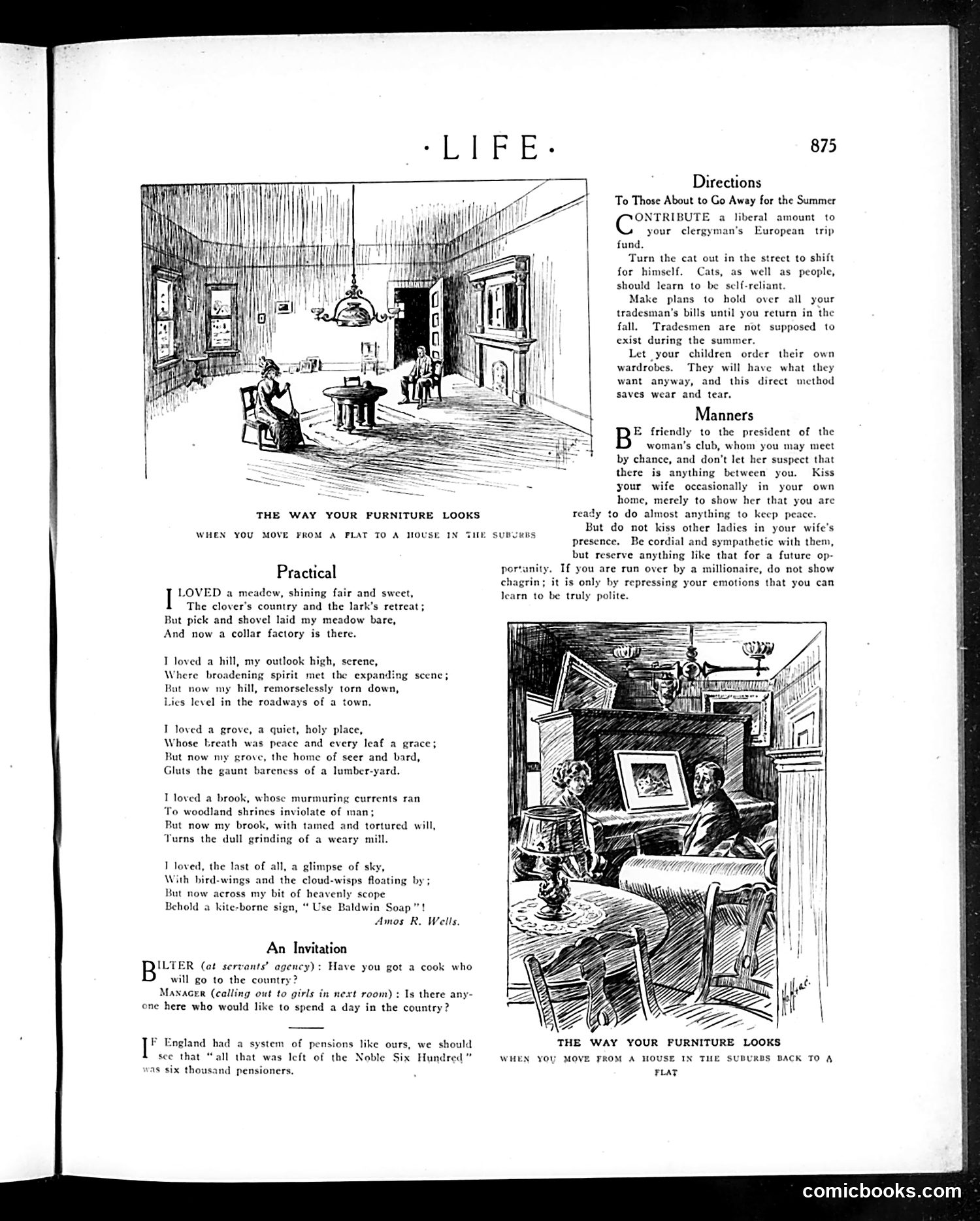
This page contains several distinct satirical pieces typical of early Life magazine: **"Practical" Poem**: A nostalgic lament about industrialization. The poet recalls loving natural landscapes—meadows, hills, groves, brooks, and sky—but each has been destroyed by urban development (factories, roads, lumber yards, mills, and advertising signs). The Baldwin Soap ad sign is the final insult, commercializing even the sky. This reflects progressive-era anxieties about unchecked industrial expansion destroying rural America. **Two cartoon illustrations** show furniture appearing awkward when moved between apartments and suburban houses—visual humor about the mismatch between furnishings and living spaces. **"An Invitation" and other humor sections** offer light satirical advice about summer behavior, servants, and manners—poking fun at upper-middle-class pretensions and hypocrisy (kissing your wife occasionally "to keep peace," treating servants poorly). The overall tone critiques both industrial progress's environmental costs and the affectations of polite society.
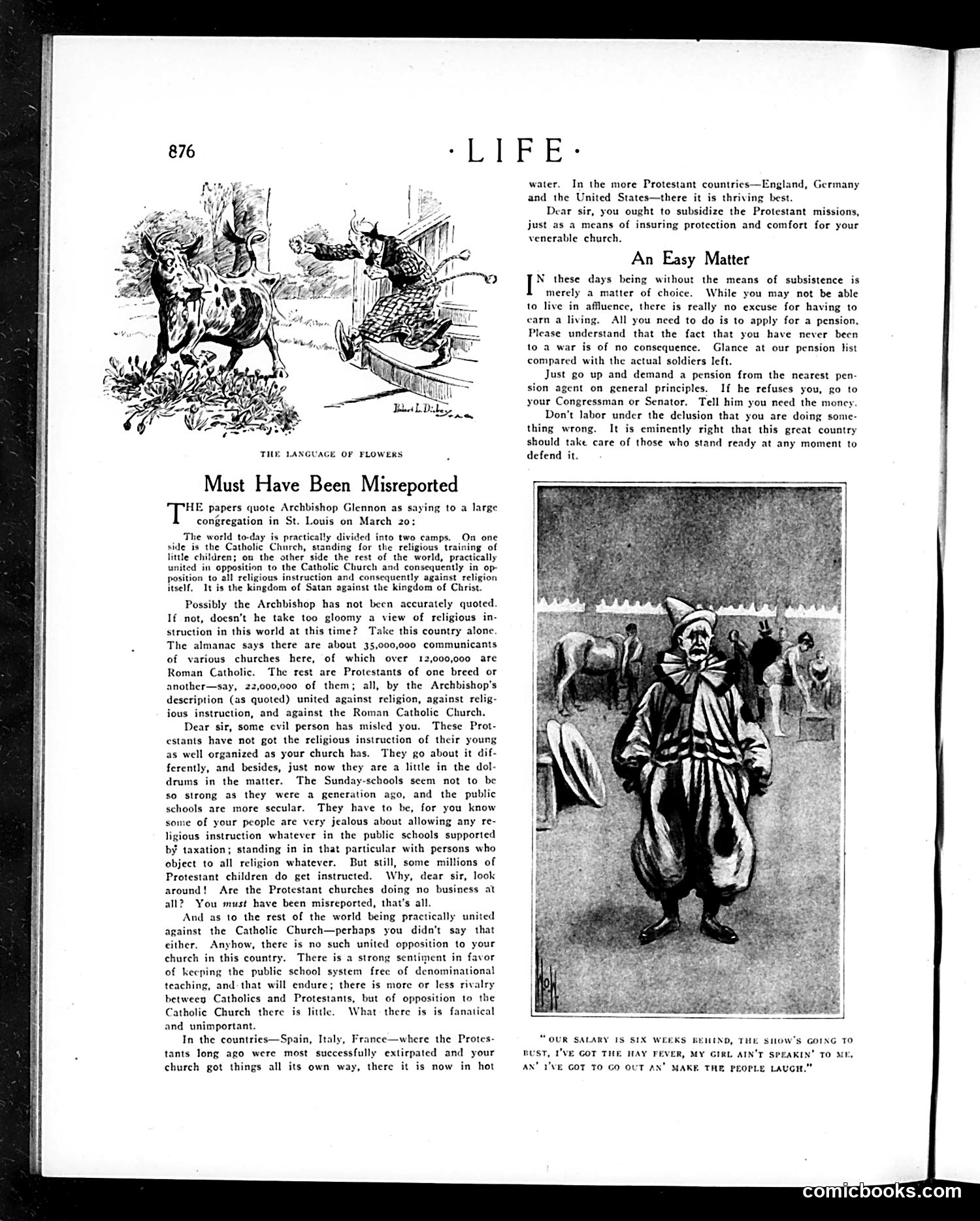
This page contains two distinct pieces of social commentary: **"The Language of Flowers"** (top left): A sketch cartoon showing two figures in what appears to be a theatrical or exaggerated confrontation, likely illustrating figurative "language" through body gesture and expression. **"Must Have Been Misreported"** (main article): A lengthy satirical letter addressing Archbishop Glennon's recent sermon claiming the world divides into Catholics versus everyone else "united against religion." Life's editor sarcastically suggests the Archbishop was misquoted, pointing out that Protestants (22 million of 35 million American church communicants) actively teach religion too—just less formally than Catholics. The piece mocks the Archbishop's "gloomy" characterization while defending Protestant religious instruction and secular public schools as appropriate compromises. **"An Easy Matter"** (right column): Brief satire about pension-seekers, suggesting one can obtain government pensions without legitimate military service—a jab at pension system abuse. The overall page targets Catholic institutional claims to religious monopoly while defending Protestant pluralism and public education secularism.
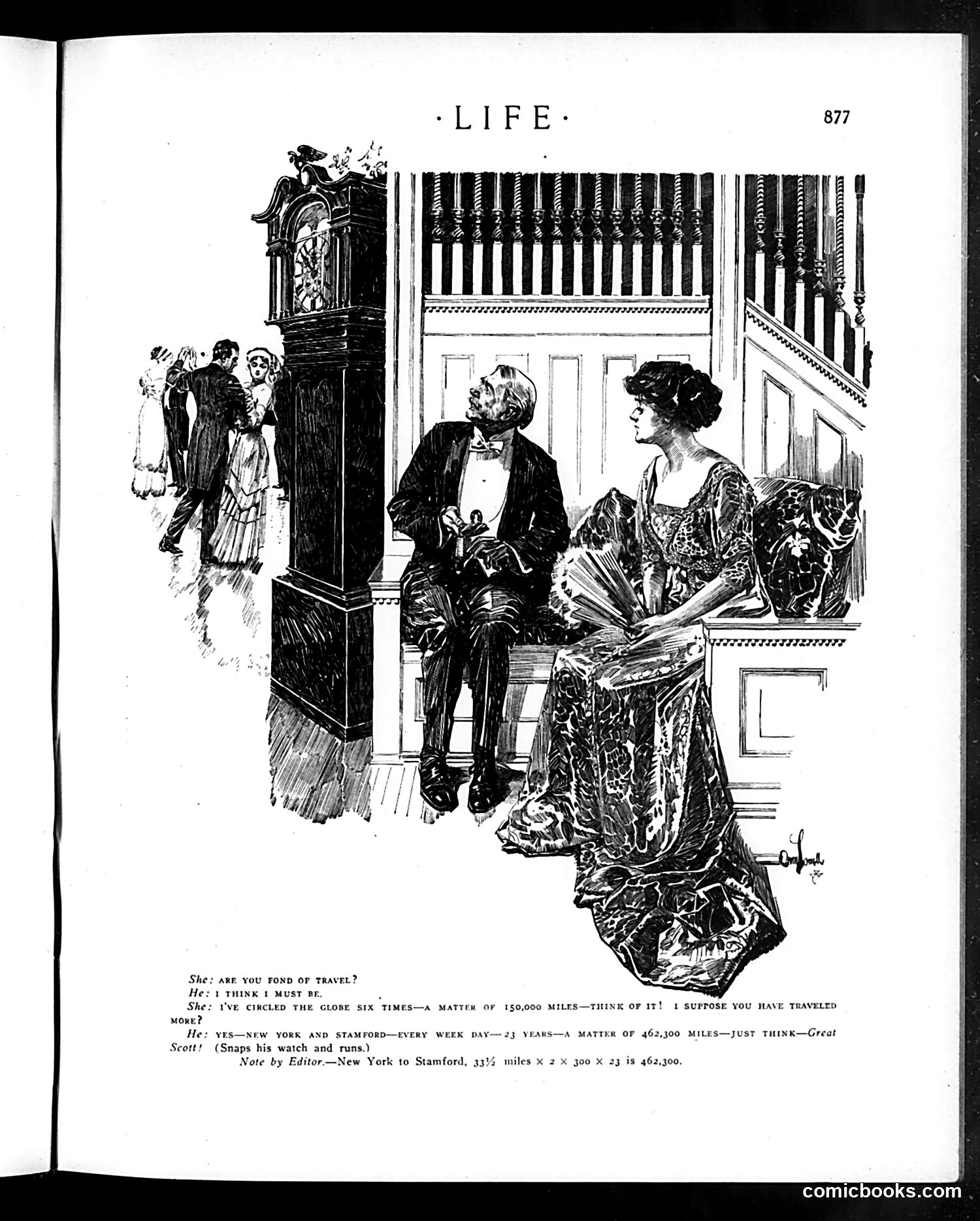
This satirical cartoon contrasts two types of "travel." An elegantly dressed woman boasts of circling the globe six times—150,000 miles of leisure travel. A man responds that he commutes between New York and Stamford every weekday for 23 years, totaling 462,300 miles. The joke's punch line: his mundane commute actually covers *more* distance than her glamorous world touring. The man's shocked reaction ("Great Scott!") and hurried departure suggest he's been humbled by this calculation. The satire targets the pretentiousness of leisure travelers who view regular commuting as unstylish drudgery, while overlooking that daily work travel accumulates far greater mileage. It's a commentary on class perspective and what counts as "real" travel in early 20th-century America.
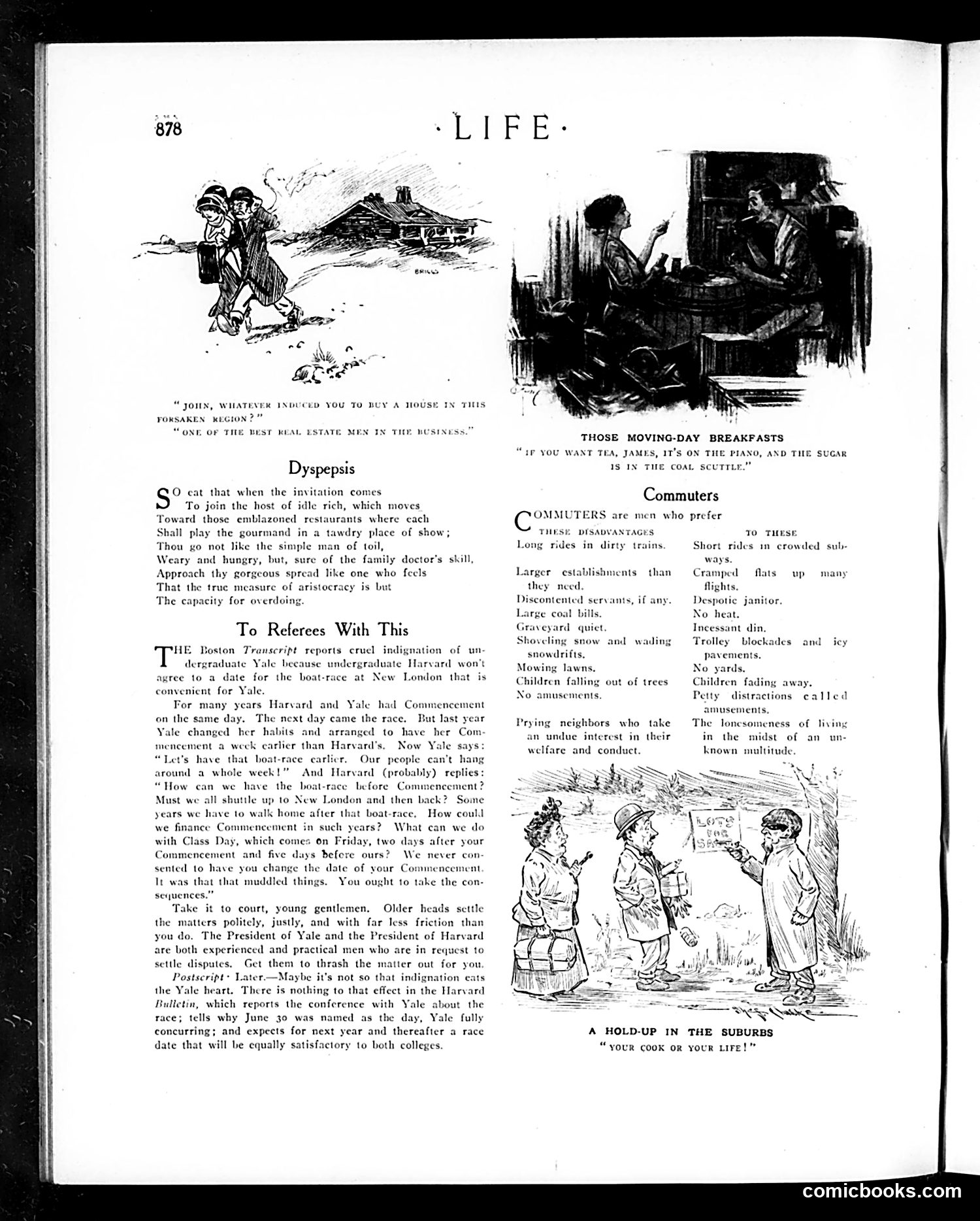
This page lampoons several aspects of American upper-middle-class life circa early 1900s: **"Dyspepsia"**: A poem mocking wealthy people who frequent fancy restaurants to display status while eating excessively, damaging their health—equating aristocratic pretension with gluttony. **"To Referees With This"**: Satirizes the petty dispute between Harvard and Yale universities over scheduling their annual boat race around Commencement ceremonies. The piece ridicules how undergraduates bicker over logistics while their presidents could easily resolve it maturely. **"Those Moving-Day Breakfasts"** and **"Commuters"**: Mock the suburban lifestyle emerging in America, contrasting the disadvantages (cramped apartments, despotic janitors, mowing lawns, nosy neighbors) against promised benefits. The final cartoon, "A Hold-Up in the Suburbs," darkly jokes that suburban servants/cooks are so valuable they can extort money ("your cook or your life!")—suggesting the absurdity of suburban dependence on domestic help.
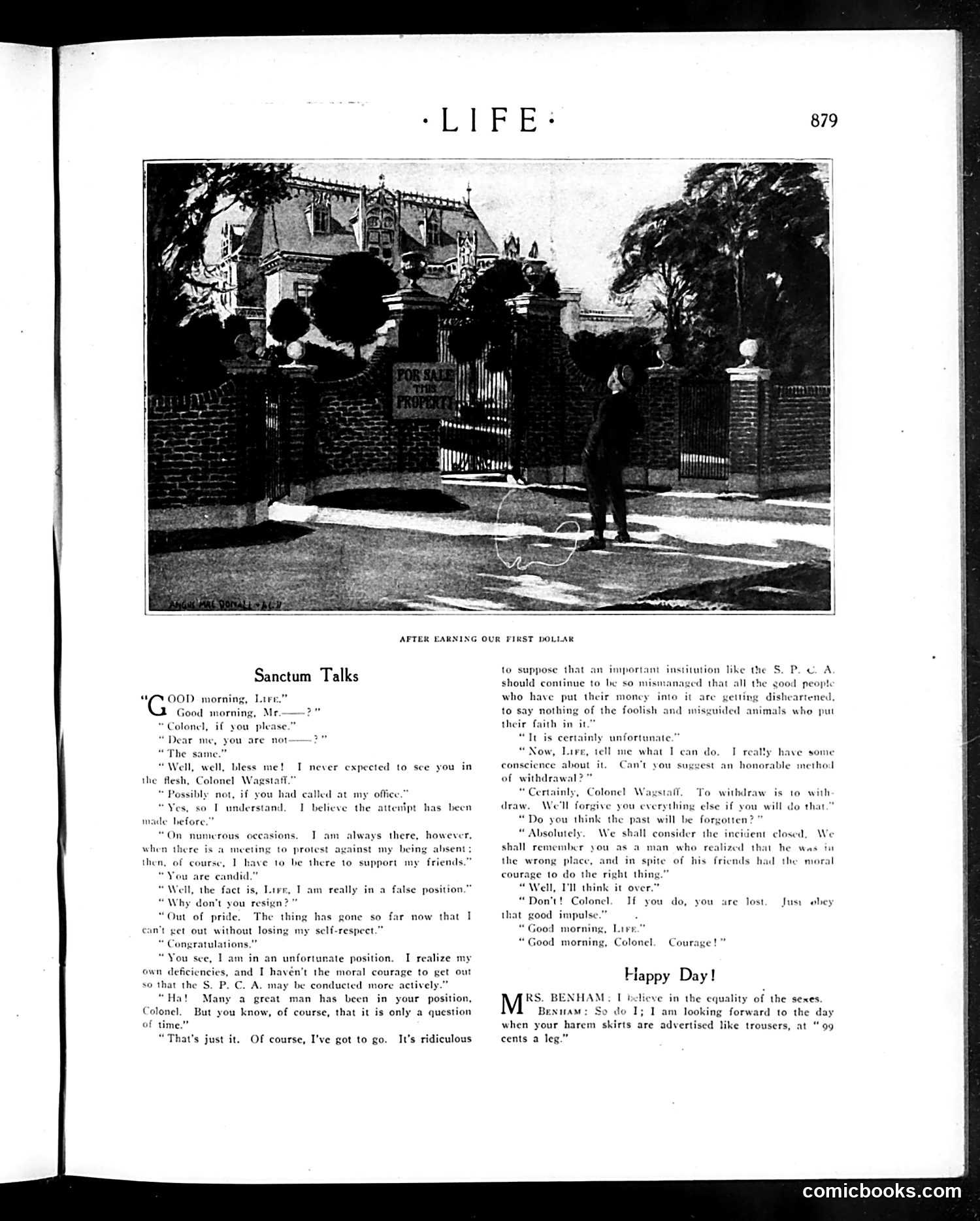
The main cartoon depicts a conversation between "Life" (the magazine's personified editor/voice) and Colonel Wagstaff regarding the S.P.C.A. (Society for the Prevention of Cruelty to Animals). Wagstaff admits he's mismanaging the organization but lacks the moral courage to resign, citing pride and self-respect as obstacles. Life urges him to withdraw immediately, promising the incident will be forgotten if he acts on this "good impulse" without deliberation. The satire targets organizational corruption and the cowardice of leaders who know they're unfit but cling to positions anyway. It mocks Wagstaff's contradictory reasoning—he acknowledges his deficiencies harm both the institution and the animals it protects, yet won't leave. The secondary joke about "Mrs. Benham" and "harem skirts" appears unrelated—a brief gag about women's fashion and equality, suggesting that advertising women's clothing with prices "per leg" (like trousers) represents gender equality. The image shows an estate gate, likely representing institutional prestige.
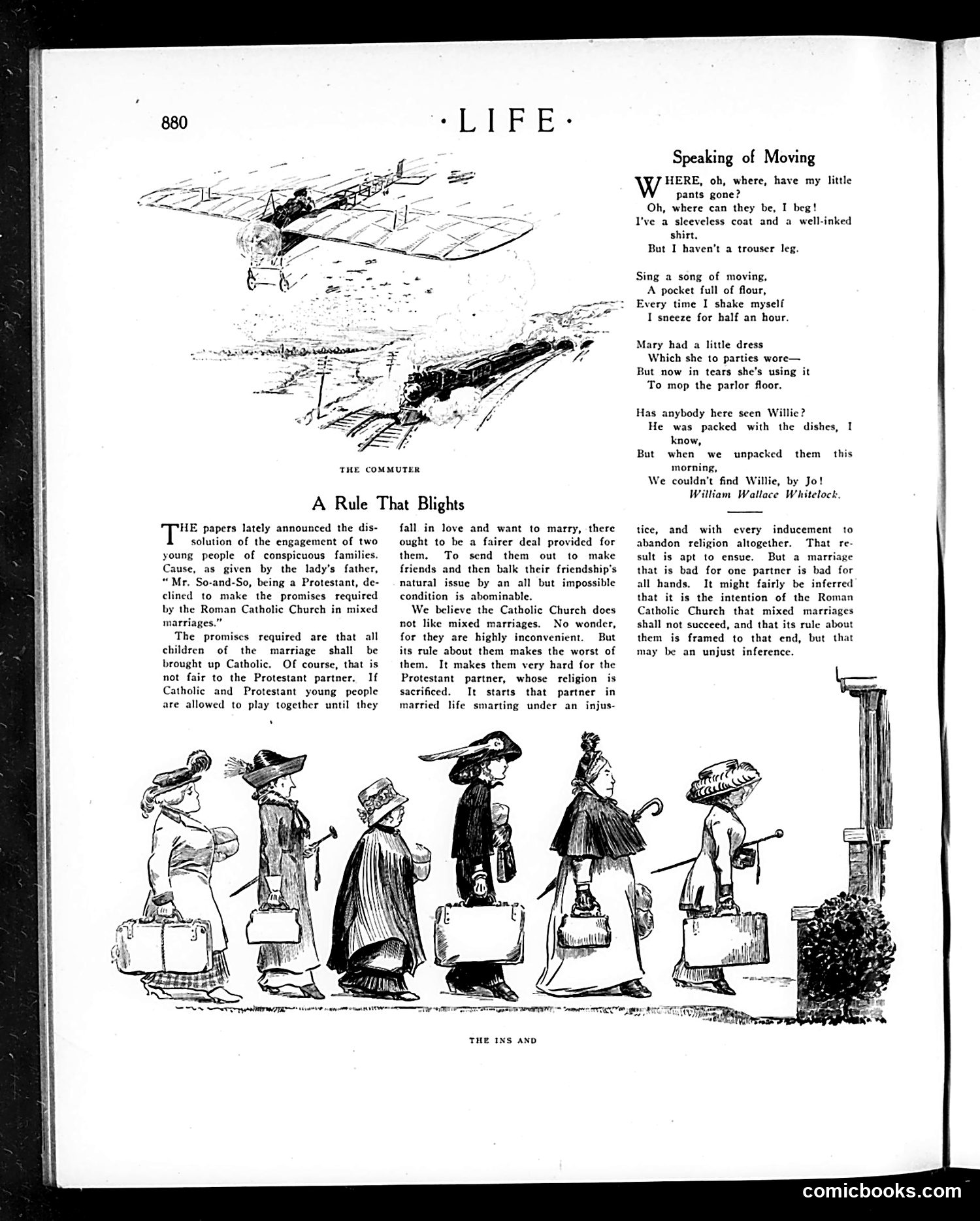
**"A Rule That Blights"** critiques Catholic Church policy on mixed-religion marriages. The article argues that while the Church discourages interfaith unions, it simultaneously permits Catholic and Protestant youth to socialize freely—then enforces an impossible condition: all children must be raised Catholic. The author contends this creates an "unjust" situation, particularly punishing the Protestant partner whose religion is "sacrificed," potentially driving them away from faith entirely. The satire targets the logical inconsistency of the Church's approach rather than religion itself. **"Speaking of Moving"** is humorous verse by William Wallace Whitelock about the chaos of relocating—lost clothing, spilled flour, repurposed dresses, and missing family members packed with dishes. It's lighthearted domestic humor about moving day mishaps. The illustration shows travelers with luggage, likely accompanying the moving poem.
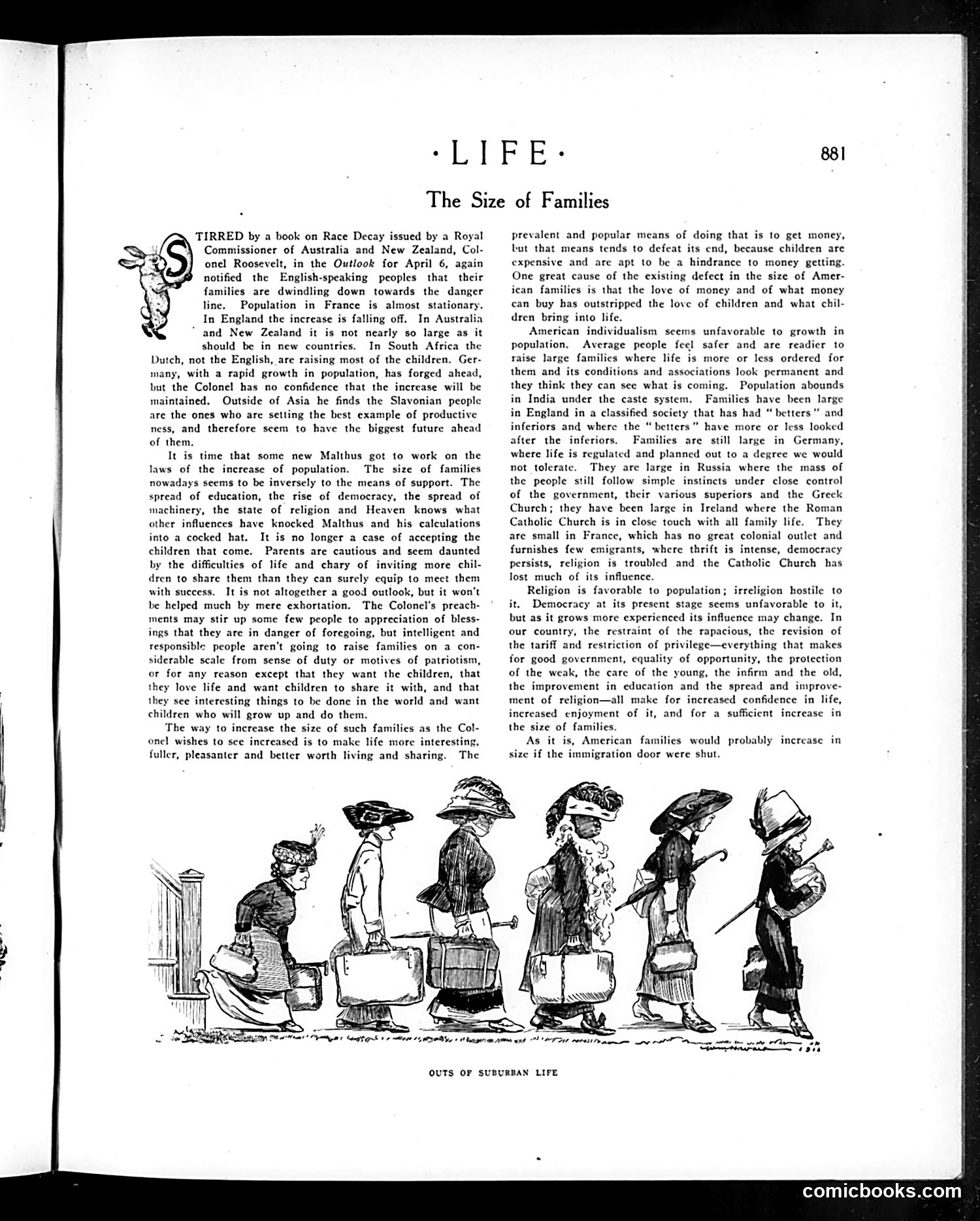
This page addresses declining birth rates among English-speaking populations, prompted by Colonel Theodore Roosevelt's public concern about "Race Decay." The article critiques Roosevelt's exhortations for larger families, arguing that intelligent people won't have children purely from patriotic duty or moral pressure. The cartoon captioned "OUTS OF SUBURBAN LIFE" depicts a line of women carrying suitcases—likely representing emigration or departure from domestic life. This visually satirizes the tension between traditional expectations of motherhood and women's emerging independence and mobility. The text's core argument: modern capitalism and individualism discourage large families because children are economically burdensome. The piece observes that populations remain large only under rigid social structures (India's caste system, Germany's regulation, Russia's authoritarianism, Catholic Ireland)—implying that American freedom inherently reduces family size, making Roosevelt's appeals futile.
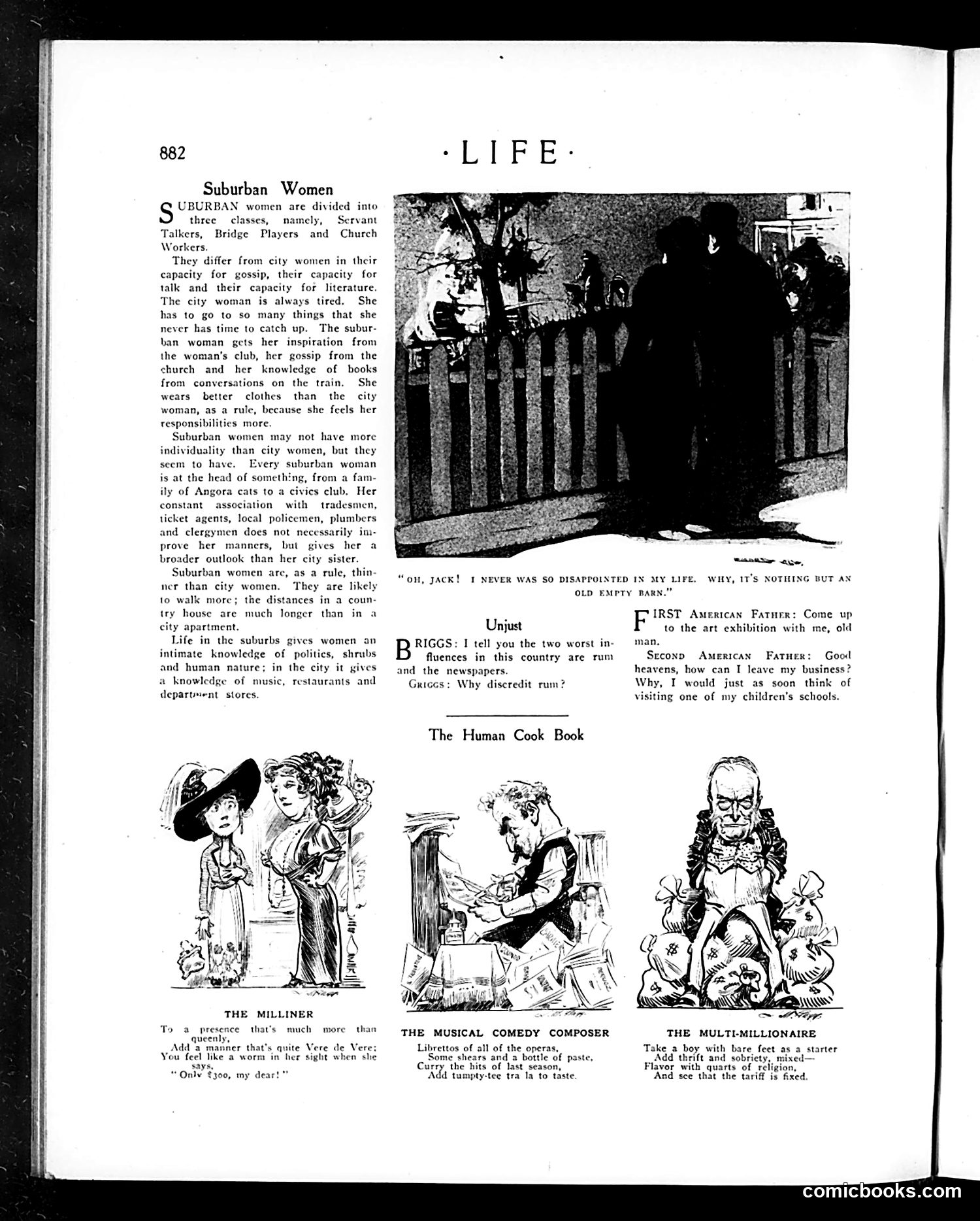
This page satirizes early 20th-century American social hierarchies through two main pieces: **"Suburban Women"** stereotypes suburban wives as gossipy, class-conscious figures obsessed with clubs and church work—contrasting them favorably (yet mockingly) with tired city women. The satire suggests suburban women, despite their pretensions and constant "heading" of organizations, lack genuine sophistication. **"The Human Cook Book"** uses caricatured social types to mock different professions and classes. "The Musical Comedy Composer" ridicules hack artists who recycle old material. "The Multi-Millionaire" satirizes the self-made businessman mythology by reducing success to mere ingredients (thrift, religion, tariff protection)—suggesting wealth isn't earned merit but systematic exploitation. The cartoons mock both working-class pretension and capitalist ideology, using exaggerated physical features typical of period satire. The overall tone reflects Life magazine's urbane critique of American social climbing and commercial culture.
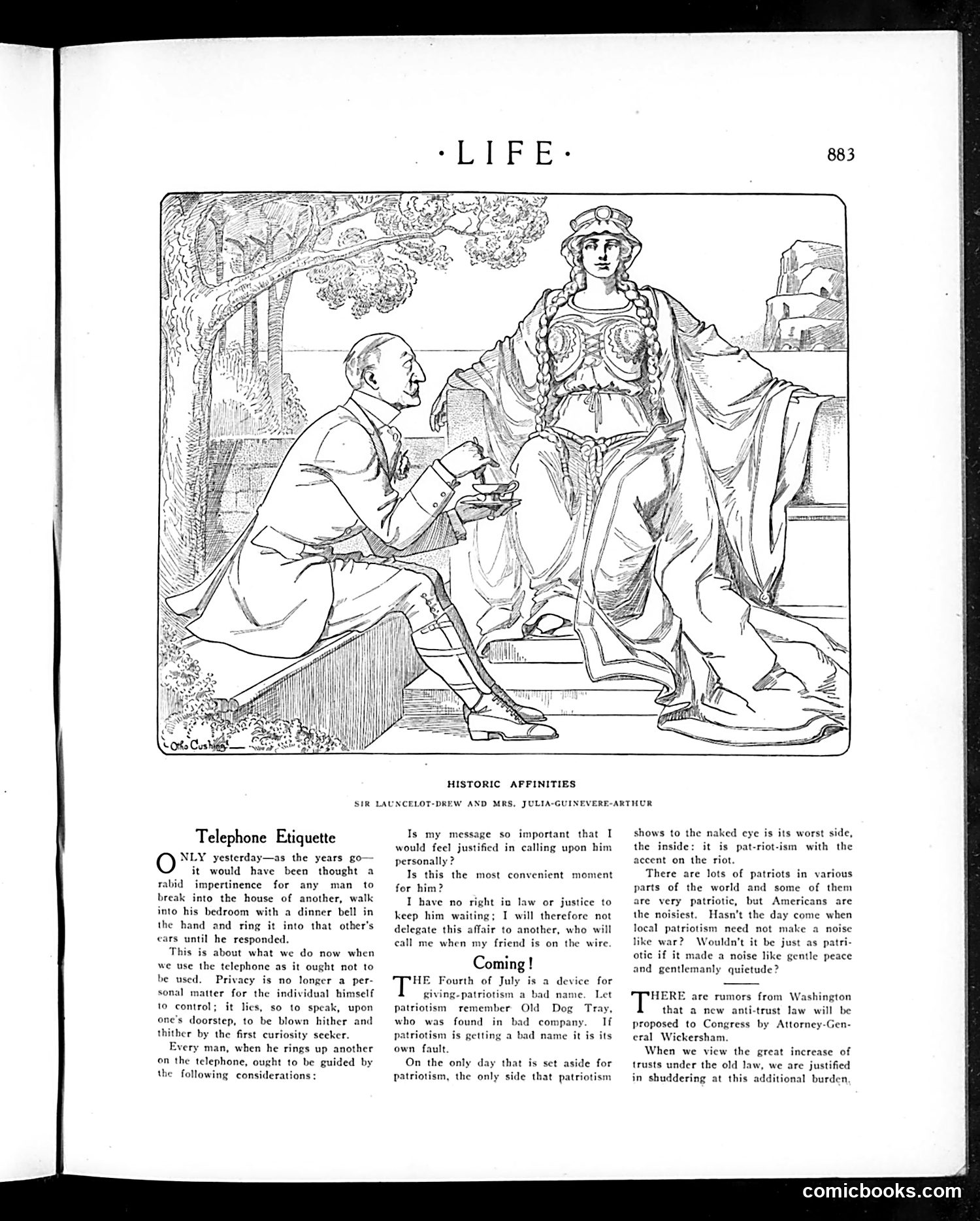
This page contains two satirical pieces: **Top Illustration ("Historic Affinities"):** A playful comparison labels a man "Sir Launcelot-Drew" and a woman "Mrs. Julia-Guinevere-Arthur," invoking Arthurian legend. The title suggests an illicit affair paralleling Lancelot and Guinevere's romance. The specifics of who these figures represent aren't identifiable from the image alone. **"Telephone Etiquette":** Satirizes the newly intrusive nature of telephone technology. The piece argues that calling someone without invitation is socially equivalent to "break[ing] into the house of another" with a dinner bell. It mocks how the telephone violates personal privacy—a modern concern when phones were still novel technology requiring deliberate etiquette rules. **"Coming!":** Criticizes Fourth of July celebrations as noisy, chaotic "patriotism" focused on rioting rather than genuine civic virtue, suggesting Americans are unnecessarily loud compared to other patriots. **Final note:** References Attorney General Wickersham and anti-trust law concerns, likely from the Progressive Era.
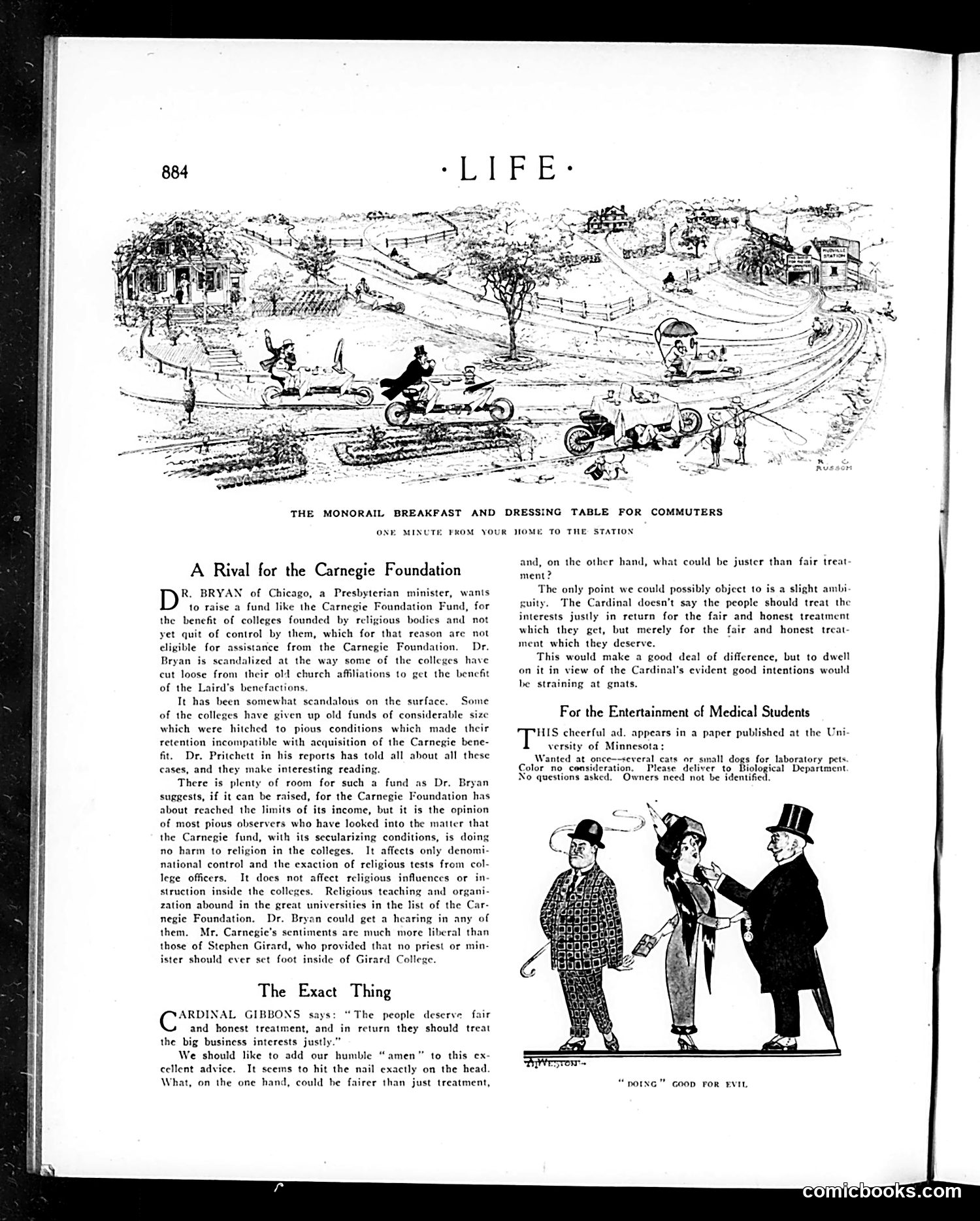
This page contains three distinct satirical pieces: **Top illustration**: "The Monorail Breakfast and Dressing Table for Commuters" depicts an absurdly futuristic contraption allowing commuters to eat and dress while traveling to work in one minute. The satire mocks contemporary obsession with time-saving technology and efficiency. **"A Rival for the Carnegie Foundation"**: Critiques Dr. Bryan's proposal for a separate charitable fund. The satire highlights hypocrisy: colleges abandon religious affiliations to access Carnegie's secular funding, yet Bryan wants to reward those retaining religious control. Life's editors argue Carnegie's conditions harm neither religion nor instruction—only denominational power. **"The Exact Thing"**: Sarcastically praises Cardinal Gibbons's circular logic: people deserve fair treatment; in return, they should treat business justly. Life notes the absurd tautology—Gibbons doesn't say people should reciprocate for *actual* fair treatment received, only treatment they "deserve"—mocking vague corporate-friendly platitudes. **Bottom cartoon**: A darkly humorous advertisement seeking cats/dogs for medical labs "no questions asked" — satirizing unethical animal procurement practices at universities.
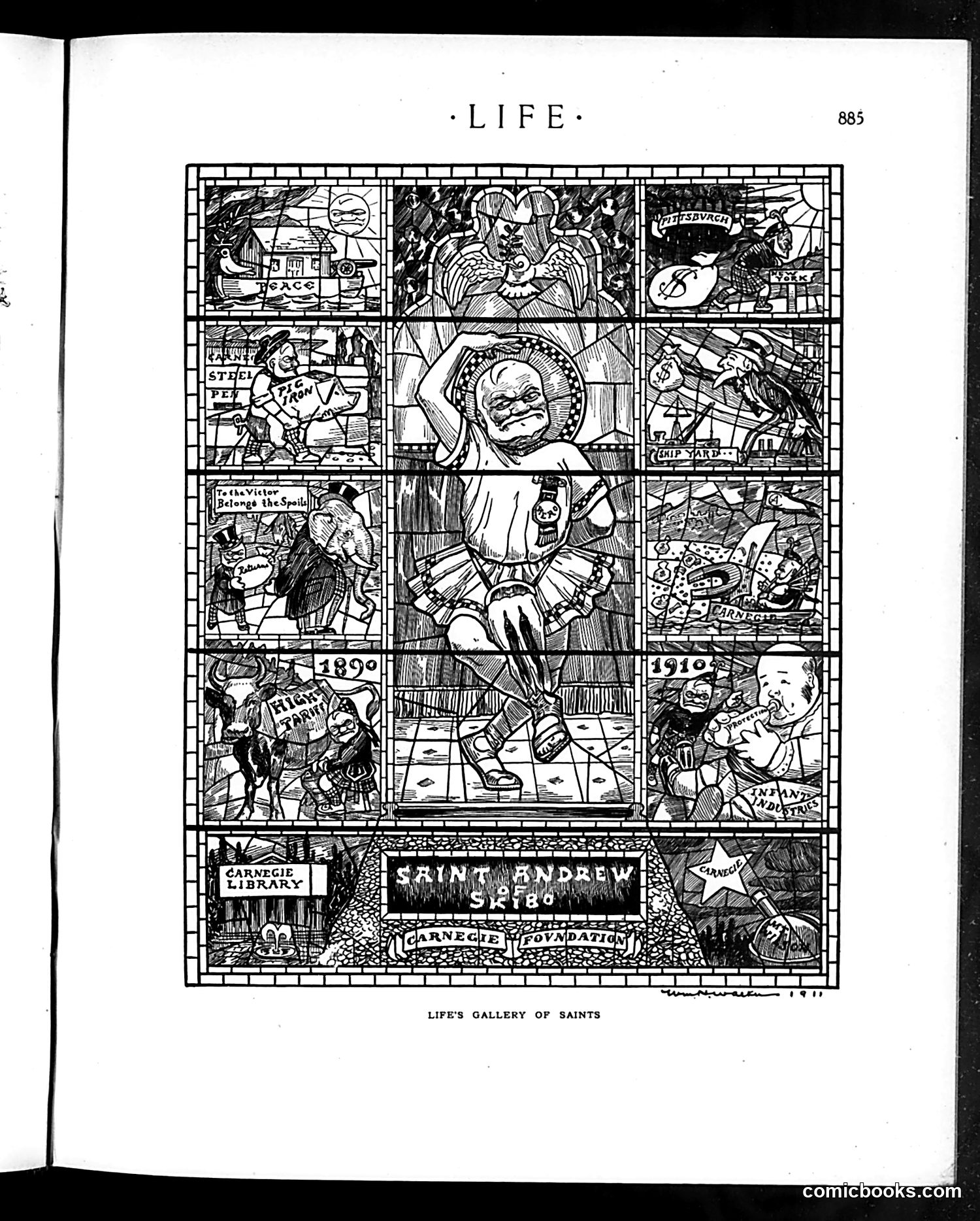
This is a satirical stained-glass window design mocking Andrew Carnegie, the steel magnate and philanthropist. The central figure depicts Carnegie as a saint, with "Saint Andrew Skibo" labeled below (Skibo Castle was his Scottish estate). The surrounding panels chronicle his life and business exploits, including references to steel manufacturing, wealth accumulation, and his Carnegie Foundation philanthropy. The satire targets the veneration of wealthy industrialists as moral figures. By framing Carnegie in religious iconography—a stained-glass saint—Life magazine criticizes the culture that treats robber barons as benefactors worthy of sainthood, despite their ruthless business practices. The juxtaposition of his industrial empire with sacred imagery underscores the irony of treating capitalists as moral exemplars.
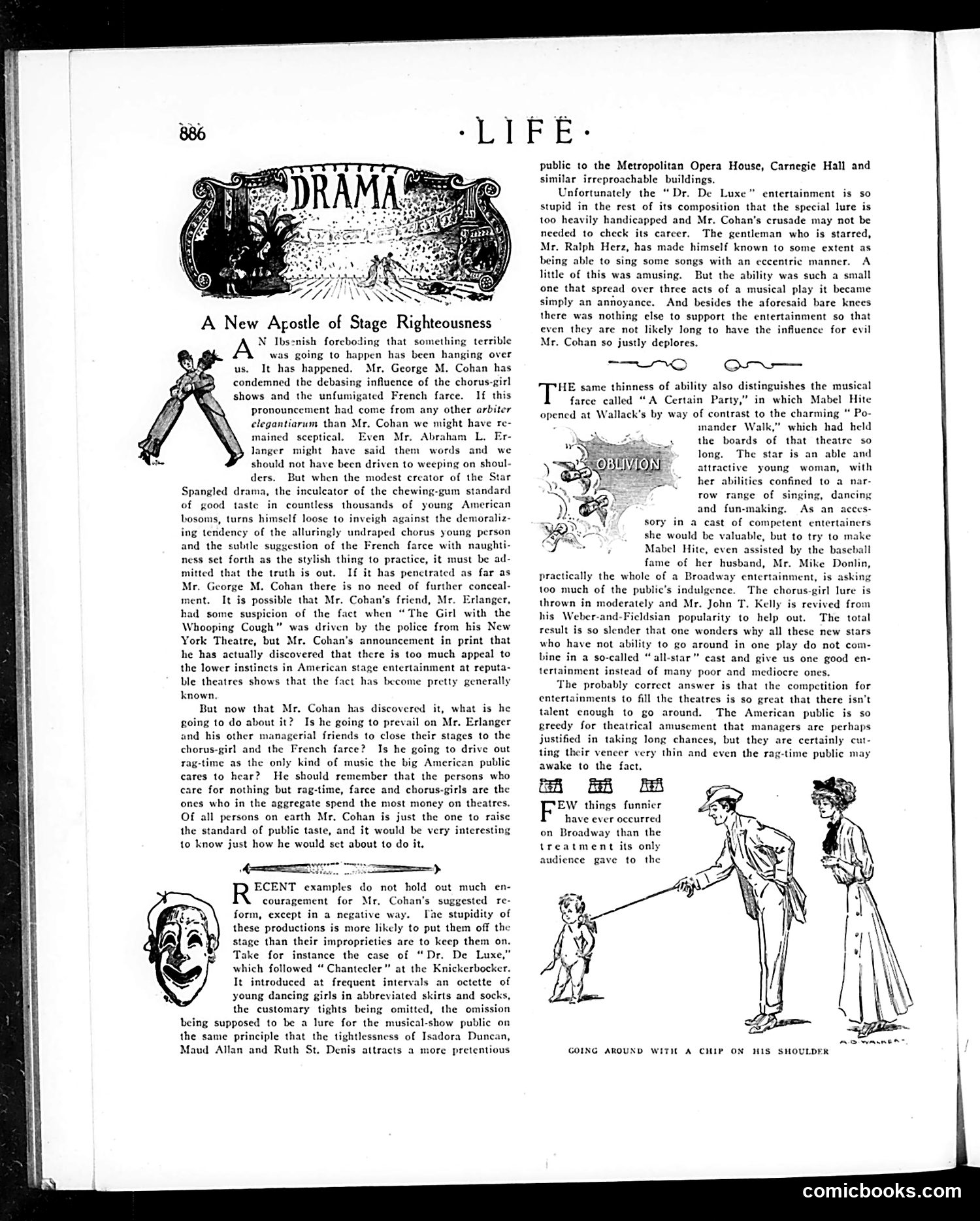
This page satirizes George M. Cohan's sudden moral crusade against Broadway's "debasing" chorus-girl shows and French farces. The irony is sharp: Cohan—creator of populist "Yankee Doodle Dandy" entertainment and "chewing-gum standard" productions—is condemned as the *last* person qualified to preach theatrical righteousness. The satire's bite: Cohan built his fortune on precisely the lowbrow entertainment he now denounces. The writer notes that chorus girls and rag-time farce attract the paying audiences that fund theaters. By calling for reform, Cohan would essentially eliminate his own audience. The page mocks contemporary Broadway figures like Abraham Erlanger (a theater manager), references specific shows like "Dr. De Luxe," and compares the appeal of partially-clothed dancers to modern dancers Isadora Duncan and Maud Allan—suggesting pseudo-intellectual justifications for exploitation. The cartoon at bottom (captioned "Going Around with a Chip on His Shoulder") likely visualizes this hypocrisy through physical metaphor.
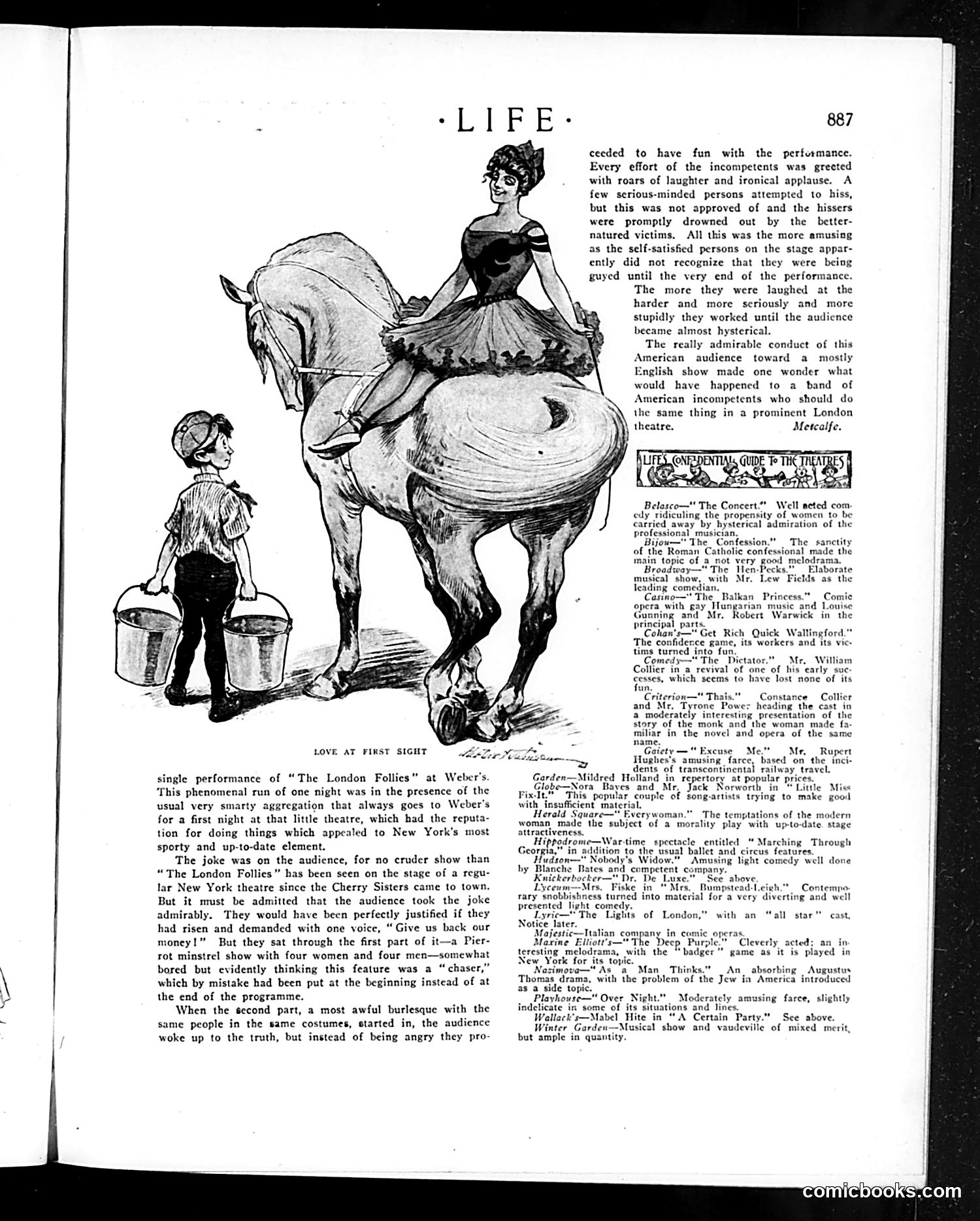
This cartoon critiques a disastrous theatrical performance of "The London Follies" at Weber's Theatre in New York. The illustration shows a woman on a horse, accompanied by a small boy carrying buckets—depicting the show's crude quality. The accompanying text explains that the audience recognized the performance as incompetent but responded with good humor rather than anger. They laughed ironically at the performers' earnest but awful efforts, apparently unaware they were being mocked. The critic (Metcalfe) suggests American audiences behaved admirably—with sophisticated tolerance—and sarcastically wonders if British audiences would have shown similar restraint toward incompetent American performers. The satire targets both the terrible show and celebrates the audience's witty, urbane response to theatrical failure.
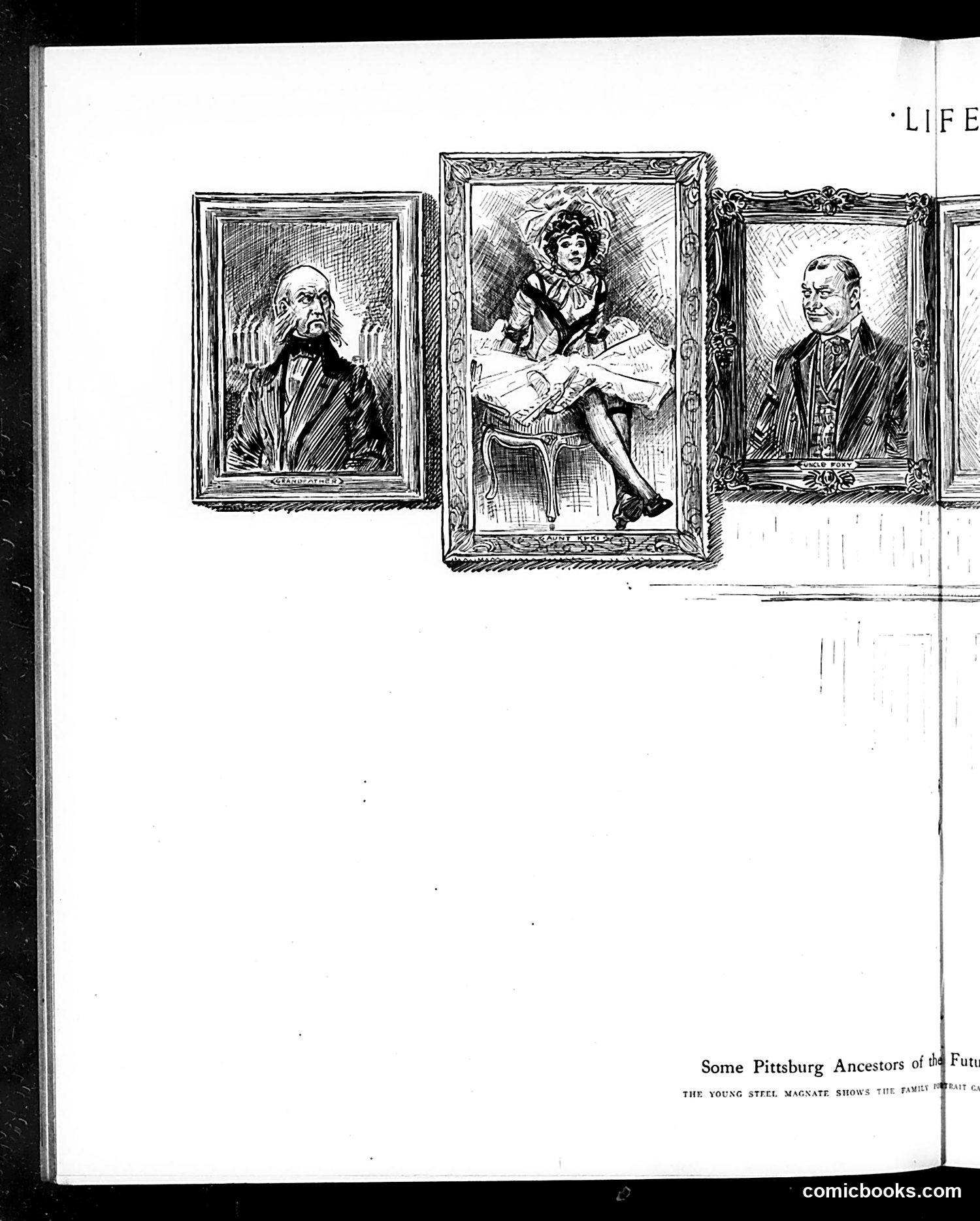
This page from *Life* magazine presents three framed portraits labeled "Some Pittsburgh Ancestors of the Future," with a caption about "The Young Steel Magnate Shows the Family Portrait Gallery." The cartoon satirizes the rapid wealth accumulation and social climbing of Pittsburgh's steel industry magnates during America's industrial boom. The three portraits—showing an austere older man (likely representing a fictional ancestor), a young woman at a desk, and another businessman—appear to mock how newly wealthy steel industrialists were inventing fictional family histories to establish themselves as old-money aristocrats. The humor lies in the pretension: these are *future* ancestors being displayed as if already historical, suggesting the young steel magnate is fabricating genealogical legitimacy to match his newfound wealth. It's satire on industrial-era social aspiration and the gap between nouveau riche reality and aristocratic pretense.
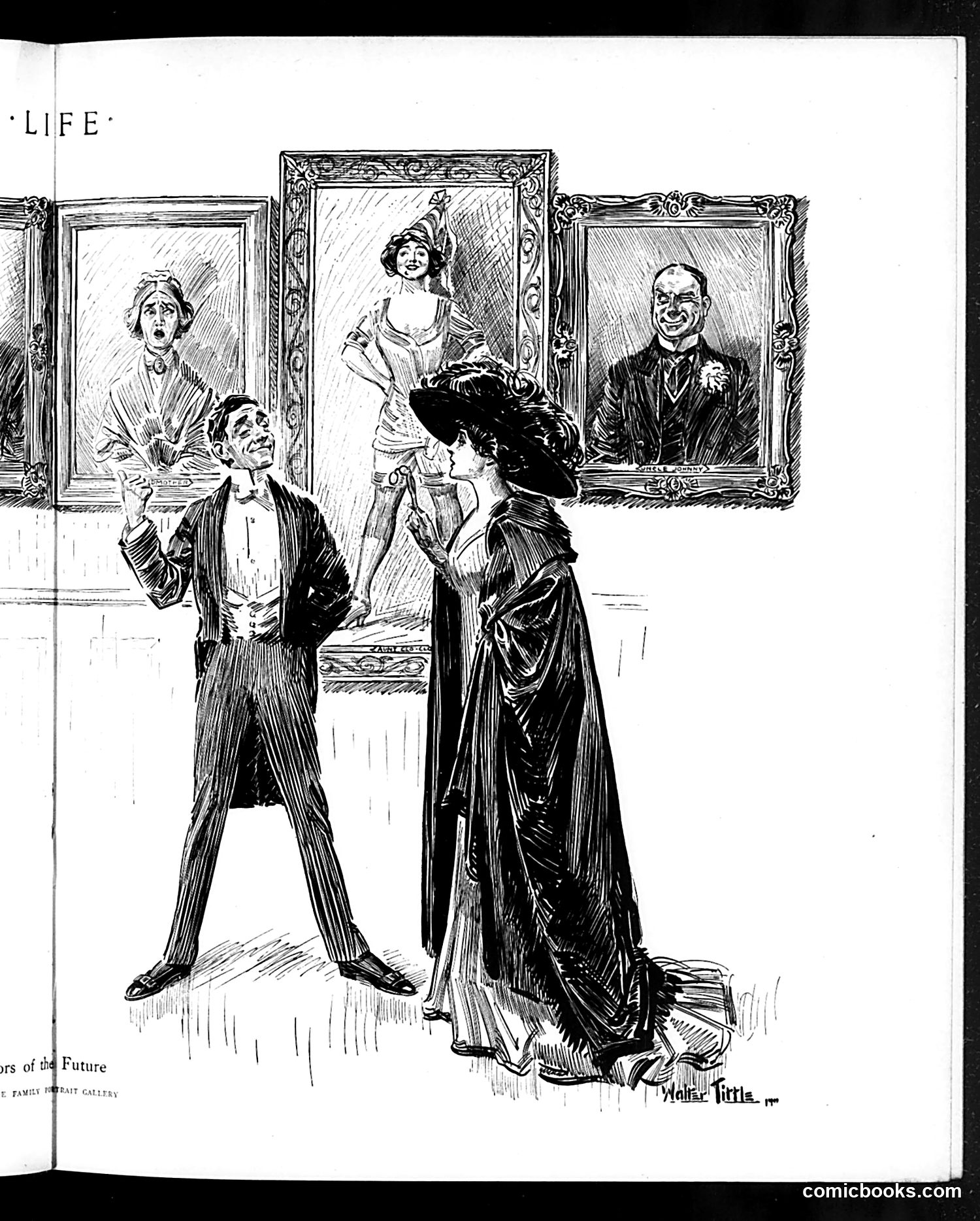
This is a satirical cartoon from *Life* magazine showing a couple viewing portraits in what appears to be an art gallery or portrait exhibition. The man gestures expressively while the elegantly dressed woman observes three framed portraits on the wall behind them. The cartoon's humor likely satirizes early 20th-century social pretensions—either about art appreciation, portrait culture, or the contrast between how people present themselves in formal portraits versus their actual personalities. The exaggerated expressions of both the viewing couple and the portrayed subjects suggest mockery of affected sophistication or the artificiality of portrait conventions. The artist signature reads "Walt" (likely Walter Tittle). Without additional context from surrounding page content, the specific social commentary remains somewhat unclear, though it clearly comments on portraiture or aesthetic judgment.
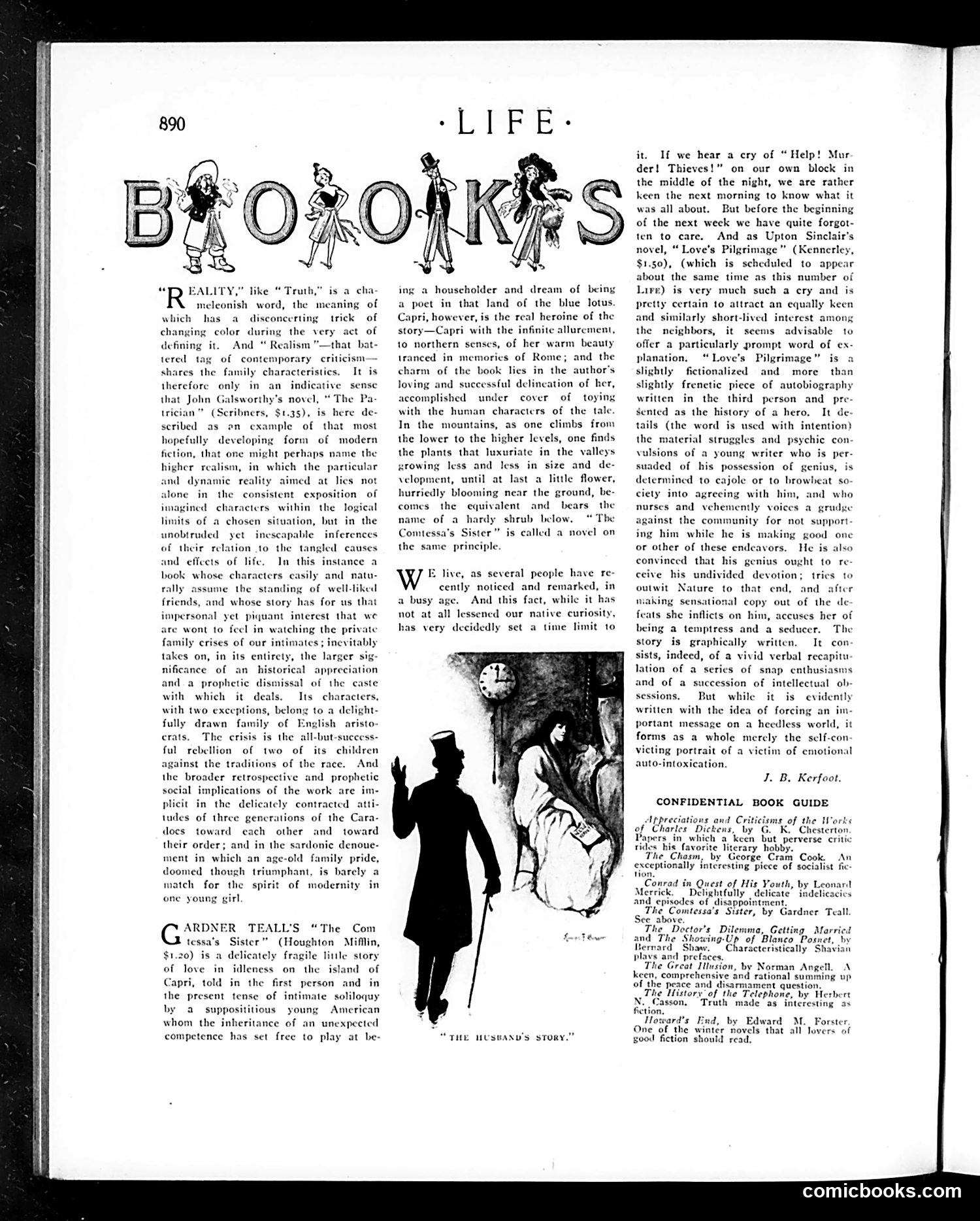
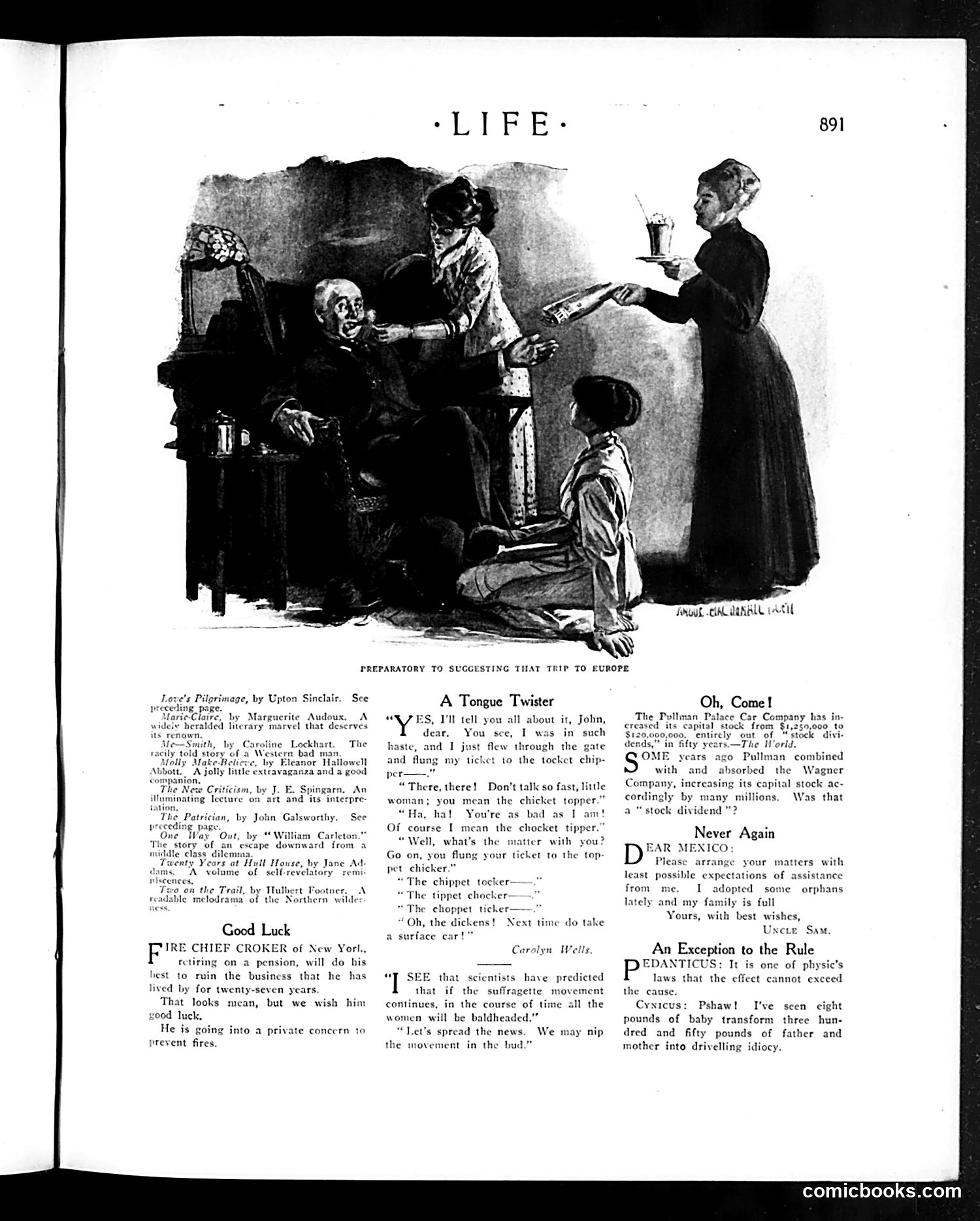
This page contains several satirical pieces from Life magazine: **Main Cartoon ("A Tongue Twister"):** A domestic scene showing a woman trying to recount a story to her husband while repeatedly mangling her words ("chicket topper," "choppet ticker," etc.). The joke satirizes women's supposed inability to speak clearly or coherently—a common period stereotype used for comedic effect. **"Fire Chief Croker" piece:** References John Gould Croker, New York City's Fire Chief retiring after 27 years. The satire suggests he'll now work in private fire prevention, wishing him "good luck" in a tongue-in-cheek way, implying skepticism about his ability to succeed outside municipal work. **"Suffragette" brief:** Mocks the suffragette movement by reporting (falsely) that scientists predict women will go bald if suffrage activism continues—absurdist humor dismissing women's political activism. **Other items:** Include book reviews and brief satirical notes on business matters and family life, typical of Life's miscellaneous humor format. The page reflects early 20th-century attitudes toward women, politics, and social change through period-specific satire.
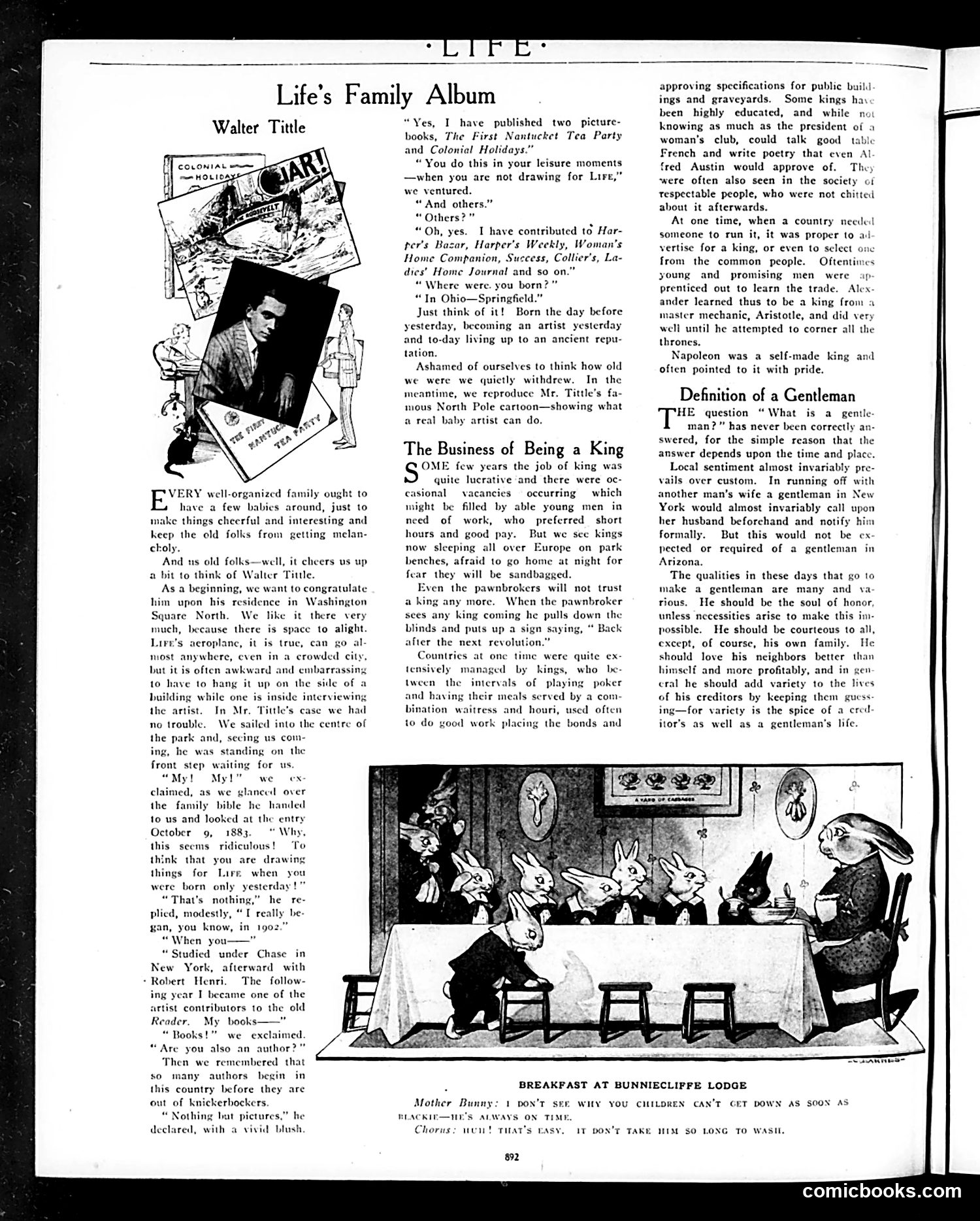
This page features Walter Tittle, an illustrator-artist being profiled in Life's "Family Album" interview series. The satire centers on Tittle's remarkably prolific output despite his youth—born in 1883, he claims to have "really begun" in 1902 when studying under William Merritt Chase. The joke is the absurdity of his accomplishments: he's already contributed to *Harper's*, *Life*, *Collier's*, multiple women's magazines, published picture books, and created cartoons—all while being barely in his twenties. The lower cartoon, "Breakfast at Bunniecliffe Lodge," shows anthropomorphic rabbits at a meal; it exemplifies the type of whimsical animal-character work Tittle produced. The "Business of Being a King" essay satirizes monarchies' declining relevance in early 20th-century Europe. It jokes that kingships are no longer lucrative, pawnbrokers won't trust kings, and revolution is so constant that even creditors give up. The piece mocks hereditary rule as outdated while pretending it's merely an employment problem.
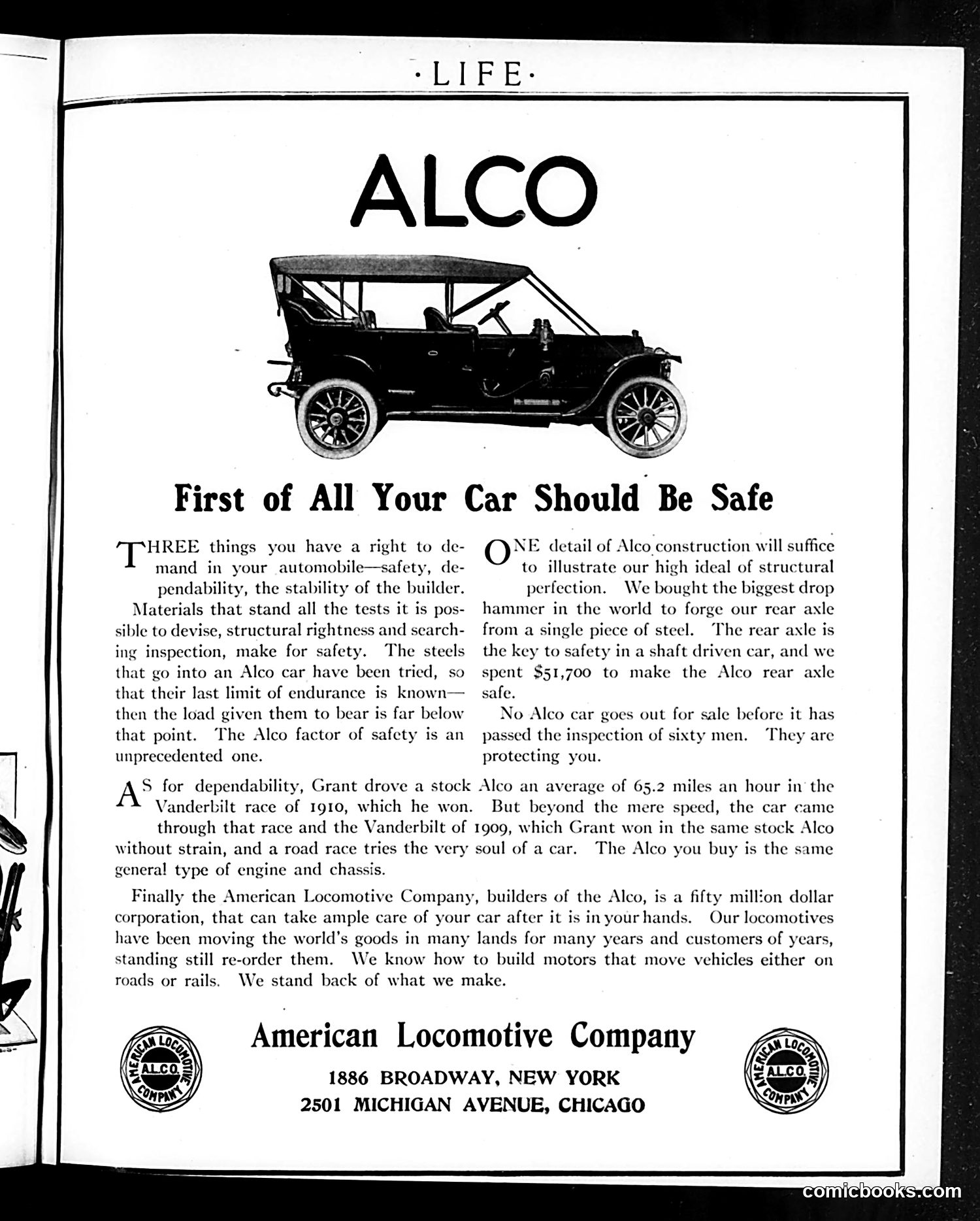
This is **not a cartoon or satire page**—it's a straightforward automobile advertisement from Life magazine's advertising section. The Alco automobile company (American Locomotive Company) uses a full-page ad highlighting three selling points: safety, dependability, and builder stability. The ad emphasizes engineering rigor—mentioning a $51,700 investment in forging rear axles from single steel pieces and sixty-man inspection protocols. The text references real racing credentials: Grant's victories in the 1909 and 1910 Vanderbilt races, prestigious early automotive competitions. By invoking these races and the company's railroad locomotive-building expertise (established 1886), the ad positions Alco as trustworthy and engineered for durability. This reflects the early 1900s automotive market, when cars were novel luxuries and companies competed on technical merit and manufacturing credibility rather than style or marketing gimmicks. The tone is earnest persuasion, not humor.
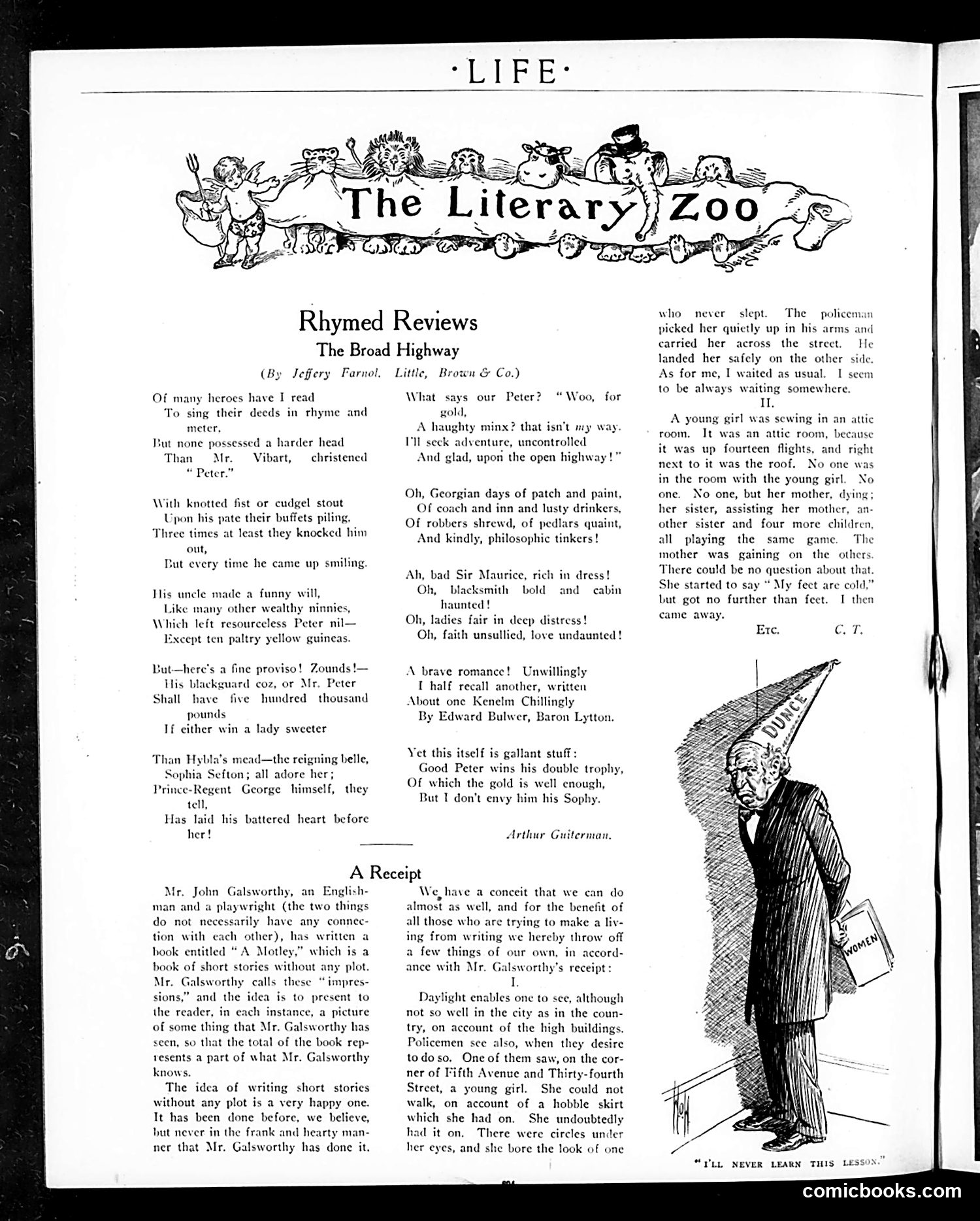
This page from *Life* magazine contains literary reviews and social satire. The main cartoon (bottom right) shows a tall, thin man in a coat labeled "I'LL NEVER LEARN THIS LESSON"—likely satirizing fashion victims or social folly, possibly referencing the "hobble skirt" mentioned in the text below, which constrained women's movement. The upper section reviews "The Broad Highway" by Jeffery Farnol in verse, praising its romantic adventure plot. Below, the satirical "Receipt" mocks author John Galsworthy's plotless short story collection "A Moth." *Life's* writer pretends to adopt Galsworthy's method, deliberately writing absurdist, pointless vignettes (a girl who can't walk in a hobble skirt; a dying mother in an attic)—the joke being that Galsworthy's "impressionistic" approach produces meaningless drivel. It's criticism through parody.
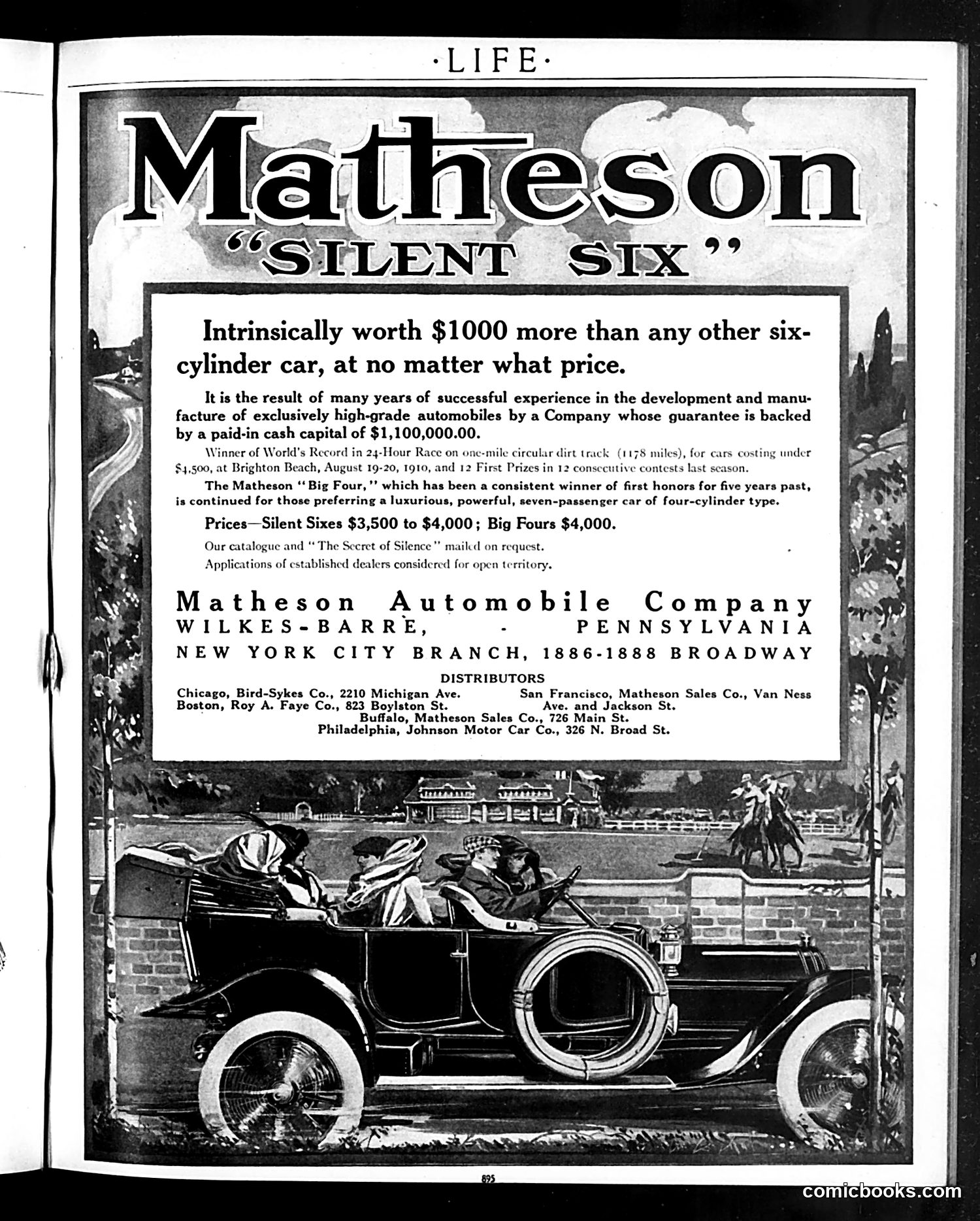
This is a **full-page automobile advertisement**, not satire or political commentary. It promotes the Matheson Motor Company's "Silent Six" car—a six-cylinder vehicle priced at $3,500–$4,000 (circa 1910). The ad emphasizes the car's engineering superiority, claiming it's "intrinsically worth $1000 more" than competitors. It highlights the company's racing credentials: winning a 24-hour endurance race at Brighton Beach and twelve consecutive contest victories. The "Big Four" model is offered as an alternative for buyers wanting seven-passenger capacity. The illustration shows three well-dressed passengers in an open touring car, suggesting luxury and modern transportation. The "Secret of Silence" reference likely alludes to the car's quiet, smooth operation—a selling point for early automobiles. This reflects the early automotive era when racing success and engineering claims were primary marketing tools.
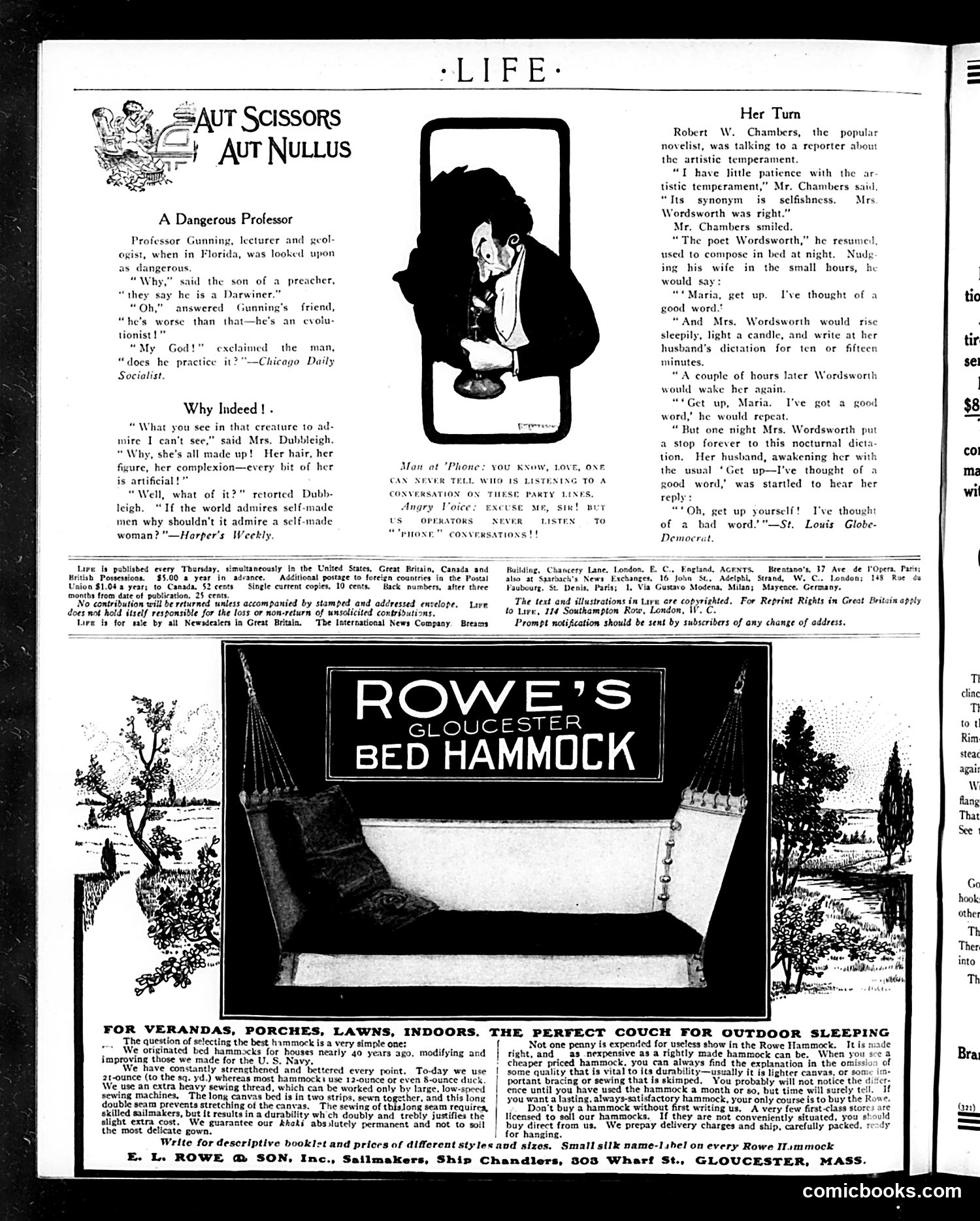
This page contains three distinct satirical pieces: **"A Dangerous Professor"**: A brief joke mocking anti-evolution sentiment. A preacher's son considers Professor Gunning dangerous—not because he's an evolutionist, but because he's a *socialist*, viewed as worse than Darwin's evolutionary theory. **"Why Indeed!"**: A husband-and-wife joke about artificial beauty. When his wife is criticized for being "all made up," the husband defends her by arguing: if society admires "self-made men," why not admire a self-made woman? The satire targets both vanity and gender double standards. **"Her Turn"**: A anecdote about poet Wordsworth who woke his wife nightly to dictate poetry. When he finally wakes her again with "I've thought of a good word," she replies by getting up herself to write down a "bad word"—a witty inversion of his artistic tyranny. The page also contains a full-page advertisement for Rowe's Gloucester Bed Hammock, emphasizing its quality construction for outdoor relaxation.
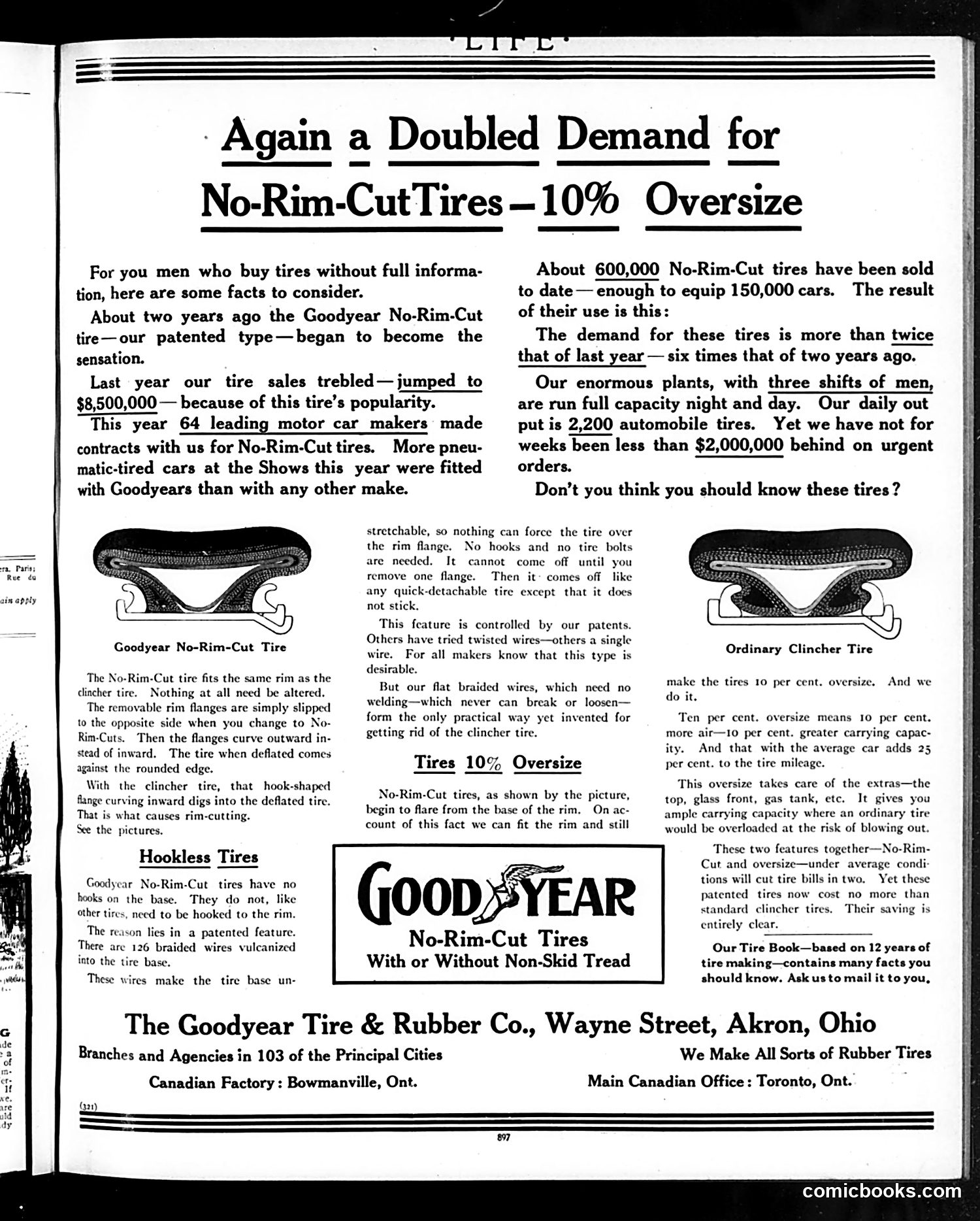
This is a **Goodyear tire advertisement**, not satire or political content. It promotes the company's patented "No-Rim-Cut" tire technology to early automobile owners. The page uses comparative diagrams showing the No-Rim-Cut tire's hookless design versus traditional "clincher" tires with rim-catching flanges—the latter causing rim-cutting damage during deflation. Goodyear claims their patented braided-wire base prevents this problem. The advertisement emphasizes market dominance: 600,000 tires sold, 64 automakers contracted, tripled sales reaching $8.5 million, and persistent $2 million order backlogs despite three-shift production of 2,200 daily tires. The "10% oversize" feature claims greater air capacity and 25% improved mileage while fitting standard rims—positioned as a cost-saving innovation matching competitors' prices. For modern readers: this reflects early 1900s automotive growth, when tire technology was rapidly evolving and manufacturers competed fiercely on patent-protected innovations marketed as consumer benefits.
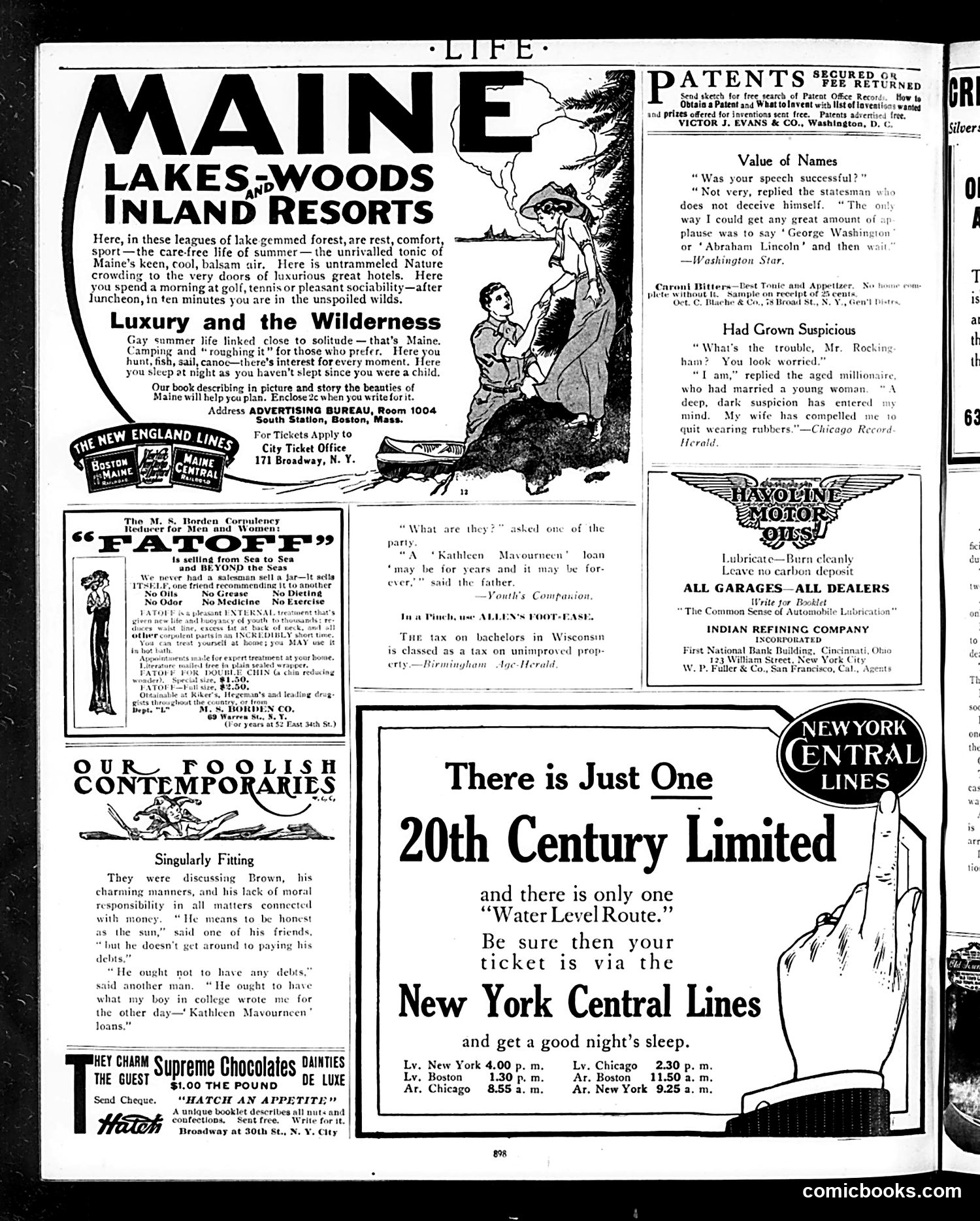
This page is primarily **advertising**, with several satirical anecdotes interspersed. The main cartoons/jokes include: **"Value of Names"**: A politician admits that invoking famous names like George Washington or Abraham Lincoln—regardless of relevance—reliably generates applause. The satire mocks hollow political rhetoric and audiences' susceptibility to name-dropping. **"Had Grown Suspicious"**: An aged millionaire expresses marital doubt after his young wife demands he stop wearing rubbers. The humor plays on the disparity in their ages and his suspicion about her motives. **"Our Foolish Contemporaries"**: A brief satire about a man named Brown praised for honesty despite avoiding paying debts—mocking the contradiction between claimed virtue and actual behavior. The page also includes period advertisements for Maine resorts, patents, chocolates, and railroad lines. The "20th Century Limited" ad for New York Central Lines dominates the lower half, promoting travel convenience.
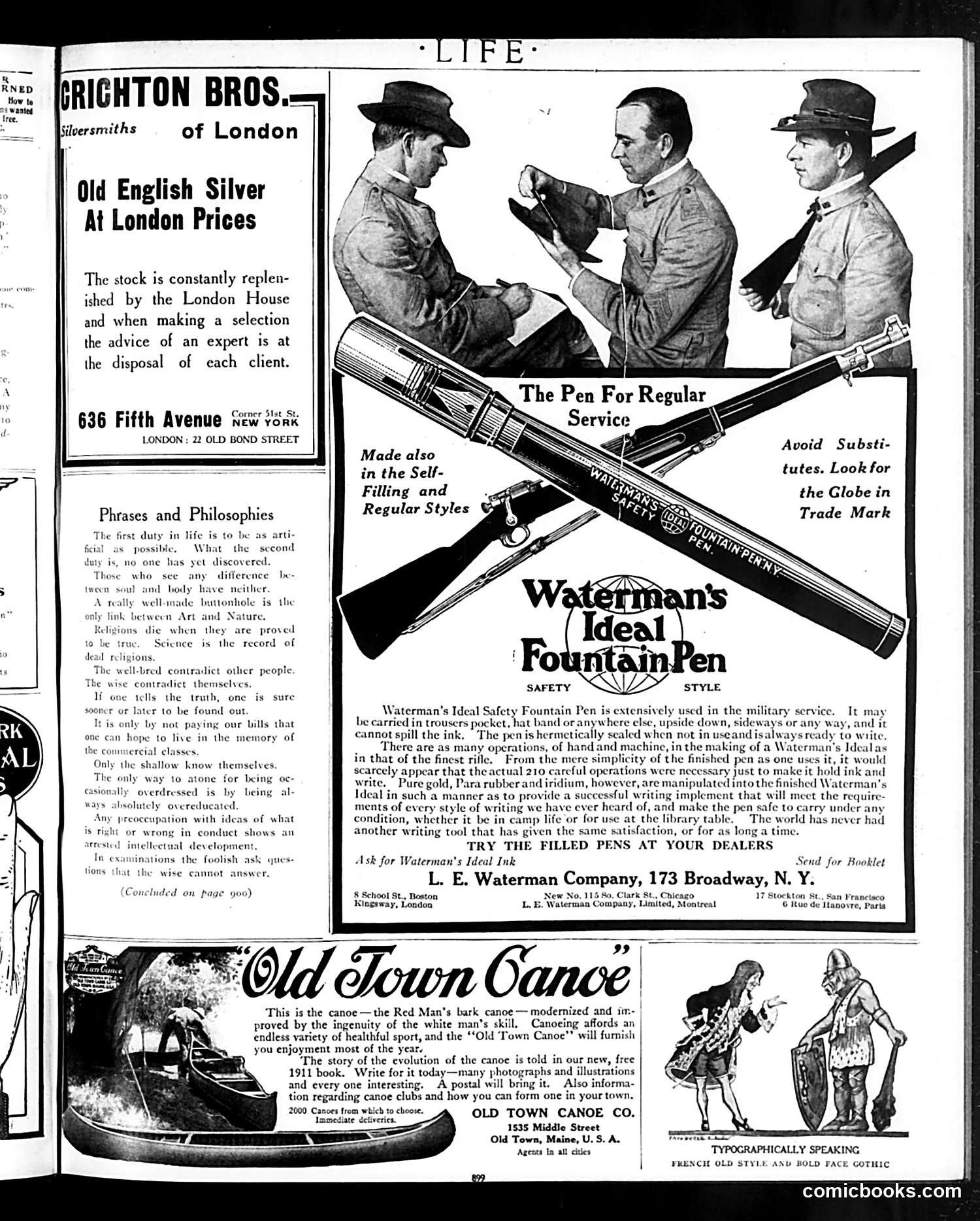
This page is primarily **advertising** with a brief satirical column. The main content includes: **"Phrases and Philosophies"** — a short satirical piece mocking Oscar Wilde's aphoristic style. It presents deliberately absurd observations ("A really well-made buttonhole is the only link between Art and Nature") that parody Wilde's witty paradoxes and aesthetic philosophy popular in the early 1900s. **Advertisements** dominate the page: - Crichton Bros. (English silver) - Waterman's Ideal Safety Fountain Pen (with photos of men demonstrating its reliability) - Old Town Canoe Company The satire targets intellectual pretension and "art for art's sake" philosophy. For modern readers, the Wilde parody would be obscure without context—it relies on readers recognizing and mocking a specific literary voice that was fashionable but also ridiculed as self-indulgent. The magazine uses humor to sell products while gently ribbing contemporary aesthetic movements.
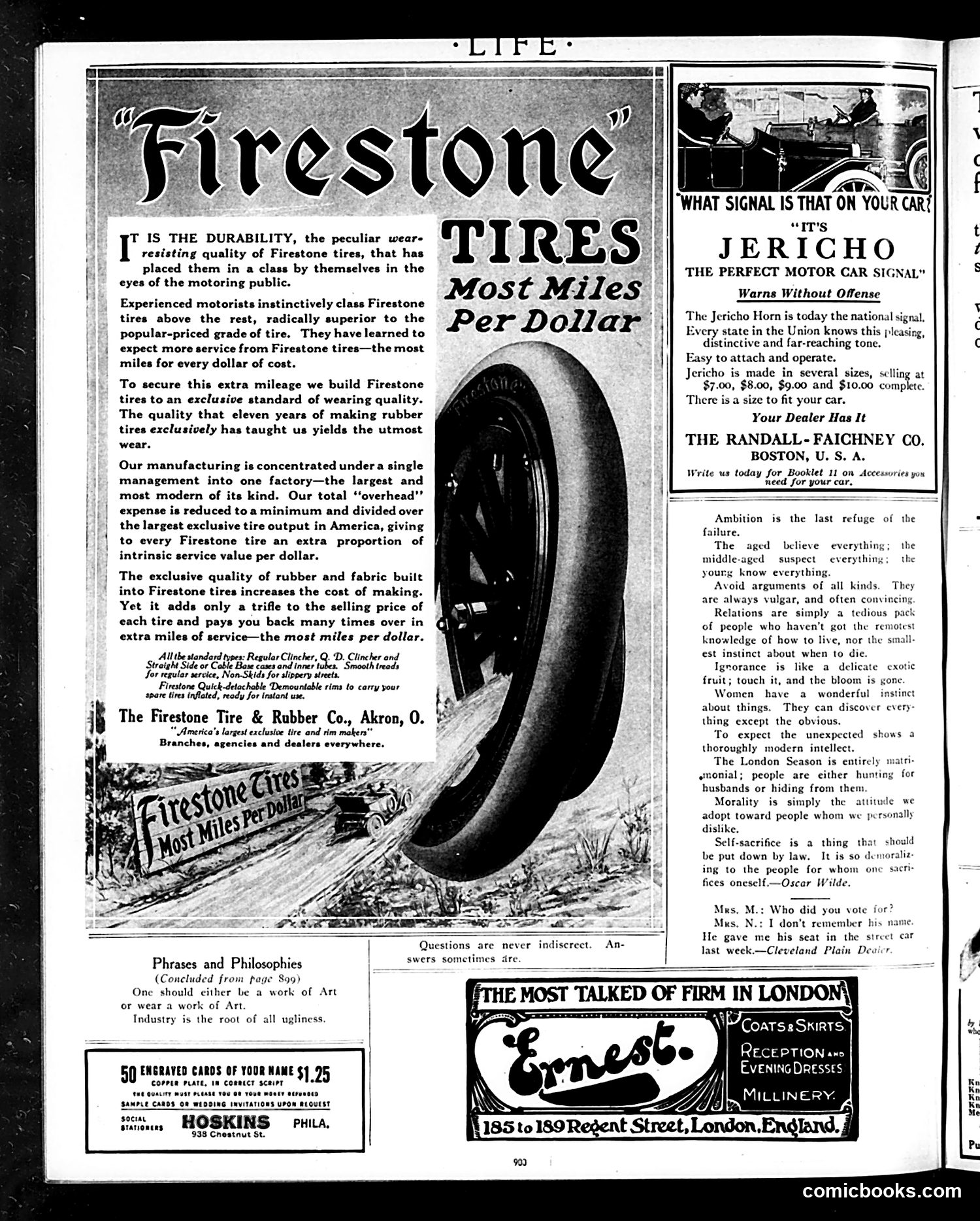
This page is primarily **advertising**, not political satire. It contains: 1. **Firestone Tires advertisement** (dominant): A large tire image promoting durability and "most miles per dollar"—standard automotive marketing emphasizing value and manufacturing efficiency. 2. **Jericho car horn advertisement**: Selling an automobile horn as a safety signal, with pricing information ($7-$10). 3. **"Phrases and Philosophies" column**: Appears to be Oscar Wilde quotations about human nature—witty observations about ambition, women, morality, and self-sacrifice. These are satirical *aphorisms*, not cartoons. 4. **Minor advertisements**: Business cards, Ernest London clothing. 5. **Small anecdote**: A joke about voting based on seating courtesy, not candidate quality. The page reflects early 20th-century American consumer culture and leisure reading. There are no political cartoons or caricatures—the "satire" consists of Wilde's cynical social commentary typical of Life magazine's literary content.
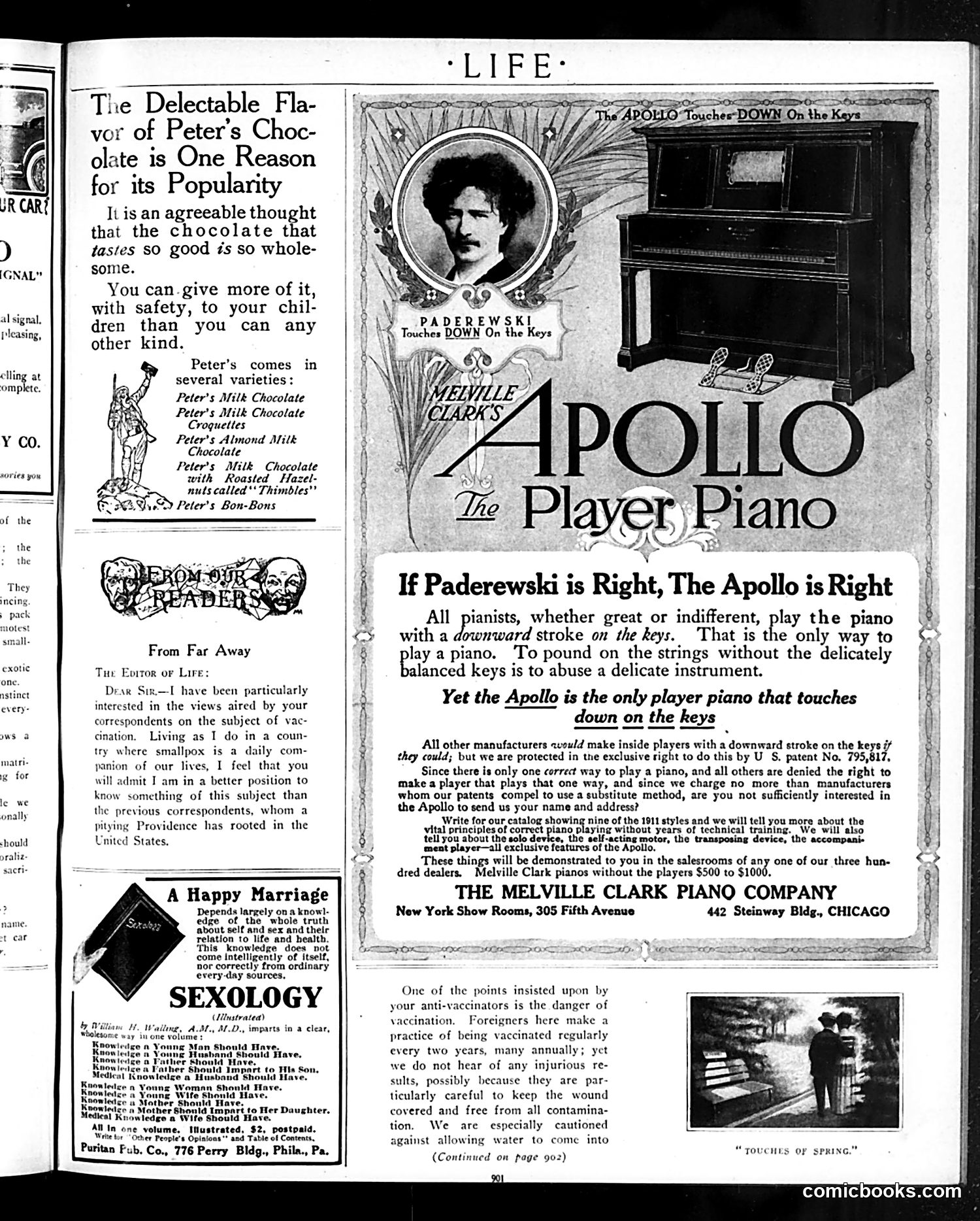
This page is primarily **advertising**, not satire or political commentary. The main advertisement features **Ignacy Jan Paderewski**, a famous Polish pianist of the era, endorsing the **Apollo Player Piano**. The ad's argument: Paderewski (a renowned concert pianist) plays piano with a downward keystroke; therefore, the Apollo—the only player piano that mimics this downward motion—must be superior. The ad emphasizes this as patented technology competitors cannot match. Secondary ads promote: - **Peter's Chocolate** (emphasizing wholesomeness for children) - **Sexology** (an illustrated book about marriage and sexuality) A "From Far Away" reader letter discusses vaccination safety—typical magazine content of the era. **The point**: These are straightforward period advertisements using celebrity endorsement and technical superiority claims to sell products to early-1900s consumers. No hidden satire; this reflects genuine marketing practices and consumer anxieties (vaccination, proper piano technique, food safety) of the time.
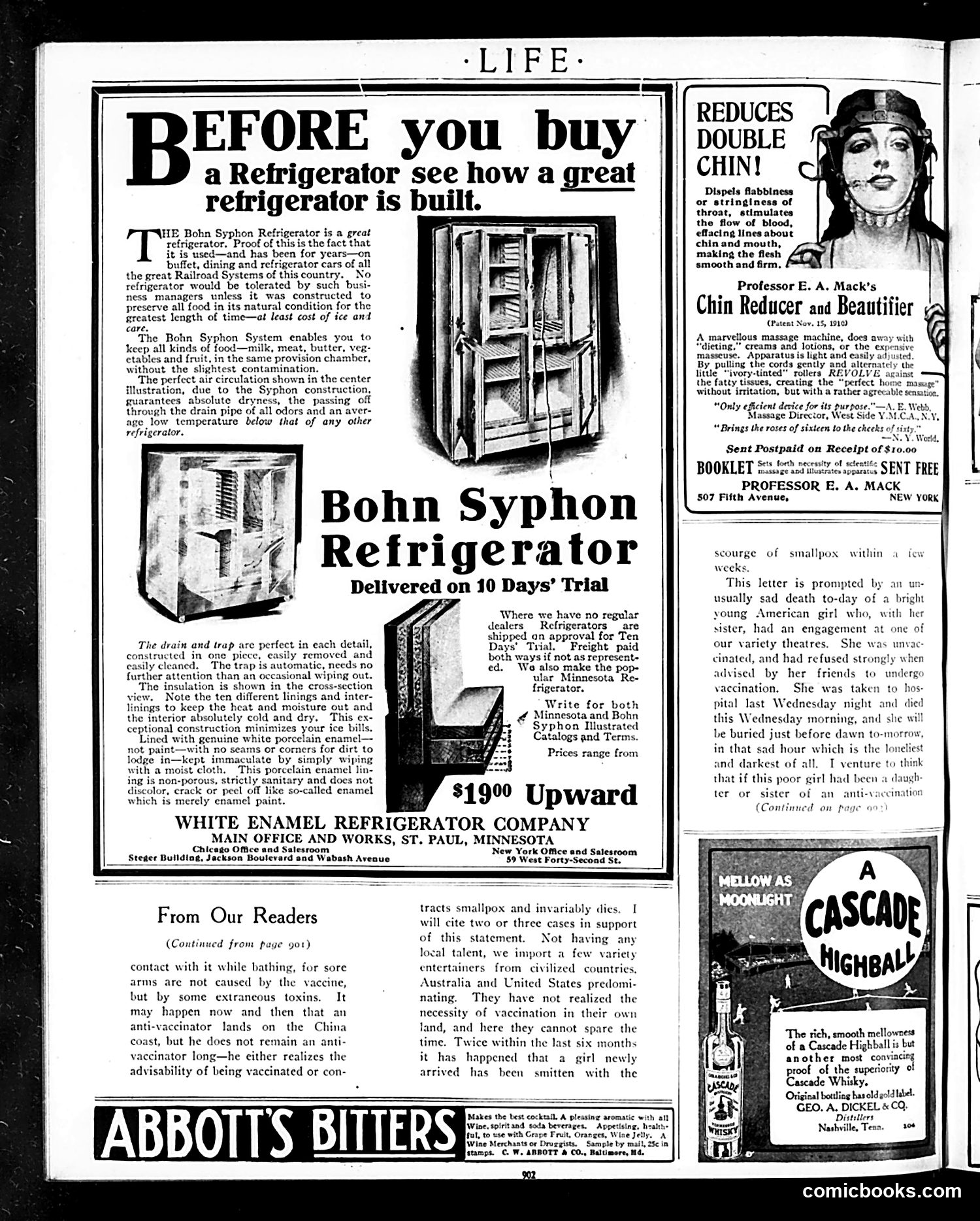
This page is primarily **advertising**, not satire or political commentary. The main content features a **Bohn Syphon Refrigerator advertisement** from the White Enamel Refrigerator Company (St. Paul, Minnesota), emphasizing superior construction and affordability ($19 upward). The ad highlights railroad use as proof of reliability—a common early 20th-century marketing strategy appealing to business trust. Secondary advertisements include: - **Professor E.A. Mack's "Chin Reducer and Beautifier"** (patent 1910)—a mechanical massage device marketed to reduce double chins and facial sagging - **Abbott's Bitters** (beverage) - **Cascade Highball** whiskey The "From Our Readers" section contains anti-vaccination arguments (pro-vaccination actually), discussing smallpox deaths among unvaccinated entertainers imported from Australia and America. There is **no political cartoon or satire** on this page. It represents typical early 1900s Life magazine content: product advertisements alongside reader letters on contemporary health and social topics.
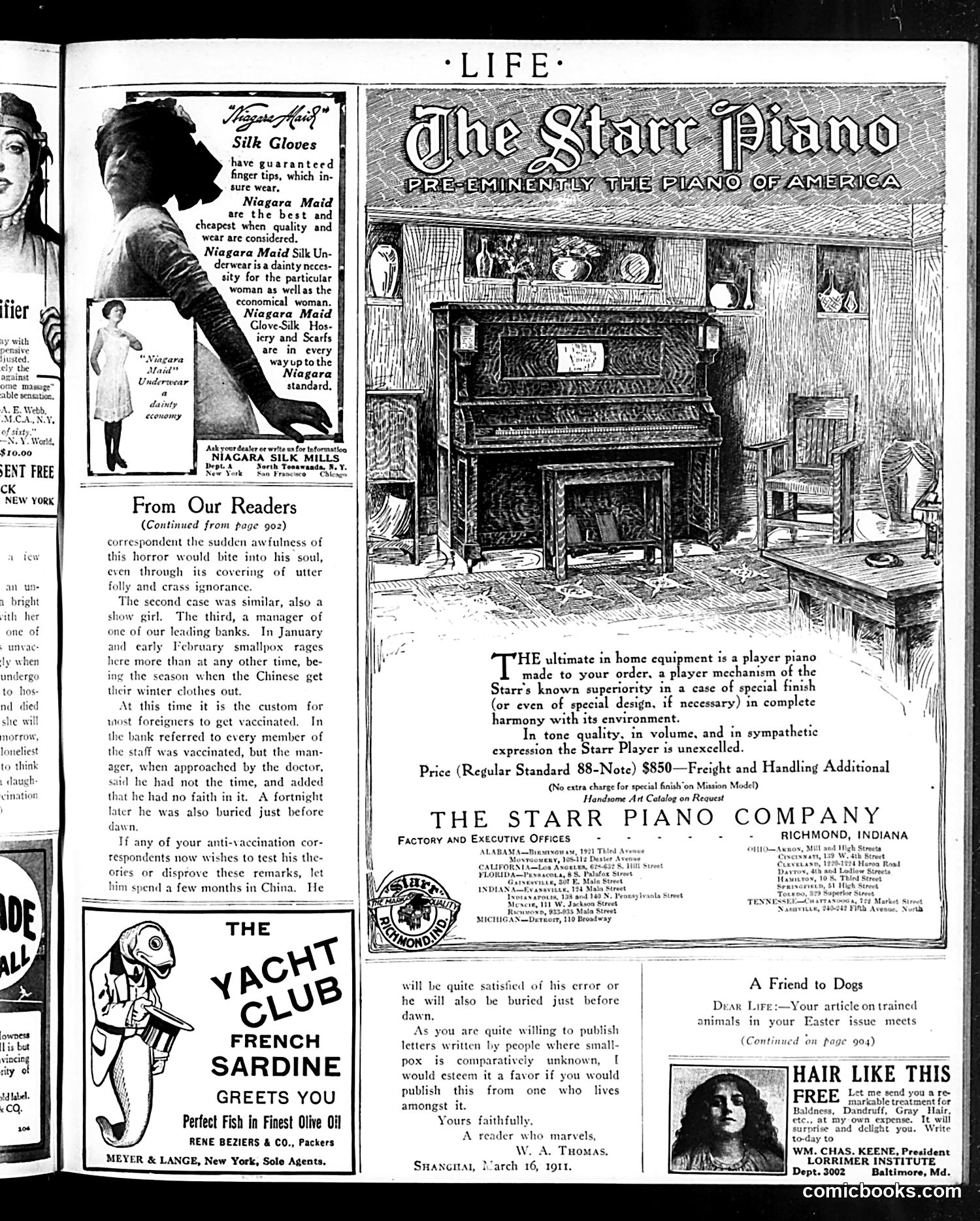
This page is primarily **advertisements and reader letters**, not political satire. The main content includes: **Advertisements:** - Niagara Maid silk gloves and underwear (emphasizing quality and economy for women) - Starr Piano Company's player piano ($850, positioned as luxury home equipment) - Yacht Club French Sardines - Hair treatment service **"From Our Readers" section:** A letter from W.A. Thomas in Shanghai (dated March 16, 1911) describing three deaths from smallpox among foreigners who refused vaccination. The writer argues anti-vaccination sentiment is dangerous, using his China experience as evidence. He's responding to previous letters skeptical of vaccination. **Other brief letters** address dog training and hair treatment. The page reflects early 1910s concerns: vaccination debates (still contentious), anti-Chinese prejudice (blaming winter clothing for disease spread), and consumer goods marketed to middle/upper-class Americans. There is no cartoon or satire visible—this appears to be a standard editorial/advertising page.
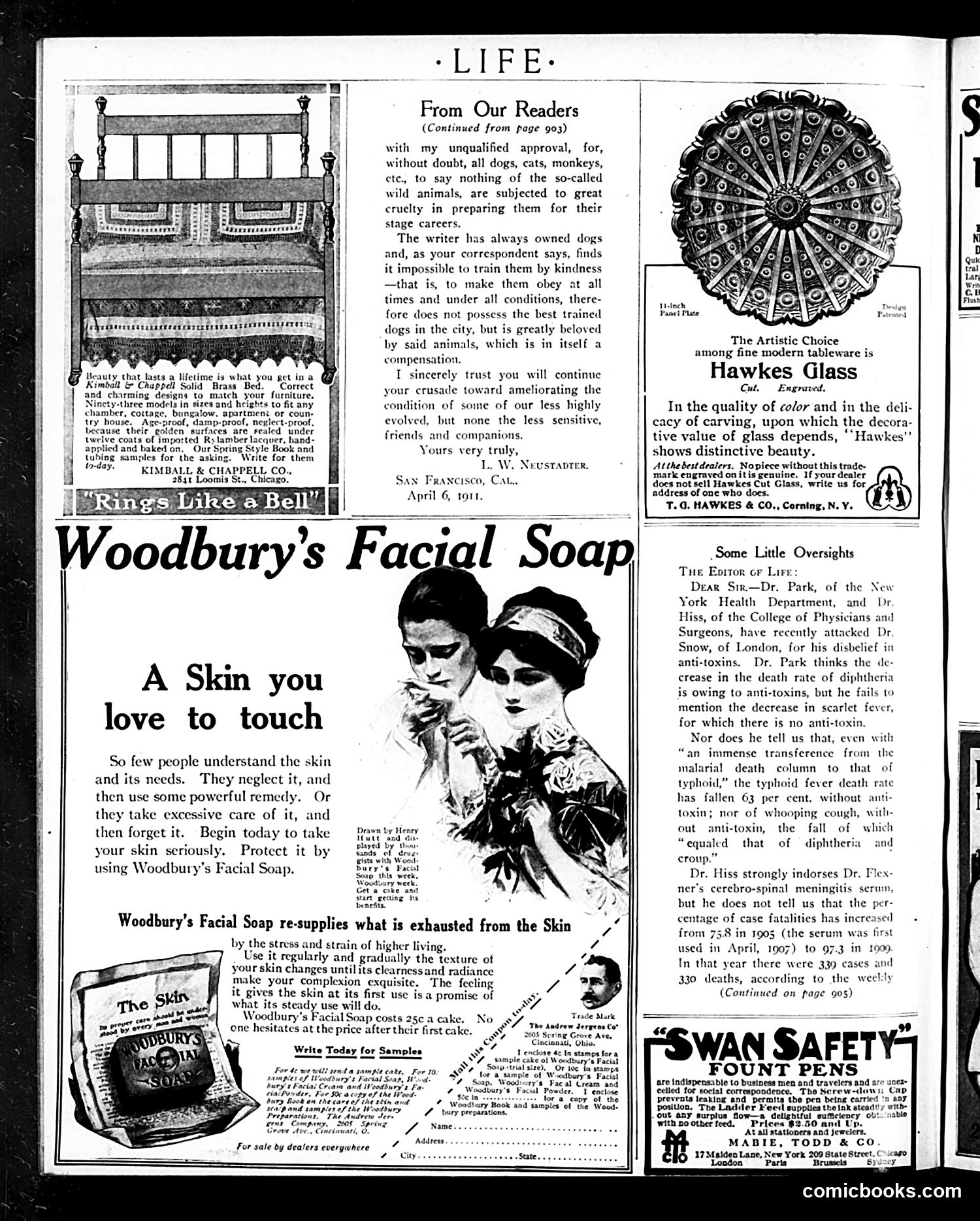
This page is primarily **advertisements and reader letters**, not political satire or cartoons. The main content includes: **Reader Letters Section**: A correspondent from San Francisco argues that animals used in stage performances suffer cruelty, and defends the writer's assertion that dogs cannot be trained by kindness alone—implying force is necessary. This reflects early 1900s attitudes about animal treatment and training methods. **"Some Little Oversights"**: A letter criticizing New York health officials (Dr. Park and Dr. Hiss) for claiming anti-toxins caused decreased diphtheria deaths while ignoring that scarlet fever (which has no anti-toxin) also declined. This suggests external factors beyond medicine caused mortality improvements—a legitimate public health debate of the era. **Advertisements**: Woodbury's Facial Soap, Hawkes Glass, Swan Safety Fountain Pens, and furniture dominate the page. The page contains **no political cartoons or satire**—it's a mix of earnest reader correspondence and commercial advertising typical of Life's format during this period.
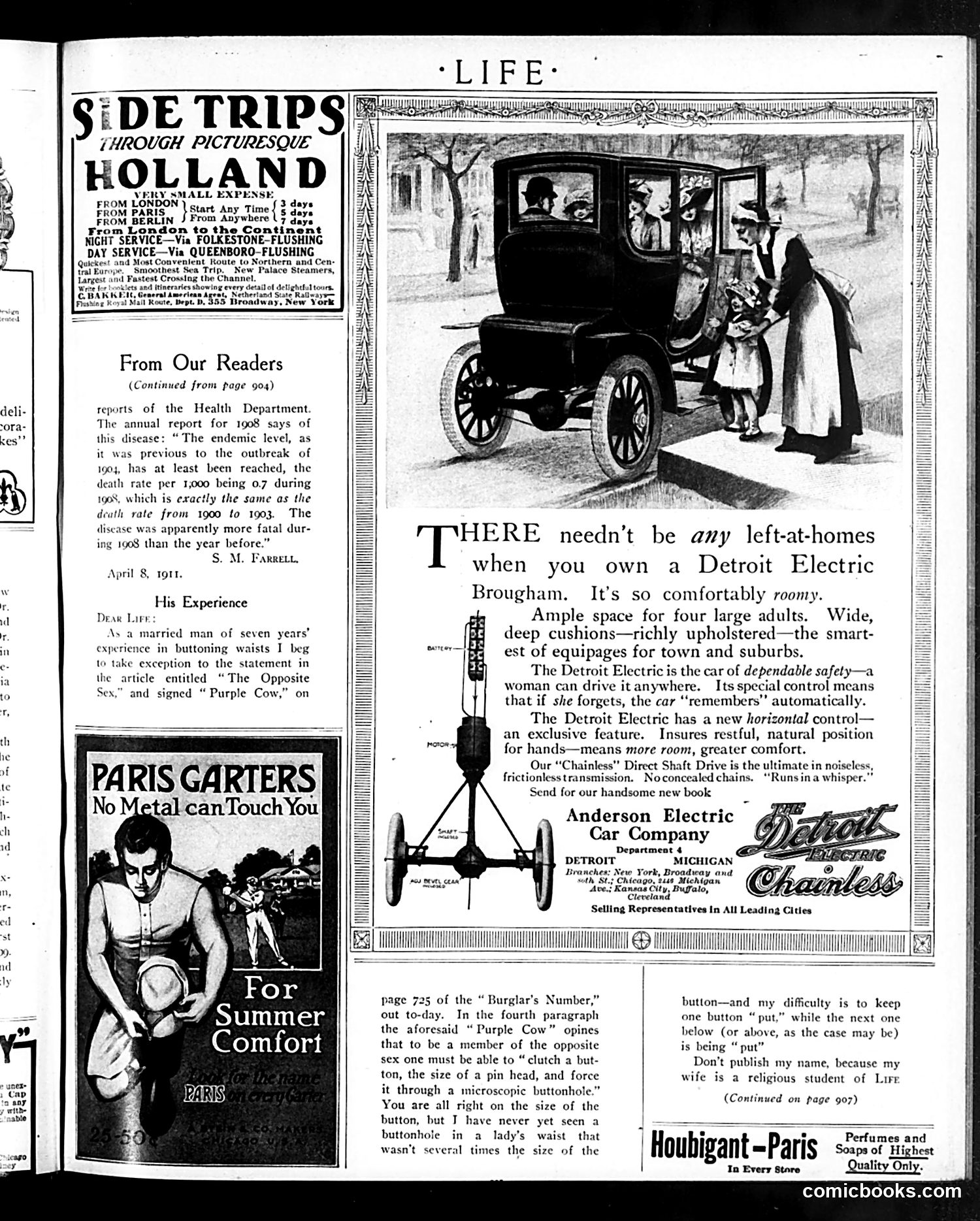
This page contains **advertisements and reader letters**, not political satire. **Main content:** - A **Detroit Electric automobile ad** featuring a woman driver and passengers. The copy emphasizes the car's safety features—notably that it has automatic controls so "if she forgets, the car 'remembers' automatically." This reflects early-1900s anxiety about women drivers, positioning the electric car as foolproof enough for female operation. - **Reader letters** discussing buttonholes on women's clothing (responding to an article called "The Opposite Sex" signed "Purple Cow") and health department statistics on disease mortality rates. - A **Paris Garters advertisement** for men's clothing accessories. The page reflects early-20th-century gender attitudes: automobiles marketed to women emphasize safety and simplicity, while male readers debate women's competence with basic tasks like buttoning clothes. The ads assume distinct male and female consumer spheres.
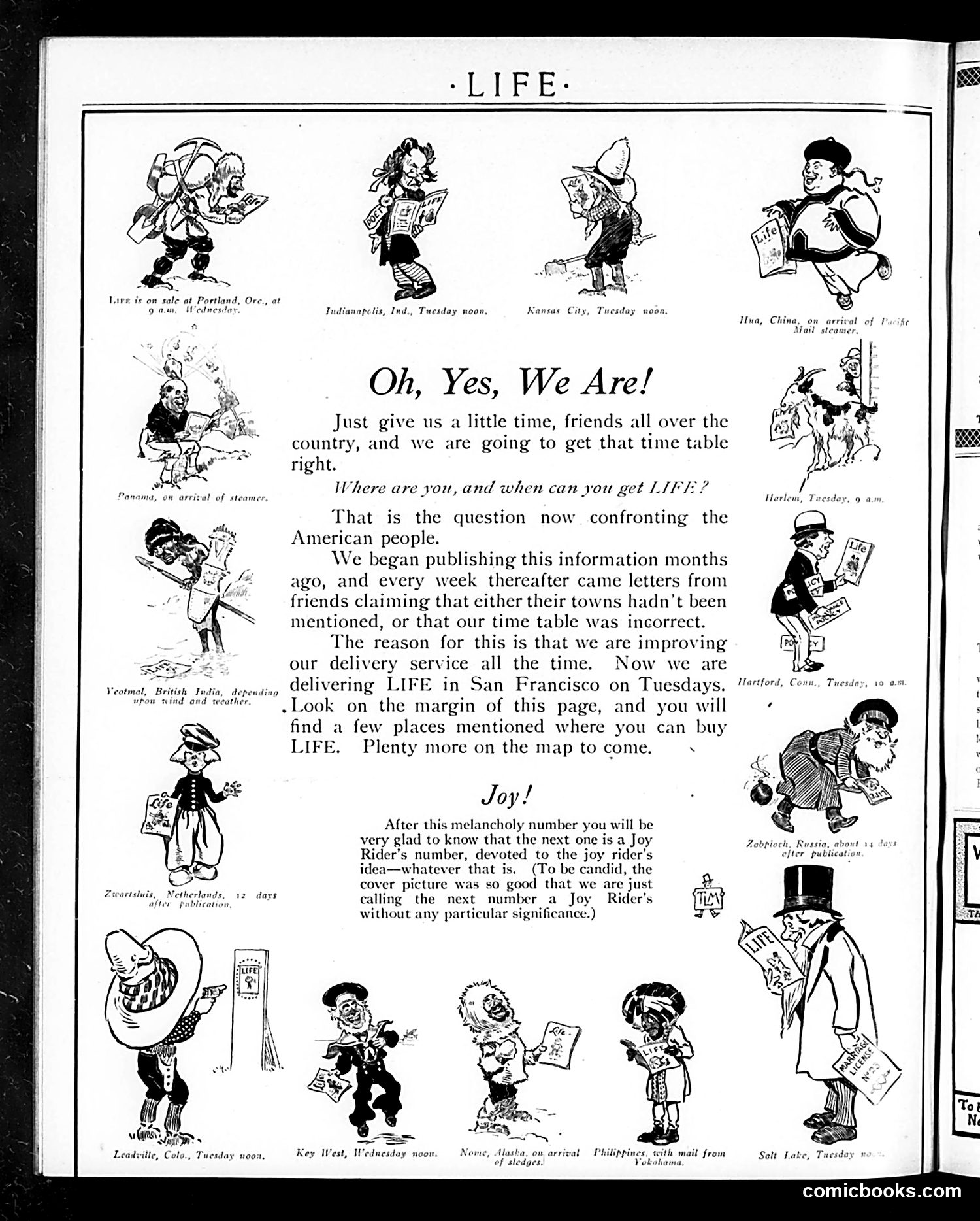
This page satirizes *Life* magazine's distribution problems. The central joke: *Life* promises nationwide delivery but readers constantly complain their towns aren't included or delivery dates are wrong. The cartoons show characters from various U.S. and international locations (Portland, Indianapolis, Kansas City, Hna China, Harlem, etc.) holding *Life* magazines, illustrating the magazine's aspiration to reach everywhere. The text wryly acknowledges these complaints while claiming improvement—they're "now" delivering to San Francisco on Tuesdays. The humor lies in the gap between ambition and reality: despite months of publishing a delivery schedule, *Life* still can't reliably reach readers on time or in their locations. The following section announces the next issue as a "Joy Rider's number," humorously admitting the connection is tenuous—they chose the name mainly because the cover image was good.
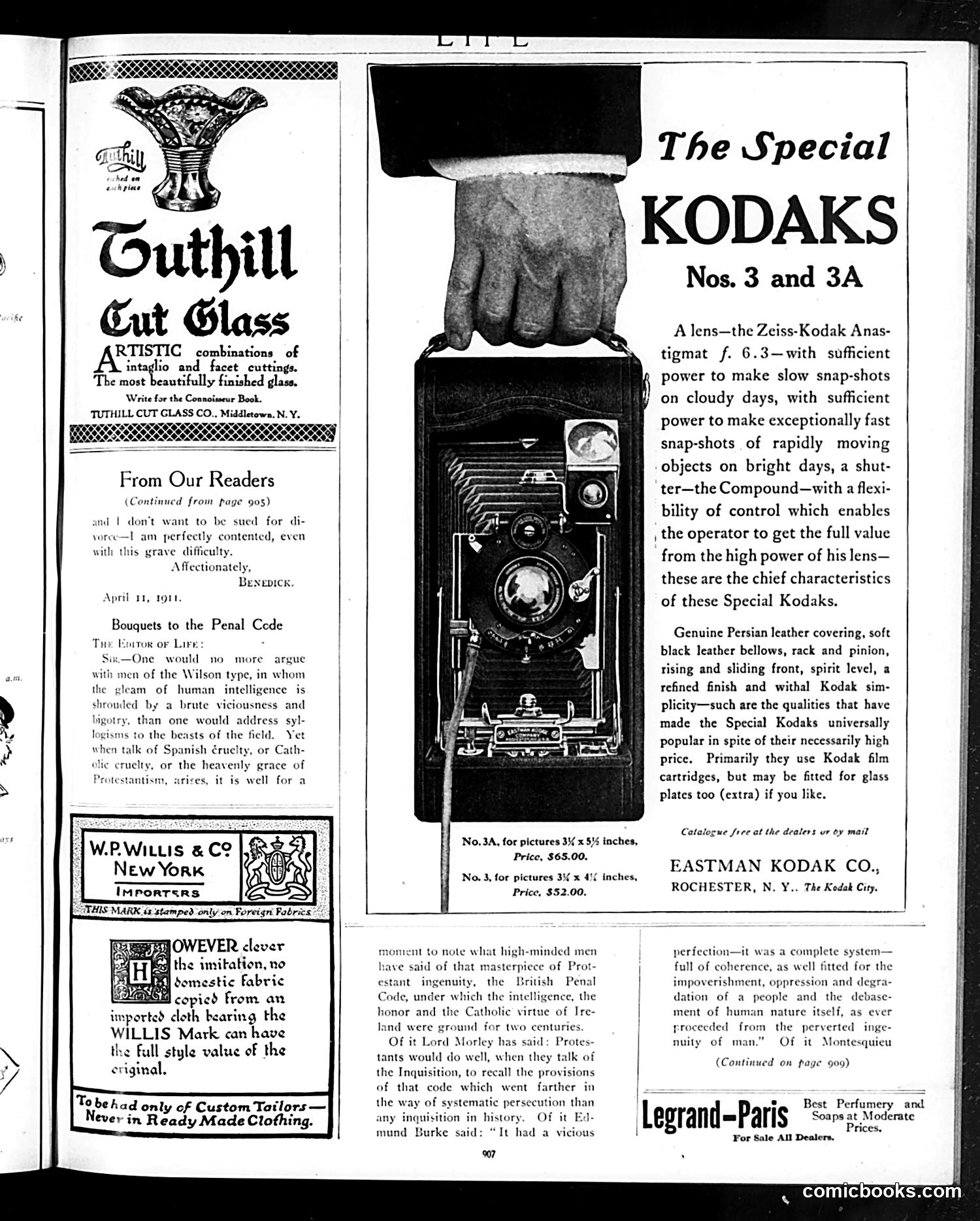
This page is primarily **advertising with editorial content**, not political satire. The main editorial piece, "Bouquets to the Penal Code," critiques **British treatment of Ireland**. The author challenges readers who condemn Spanish or Catholic cruelty while ignoring the British Penal Code's systematic oppression of Ireland over two centuries. It quotes Lord Morley, Edmund Burke, and Montesquieu—historical figures who condemned the Code as worse than the Spanish Inquisition, designed to impoverish and degrade the Irish people. The satire is implicit: the title's "bouquets" (praise) is ironic—the piece sardonically "praises" the Code by citing condemnations from respected thinkers, exposing the hypocrisy of Protestant critics who attack Catholicism while ignoring institutionalized Protestant persecution. **Advertisements** include Tuthill Cut Glass, W.P. Willis & Co. imported fabrics, Eastman Kodak cameras, and Legrand-Paris perfume—typical luxury goods for Life's affluent readership.
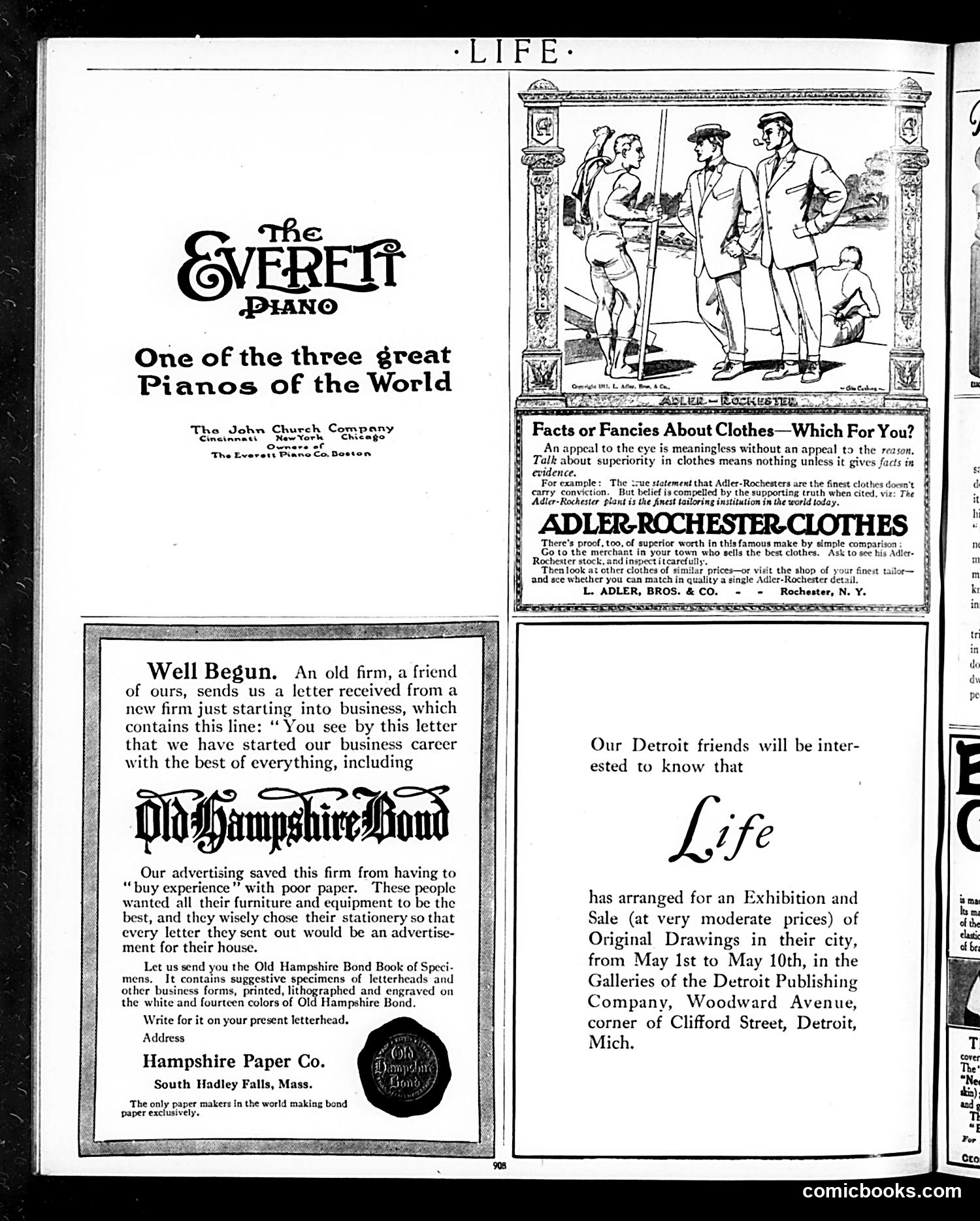
This page is primarily **advertising content** rather than satirical cartoons. It contains four separate advertisements: 1. **Everett Piano** - promoting pianos as "one of the three great pianos of the world" 2. **Adler-Rochester Clothes** - an appeal to reason in purchasing decisions, arguing that superior quality requires supporting evidence, not just claims 3. **Hampshire Paper Co.** - a "Well Begun" testimonial about a new business that started with quality stationery, emphasizing that good advertising materials reflect business credibility 4. **Life Magazine announcement** - promoting an exhibition and sale of original drawings in Detroit (May 1-10) at the Detroit Publishing Company The only visual element is an illustration accompanying the Adler-Rochester ad showing men in period clothing discussing garments. **For modern readers:** This represents early 20th-century marketing emphasizing quality, testimonials, and the belief that professional presentation (stationery, clothing) directly reflects business reputation—concepts that parallel modern branding strategies.
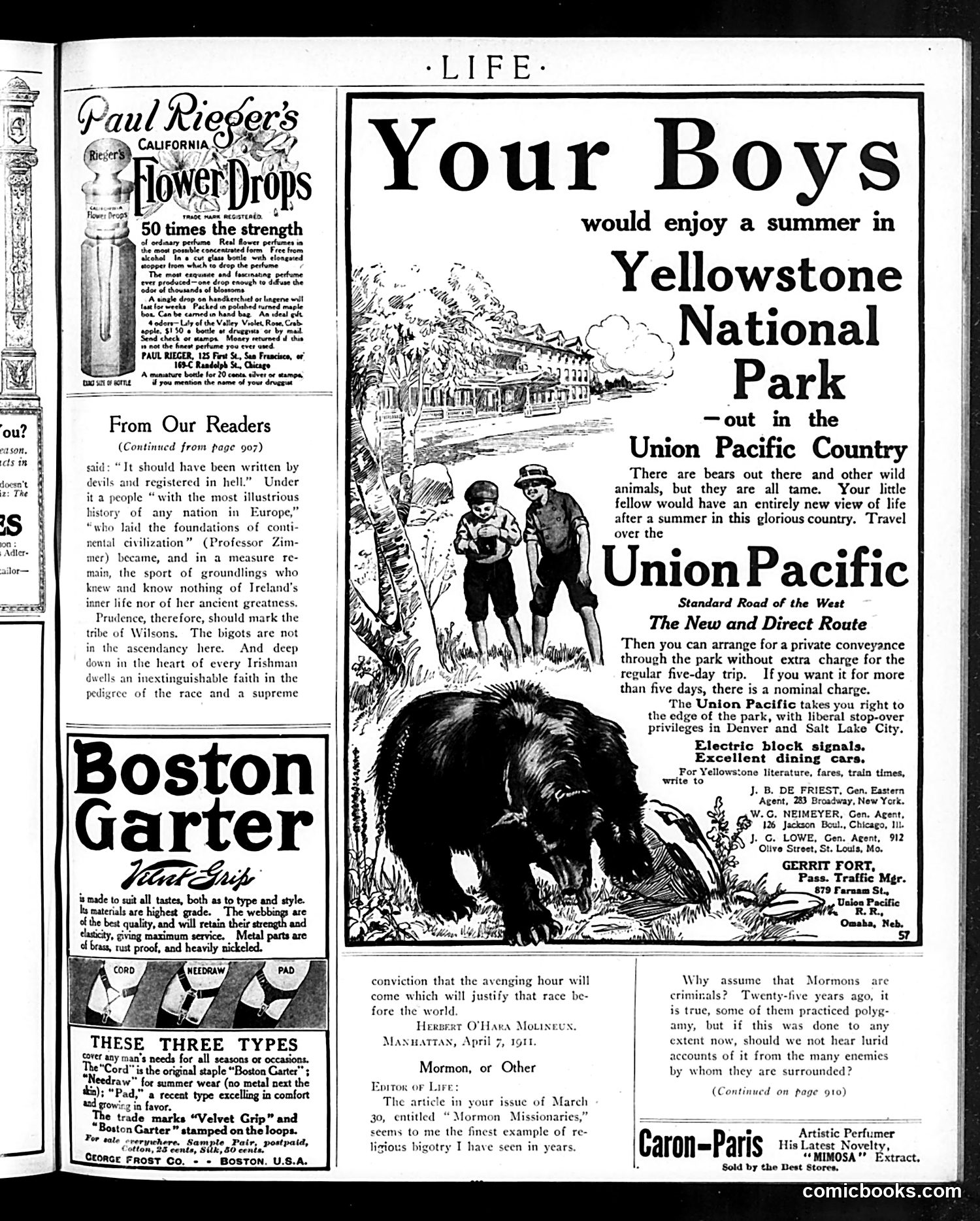
This is primarily an **advertising and letters page** rather than a satirical cartoon page. The main content includes: **Advertisements:** Paul Rieger's Flower Drops perfume, Boston Garter (men's garters), and a Union Pacific Railroad ad promoting Yellowstone National Park family travel. **Letters section ("From Our Readers"):** Two reader submissions—one defending Irish character against negative stereotyping, and another **criticizing the magazine's March 30 article on "Mormon Missionaries."** The letter writer challenges the characterization of Mormons as criminals, noting that while some practiced polygamy 25 years prior (around 1886), continued accusations lack evidence given the many observers present. **The satire/social reference:** The Mormon letter implicitly critiques religious prejudice and outdated characterizations. It suggests Life magazine itself may have engaged in unfair religious bigotry—relevant context being the Church's controversial polygamy practices, officially discontinued in 1890 but still subject to public suspicion. No cartoons are visible on this page.
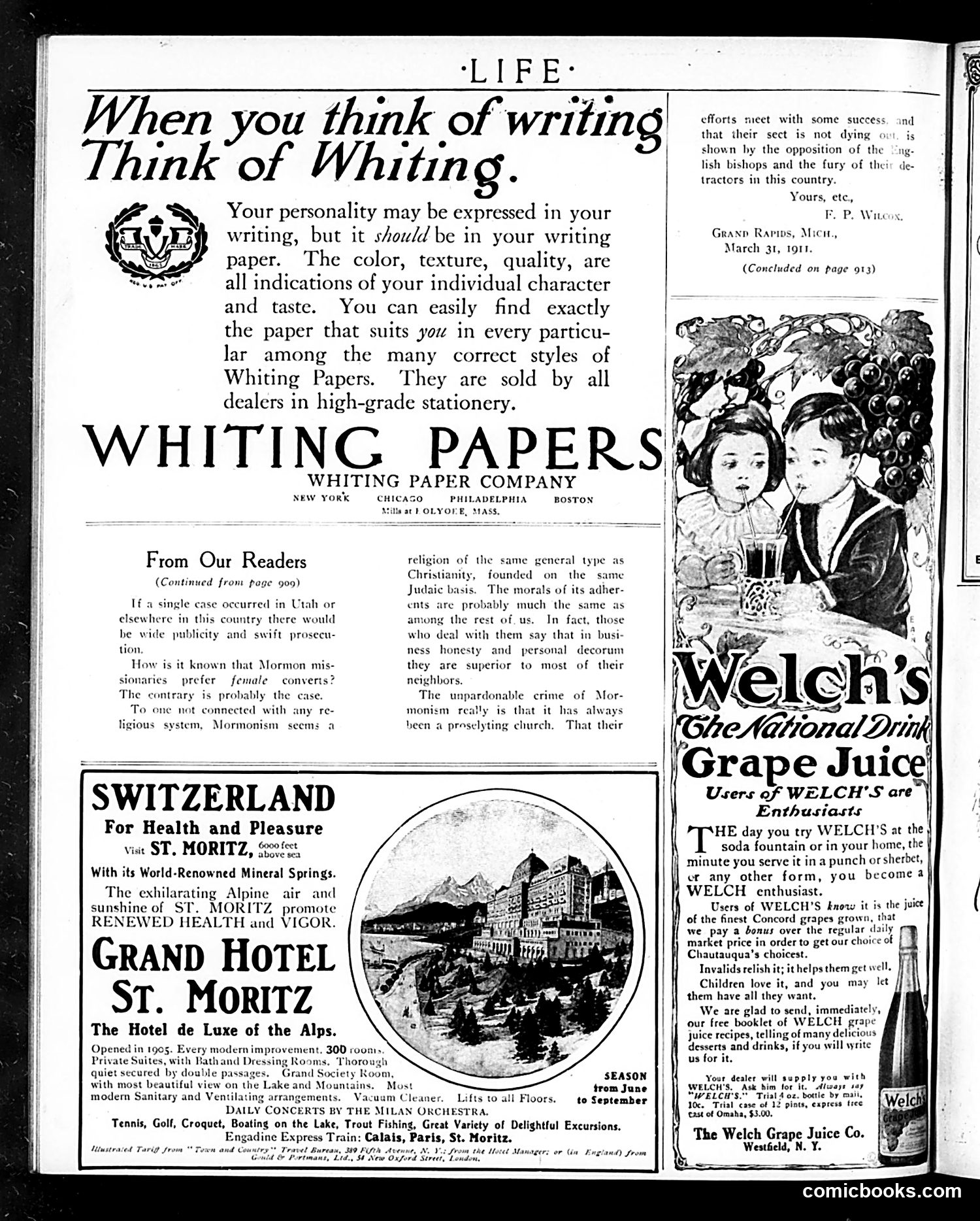
This page is primarily **advertising with minimal editorial content**. The dominant visual element is an illustration of two children (appearing to be Asian or of foreign origin) enjoying grapes, accompanying a Welch's Grape Juice advertisement. The editorial section, "From Our Readers," contains a letter criticizing **Mormon missionary practices**, specifically questioning why Mormon missionaries allegedly prefer converting women. The response defends Mormons as honest businesspeople, but argues their "unpardonable crime" is being a proselytizing church—implying aggressive conversion efforts are controversial. The page reflects early 20th-century American anxieties about religious minorities and their recruitment methods. The juxtaposition of this religious debate with cheerful consumer advertising (Whiting Papers, Swiss hotels, grape juice) is typical of Life's format, where serious social commentary shared pages with commercial pitches aimed at affluent readers.
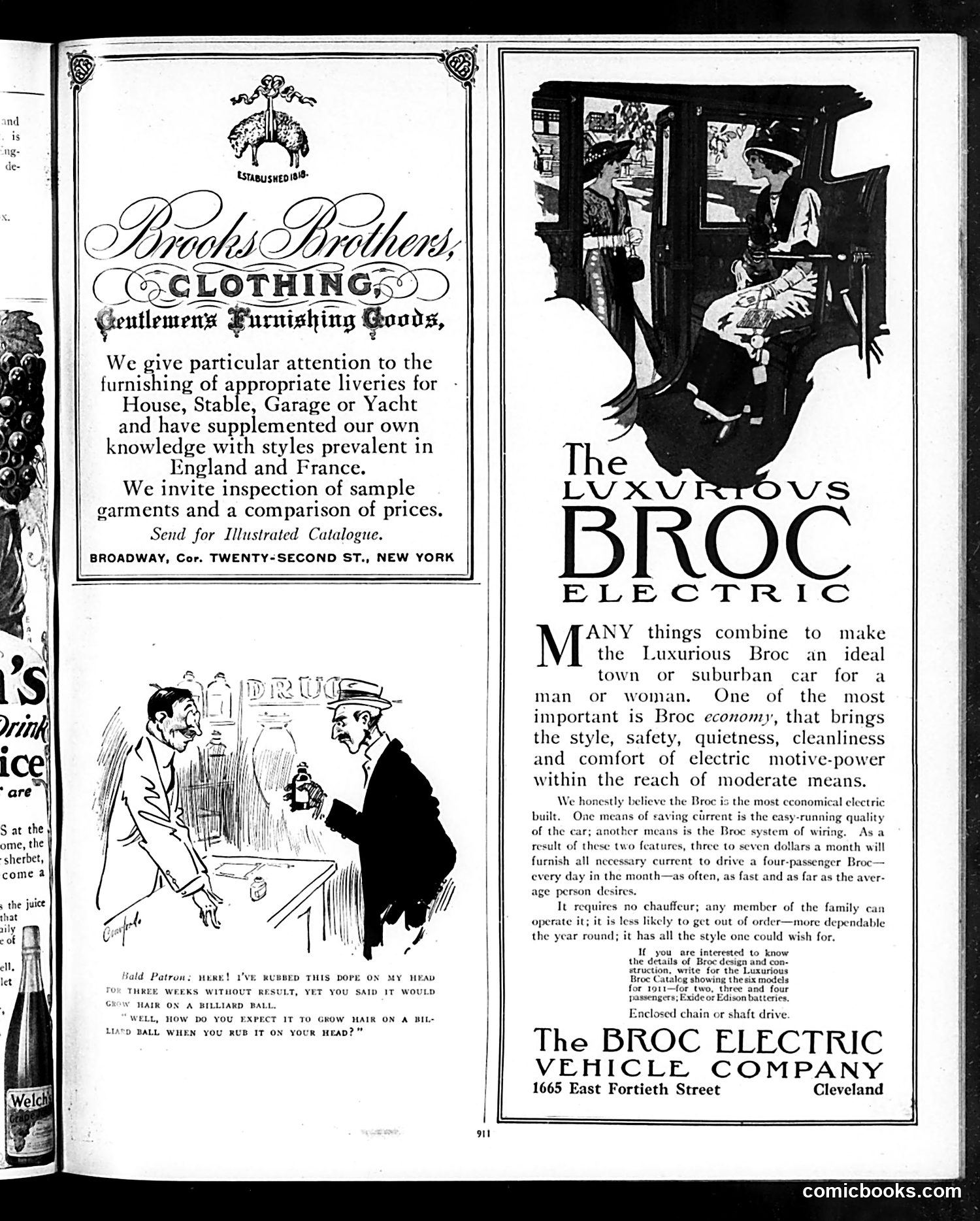
This page contains two distinct advertisements bracketing a small cartoon joke. **The Cartoon (center-left):** A druggist and skeptical customer argue about a hair-growth product. The customer sarcastically notes that if the remedy doesn't work on a billiard ball (notoriously smooth), why expect results on his bald head? The joke mocks patent medicine claims—a common target of satire in this era, when dubious "cure-all" products flooded the market with exaggerated promises. **The Advertisements:** - **Brooks Brothers** (upper left): A clothing retailer emphasizing livery services for wealthy clients' estates, yachts, and stables—targeting the wealthy. - **Broc Electric Vehicle Company** (right): Promotes an electric automobile as economical and easy to operate, requiring no chauffeur. The illustration shows fashionably-dressed passengers in the vehicle, appealing to affluent buyers seeking modern luxury. The page reflects early-1900s consumer culture: skepticism toward dubious remedies, rising automobile adoption among the wealthy, and the new convenience of electric vehicles for leisure and transportation.
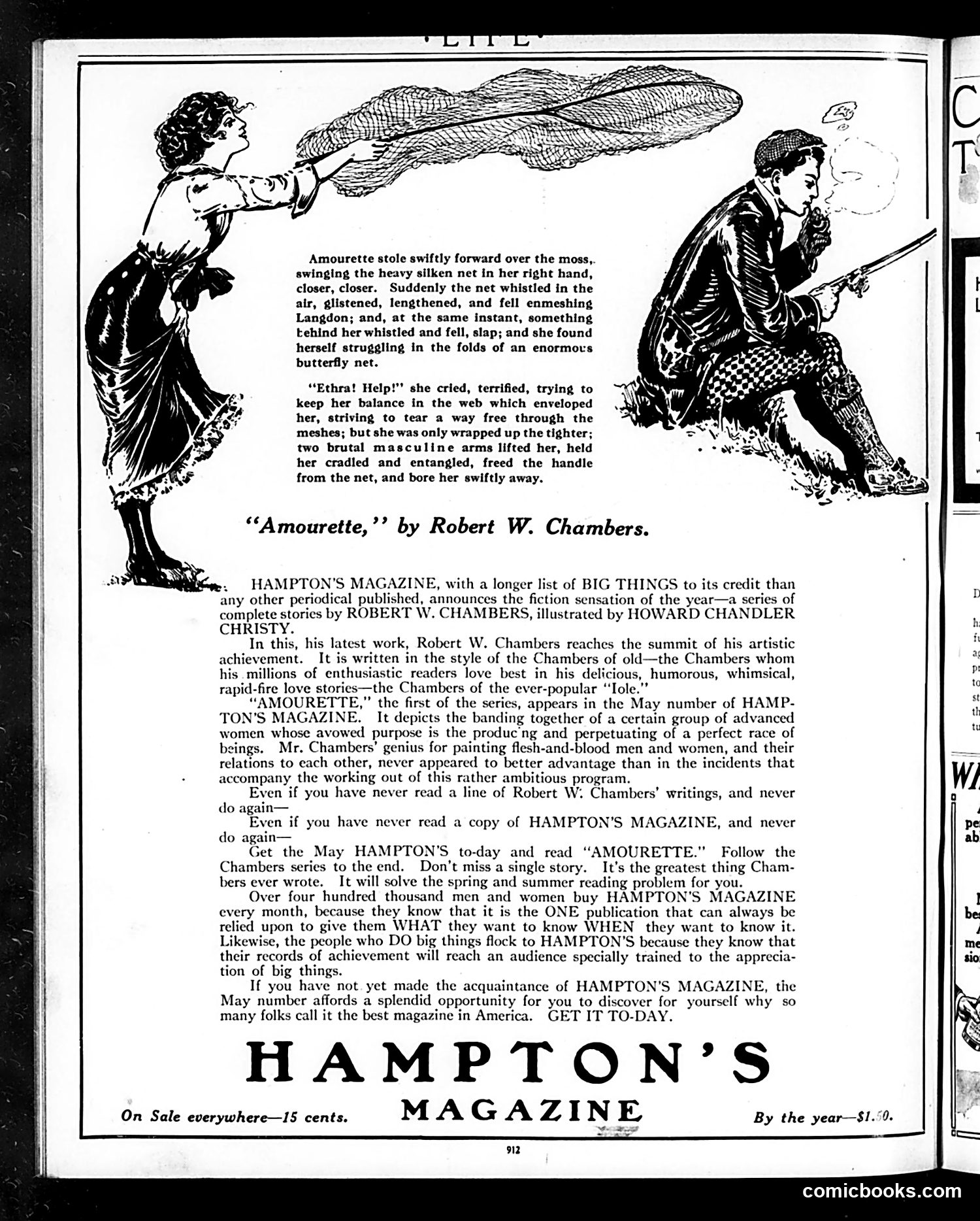
This page primarily advertises Hampton's Magazine's serialization of Robert W. Chambers' story "Amourette," illustrated by Howard Chandler Christy. The cartoon depicts the story's plot: a woman named Amourette attempts to catch a man (Langdon) with a butterfly net, but is herself trapped and captured by an unseen man using an identical net. The advertisement emphasizes the story's themes of romance and gender dynamics—specifically, an organization of "advanced women" seeking to engineer a "perfect race." The ironic visual joke plays on role reversal: the hunter becomes the hunted. This reflects early 20th-century anxieties about women's suffrage and independence movements ("advanced women"), presenting courtship as a competitive battle where traditional gender roles are inverted. The advertisement targets Hampton's upscale readership, claiming 400,000 monthly subscribers and positioning the magazine as essential for people "who DO big things."
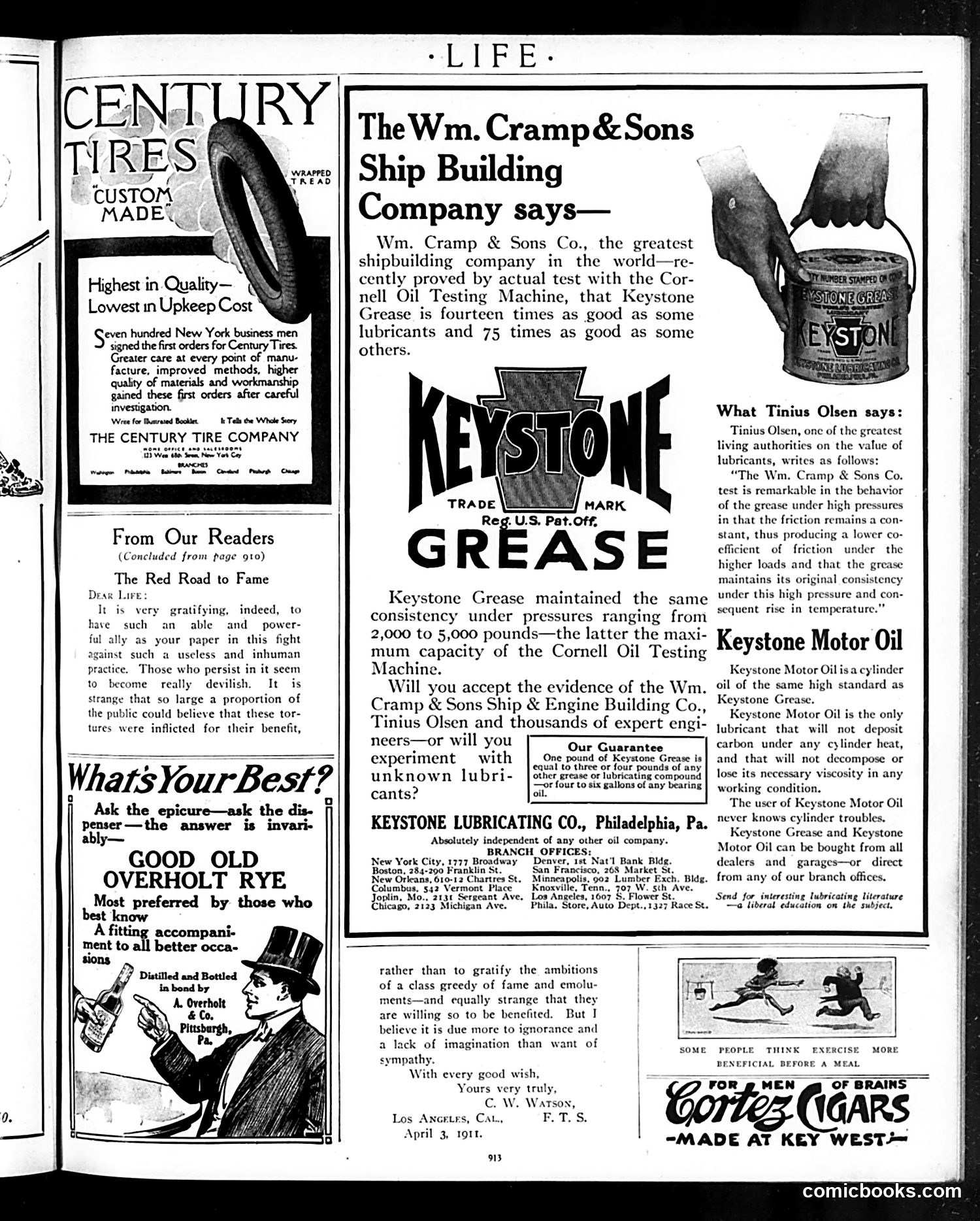
This page is primarily **advertising**, not satire or political commentary. The dominant content is a large advertisement for **Keystone Grease and Motor Oil**, featuring testimonials from the Wm. Cramp & Sons shipbuilding company and lubricant expert Tinius Olsen endorsing the product's superior performance under pressure. Supporting advertisements include: - **Century Tires** (top left) - **Good Old Overholt Rye whiskey** (bottom left) with a gentleman in formal dress - **Cortz Cigars** (bottom right) There is one non-advertising element: a reader's letter titled "The Red Road to Fame" criticizing some unnamed inhumane practice (unclear from context), followed by its conclusion discussing ambition and willingness to be benefited. The page reflects early 20th-century advertising practices: testimonial-driven marketing, emphasis on scientific testing, and juxtaposition of luxury goods advertising.
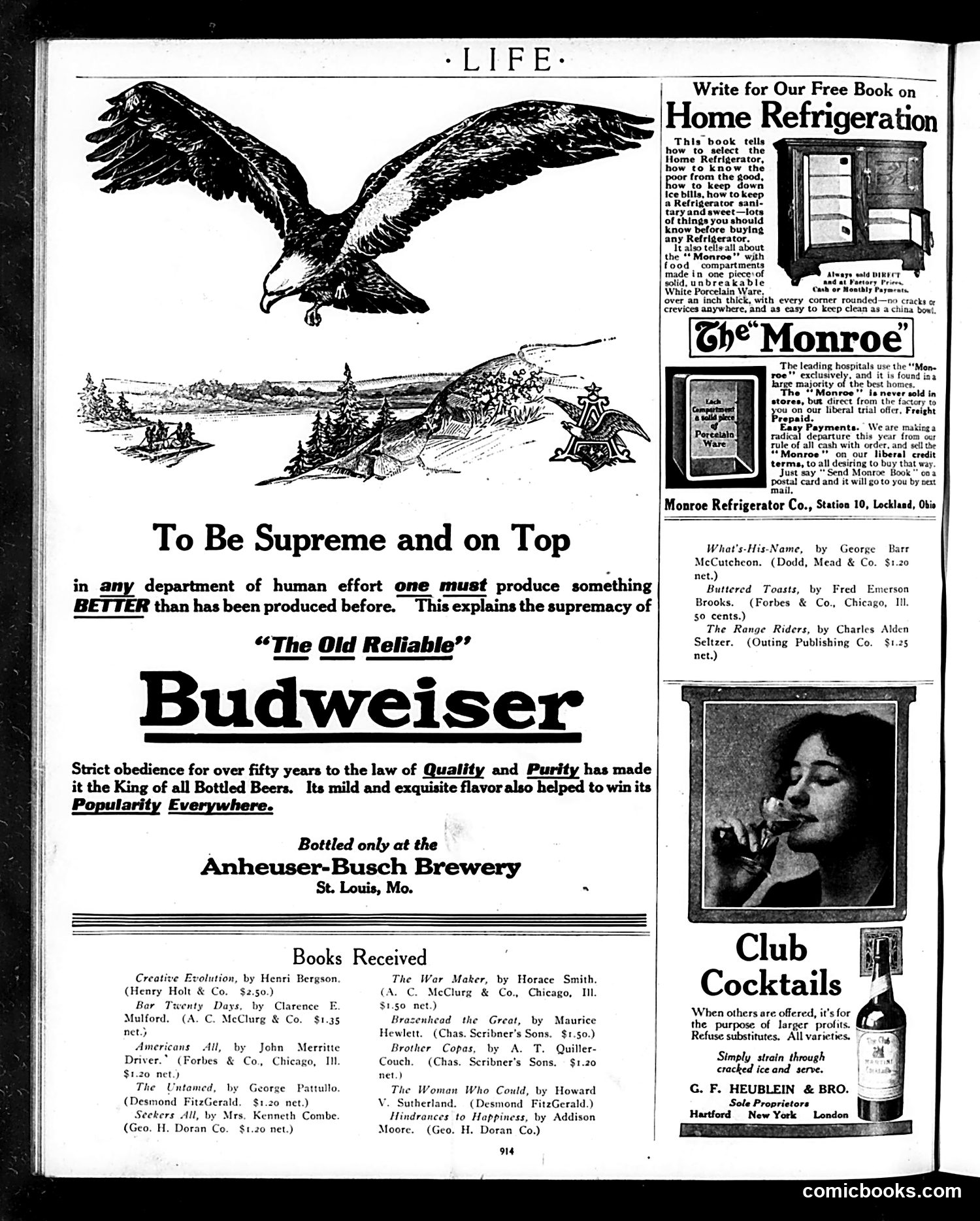
This page is primarily **advertising and book listings**, not political satire. The dominant content includes: **Main Advertisement:** A Budweiser beer ad featuring an eagle and landscape, claiming Budweiser achieves supremacy through fifty years of adherence to "Quality and Purity." The rhetoric mirrors nationalist/competitive discourse of the era. **Secondary Ads:** Monroe home refrigerators (emphasizing sanitary porcelain construction and hospital use) and Club Cocktails. **"Books Received" Section:** Lists recently published titles with prices, including works on philosophy (Bergson's *Creative Evolution*), fiction, and war-related subjects. **Visual Elements:** The eagle symbolizes American dominance and reliability—a common advertising motif. The landscape scene suggests wholesome American values. **Context:** This appears to be from the 1910s-1920s, when refrigeration and bottled beer were still relatively new consumer products. The ads emphasize modern technology and quality as markers of American progress. No clear political cartoon or satire is present on this page.
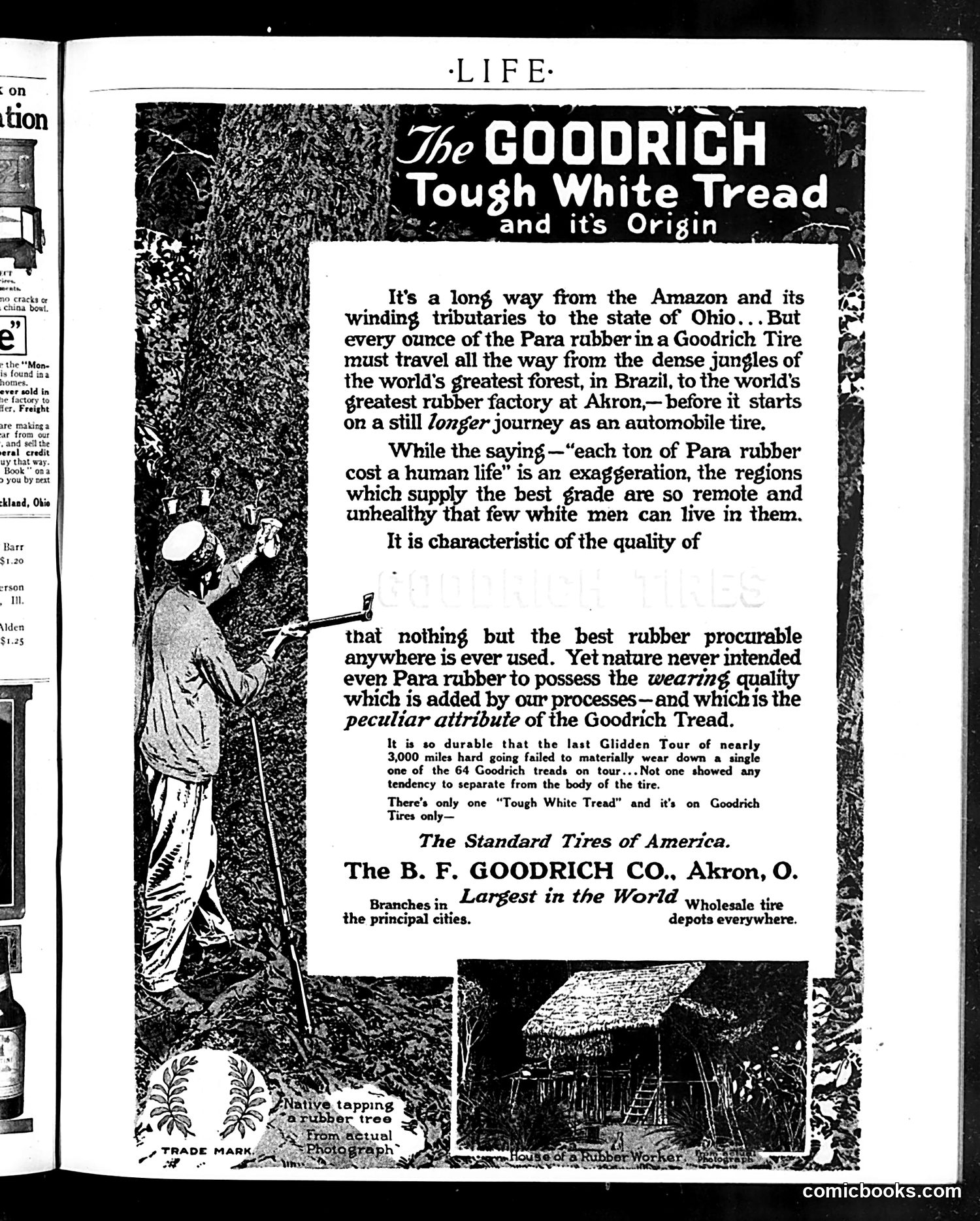
This is primarily a **product advertisement**, not satire or political commentary. The B.F. Goodrich Company uses this full-page ad to promote their "Tough White Tread" automobile tires. The ad emphasizes supply-chain sophistication: Para rubber from the Amazon jungle in Brazil travels to Goodrich's factory in Akron, Ohio, where proprietary manufacturing processes add durability that "nature never intended." The accompanying images show rubber tapping in the Amazon and indigenous workers' housing. The advertisement references the Glidden Tour (a real automotive endurance test) as proof of tire durability. The phrase about rubber costing "a human life" acknowledges—while dismissing as exaggeration—dangerous working conditions in Amazon rubber extraction, but this serves only to highlight how Goodrich sources "the best grade" despite regional hazards. This represents early 20th-century corporate marketing emphasizing global sourcing and technological superiority, with minimal concern for labor conditions in source countries.
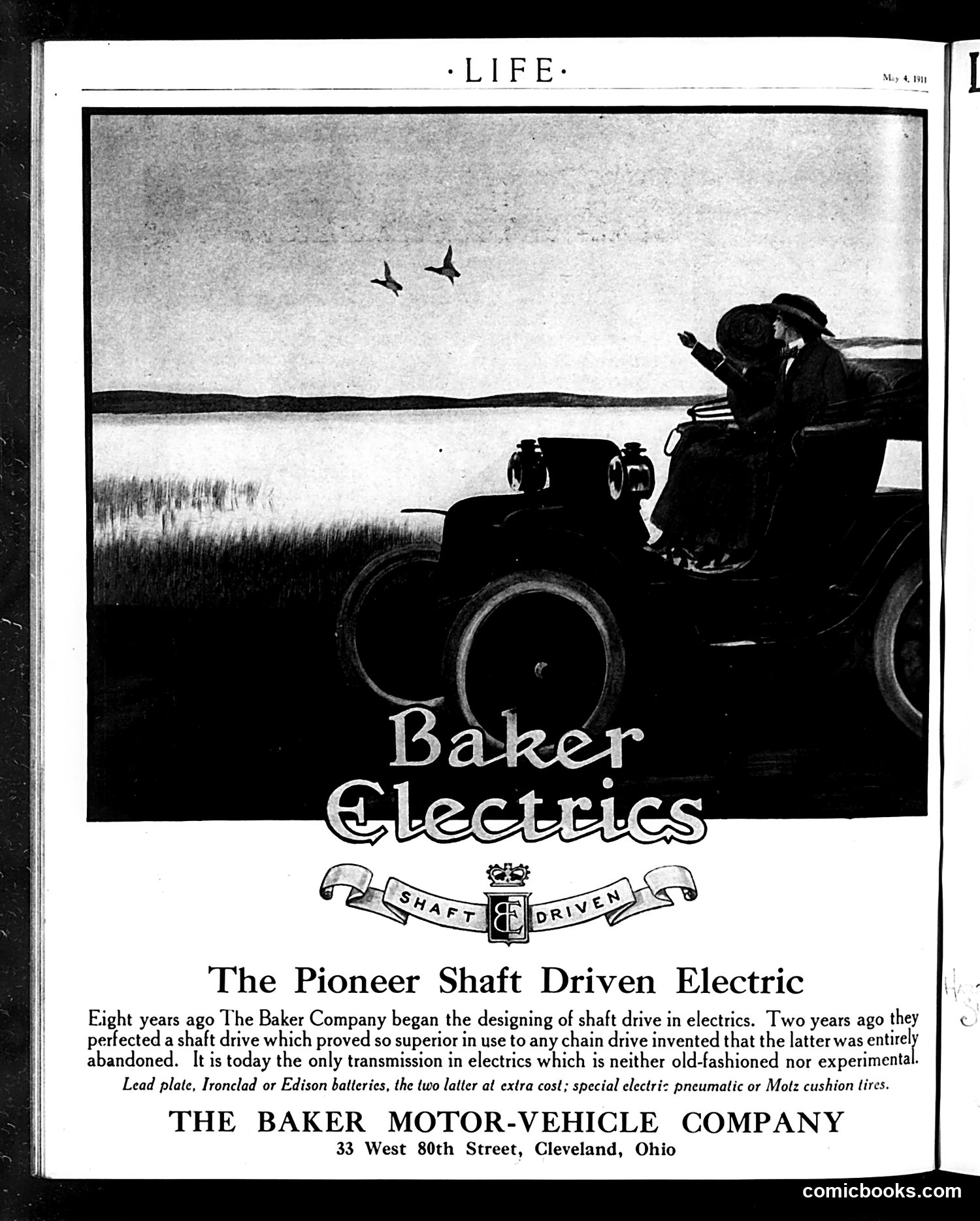
This is primarily a **product advertisement**, not satire or political commentary. It promotes Baker Motor-Vehicle Company's electric automobiles, specifically their "shaft driven" transmission technology. The image shows a silhouetted couple in an early electric car, pointing at flying birds—depicting leisure and carefree motoring. The advertisement emphasizes Baker's innovation: their shaft drive transmission supposedly surpasses the chain drive used by competitors and represents neither outdated nor experimental technology. The text highlights practical features (battery options, tire types) to appeal to buyers. The "Pioneer" branding suggests Baker's leadership in electric vehicle design. **Context for modern readers**: This reflects the early 1900s when electric vehicles competed seriously with gasoline cars. The focus on smooth, quiet transmission reflects electric cars' marketing advantage—they were cleaner and easier to operate than loud, hand-crank gasoline vehicles. Baker was indeed a real, prominent electric automobile manufacturer of this era.