
Life, 1911-05-04 · page 30 of 56
Life — May 4, 1911 — page 30: what you’re looking at
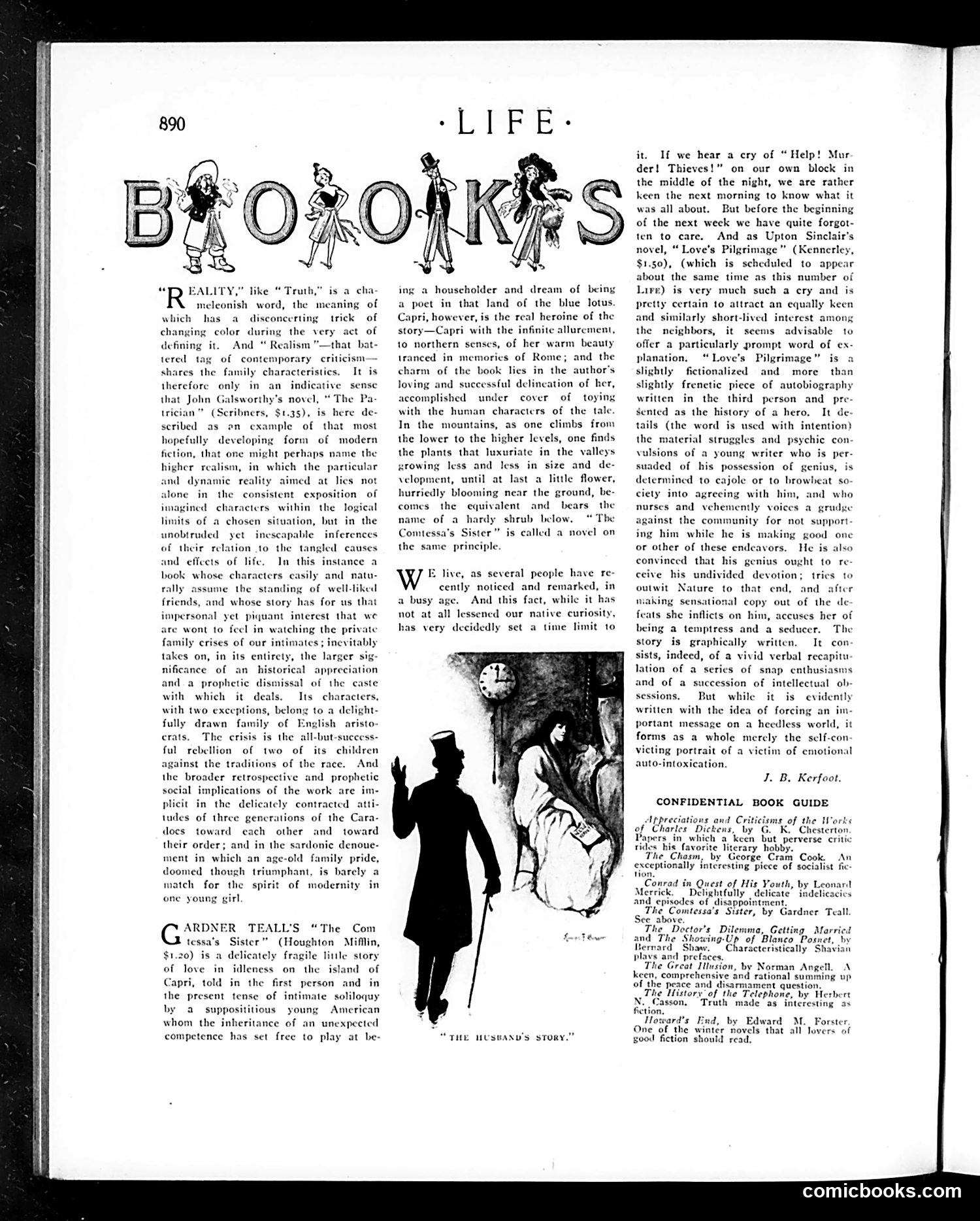
A restored page from Life, 1911-05-04. Page through the whole issue in the reader above.
📄 Transcribed text from this page (OCR, searchable)
Machine-transcribed from the original scan — historical spelling and the odd misread are preserved.
like “Truth,” is a cha meleonish word, the meaning of which has a disconcerting trick of changing color during the very act of defining it. And “ Realism "—that bat- tered tag of contemporary criticism— shares the family characteristics, It therefore indicative sens that John Galsworthy’s novel, “The Ps (Scribners, $1.35), is here de- example of that most hopefully developing form of modern fiction, that one might perhaps name the higher realism, in which the particular aimed at lies n exposition of characters within the logical n, but in the apable only in an trician ” scribed as an and dynamic reality alone in the consistent imagined limits of a chosen si unobtruded yet ine of ir relation to the tangled causes and effcets of life. In this instance a book whose characters casily and natu- rally assume the standing of well-liked friends, and whose story has for us that impersonal yet piquant interest that we are wont to feel in watching the private family crises of our intimates ; inevitably takes on, in its entirety, the larger si nificance of an_ historical and a prophetic dismissal of the with which it deals. with two exceptions, belong to a delight- fully drawn crats, The crisis is the all-but-success- ful rebellion of two of its children against the traditions of the race. And the broader retrospective and prophetic social implications of the work are im- plicit. in the delicately contracted atti- iudes of three generations of the Cara- docs cach other and toward their order; and in the sardonic denoue- ment in which an age-old family pride, doomed though triumphant, is barely a match for the spirit of modernity in one young girl inferences ppreciation caste Its characters, family of English aristo- toward ARDNER TEALL'S “The Com tessa’s Sister” (Houghton Mifliin, $1.20) is a delicately fragile little story of love in idleness on the Capri, told in the first person and in the present tense of intimate soliloquy supposititious young American whom the inheritance of an unexpected competence has set free to play at be- island of by a ing a householder and dream of being a poet in that land of the blue lotus. Capri, however, is the real heroine of the story—Capri with the infinite allurement, 1o northern senses, of her warm beauty tranced in memorics of Rome; and the charm of the book lies in the author's loving and sucecssful delineation of her, accomplished under cover of toying with the human characters of the tale In the mountains, as one climbs from the lower to the higher levels, one finds the plants that luxuriate in the valleys growing less and less in size and de- velopment, until at last a little flower, hurriedly blooming near the ground, be- comes the equivalent and the name of a hardy shrub below, “ The Comtessa’s Sister” is called a novel on the same principle. live, as several people have re- cently noticed and remarked, in a busy age. And this fact, while it has not at all lessened our native curiosity, has very decidedly set a time limit to W “THE MUSBAND'S STORY it. If we hear a cry of “Help! Mur der! Thieves!” on our own block in the middle of the night, we are rather keen the next morning to know what it was all about. But before the beginning of the next week we have quite forgot- ten to care. And as Upton Sinclair's “Love's Pilgrimage” (Kennerley, $1.50), (which is scheduled to appear about the same time as this number of Lire) is very much such a ery and is pretty certain to attract an equally keen and similarly short-lived interest among the neighbors, it offer a particularly prompt word of ex- planation, “Love's Pilgrimage” is slightly fictionalized and more slightly frenetic piece of autobiography written in the third person and pre- Sented as the history of a hero, It de tails (the word is used with intention) the material struggles and psychic con- vulsions of a young writer who is per- suaded of his possession of genius, is determined to cajole or to browbe ciety into nurses and vehemently voices a griudse against the community for not support ing him while he is making good one or other of these endeavors. He is also convinced that his genius ought to re ceive his undivided devotion; trics to outwit Nature to that en¢ making sensational copy out of the de feats she inflicts on him, accuses her of being a temptress and a seducer. The story is graphically written. It con sists, indeed, of a vivid verbal recapitu lation of a series of snap enthusiasms and of a succession of intellectual ob- sessions. But while it is evidently written with the idea of forcing an im- portant message on a heedless world, it forms as a whole merely the self-con victing portrait of a victim of emotion auto-intoxication. seems advisable to greeing with him, and who and after J. B. Kerfoot. CONFIDENTIAL BOOK GUIDE Appreciations and Criticisms of the Works of Charles Dickens, by G. K. Chesterton. Papers in’ which a keen but perverse critic rides his favorite literary hobby. The Chasm, by George Cram Cook. A exceptionally interesting piece of socialist Conrad in Quest of His Youth, by Leonard Merrick. Delightfully delicate’ indelicacies and episodes of disappointment, The Comtessa's Sister, by Gardner Teall. See above. The Doctor's Dilemme, Getting Married and The Showing-Up of Blanco Posnet, by Bernard Shaw Characteristically Shavian plays and prefaces. The Great Itlusion, by Norman Angell. A keen, comprehensive and rational summing up of the peace and disarmament question. The History of the Telephone, by Herbert N. Casson, “Truth made as interesting as Howard's End, by Edward M. Forster. One of the winter novels that all lovers of good fiction should read. comicbooks.com