
Life, 1911-05-04 · page 14 of 56
Life — May 4, 1911 — page 14: what you’re looking at
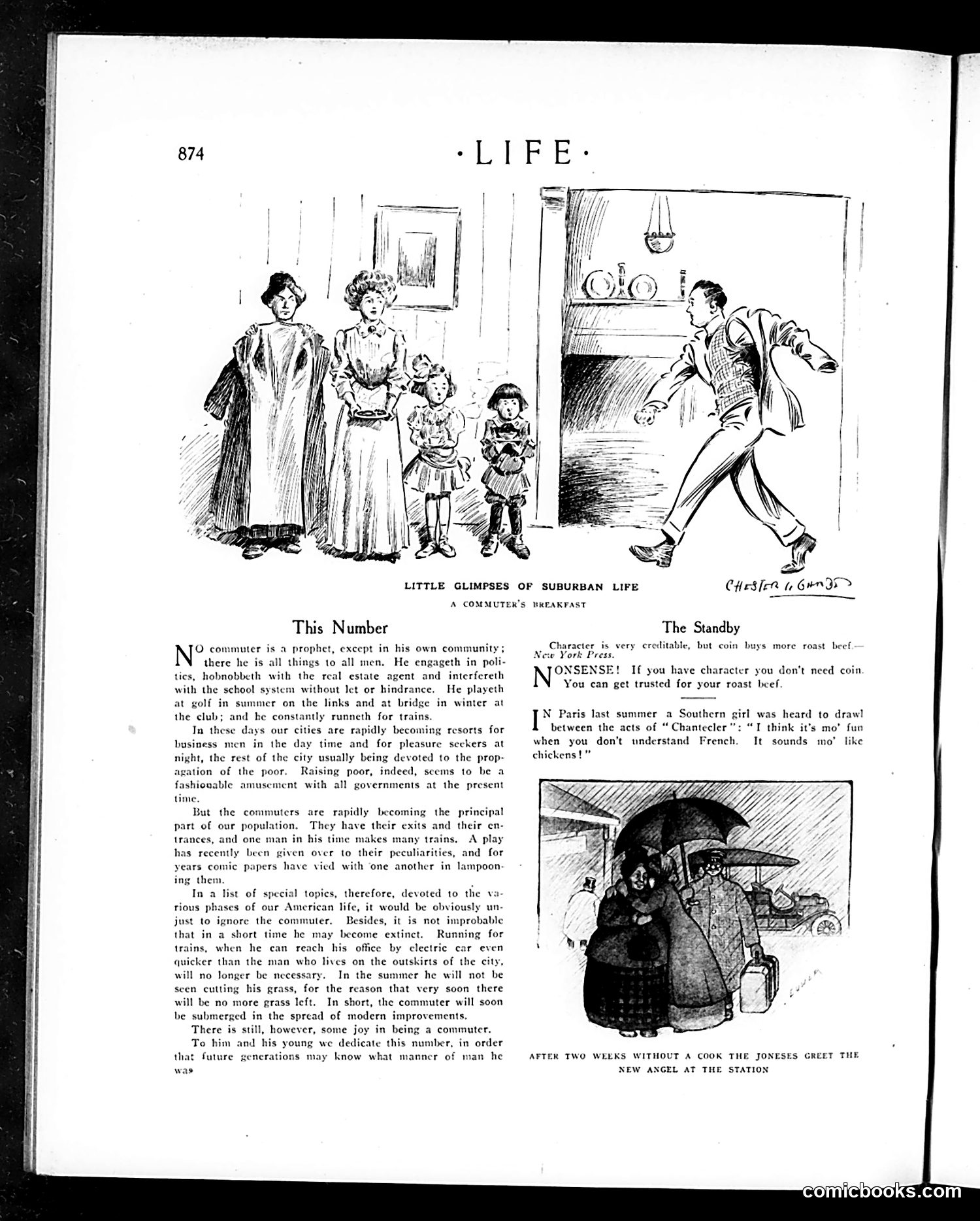
What you’re looking at
This page satirizes American suburban commuters—a rapidly growing demographic in the early 1900s. The main illustration shows a typical commuter scene: a man rushing out the door while his wife and children wait, depicting the hectic domestic life of someone constantly "running for trains." The editorial text warns that commuters, while becoming central to American life, may soon become extinct due to electric cars and urban sprawl eliminating the need for suburban living. The satire is gentle: commuters are portrayed as self-important in their small communities, juggling golf, bridge, politics, and school board involvement while perpetually chasing trains. The two sidebar jokes mock middle-class pretensions: "The Standby" disputes whether character or money matters more (ultimately endorsing credit), while the bottom cartoon shows a family greeting their new cook—suggesting domestic help's crucial importance to suburban wives managing households. The overall tone is affectionate mockery of an emerging American social class.
📄 Transcribed text from this page (OCR, searchable)
Machine-transcribed from the original scan — historical spelling and the odd misread are preserved.
LITTLE GLIMPSES OF A COMMUTER'S This Number N° commuter is a prophet, except in his own community; there he is all things to all men. He engageth in pol tics, hobnobbeth with the real estate agent and interfereth with the school system without let or hindrance. He playeth at golf in summer on the links and at bridge in winter at the club; and he constantly runneth for trains. In these days our cities are rapidly becoming resorts for business men in the day time and for pleasure scekers at night, the rest of the city usually being devoted to the prop- agation of the poor. Raising poor, indeed, scems to be a fashiooable amusement with all governments at the present time. But the commuters are rapidly becoming the principal part of our population. They have their exits and their en- trances, and one man in his time makes many trains, A play has recently been given over to their peculiarities, and for ers have vied with one another in lampoon years comic ing them. . In a list of special topics, therefore, devoted to the va rious phases of our American life, it would be obviously un- just to ignore the commuter, Besides, it is not improbable that in a short time he may become extinct. Running for trains, when he can reach his office by clectric car even quicker than the man who lives on the outskirts of the city, will no longer be necessary. In the summer he will not be scen cutting his grass, for the reason that very soon there will be no more grass left. In short, the commuter will soon be submerged in the spread of modern improvements. There is still, however, some joy in being a commuter. To him and his young we dedicate this number, in order that future generations may know what manner of man he was CHeS[eR te GER > —_—_—_——_—_ SUBURBAN LIFE UKEAKPAST The Standby Character is very creditable, but coin buys more roast beef ie York Press. ONSENSE! If you have character you don't need coin You can get trusted for your roast beef. N Paris last summer a Southern girl was heard to draw! between the acts of “ Chantecler”: “T think it’s mo’ fun when you don’t understand French. It sounds mo’ like chickens!" AFTER TWO WEEKS WITHOUT A COOK THE JONESES GREET THE NEW ANGEL AT THE STATION ‘omicbooks.com