
Life, 1911-05-04 · page 21 of 56
Life — May 4, 1911 — page 21: what you’re looking at
What you’re looking at
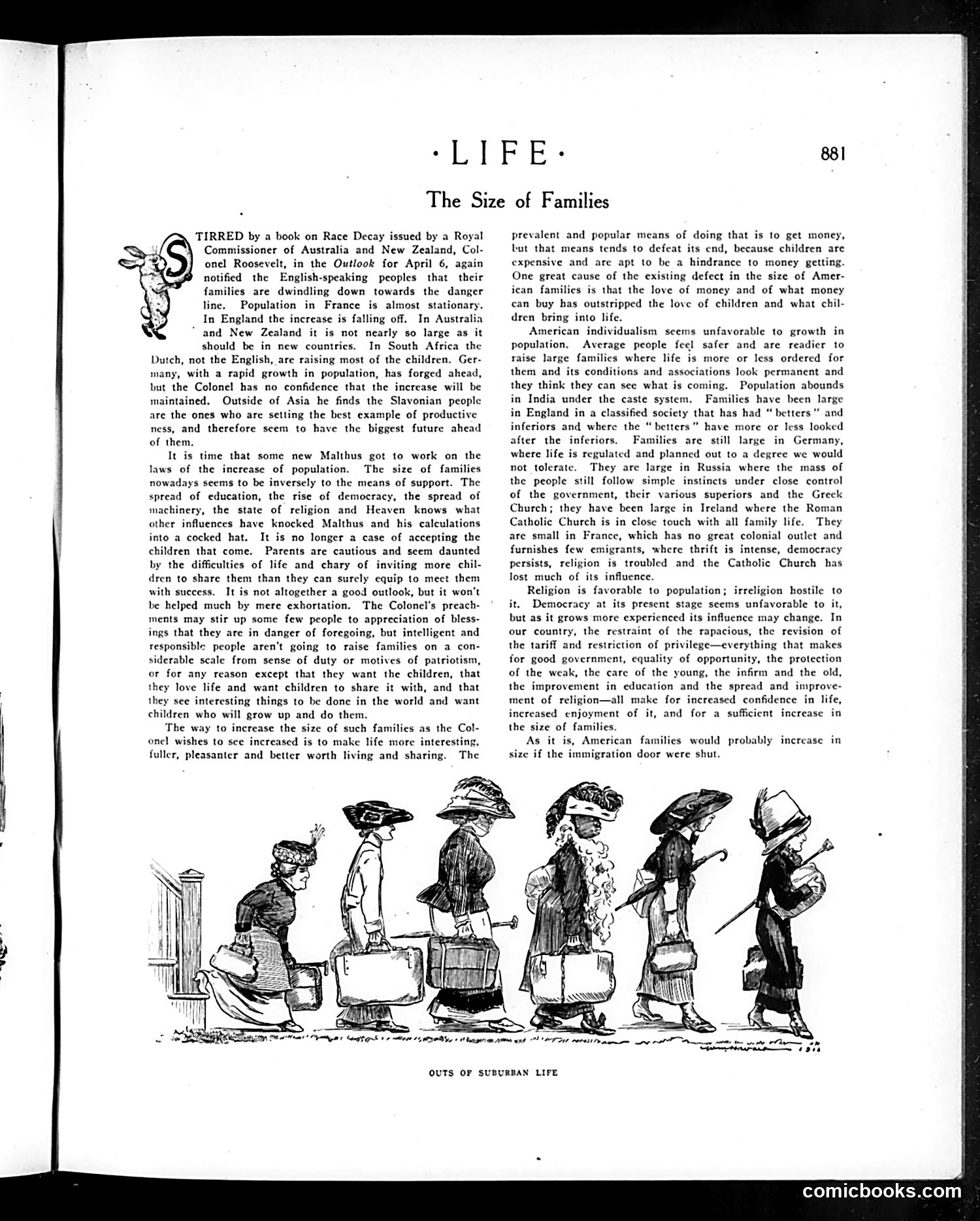
This page addresses declining birth rates among English-speaking populations, prompted by Colonel Theodore Roosevelt's public concern about "Race Decay." The article critiques Roosevelt's exhortations for larger families, arguing that intelligent people won't have children purely from patriotic duty or moral pressure. The cartoon captioned "OUTS OF SUBURBAN LIFE" depicts a line of women carrying suitcases—likely representing emigration or departure from domestic life. This visually satirizes the tension between traditional expectations of motherhood and women's emerging independence and mobility. The text's core argument: modern capitalism and individualism discourage large families because children are economically burdensome. The piece observes that populations remain large only under rigid social structures (India's caste system, Germany's regulation, Russia's authoritarianism, Catholic Ireland)—implying that American freedom inherently reduces family size, making Roosevelt's appeals futile.
📄 Transcribed text from this page (OCR, searchable)
Machine-transcribed from the original scan — historical spelling and the odd misread are preserved.
‘LIFE* The Size of Families TIRRED by a book on Race Decay issued by a Royal Commissioner of Australia and New Zealand, Col- onel Roosevelt, in the Outlook for April 6, again notified the English-speaking peoples that their families are dwindling down towards the danger line. Population in France is almost stationary. In England the increase is falling off. In Australia “and New Zealand it is not nearly so large as it should be in new countrics, In South Africa the Dutch, not the English, are raising most of the children, Ger- many, with a rapid growth in population, has forged ahead, but the Colonel has no confidence that the increase will be maintained. Outside of Asia he finds the Slavonian people are the ones who are setting the best example of productive ness, and therefore seem to have the biggest future ahead of them. It is time that some new Malthus got to work on the laws of the increase of population. The size of families nowadays seems to be inversely to the means of support. The spread of education, the rise of democracy, the spread of machinery, the state of religion and Heaven knows what other influences have knocked Malthus and his calculations into a cocked hat. It is no longer a case of accepting the children that come. Parents are cautious and seem daunted by the difficulties of life and chary of inviting more chil- dren to share them than they can surely equip to meet them with success. It is not altogether a good outlook, but it won't be helped much by mere exhortation. The Colonel's preach- ments may stir up some few people to appreciation of bless- ings that they are in danger of foregoing, but intelligent and responsible people aren't going to raise families on a con- siderable scale from sense of duty or motives of patriotism, or for any reason except that they want the children, that they love life and want children to share it , and that see interesting things to be done in the world and want children who will grow up and do them, to increase the size of such families as the Col- onel wishes to see increased is to make life more interesting, fuller, pleasanter and better worth living and sharing. The FN a pag ang 42 Oe ONY e + Hanger en Ain aah "TL mereil Renee ang ee ts to sate PC Tea eS prevalent and popular means of doing that is to get money, but that means tends to defeat its end, because children are expensive and are apt to be a hindrance to money getting. One great cause of the existing defect in the size of Amer- ican families is that the love of money and of what money can buy has outstripped the love of children and what chil- dren bring into life. American individualism seems unfavorable to growth in population. Average people feel safer and are readier to raise large families where life is more or less ordered for them and its conditions and associations look permanent and they think they can see what is coming. Population abounds in India under the caste system. Families have been large in England in a classified society that has had “ betters” and inferiors and where the “betters” have more or less looked after the inferiors. Families are still large in Germany, where life is regulated and planned out to a degree we would not tolerate. They are large in Russia where the mass of the people still follow simple instincts under close control of the government, their various superiors and the Greck Church; they have been large in Ireland where the Roman Catholic Church is in close touch with all family life. They are small in France, which has no great colonial outlet and furnishes few emigrants, where thrift is intense, democracy persists, religion is troubled and the Catholic Church has lost much of its influence. Religion is favorable to population; irreligion hostile to it, Democracy at its present stage seems unfavorable to it, but as it grows more experienced its influence may change. In our country, the restraint of the rapacious, the revision of the tariff and restriction of privilege—everything that makes for good government, equality of opportunity, the protection of the weak, the care of the young, the infirm and the old, the improvement in education and the spread and improve- ment of religion—all make for increased confidence in life increased enjoyment of it, and for a sufficient increase in the size of families. As it is, American families would probably increase in size if the immigration door were shut. aaee OUTS OF SUBURBAN LIFE comicbooks.com