
Life, 1911-05-04 · page 22 of 56
Life — May 4, 1911 — page 22: what you’re looking at
What you’re looking at
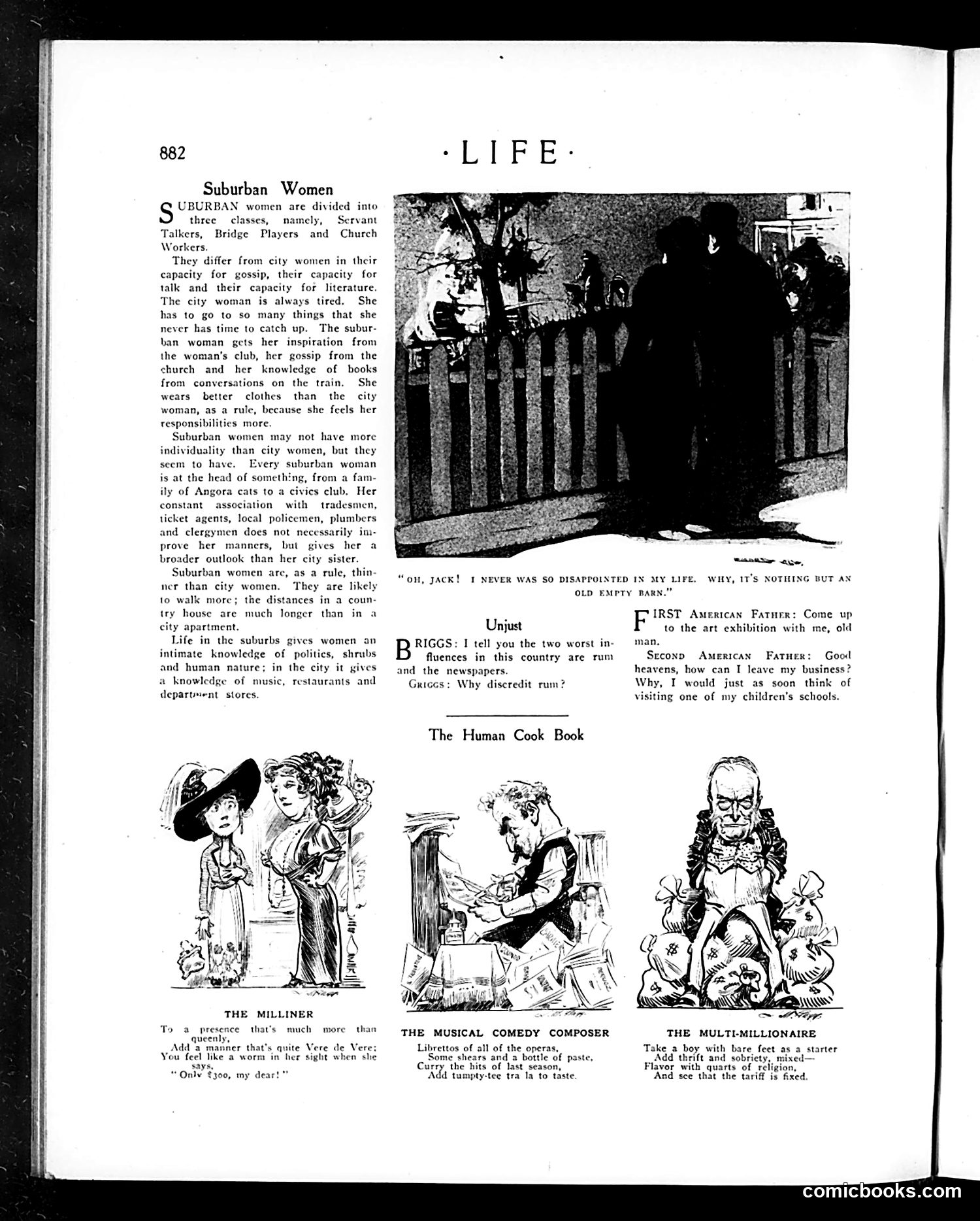
This page satirizes early 20th-century American social hierarchies through two main pieces: **"Suburban Women"** stereotypes suburban wives as gossipy, class-conscious figures obsessed with clubs and church work—contrasting them favorably (yet mockingly) with tired city women. The satire suggests suburban women, despite their pretensions and constant "heading" of organizations, lack genuine sophistication. **"The Human Cook Book"** uses caricatured social types to mock different professions and classes. "The Musical Comedy Composer" ridicules hack artists who recycle old material. "The Multi-Millionaire" satirizes the self-made businessman mythology by reducing success to mere ingredients (thrift, religion, tariff protection)—suggesting wealth isn't earned merit but systematic exploitation. The cartoons mock both working-class pretension and capitalist ideology, using exaggerated physical features typical of period satire. The overall tone reflects Life magazine's urbane critique of American social climbing and commercial culture.
📄 Transcribed text from this page (OCR, searchable)
Machine-transcribed from the original scan — historical spelling and the odd misread are preserved.
i 882 Suburban Women UBURBAN women are divided into three classes, namely, Servant Talkers, Bridge Players and Church Workers. They differ from city women in their capacity for gossip, their capacity for talk and their capacity for literature. The city woman is always tired. She has to go to so many things that she never has time to catch up. The subur- ban woman gets her inspiration from the woman's club, her gossip from the church and her knowledge of books from conversations on the train. She wears better clothes than the city woman, as a rule, because she feels her responsibilities more. Suburban women may not have more individuality than city women, but they seem to have. Every suburban woman is at the head of something, from a fam- ily of Angora cats to a civics club, Her constant association with tradesmen, ticket agents, local policemen, plumbers and clergymen does not necessarily im- prove her manners, but gives her a broader outlook than her city sister. Suburban women are, as a rule, thin- ner than city women. They are likely to walk more; the distances in a coun- try house are much longer than in a y apartment. Life in the suburbs gives women an intimate knowledge of polities, shrubs and human nature; in the city it gives & knowledge of music, restaurants and department stores THE MILLINER To a presence that's much more than queenly, Adda manner that’s quite Vere de Vere: You feel like a worm i hee sight when she Unjust RIGGS: I tell you the two worst in- fluences in this country are rum and the newspapers Gxices: Why discredit rum? The Human Cook Book Ou, JACK! 1 NEVER WAS SO DISAPPOINTED IX MY LIFE. OLD EMPTY BARS wane ace, WHY, 11'S NOTHING BUT AN IRST Awericay Fatirr: Come up to the art exhibition with me, old xo AMERICAN Fatner: Good heavens, how can I leave my business? Why, I would just as soon think of ing one of my children’s schools. THE MUSICAL COMEDY COMPOSER Librettos of all of the operas, Some shears and a bottle of paste, Curry the hits of last season, Add tumpty-tee tra la to taste. THE MULTI-MILLIONAIRE Take a boy with bare feet as a starter Add thrift and sobriety, mixed— Flavor with quarts of religion, And sce that the tariff is fixed. comicbooks.com