
Life, 1911-05-04 · page 27 of 56
Life — May 4, 1911 — page 27: what you’re looking at
What you’re looking at
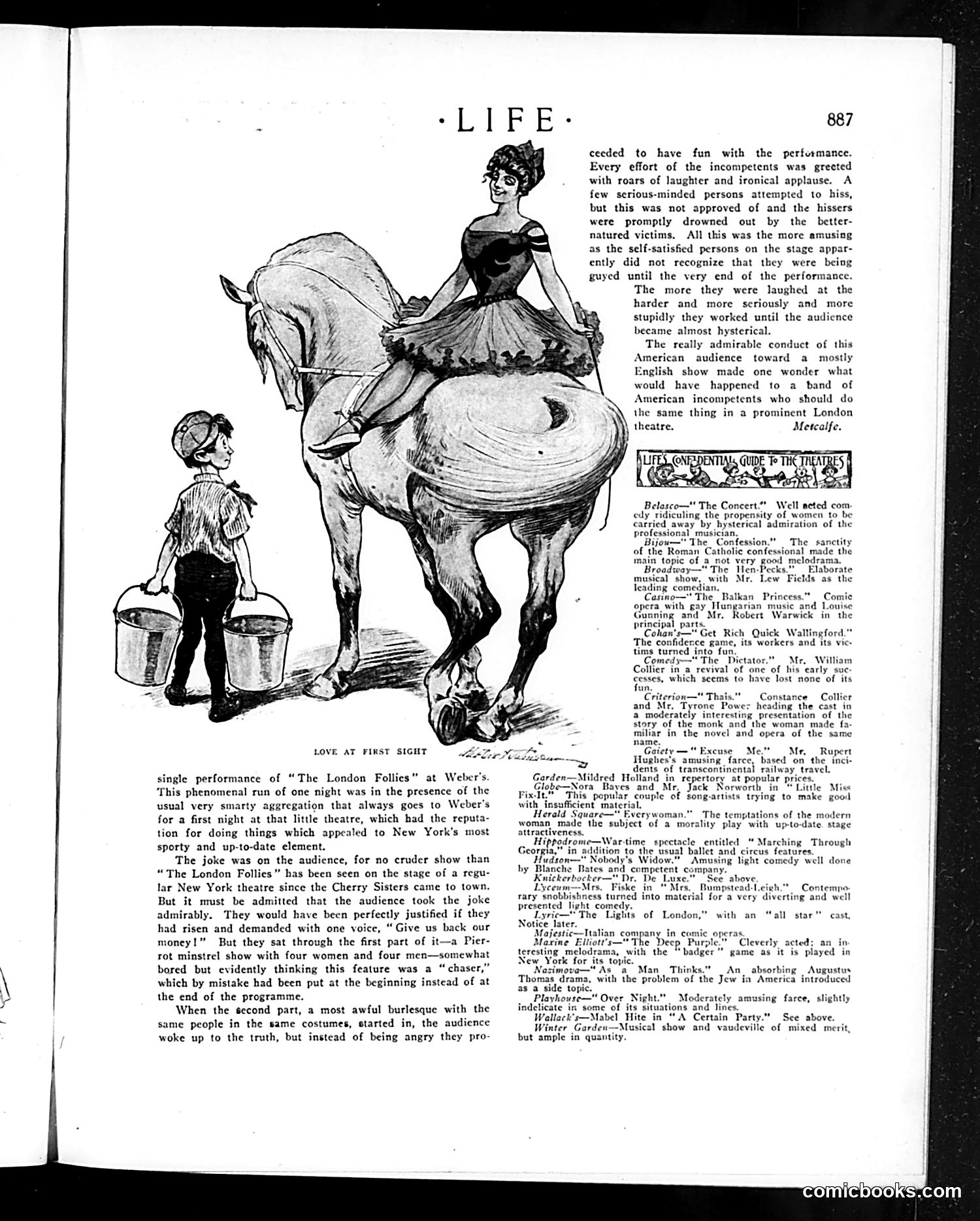
This cartoon critiques a disastrous theatrical performance of "The London Follies" at Weber's Theatre in New York. The illustration shows a woman on a horse, accompanied by a small boy carrying buckets—depicting the show's crude quality. The accompanying text explains that the audience recognized the performance as incompetent but responded with good humor rather than anger. They laughed ironically at the performers' earnest but awful efforts, apparently unaware they were being mocked. The critic (Metcalfe) suggests American audiences behaved admirably—with sophisticated tolerance—and sarcastically wonders if British audiences would have shown similar restraint toward incompetent American performers. The satire targets both the terrible show and celebrates the audience's witty, urbane response to theatrical failure.
📄 Transcribed text from this page (OCR, searchable)
Machine-transcribed from the original scan — historical spelling and the odd misread are preserved.
LOVE AT FIRST SIGHT single performance of “The London Follies” at Weber's. ‘This phenomenal run of one night was in the presence of the usual very smarty aggregation that always goes to Weber's for a first night at that little theatre, which bad the reputa- tion for doing things which appealed to New York's most sporty and up-to-date element. The joke was on the audience, for no cruder show than “The London Follies” has been seen on the stage of a regu- lar New York theatre since the Cherry Sisters came to town. But it must be admitted that the audience took the joke admirably. They would have been perfectly justified if they had risen and demanded with one voice, “Give us back our money!” But they sat through the first part of it—a Pier- rot minstrel show with four women and four men—somewhat bored but evidently thinking this feature was a “chaser,” which by mistake had been put at the beginning instead of at the end of the programme. When the second part, a most awful burlesque with the same people in the same costumes, started in, the audience woke up to the truth, but instead of being angry they pro- ir Miles 887 ceeded to have fun with the perfurmance. Every effort of the incompetents was grected with roars of laughter and ironical applause. A few scrious-minded persons attempted to hiss, but this was not approved of and the hissers were promptly drowned out by the better- natured victims, All this was the more amusing as the self-satisfied persons on the stage appar- ently did not recognize that they were being guyed until the very end of the performance. The more they were laughed at the harder and more seriously and more stupidly they worked until the audience became almost hysterical. The really admirable conduct of this American audience toward a mostly glish show made one wonder what would have happened to a band of American incompetents who should do the same thing in a prominent London theatre. Metcalfe. Belasco—' The Concert.” Well acted com: edy ridiculing the propensity of women to be carried away by hysterical admiration of the professional musician, Bijou—" The, Confession.” The san of the Roman Catholic confessional made the in topic of a not very good melodrama. roadway—" The Hen-Pecks.” Elaborate musical show, with Mr. Lew Fields as the ian, he Balkan Princess." Comic y Hungarian music and Louise t Warwick in the principal, parts. n’'s—" Get Rich Quick Wallingford.” fidence game, its workers and its vic- tims turned into fun. Comedy—" The Dictator.” — Mr. William Collier in a revival of one of his early suc cesses, which seems to have lost none of its Criterion—" Thais.” Constance Collier and Mr, Tyrone Power heading the cast in a moderately interesting presentation of the story of the monk and the woman made fa- miliar in the novel and opera of the same name. Ae Gaiety —" Excuse Me." Mr. Rupert ~y Hughes's amusing farce, based on the inci- dents of transcontinental railway travel. Garden—Mildred Holland in repertory at popular prices. . Globe—Nora Bayes and Mr, Jack Norworth in Little Fix-It," This popular couple of Song-artists trying to make good with insufficient material, Herald Square—" Everywoman.” The temptations of the modern woman made the subject of a morality play with up-to-date. stage attractiveness. Hippodrome—War-time spectacle entitled “ Marching Through Georgia,” in addition to the usual ballet and circus features. Hudson—" Nobody's Widow.” Amusing light comedy well done by Blanche Bates and competent company. Knickerbocker—" Dr. De Luxe.” See above. 4 n—-Mrs. Fiske in “Mrs. Bumpstead-Leigh.” Contempo: rary snobbishness turned into material for a very diverting and well presented light comedy. Lyric—" The Lights of London,” with an “all star” cast, Notice later. MajesticMalian company in comic on Marine Eniott's—" The Deep Pur; Cleverly acted; an teresting melodrama, with the “badger” game as it is played in New York for its topic. Nasimove—" As a Man Thinks.” —An_ absorbing Augustus Thomas drama, with the problem of the Jew in America introduced as a side topic. Playhouse—" Over Night.” Moderately amusing farce, slightly indelicate in some of its situations and lines. Wallack’s—Mabel Hite in “A Certain Party.” See above. 7 al show and vaudeville of mixed mer opera with g2 inning and Mr, Rob but ample in quai