
Life, 1911-05-04 · page 26 of 56
Life — May 4, 1911 — page 26: what you’re looking at
What you’re looking at
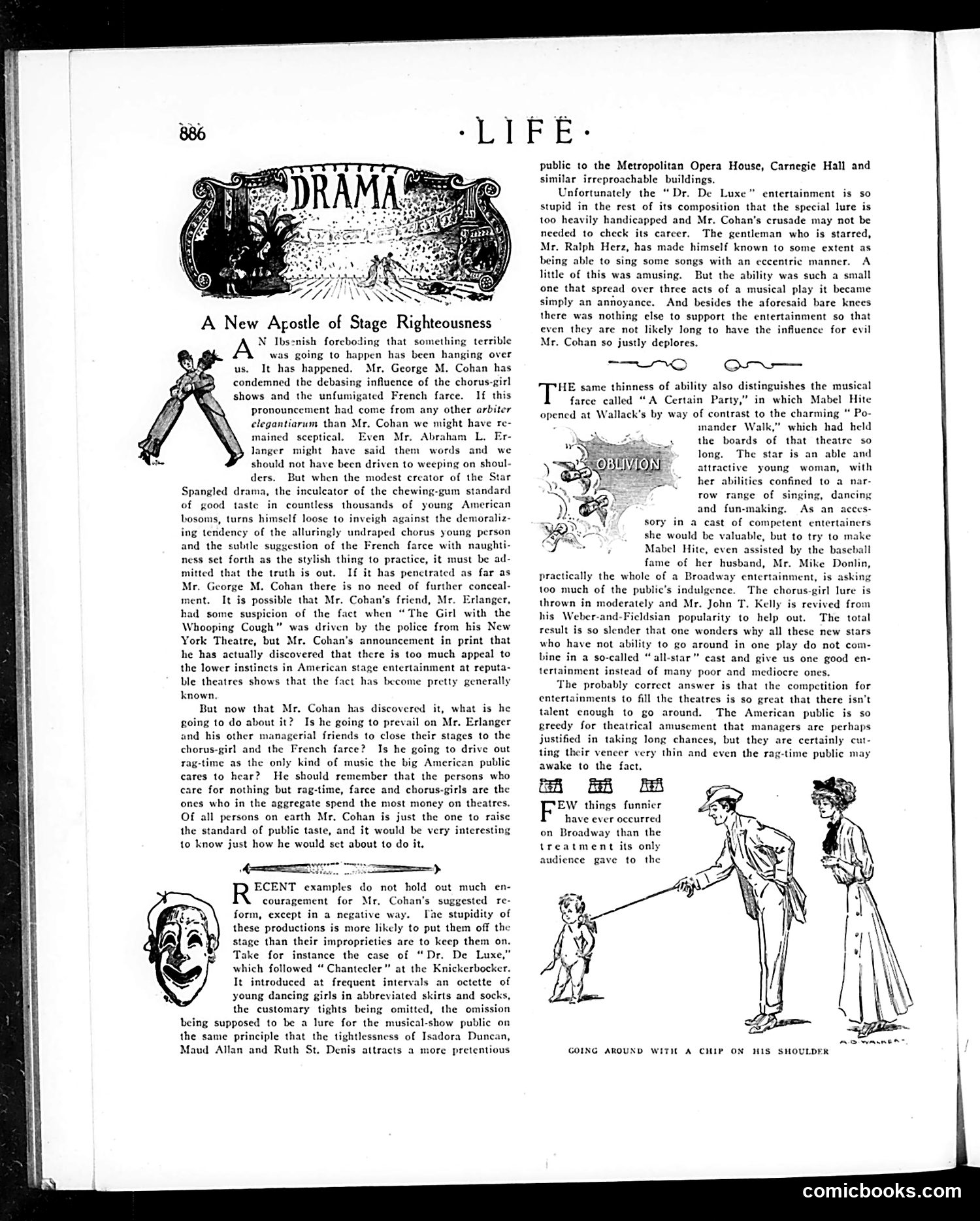
This page satirizes George M. Cohan's sudden moral crusade against Broadway's "debasing" chorus-girl shows and French farces. The irony is sharp: Cohan—creator of populist "Yankee Doodle Dandy" entertainment and "chewing-gum standard" productions—is condemned as the *last* person qualified to preach theatrical righteousness. The satire's bite: Cohan built his fortune on precisely the lowbrow entertainment he now denounces. The writer notes that chorus girls and rag-time farce attract the paying audiences that fund theaters. By calling for reform, Cohan would essentially eliminate his own audience. The page mocks contemporary Broadway figures like Abraham Erlanger (a theater manager), references specific shows like "Dr. De Luxe," and compares the appeal of partially-clothed dancers to modern dancers Isadora Duncan and Maud Allan—suggesting pseudo-intellectual justifications for exploitation. The cartoon at bottom (captioned "Going Around with a Chip on His Shoulder") likely visualizes this hypocrisy through physical metaphor.
📄 Transcribed text from this page (OCR, searchable)
Machine-transcribed from the original scan — historical spelling and the odd misread are preserved.
A New Agostle of Stage Righteousness N Ibs:nish foreboding that something terrible was going to happen has been hanging over us, It has happened. Mr. George M. Cohan has condemned the debasing influence of the chorus-girl shows and the unfumigated French farce. If this pronouncement had come from any other arbiter ¢legantiarum than Mr, Cohan we might have re- mained sceptical, Even Mr. Abraham L. Er- langer might’ have sal should not have been driven to weeping on shoul- ders. But when the modest ercator of the Spangled drama, the inculeator of the chewing-gum standard of good taste in countless thousands of young American bosoms, turns himself loose to inveigh against the demoraliz- ing tendency of the alluringly undraped chorus young person and the subtle suggestion of the French farce with naughti- ness set forth as the stylish thing to practice, it must be ad- mitted that the truth is out. If it has penetrated as far as Mr. George M. Cohan there is no need of further conceal ment. It is possible that Mr. Cohan’s friend, Mr. Erlanger, had some suspicion of the fact when “The Girl with the Whooping Cough” was driven by the police from his New York Theatre, but Mr. Cohan’s announcement in print that he has actually discovered that there is too much appeal to the lower instincts in American stage entertainment at reputa- Dle theatres shows that the fact has become pretty generally known, But now that Mr, Cohan has discovered it, what is he going to do about it? Is he going to prevail on Mr. Erlanger and his other managerial friends to close their stages to the chorus-girl and the French farce? Is he going to drive out rag-time as the only kind of music the big American public cares to hear? He should remember that the persons who care for nothing but rag-time, farce and chorus-girls are the ones who in the aggregate spend the most money on theatres. Of all persons on earth Mr. Cohan is just the one to raise the standard of public taste, and it would be very interesting to know just how he would set about to do it. them words and we ——I_ > ECENT examples do not hold out much en- couragement for Mr, Cohan's suggested re- form, except in a negative way. Tae stupidity of these productions is more likely to put them off the stage than their improprietics are to keep them on. Take for instance the case of “Dr. De Luxe,” which followed “ Chantecler” at the Knickerbocker. It introduced at frequent intervals an octette of young dancing girls in abbreviated skirts and socks, the customary tights being omitted, the omission being supposed to be a lure for the musical-show public on the same principle that the tightlessness of Isadora Duncan, Maud Allan and Ruth St. Denis attracts a more pretentious oo eB ois oi public to the Metropolitan Opera House, Carnegie Hall and similar irreproachable buildings. Unfortunately the “Dr. De Luxe” entertainment is so stupid in the rest of its composition that the special lure is too heavily handicapped and Mr. Cohan's crusade may not be needed to check its carcer, The gentleman who is starred, Mr. Ralph Herz, has made himself known to some extent as being able to sing some songs with an eccentric manner. A little of this was amusing. But the ability was such a small ‘one that spread over three acts of a musical play it became simply an annoyance. And besides the aforesaid bare knees there was nothing else to support the entertainment so that even they are not likely long to have the influence for evil Mr. Cohan so justly deplores. =O) ont HE same thinness of ability also distinguishes the musical farce called “A Certain Part: in which Mabel Hite opened at Wallack's by way of contrast to the charming “ Po- ander Walk,” which had held the boards of that theatre so long. The star is an able and attractive young woman, with her abilities confined to a nar- row range of singing, dancing and fun-making. As an acces- sory in a cast of competent enterta she would be valuable, but to try to m Mabel Hite, even assisted by the base fame of her husband, Mr. Mike Donlin, practically the whole of a Broadway entertainment, is asking too much of the public’s indulgence. The chorus-girl lure is thrown in moderately and Mr. John T. Kelly is revived from his Weber-and-Ficldsian popularity to help out. The total result is so slender that one wonders why all these new stars who have not ability to go around in one play do not com- bine in a so-called “all-star” cast and give us one good en- tertainment instead of many poor and mediocre ones. he probably correct answer is that the competition for entertainments to fill the theatres is so great that there isn't talent cnough to go around. The American public greedy for theatrical amusement that managers are perhaps justified in taking long chances, but they are certainly cut- ting their veneer very thin and even the rag-time public may awake to the fact, i Gi mB EW things funnier have ever occurred on Broadway than the treatment its only audience gave to the GOING AROUND WITIL A CHIP ON 11S SHOULDER comicbooks.com