
Life, 1911-05-04 · page 32 of 56
Life — May 4, 1911 — page 32: what you’re looking at
What you’re looking at
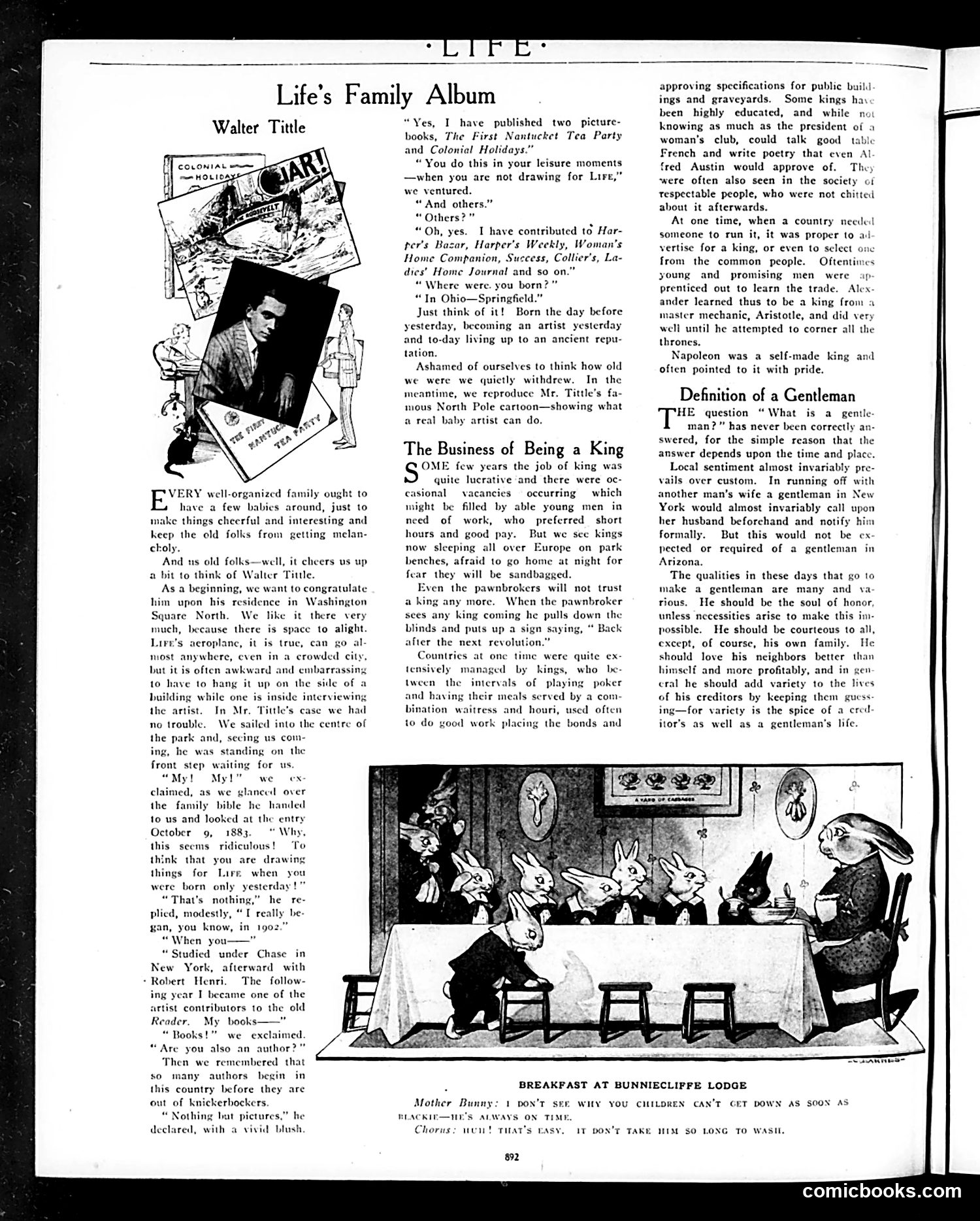
This page features Walter Tittle, an illustrator-artist being profiled in Life's "Family Album" interview series. The satire centers on Tittle's remarkably prolific output despite his youth—born in 1883, he claims to have "really begun" in 1902 when studying under William Merritt Chase. The joke is the absurdity of his accomplishments: he's already contributed to *Harper's*, *Life*, *Collier's*, multiple women's magazines, published picture books, and created cartoons—all while being barely in his twenties. The lower cartoon, "Breakfast at Bunniecliffe Lodge," shows anthropomorphic rabbits at a meal; it exemplifies the type of whimsical animal-character work Tittle produced. The "Business of Being a King" essay satirizes monarchies' declining relevance in early 20th-century Europe. It jokes that kingships are no longer lucrative, pawnbrokers won't trust kings, and revolution is so constant that even creditors give up. The piece mocks hereditary rule as outdated while pretending it's merely an employment problem.
📄 Transcribed text from this page (OCR, searchable)
Machine-transcribed from the original scan — historical spelling and the odd misread are preserved.
Life’s Family Album Walter Tittle COLONIAL mmm Y well-organized family ought to have a few babies around, just to ke things cheerful and interesting and keep the old folks from getting melan- ckoly. And us old folks—well, it cheers us up a bit to think of Walter Tittle. As a beginning, we want to congratulate him upon his residence in Washington Square North. We like it there very much, because there is space to alight. Lirt’s aeroplane, it is true, can go al- most anywhere, even in a crowded city, but it is often awkward and embarras: © to hang it up on the side of Iding while one is inside interviewing the artist. In Mr. Tittle’s case we had no trouble. Ws 1 into the tre of the park and, secing us com- ing, he was standing on the front step waiting for us. “My! My!" we ex claimes we the family bible he handed to us and looked at the entry October 9, 1883. “Why, this seems ridiculous! 1 think that you are drawing things for Lire when you were born only yesterday!" “That's nothing,” he re- plicd, modestly, “I really be- gan, you know, in 1902.” “When you——” “Studied under Chase in New York, afterward with * Robert Henri. The follow- ing year I became one of the rtist contributors to the old der. My books——" “ Books!" we exclaimed. “Are you also an author?” Then we remembered that so many authors be this country before they are out of knickerbockers. “ Nothi 1 pictures,” he declared, with a vivid: blush nee over “Yes, I have published two picture- books, The First Nantucket Tea Party and Colonial Holidays.” “You do this in your leisure moments —when you are not drawing for Lire,” we ventured. “ And others.” “ Others?” “Oh, yes. I have contributed to Har- ter's Bazar, Harper's Weekly, Woman's Home Companion, Success, Collier's, La- dies’ Home Journal and so on.” “ Where were. you born?” “In Ohio—Springfield.” Just think of it! Born the day before yesterday, becoming an artist yesterday and to-day living up to an ancient repu- tation. Ashamed of ourselves to think how old we were we quietly withdrew. In the meantime, we reproduce Mr. Tittle’s fa- mous North Pole cartoon—showing what a real baby artist can do. The Business of Being a King OME few years the job of king was quite Tucrative and there were oc- vacancies occurring which might be filled by able young men in need of work, who preferred short hours and good pay. But we sce kings now sleeping all over Europe on park benches, afraid 10 go home at night for fear they will be sandbagged. en the pawnbrokers will not trust any more. When the pawnbroker sees any king coming he pulls down the Liinds and puts up a sign saying, “ Back after the next revolution.” Countries at one time were quite ex: tensively managed by kings, who be- tween the intervals of playing poker and having their meals served by a com- bination waitress and houri, used often to do good work placing the bonds and casional approving specifications for public build ings and graveyards. Some kings hay been highly educated, and while no knowing as much as the president of a woman's club, could talk good tal French and write poetry that even Al fred Austin would approve of. The) were often also seen in the society of respectable people, who were not chitted about it afterwards. At one time, when a country needed someone to run it, it was proper to vertise for a king, or even to select ¢ from the common people. Oftentimes young and promising men were ap: prenticed out to learn the trade. Alex ander learned thus to be a king from a master mechanic, Aristotle, and did very well until he attempted to corner all the thrones, Napoleon was a self-made king and often pointed to it with pride. Definition of a Gentleman HE question “What is a gentle man?” has never been correctly swered, for the simple reason that the answer depends upon the time and place. Local sentiment almost invariably pre- vails over custom. In running off with another man’s wife a gentleman in New York would almost invariably call upon her husband beforehand and notify him formally. But this would not be ex pected or required of a gentleman in Arizona. The qualities in these days that go to make a gentleman are many and va rious. He should be the soul of honor, unless necessities arise to make this im- possible. He should be courteous to all, except, of course, his own family. He should love his neighbors better than himself and more profitably, and in gen cral he should add variety to the lives of his ereditors by keeping them gucss- ing—for variety is the spice of a cred itor’s as well as a gentleman's life. BREAKFAST AT BUNNIECLIFFE LODGE Mother Bunn REACKIF—ME'S ALWAYS ON TIME 1 DON'T SEE WHY YOU CHILDREN CAN'T GET DOWN AS SOON AS Chorus: Wu! THAT'S EASY, IT DON'T TAKE MIM SO LONG TO WaSIL, 2 comicbooks.com