
Life, 1911-05-04 · page 12 of 56
Life — May 4, 1911 — page 12: what you’re looking at
What you’re looking at
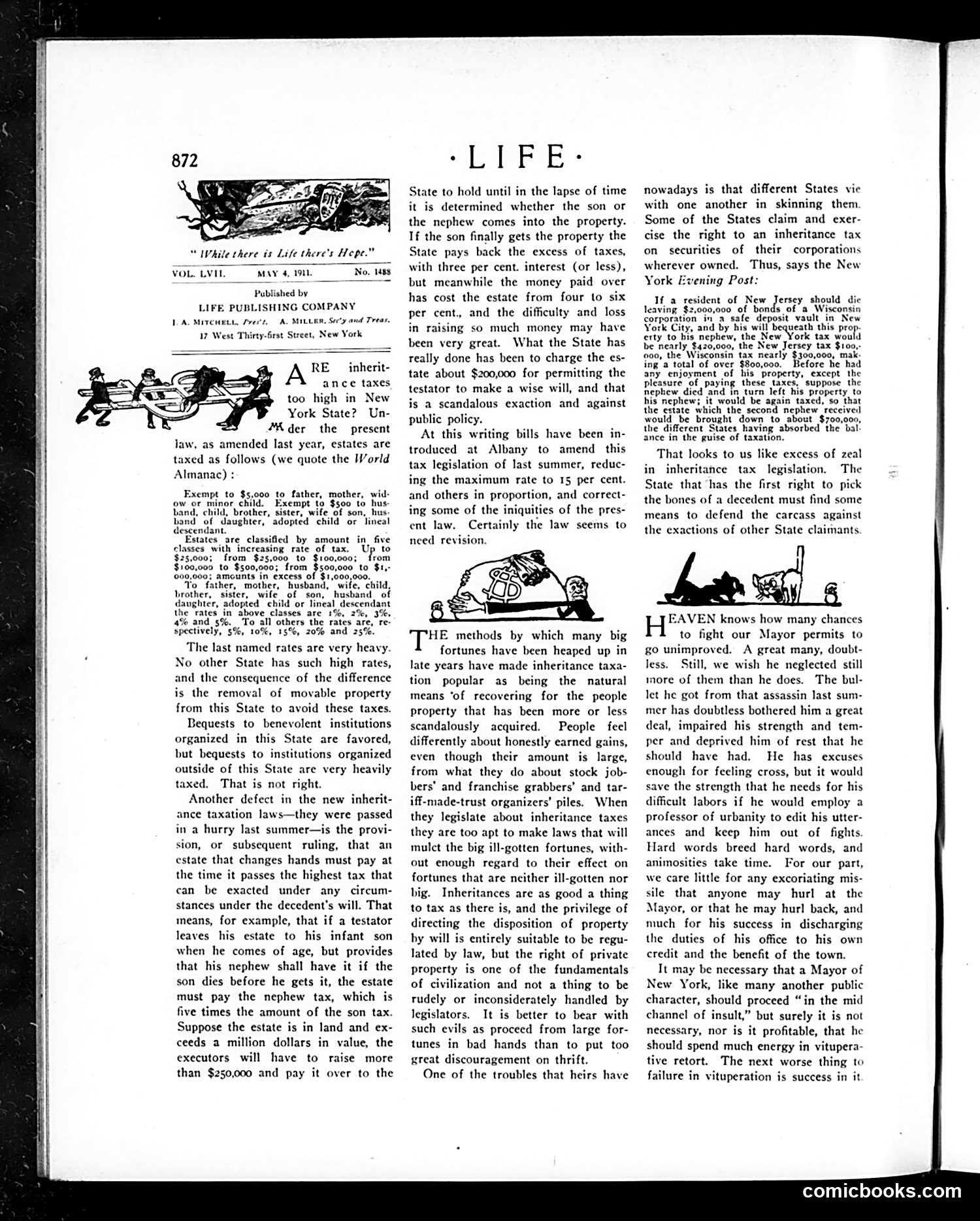
This page discusses inheritance taxation in New York State during the Progressive Era. The article critiques how wealthy estates are taxed at varying rates depending on the heir's relationship to the deceased—ranging from 1% to 5% or higher. The cartoon depicts a figure being crushed or weighed down, likely representing an heir burdened by heavy inheritance taxes. The satire targets what the author sees as excessive and arbitrary state taxation of estates, arguing the system is unfair and discourages productive wealth transfer. The article references a proposed bill at Albany to reduce maximum inheritance tax rates from higher levels to 15 percent, suggesting contemporary debate over whether such taxation serves the public good or unjustly penalizes families and their legacies.
📄 Transcribed text from this page (OCR, searchable)
Machine-transcribed from the original scan — historical spelling and the odd misread are preserved.
“ While there is Life there's Hope.” VOL. LV. MAY 4, 1911. Published by LIFE PUBLISHING COMPANY FAL MITCHELL, Pres, AL MILLER, Sec’y and Treas, 17 West Thirty-first Street, New York No. 1483 RE __ inherit- ance taxes too high in New York State? Un- *Kder the present law, as amended last year, estates are taxed as follows (we quote the World Almanac) : Exempt to $5,000 to father, mother, wid- ow or minor child. Exempt 10 $500 to hus. band, child, brother, sister, wife of son, hus. band of daughter, adopted child or lineal descendant. Estates are classified by amount in five classes with increasing rate of tax. Up to ‘000; from $25,000 to $100,000; from $100,009 to $500,000; from $500,000 to $1, 000,00 mounts in excess of $1,000,000. To father, mother, husband, wife, child, brother, sister, wife of son, husband of daughter, adopted child or lineal descendant the rates in above classes are 1%, 2%, 3%, 4% and 5%. To all others the rates are, re- spectively, $%, 10%, 15%, 20% and 25%. The last named rates are very heavy. No other State has such high rates, and the consequence of the difference is the removal of movable property from this State to avoid these taxes. Bequests to benevolent institutions organized in this State are favored, but bequests to institutions organized outside of this State are very heavily taxed, That is not right. Another defect in the new inherit- ance taxation laws—they were passed in a hurry last summer—is the provi- sion, or subsequent ruling, that an estate that changes hands must pay at the time it passes the highest tax that can be exacted under any circum- stances under the decedent's will. That means, for example, that if a testator leaves his estate to his infant son when he comes of age, but provides that his nephew shall have it if the son dies before he gets it, the estate must pay the nephew tax, which is five times the amount of the son tax. Suppose the estate is in land and ex- ceeds a million dollars in value, the executors will have to raise more than $250,000 and pay it over to the “RE + State to hold until in the lapse of time it is determined whether the son or the nephew comes into the property. If the son finally gets the property the State pays back the excess of taxes, with three per cent. interest (or less), but meanwhile the money paid over has cost the estate from four to six per cent, and the difficulty and loss in raising so much money may have been very great. What the State has really done has been to charge the es- tate about $200,000 for permitting the testator to make a wise will, and that is a scandalous exaction and against public policy. At this writing bills have been in- troduced at Albany to amend _ this tax legislation of last summer, reduc- ing the maximum rate to 15 per cent. and others in proportion, and correct- ing some of the iniquities of the pres- ent law. Certainly the law seems to need revision. THE methods by which many big fortunes have been heaped up in late years have made inheritance taxa- tion popular as being the natural means ‘of recovering for the people property that has been more or less scandalously acquired. People feel differently about honestly earned gains, even though their amount is large, from what they do about stock job- bers’ and franchise grabbers’ and tar- iff-made-trust organizers’ piles. When they legislate about inheritance taxes they are too apt to make laws that will mulct the big ill-gotten fortunes, with- out enough regard to their effect on fortunes that are neither ill-gotten nor big. Inheritances are as good a thing to tax as there is, and the privilege of directing the disposition of property hy will is entirely suitable to be regu- lated by law, but the right of private property is one of the fundamentals of civilization and not a thing to be tudely or inconsiderately handled by legislators. It is better to bear with such evils as proceed from large for- tunes in bad hands than to put too great discouragement on thrift. One of the troubles that heirs have nowadays is that different States vie with one another in skinning them Some of the States claim and exer- cise the right to an inheritance tax on securities of their corporations wherever owned. Thus, says the New York Evening Post: If a resident of New Jersey should die leaving $2,000,000 of bonds of a Wisconsin corporation ina safe deposit. vault in New York City, and by his will bequeath this prop. erty to his nephew, the New Vork tax would be nearly $420,000, the New Jersey tax $100,- 000, the Wisconsin tax nearly $300,000, mak. ing a total of over $800,000. Before he had any enjoyment of his property, except the pleasure of paying these taxes,’ suppose the fephew died and fn turn left his property to his nephew; it would be again taxed, so that the estate which the, second nephew ‘received would. be brought down to about’ $700,000, the different States having absorbed the bal ance in the guise of taxation. That looks to us like excess of zeal in inheritance tax legislation. The State that has the first right to pick the bones of a decedent must find some means to defend the carcass against the exactions of other State claimants. H AVEN knows how many chances to fight our Mayor permits to go unimproved. A great many, doubt- less. Still, we wish he neglected still more of them than he does. The bul- let he got from that assassin last sum- mer has doubtless bothered him a great deal, impaired his strength and tem- per and deprived him of rest that he should have had. He has excuses enough for feeling cross, but it would save the strength that he needs for his difficult labors if he would employ a professor of urbanity to edit his utter- ances and keep him out of fights. Hard words breed hard words, and animosities take time. For our part, we care little for any excoriating mis- sile that anyone may hurl at the Mayor, or that he may hurl back, and much for his success in discharging the duties of his office to his own credit and the benefit of the town. It may be necessary that a Mayor of New York, like many another public character, should proceed “in the mid channel of insult,” but surely it is not necessary, nor is it profitable, that he should spend much energy in vitupera- tive retort. The next worse thing to failure in vituperation is success in it comicbooks.com