
A complete issue · 36 pages · 1923
Judge — January 27, 1923
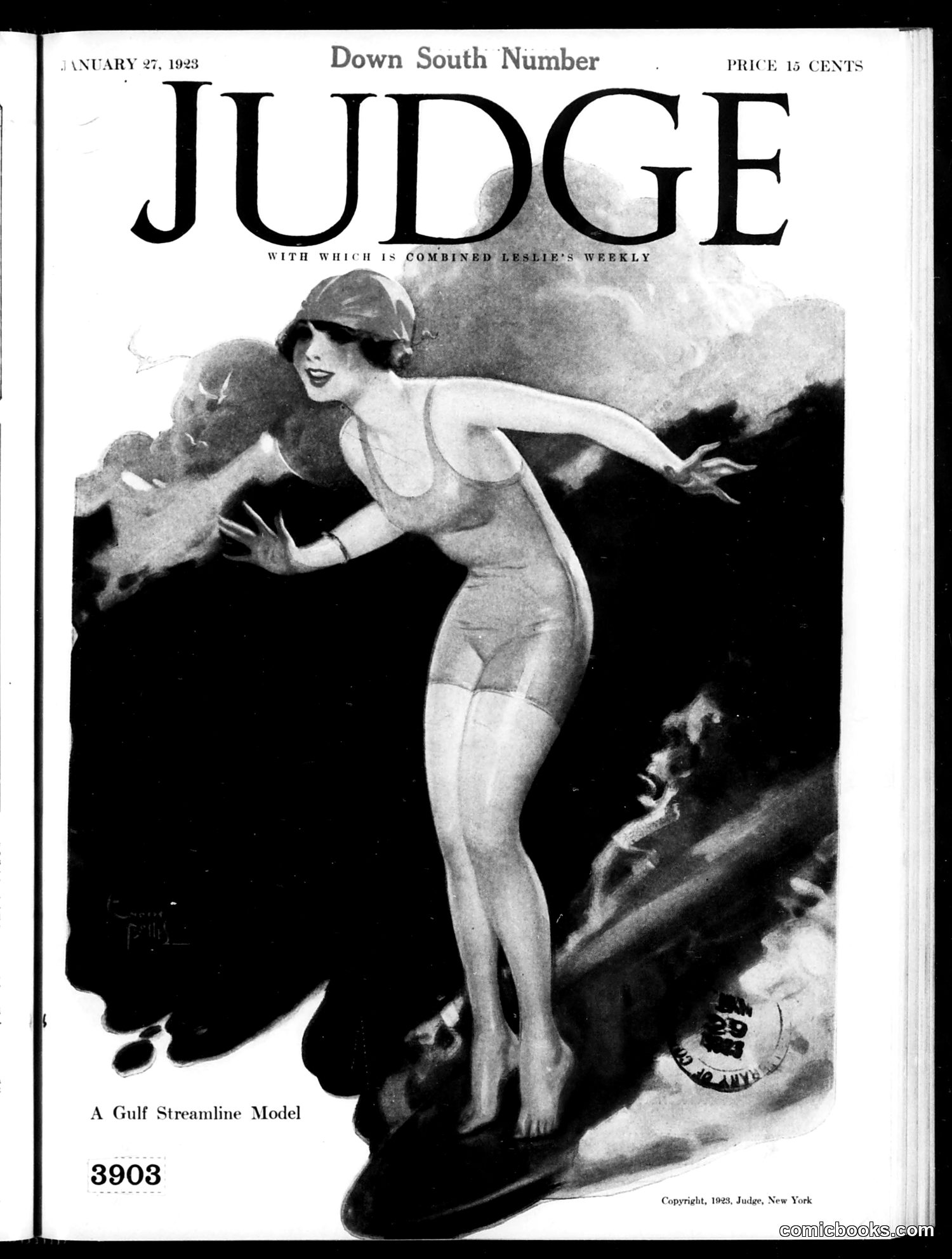
This is the cover of Judge magazine from January 27, 1923. The image shows a woman in a swimming costume labeled "A Gulf Streamline Model," depicted in a stylized, idealized pose with period-appropriate 1920s styling (cloche hat, makeup). This appears to be straightforward cover art rather than political satire. The "Gulf Streamline" reference suggests this is promotional or illustrative content related to contemporary fashion or automotive design aesthetics of the era—the 1920s frequently borrowed nautical/streamline imagery as modern design language. The content is primarily illustrative rather than satirical commentary. The magazine itself was satirical, but this particular cover seems focused on aesthetic representation of modern femininity and design trends of the Jazz Age period.
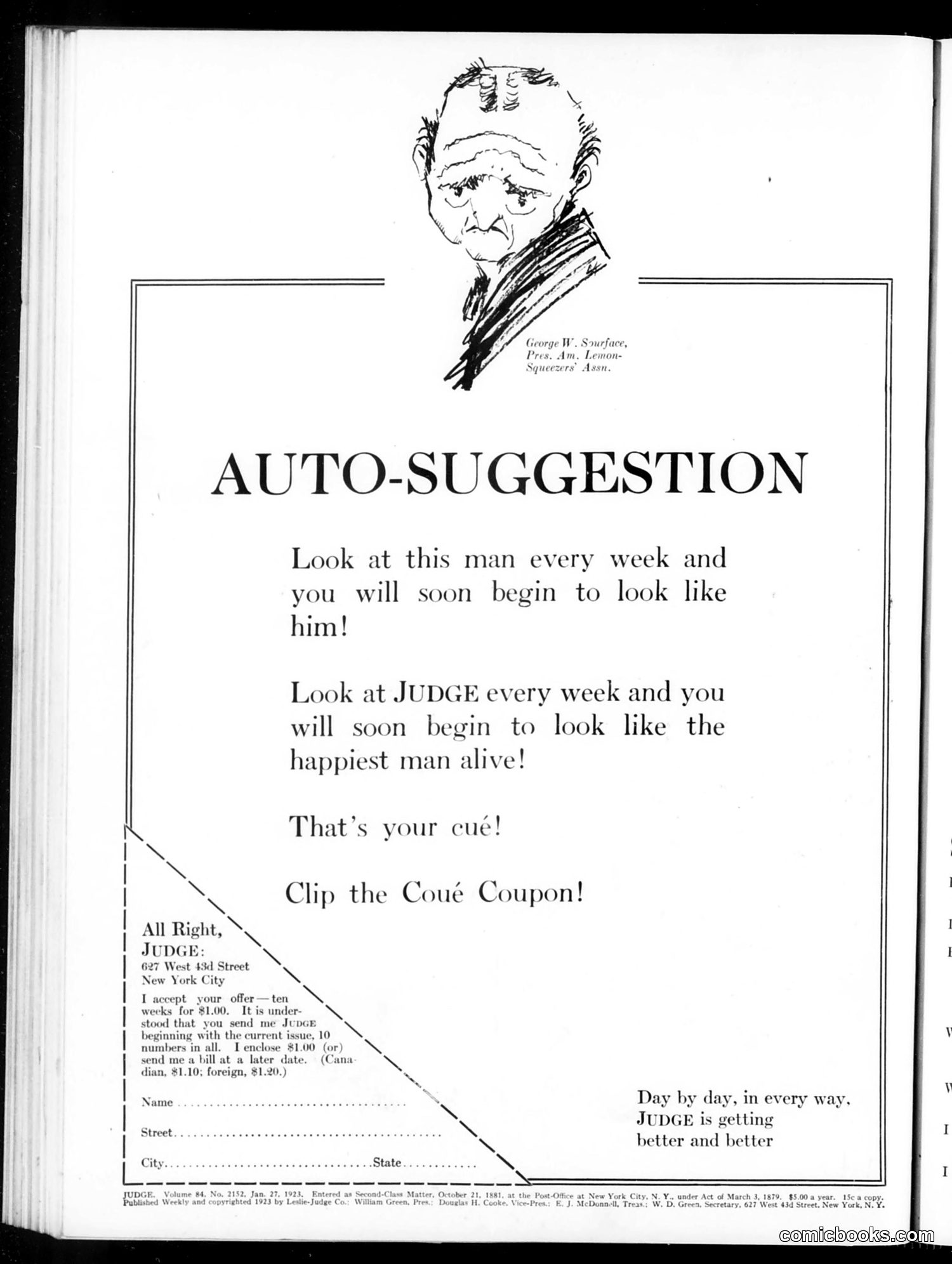
This page is primarily an **advertisement**, not political satire. It promotes "Judge" magazine's mail subscription service using the concept of auto-suggestion—a popular early 20th-century psychological idea that regularly viewing something influences you to resemble or imitate it. The ad features a caricatured portrait of **George W. Surflace**, identified as "Pres. Am. Lemon-Squeezers' Assn." (a humorous fictional title). The pitch claims: looking at this man weekly will make you look like him, but reading Judge weekly will make you "the happiest man alive." It's a playful self-promotional hook using period psychology trends to encourage subscriptions at $1.00 for ten weeks—a typical direct-mail coupon advertisement of the era.
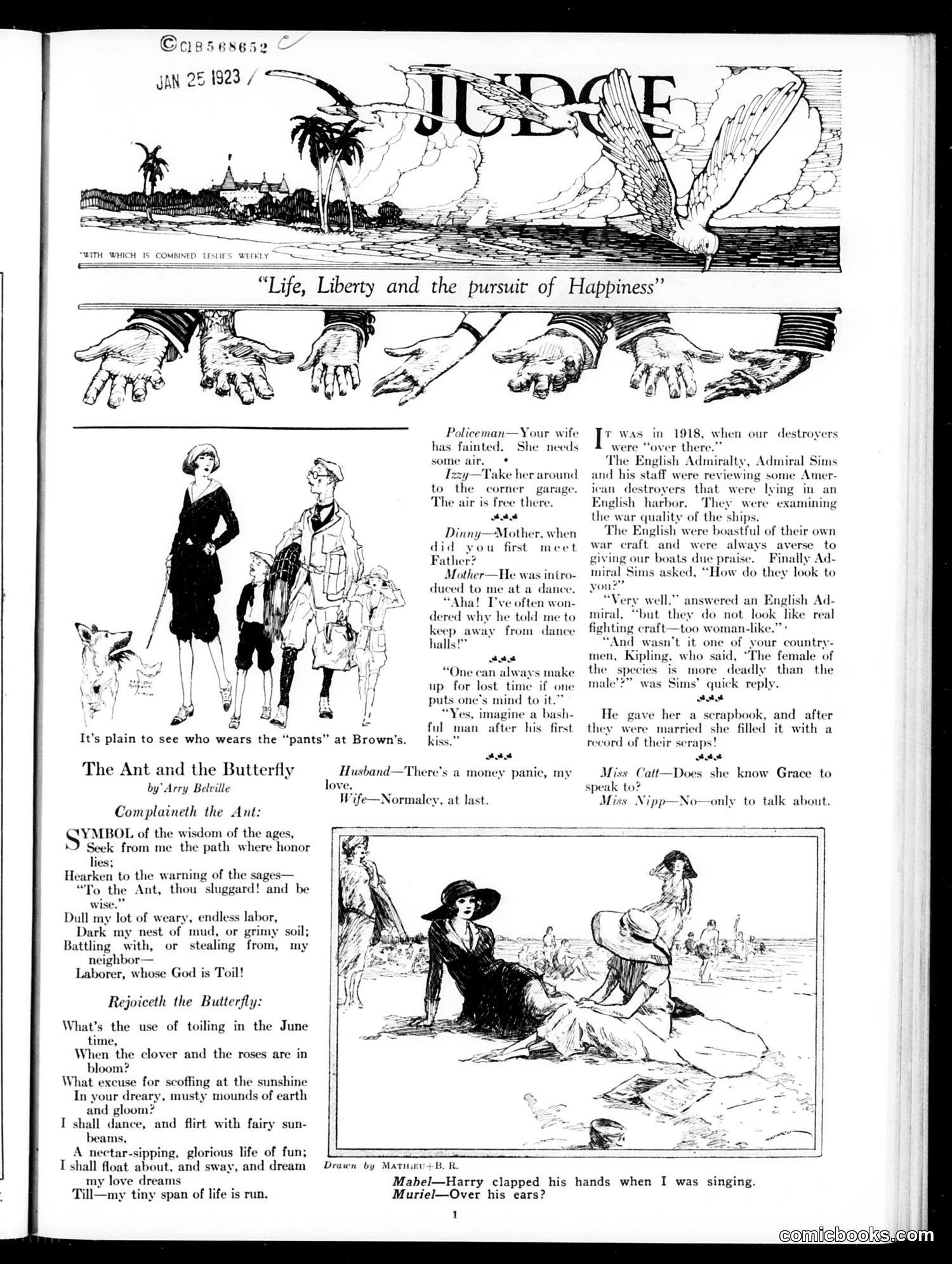
This page contains two main pieces: **"The Ant and the Butterfly"** is a moral fable poem contrasting the industrious ant with the carefree butterfly—a traditional Aesop's-style lesson about the virtue of hard work versus idle pleasure. **"It's Plain to See Who Wears the Pants at Brown's"** is a satirical cartoon about gender dynamics and household authority. The illustration shows a woman and children, suggesting she controls domestic decisions despite the era's formal male authority. The joke targets the contradiction between traditional male dominance and women's actual household management power—a relevant social commentary during the 1920s when women had recently gained voting rights and were challenging traditional gender roles. The page also includes miscellaneous brief humorous anecdotes about domestic and romantic situations.
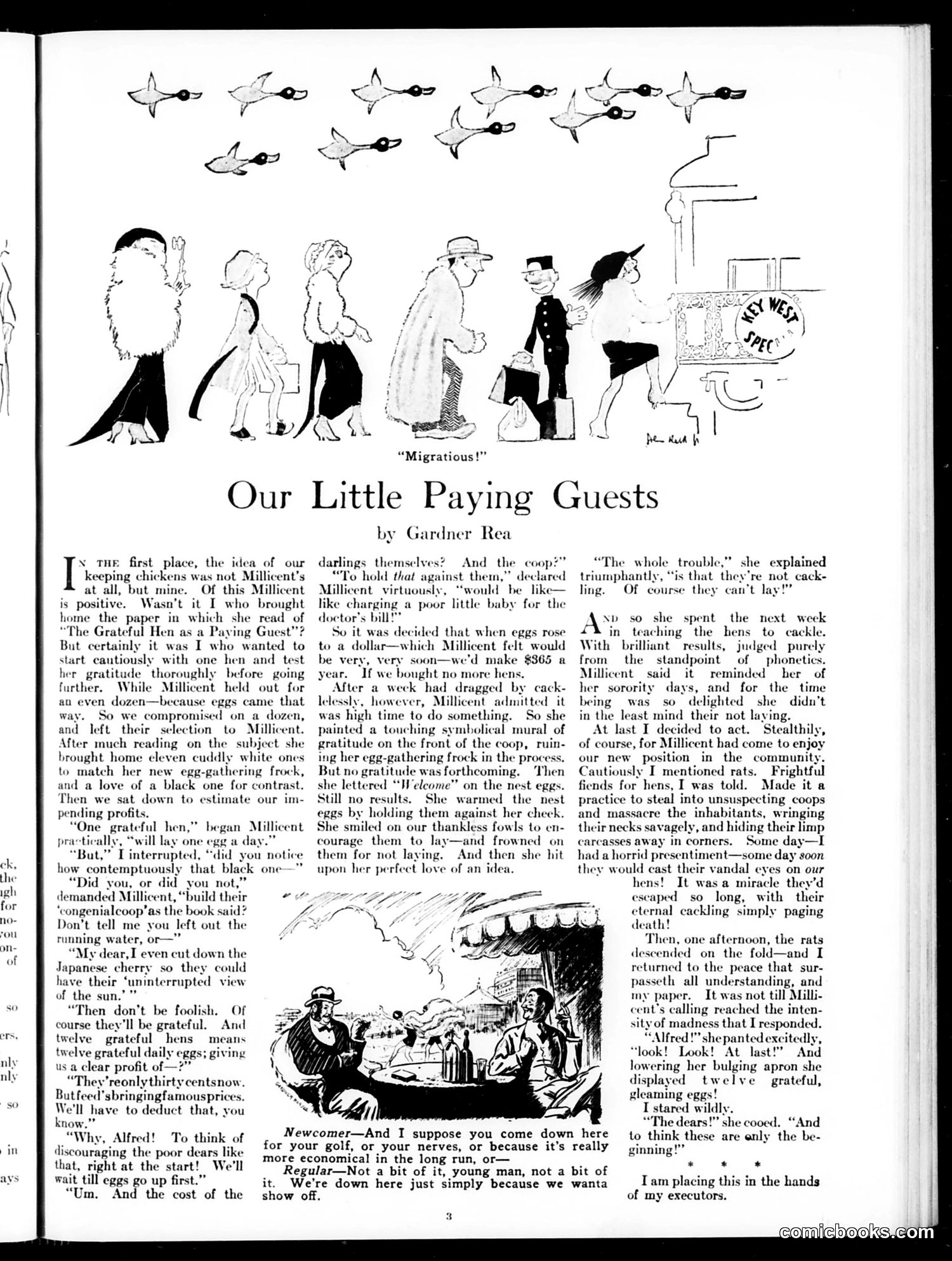
This story satirizes wealthy people's attempts to profit from keeping chickens as a fashionable hobby. A character named Millient, apparently from the affluent class, decides to raise hens to generate income, viewing it as both genteel and economically clever. The narrative mocks the gap between upper-class pretensions and practical reality. Millient's romantic notions about egg production clash with actual farm challenges—rats invade the coop, eggs disappear, and her venture becomes chaotic rather than profitable. The satire targets the Gilded Age trend of wealthy urbanites playing at farming or rural pursuits as status symbols while remaining incompetent at actual agricultural work. The cartoon critiques both their naïveté and their assumption that money alone ensures success at any endeavor.
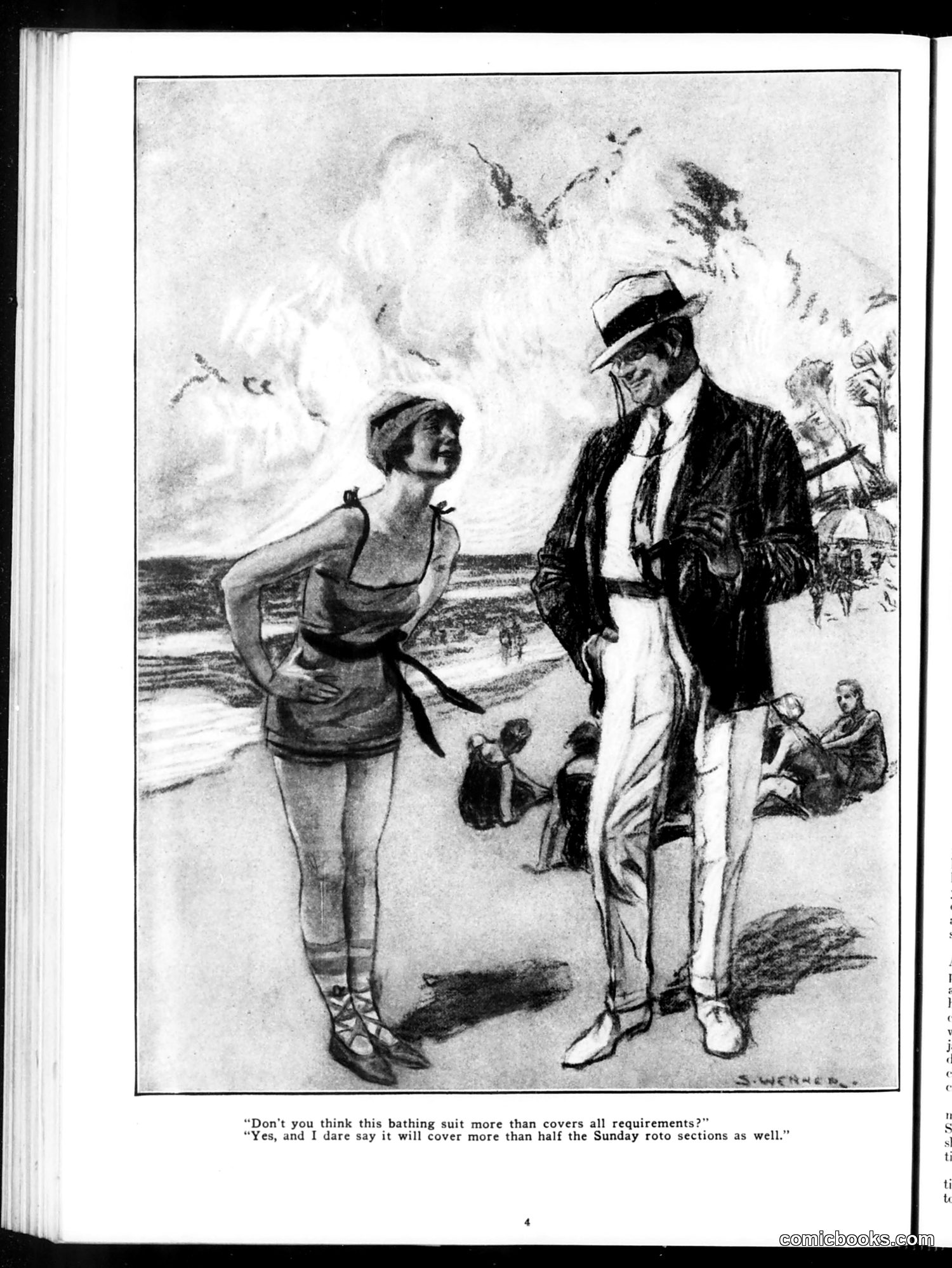
This beach scene satirizes women's bathing suit fashion standards of the early 20th century. A well-dressed man compliments a woman's modest swimsuit, suggesting it covers more than necessary—even exceeding "Sunday roto sections" (newspaper supplements). The joke targets anxieties about female modesty and changing social norms. The man's comment is ironic: he's praising the suit for being *overly* modest, reflecting conservative attitudes that women's swimwear was becoming scandalously revealing. The woman's confident posture suggests she's unbothered by such criticism. The cartoon captures period tension between traditional morality and modern beach culture, where women increasingly wore shorter, less restrictive bathing attire—a development some considered improper.
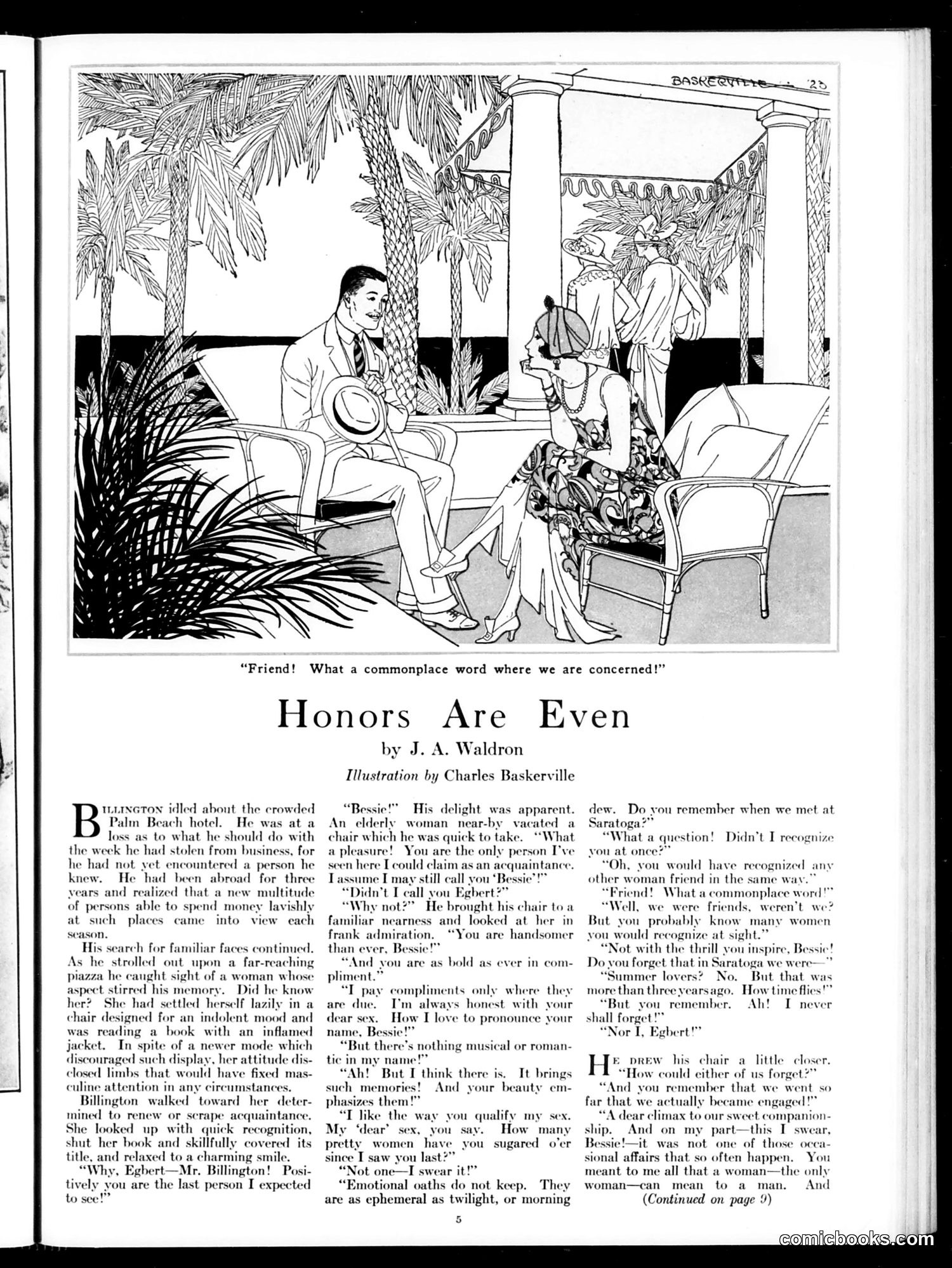
This is a romantic story illustration, not political satire. The narrative depicts two former lovers, Egbert and Bessie, reuniting at a fashionable Palm Beach hotel after three years apart. The "joke" centers on social pretense and romantic nostalgia: Egbert initially doesn't recognize Bessie, then flatters her effusively upon realization. Their dialogue reveals they were once engaged during a summer romance in Saratoga, which they're now romantically rekindling. The cartoon's title, "Honors Are Even," suggests mutual romantic claims or debts between the characters. The illustration shows them in an elegant tropical setting—characteristic of 1920s leisure society—with Bessie deliberately hiding her book's title, suggesting she was reading something romantic in anticipation of such an encounter. The story explores themes of rekindled romance, emotional honesty, and social performance among the wealthy leisure class typical of Judge magazine's audience.
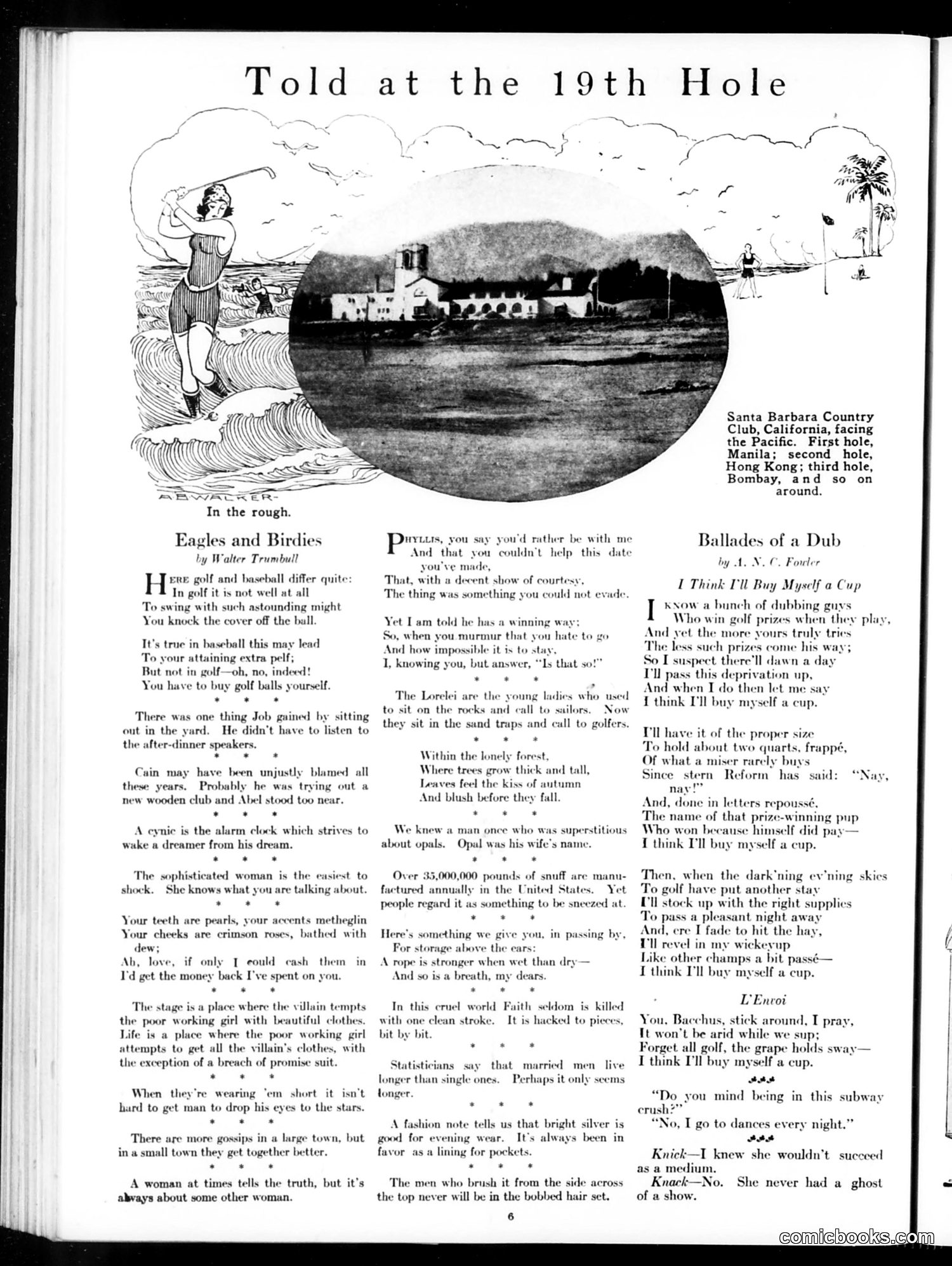
This page collects golf humor and verse from *Judge*, a satirical magazine. The central image shows Santa Barbara Country Club, establishing the setting as upscale golf culture. The content reflects early 20th-century golf humor: brief jokes about golf etiquette, equipment costs, and male courtship rituals. "Eagles and Birdies" by Walter Trumbull contains social commentary disguised as golf wisdom—jokes about wealthy men's frivolous spending and women's romantic deception. The "Ballades of a Dub" satirizes amateur golfers' failures and their consolation-prize drinking. The scattered aphorisms mock human nature (women, marriage, hypocrisy) in characteristic satirical style. References to "the 19th hole" (the clubhouse bar) underscore that these are post-round social observations. The overall tone is gentle mockery of the golf-club social set—their vanities, romantic pretenses, and drinking habits—targeting the leisure class readers of *Judge*.
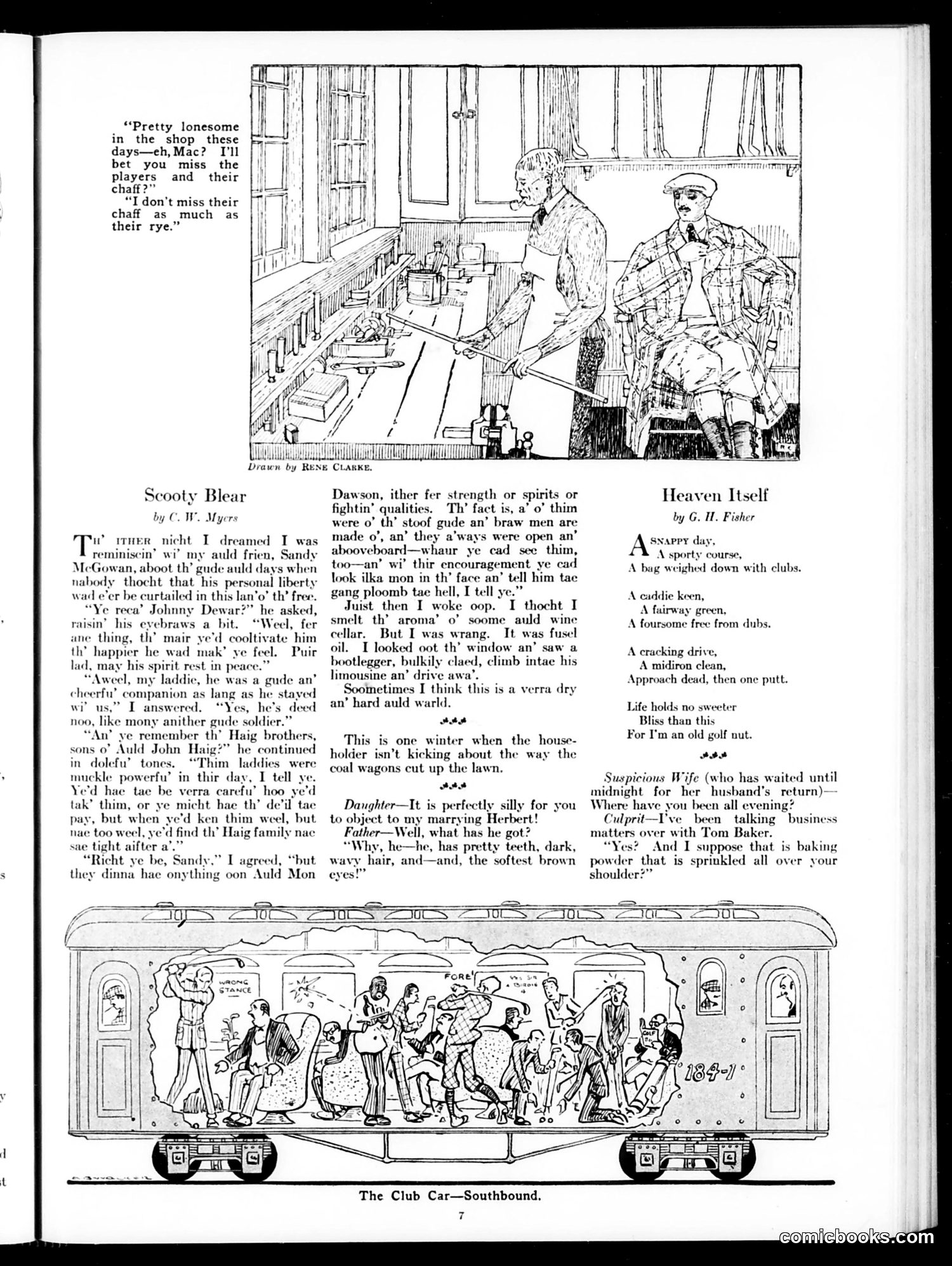
This page contains multiple satirical pieces typical of early 20th-century American humor magazines: **"Scooty Blear"** (top left): A Scottish-dialect story about a man reminiscing on Prohibition-era hardships. The opening dialogue jokes that a bartender misses patrons' conversation less than their alcohol purchases ("rye" whiskey). The narrative laments loss of Scottish whisky culture and celebrates figures like the Haig brothers, while ending with dark irony—a bootlegger replacing legitimate alcohol distribution. **"Heaven Itself"** (top right): A light golf poem celebrating the sport's pleasures. **"The Suspicious Wife"** and **"Daughter"** (middle): Quick joke panels—one about a husband's dubious alibi involving "Tom Baker" and mysterious powder on his shoulder (implying infidelity), and another about a daughter defending a suitor's appearance rather than character. **"The Club Car—Southbound"** (bottom): A crowded train-car illustration showing social chaos, likely satirizing modern travel conditions. The dominant theme is **Prohibition's social impact**—mourning lost drinking culture while acknowledging illegal bootlegging's rise.
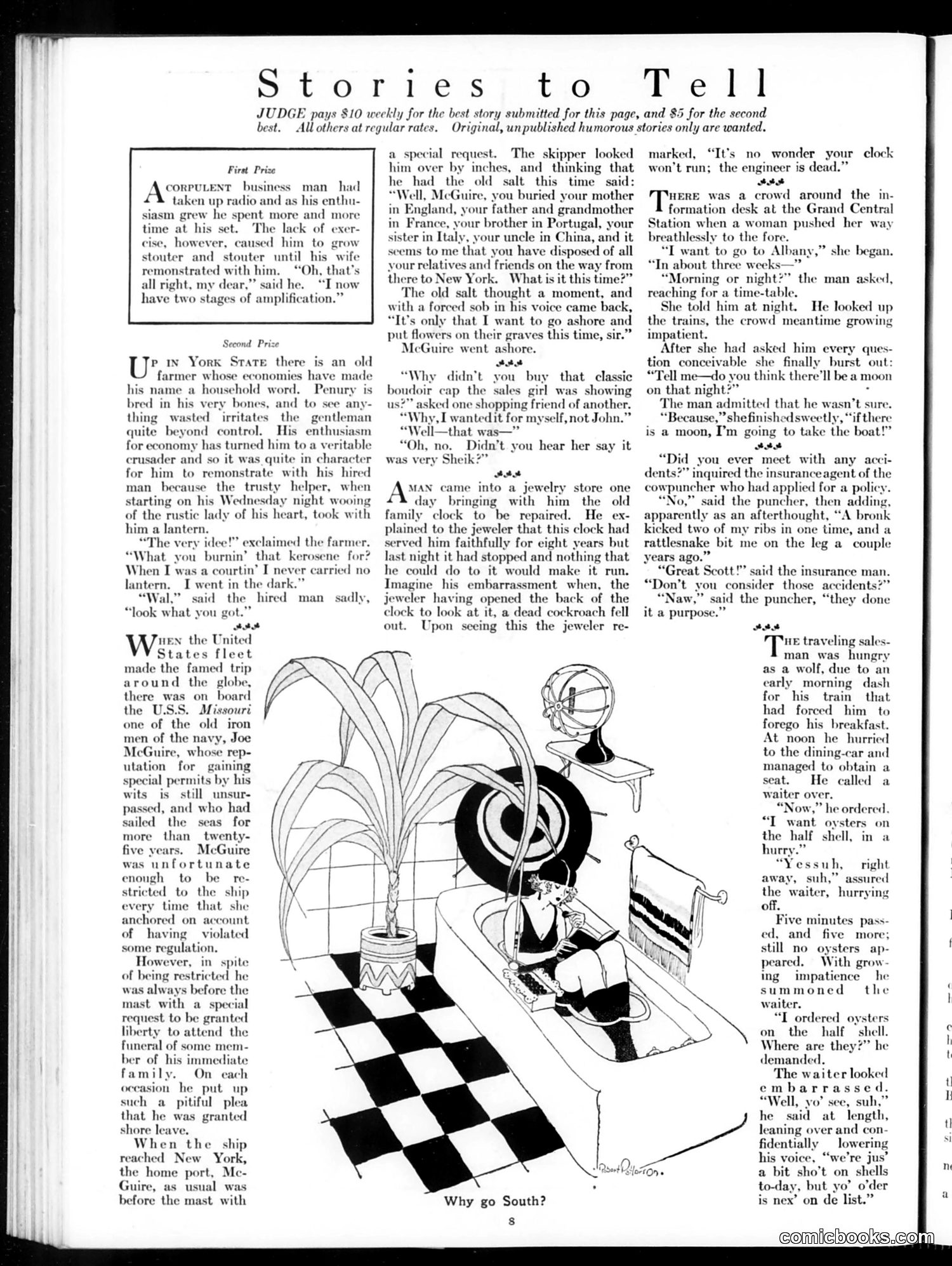
This page from *Judge* contains four humorous short stories, each with distinct satirical targets: 1. **"Two Stages of Amplification"**: Mocks a wealthy businessman's obsession with the new radio technology, suggesting his growing obesity from inactivity is merely "amplification"—a joke about both radio terminology and his expanding waistline. 2. **The Hired Man's Lantern**: Rural satire about an extremely miserly farmer who criticizes his hired hand for wasting kerosene on a lantern while courting, revealing the farmer's own dim romantic past. 3. **Joe McGuire's Serial Funerals**: Military humor about a clever Navy sailor who repeatedly exploits shore leave by claiming family deaths. The running joke: he's allegedly buried relatives across the globe, yet keeps finding more to mourn. 4. **The Dead Cockroach Clock**: A jewelry-store punchline where a broken clock's malfunction is explained by a dead insect inside—the "engineer" being dead. These are lighthearted, family-friendly comedies typical of 1920s-era humor magazines, targeting vanity, penny-pinching, military bureaucratic exploitation, and simple mechanical ironies.
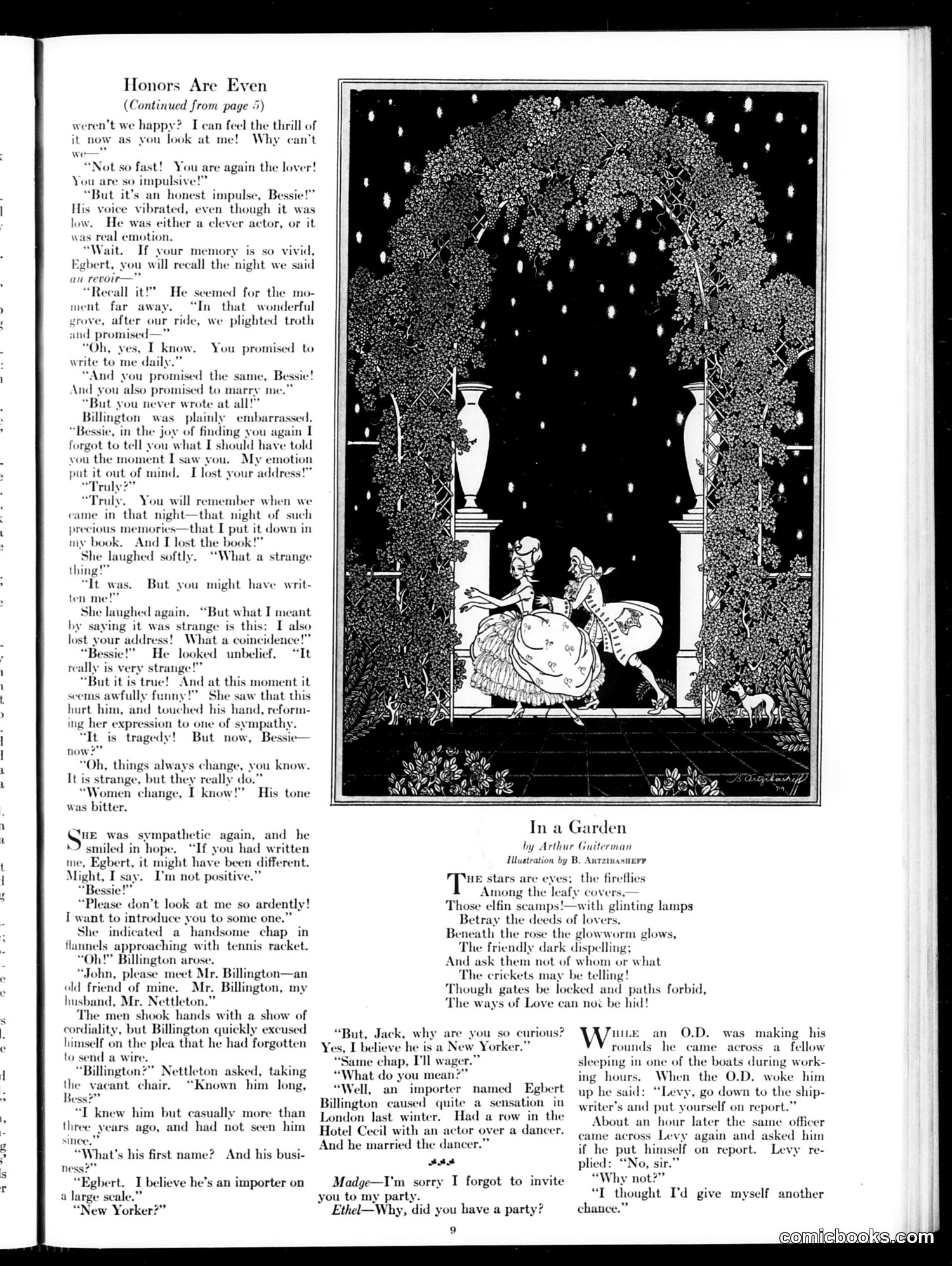
This page contains a serialized romantic drama titled "Honors Are Even" alongside a poetry piece and brief humorous anecdotes. ## Main Content: "Honors Are Even" The narrative depicts a chance reunion between Bessie and an old suitor named Egbert Billington. Years earlier, they exchanged romantic promises in a grove, but he failed to write daily as promised—he claims he lost her address in a misplaced book. When he encounters her again, she introduces him to her husband, Mr. Nettleton. The ironic twist: Nettleton reveals that an "Egbert Billington" caused scandal in London by fighting over a dancer at the Hotel Cecil and then marrying her. This suggests either Billington is lying about his past, or there's a coincidental namesake—either way, the "honors" (romantic debts) remain unsettled. ## Supporting Content "In a Garden" is a sentimental poem about lovers meeting under garden cover. The page also includes brief comic anecdotes about mistaken identities and wordplay typical of Judge's humor. **Context**: This reflects early 20th-century magazine serial storytelling and period attitudes toward romance, infidelity, and social scandal.
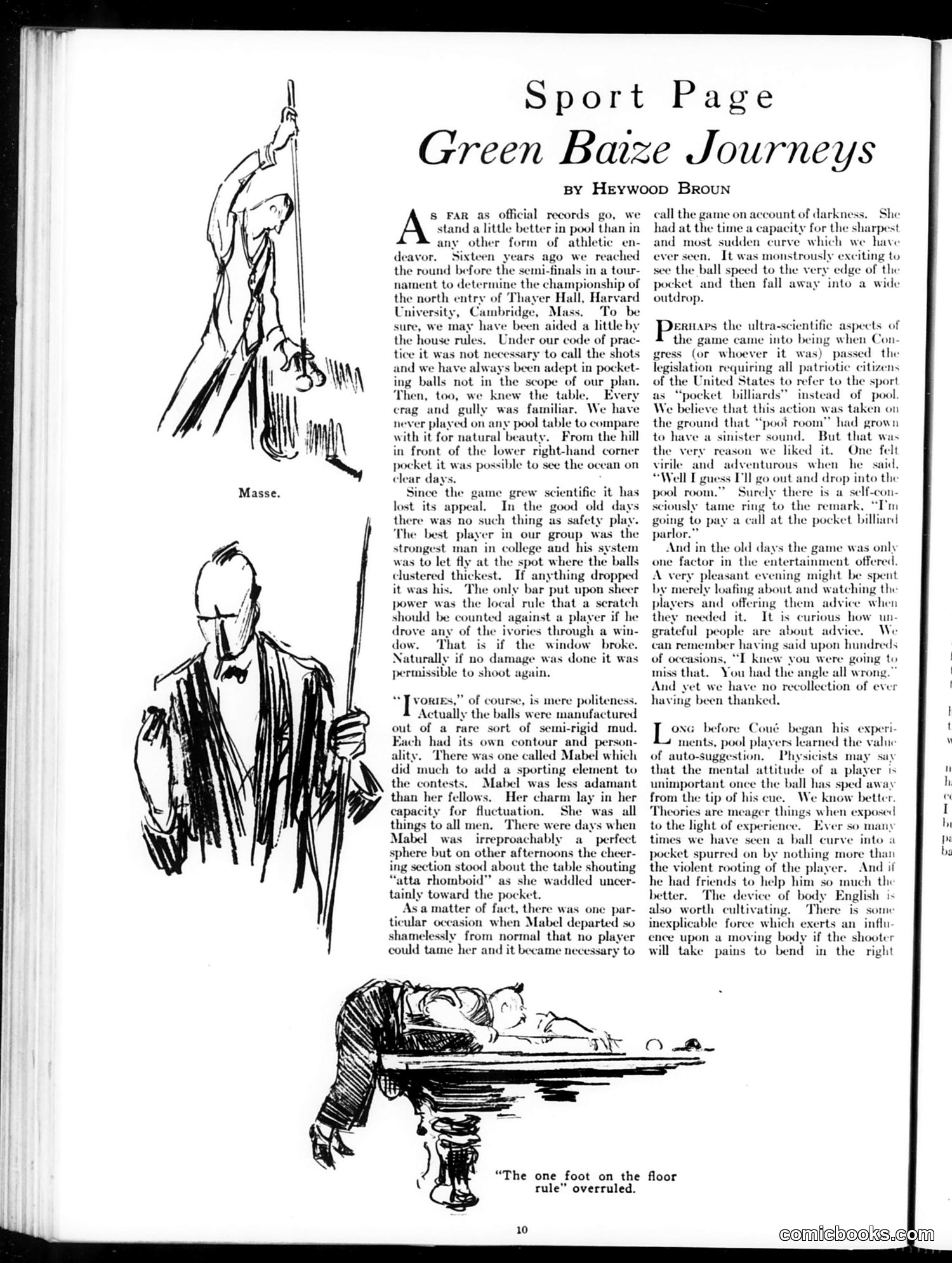
This is not primarily a political cartoon but rather a humorous sports essay by Heywood Broun about pool (or "billiards," as the government preferred to call it). The sketches illustrate the essay rather than satirize politics. The piece humorously recounts Broun's pool-playing experiences at Harvard, including a tournament sixteen years prior. Key jokes include: the absurdity of house rules that permitted unsportsmanlike play; a defective ball nicknamed "Mabel" that warped unpredictably; the government's renaming of "pool rooms" to "billiard parlors" to remove associations with vice; and the ungrateful reception of the author's uninvited playing advice. The satire targets the era's moral panic about pool halls as dens of corruption, while celebrating the game's social aspects. The illustrations depict pool-playing figures in period dress, reinforcing the nostalgic, anecdotal tone rather than delivering political commentary.
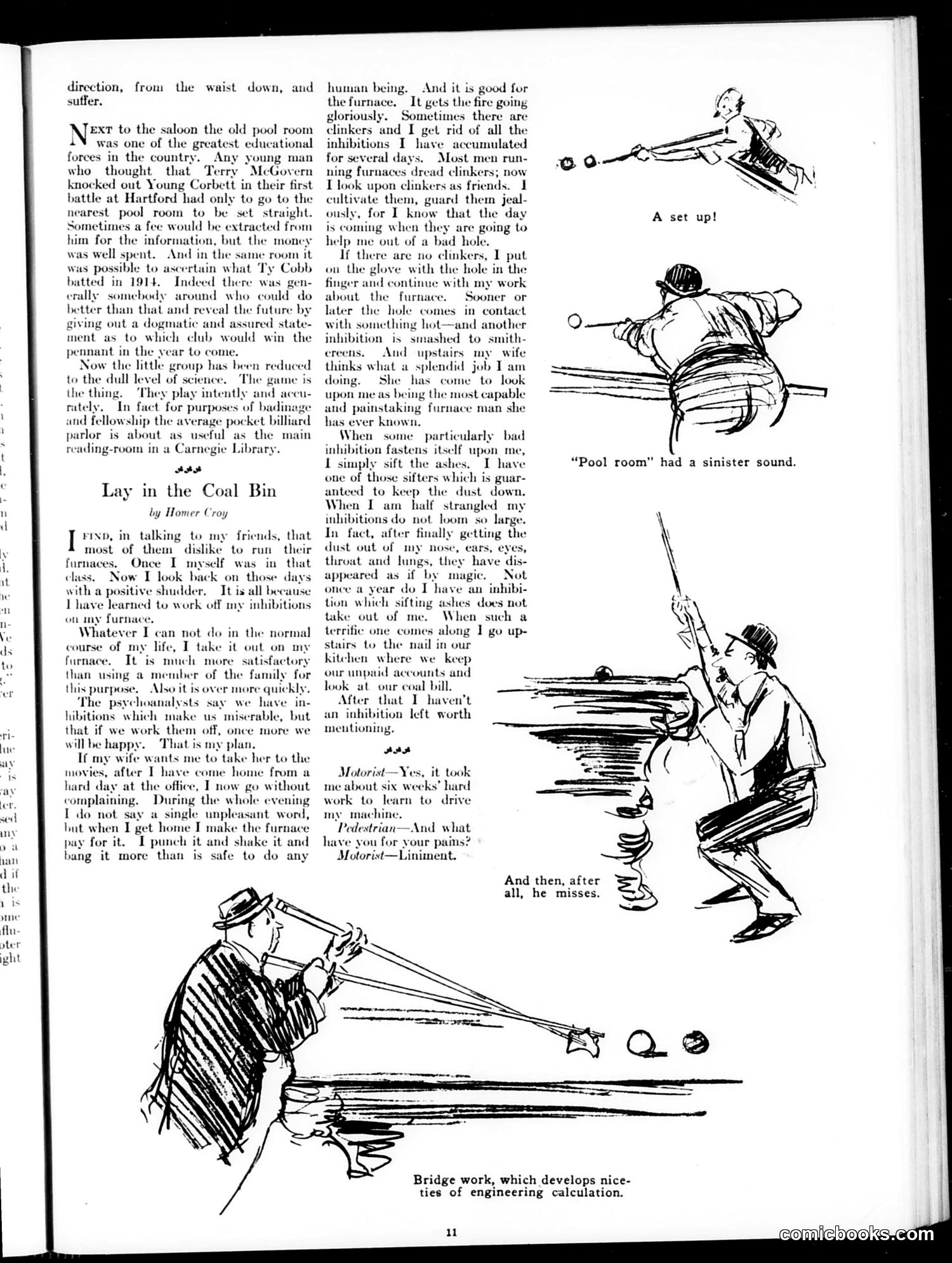
This article by Homer Croy humorously addresses the then-popular psychological concept of "inhibitions"—emotional repressions that psychoanalysts claimed caused unhappiness. The author proposes an unconventional remedy: channeling frustrations onto his home furnace rather than family members. The satire works by taking Freudian psychology literally. Instead of actual therapy, Croy describes physically abusing his furnace—punching it, shaking it, and deliberately creating situations (like wearing a glove with a hole to burn himself) to release pent-up anger. The joke escalates when he admits that looking at unpaid coal bills provides the ultimate emotional catharsis. The accompanying illustrations show a man fishing, boxing, and flailing—visual metaphors for his furnace-based "therapy." A sidebar motorist joke provides related commentary: a driver spent six weeks learning to operate a car only to suffer pain ("liniment") in return—another absurdist take on modern life's supposed "improvements." The piece satirizes both pop psychology trends and American domestic frustration of the era.
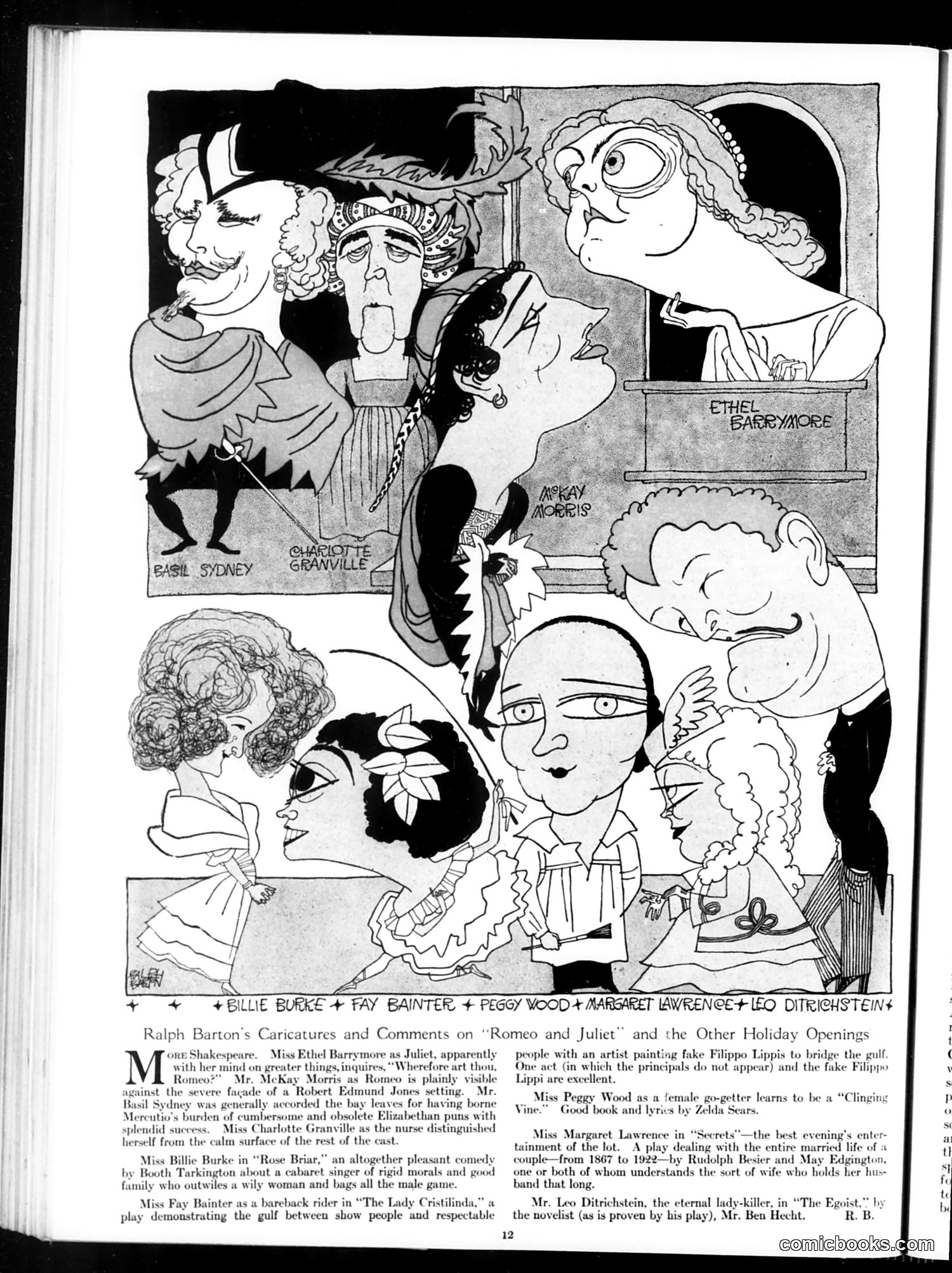
This page presents **Ralph Barton's theatrical caricatures** reviewing New York holiday Broadway openings, circa the 1920s. The top section mocks Shakespeare's *Romeo and Juliet*, with exaggerated portraits of performers including **Basil Sydney, Charlotte Granville, and others**. Barton satirizes the production's artistic pretensions—the "fake Filippo Lippi" reference suggests the elaborate Robert Edmund Jones set design appears borrowed from Renaissance painting rather than organically staged. Below are caricatures of actresses in contemporary comedies: **Billie Burke** in a society farce, **Fay Bainter** in a show-people drama, **Peggy Wood** and **Margaret Lawrence** in romantic comedies, and **Leo Ditrichstein** in *The Egoist*. The satire targets both theatrical excess and the social comedy of flapper-era New York—the gulf between "respectable" society and theater people, performers' romantic entanglements, and the eternal appeal of the "lady-killer" archetype. Barton's caricature style emphasizes actors' distinctive features for comedic effect.
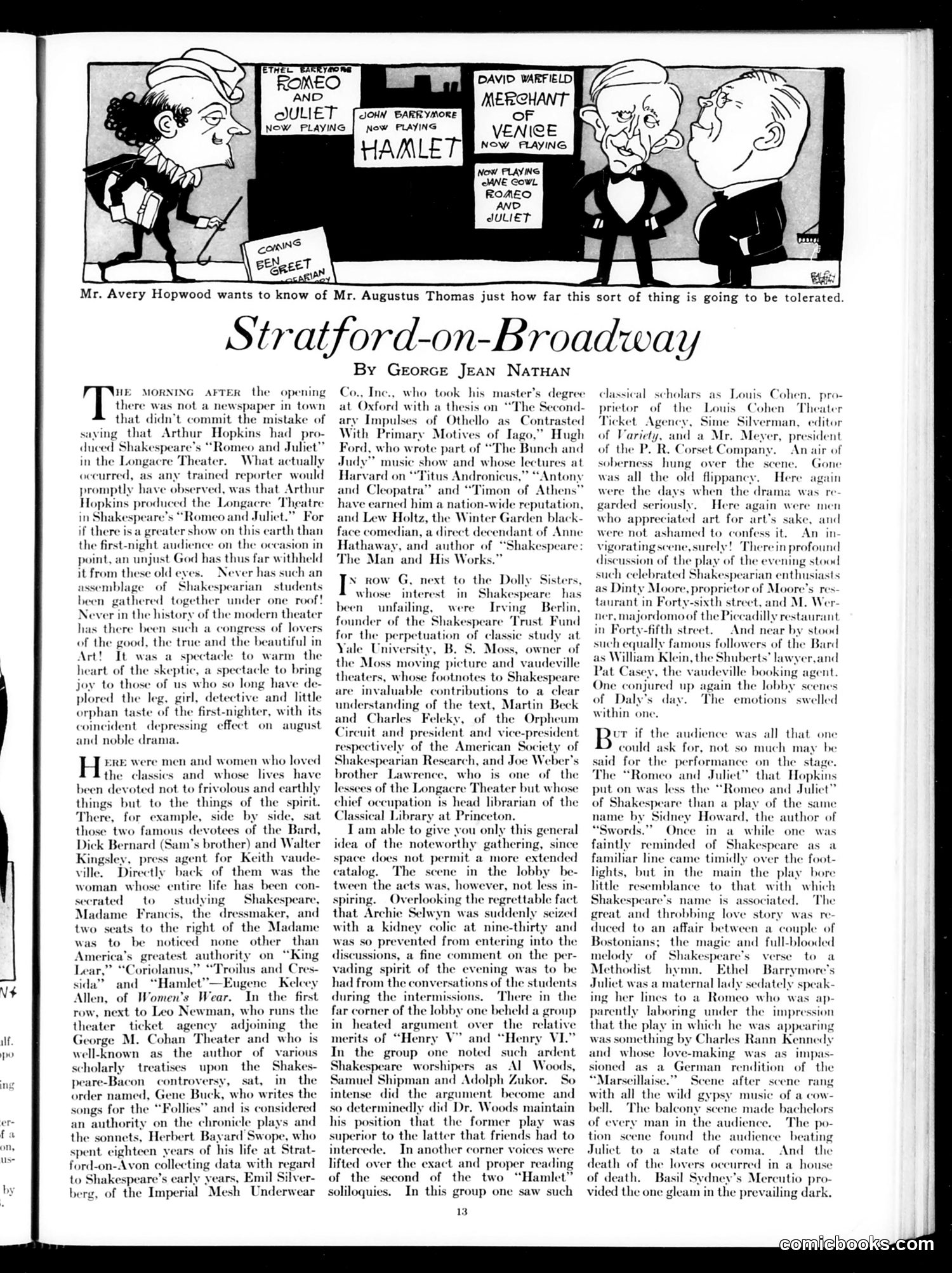
This is a satirical article by George Jean Nathan mocking the pretentiousness of Broadway's opening-night audiences. The cartoon shows theater figures (likely including producer Arthur Hopkins and playwrights Avery Hopwood and Augustus Thomas based on the caption) discussing Shakespeare productions. Nathan's satire targets the absurd juxtaposition of serious Shakespeare with Broadway's commercial world. He sarcastically catalogs attendees claiming deep Shakespearean scholarship—a dressmaker, an underwear manufacturer, songwriters, and comedians—while attributing ridiculous credentials to them (e.g., one spent "eighteen years" at Stratford studying). The joke exposes how Broadway celebrities and businessmen manufactured fake intellectual credibility by attending prestigious productions, and how the theater industry exploited this social climbing to boost ticket sales and prestige. The title "Stratford-on-Broadway" encapsulates the satire: the collision of England's Shakespeare shrine with crass American commercial theater.
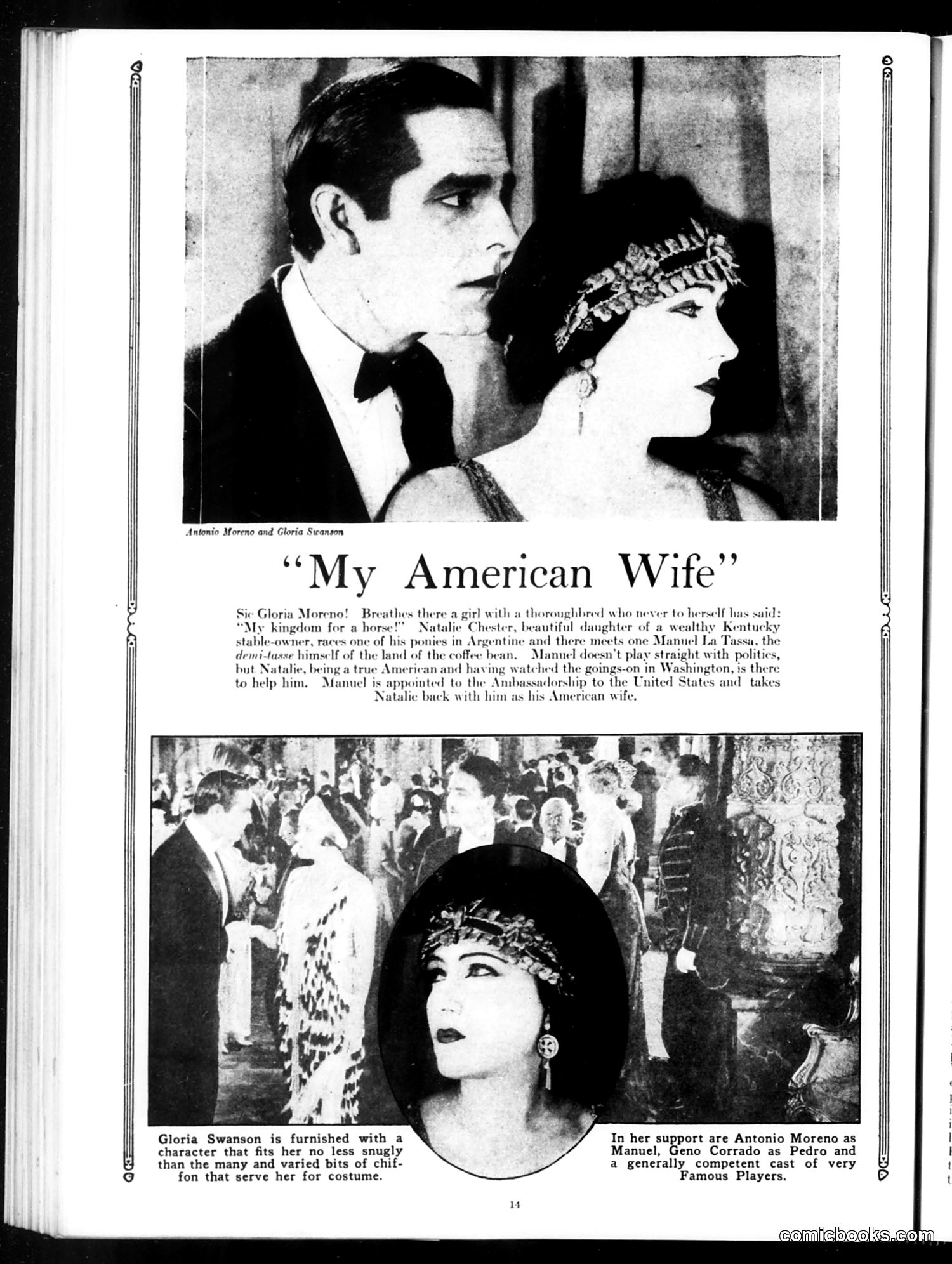
This page reviews a silent film starring Gloria Swanson and Antonio Moreno. The plot involves an American woman (Natalie Chester, daughter of a wealthy Kentucky horse-breeder) who travels to Argentina, where she meets Manuel La Tassa, a local man involved in politics. Manuel becomes appointed ambassador to the United States, and Natalie returns with him as his wife. The satirical angle appears to target romantic entanglements between American women and foreign men of questionable character—Manuel "doesn't play straight with politics." The humor lies in the irony of an American woman using her influence to help an ethically dubious foreigner gain diplomatic status. The page emphasizes Swanson's costume and glamorous appearance rather than plot substance, typical of Judge's film commentary during the silent era. The supporting cast included Antonio Moreno and Geno Corrado.
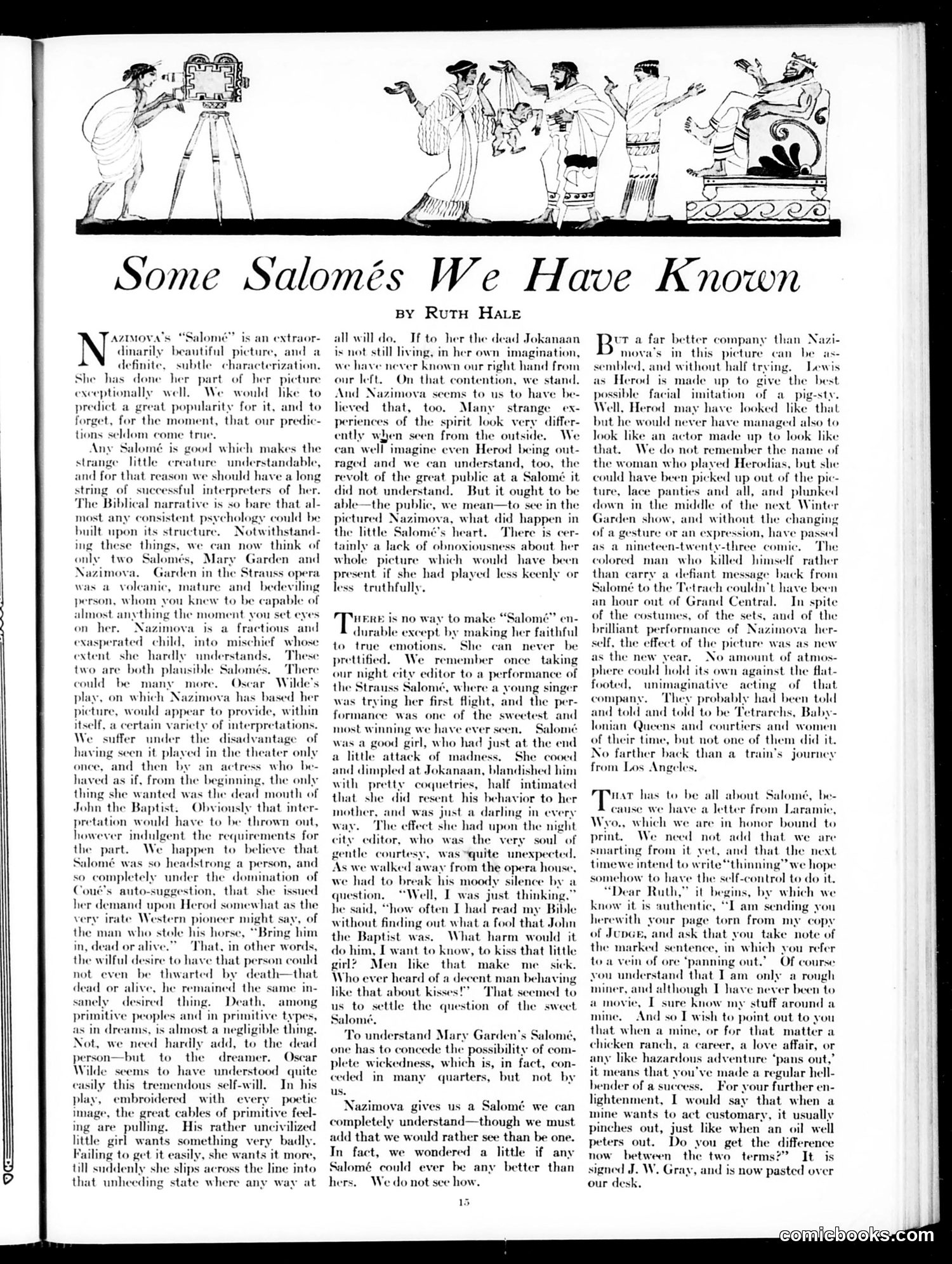
This article by film critic Ruth Hale discusses Alla Nazimova's film adaptation of Oscar Wilde's *Salomé*. The illustrated header shows various interpretations of the biblical Salomé character across different artistic mediums. Hale compares Nazimova's portrayal to Mary Garden's operatic interpretation (from Richard Strauss's opera). She argues that Salomé should be understood as a willful, primitive personality—a child-like figure whose desire becomes obsessive and dangerous, rather than a seductress. Hale praises Nazimova for playing the character "faithfully to true emotions" without prettifying her. The piece critiques audiences who misunderstood Salomé's psychology, suggesting they couldn't recognize authentic emotional portrayal. Hale positions the film as superior to other theatrical versions because it captures the character's genuine internal motivations—her relentless, almost animal will—rather than surface glamour or moralistic judgment.
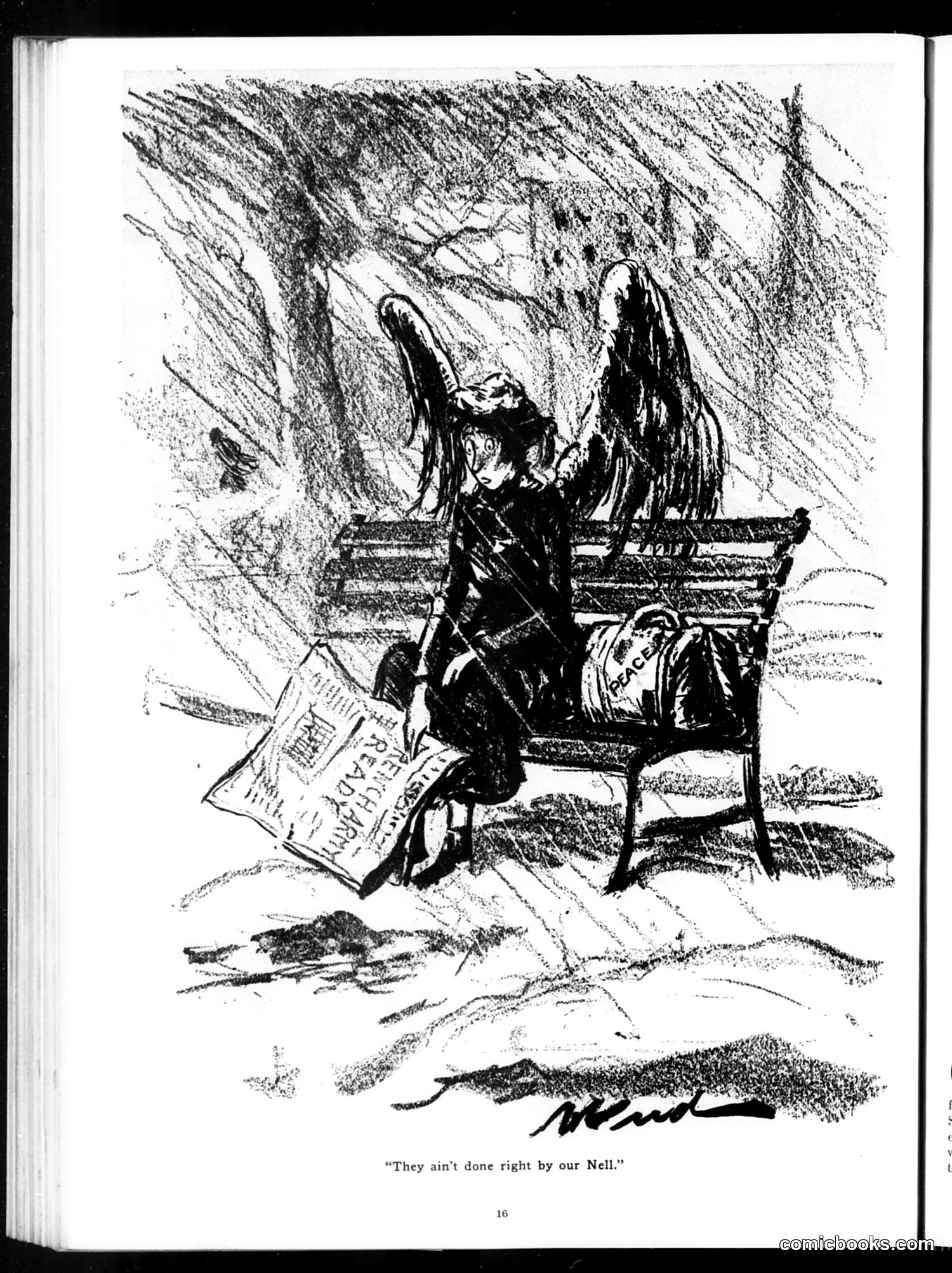
This cartoon depicts a winged female figure (labeled "Nell," likely representing a allegorical concept or specific person) sitting on a bench, appearing distressed or neglected. She holds what appears to be a document or notice beside her. The artistic style—heavy crosshatching suggesting emotional turbulence—emphasizes her unhappy state. The caption "They ain't done right by our Nell" suggests a complaint about mistreatment or injustice toward this figure. Without additional context from the magazine's date or surrounding articles, the specific identity of "Nell" and the particular grievance remain unclear. This could reference political policy, labor conditions, women's rights, or another contemporary social issue Judge's readership would have recognized.
This page contains three editorials critiquing contemporary issues circa 1923-1924: **"The Ruhr"** satirizes French occupation of Germany's industrial region. Judge argues France's military action is counterproductive—costly to France, harmful to European recovery, and hypocritical given America's willingness to forgive Allied war debts while expecting France to forgive German debts. **"Henry's Latest Venture"** discusses Henry Ford's potential presidential candidacy. Judge acknowledges Ford's popular appeal but questions his fitness for office, citing his "peculiar notions." The editorial welcomes his candidacy anyway, hoping it forces both parties to field competitive candidates in 1924. **"An Inebriates' Gallery"** describes Des Moines Police Chief Hammond's scheme: photographing arrested drunk men to shame them into sobriety. Judge supports this creative temperance measure as superior to Prohibition enforcement, while acknowledging legal concerns about "cruel and unusual punishment." The cartoonish masthead depicts Judge as a jester character addressing readers.
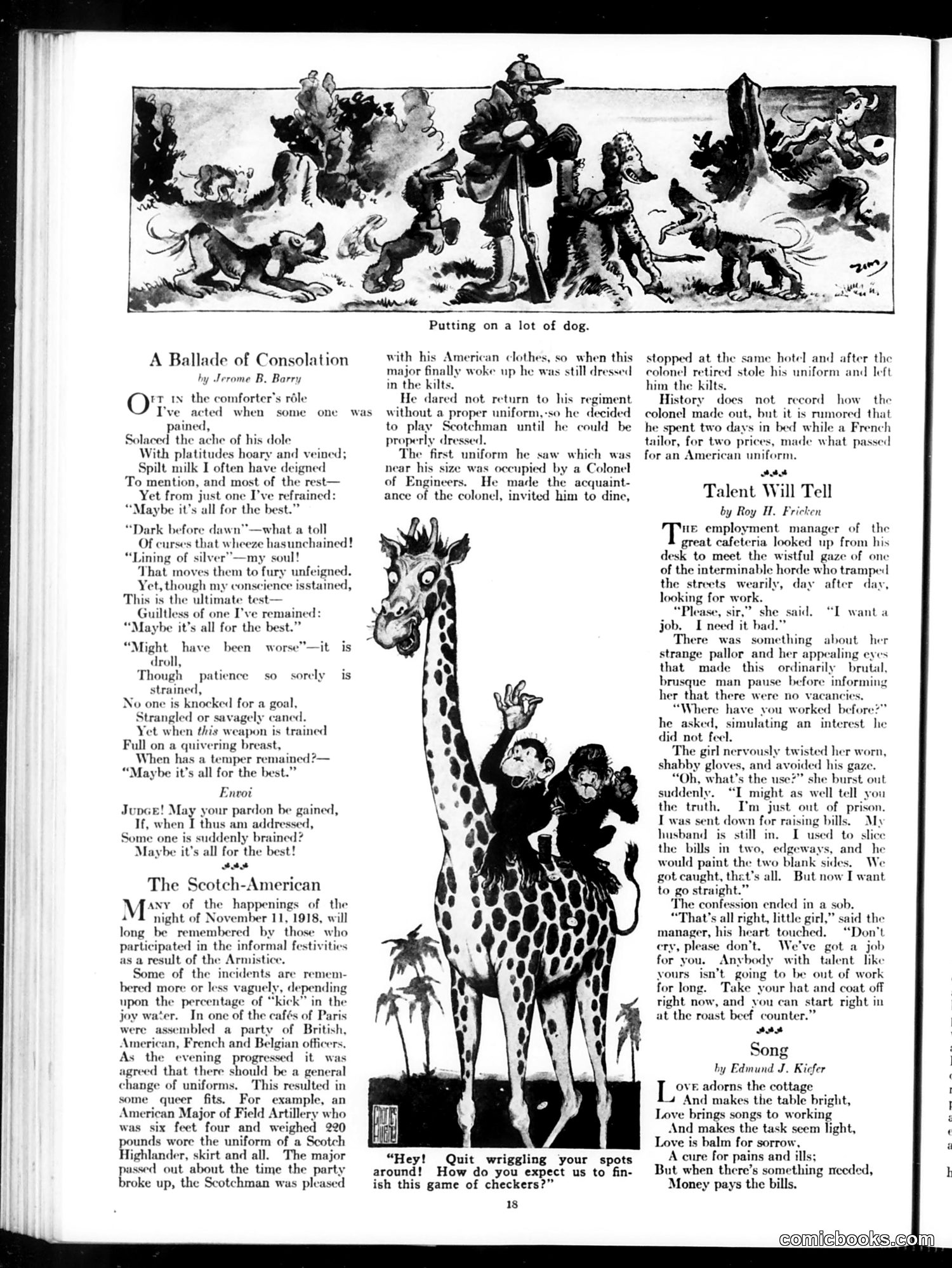
This page from *Judge* contains three distinct pieces of satirical content: **"A Ballad of Consolation"** (poem): A darkly humorous verse about avoiding the platitude "Maybe it's all for the best"—suggesting that offering such hollow comfort to suffering people risks provoking violent retaliation ("Some one is suddenly brained"). **"The Scotch-American"** (story with cartoon): A comedic WWI anecdote from Armistice Night (November 11, 1918) in Paris. An American major, accidentally left wearing a Scottish Highland uniform after a drunken costume party, solves his problem by stealing a Colonel's American uniform and leaving the officer with the kilt. The cartoon shows a giraffe being dressed by men, illustrating the chaos of uniform-swapping. **"Talent Will Tell"** (story): A job-interview scene where a desperate female applicant admits to prison time for counterfeiting ("raising bills"). The sympathetic manager recognizes her talent and hires her anyway. The page reflects post-WWI American humor: celebrating the Armistice through soldier misadventures, while also addressing Depression-era unemployment and desperation through gentle satire.
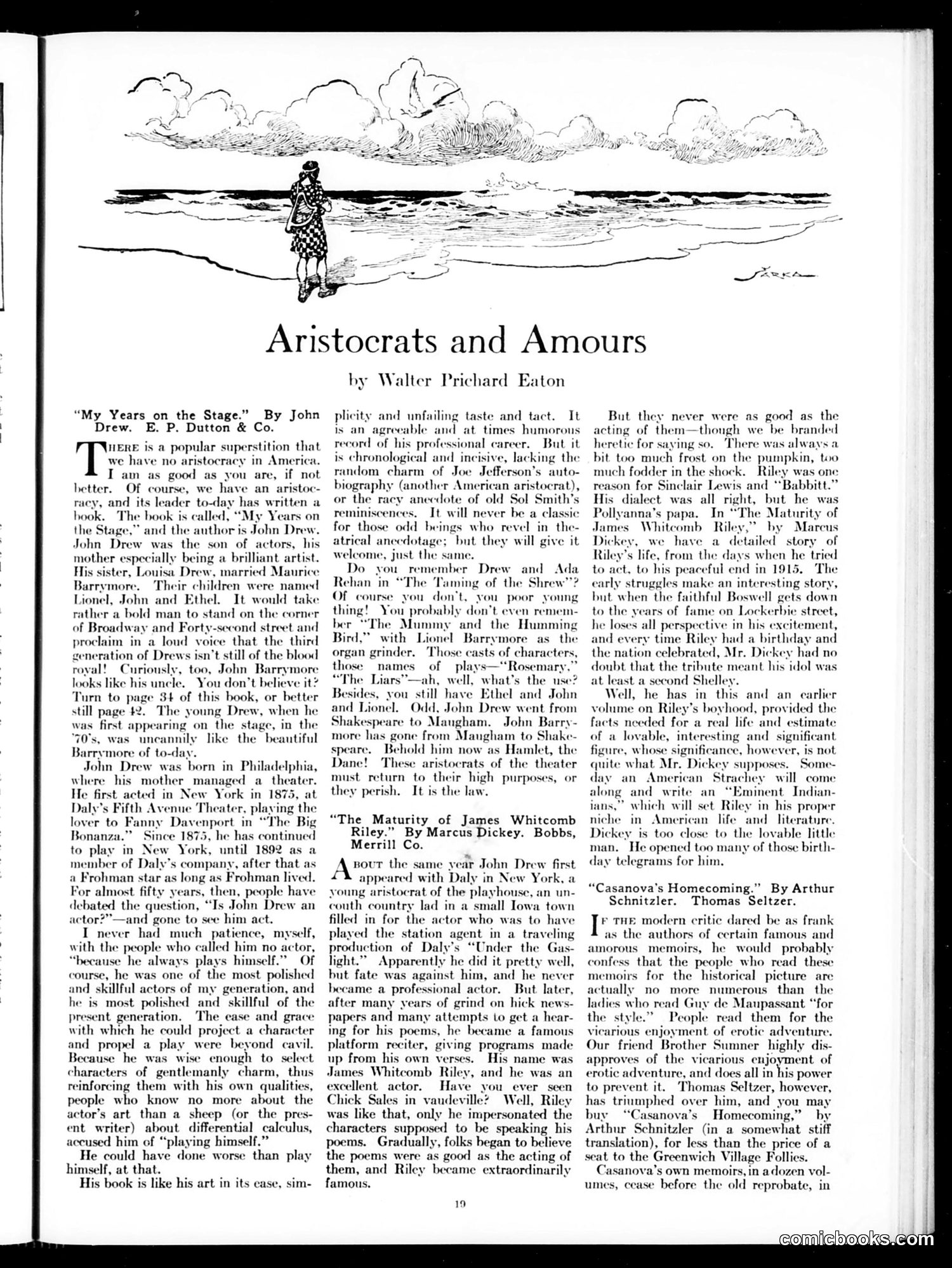
This page discusses John Drew, a theatrical aristocrat—the son and brother of famous actors (the Barrymore family connection through his sister Louisa). The author Walter Prichard Eaton defends Drew against critics who dismissed him as merely "playing himself" rather than acting. Eaton argues Drew was actually a skilled, polished performer who wisely chose roles matching his gentlemanly persona. The piece references Drew's long career (since 1875) and compares him to other theatrical dynasties like Joe Jefferson. It criticizes the "aristocrats of the theater" (Drew, his nephew John Barrymore, Lionel Barrymore) for abandoning Shakespeare for commercial plays like Maugham's work, warning they must "return to their high purposes, or they perish." The page also reviews James Whitcomb Riley's biography, apparently contrasting Riley's humble Iowa origins with theatrical aristocrats. The satirical point: America's theatrical elite must maintain artistic standards or lose their legitimacy.
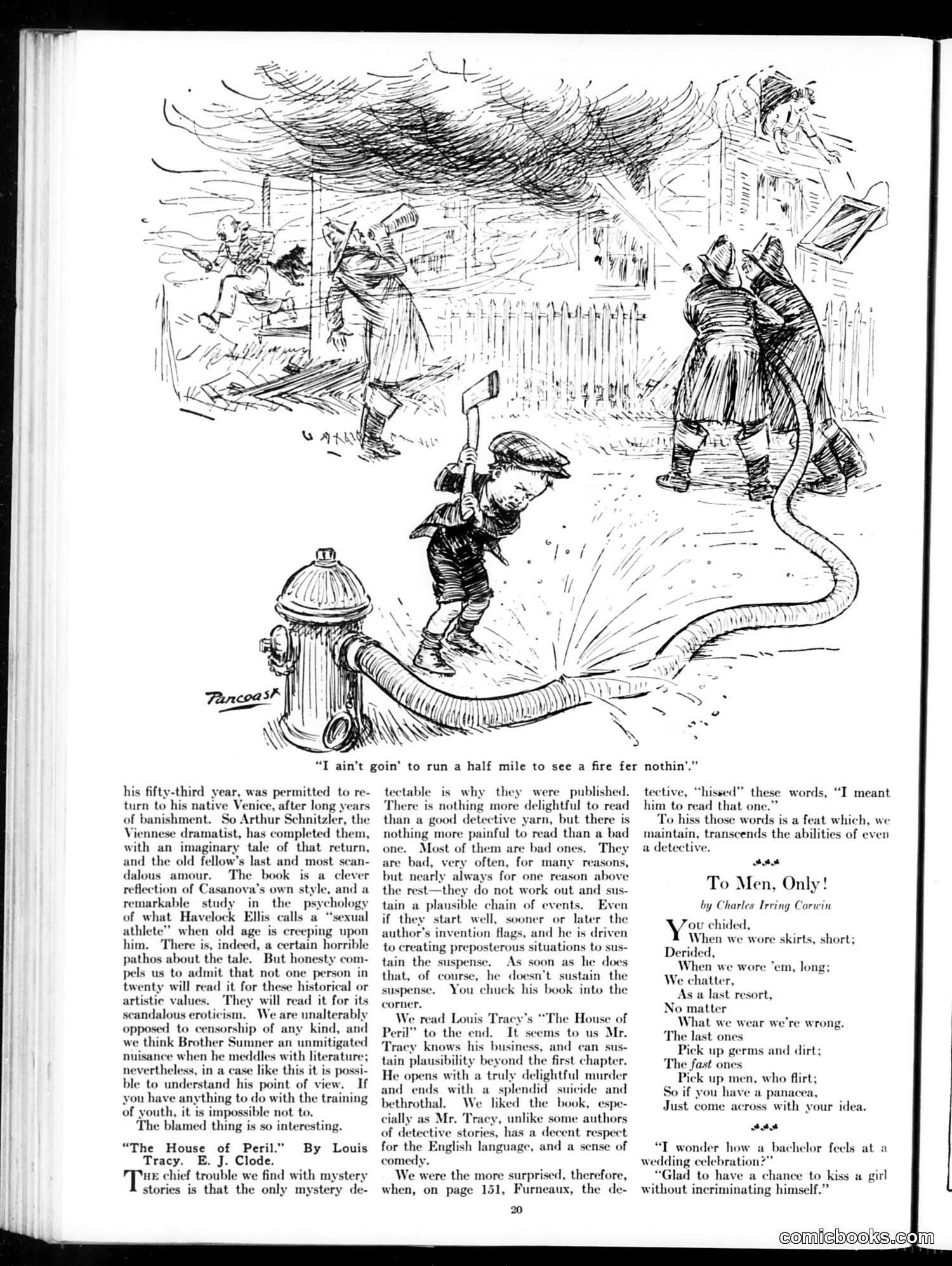
**The Main Cartoon** (top, signed "Pancoast"): Depicts a child refusing to leave a fire hydrant to watch an actual house fire down the street, saying "I ain't goin' to run a half mile to see a fire fer nothin'." This satirizes American materialism and apathy—even dramatic spectacles like fires hold no interest unless there's something personal to gain. The humor lies in the child's blunt pragmatism. **Literary Content Below:** Reviews of mystery novels and essays on detective fiction quality. The text critiques poorly-constructed mystery plots that lose plausibility mid-story, contrasting Louis Tracy's competent work with mediocre competitors. **"To Men, Only!" Poem** (right): Charles Irving Corwin's satirical verse about women's fashion contradictions: women are criticized regardless of hemline choice (short skirts deemed improper, long skirts old-fashioned). It mocks male inconsistency in judging female appearance—a commentary on gender double standards in early 20th-century society. The page reflects Judge's typical mix of social satire, literary criticism, and humor targeting contemporary attitudes and cultural hypocrisy.
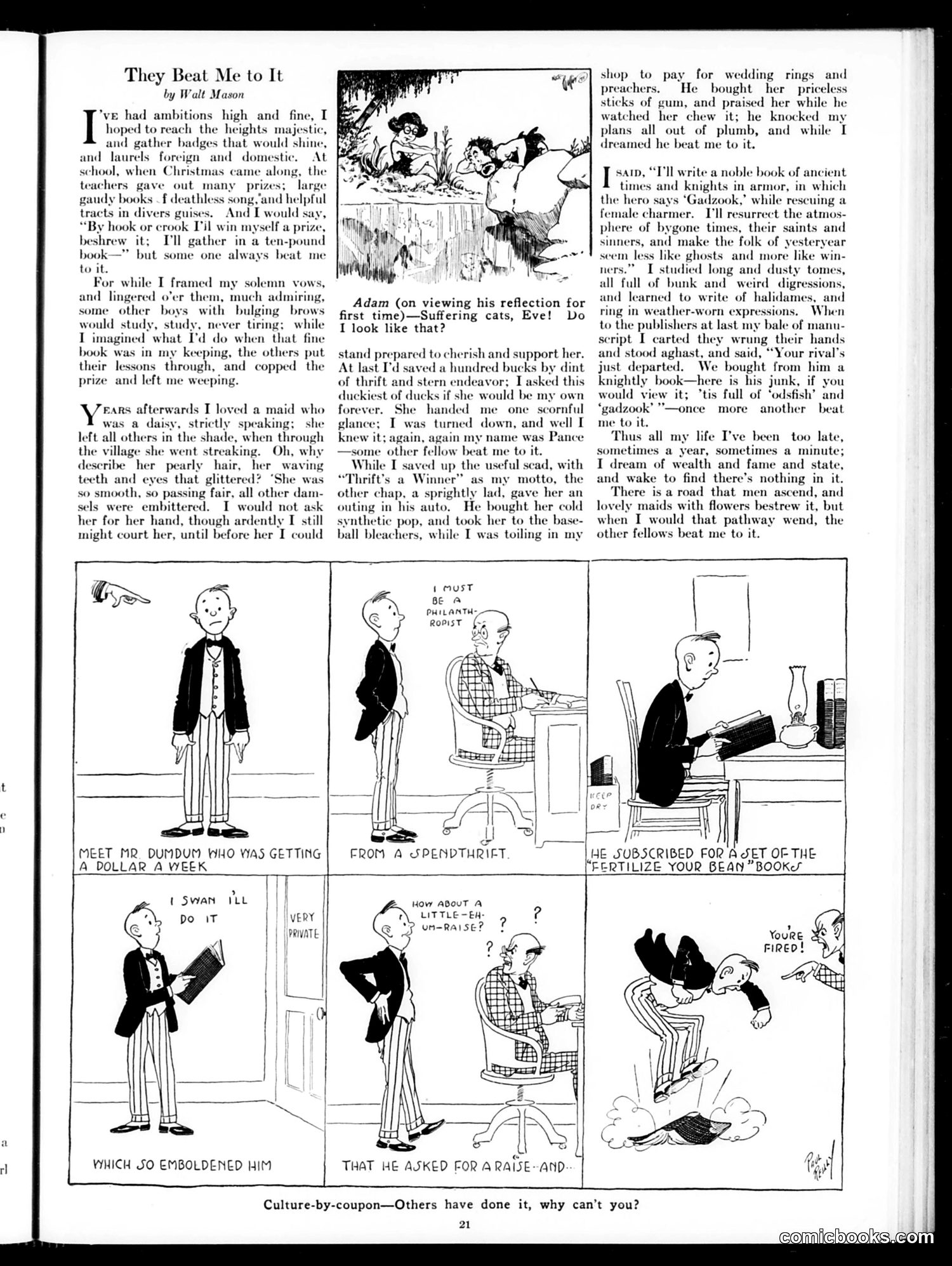
This page contains a humorous poem illustrated with comics about perpetual failure through procrastination. The narrator chronicles a lifetime of being outcompeted: losing school prizes to diligent classmates, losing a romantic pursuit when a rival suitor buys his girlfriend outings and gum while he saves for wedding rings, and losing a book deal when a competitor publishes a similar work first. The bottom comic strip shows a practical application: "Mr. Dumdum" gains confidence from a self-help book series called "Fertilize Your Bean," then attempts to ask his employer for a raise—only to be fired. The satire targets both the narrator's chronic indecision and the era's proliferation of dubious self-help literature ("culture-by-coupon"). The message: ambition without action, or reliance on shortcuts, guarantees failure.
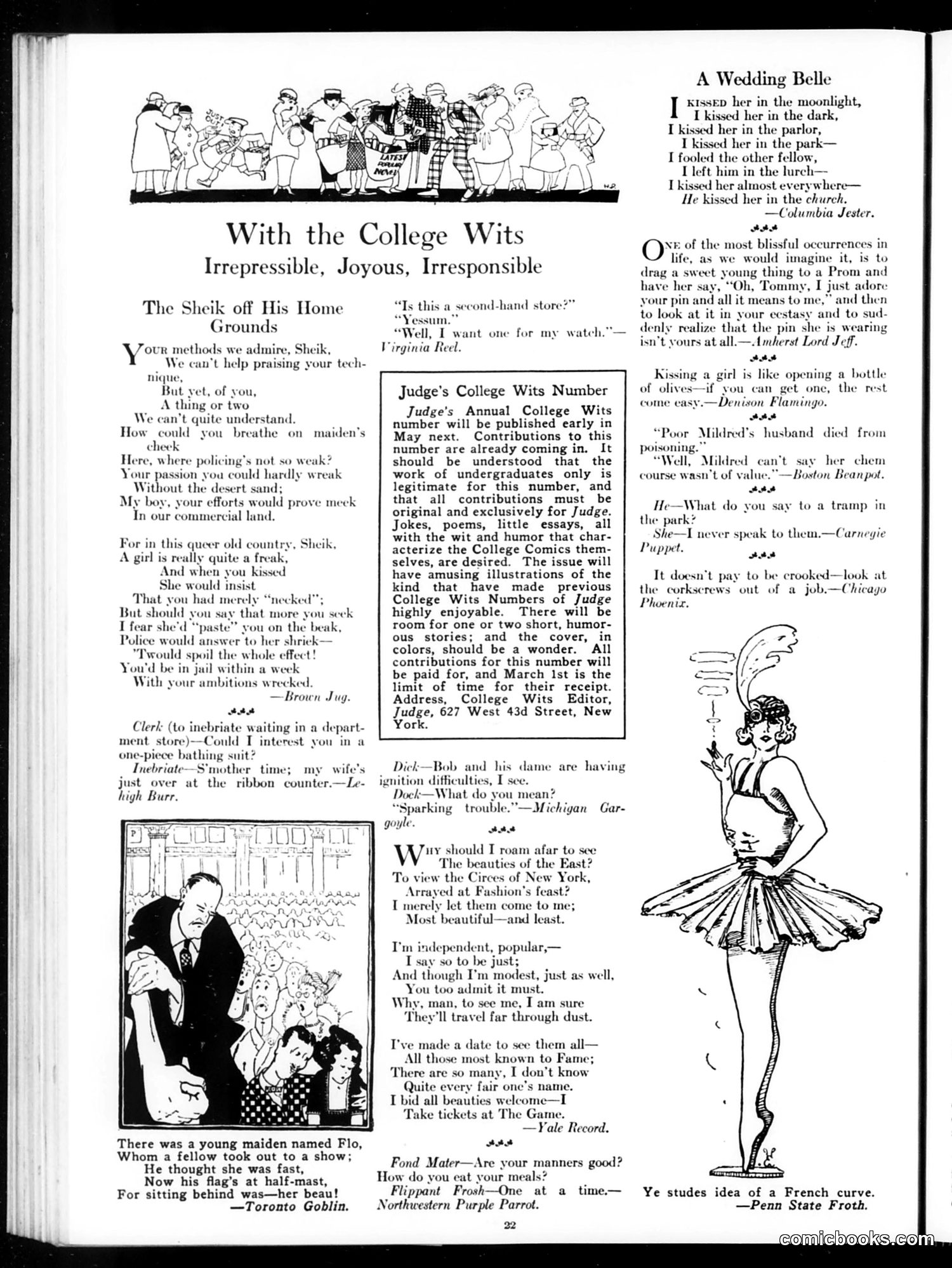
This 1920s college humor page satirizes social conventions and dating practices among American undergraduates. "The Sheik off His Home Grounds" mocks the "Sheik" archetype—a popular romantic figure inspired by Rudolph Valentino films—by contrasting his aggressive courtship style in exotic desert settings with American social reality. The poem argues American girls won't tolerate such behavior; they'd call police rather than submit passively. Other pieces humorously depict college social life: flirtation, the competitive dating scene, and the consequences of miscalculating a girl's moral boundaries. References to "necking" and "sparking trouble" indicate physical intimacy norms of the era. The page reflects post-WWI American college culture, where dating had modernized but strict propriety remained enforced—particularly for women. The humor derives from tension between changing social expectations and lingering Victorian restraint.
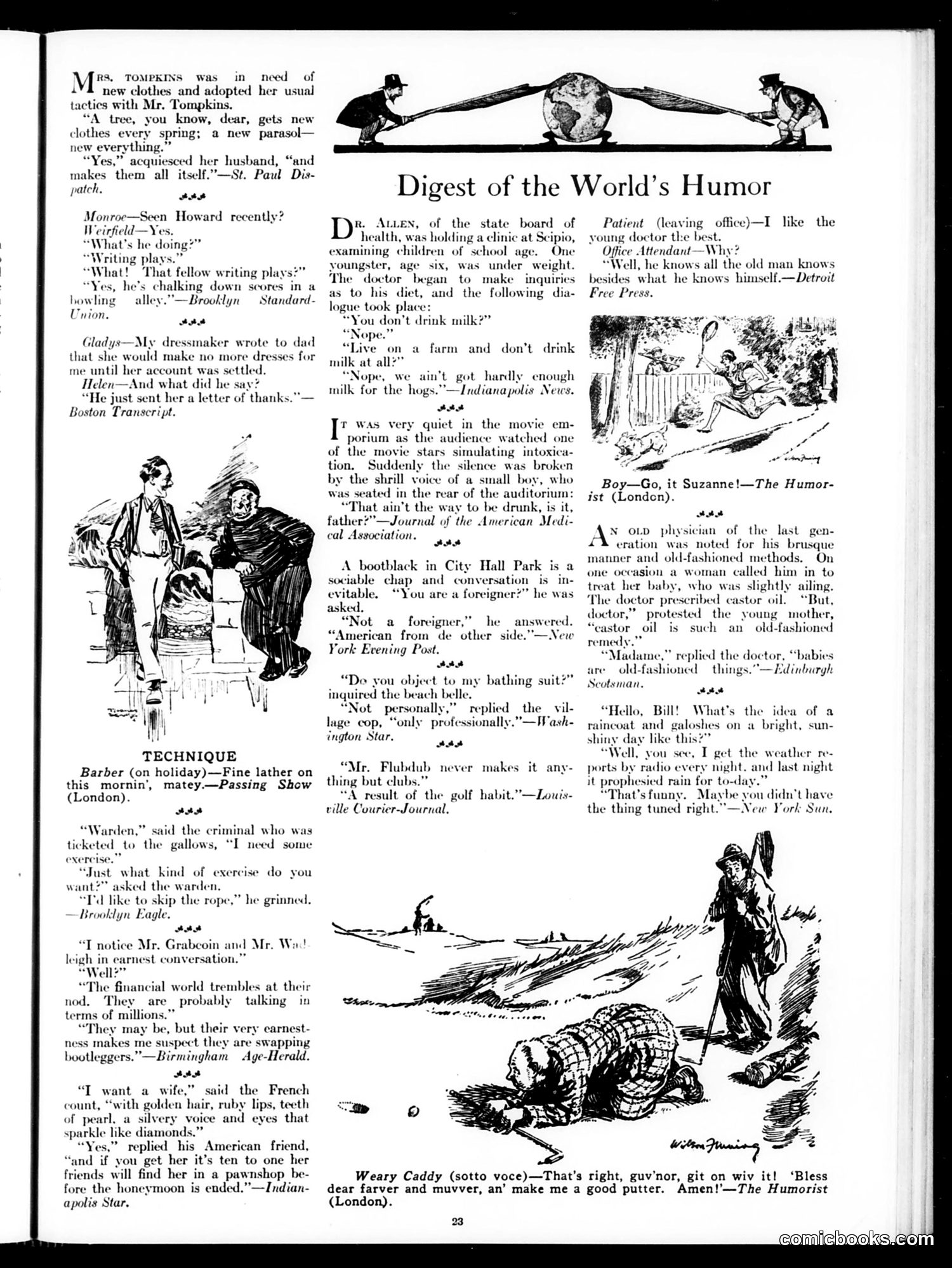
This page collects brief humorous anecdotes from various publications, arranged under the heading "Digest of the World's Humor." The jokes touch on familiar domestic and social themes of the era: **Key recurring themes:** - **Marriage economics**: Mrs. Tompkins manipulates her husband into buying clothes by invoking nature's renewal cycle - **Class and profession**: A dressmaker refuses further work until paid; a bootblack claims American identity - **Generational gaps**: Children innocently expose adult hypocrisy (a boy corrects a drunk actor's technique; a child questions milk consumption on a farm) - **Gender and consumption**: A Frenchman seeks an ideal wife; his American friend jokes she'll end up in a pawnshop - **Professional oddities**: A golf enthusiast only plays clubs; a young doctor's main advantage is youthful ignorance The cartoons (two visible) depict exaggerated physical comedy—figures pulling a globe, a weary caddy—typical of Judge's visual style. **Overall purpose**: These are light, society-page humor reflecting early 20th-century middle-class anxieties about marriage, money, and modern life.
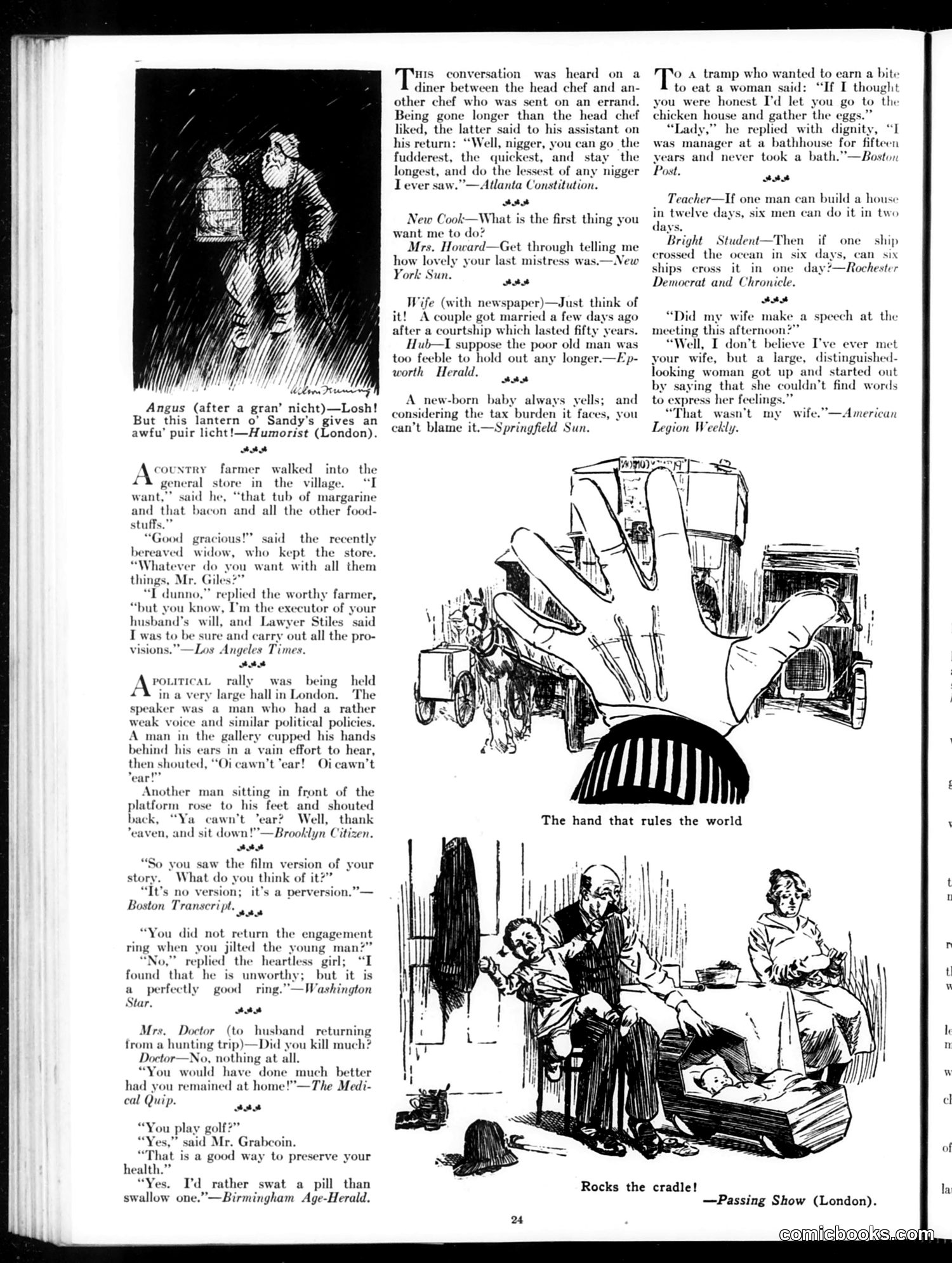
This page from *Judge* contains multiple short humorous anecdotes and two illustrations, typical of early 20th-century American satirical magazines. **Notable content includes:** The illustrations depict domestic scenes—one showing a man examining shoes ("The hand that rules the world") and another of a woman rocking a cradle ("Rocks the cradle!"), both playing on gender roles and domestic authority. **The jokes touch on:** - Working-class life (a Scottish laborer with poor lantern light) - Rural/class dynamics (a farmer executing a will, references to racial slurs typical of the era's casual racism) - Political rallies (a speaker with a weak voice) - Marriage and courtship satire - Gender relations and women's roles - Tax burden commentary The humor relies on wordplay, irony, and social observation rather than visual complexity. Many jokes mock marital discord, cheapness, and social pretension—common *Judge* targets. The racial language reflects the publication's era but marks it as historically problematic by modern standards.
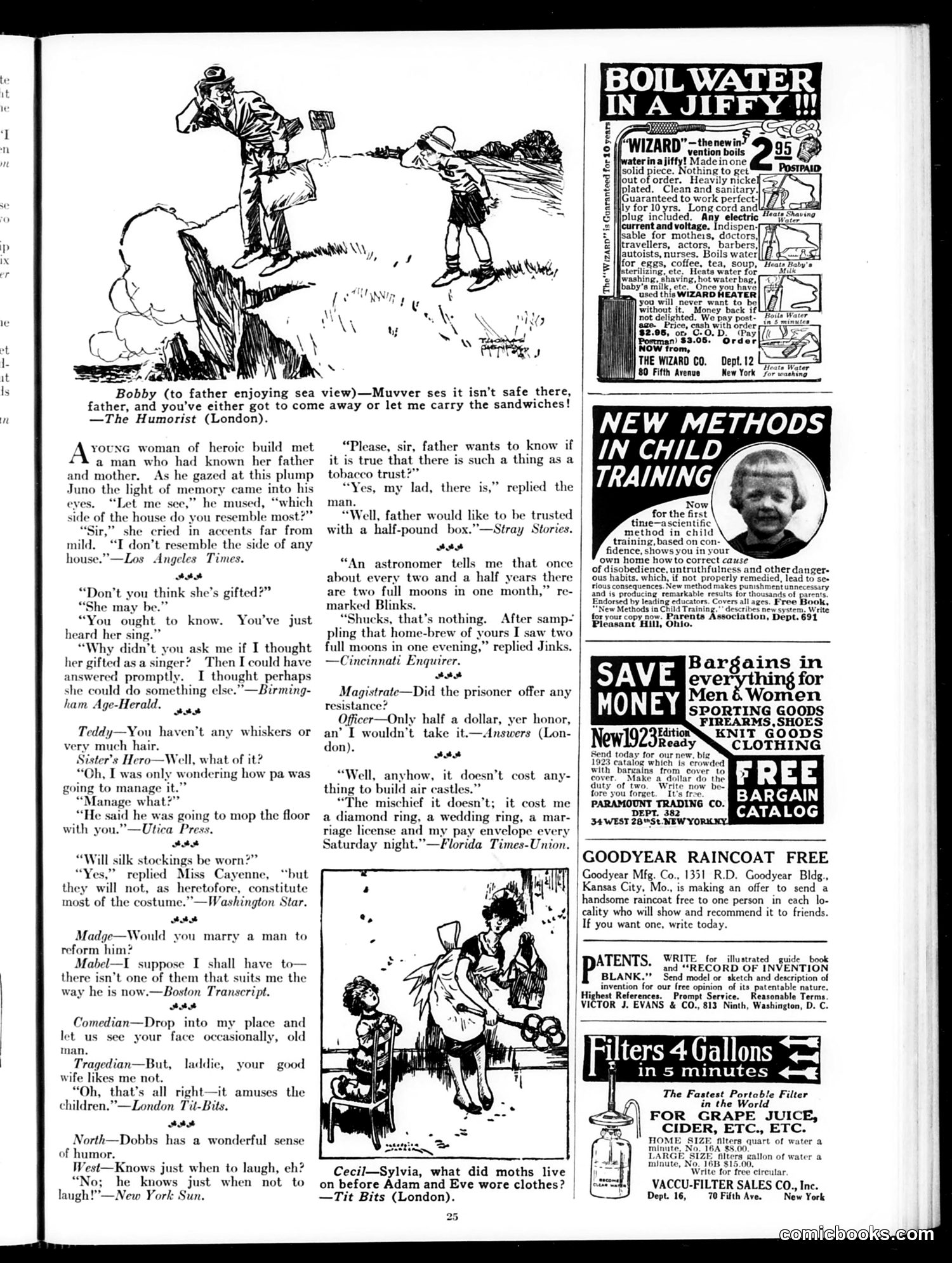
The top cartoon depicts a domestic humor scene: a young boy ("Bobby") stands on a cliff overlooking the sea, telling his father that his mother ("Muwver") considers it unsafe there. Bobby offers a practical solution—either the father must leave, or Bobby will carry the sandwiches away. The joke plays on **British domestic hierarchy and child logic**. In Edwardian-era society, children were expected to obey parental authority unquestioningly. Bobby's matter-of-fact ultimatum humorously reverses this dynamic: the child is essentially ordering the adult to comply with mother's safety concerns, framed as a responsible practical problem-solver. The reference to sandwiches adds absurdist humor—suggesting the boy prioritizes preserving the picnic provisions over his father's safety. The cartoon satirizes **changing family dynamics and the role of protective mothers** in early 20th-century middle-class life, while the child's deadpan practicality provides comic relief.
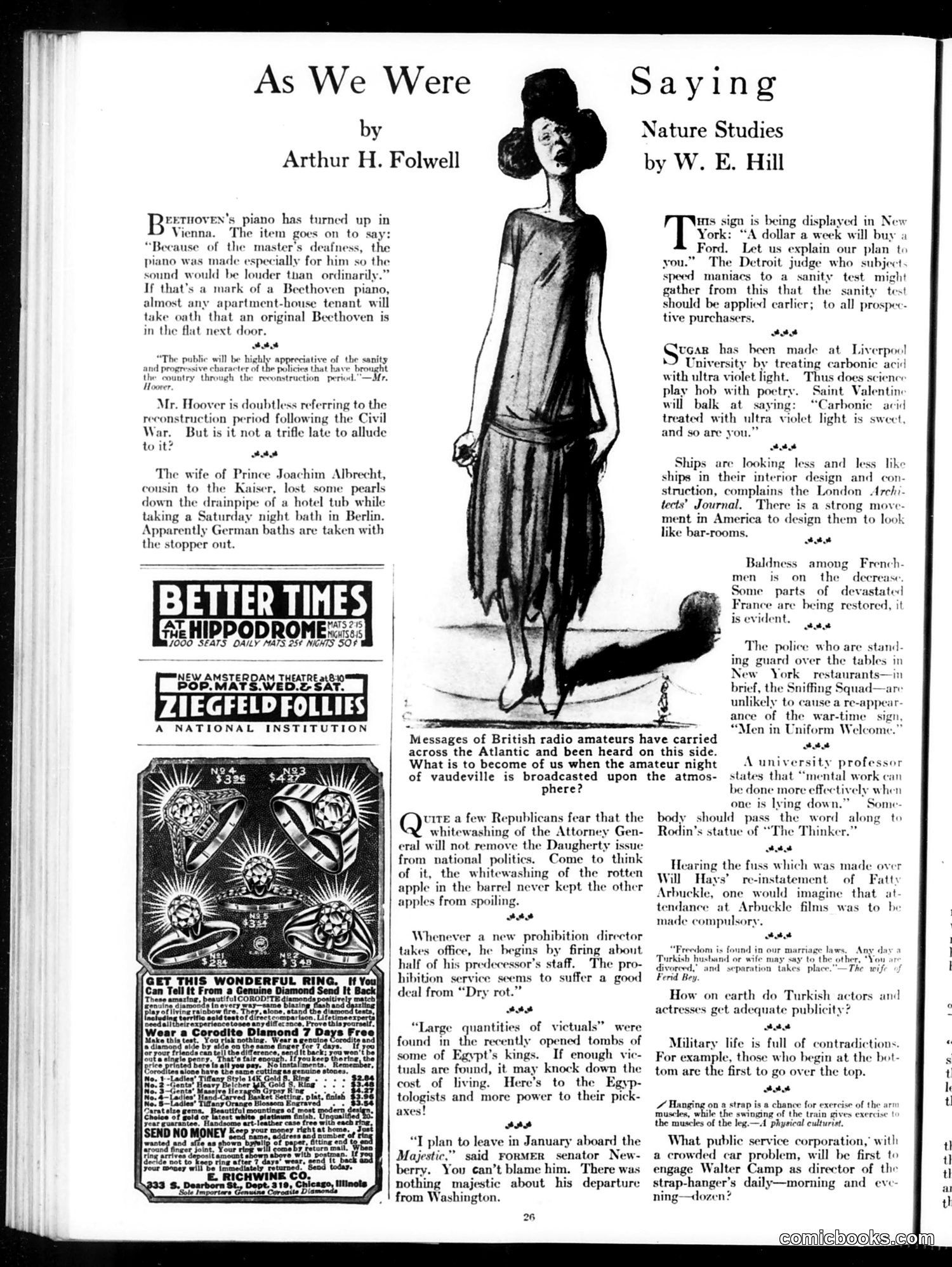
This page from Judge magazine contains brief satirical commentary pieces rather than a single cartoon. The content targets various contemporary 1920s topics: **Key Satire:** 1. **Beethoven's Piano**: Mock-serious commentary on a Beethoven piano found in Vienna—the joke is that apartment dwellers claim their neighbors have equally loud pianos, suggesting tenement noise problems. 2. **Hoover/Reconstruction**: Criticism of President Hoover referencing post-Civil War reconstruction—implying his policies are outdated. 3. **Cost of Living**: Multiple quips about economics and sanity tests for Ford purchasers and prohibition enforcement. 4. **Radio/Broadcasting**: Dark humor about amateur radio broadcasts reaching across the Atlantic—questioning cultural standards if "vaudeville amateur night" reaches the masses. 5. **Prohibition**: Satire about newly appointed prohibition directors and their ineffectiveness. 6. **Political Scandal**: References to Attorney General Daugherty's "whitewashing" (coverup)—a real scandal from the Harding administration. The page is primarily text-based satire with period advertisements, reflecting Judge's blend of humor, social commentary, and advocacy against Prohibition and government corruption.
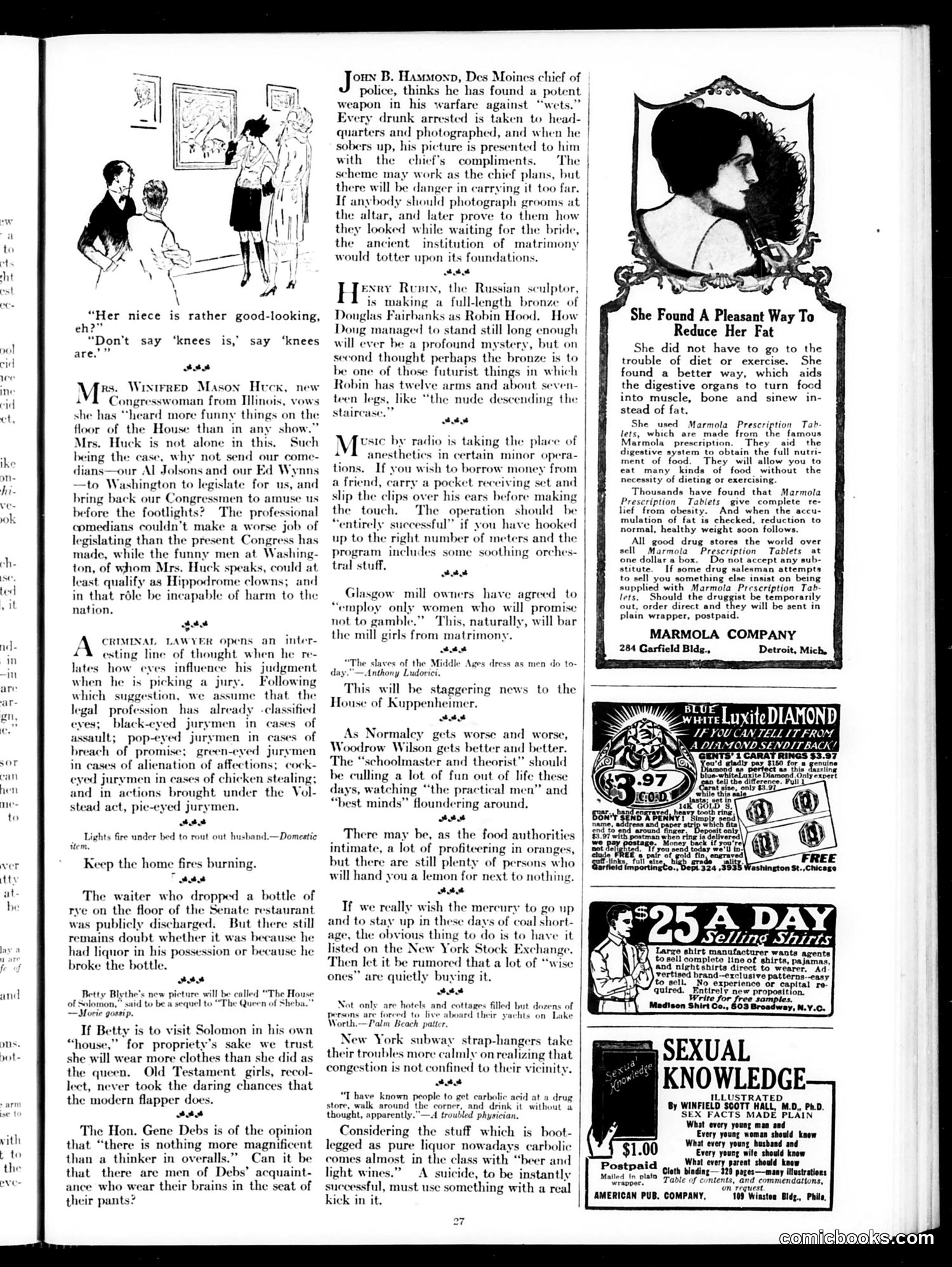
This page contains political and social satire typical of 1920s Judge magazine, with multiple brief humorous commentaries: **Key Targets:** 1. **Congress's incompetence**: The joke about Congresswoman Winfred Mason Heck suggests Congress functions so poorly that replacing them with professional comedians couldn't make things worse—a direct critique of legislative dysfunction. 2. **Prohibition enforcement**: Chief Hammond's plan to photograph drunk arrestees and shame them when sober mocks anti-alcohol efforts, warning the approach could backfire (e.g., photographing grooms). 3. **Post-war politics**: References to Gene Debs (socialist politician) and improving attitudes toward Woodrow Wilson suggest ongoing ideological debates about economic justice and Wilson's legacy. 4. **Modern absurdities**: Jokes about radio anesthesia, Douglas Fairbanks sculptures, and flappers satirize contemporary fads and social changes. 5. **Gender roles**: A quip about Glasgow mill owners banning gambling among female workers jokes that such restrictions would prevent women from marrying. The page primarily uses dry wit to critique governmental incompetence, Prohibition, and social pretension rather than featuring detailed political cartoons.
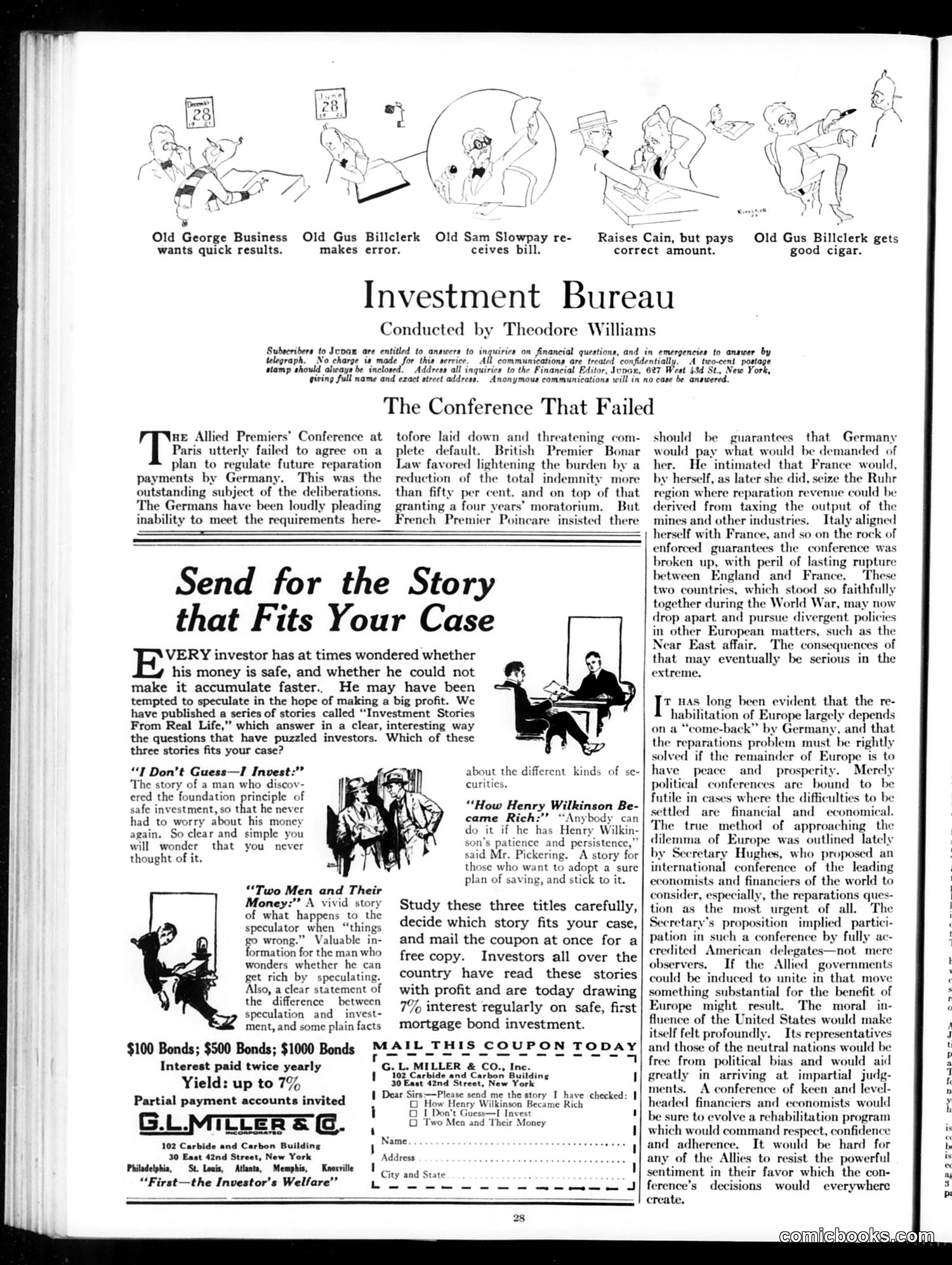
The top of this Judge magazine page contains five cartoon panels satirizing common business frustrations: an impatient boss, a clerk's error, slow payment, complaint followed by payment, and reward for good service. These appear to be generic workplace humor rather than political satire. The main content concerns the 1921 Allied Premiers' Conference in Paris, which failed to agree on German reparations payments after World War I. The article criticizes the breakdown: Germany claimed inability to pay; British Premier Bonar Law wanted to reduce demands by 50% and grant a four-year moratorium; French Premier Poincaré insisted on full payment and (as the text notes) later seized the Ruhr region. Italy "aligned" with France. The piece suggests this disagreement between Britain and France threatened their post-war alliance and risked broader European instability. The remainder is advertising for investment advice stories and G.L. Miller & Co. bonds.
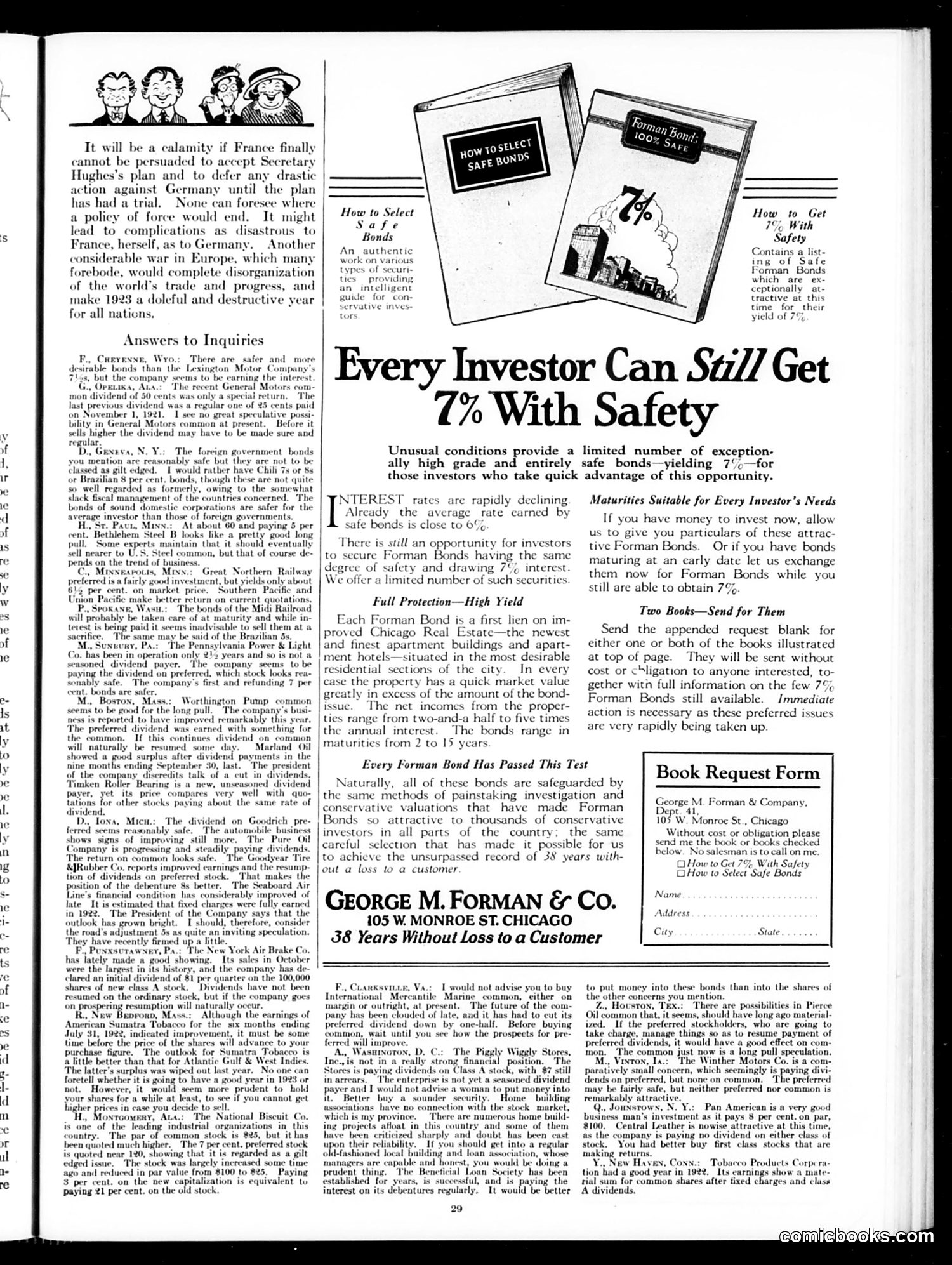
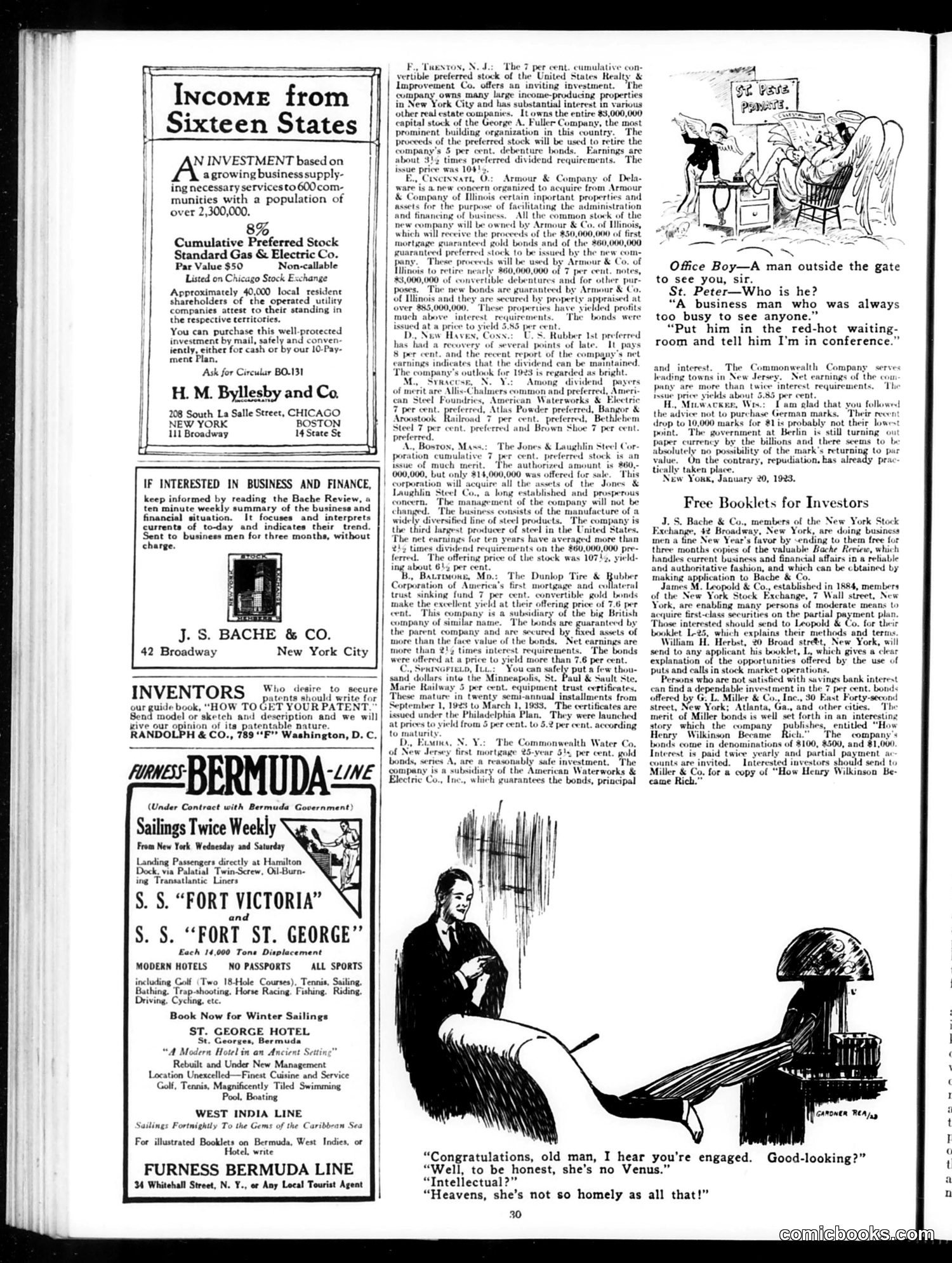
This page is primarily **advertisements and financial notices** rather than satirical content. The single cartoon at bottom right depicts a man and woman in conversation about an engagement. The man says "Congratulations, old man, I hear you're engaged. Good-looking?" and is told she's "no Venus" but "Intellectual?" He responds "Heavens, she's not so homely as all that!" **The satire:** This mocks the pretension of calling plain-looking women "intellectual" as a polite euphemism—suggesting that in 1920s society, men used flattering language to describe unattractive fiancées, and that "intellectual" was code for "not pretty." The joke assumes readers would find it absurd to prioritize a woman's intellect over appearance. The page otherwise contains investment ads for stocks, bonds, and steamship lines to Bermuda—typical Judge advertising from this era.
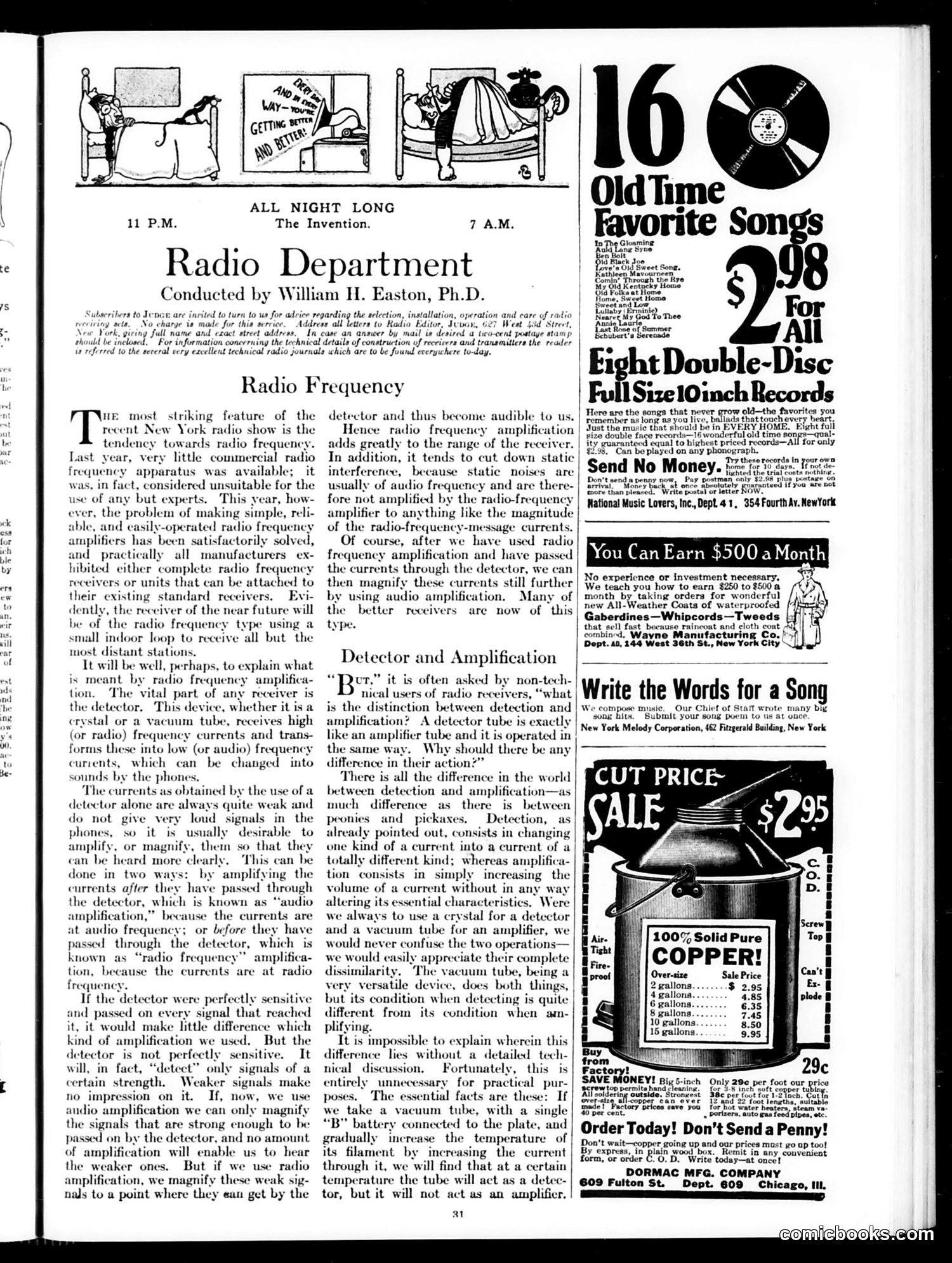
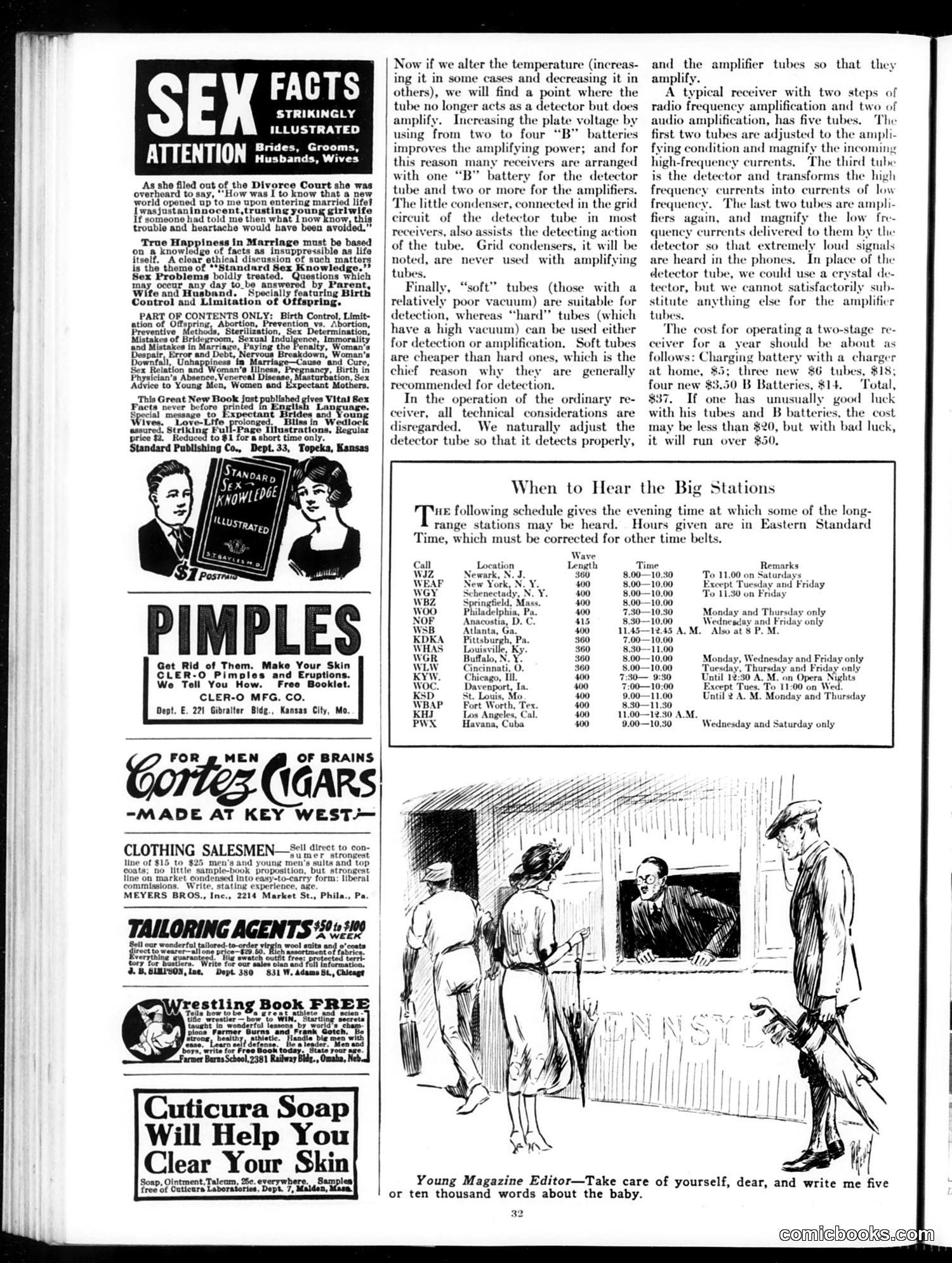
This page is **primarily technical and advertising content**, not satirical cartooning. The three-panel cartoon at the top ("All Night Long: The Invention," 11 P.M. to 7 A.M.) appears to show someone's nighttime sleep being progressively disrupted—likely mocking the discomfort of early radio experimentation or the obsessive nature of radio hobbyists. The main content is William H. Easton's educational "Radio Department" column explaining radio frequency amplification—a cutting-edge technology circa the 1920s. Easton addresses a common problem: early radio receivers picked up weak signals. He explains that amplifying signals *before* detection (radio frequency amplification) rather than after (audio amplification) both strengthens weak signals and reduces static interference. The page is otherwise dominated by period advertisements: 16 Old Time Favorite Songs records for $2.98, a $500/month earnings scheme, copper containers on sale, and songwriting opportunities—typical of Judge's revenue model targeting middle-class readers interested in emerging consumer technologies.
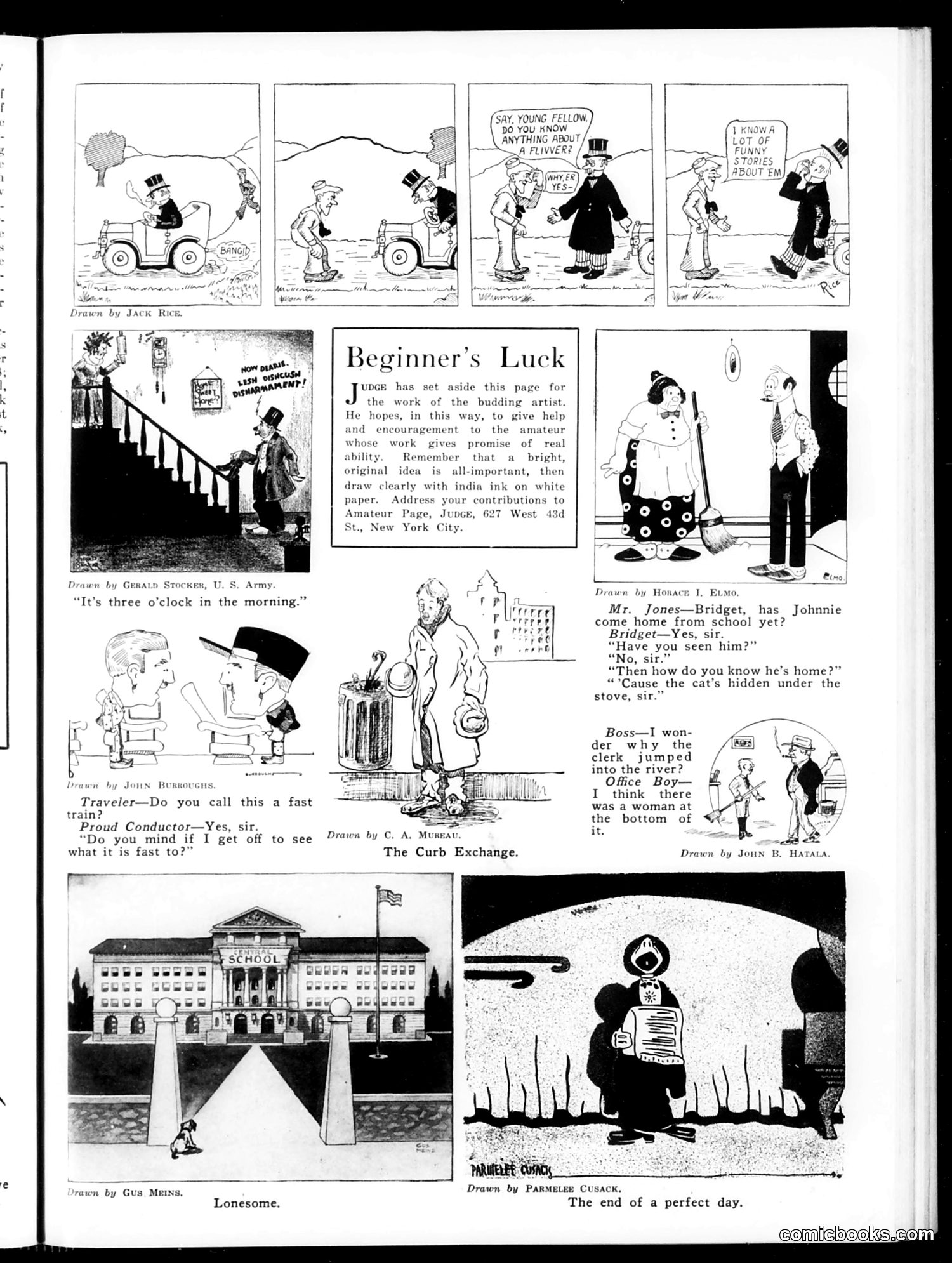
This page showcases **amateur cartoonist submissions** for Judge's "Beginner's Luck" feature, which encouraged aspiring artists by publishing their work alongside established cartoonists. The cartoons employ **simple, accessible humor** typical of early-20th-century American comedy: - **Top strip** (Jack Rick): A man in a tiny car encounters a woman; the joke involves her claiming he's "funny" about something (the humor is obscure without fuller context). - **"It's three o'clock in the morning"**: A domestic joke—a servant knows the boy is home because the cat hid under the stove, implying the boy's mischievous nature. - **Train/River jokes**: Quick one-liners about a fast train and an office clerk jumping into a river—punchy setups with minimal payoffs. - **"Lonesome"** and **"The end of a perfect day"**: Darker, more surreal images suggesting isolation and melancholy. The page reflects Judge's mission to balance professional satire with encouragement for amateur contributors, emphasizing that "a bright, original idea is all-important."
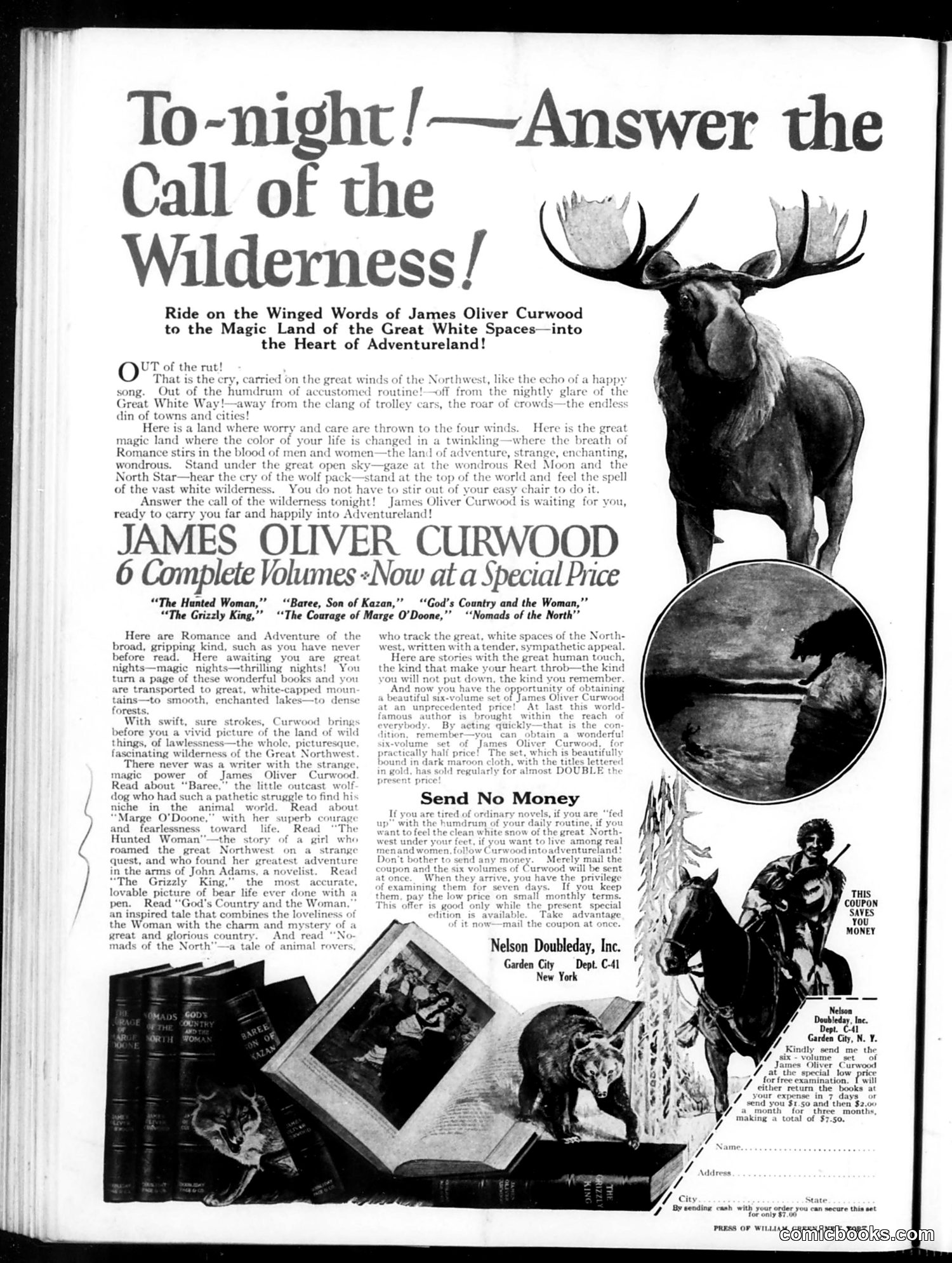
This is primarily **advertising content**, not political satire. The page promotes James Oliver Curwood's adventure novels—six volumes available at a special price through Nelson Doubleday, Inc. The imagery (moose, wilderness scenes, frontier imagery) and text appeal to early 20th-century readers' appetite for romantic adventure stories set in the North American wilderness. Titles like "Baree, Son of Kazan" and "God's Country and the Woman" emphasize themes of nature, romance, and masculine adventure. The "Call of the Wilderness" framing—promising escape from "worry and care" and "the din of towns and cities"—reflects a common early-1900s cultural nostalgia for frontier life amid increasing industrialization and urbanization. This represents a marketing appeal to readers seeking escapism rather than political commentary. The coupon at bottom offers the complete set without requiring prepayment—a sales technique of the era.