
Judge, 1923-01-27 · page 5 of 36
Judge — January 27, 1923 — page 5: what you’re looking at
What you’re looking at
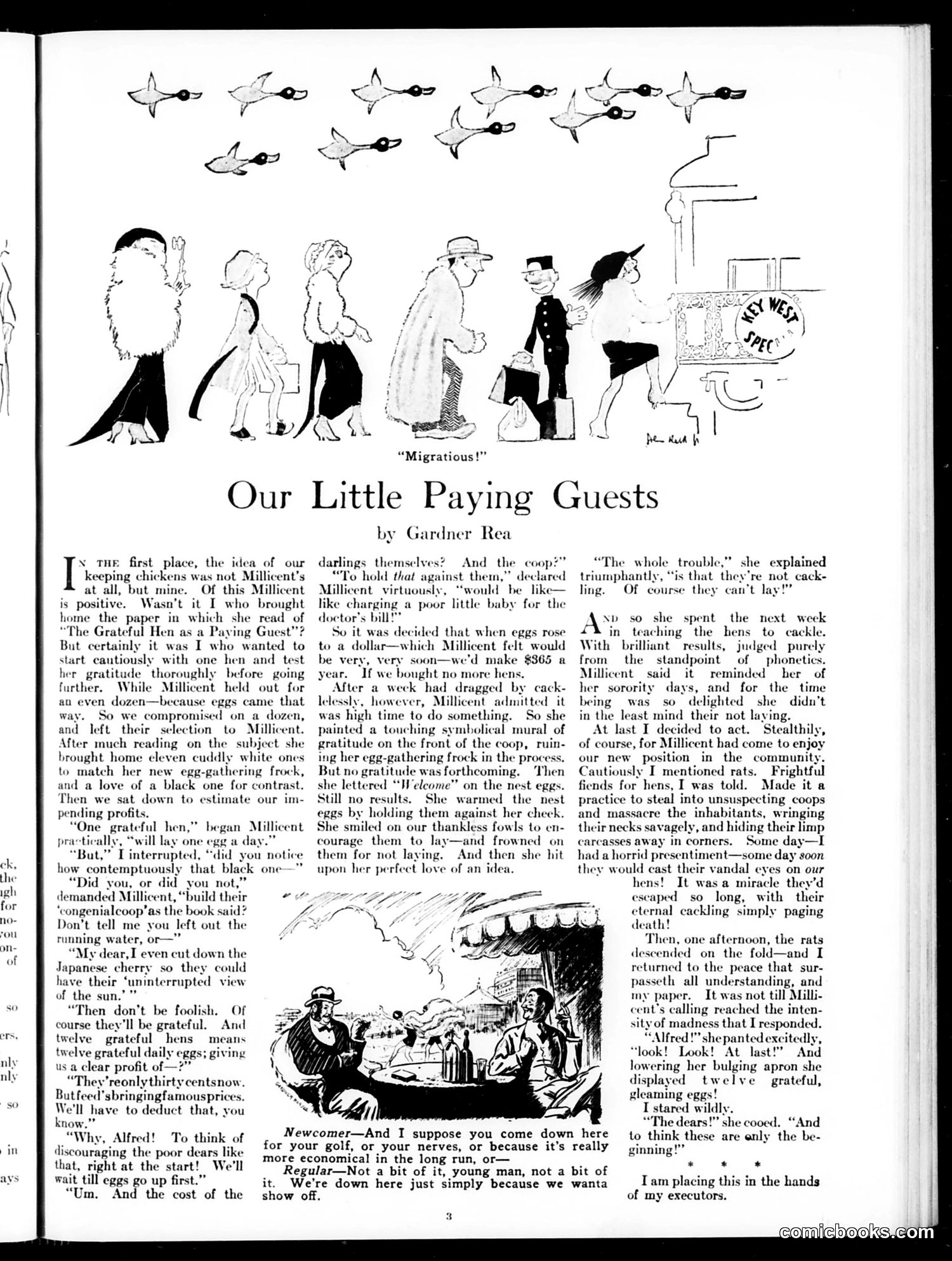
This story satirizes wealthy people's attempts to profit from keeping chickens as a fashionable hobby. A character named Millient, apparently from the affluent class, decides to raise hens to generate income, viewing it as both genteel and economically clever. The narrative mocks the gap between upper-class pretensions and practical reality. Millient's romantic notions about egg production clash with actual farm challenges—rats invade the coop, eggs disappear, and her venture becomes chaotic rather than profitable. The satire targets the Gilded Age trend of wealthy urbanites playing at farming or rural pursuits as status symbols while remaining incompetent at actual agricultural work. The cartoon critiques both their naïveté and their assumption that money alone ensures success at any endeavor.
📄 Transcribed text from this page (OCR, searchable)
Machine-transcribed from the original scan — historical spelling and the odd misread are preserved.
ne — al “Migratious!” Our Little Paying Guests h THE first place, the idea of our keeping chi s was not Millicent’s at all, but mine. Of this Millicent is positive. Wasn't it I who brought home the paper in which she read of “The Grateful Hen as a Paying Guest’’? But certainly it was I who wanted to start cautiously with one hen and test her gratitude thoroughly before going further. Millic held out for an 2 C8 eggs came that way compromised on a do: and left their selection to Millicent. After much reading on the subject she brought home eleven cuddly white ones to match her new egg-gathering frock, and a love of a black one for contrast. Then we sat down to estimate our im- pending profit “One grateful hen,” began Millicent ri ly, “will lay one day.” ” T interrupted, “did you notice how contemptuously that black one “Did you, or did you not,” demanded Millicent, “build their ‘congenialcoop’as the book said? Don’t tell me you left out the running water, or—" “My dear, I even cut down the apanese cherry so they could jave their ‘uninterrupted view of the sun.’ ” “Then don’t be foolish. course they'll be grateful. twelve grateful hens twelve grateful daily us a clear profit of “They’reonly thirty centsnow. Butfeed’sbringingfamousprices. We'll have to deduct that, you y, Alfred! To think of discouraging the poor dears like that, right at the start! We'll wait till eggs go up first.” it. “Um. And the cost of the Of And means iving by Gardner Rea ings themselves? And_ the 'o hold that against them,” Millicent virtuously, “would be like charging a poor little baby for the doctor's bill So it was decided that when eggs rose to a dollar—which Millicent felt would be very, very soon—we'd make $3865 a year. ‘If we bought no more hens. After a weck had dragged by cack- lelessly, however, Millicent: admitted it was high time to do something. So she painted a touching symbolical mural of gratitude on the front of the coop, ruin- ing her egg-gathering frock in the process. But no gratitude was forthcoming. ‘Then she lettered “Welcome” on the nest eggs. Still no results. She warmed the nest eggs by holding them against her cheek. She smiled on our thankless fowls to en- courage them to lay—and frowned on them for not laying. And then she hit upon her perfect love of an idea. Newcomer—And I suppose you come down here for your golf, or your nerves, or because it’s really more economical in the long run, or— Regular—Not a bit of it, young man, not a bit of We're down here just simply because we wanta show off. “The whole trouble,” she explained triumphantly, “is that they're not cack- ling. Of course they can’t lay!” the next week she spent xb. so AN 4 aching the hens to cackle. With brilliant from the standpoint of Millicent said it reminded her of her sorority days, and for the time being was so delighted she didn’t in the least mind their not laying. At last I decided to act. Stealthily, of course, for Millicent had come to enjoy our new position in the community. Cautiously I mentioned rats. _ Frightful fiends for hens, I was told. Made it a practice to steal into unsuspecting coops and massacre the inhabitants, wringing their necks savagely, and hiding their limp reasses away in corners. Some day—I had a horrid presentiment—some day soon they would cast their vandal eyes on our hens! It was a miracle they'd escaped so long, with their eternal cackling simply paging ath! Then, one afternoon, the rats descended on the fold—and I returned to the peace that sur- passeth all understanding, and my paper. It was not till Milli- cent’s calling reached the inten- sity of madness that I responded. “Alfred!” she panted excitedly, “look! Look! At last!” And lowering her bulging apron she displayed twelve grateful, gleaming eggs! I stared wildly. “The dears!” she cooed. “And to think these are enly the be- ginning!” + *£ Tam placing this in the hands of my executors. results, judged purely phonetics.