
Judge, 1923-01-27 · page 22 of 36
Judge — January 27, 1923 — page 22: what you’re looking at
What you’re looking at
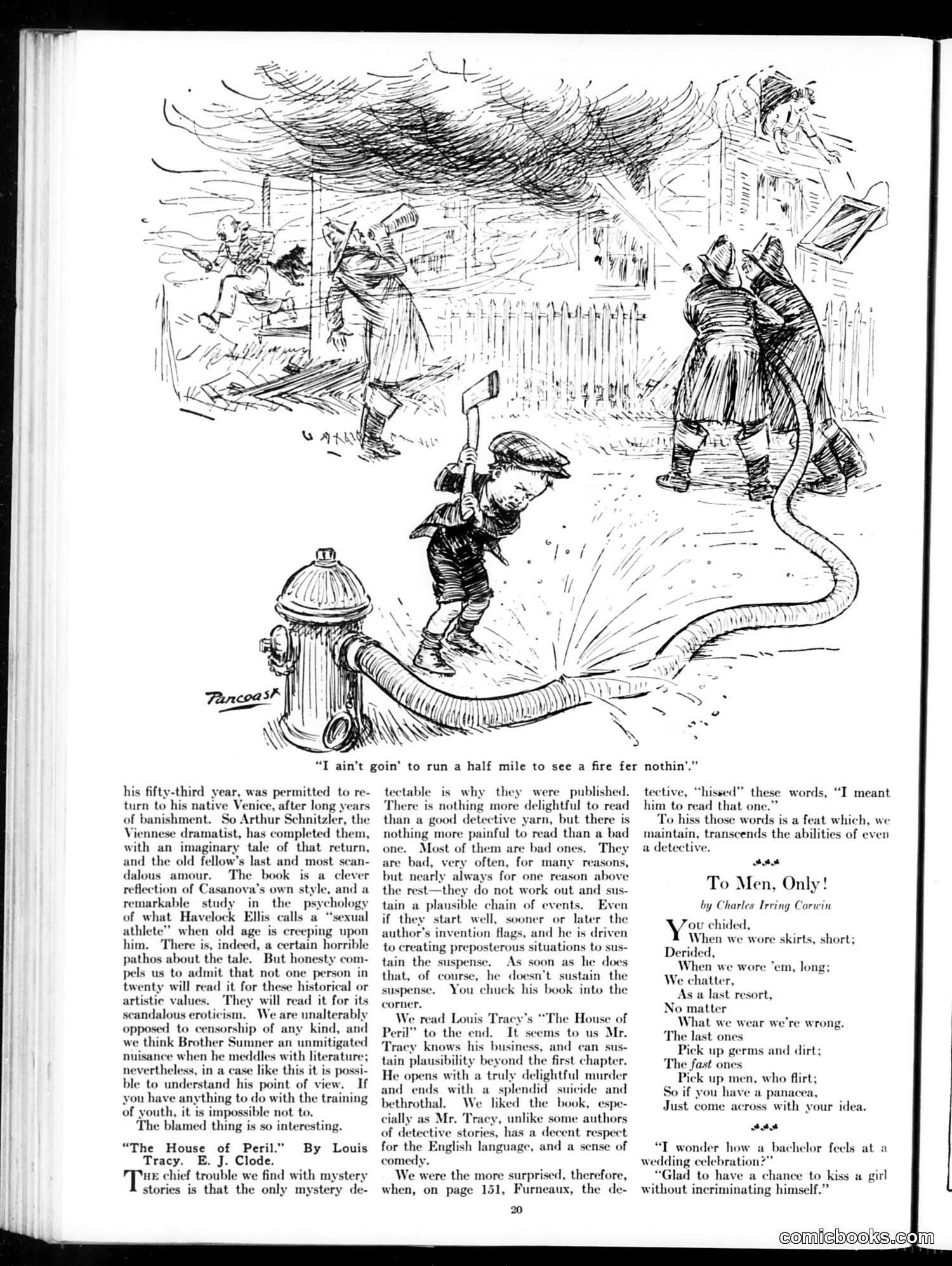
**The Main Cartoon** (top, signed "Pancoast"): Depicts a child refusing to leave a fire hydrant to watch an actual house fire down the street, saying "I ain't goin' to run a half mile to see a fire fer nothin'." This satirizes American materialism and apathy—even dramatic spectacles like fires hold no interest unless there's something personal to gain. The humor lies in the child's blunt pragmatism. **Literary Content Below:** Reviews of mystery novels and essays on detective fiction quality. The text critiques poorly-constructed mystery plots that lose plausibility mid-story, contrasting Louis Tracy's competent work with mediocre competitors. **"To Men, Only!" Poem** (right): Charles Irving Corwin's satirical verse about women's fashion contradictions: women are criticized regardless of hemline choice (short skirts deemed improper, long skirts old-fashioned). It mocks male inconsistency in judging female appearance—a commentary on gender double standards in early 20th-century society. The page reflects Judge's typical mix of social satire, literary criticism, and humor targeting contemporary attitudes and cultural hypocrisy.
📄 Transcribed text from this page (OCR, searchable)
Machine-transcribed from the original scan — historical spelling and the odd misread are preserved.
“I ain’t goin’ to run a half mile to see a fire fer nothin’.” his fifty-third year, was permitted to re- turn to his native Venice, after long y So Arthur Schnitzler, the , has completed them, tale of that return, with an imagina and the old fellow’s last and most scan- mour. The book a clever reflection of Casanova’s own style, and a remarkable study in the psychology of what Havelock E alls a “sexual *’ when old age is creeping upon here is, indeed, a certain horrible bout the tale. But honesty com- us to admit that not one person in ty will read it for these historical or artistic values. They will read it for its scandalous eroticism. re unalterably opposed to censorship of any kind, and we think Brother Sumner an unmitigated nce when he meddles with literature; in a case like this it land his point of view you have anything to do with the training of youth, it is impossible not to. The blamed thing is so interesting. “The Tracy. T chief trouble we find with mystery stories is that the only mystery de- ble to unde: House of Peril.” E. J. Clode. By Louis tectable is why they were published. There is nothing more delightful to read than a good detective yarn, but there is nothing more painful to read than a bad one. Most of them are bad ones. They are bad, very often, for many reasons, but nearly always for one reason above the rest—they do not work out and tain a plausible chain of events. y if they start well, sooner or later the author's invention flags, and he is driven to creating preposterous situations to sus- tain the suspense. As soon as he does that, of course, he doesn’t sustain the suspense. You chuck his book into the corner. We read Louis Tracy’s “The House of 1 to the er It seems to us Mr. acy knows his business, and can sus- n plausibility beyond the first chapter. He opens with a truly delightful murder and ends with a splendid suicide and bethrothal. We liked the bo spe- ‘ially as Mr. Tracy, unlike some authors of detective stories, has a decent respect for the English language, and a sense of comedy. We were the more surprised, therefore, when, on page 151, Furneaux, the de- 20 in, transcends the abilities of even a detective. ery To Men, Only! by Charles Irving Corwin ided, When we wore skirts, short; Derided, When we wore ‘em, long: We chatter, As a last resort, No matter What we wear we're wrong. The last ones Pick up germs and dirt; The fast ones Pick up men, who flirt; So if you have a panacea, Just come across with your idea. sae “T wonder how a bachelor feels at a wedding celebration?” “Glad to hb a chance to kiss a girl without incriminating himself.” comichooks.