
Judge, 1923-01-27 · page 17 of 36
Judge — January 27, 1923 — page 17: what you’re looking at
What you’re looking at
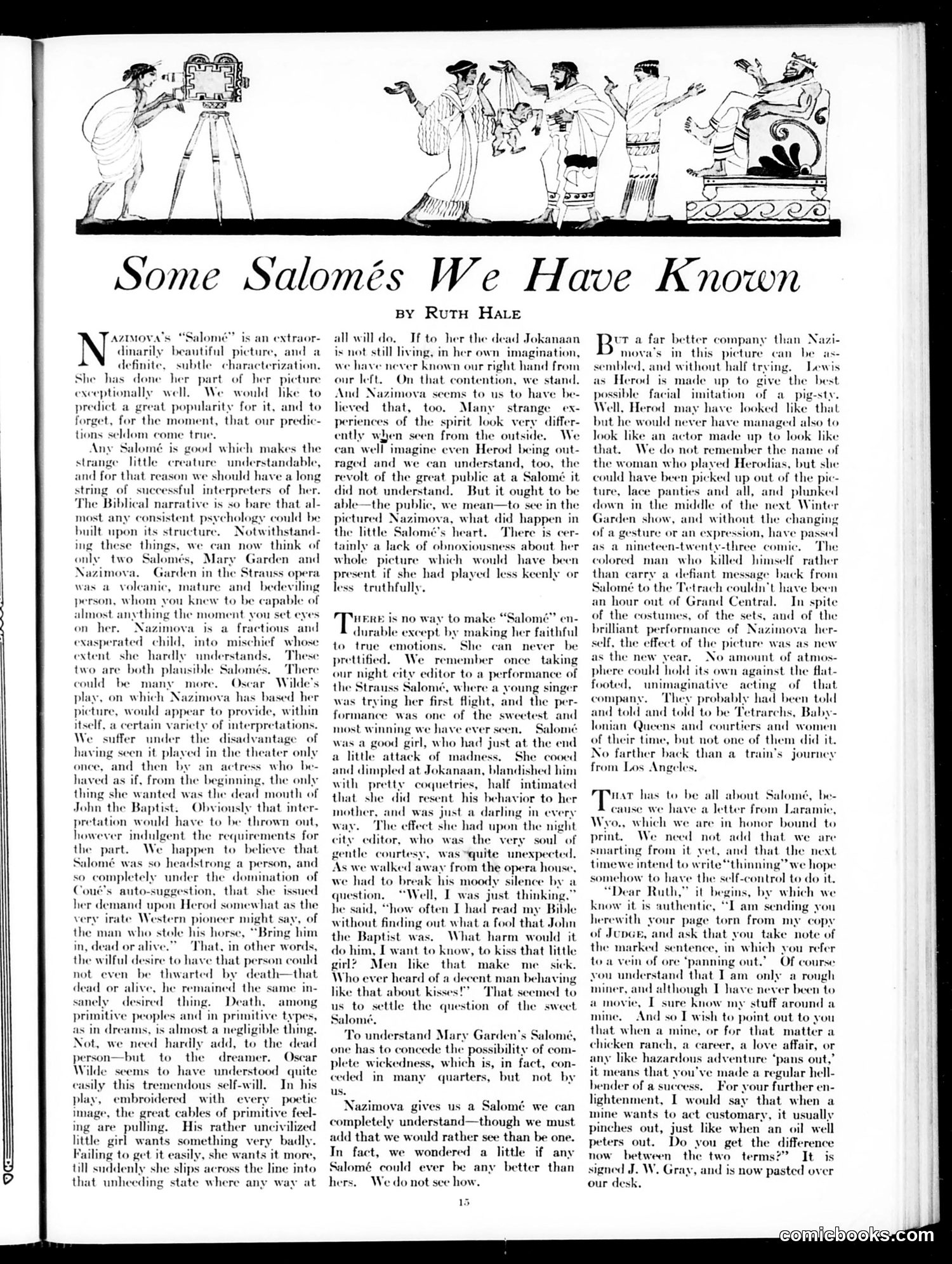
This article by film critic Ruth Hale discusses Alla Nazimova's film adaptation of Oscar Wilde's *Salomé*. The illustrated header shows various interpretations of the biblical Salomé character across different artistic mediums. Hale compares Nazimova's portrayal to Mary Garden's operatic interpretation (from Richard Strauss's opera). She argues that Salomé should be understood as a willful, primitive personality—a child-like figure whose desire becomes obsessive and dangerous, rather than a seductress. Hale praises Nazimova for playing the character "faithfully to true emotions" without prettifying her. The piece critiques audiences who misunderstood Salomé's psychology, suggesting they couldn't recognize authentic emotional portrayal. Hale positions the film as superior to other theatrical versions because it captures the character's genuine internal motivations—her relentless, almost animal will—rather than surface glamour or moralistic judgment.
📄 Transcribed text from this page (OCR, searchable)
Machine-transcribed from the original scan — historical spelling and the odd misread are preserved.
Some Salomés We Have Known AZIMOVA'’S * 3 dinarily beautiful pic definite, subtle charac She has done her part of her picture exceptionally well. We would like to predict a great popularity for it, and to forget, for the moment, that our predic- tions sel Any strang é is good which makes the little creature underst and for that reason we should ha srs of her. re that al- string of successful interpre’ The Bibl built upon its structure. otwithstand- ing these things, we can now think of only two Salomés, Mary Garden and Nazimova. Garden in the Strauss opera voleanic, mature and bedeviling person, whom you knew to be capi almost anything the moment you set on he Nazimova i: exasperated child, into mischief whose extent she hardly understands. These two are both plausible Salomés. There could be more. Oscar Wilde's play, on which Nazimova has based her picture, would appear to provide, within itself, a certain variety of interpretations. We suffer under the dis: uge of having seen it played in the th nd then by an actress who haved as if, from the beginning, the or thing she wanted was the dead mouth of John the Baptist. Obviously that inter- pretation would have to be thrown out, however indulgent the requirements for Ye happen to believe that was so headstrong a person, and nplet: under the domination of s auto-suggestion, that she issued 1d upon Herod somewhat as the ate Western pioneer n \ Sman wl his horse, “Bring him in, dead or ‘That, in other words, the wilful desire to have that person could not even be thwarted by death—that de: live, he remained the same in- \ ired thing. Death, among primitive peoples and in primitive types, as in dreams, is almost a negligible thing. Not, we need hardly add, to the dead person—but to the dreamer. Oscar Wilde seems to have understood quite easily this tremendous self-will. In his play, embroidered with every poetic image, the great cables of primitive ing are pulling. His rather uncivili little girl wants something very badly. Failing to get it easily, she wants it more, till suddenly she slips across the line into that unheeding state where any way at Was a BY RutH Hate all will do. If to her the « is not still living, in her own ve never known our right our left. On that contention, we stand. And Nazimova seems to us to have be- lieved that, too. Many strange periences of the spirit look very. dif ently when seen from the outside. We can well imagine even Herod being out- raged and we can understand, too, the revolt of the great public at a Salomé it did not understand. But it ought to be able—the pul we mean—to see in the pictured Nazimova, what did i the little Salomé’s heart. There is cer- tainly a lack of obnoxiousness about her whole picture which would have been present if she had played less keenly or less. truthfully. » to make “Salomé”’ en- durable except by making her faithful to true emotions. She can never be prettified. We remember once taking our night city editor to a performance of the Strauss Salomé, where a young singer was trying her first flight, and the per- formance was one of the sweetest and most winning we have ever seen. Salomé was a good girl, who had just at the end a little attack of madness. She coc ind dimp! with pretty ie: f that she did resent his bel HERE is no intimated or to her rling in every d upon the night the very soul of was “quite unexpected. ‘ay from the ope ra house y editor, who gentle courtesy, As we walked question. “Well, I he said, “how often I without finding out wl the Baptist was. What do him, I want to know, to kiss that little girl?) Men like that make me sick. Who ever heard of a decent man behaving like that about kisses!” That seemed us to settle the question of the sweet Salomé. ‘To understand Mary Garden's Salomé, one has to concede the possibility of com- plete wickedness, which is, in fact, con- ceded in many quarters, but not by us. Nazimova gives us a can completely understand—though we must add that we would rather see than be one. In fact, we wondered a little if any Salomé could ever be any better than hers. We do not see how. read my Bible 1 fool that John arm would it Salomé we B" a far better company than Nazi- mova’s in this picture can be as- sembled, and without half trying. Lewis as Herod is up to give the best possible facial imitation of a pig-sty. Well. Herod may have looked like that but he would never have managed also to look like an actor made up to look like that. do not remember the name of the woman who played Hero . could have been picked up out of the pic ture, lace panties and all, and plunked down in the middle of the next: Winter Garden show, and without the changing of a gesture or an expression, have p as a nineteen-twenty-three com The colored man who killed himself rather than carry a defiant message back from Salomé to the Tetrach couldn't have been an hour out of Grand Central. In spite of the costumes, of the sets, and of the brilliant performance of Nazimova her- self, the effect of the picture was as new the new y No amount of atmos- ainst the flat- sininiaginative acting of that company. They probably had been told and told and told to be archs, Baby- lonian Queens and courtiers and women of their time, but not one of them did it. No farther back than a train’s journey from Los Angeles. Es has to b cause we hay tter from Laramie, Wyo., which we are in honor bound to print. We need not add that we smarting from it yet, and that the next timewe intend to write“thinning”’ we hope somehow to ha he self-control to do it. “Dear Ruth,” it begins, by which we i i nding you with your page torn from my copy and ask that you take note of ked sentence, in which you refer toa vein of ore ‘panning out.” Of course you understand that Tam only a rough ilthough T have never been to a movie, I sure know my stuff around a mine. And so I wish to point out to you at when a mine, or for that matter a ‘n ranch, any like ha! it means the bender of a success. IH about Salomé, » ‘pans out,” gular hell- For your further en- lightenment, I would say that when a mine wants to act customa: it usually pinches out, just like when an oil well peters out. Do you get the difference now between the two terms?” It is signed J. W. Gray, and is now pasted over our desk.