
Judge, 1923-01-27 · page 7 of 36
Judge — January 27, 1923 — page 7: what you’re looking at
What you’re looking at
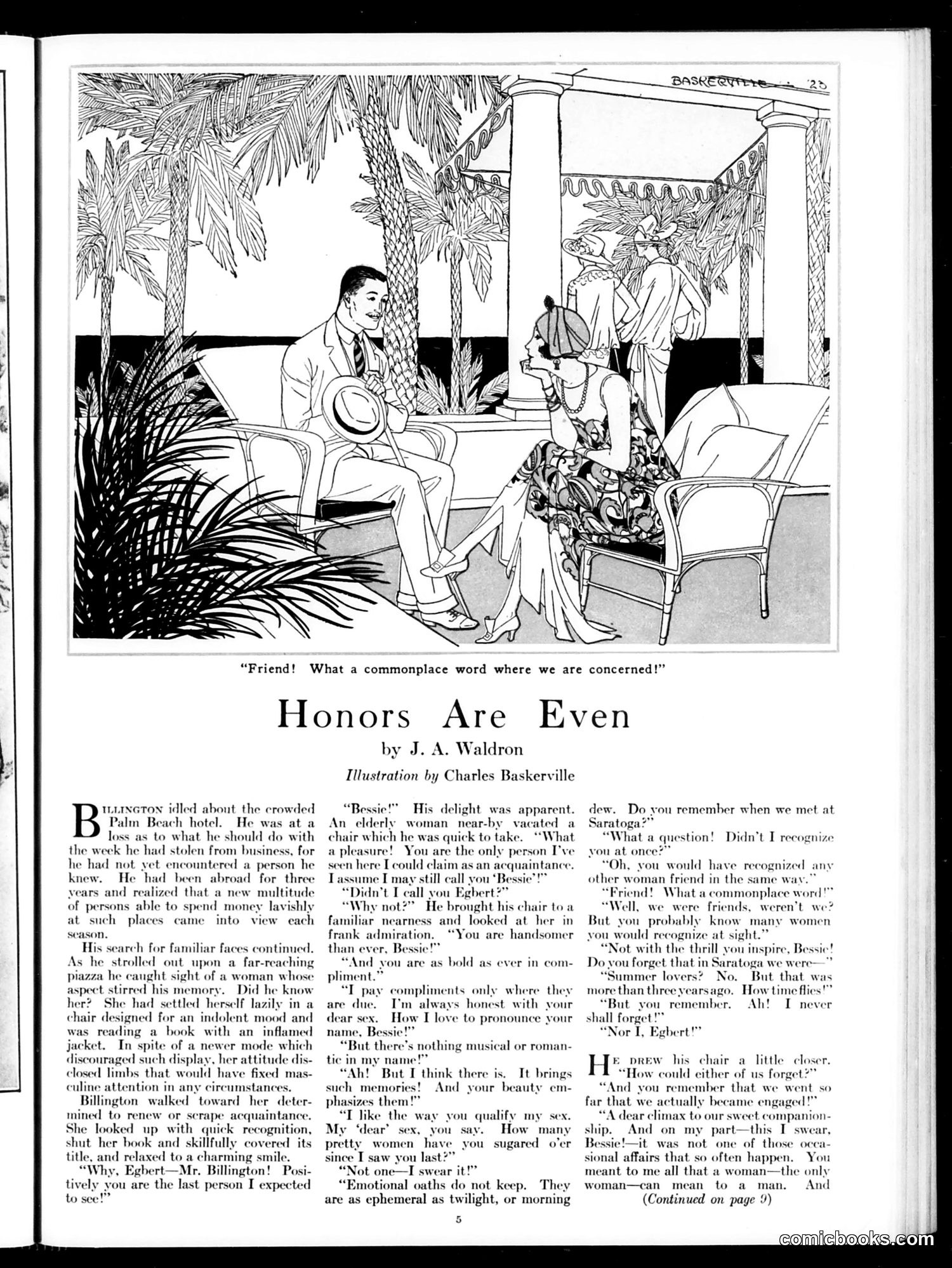
This is a romantic story illustration, not political satire. The narrative depicts two former lovers, Egbert and Bessie, reuniting at a fashionable Palm Beach hotel after three years apart. The "joke" centers on social pretense and romantic nostalgia: Egbert initially doesn't recognize Bessie, then flatters her effusively upon realization. Their dialogue reveals they were once engaged during a summer romance in Saratoga, which they're now romantically rekindling. The cartoon's title, "Honors Are Even," suggests mutual romantic claims or debts between the characters. The illustration shows them in an elegant tropical setting—characteristic of 1920s leisure society—with Bessie deliberately hiding her book's title, suggesting she was reading something romantic in anticipation of such an encounter. The story explores themes of rekindled romance, emotional honesty, and social performance among the wealthy leisure class typical of Judge magazine's audience.
📄 Transcribed text from this page (OCR, searchable)
Machine-transcribed from the original scan — historical spelling and the odd misread are preserved.
— Ze —— \ “Friend! Honors MWAAINGTON idled about the crowded B Palm Beach hotel. He was a loss as to what he should do with the week he had stolen from business, for he had not yet encountered a person he knew. He had been abroad for three years and realized th new multitude of persons able to spend money lavishly at such places came into view each season. His search for familiar faces continued. As he strolled out upon i ght sight of a wom: {his memory. Did settled herself d for an indolent mood and s reading a book with an inflamed In spite of a newer mode which titude dis- culine attention in any circumstances. Billington w: - mined to renew or scrape acquaintance. She looked up with quick recognition, shut her book and skillfully covered its title, and relaxed to a charming smile. “Why, E ngton! Posi- 1 are the last person I expected by J. A. Waldron Illustration by Charles Baskerville “Bessie!” His delight was a An elderly woman near-by vacated a chair which he was quick to take. ‘What a pleasure! You are the only person I’ve seen here I could claim as an acquaintance, Tassume I may still call you ‘Bessie’! “Didn't I call you Egbert?” “Why not?” He brought his chair to a familiar nearness and looked at her in frank admiration. ‘You are handsomer than ever, Bessie!” “And you are as bold as ever in com- pliment I pay compliments only where they are ‘die. Lmalways honest with your I love to pronounce your “But there’s nothing musical or roman- tic in my name!” “Ah! But I think there is. It brings such memories! And your beauty cem- phasizes them!” like the way you qualify my sex. My ‘dear’ sex, you How ‘many pretty women you sugared o'er since I saw you la: “Not one—I swear it!” “Emotional oaths do not keep. y are as ephemeral as twilight, or morning 5 What a commonplace word where we are concerned!” Are Even you remember when we met at a question! Didn't I recognize you at once?” “Oh, you would have recognized any other woman friend in the same v r end! What a commonpl. word ell, we were friends, weren't we? But you probably know many women you would recognize at sight.” “Not with the thrill you inspire, Bessie! Do you forget that in Saratoga we were—" “Summer lovers? No. But that w more than three yearsago. How time fl “But nember. Ah! [never shall forget “Nor I, Egbert!” prew his chair a little cle E } How could either of us forget? “And you remember that we went so far that we actually became engaged!” “A dear climax to our sweet companion- ship. And on my part—this T swear, Be: —it was not one of those occa- sional affairs that so often happen. You meant to me all that a we —the only woman—can mean to a man. And (Continued on page )