
Judge, 1923-01-27 · page 10 of 36
Judge — January 27, 1923 — page 10: what you’re looking at
What you’re looking at
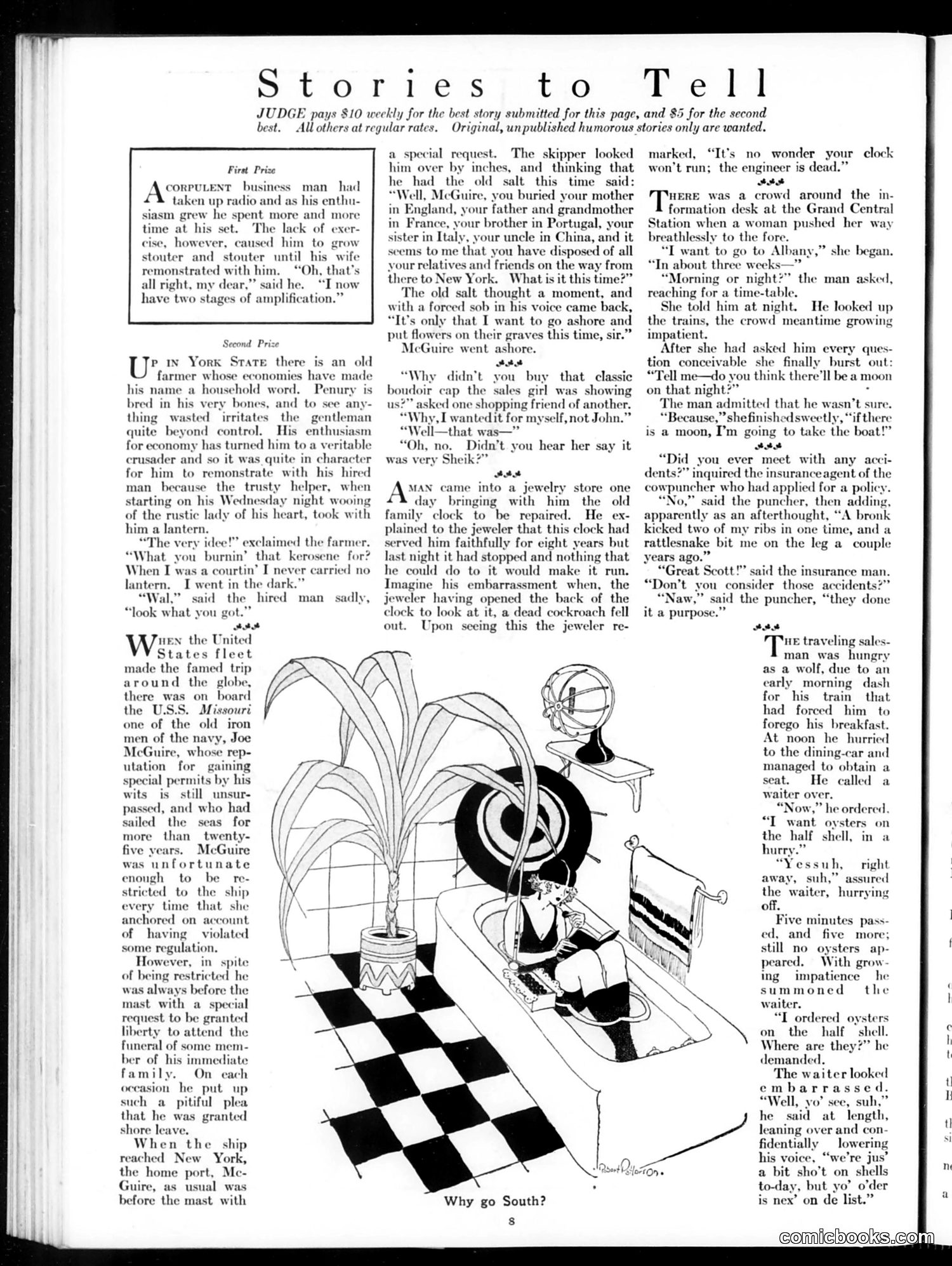
This page from *Judge* contains four humorous short stories, each with distinct satirical targets: 1. **"Two Stages of Amplification"**: Mocks a wealthy businessman's obsession with the new radio technology, suggesting his growing obesity from inactivity is merely "amplification"—a joke about both radio terminology and his expanding waistline. 2. **The Hired Man's Lantern**: Rural satire about an extremely miserly farmer who criticizes his hired hand for wasting kerosene on a lantern while courting, revealing the farmer's own dim romantic past. 3. **Joe McGuire's Serial Funerals**: Military humor about a clever Navy sailor who repeatedly exploits shore leave by claiming family deaths. The running joke: he's allegedly buried relatives across the globe, yet keeps finding more to mourn. 4. **The Dead Cockroach Clock**: A jewelry-store punchline where a broken clock's malfunction is explained by a dead insect inside—the "engineer" being dead. These are lighthearted, family-friendly comedies typical of 1920s-era humor magazines, targeting vanity, penny-pinching, military bureaucratic exploitation, and simple mechanical ironies.
📄 Transcribed text from this page (OCR, searchable)
Machine-transcribed from the original scan — historical spelling and the odd misread are preserved.
Stories to Peli JUDGE pays $10 weekly for the best story submitted for this page, and $5 for the second best. First Prize CORPULENT business man had taken up radio and as his enthu- m grew he spent more and more time at his set. The lack of exer- cise, however, caused him to grow stouter and_stouter until his wife remonstrated with him. “Oh, that’s all right, my dear,” said he. “I now have two stages of amplification.” Second Prize p i York Srate there is an old mer whose economies have made » a household word. Penury is in his very bones, and to wasted irritates the gentlem quite beyond control. His enthusiasm for economy has turned him to a veritable crusader and so it was quite in character for him to remonstrate with his hired man because the trusty helper, when starting on his Wednes night wooing of the rustic lady of his heart, took with him a lantern. “The very idee!’ “What you burnin’ that kero: When I was a courtin’ I never carried no lantern. I went in the dark.” “Wal,” said the hired man “look what you got.” rer HEN the United States fleet made the famed trip around the globe, there was on board the U.S.S. Missouri one of the old iron men of the navy, Joe McGuire, whose rep- utation for gaining special permits by his wits is still unsur- passed, and who had sailed the seas for more than twenty- five years. McGuire was unfortunate enough to be re- stricted to the ship every time that anchored on account of having violated some regulation, However, in spite of being restricted he always before the mast with a special request to be granted liberty to attend the funeral of some mem- ber of his immediate family. On each oceasion he put up such a pitiful plea that he was granted shore leave. When the ship reached New York, the home port, Mc- Guire, as usual was before the mast with sadly, she All others at regular rates. The skipper looked him over by inches, and thinking that he had the old salt this time said: “Well, McGuire, you buried your mother in England, your father and grandmother in France, your brother in Portugal, your sister in Italy, your uncle in China, and it seems to me that you have disposed of all your relatives and friends on the way from there to New York. What is it this time?” The old salt thought a moment, and with a forced sob in his voice came back, “It’s only that I want to go ashore and put flowers on their graves this time, sir.” McGuire went ashore. * “Why didn’t you buy that classic boudoir cap the sales girl was showing us?” asked one shopping friend of another. “Why, I wantedit for myself, not John.” “Well—that was—” “Oh, no. Didn’t you hear her say it was very Sheik?” a special request. ery Ass came into a jewelry store one f bringing with him the old family ‘clock to be repaired. plained to the jeweler that this clock had served him faithfully for eight years but last night it had stopped and nothing that he could do to it would make it run. Imagine his embarrassment when, the jeweler having opened the back of the clock to look at it, a dead cockroach fell out. Upon seeing this the jeweler re- Why go South? 8 Original, unpublished humorous stories only are wanted. marked, “It’s no wonder your clock won't run; the engineer is dead.” toe HERE was a crowd around the in- formation desk at the Grand Central Station when a woman pushed her way breathlessly to the fore. “I want to go to Albany, “In about three weeks Morning or night? reaching for a time-ta She told him at n He looked up the trains, the crowd meantime growing impatient. After she had asked him every ques- tion conceivable she finally burst out: “Tell me—do you think there'll be a moon on that night?” The man admitted that he wasn’t sure. “Because,” shefinishedsweetly, “if there is a moon, I’m going to take the boat!” Ree you ever meet with any acci- ?” inquired the insurance agent of the cowpuncher who had applied for a policy. “No,” said the puncher, then adding, apparently as an afterthought, “A bronk kicked two of my ribs in one time, and a rattlesnake bit me on the leg a couple years ago.” “Great Scott!” “Don’t you consider those Vaw,”” id the puncher, it a purpose she began. the man asked, said the insurance 1 cidents? “they done v | ‘HE traveling sales- man was hungry as a wolf, due to an early morning dash for his train that had forced him to forego his breakfast. At noon he hurried to the dining-car and managed to obtain a He called a waiter ove “Now,” he ordered. “IT want oysters on the half shell, in a hur Yessuh, right away, suh,” assured the waiter, hurrying off. Five minutes pass- ed, and five more; still no oysters peared. With grow ing impatience he summoned the iter. “T ordered oysters on the half shell. Where are they?” he demanded. The waiter looked embarrassed. “Well, yo’ see, suh,” he said at length, leaning over and con- fidentially lowering his voice, “we're jus’ a bit sho’t on shells but yo” o’der on de list.”