
Judge, 1923-01-27 · page 33 of 36
Judge — January 27, 1923 — page 33: what you’re looking at
What you’re looking at
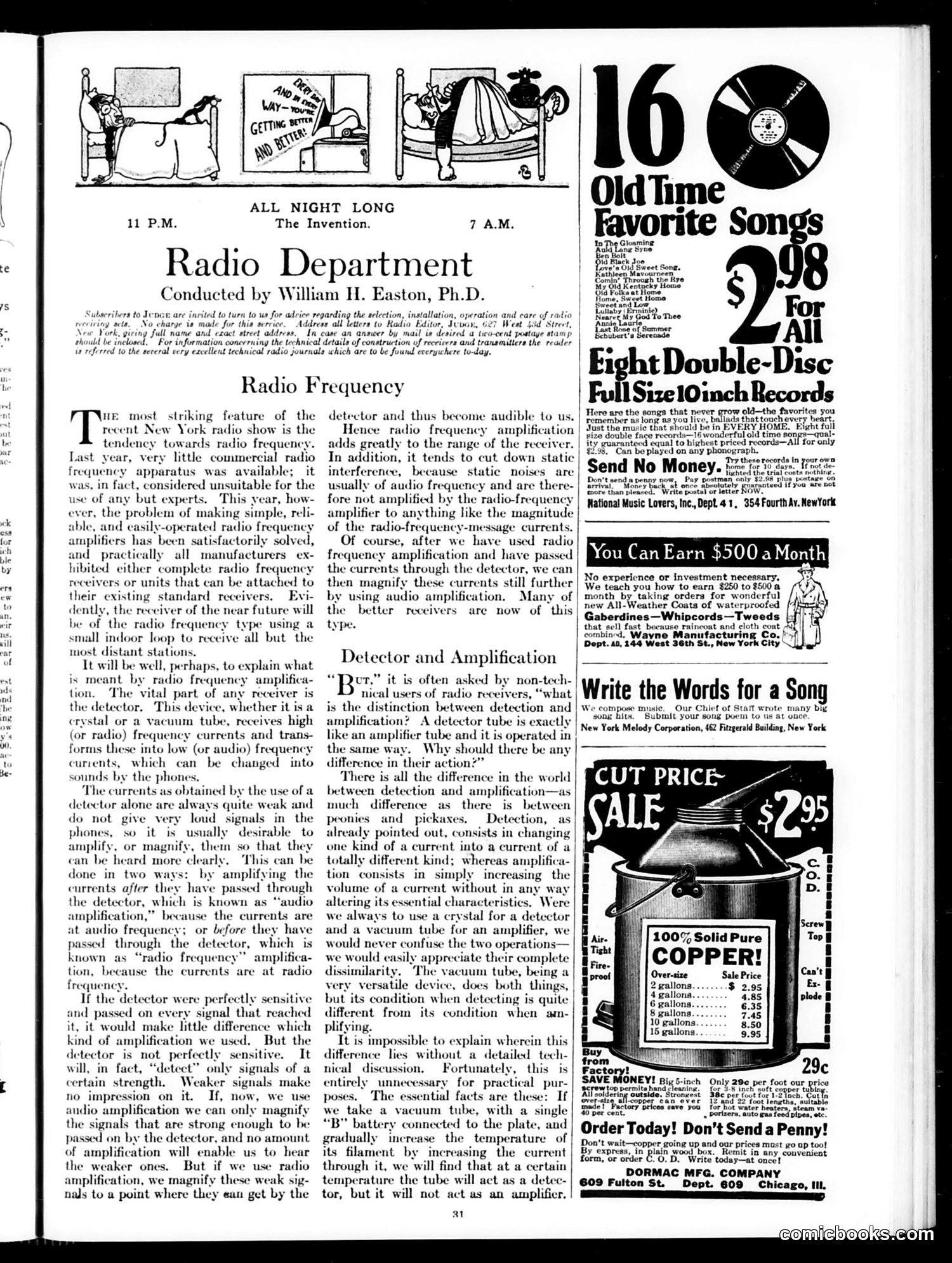
This page is **primarily technical and advertising content**, not satirical cartooning. The three-panel cartoon at the top ("All Night Long: The Invention," 11 P.M. to 7 A.M.) appears to show someone's nighttime sleep being progressively disrupted—likely mocking the discomfort of early radio experimentation or the obsessive nature of radio hobbyists. The main content is William H. Easton's educational "Radio Department" column explaining radio frequency amplification—a cutting-edge technology circa the 1920s. Easton addresses a common problem: early radio receivers picked up weak signals. He explains that amplifying signals *before* detection (radio frequency amplification) rather than after (audio amplification) both strengthens weak signals and reduces static interference. The page is otherwise dominated by period advertisements: 16 Old Time Favorite Songs records for $2.98, a $500/month earnings scheme, copper containers on sale, and songwriting opportunities—typical of Judge's revenue model targeting middle-class readers interested in emerging consumer technologies.
📄 Transcribed text from this page (OCR, searchable)
Machine-transcribed from the original scan — historical spelling and the odd misread are preserved.
ALL NIGHT LONG 11 P.M. The Invention. Radio Department Conducted by William H. Easton, Ph.D. Subaeriters to Jeooe are invited ta turn to us for acice regarding the selection, installation, operation and care of ratio | Address all letters to Radio Editur, Suvar, ¢ Str In case an answer by mail ix desired a tico-cent postaye recviving acta, No charye ig made for this serriee New York, gicing full name and eZact atrect addreas should be inclosed.” For information concerning the technical is referred to the sereral very excellent technical radio journals which are to be found eterywhere to-day. Radio F HE most striking feature of the scent New York radio show is the tendency towards radio frequency. very little commercial radio us was available; it dered unsuitable for the This year, how- was, in fact, con: use of any but experts. ever, the problem of making simple, reli- and easily-operated radio frequency amplifiers has been satisfactorily solved, and practically all manufacturers ex- hibited either complete radio frequency ivers or units that can be attached to their existing standard receivers. Evi- dently, the receiver of the near future will be of the radio frequency type using a small indoor loop to receive all but the most distant stations. It will be well, perhaps, to explain what is meant by radio frequency ampl tion. The Vital part of any receiver is the detector. This device, whether it is a crystal or a vacuum tube, receives high (or radio) frequency currents and trans- forms these into low (or audio) frequency currents, which can be changed into sounds by the phone: - currents as obtained by the use of a detector alone are always quite weak and do not give very loud signals in the phones, so it is usually desirable to amplify, or magnify, them so that they can be heard more clearly. This can be done in two ways: by amplifying the currents after they have passed through the detector, which is known as “audio amplification,” because the currents are at audio frequer or before they hav passed through the detector, which known as “radio frequen amplifica- tion, because the currents are at radio frequency If the detector were perfectly sensitive and passed on every signal that reached it, it would make little difference which kind of amplification we used. But the de’ tector i not perfectly | sensitive. It will, “detect” only signals of a certain trend Weaker signals make no impression on it. If, now, we use andio amplification we can only magnify the signals that are strong enough to be passed on by the detector, and no amount of amplification will enable us to hear the weaker ones. But if we use radio amplification, we magnify these weak sig- nals to a point where they ean get by the West 4. mp details of construction of receivers and transmitters the reader requency detector and thus become audible to us. Hence radio frequency amplific: adds greatly to the range of the receiver. In addition, it tends to cut down static interference, because static noises are usually of audio frequency and are there. fore not amplified by the radio-frequency amplifier to anything like the magnitude of the radio-frequency-message currents. Of course, after we have used radio frequency amplification and have passed the currents through the detector, we can then magnify these currents still further by using audio Many of the better receivers are now of this type. Detector and Amplification “Be it is often asked by non-tech- nical users of radio receivers, “what is the distinction between detection and amplificat: A detector tube is exactly like an amplifier tube and it is operated in the same way. Why should there be any difference in their action?” There is all the difference in the world between detection and amplification—as much difference there is between peonies and pickaxes. Detection, as already pointed out, consists in changing one kind of a current into a current of a totally different kind; whereas amplifi tion consists in simply ine reasing the volume of a current without i in any way altering its essential characteri: we always to use a crystal for a de ‘tector and a uum tube for an amplifier, we would never confuse the two operations— we would easily appreciate their complete The vacuum tube, being does both things, but its condition when detecting is quite different from its condition when aan- plifying. It is impossible to explain wherein this difference lies without a detailed tech- nical discussion, Fortunately, this entirely unnecessary for practical pur- poses. The essential facts are these: If we take a vacuum tube, with a single “B” battery connected to the plate, and gradually increase the temperature of | its filament by increasing the current | through it, we will find that at a certain temperature the tube will act as a detec- as ation | Favorite Songs Gleaming fans fant Rime of Sommer Schubert's Sere: for Eight Double-Disc Full Size10inch Records | Here are the songs that ne Lathe favorites you Femember as ongeas you lite, ballads thattouch every hi Just the musie that should be in EVERY HOME, Bhicht f tal size double face records—16 wonderful old time son; ity guaranteed equal to highest priced records—All for aly 2.98, Can be played on any phonograph. Send No Money. f2273°0%% home for 0 dare Don't nend a pengy now, Bay gostran a arrival Money back fbnolutely Pmt de bata nenhitie sy beatae sc if you are nok No experience or investment necessary, We teach you how to earn $250 to $500 a month by taking orders for wonderful new All-Weather Coats of waterproofed Gaberdines—Whipcords—Tweeds that sell fast because raincoat and cloth coat combined, Wayne Manufacturing Co. Dept. 10,144 West 36th St., New York City Write the Words for a Song We compose music. Our Chief of Statt wrote many Dlg song bits, Submit your song poem to us at of | New York Melody Corporation, 462 Fitzgerald Building, New York 100% Solid Pure COPPER! Over-size Sale Price 2 gallons...... 4 gallons. 6 gallons. 8 gallons. . 10 gallons. 15 gallons. . Only 29¢ per foot our price 38 per out fora 2th, ut Zand 22 toot lenatha, for'hot water heater atearsres jer, auto gaa feed pipes, ete. Order Today! Don’t Senda Penny! Pon’t wait—copper going up and oar prices mast xo ap too! By express, in wood box. Remit in any convenient form, oF 0 .D. Write today—at once! DORMAC MFG. COMPANY 609 Fulton St. Dept. 6 Chicago, tor, but it will not act as an amplifier. aq