
Judge, 1923-01-27 · page 3 of 36
Judge — January 27, 1923 — page 3: what you’re looking at
What you’re looking at
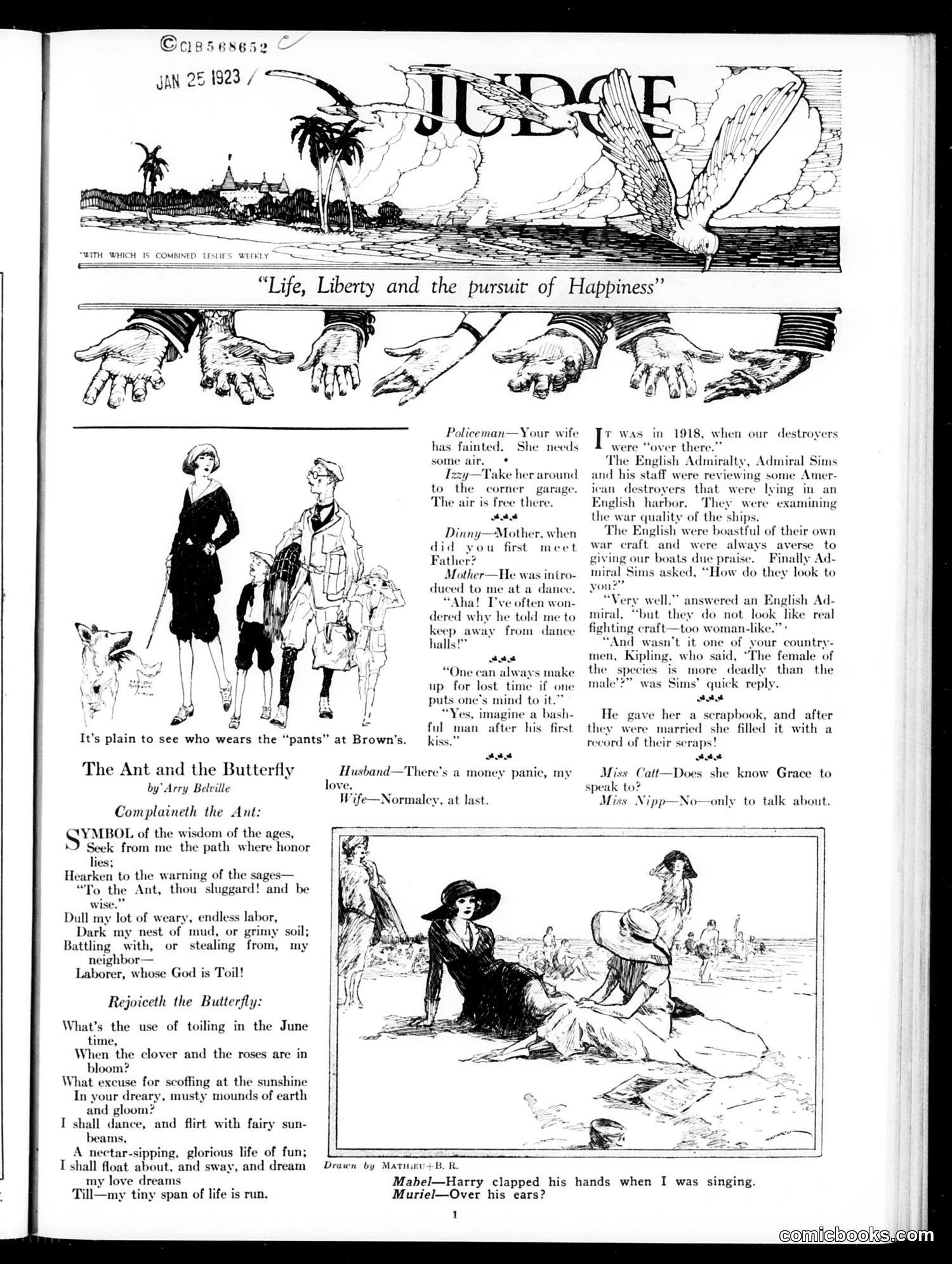
This page contains two main pieces: **"The Ant and the Butterfly"** is a moral fable poem contrasting the industrious ant with the carefree butterfly—a traditional Aesop's-style lesson about the virtue of hard work versus idle pleasure. **"It's Plain to See Who Wears the Pants at Brown's"** is a satirical cartoon about gender dynamics and household authority. The illustration shows a woman and children, suggesting she controls domestic decisions despite the era's formal male authority. The joke targets the contradiction between traditional male dominance and women's actual household management power—a relevant social commentary during the 1920s when women had recently gained voting rights and were challenging traditional gender roles. The page also includes miscellaneous brief humorous anecdotes about domestic and romantic situations.
📄 Transcribed text from this page (OCR, searchable)
Machine-transcribed from the original scan — historical spelling and the odd misread are preserved.
©rssesese © JAN 25 1923 / vi; pf & “el It's plain to see who wears the “pants” at Brown's. The Ant and the Butterfly by’Arry Belville Complaineth the Ant: YYMBOL of the wisdom of the ages, ek from me the path where honor ken to the warning of the sages— “To the Ant, thou sluggard! and be wise, Dull my lot of weary, endless labor, Dark my nest of mud, or grimy soil; Battling with, or stealing from, my neighbor— Laborer, whose God is Toil! Rejoiceth the Butterfly: What’s the use of toiling in the June time, When the clover and the roses are in bloom? What excuse for scoffing at the sunshine In your dreary, musty mounds of earth and gloom? I shall dance, and flirt with fairy sun- beams, A nectar-sipping, glorious life of fun; I shall float about, and sway, and dream my love dreams Till—my tiny span of life is run. Policeman—Your wife She needs to the The air is free was Dinny—Mother, when did you first’ meet Father? Mother—He was intro- duced to me at a dance. “Aha! T've often won- dered why he told me to keep away from dance halls!” up for lost time if one puts one’s mind to it.” “Yes, imagine a bash- man after his first kiss.” i ful ery Husband—There’s a money panic, my ife—Normalcy, at last. I" was in 1918, when our de: ‘over there.” The English Admiralty, Admi id his staff were reviewing som ican destroyers that were English harbor. They were the war quality of the ships. ¢nglish were boastful of ‘a war craft and were giving our boats due ora miral Sims asked, “How do they iting craft—too woman-liki “And wasn’t it one of your ¢ men, the is more ¢ lv tl male’? as Sims’ quick reply. ttt He they were married she record of their scraps! ey * Catt—Does she filled it Nipp—No—only to talk Kipling, who said, “The fe gave her a serapbook, and stroyers ral Sims ie Amer- lying in an exi mining heir own ly 2 look to -ountry- male of ian the after with a know Grace to about. Drawn by Matiuny+B. R. Mabel—Harry clapped his hands when I was singing. Muriel—Over his ears? 1 comichooks conn)