
Judge, 1923-01-27 · page 19 of 36
Judge — January 27, 1923 — page 19: what you’re looking at
What you’re looking at
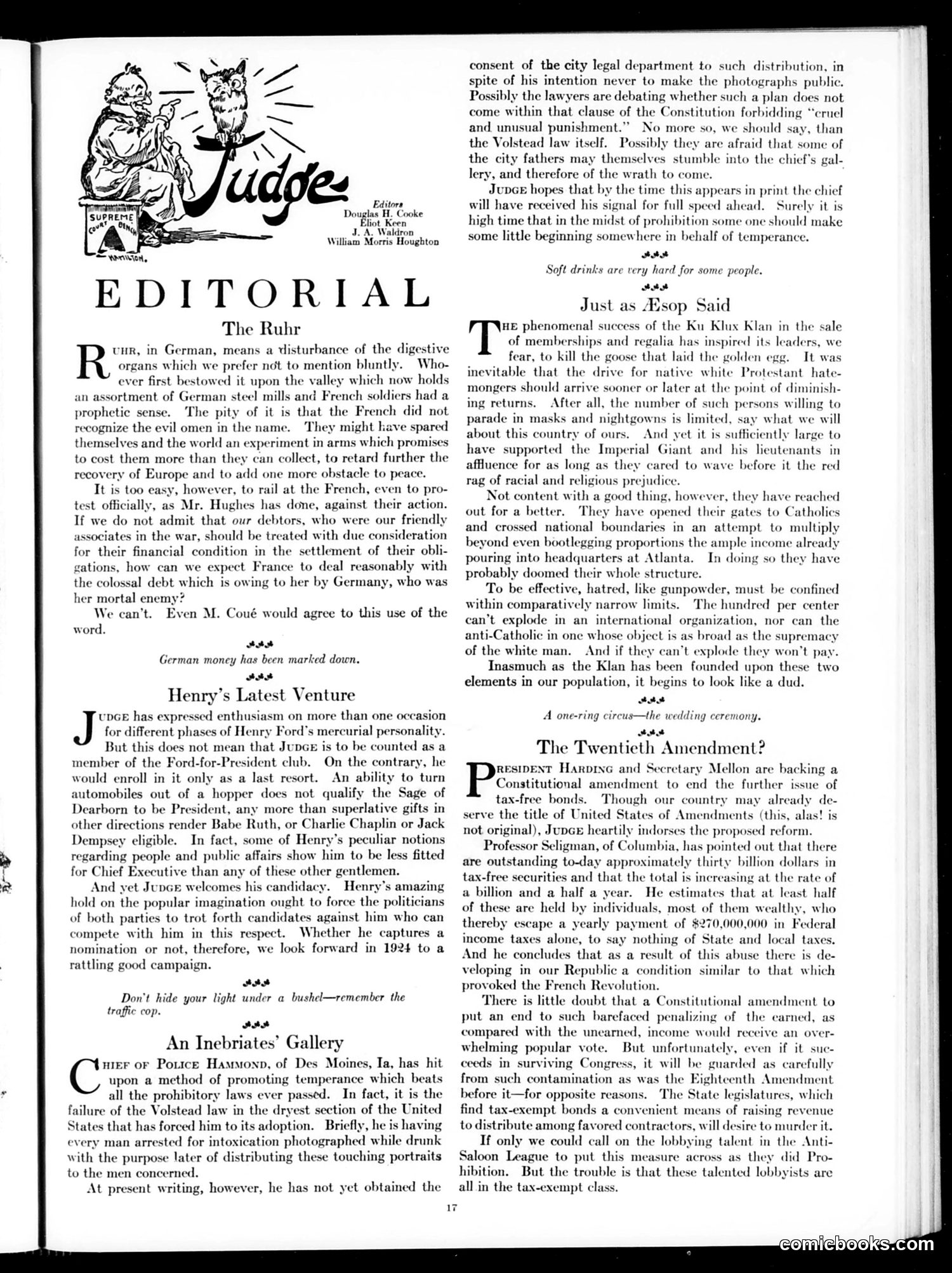
This page contains three editorials critiquing contemporary issues circa 1923-1924: **"The Ruhr"** satirizes French occupation of Germany's industrial region. Judge argues France's military action is counterproductive—costly to France, harmful to European recovery, and hypocritical given America's willingness to forgive Allied war debts while expecting France to forgive German debts. **"Henry's Latest Venture"** discusses Henry Ford's potential presidential candidacy. Judge acknowledges Ford's popular appeal but questions his fitness for office, citing his "peculiar notions." The editorial welcomes his candidacy anyway, hoping it forces both parties to field competitive candidates in 1924. **"An Inebriates' Gallery"** describes Des Moines Police Chief Hammond's scheme: photographing arrested drunk men to shame them into sobriety. Judge supports this creative temperance measure as superior to Prohibition enforcement, while acknowledging legal concerns about "cruel and unusual punishment." The cartoonish masthead depicts Judge as a jester character addressing readers.
📄 Transcribed text from this page (OCR, searchable)
Machine-transcribed from the original scan — historical spelling and the odd misread are preserved.
Waldron William Morris Houghton EDITORIAL The Ruhr unr, in German, means a disturbance of the digestive organs which we prefer ndt to mention bluntly. Who- ever first bestowed it upon the v: which now holds an assortment of C 1 steel mills and French soldiers had a prophetic sense. The pity of it is that the French did not recognize the evil omen in the name. They might k. spared themselves and the world an experiment in arms which promises to cost them more than they can collect, to retard further the recovery of Europe and to add one more obstacle to peace. It is too easy, however, to rail at the French, even to pro- test officially, as Mr. Hughes has done, against their action. If we do admit that our debtors, who were our friendly associates in the war, should be treated with due consideration for their financial condition in the settlement of their obli- gations, how can we expect France to deal reasonably with the colossal debt which is owing to her by Germany, who was her mortal enem; We can’t. E word. n M. Coué would agree to this use of the Rated German money has been marked down. Rad Henry’s Latest Venture upGE has expressed enthusiasm on more than one occasion J for different phases of Henry Ford’s mercurial personalit But this does not mean that JupGe is to be counted a member of the Ford-for-President club. On the contrary, he would enroll in it only as a last resort. An ability to turn automobiles out of a hopper does not qualify the Sage of Dearborn to be President, any more than superlative gifts in other directions render Babe Ruth, or Charlie Chaplin or Jack Dempsey eligible. In fact, some of Henry’s peculiar notions regarding people and public affairs show him to be less fitted for Chief Executive than any of these other gentlemen. And yet Jupce welcomes his candidacy. Henry’s amazing hold on the popular imagination ought to force the politicians of both parties to trot forth candidates against him who can compete with him in this respect. Whether he captures a nomination or not, therefore, we look forward in 1924 to a rattling good campaign. rd Don't hide your light under a bushel—remember the traffic cop. Patel An Inebriates’ Gallery HIEF OF Potice Hammonp, of Des Moines, Ia, has hit upon a method of promoting temperance which beats all the prohibitory laws ever passed. In fact, it is the C failure of the Volstead law in the dryest section of the United States that has forced him to its adoption. Briefly, he is having every man arrested for intoxication photographed while drunk with the purpose later of distributing these touching portraits to the men concerned. At present writing, however, he has not yet obtained the 17 consent of the city legal department to such distribution, in spite of his intention never to make the photographs public. Possibly the law; are debating whether such a plan does not come within that clause of the Constitution forbidding “cruel and unusual punishment.” No more so, we should say, than the Volstead law itself. Possibly they are afraid that some of the city fathers may themselves stumble into the chief's gal- lery, and therefore of the wrath to come. JupGE hopes that by the time this appears in print the chief will have received his signal for full speed ahead. Surely it is high time that in the midst of prohibition some one should make some little beginning somewhere in behalf of temperance. toe Soft drinks are very hard for some people. tot Just as sop Said TT phenomenal success of the Ku Klux Klan in the sale of memberships and regalia has inspired its leaders, we fear, to kill the goose that laid the golden egg. It was inevitable that the drive for native white Protestant hate- mongers should arrive sooner or later at the point of diminish- After all, the number of such persons willing to ing returns. y what we will parade in masks and nightgowns is limited, sa about this country of ours. And yet it is suffic have supported the Imperial Giant and his lieutenants in affluence for as long as they cared to wave before it the red rag of racial and religious prejudice Not content with a good thing, however, they have reached They have opened their gates to Catholics mntly large to out for a better, and crossed national boundaries in an attempt to multiply beyond even bootlegging proportions the ample income already pouring into headquarters at Atlanta. In doing so they have probably doomed their whole structure. To be effective, hatred, like gunpowder, must be confined within comparatively narrow limits. The hundred per center can’t explode in an international organization, nor can the anti-Catholic in one whose object is as broad as the supremacy of the white man. And if they can’t explode they won't pay. Inasmuch as the Klan has been founded upon these two elements in our population, it begins to look like a dud. te A one-ring circus—the wedding ceremony. Rael The Twentieth Amendment? RESIDENT Harpinc and Secretary Mellon are backing a Pierrsictona amendment to end the further issue of tax-free bonds. Though our country may already de- serve the title of United States of Amendments (this, alas! is not original), JupGE heartily indorses the proposed reform. Professor Seligman, of Columbia, has pointed out that there are outstanding to-day approximately thirty billion dollars in tax-free securities and that the total is increasing at the rate of a billion and a half a year. He estimates that at least half of these are held by individuals, most of them wealthy, who thereby escape a yearly payment of $270,000,000 in Federal income taxes alone, to say nothing of State and local taxes. And he concludes that as a result of this abuse there is de- veloping in our Republic a condition similar to that which provoked the French Revolution. There is little doubt that a Constitutional amendment to put an end to such barefaced penalizing of the carned, as compared with the unearned, income would receive an over- whelming popular vote. But unfortunately, even if it suc- ceeds in surviving Congress, it will be guarded as carefully from such contamination as was the Eighteenth Amendment before it—for opposite reasons. The State legislatures, which find tax-exempt bonds a convenient me: aising revenue to distribute among favored contractors, will desire to murder it. If only we could call on the lobbying talent in the Anti- Saloon League to put this measure across they did Pro- hibition. But the trouble is that these talented lobbyists are all in the tax-exempt class. ns of