
Judge, 1923-01-27 · page 30 of 36
Judge — January 27, 1923 — page 30: what you’re looking at
What you’re looking at
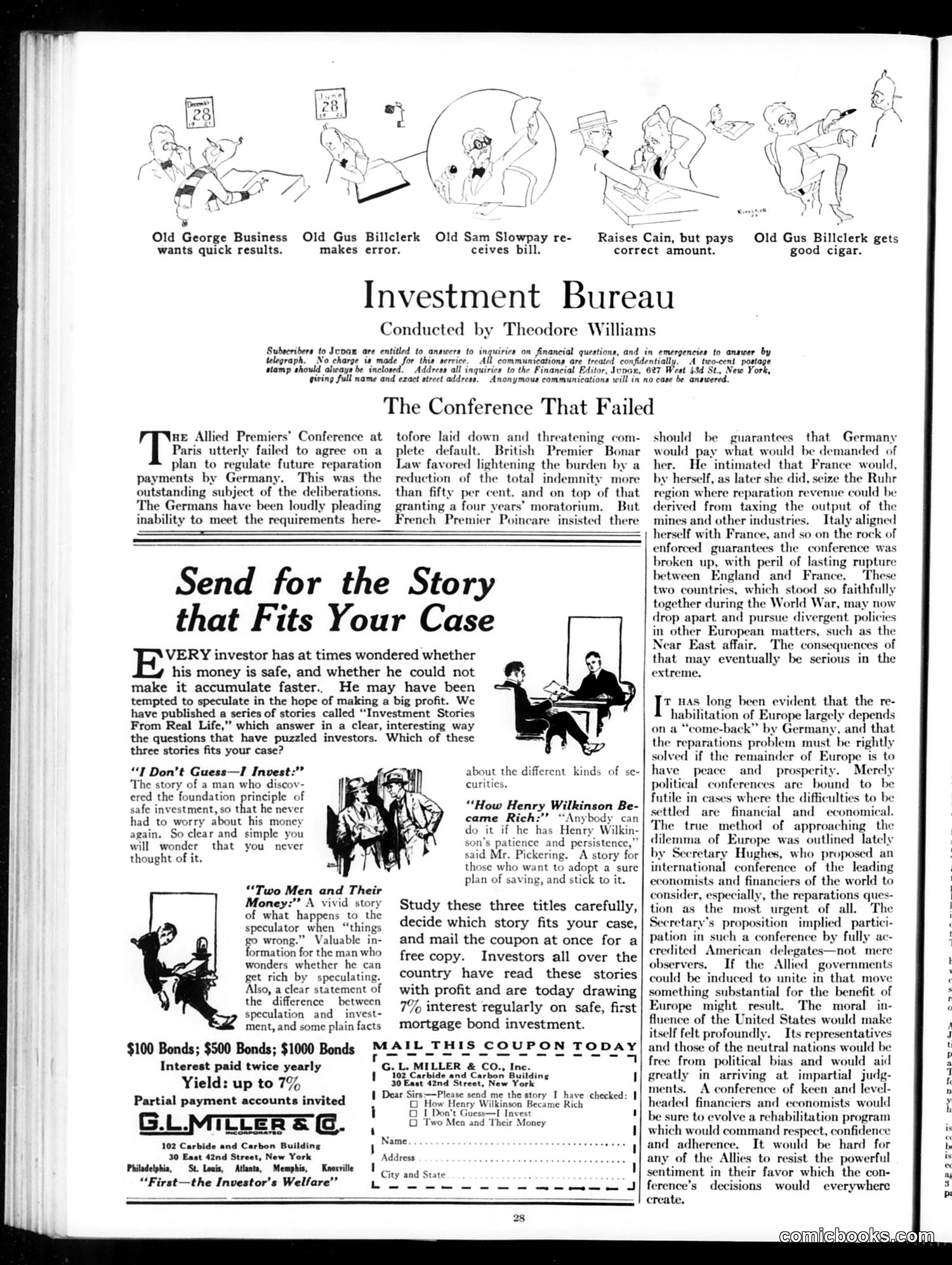
The top of this Judge magazine page contains five cartoon panels satirizing common business frustrations: an impatient boss, a clerk's error, slow payment, complaint followed by payment, and reward for good service. These appear to be generic workplace humor rather than political satire. The main content concerns the 1921 Allied Premiers' Conference in Paris, which failed to agree on German reparations payments after World War I. The article criticizes the breakdown: Germany claimed inability to pay; British Premier Bonar Law wanted to reduce demands by 50% and grant a four-year moratorium; French Premier Poincaré insisted on full payment and (as the text notes) later seized the Ruhr region. Italy "aligned" with France. The piece suggests this disagreement between Britain and France threatened their post-war alliance and risked broader European instability. The remainder is advertising for investment advice stories and G.L. Miller & Co. bonds.
📄 Transcribed text from this page (OCR, searchable)
Machine-transcribed from the original scan — historical spelling and the odd misread are preserved.
Old George Business wants quick results. Old Gus Billclerk Old Sam Slowpay re- makes error. ceives bill. Raises Cain, but pays correct amount. Old Gus Billclerk gets good cigar. Investment Bureau Conducted by Theodore Williams Subveritere fo Sopa are entitled to, answers to inguirice on financial queations, and in emergencies to answer by telegraph. No charge is made for this service. stamp should always be inclosed. Giving full name and exact street address Address all inquiries to the Financial Edii communications are treated confidentially. cpar, 627 Weat $3d St, Anonymous communications will in no case be answer A tieo-cent postage New York, The Conference That Failed r I NueE Allied Premiers’ Conference at Paris utterly failed to agree on a plan to regulate future reparation payments by Germany. This was the outstanding subject of the deliberations. The Germans have been loudly pleading inability to meet the requirements here- tofore laid down and threatening com- plete default. British Premier Bonar Law favored lightening the burden by a reduction of the total indemnity more than fifty per cent. and on top of that granting a four years’ moratorium. But French Premier Poincare insisted there Send for the Story that Fits Your Case VERY investor has at times wondered whether his money is safe, and whether he could not make it accumulate faster.. He may have been tempted to speculate in the hope of making a big profit. We have published a series of stories called “Investment Stories From Real Life,” which answer in a clear, interesting way the questions that have puzzled investors. Which of these three stories fits your case? “I Don’t Guess—I Invest:’” The story of a man who discov- ered the foundation principle of safe investment, so that he never had to worry about his money again. So clear and simple you will wonder that you never thought of it. “Two Men and Their Money:”’ & vivid story of what happens to the speculator when “things go wrong.” Valuable in- formation for the man who wonders whether he can get rich by speculating. Also, a clear statement of the difference between speculation and_ invest- ment, and some plain facts $100 Bonds; $500 Bonds; $1000 Bonds Interest paid twice yearly Yield: up to 7% Partial payment accounts invited G.LMiccERS=G. ! 102 Carbide and Carbon Building 30 East 42nd Street, New York Philadelphia, St. Louis, Atlanta, ~Mempl “First—the Investor’s Welfare” about the different kinds of se- curities. “How Henry Wilkinson Be- came Rich:’’ “Anybody can do it if he has Henry Wilkin- son's patience and persistence,” said Mr. Pickering. A story for those who want to adopt a sure plan of saving, and stick to it. Study these three titles carefully, decide which story fits your case, and mail the coupon at once for a free copy. Investors all over the country have read these stories with profit and are today drawing '% interest regularly on safe, first mortgage bond investment. MAIL THIS SOUPON TOD G.L. MILLER & CO., Inc. 102 Carbide and Carbon Building 30 East 42nd Street, New York 1 Dear Sirs—Please send me the story I have checked © How Henry Wilkinson Became Rich © I Don’t Guess—I Invest O Two Men and Their Money Name Address City and State should be guarantees that Germany would pay what would be demanded of her. He intimated that France would, by herself, as later she did, seize the Ruhr region where reparation revenue could be derived from taxing the output of the mines and other industries. Italy aligned herself with France, and so on the rock of enforced guarantees the conference wi broken up, with peril of lasting rupture between England and France. The: two countries, which stood so faithful together during the World War, may now drop apart and pursue divergent policies in other European matters, such as the Near East affair. The consequences of that may eventually be serious in the extreme. long been evident that the re- ilitation of Europe largely depends rome-back” by Germany, and that the reparations problem must be rightly solved if the remainder of Europe is to have peace d_prosperity. Merely political conferences are bound to be futile in cases where the difficulties to be settled are financial and economical. The true method of approaching the dilemma of Europe was outlined lately sretary Hughes, who proposed international conference of the leading economists and financiers of the world to consider, especially, the reparations ques- tion as the most urgent of all. The Secretary's proposition implied partici- pation in such a conference by fully ac- credited American delegates—not observers. If the Allied governt could be induced to unite in that move something substantial for the benefit of Europe might result. The moral in- fluence of the United States would make itself felt profoundly. Its representatives and those of the neutral nations would be free from political bias and would aid greatly in arriving at impartial judg- ments. A conference of keen and level- headed financiers and economists would be sure to evolve a rehabilitation program which would command respect, confidence and adherence. It would be hard for any of the Allies to resist the powerful sentiment in their favor which the con- ference’s decisions would everywhere create,