
Judge, 1923-01-27 · page 15 of 36
Judge — January 27, 1923 — page 15: what you’re looking at
What you’re looking at
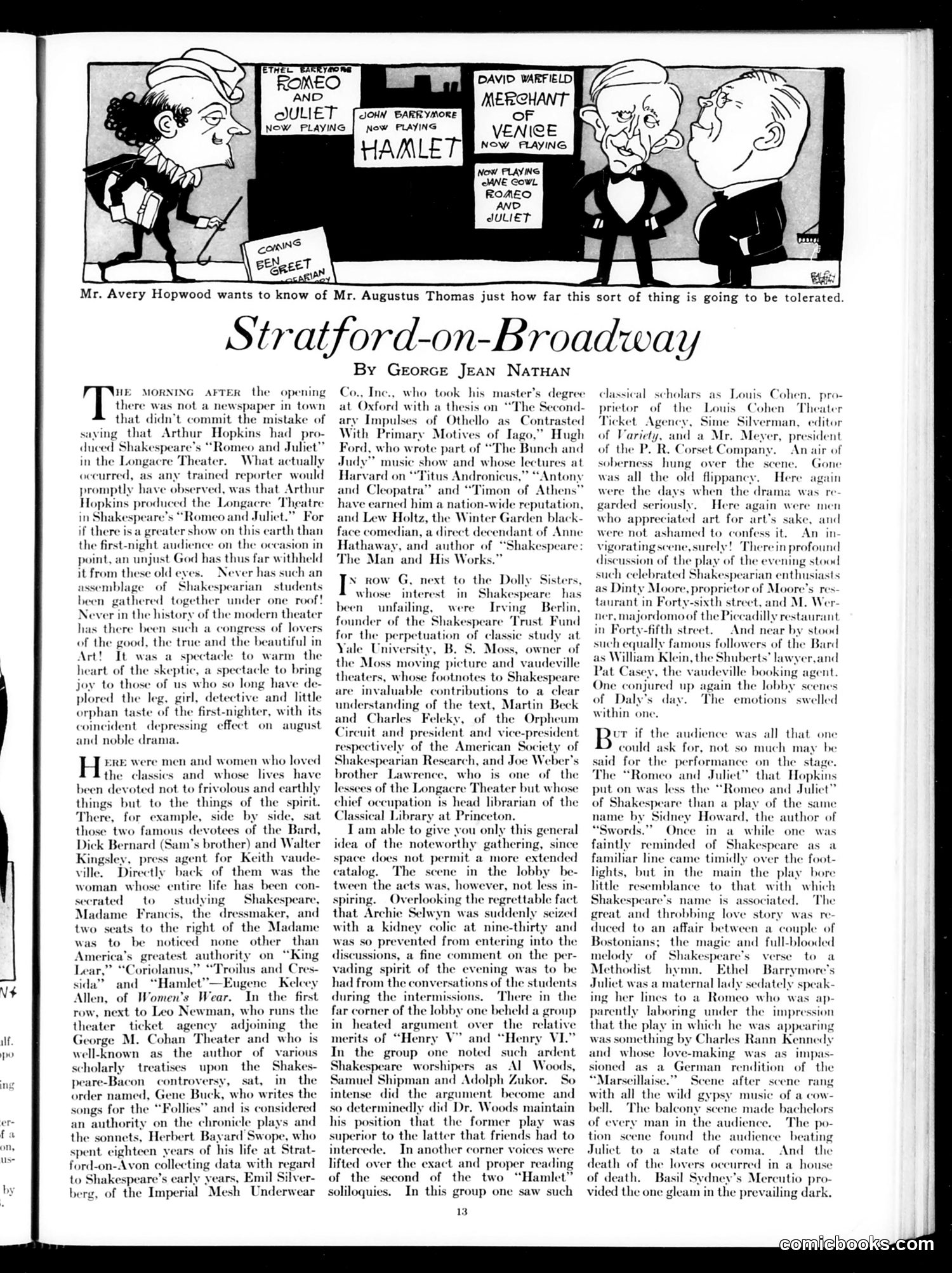
This is a satirical article by George Jean Nathan mocking the pretentiousness of Broadway's opening-night audiences. The cartoon shows theater figures (likely including producer Arthur Hopkins and playwrights Avery Hopwood and Augustus Thomas based on the caption) discussing Shakespeare productions. Nathan's satire targets the absurd juxtaposition of serious Shakespeare with Broadway's commercial world. He sarcastically catalogs attendees claiming deep Shakespearean scholarship—a dressmaker, an underwear manufacturer, songwriters, and comedians—while attributing ridiculous credentials to them (e.g., one spent "eighteen years" at Stratford studying). The joke exposes how Broadway celebrities and businessmen manufactured fake intellectual credibility by attending prestigious productions, and how the theater industry exploited this social climbing to boost ticket sales and prestige. The title "Stratford-on-Broadway" encapsulates the satire: the collision of England's Shakespeare shrine with crass American commercial theater.
📄 Transcribed text from this page (OCR, searchable)
Machine-transcribed from the original scan — historical spelling and the odd misread are preserved.
ulf. po ing ere fa Us- DAVID WARFIELD| MERCHANT OF JOHN BARRYMORE Now PLAYING Now PLAYING Mr. Avery Hopwood wants to know of Mr. Augustus Thomas just how far this sort of thing is going to be tolerated. Stratford-on-Broadway HE MORNING AFTER the opening there was not a newspaper in town that didn’t commit the mistake of saying that Arthur Hopkins had pro- duced Shakespeare's “Romeo and Julie in th re Theater. What actually occurred, as any trained reporter would promptly have observed, was that Arthur Hopkins produced the Longacre Theatre in Shakespeare’s “Romeo and Juliet.” For if there is a greater show on this earth than the first-night audience on the occasion in point, an unjust God has thus far withheld it from these old ey Never has such an assemblage of Shakespearian students been gathered together under one r« Never in the history of the modern theater has there been such a congress of lovers of the good, the true and the beautiful in Art! It was a spectacle to warm the heart of the skeptic, a spectacle to bring joy to those of us who so long have de- plored the leg, girl, detective and little orphan taste of the first-nighter, with its coincident depressing effect. on august and noble drama. H ERE were men and women who loved the classics and whose lives have been devoted not to frivolous and earthly things but to the things of the spirit. There, for example, side by side, sat those two famous devotees of the Bard, Dick Bernard (Sam’s brother) and Walter Kingsley ville. Directly back of them was the woman whose entire life has been con- to studying Shakespeare, the dre: ssmaker, and be notic r none other than s greatest authority on “King ‘oriolanus, ‘oilus and Cres- sida” and “Hamlet”—Eugene Kelcey Allen, of Women’s Wear. In the first row, next to Leo Newman, who runs the theater ticket. agency adjoining the George M. Cohan Theater and who is well-known as the author of various scholarly treatises upon the Shakes- peare-Bacon controversy, sat, in’ the order named, Gene Buck, who writes the songs for the “Follies” and is considered an authority on the chronicl ys and the sonnets, Herbert Bayard Swope, who spent cighteen years of his life at Strat. 1-on-Avon collecting i 1akespeare’s early years, Emil Silver- of the Imperial Mesh Underwear By GeorGe JEAN NaTHAN Co., Inc., who took his master’s degrec at Oxford with a thesis on “The Second- ary Impulses of Othello as Contrasted With Primary Motives of Iago,” Hugh Ford, who wrote part of “The Bunch and Judy” musie show and whose lec tures at Harvard on “Titus Andronicus,” “Antony and Cleopat mon of Athen have earned him a nation-wide reputation, and Lew Holtz, the Winter Garden black- face comedian, a direct decendant of Anne yy, and author of hakespeare ‘The Man and His Works.” I row G, next to the Dolly Sisters, whose interest in’ Shakespeare has been unfailing, were Irving — Berlin, founder of the Shakespeare Trust Fund for the perpetuation of classic study at Yale University, B. Moss, owner of the Moss moving picture and vaud theaters, whose footnotes to are invaluable contributions to a clear understanding of the text, Martin Beck and Charles Feleky, of the Orpheum Cireuit and president. and vice-president respectively of the American Soci Shakespearian Research, and Joe Weber's brother Lawrence, who is one of the lessees of the Longacre Theater but whose chief occupation is head librarian of the Classical Library at Princeton. I am able to give you only this general idea of the noteworthy gathering, since space does not permit a more extended catalog. The scene in the lobby be- tween the acts was, however, not less i spiring. Overlooking the regrett that Archie Selwyn was suddenly se with a kidney colic at nine-thirty was so prevented from entering into the ussions, a fine comment on the per- vading spirit of the ¢ ng was to be had from the conversations of the students during the intermissions. There in the far corner of the lobby one beheld a group in heated argument over the relative merits of “Henry V" and “Henry VI.” In the group one noted such ardent Shakespeare worshipers as Al Woods, muel Shipman and Adolph Zukor. So intense did the argument become and so determinedly did Dr. Woods n Ain his position that the former play was superior to the latter that friends had to intercede. In another corner voices were lifted over the exact and proper reading of the second of the two “Hamlet” soliloquies. In this group one saw such 13 classical scholars as Louis Cohen. pro- prietor of the Louis Cohen Theater Ticket Agency, Sime Silverman, editor of Variety, and a Mr, Meyer, president of the P. R. Corset Company, An air of soberness hung over the » Gor was all the old flippancy. Here again were the days when the drama was rc garded seriously. Here again were men who appreciated art for art's sake, and were not ashamed to confess it. An in- vigorating surely! Therein profound discussion « lay of the evening stood such celebrated Shakespearian enthusiasts as Dinty Moore, proprietor of Moore's res- taurant in Forty-sixth street, and M. Wer- ner, majordomoof the Piccadilly restaurant in Forty-fifth street. And near by stood such equally famous followers of the Bard as William Klein, the Shuberts’ lawyer,and Pat Casey, the vaudeville booking agent. One conjured up again the lobby scenes of Daly’s day. The emotions swelled within one. B' T if the audience was all that one could ask for, not so much may be said for the performance on the stage. The “Romeo and Juliet” that Hopkins put on was less the “Rome 1 Juliet” of Shakespeare than a play of the same name by Sidney Howard, the author of “Swords.” Once in a while one was faintly reminded of Shakespeare familiar line came timidly over the foot- lights, but in the main the play bore little resemblance to that with wh Shakespeare’s name is associated. 'T great and throbbing love story was. re- duced to an affair between a coupl Bostonians; the magic and full-bloc melody of Shakespeare's verse to Methodist hymn, Ethel Barrym Juliet was a maternal lady sedately speak- ing her lines to a Romeo who was ap- boring under the impression yin which he was appearing was something by Charles Rann Kenne and whose love-making was as imp: sioned as a German rendition of the *Marseillaisé Scene after scene rang with all the wild gypsy music o bell. The balcony s of every man in the audience. ‘The po- tion scene found the audience beating Juliet to a state of some And the death of the lovers oceurred in a house of death. Basil Sydney's Mercutio pro- vided the one gleam in the prevailing dark, as a