
A complete issue · 36 pages · 1922
Judge — July 29, 1922
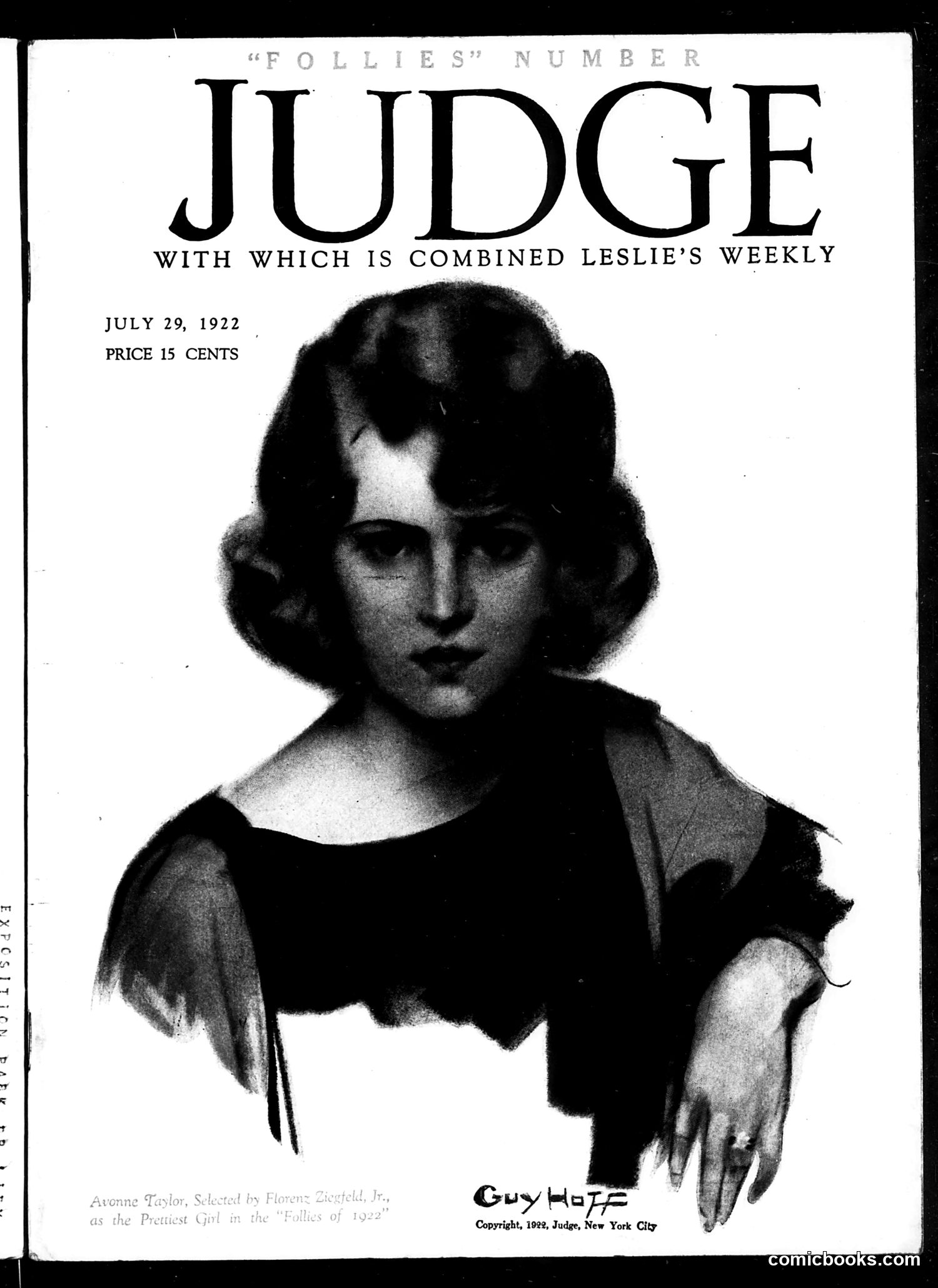
This is primarily a magazine cover featuring a photograph rather than a cartoon. The image shows a young woman with the distinctive short, waved hairstyle of the 1920s ("bob" cut), styled in the fashionable "flapper" aesthetic of that era. The caption credits "Avonne Taylor, Selected by Florenz Ziegfeld, Jr., as the Prettiest Girl in the 'Follies of 1922.'" This references Ziegfeld's famous theatrical revue, a major entertainment spectacle known for showcasing beautiful performers. Judge was using this as cover material to appeal to readers' interest in Broadway culture and contemporary beauty standards of the Jazz Age. The page is primarily promotional rather than satirical.
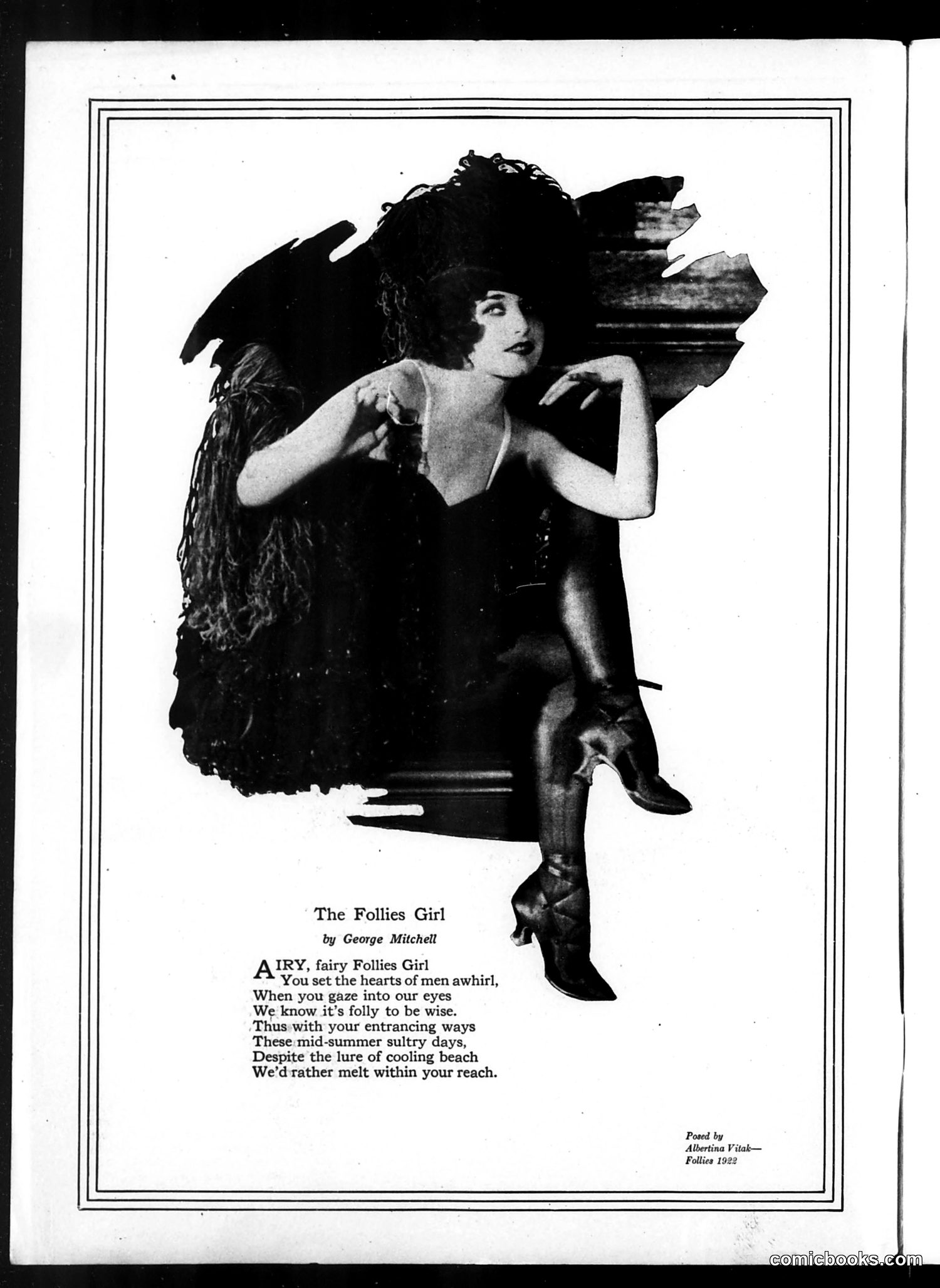
This page from Judge magazine features a poem celebrating the glamorous showgirls of the Ziegfeld Follies, a famous Broadway revue known for elaborate musical productions and beautiful performers. The poem, credited to George Mitchell and read by "Albertina Fitch—Follies 1922," uses romantic language to describe the appeal of these entertainers—their captivating eyes and "entrancing ways" that distract men even on hot summer days. The illustration shows a stylized flapper-era woman in fashionable attire with feathered accessories, embodying the sophisticated theatrical performer. This represents the glamorous "Follies Girl" archetype that was culturally prominent in 1920s entertainment and popular imagination.
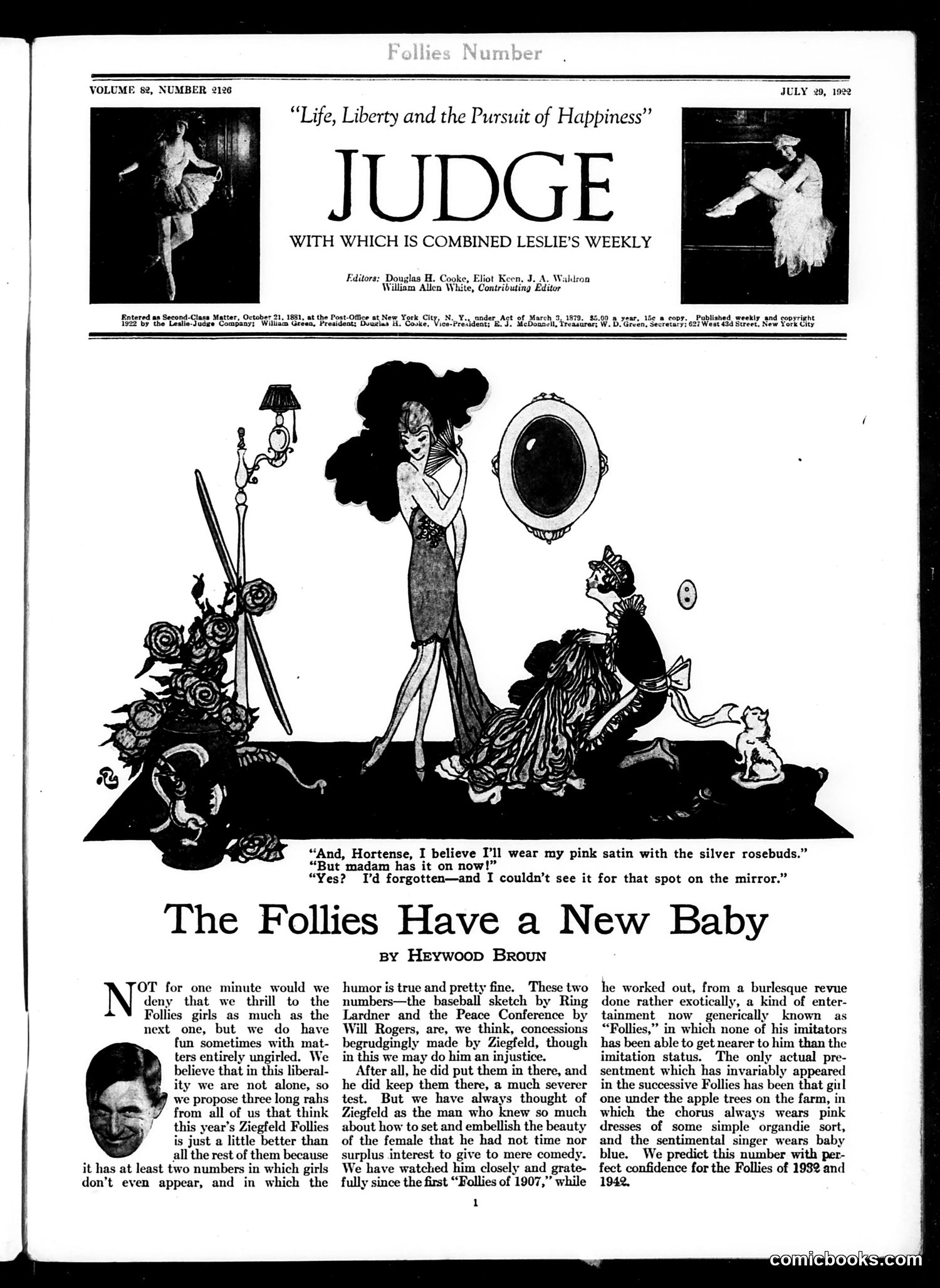
This satirical piece by Heywood Broun celebrates the Ziegfeld Follies theatrical revue. The illustration depicts glamorous showgirls in an art deco style, characteristic of 1920s entertainment publicity. The joke centers on vanity and the theatrical hierarchy: a young performer admires a pink satin dress with silver rosebuds, but an older actress (likely representing "Madame" Ziegfeld or an established star) already wears it. When the younger woman asks to see herself in the mirror, she discovers the established performer is blocking her view of the reflection—a visual metaphor for how established performers monopolize attention and opportunity. The article praises the Follies' artistic merit and production values under impresario Florenz Ziegfeld, suggesting even comedy numbers demonstrate sophistication. It references earlier Follies productions from 1907 onward, positioning 1932's edition as continuing that prestigious legacy.
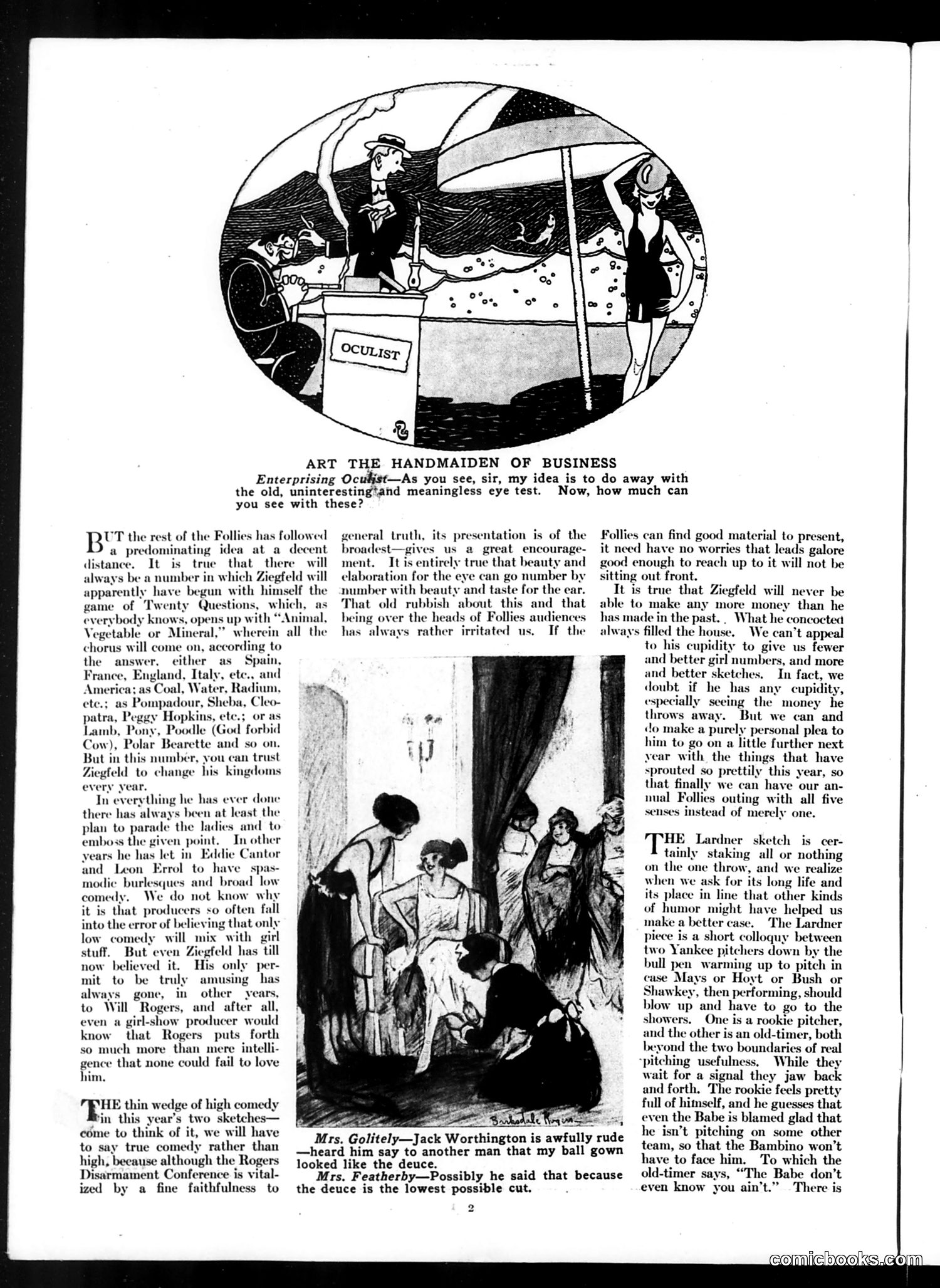
The top cartoon mocks a charlatan "oculist" (eye doctor) running a beach con-game, charging customers for fake eye tests using worthless spectacles—a dig at fraudulent medical practitioners exploiting the public. The lower illustration, captioned "Mrs. Galitely" and "Mrs. Featherby," shows two society women gossiping, with dialogue about a man's "ball gown" looking like "the deuce" and comments about a "deuce" being "the lowest possible card." This appears to satirize high-society women's shallow gossip and their tendency to demean men through catty remarks. The article criticizes Florenz Ziegfeld's theatrical productions, arguing his emphasis on visual spectacle over substance has corrupted artistic merit—a commentary on commercialism overtaking genuine art in entertainment.
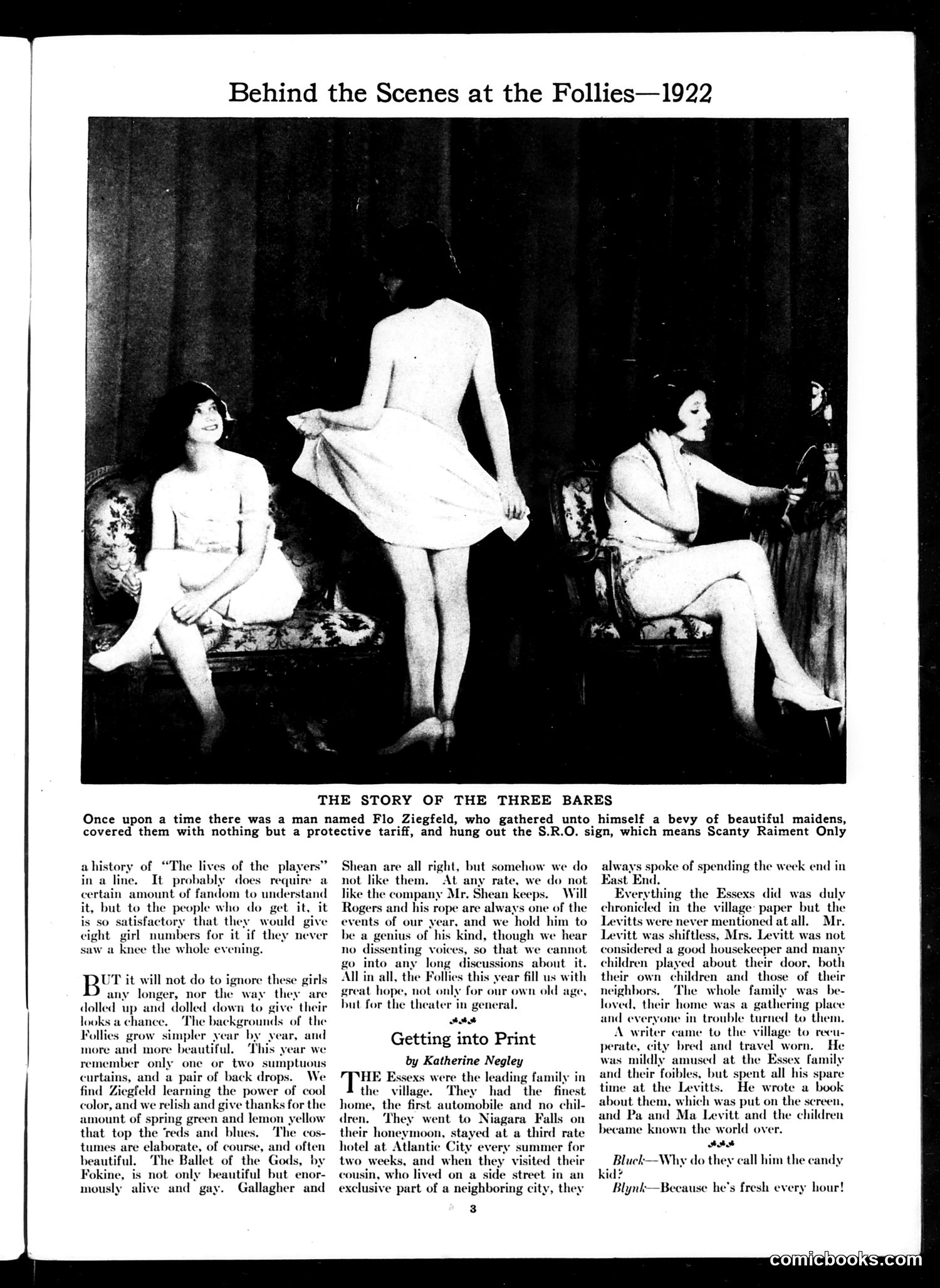
This page features a theatrical photograph titled "The Story of the Three Bares," depicting three women in various states of undress backstage at the Follies, a famous Broadway revue known for elaborate musical productions. The accompanying article discusses Flo Ziegfeld, the real impresario who ran the Follies, and his practice of hiring beautiful women as performers. The text humorously describes these dancers as "S.R.O." (Standing Room Only) attractions, playing on the theatrical term. The joke relies on 1920s audiences' fascination with Broadway entertainment and the scandalous appeal of the Follies' famous chorus girls. The satire gently mocks both Ziegfeld's star-making reputation and contemporary entertainment culture's focus on female beauty as spectacle.
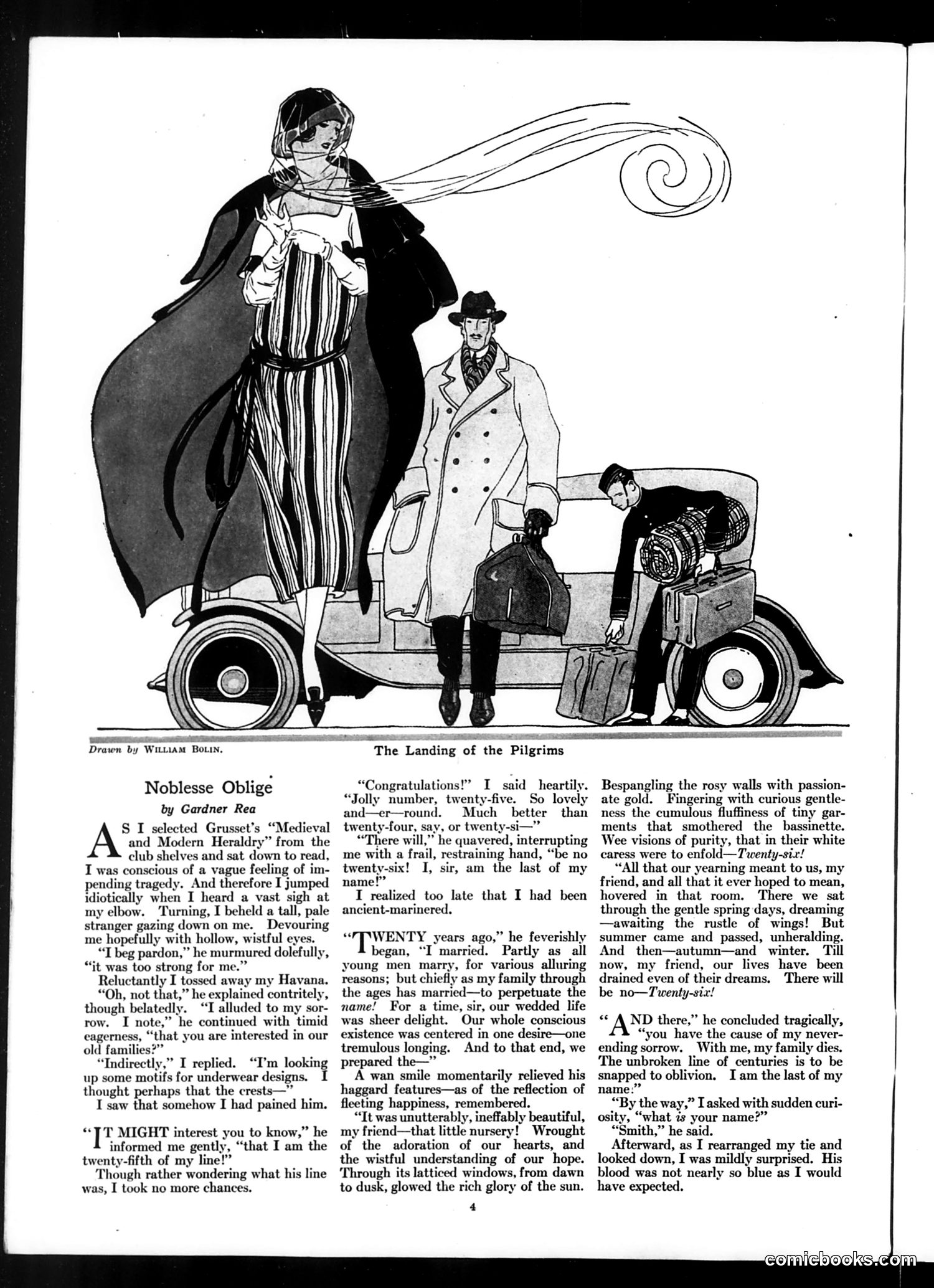
This page contains an illustration titled "The Landing of the Pilgrims" by William Bolin (top) and a short story called "Noblesse Oblige" by Gardner Rea (below). The cartoon appears to be a modernist reimagining of the Pilgrim landing, depicting a woman in classical robes standing atop an automobile filled with luggage and male passengers. The swirling decorative element suggests movement or arrival. This likely satirizes early 20th-century tourism or immigration—presenting the historical "Pilgrims" as contemporary travelers arriving by motorcar rather than ship, mocking either wealthy travelers' pretensions or contemporary attitudes toward newcomers. The juxtaposition of classical imagery with modern technology was a common satirical device in this era. The story text appears unrelated to the cartoon's apparent commentary.
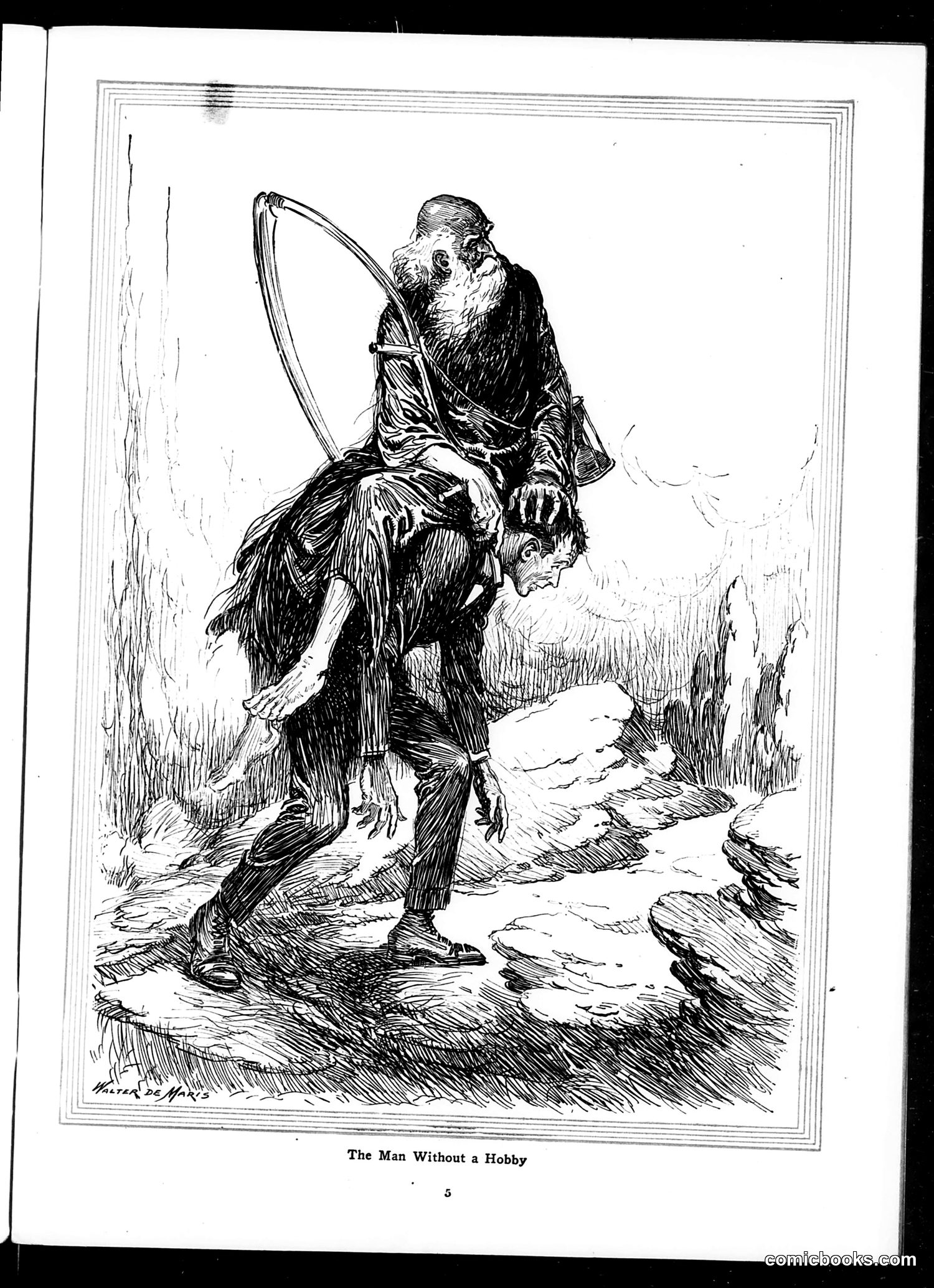
This political cartoon satirizes a figure portrayed as aimless and unproductive. The bearded man, depicted with exaggerated features in a caricatured style, is shown fishing with a child on his shoulders—yet appears listless and unfocused in his leisure activity. The title's wordplay suggests the cartoon criticizes someone lacking direction or purpose, a common satirical trope in *Judge* magazine. The fishing scene likely represents wasted time or idle pursuits rather than meaningful engagement. The child accompanying him may symbolize dependents or responsibilities being neglected. Without additional context about the specific historical moment or public figure this targeted, the exact political reference remains unclear, but the satire clearly mocks idleness and lack of ambition—values *Judge's* readership would have disapproved of.
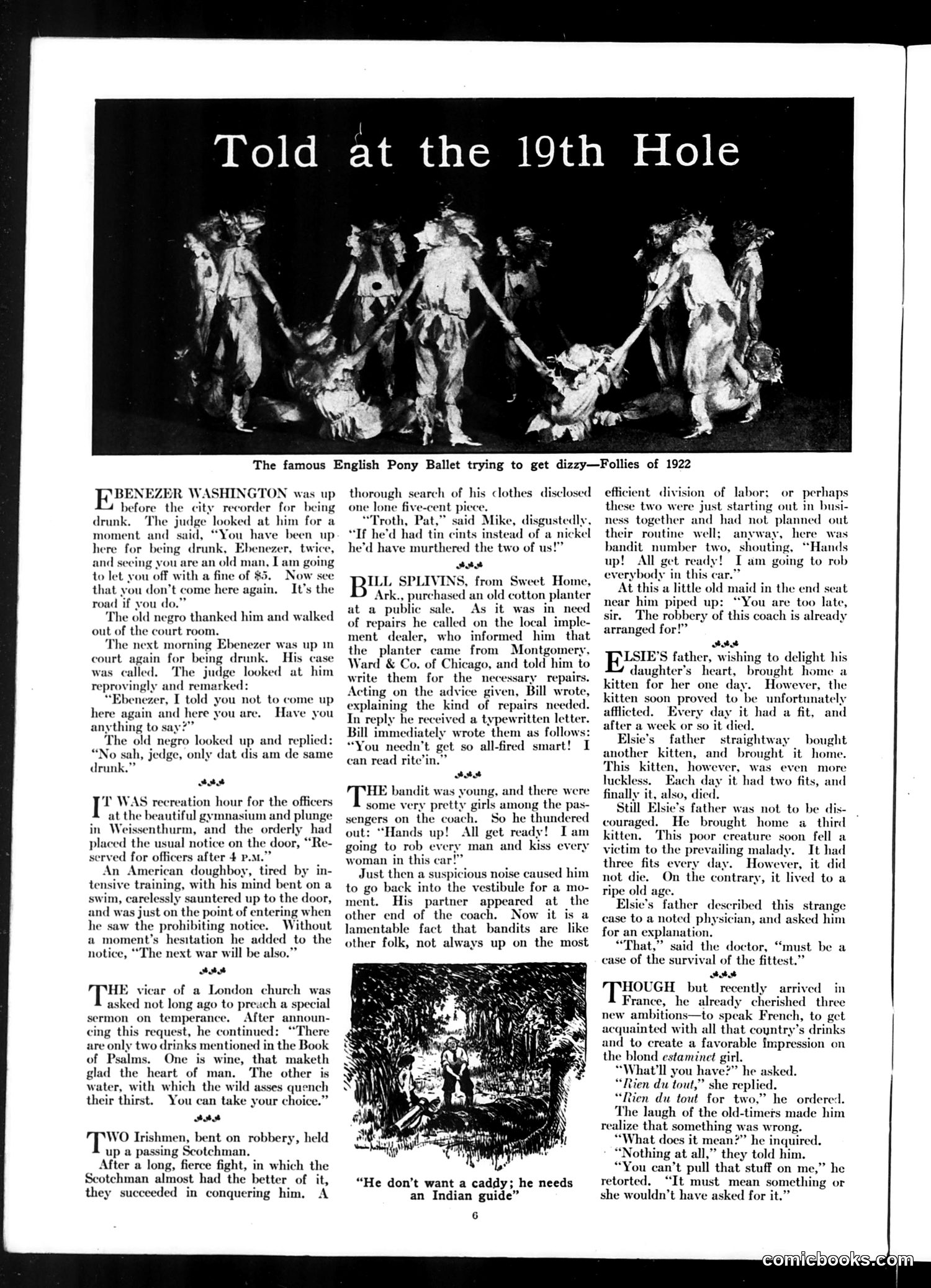
This page collects humorous anecdotes told in the informal setting of a golf club's 19th hole (the bar). The content includes: **Main stories:** - A repeat offender (named with a racial stereotype) claims he's the "same drunk" when arrested again - An American soldier adds sarcastic graffiti to an officers-only notice - A London vicar's temperance sermon offering wine or water as biblical choices - Irish robbers struggling with a Scotsman - A Southern farmer unable to communicate with Montgomery Ward about repairs - A young bandit's robbery interrupted by his partner's incompetence **The cartoon** shows performers in the "Follies of 1922" (a Broadway revue) dressed as ponies attempting choreography. The humor relies on wordplay, dialect jokes (particularly Irish and African American speech patterns), and situational comedy. These represent typical 1920s popular magazine humor—accessible, often relying on ethnic stereotypes now considered offensive, and focused on everyday mishaps and misunderstandings.
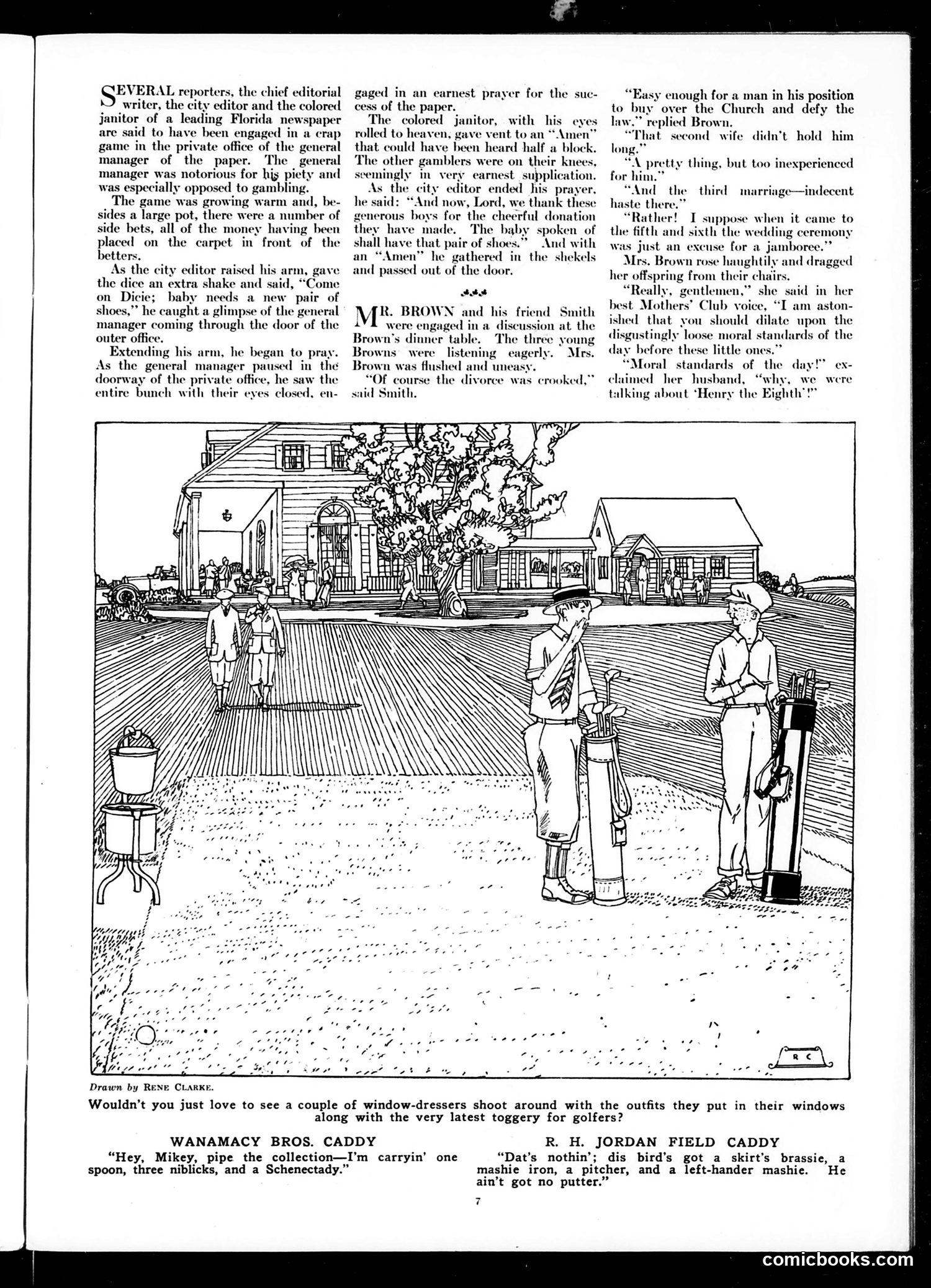
This page contains two satirical cartoons from Judge magazine: **Top cartoon**: Reporters and a janitor are caught gambling in a newspaper office by the pious general manager. They quickly disguise their craps game as prayer, fooling him into thinking they're piously fundraising for the paper. The satire mocks hypocrisy—both the manager's sanctimonious opposition to gambling and the gamblers' quick-thinking deception. **Bottom cartoons**: Two brief golf caddy jokes playing on the terminology of women's fashion ("brassie," "skirt") applied to golf clubs and equipment. The humor relies on double meanings—caddy lists gear that sounds absurd when mixed with female undergarments and clothing terms. The page also includes an advertisement about window dressing displays. The overall tone reflects early-20th-century American satire targeting workplace hypocrisy, office culture, and contemporary leisure pursuits like golf.
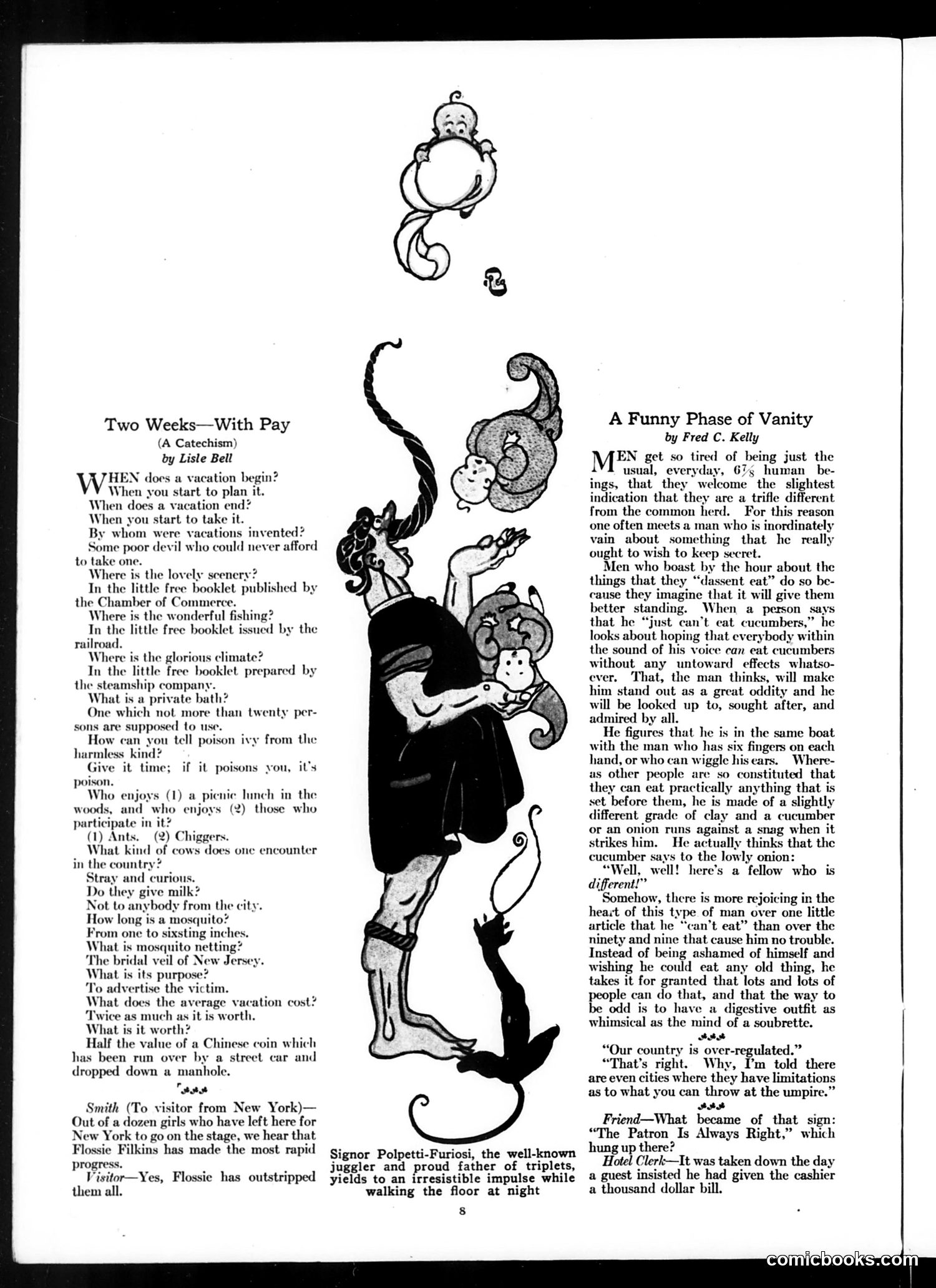
This page contains two satirical pieces from *Judge* magazine: **"Two Weeks—With Pay"** is a humorous Q&A that mocks American vacation culture. It ridicules the gap between vacation marketing and reality: beautiful scenery exists only in promotional brochures from chambers of commerce, while actual vacations involve uncomfortable accommodations ("private baths" shared by twenty people), insects, and costs double their actual worth. The humor targets both the tourism industry's deceptive advertising and vacationers' gullible expectations. **"A Funny Phase of Vanity"** satirizes men who boast about dietary restrictions they can't eat (cucumbers, onions) to appear unique or distinguished. Kelly mocks their vanity—they imagine these limitations make them peculiarly interesting, when actually most people have no such restrictions. The piece ridicules how people seek distinction through trivial personal quirks rather than genuine accomplishments. Both articles critique American social pretension and the gap between self-image and reality—common *Judge* themes targeting middle-class vanity.
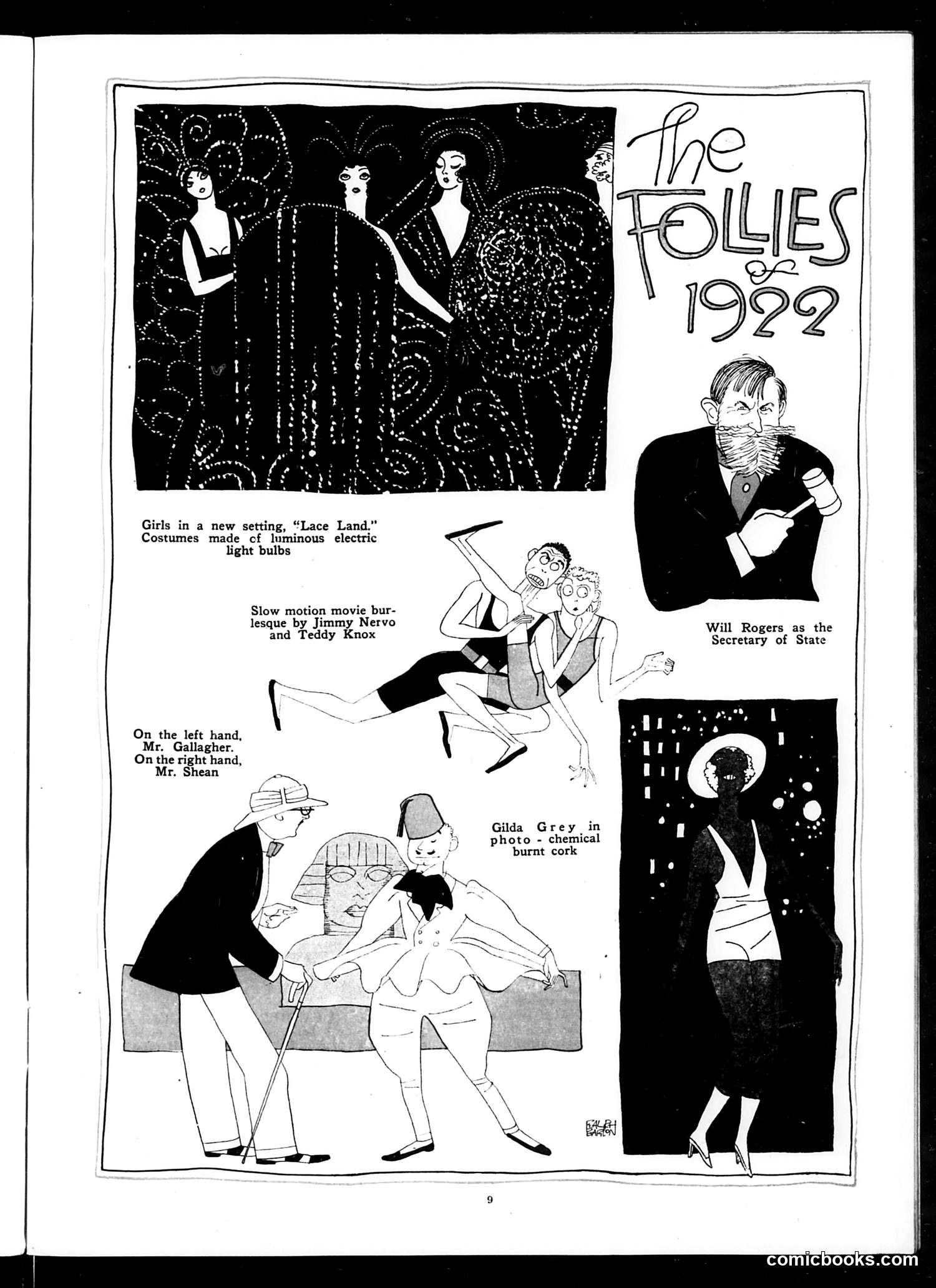
This page showcases theatrical acts and performances from the Ziegfeld Follies of 1922. The top image depicts "Lace Land," featuring chorus girls in costumes made of luminous electric light bulbs—a novelty effect highlighting the spectacular stage technology of the era. Below are vignettes of featured performers: Jimmy Nervo and Teddy Knox performing a slow-motion burlesque; Gallagher and Shean (a popular comedy duo); and dancer Gilda Grey. The Will Rogers portrait likely refers to the famous entertainer and social commentator appearing in the production. The "burnt cork" reference to Gilda Grey indicates blackface performance—a deeply offensive but common theatrical practice in 1920s entertainment that modern audiences would find shocking and unacceptable.
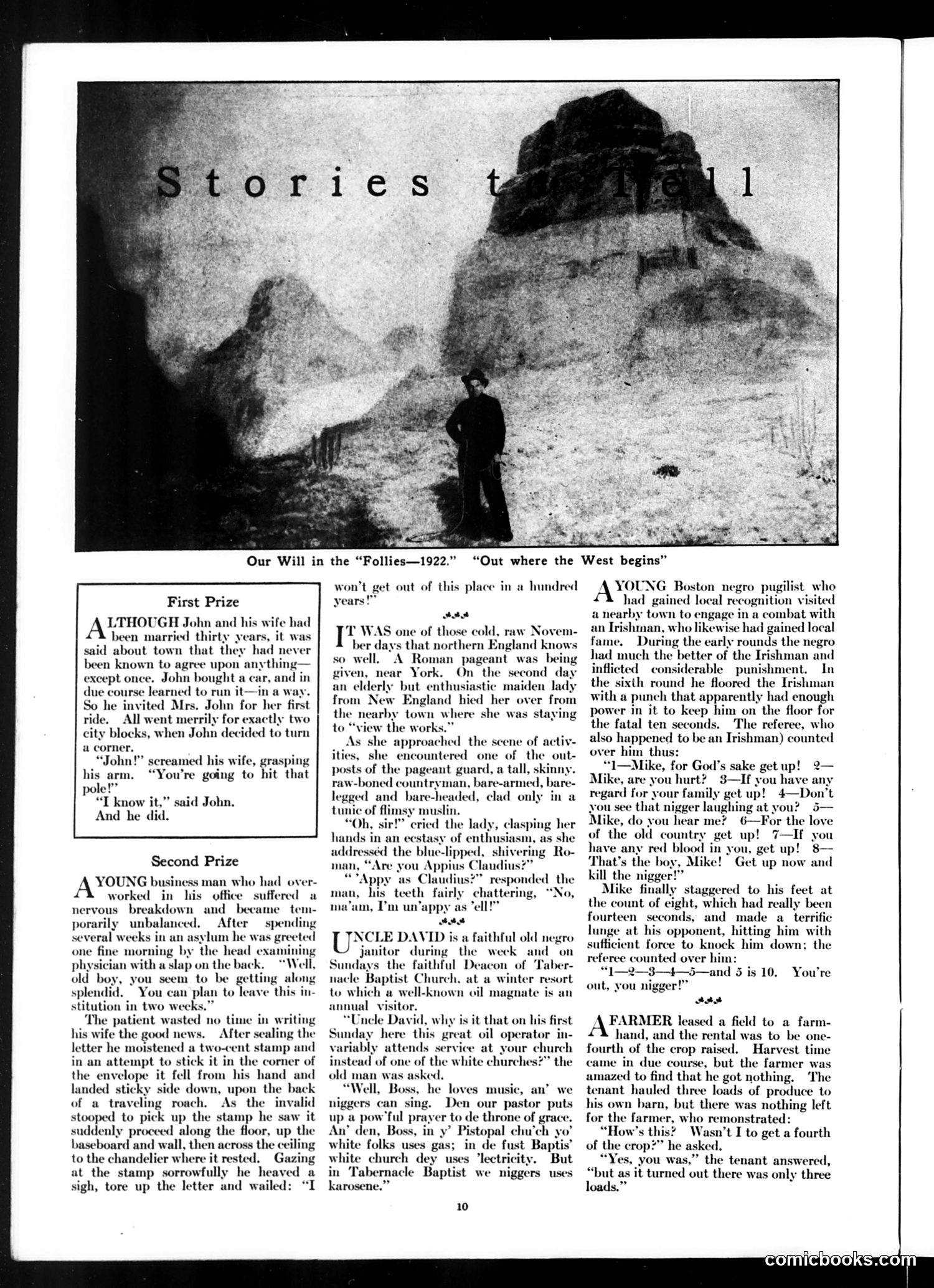
This page from *Judge* magazine contains three short humorous stories with racist and ethnic stereotypes typical of 1922 American satire. The "First Prize" and "Second Prize" sections are brief comic anecdotes: one about a husband deliberately hitting a pole despite his wife's warning; another about a mentally ill man whose escaped postage stamp ruins his chance at early discharge. The longer piece, "Our Will in the 'Follies—1922,'" depicts racist scenarios: a New England woman encounters a barely-clothed Roman pageant performer; a story contrasts Black and Irish characters in patronizing dialect; and a narrative describes a boxing match where an Irish referee deliberately miscounts to favor an Irish fighter over a Black opponent, using racial slurs throughout. The satire targets immigrant and minority groups through caricature and dehumanizing language. These pieces reflect *Judge*'s editorial stance: mocking marginalized populations was considered acceptable humor for the magazine's presumed white, educated audience. The content reveals deeply embedded prejudices of the era that would be considered offensive and unacceptable today.
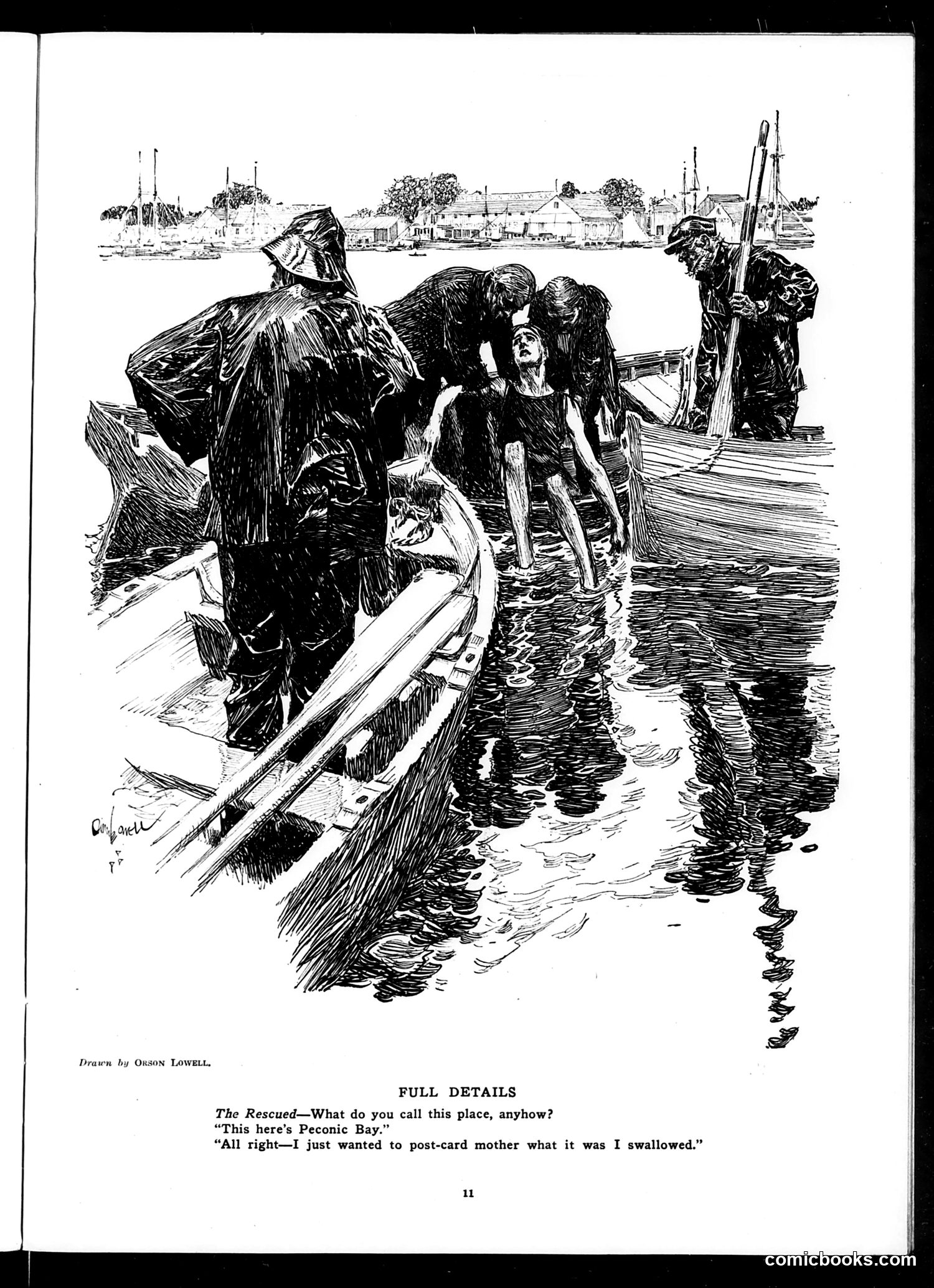
This is a humorous illustration by Orson Lowell depicting a rescue scene at Peconic Bay (a real location on Long Island). The joke centers on a rescued person asking where they are so they can send a postcard to their mother describing "what it was I swallowed"—implying they nearly drowned and ingested water from this bay. The humor is straightforward physical comedy: the rescued person wants to document their near-death experience by identifying the specific body of water that almost killed them. It's a lighthearted take on a potentially serious maritime accident, typical of Judge's satirical approach to contemporary events. The detailed pen-work captures the dramatic rescue with multiple figures in and around boats.
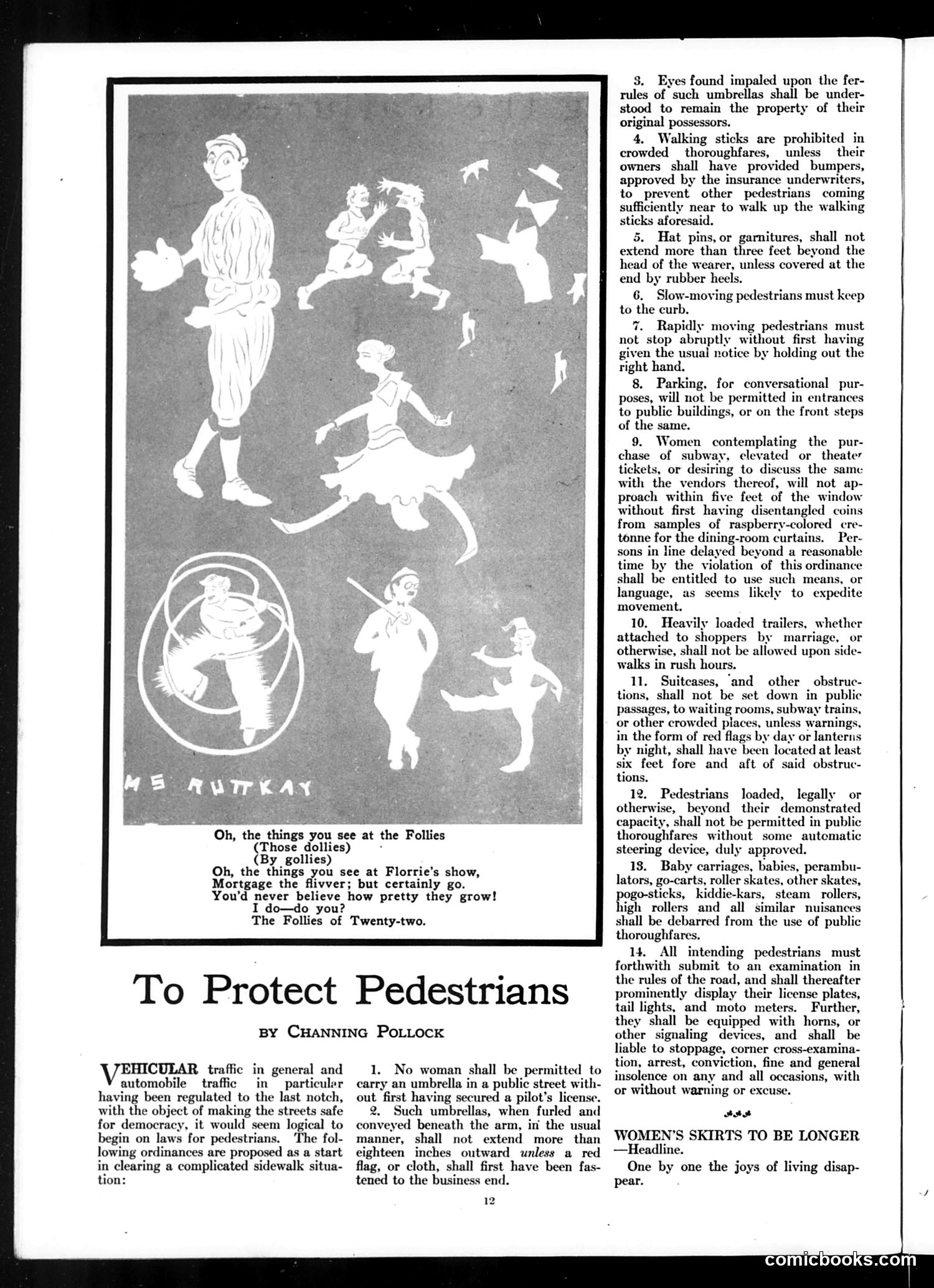
This 1922 Judge magazine piece satirizes the explosion of automobiles and resulting street congestion by proposing absurdly strict pedestrian regulations—a humorous reversal of the era's actual traffic laws targeting vehicles. The cartoon shows stylized figures from the Follies (a famous Broadway revue), illustrating urban crowds. The accompanying article by Channing Pollock mocks pedestrians as chaotic obstacles by proposing ridiculous "solutions": women need pilot's licenses for umbrellas, hat pins require rubber safety tips, people shopping need coin-disentangling time, baby carriages warrant bans, and pedestrians must display license plates like automobiles. The joke targets the absurdity of applying strict motor-vehicle regulations to human foot traffic. It's satirizing both the mechanical complexity of modern city life and the era's assumption that more rules could solve urban problems. The piece comments on how quickly automobiles had transformed city streets into contested spaces requiring extensive regulation—with pedestrians now treated as a hazard requiring bureaucratic control.
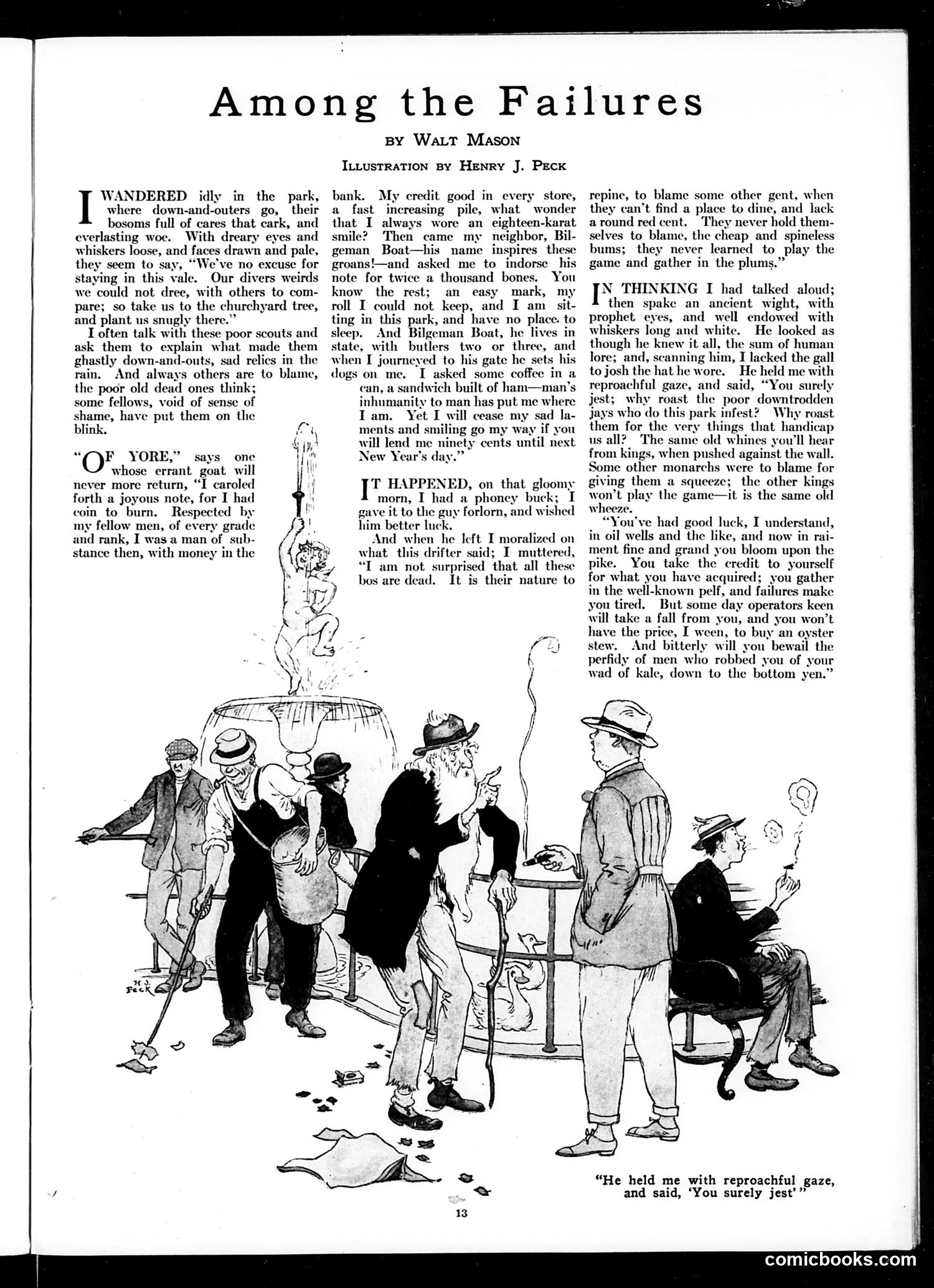
This is a morality tale about wealth, misfortune, and hypocrisy. The narrator encounters a homeless man in the park who blames his poverty on a neighbor, "Bilgeman Boat," who failed to repay a loan and thus ruined him. The narrator dismisses the vagrant as a typical failure who blames others rather than taking responsibility. However, an elderly "prophet" figure confronts the narrator's smugness, arguing that the homeless and wealthy alike make excuses—kings blame others when squeezed, just as paupers do. The prophet warns that the narrator's own fortune may reverse, and he'll then understand that misfortune isn't always one's own fault. The satire targets **self-righteous prosperity**: the smugness of successful people who attribute their wealth to virtue while dismissing the poor as morally deficient. Mason suggests luck and circumstance matter as much as character.
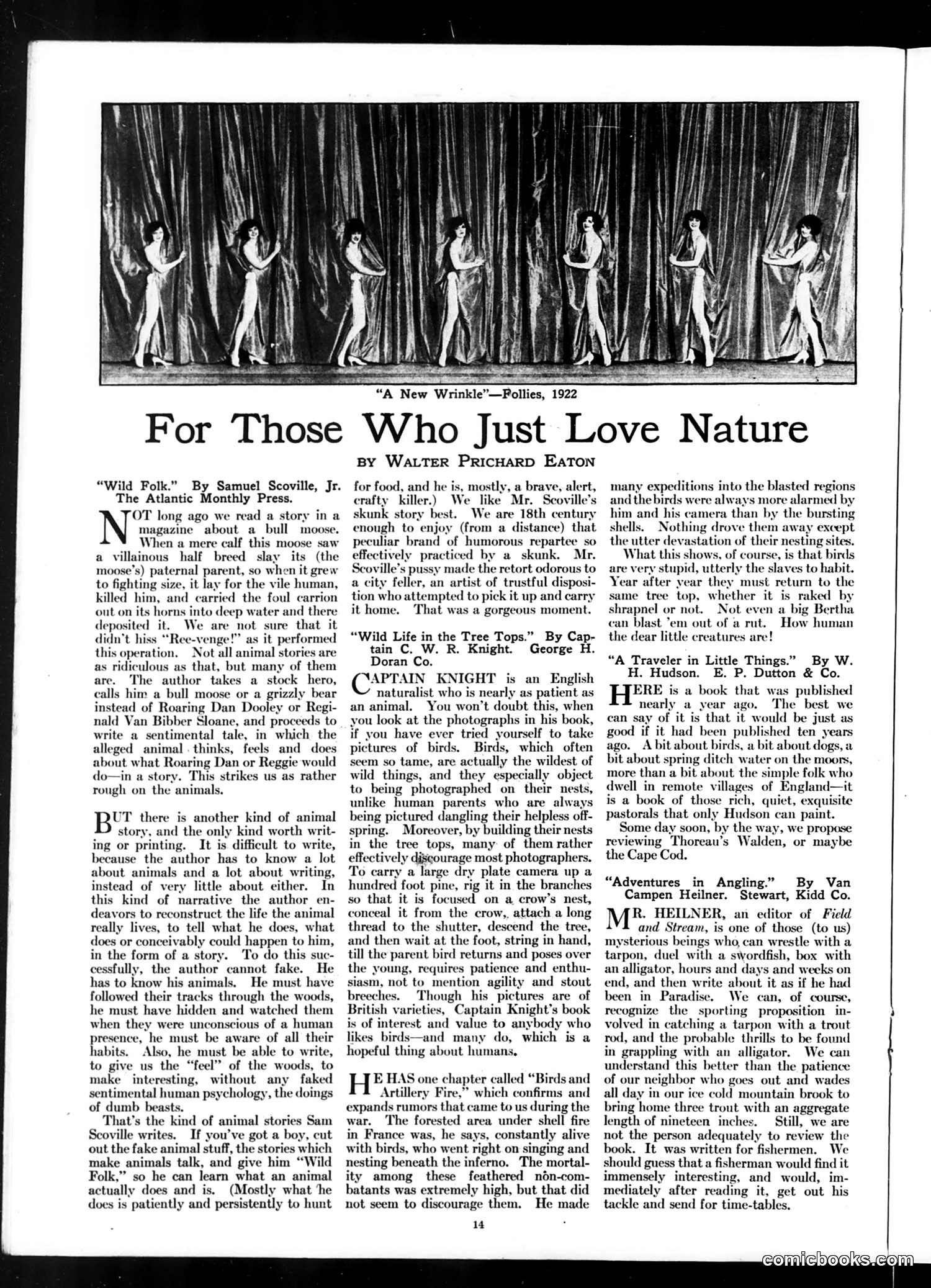
The image shows a chorus line of women in 1920s-style theatrical costumes and poses, representing a scene from the Follies production "A New Wrinkle." The text below is a book review section by Walter Prichard Eaton critiquing contemporary animal literature. Eaton distinguishes between two types of animal stories: 1. **Fake animal tales** that anthropomorphize creatures, giving them human thoughts and emotions (criticized as inauthentic) 2. **Authentic nature writing** by authors like Samuel Scoville Jr. and Captain C.W.R. Knight, who observe animals' actual behaviors through patient fieldwork The satire targets sentimental, dishonest animal fiction popular in the era—stories where moose or bears think and act like human protagonists. Eaton argues genuine animal stories require real knowledge of wildlife, not romantic projection. He particularly praises Scoville's unglamorous depiction of animals as "brave, alert, crafty killer[s]" focused on survival. The theatrical image likely illustrates the artificiality Eaton critiques—staged, choreographed nature versus authentic observation.
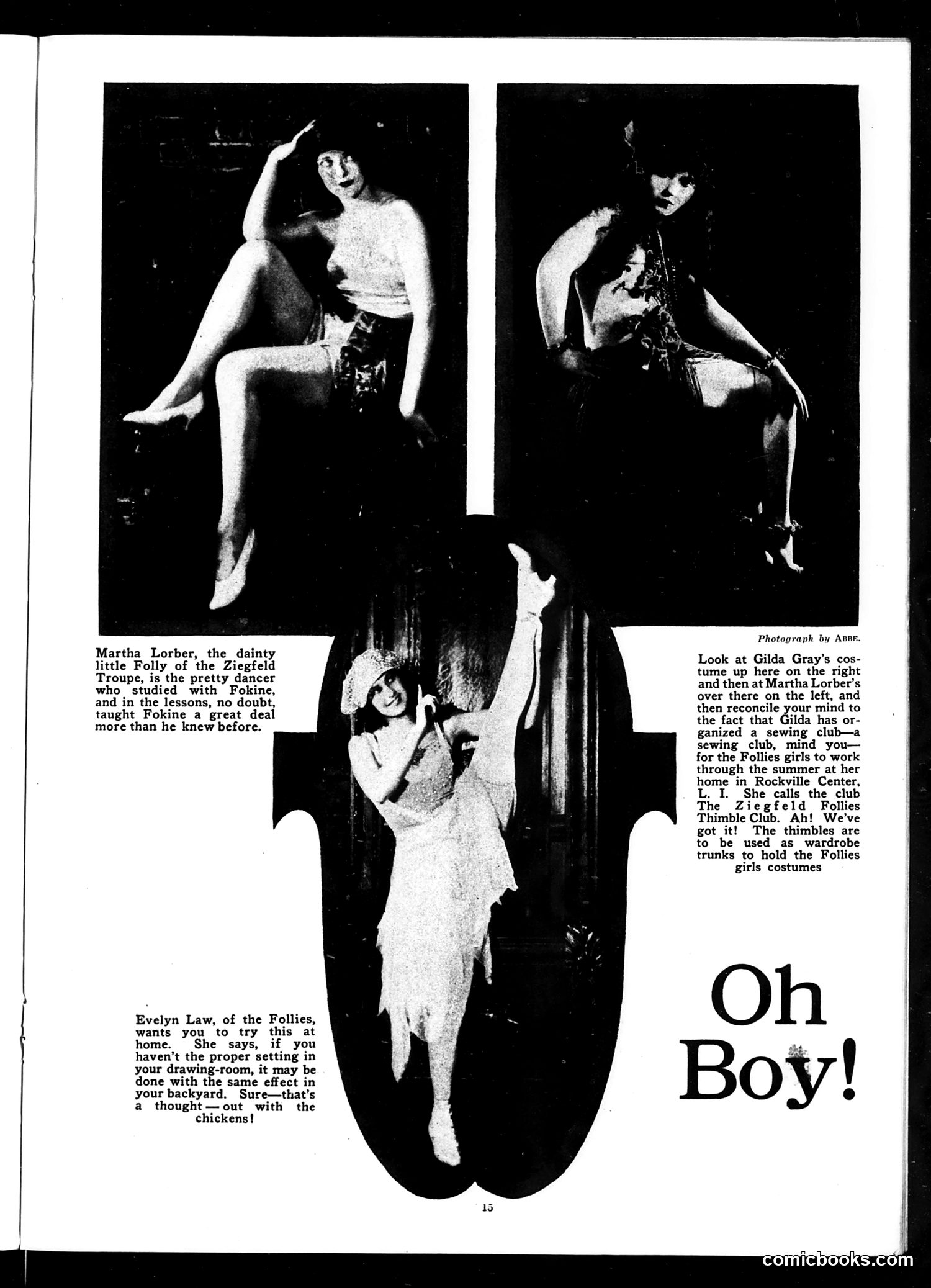
This page mocks the Ziegfeld Follies dancers and their minimal costumes through humorous commentary. Three photographs show performers from the famous revue: Martha Lorber, Evelyn Law, and Gilda Gray. The satire operates on two levels: 1. **The costume joke**: The text sarcastically notes the dancers' extremely skimpy attire—suggesting thimbles (sewing notions) could serve as "wardrobe trunks" because the costumes are so small. 2. **The ridiculous cover story**: It lampoons Gilda Gray's claimed "sewing club" for Follies girls at her home as an absurdly transparent euphemism, given how little clothing these performers actually wear. The "Oh Boy!" headline signals the magazine's mock-scandalized tone toward the Follies' famous risqué nature. This reflects 1920s public fascination with—and disapproval of—the revue's daring, semi-nude dancing that pushed moral boundaries of the era.
This page contains three satirical editorials by William Allen White: **"Once Upon a Time"** mocks the decline of German imperial power. Former Emperor William II's ornate carriages are being auctioned in Holland as curiosities—once symbols of authority that commanded respect, now relegated to museum status. White uses this as a meditation on monarchy's obsolescence in the modern democratic world, suggesting that WWI ("bang went the pistol that killed the Serbian grand duke") shattered the illusion that kings could maintain relevance in modern times. **"The Summer's Persiflage"** satirizes Senate behavior, comparing it to prizefighting. Senators exchange insults ("JAR!" "Falsifier!") rather than conducting serious legislative debate. White suggests the direct primary system has transformed the once-exclusive "rich men's club" into a spectacle of political theater, where physical vigor and rhetoric matter more than intellect. **"The Admonitions of McCumber"** critiques Senator McCumber's plea to tariff profiteers for restraint. White sarcastically suggests McCumber imagines profiteers will voluntarily share profits with customers—a naive fantasy that ignores economic self-interest.
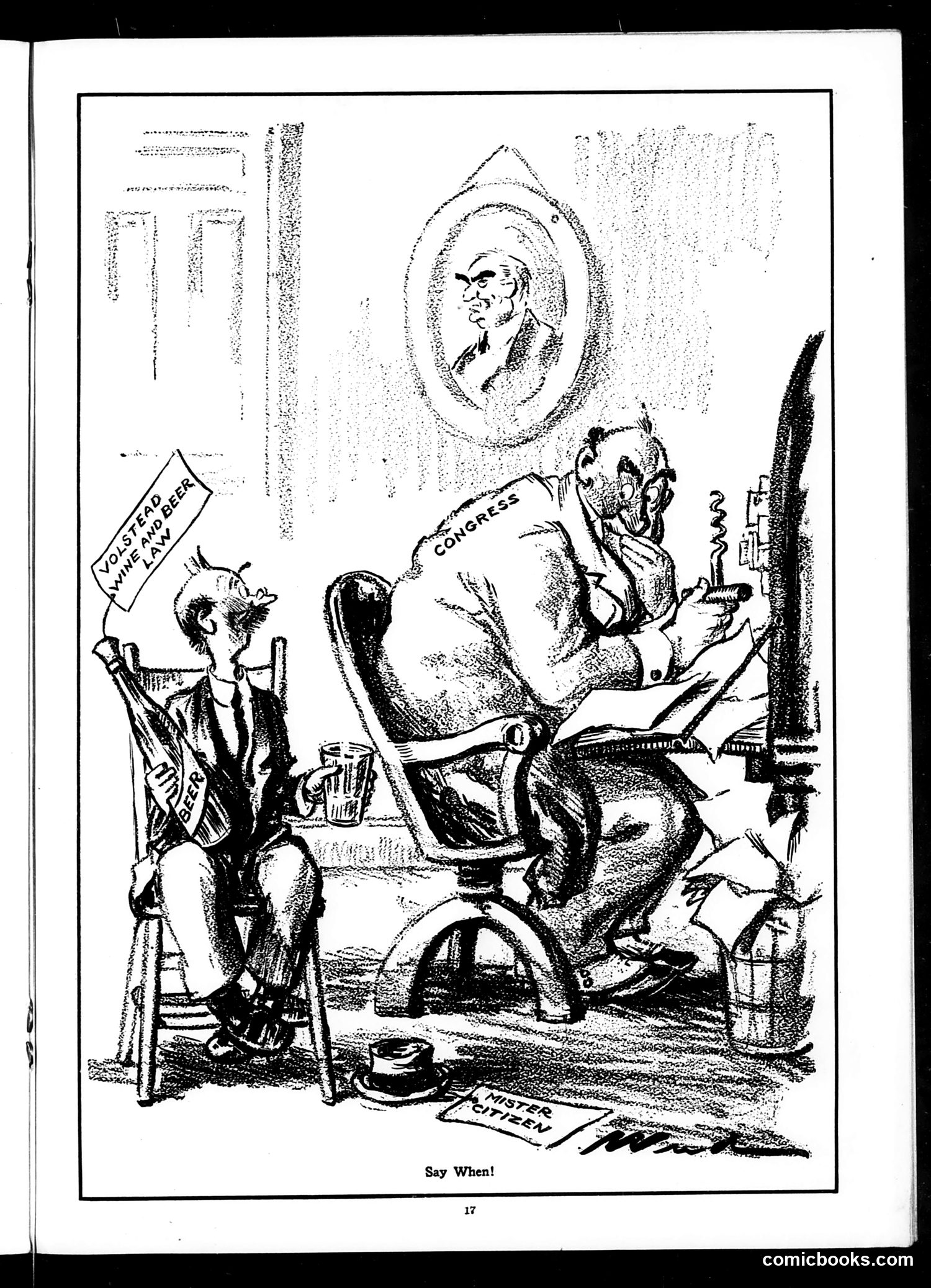
This Judge magazine cartoon satirizes **Congress** and its spending habits. A bloated figure labeled "Congress" sits in a chair, being fed money by a caricatured man (likely representing a taxpayer or citizen). The Congress figure holds documents and appears gluttonous, suggesting wasteful spending or fiscal excess. The phrase "Say When!" is the caption—implying the taxpayer is asking Congress to indicate when it will stop consuming funds. A portrait hangs above (possibly a founding father or historical figure), appearing to witness this excess disapprovingly. The cartoon critiques **congressional fiscal irresponsibility** and the burden placed on taxpayers to fund government spending. The man on the left holds a banner reading "VOTER AND TAXPAYER," emphasizing whose money is being consumed.
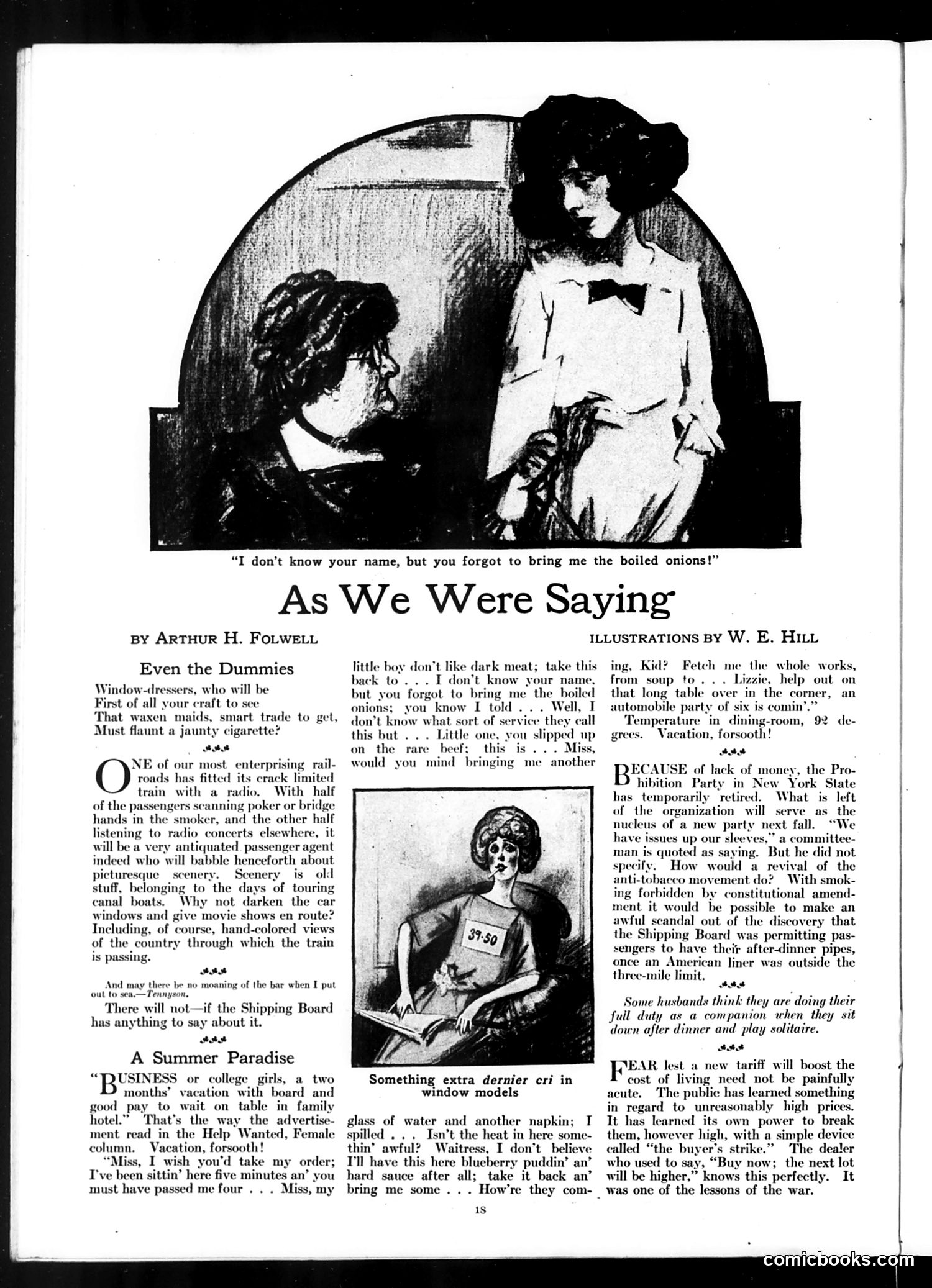
This page from *Judge* magazine contains three satirical pieces mocking American social conditions circa WWI era: **"Even the Dummies"** critiques railroads replacing scenic observation with modern entertainments (radio, movies)—lamenting lost appreciation for natural beauty. **"A Summer Paradise"** depicts the false promise of waitressing as a "vacation" job. The illustration shows a frustrated server being bombarded with demanding, rude customers—contradicting the Help Wanted ad's cheerful description. The satire exposes labor exploitation of young women. **The final section** discusses the Prohibition Party's financial collapse and pivots to mocking anti-tobacco crusades, while commenting on wartime "buyer's strikes"—public refusal to buy goods as protest against high prices. This references post-WWI inflation and consumer activism. All three pieces use humor to critique modern capitalism, false advertising, and changing social values during the rapid industrialization of 1910s-20s America.
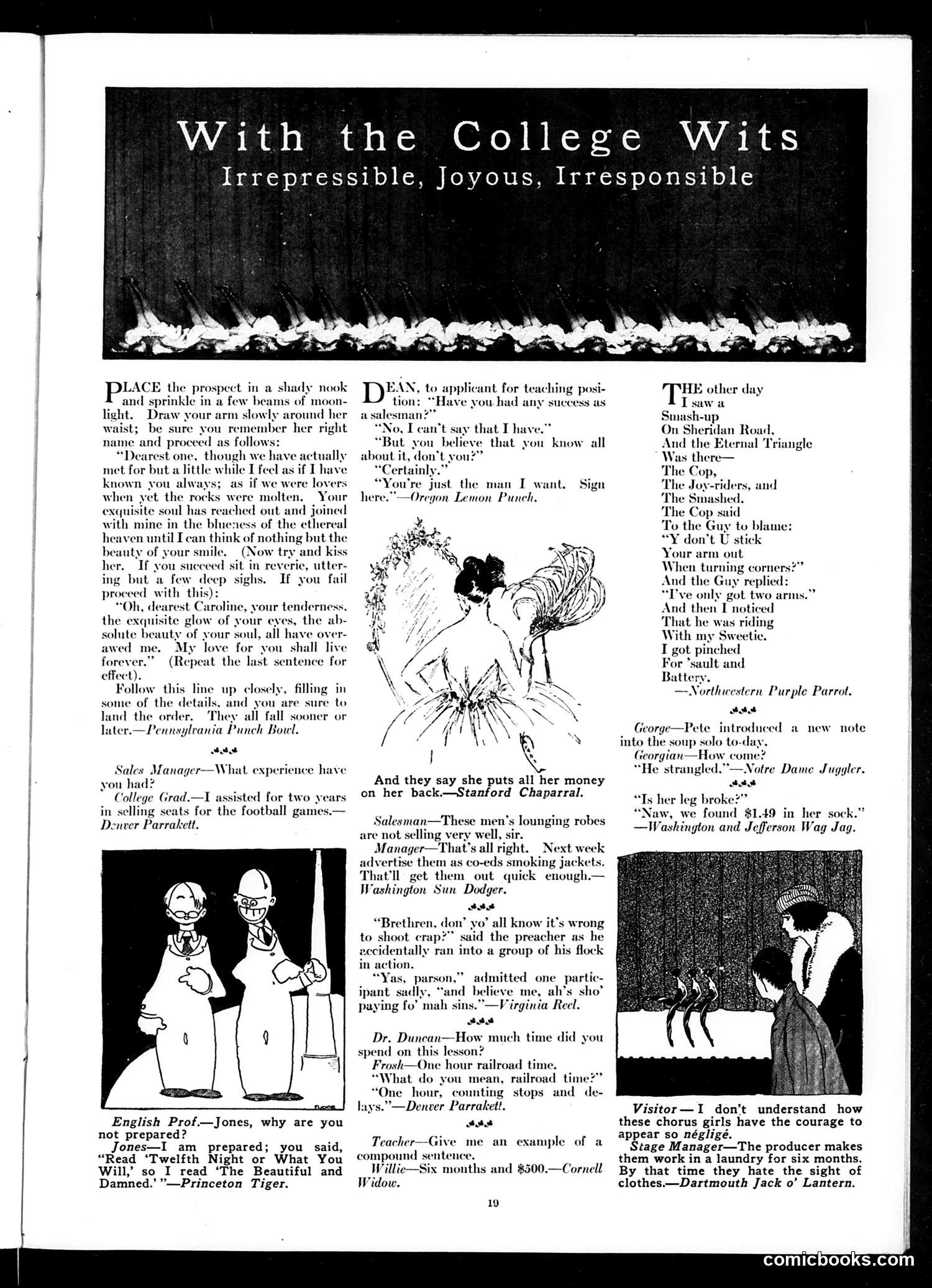
This page collects humorous anecdotes and jokes targeting college life and social pretension circa the 1920s-30s. Key satirical targets include: **Romance posturing**: The opening lengthy passage mocks male students' overwrought romantic declarations ("exquisite glow of your eyes"), suggesting sincere emotion is replaced by memorized seduction scripts. **Academic hypocrisy**: A professor's complaint about unprepared students is undercut when the student reveals he read *The Beautiful and Damned* instead of *Twelfth Night*—satirizing students' misreading of assignments. **Sales/marketing absurdity**: A manager suggests advertising lounging robes as "co-eds smoking jackets" to boost sales—mocking how gendered marketing manipulates consumers. **Gender stereotypes**: The final joke about chorus girls hating clothes after laundry work reduces women to objects while implying their profession requires minimal modesty. The cartoons feature simple line drawings of college types. Overall, the page ridicules college students' pretension, laziness, and shallow attitudes toward romance and work.
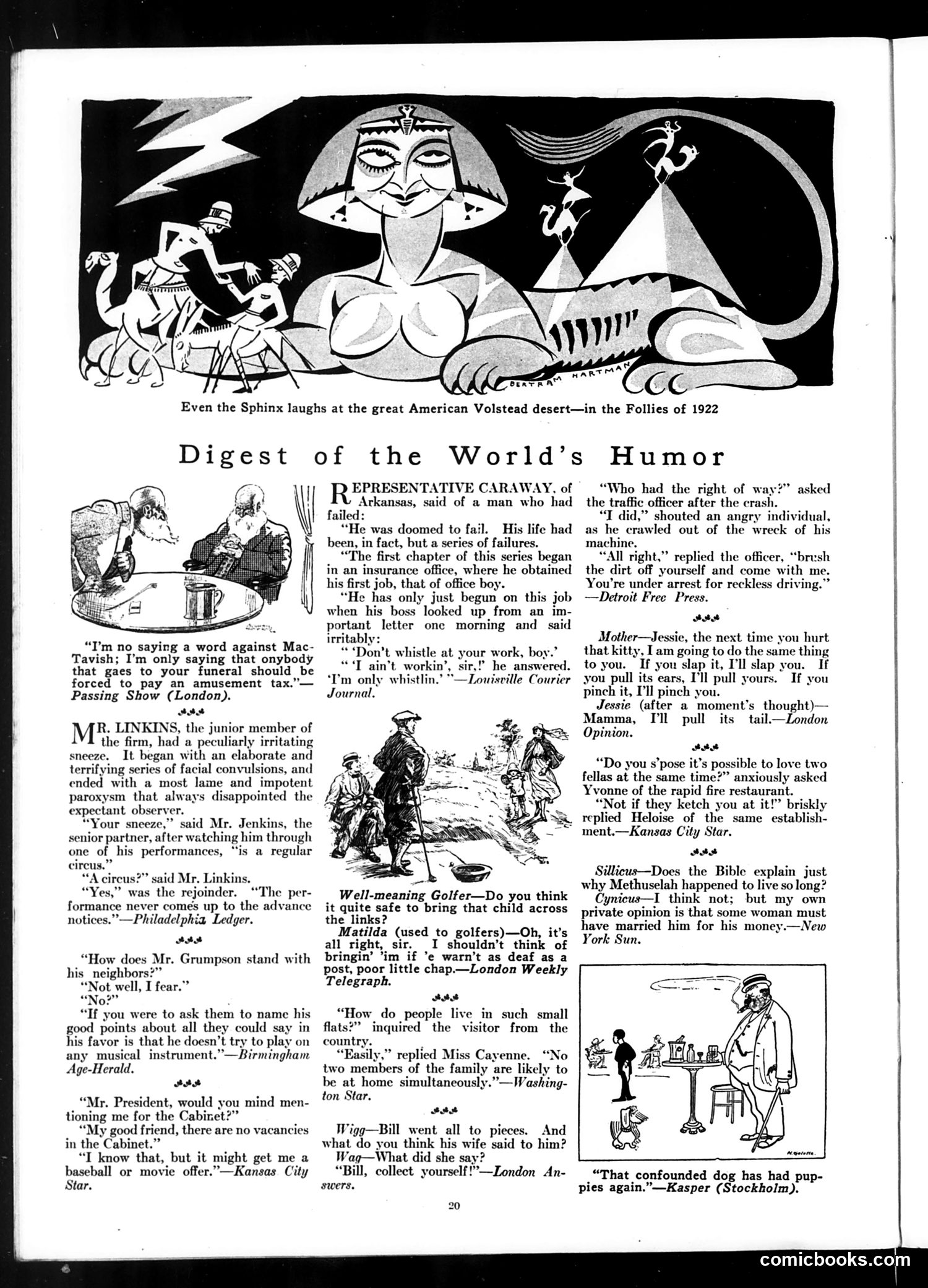
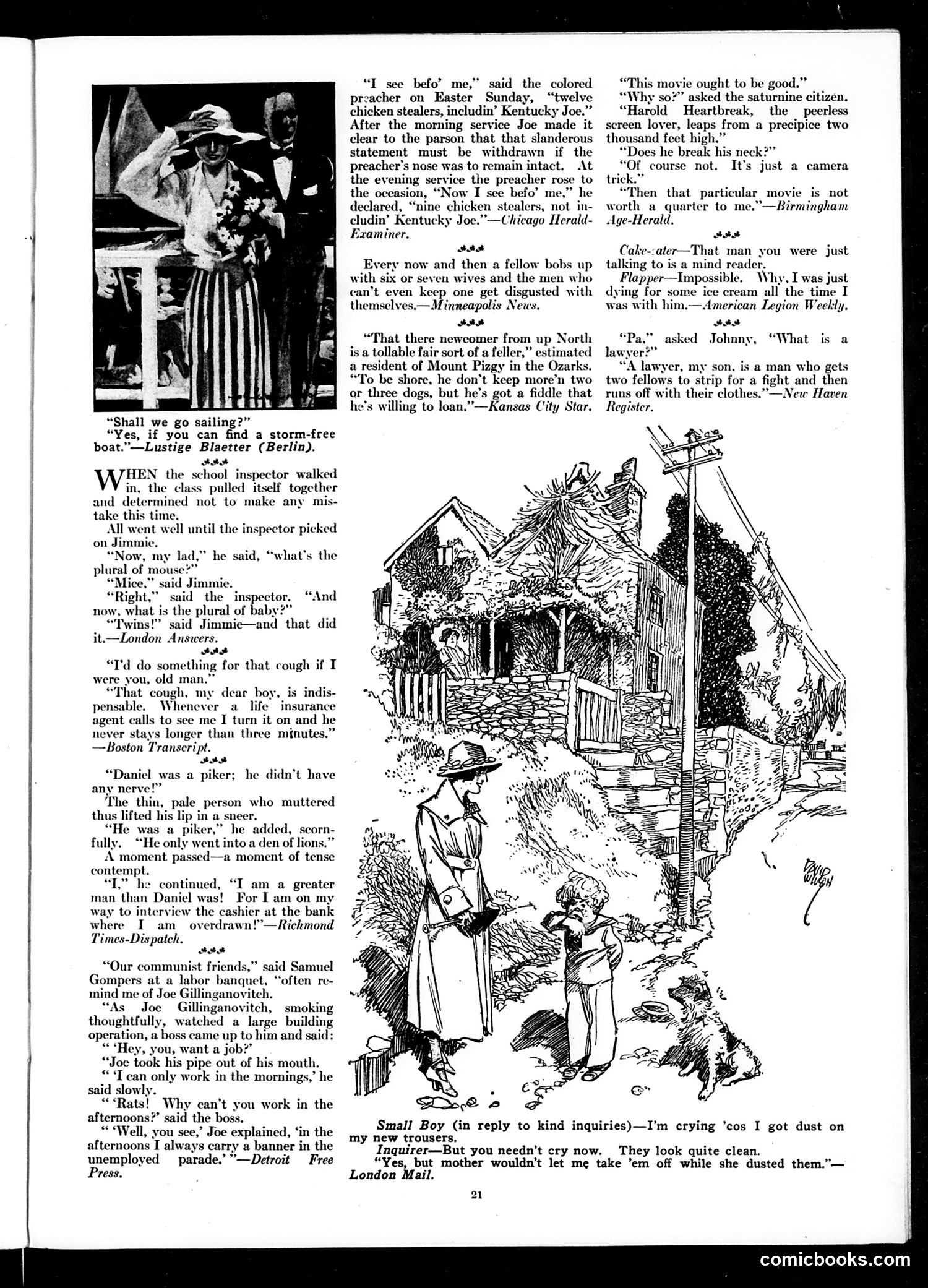
This page contains multiple brief humorous anecdotes typical of early 20th-century American humor magazines. **Key content includes:** - **School inspector joke**: A boy's literal answer ("Twins!") to "plural of baby" satirizes rigid education and clever-but-foolish literalism. - **Insurance agent joke**: Mocks life insurance salesmen by suggesting a man's persistent cough is actually profitable—he deliberately triggers it when agents visit. - **Daniel vs. bank robber comparison**: Contrasts Biblical courage with modern audacity; a man about to overdraft at his bank considers himself braver than Daniel in the lion's den. This satirizes modern commercial anxiety over biblical heroism. - **Joe Gillinganovitch/communist joke**: Samuel Gompers (real AFL leader) ridicules communists via anecdote about a man who only works mornings because he carries an "unemployed parade" banner afternoons—mocking activists as unemployed themselves. - **Movie criticism**: A cynical viewer dismisses a film because the hero survives a 2,000-foot fall—the "camera trick" disappoints him. - **Various quips** on wives, newcomers, and children's clothing stubbornness. The humor targets: institutional rigidity, commercialism, labor radicalism, and domestic absurdity.
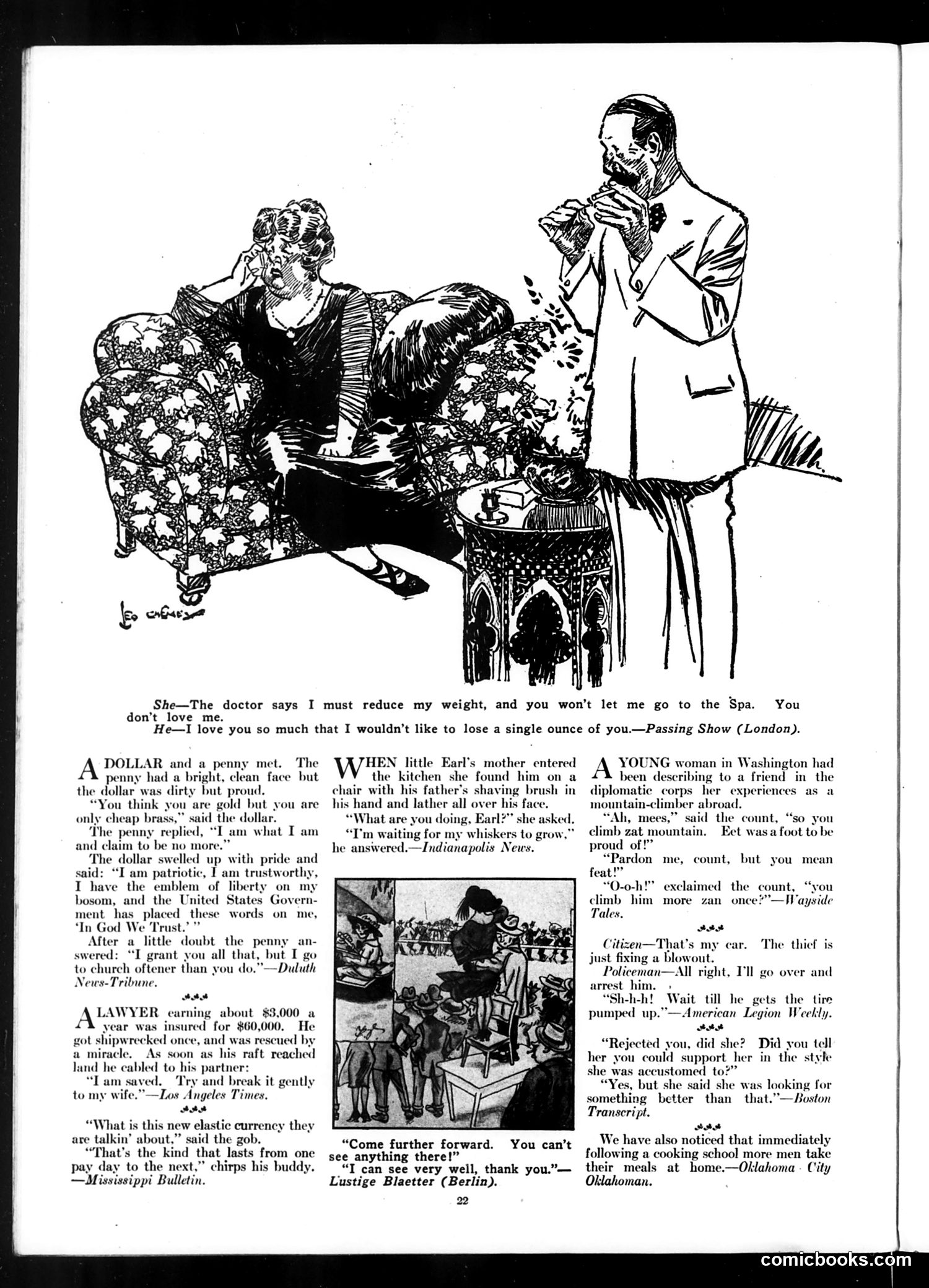
This page collects brief humorous anecdotes and jokes from various sources, typical of Judge's format. The main cartoon at top depicts a marital dispute: a woman claims her doctor demands weight loss but her husband prevents her from visiting a spa. His response—that he loves her too much to lose "a single ounce"—is romantic flattery masking selfishness, satirizing both domestic power dynamics and hollow declarations of love. The surrounding text jokes address social anxieties of the era: currency reliability ("In God We Trust"), class mobility (a lawyer insured for unexpectedly high sums), children's innocence, diplomatic pretension, automotive novelty, romantic rejection, and changing domestic labor (cooking schools affecting men's eating habits). The reprinted sources—*Lustige Blaetter*, *Wayside Tales*, *Indianapolis News*—indicate Judge's practice of mining international and American publications for material, emphasizing universal human follies rather than specific political targets.
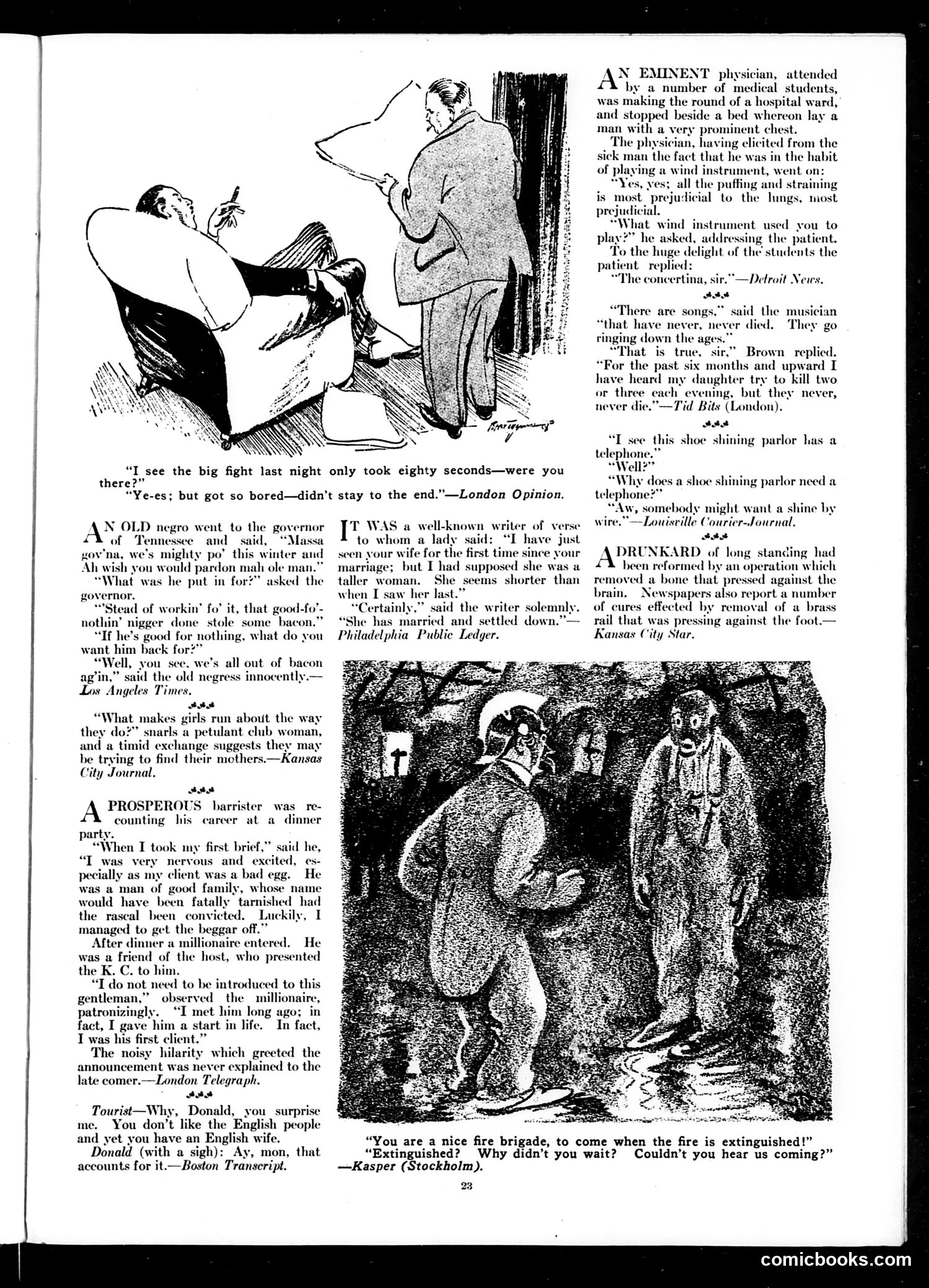
This page contains multiple unrelated humorous anecdotes typical of early 20th-century satirical magazines, plus one cartoon. **The Main Cartoon** (top left): Shows a physician lecturing medical students about a patient with a prominent chest who played wind instruments. The joke: when asked what instrument, the patient replies "concertina"—a visual/verbal pun on the accordion-like instrument and the chest expansion it requires. **Other Notable Items:** - A racist anecdote about an enslaved person's mother requesting a pardon, mocking African American dialect and logic - A barrister's awkward encounter where his first client (a millionaire) reveals he helped the lawyer start his career—the joke being the lawyer gained fame defending a guilty rich man - A writer's quip that his wife "seems shorter" because "she has married and settled down"—implying marriage diminished her - A fire brigade arriving after a fire is extinguished, unable to hear calls for help These pieces reflect period attitudes: casual racism, class commentary, and domestic humor at women's expense. The cartoons' simple line drawings accompanied brief punchlines, a Judge magazine standard.
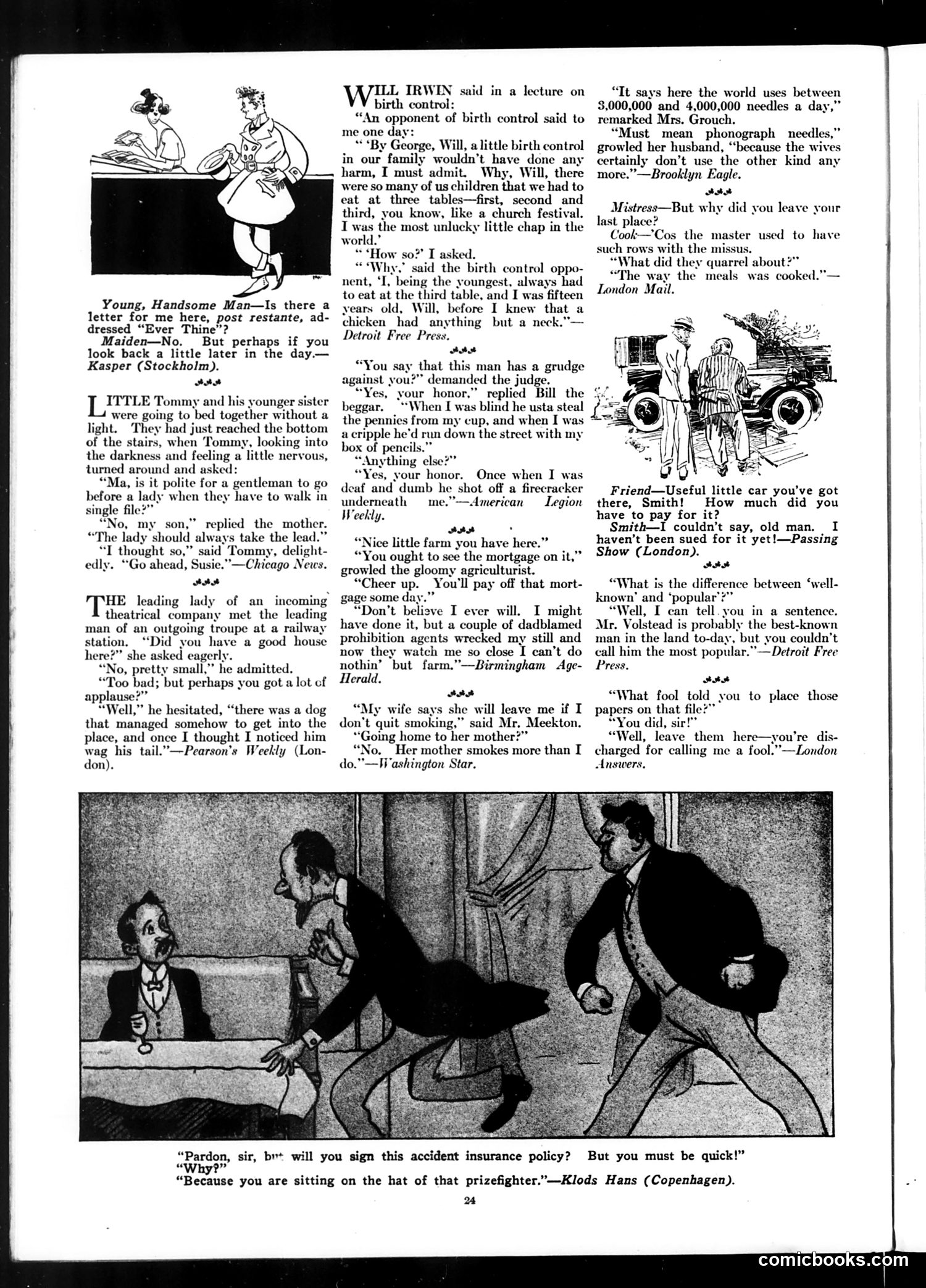
This page contains primarily **humorous anecdotes and jokes** rather than political cartoons, reflecting early 20th-century American humor. **Key content includes:** - **Will Irwin's birth control lecture**: A joke about large families and poverty, referencing contemporary debates over contraception access. - **Prohibition-era humor**: Multiple jokes reference the failed alcohol ban (Prohibition), including a farmer who lost his illegal still to federal agents—satirizing the unpopular enforcement of Prohibition laws. - **Gender/domestic humor**: Several jokes depict traditional marital discord and gender stereotypes (wives criticizing husbands' smoking, cooking, etc.). - **Class humor**: Anecdotes about poor people (beggars, cooks, farmers) in stereotypical situations. The **cartoon at bottom** appears to show men urgently requesting someone sign insurance papers while sitting on a prizefighter's hat—a visual gag about hasty business dealings. Overall, this reflects **1920s-era Judge magazine's satirical style**: topical references (Prohibition, birth control debates) mixed with conventional domestic and class-based humor that modern readers would find dated or offensive.
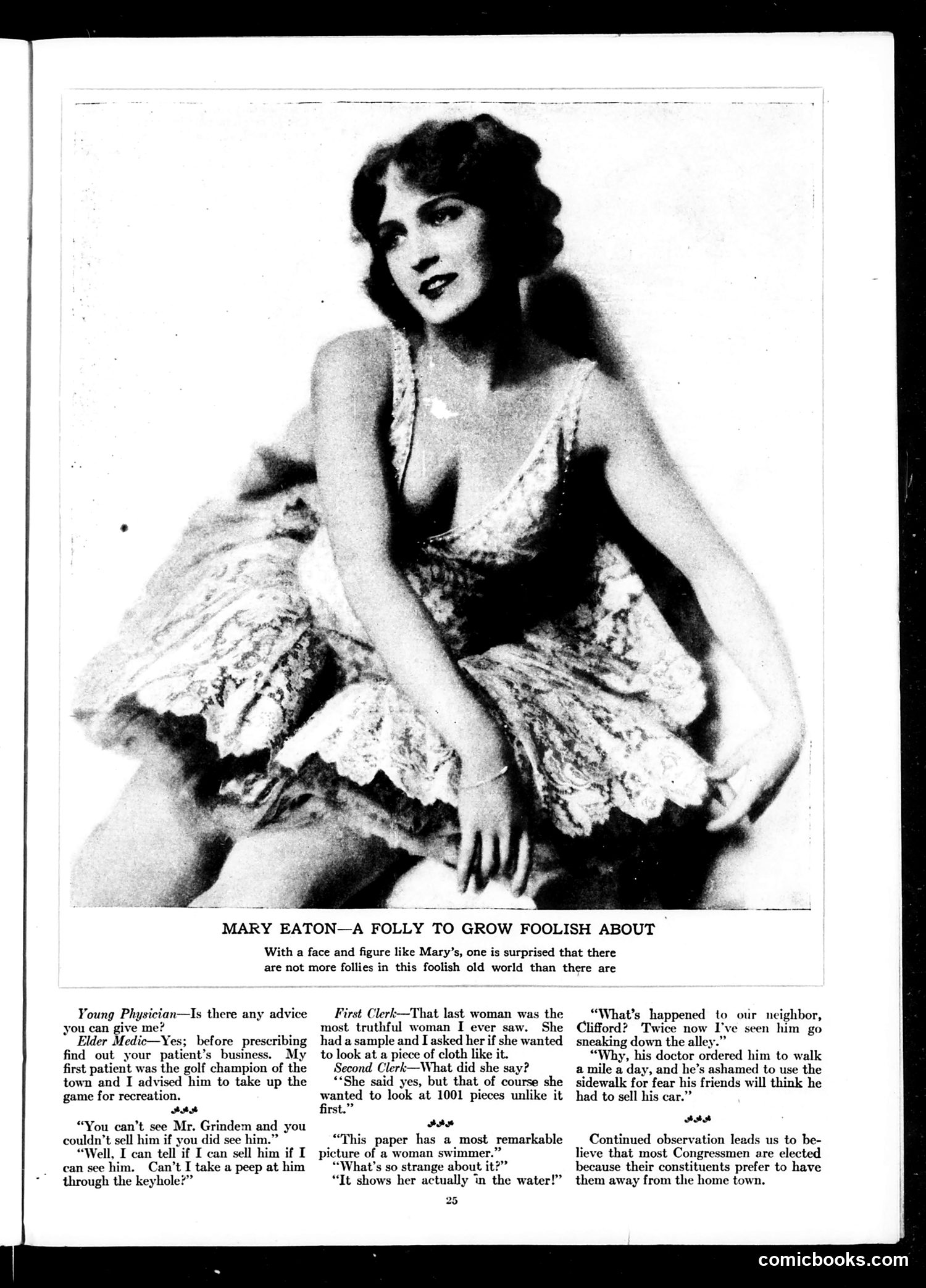
This page from *Judge* magazine features **Mary Eaton**, a performer of the era, accompanied by several unrelated humor vignettes typical of the publication's format. The main image is a glamorous photograph with light commentary about her attractiveness—standard celebrity promotion content for the period. The surrounding jokes target early 20th-century social follies: - A doctor's misguided advice to a golf champion - A salesman attempting to peek through a keyhole at a client - A woman's dishonest claim about fabric samples - A man embarrassed to walk openly after selling his car, fearing social judgment - A jab at Congressmen, suggesting constituents elect them partly to keep them away from home These reflect period anxieties: class consciousness, car ownership as status symbol, dishonest commerce, and cynicism about politics. The humor relies on recognizing common hypocrisies and social pretenses of the time.
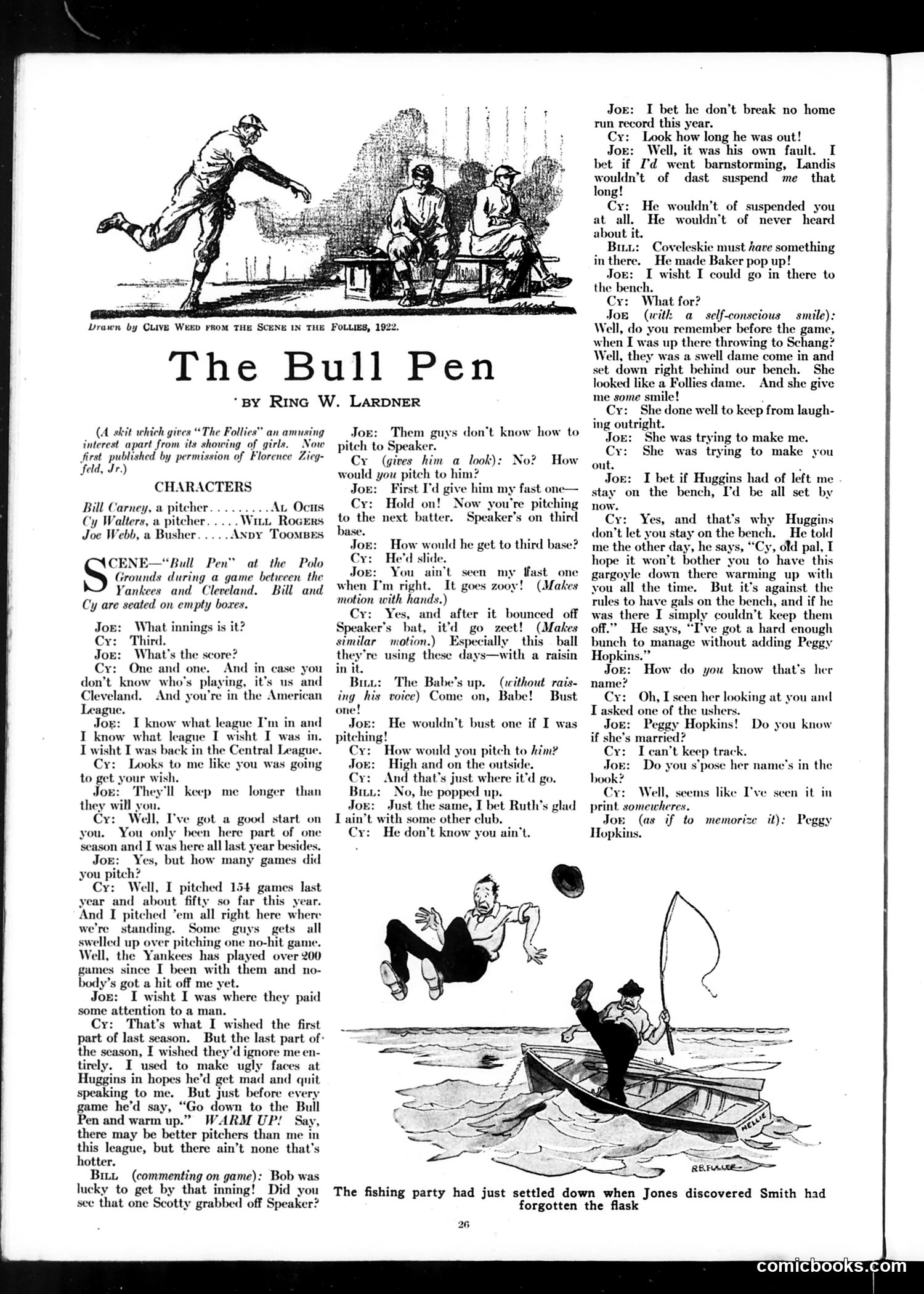
This is a comedic skit set at a 1922 baseball game (Polo Grounds, Yankees vs. Cleveland). Three pitchers in the bullpen—Bill Carney, Cy Walters (played by Will Rogers), and Joe Webb—brag and complain about their careers. The satire targets baseball's hierarchies and male ego. Cy brags endlessly about his pitching prowess while getting no playing time; Joe fantasizes about impressing a woman in the stands ("a Follies dame"—a reference to the Ziegfeld Follies). They discuss contemporary baseball stars: Babe Ruth, Ty Cobb's rival "Speaker" (likely Tris Speaker), and manager Huggins. The humor lies in these marginal players' delusions of importance and their competitive resentment—they analyze how *they'd* pitch to famous batters while sitting unused on the bench. The skit satirizes masculine vanity and the frustration of minor-league existence, using baseball as the vehicle for broader social commentary.
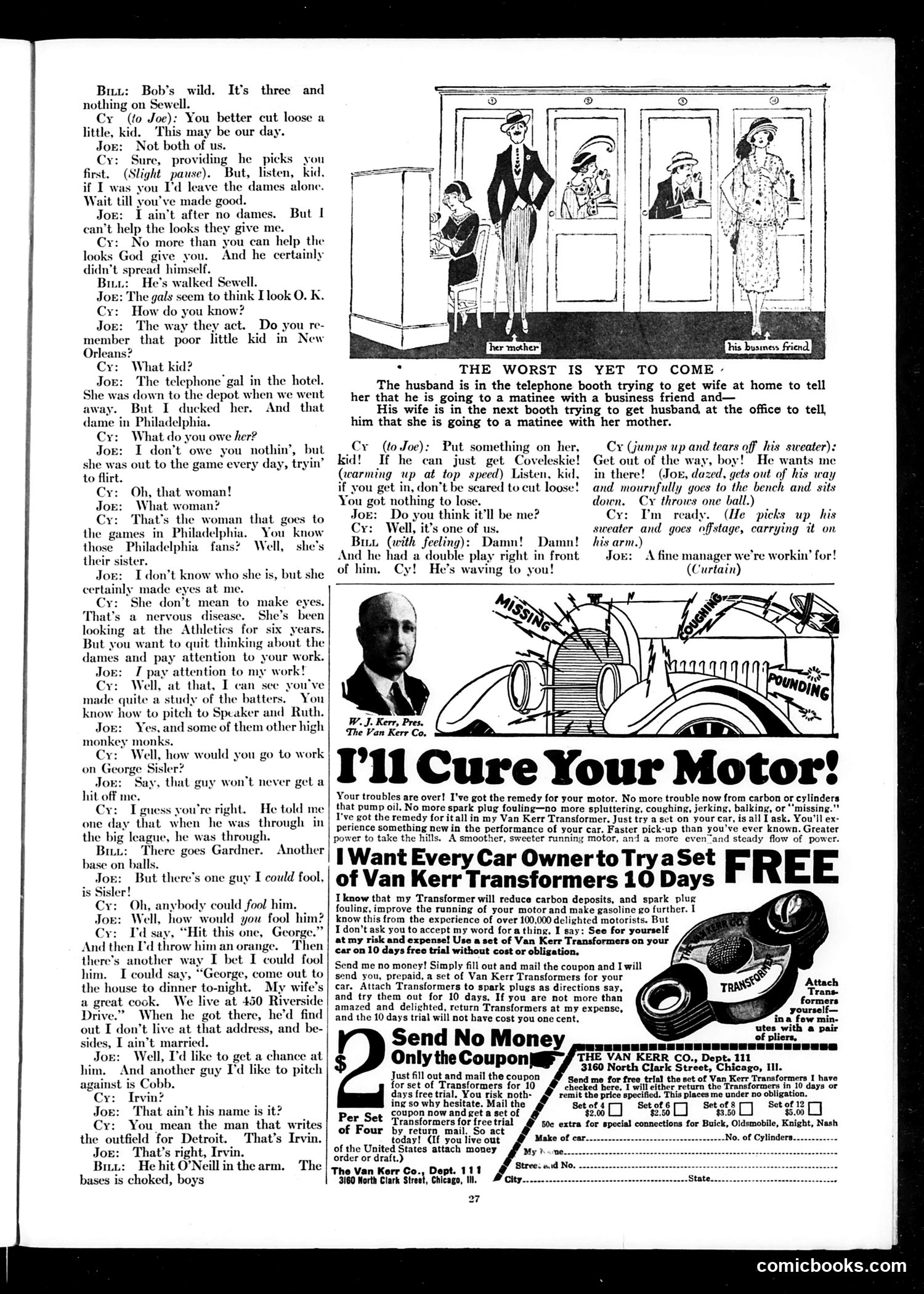
This page contains two distinct elements: a theatrical dialogue and an advertisement. **The Play Dialogue ("The Worst Is Yet to Come"):** The top portion depicts a scene from what appears to be a baseball play, featuring characters discussing pitchers and players like Speaker, Ruth, Sisler, and Cobb—all famous early 20th-century baseball figures. The humor centers on romantic entanglements and baseball strategy. The closing "worst" joke shows a husband and wife simultaneously trying to call each other with contradictory matinee plans—classic miscommunication comedy of the era. **The Advertisement:** The bottom half is a full-page ad for Van Kerr Transformers, motor car devices claiming to eliminate carbon buildup and improve engine performance. It offers a free 10-day trial with "Send No Money"—a classic direct-mail sales pitch from the 1920s-30s automotive era, when such mechanical "cures" were heavily marketed to car owners. The juxtaposition reflects Judge magazine's standard format mixing entertainment with commercial advertising.
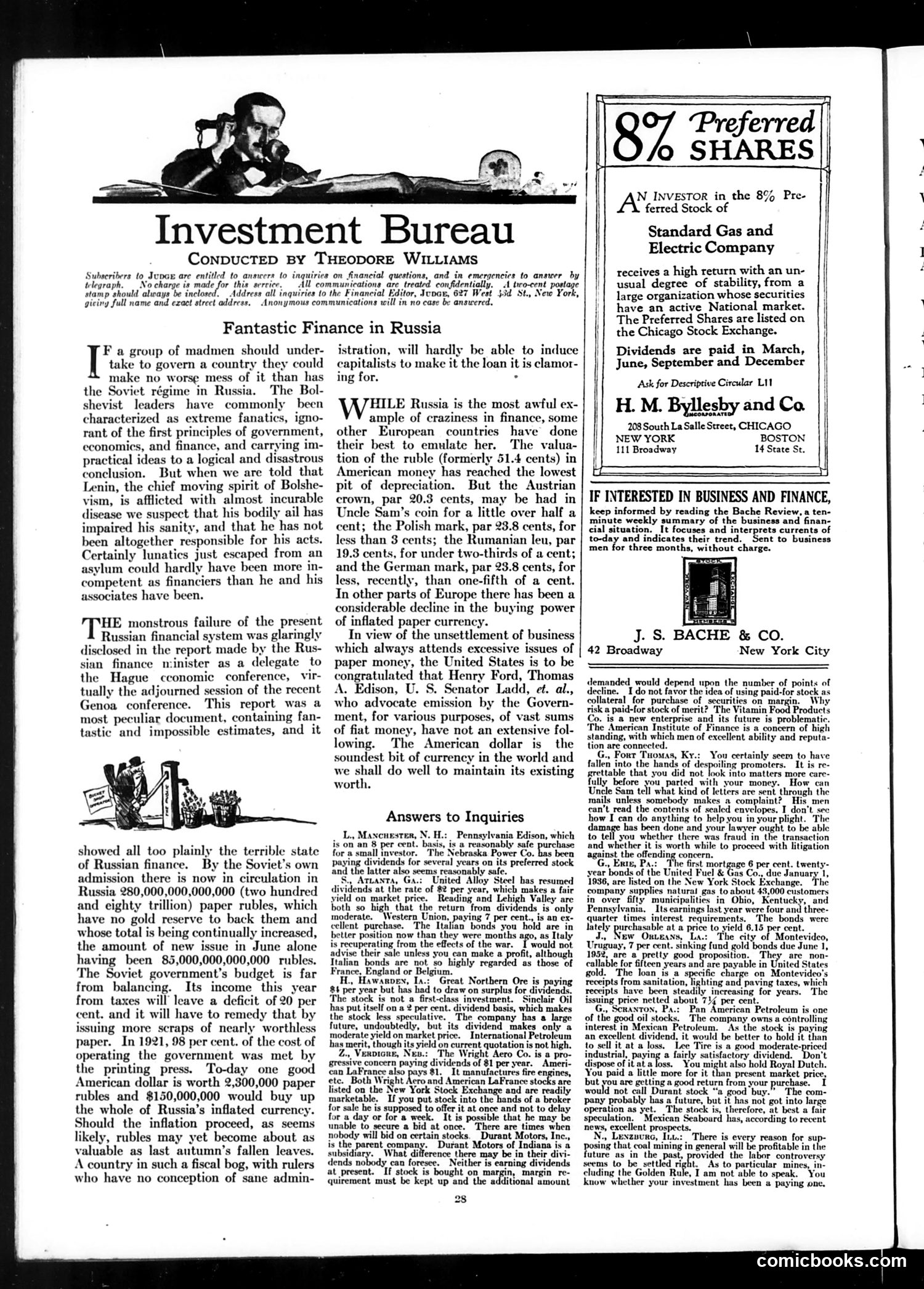
This page is primarily an **Investment Bureau advice column** (not satirical cartooning) by Theodore Williams addressing financial questions from readers. The small cartoon at top—a figure hunched over desk with papers—is a generic illustration of financial worry, not political satire. The main text is a **serious financial criticism** of Soviet Russia's hyperinflation under Lenin. The writer argues Bolshevik leaders are incompetent administrators (compared to "madmen...escaped from an asylum"), citing the circulation of 280 trillion worthless paper rubles with no gold backing. The piece notes other European currencies are similarly collapsing—Austrian crowns, Polish marks, and German marks all severely devalued. The satire is implicit rather than explicit: the author ridicules Soviet finance not through caricature but through absurdist facts (one American dollar = 2.3 million rubles; $150 million could buy Russia's entire currency). The tone suggests readers should be grateful American currency remains stable, making U.S. investment preferable to European alternatives.
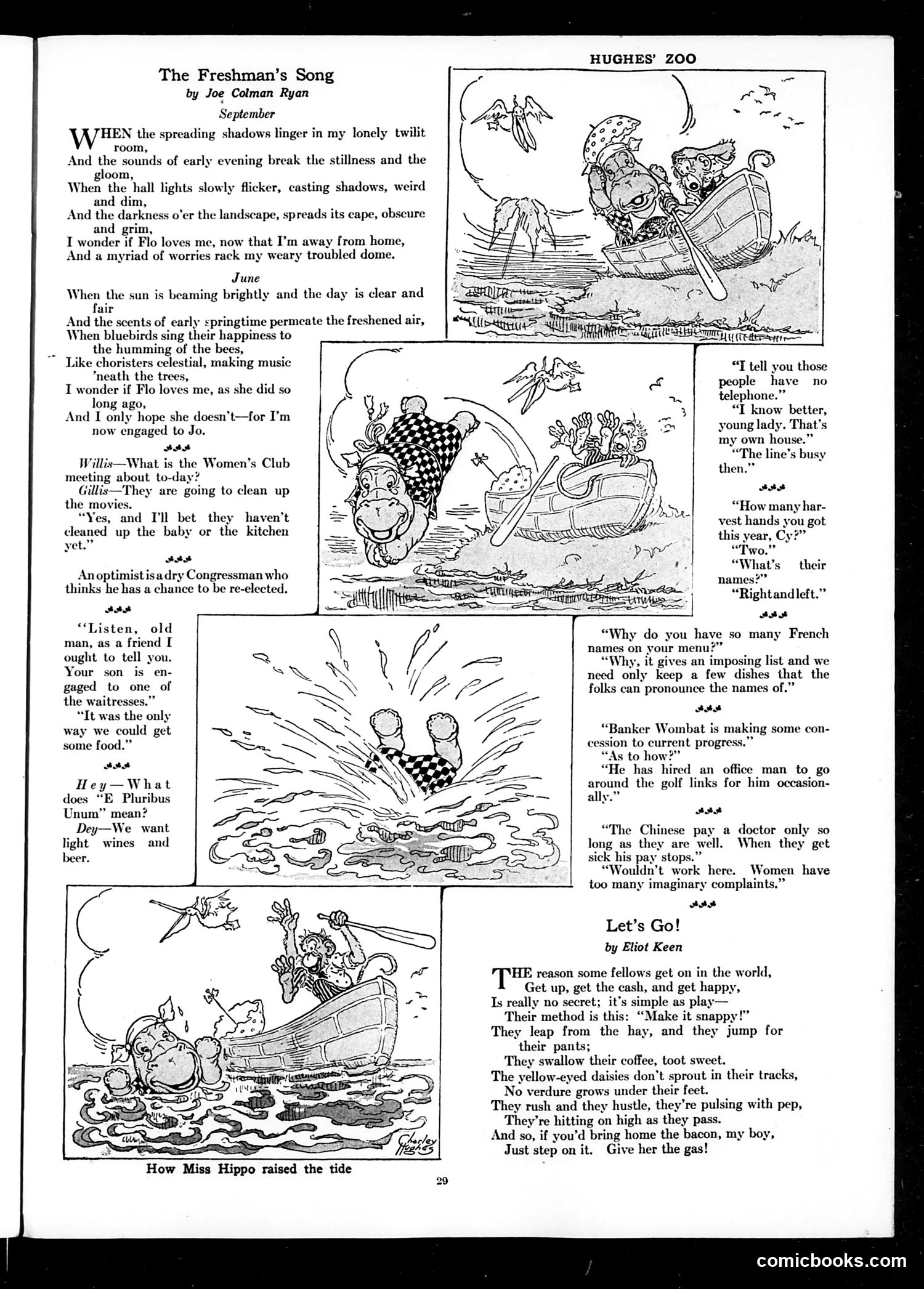
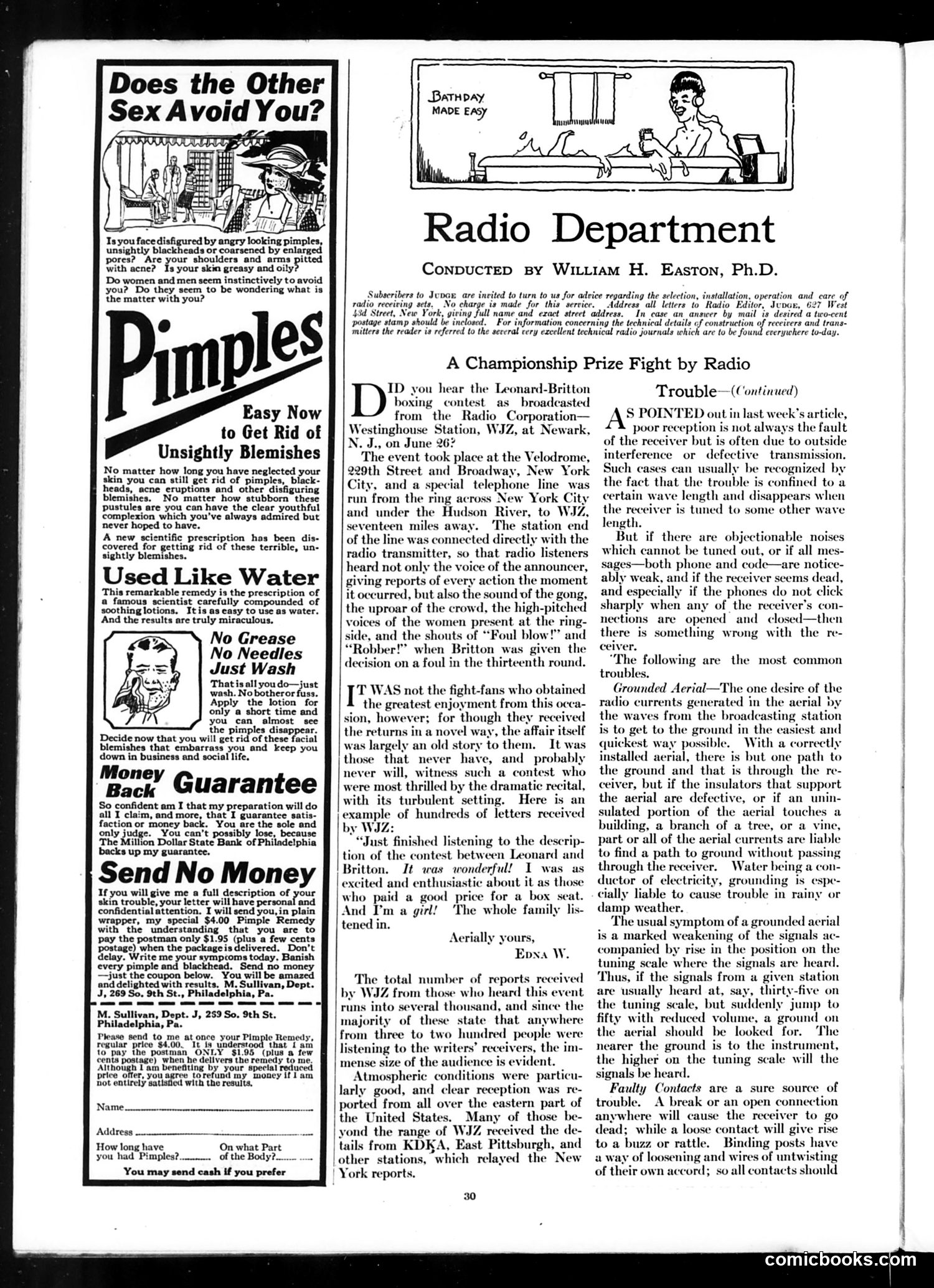
This page contains two distinct sections: **Left side:** A vintage advertisement for acne treatment ("Pimples"), claiming a scientific remedy solves skin problems that supposedly make people socially and professionally undesirable. The pitch uses shame-based marketing—typical of early 20th-century advertising—suggesting clear skin is essential for romantic and business success. **Right side:** A "Radio Department" column discussing a Leonard-Britton boxing match broadcast via WJZ radio in Newark on June 26 (year unclear from visible text). The article describes how radio technology transmitted live sports—the announcer's voice, crowd sounds, and the gong—to distant listeners, presenting this as novel entertainment. The piece notes that radio brought the experience to people who'd never attended such events in person, representing early broadcasting's revolutionary social impact. Both sections reflect 1920s consumer culture and emerging mass media technology.
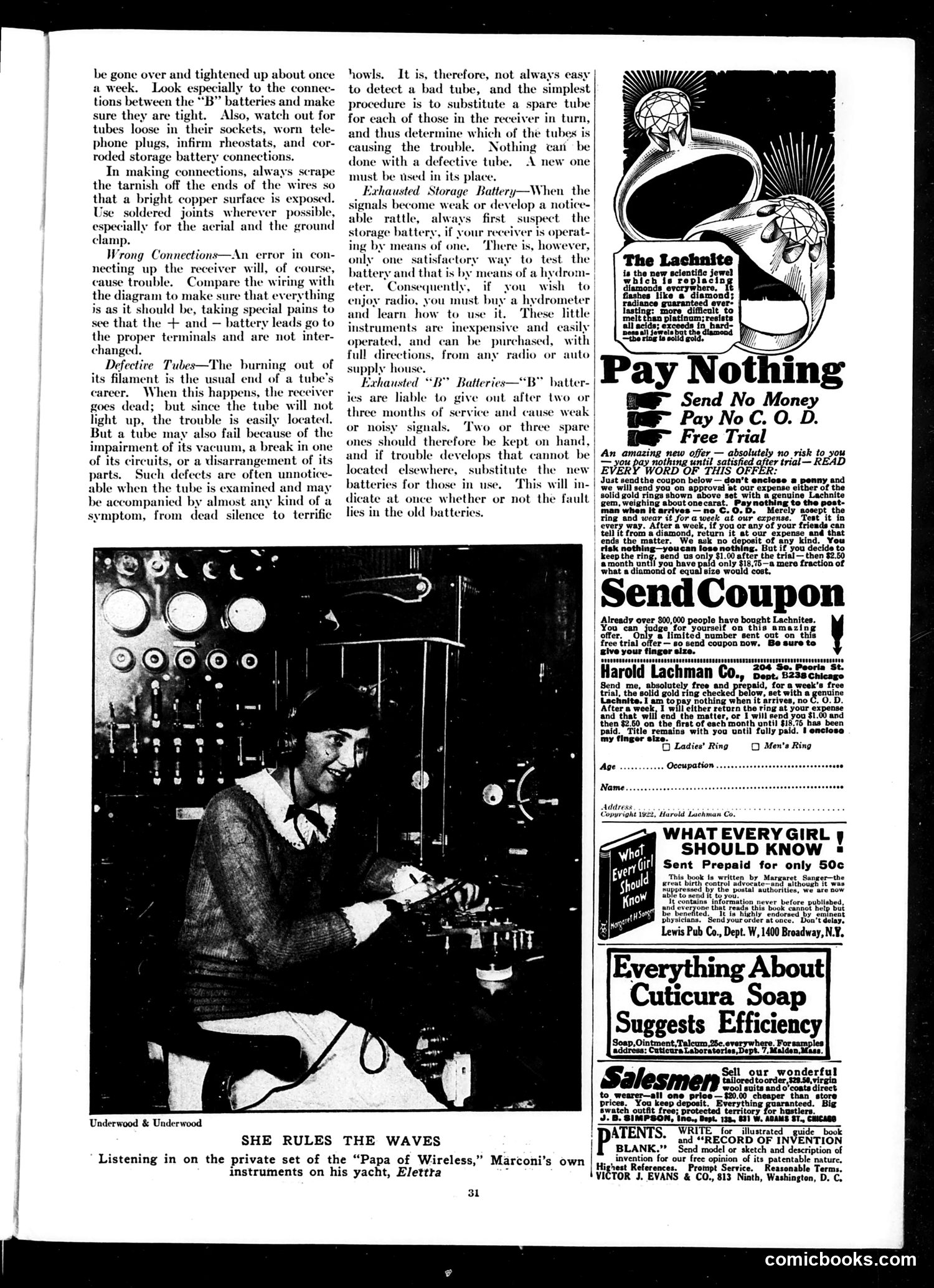
This page from *Judge* magazine combines technical radio instruction with advertising. The left side contains practical guidance on maintaining early radio receivers—checking connections, replacing defective vacuum tubes, and testing batteries. The photograph shows a woman operating wireless equipment aboard Marconi's yacht *Elettra*, captioned "She Rules the Waves," celebrating female participation in the emerging radio technology. The right side features a major advertisement for "Lachnite," a synthetic diamond substitute ring. The ad employs aggressive marketing tactics typical of the era: "Send No Money," "Pay No C.O.D.," and a free trial offer. It positions Lachnite as indistinguishable from genuine diamonds, reflecting 1920s consumer culture's embrace of affordable luxury goods and mail-order commerce.
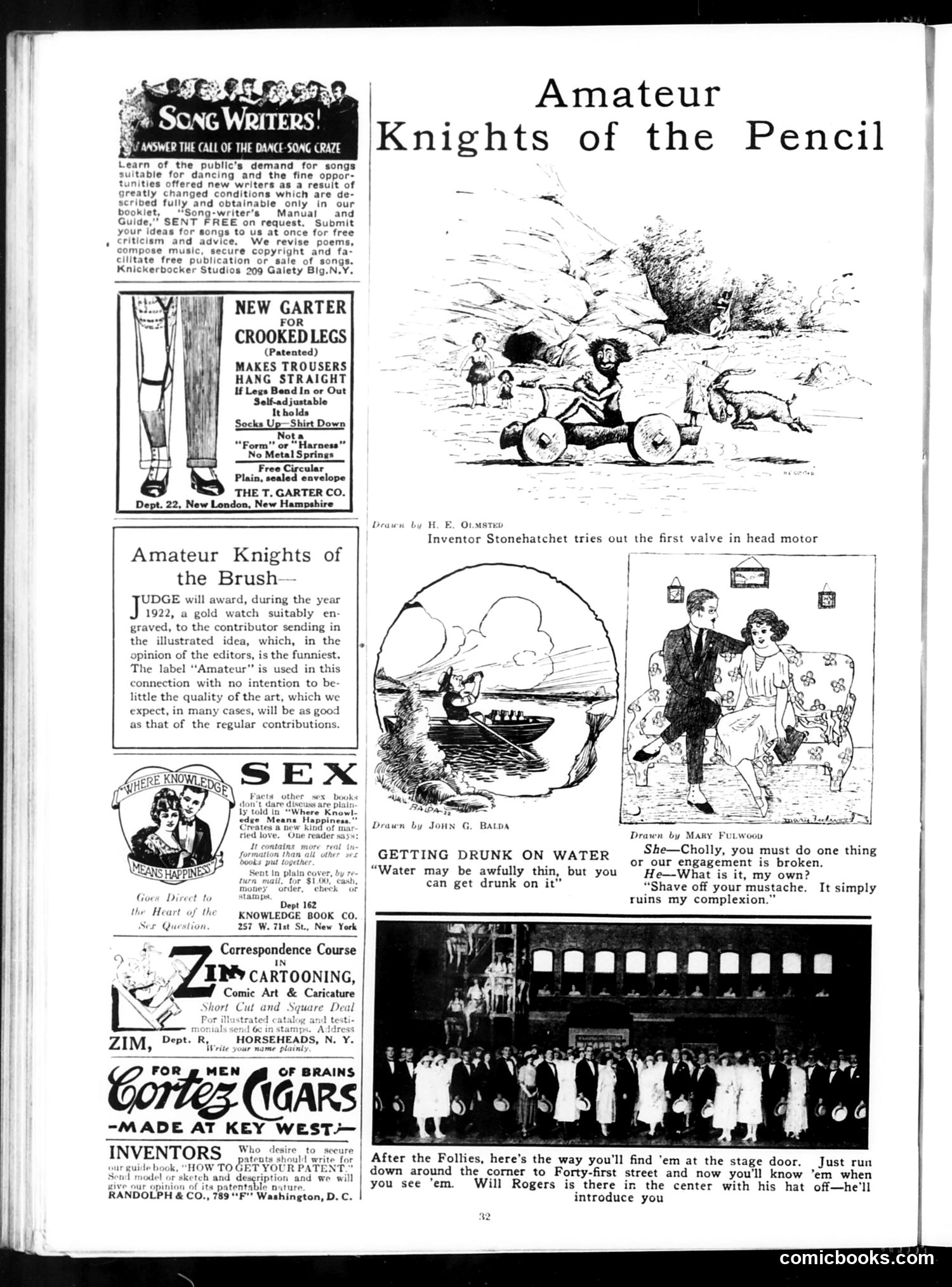
This page showcases amateur cartoonist submissions to Judge's 1922 competition, offering a gold watch to the funniest illustrated idea. The cartoons represent submissions from readers rather than professional staff artists. The visible cartoons include: - **"Inventor Stonehatchet tries out the first valve in head motor"** (by H.E. Olmsted): A primitive-looking figure in a makeshift vehicle, satirizing early automotive innovation or incompetent inventors. - **"Getting Drunk on Water"** (by John G. Balda): A fishing scene with a pun about intoxication through water rather than alcohol—likely social commentary on Prohibition (1920-1933). - **A domestic comedy** (by Mary Fulwood): A couple's engagement dispute over the man's mustache damaging the woman's complexion—typical 1920s relationship humor. The page also references a photograph featuring Will Rogers at a stage door, indicating his celebrity status of the era. The surrounding advertisements reflect period consumer products and services.
This is not a cartoon but an **editorial solicitation page** from *Judge* magazine. Rather than satire, it's a call-for-submissions appealing to readers—particularly hunters, fishermen, and sportsmen—to contribute humorous anecdotes. The pitch frames *Judge* as "the clearing house for fun" serving "a million strong" American readership. The editors argue that funny stories told around campfires, golf courses (the "19th Hole"), and cabins deserve preservation in print form where they'll entertain millions. The underlying appeal is both civic and practical: contributors should feel generous sharing laughter with the magazine's "family," while *Judge* promises to compensate them at standard advertising rates for accepted material. This represents early 20th-century magazine economics—leveraging reader-generated content to fill pages affordably while building community engagement around shared leisure activities and masculine camaraderie.
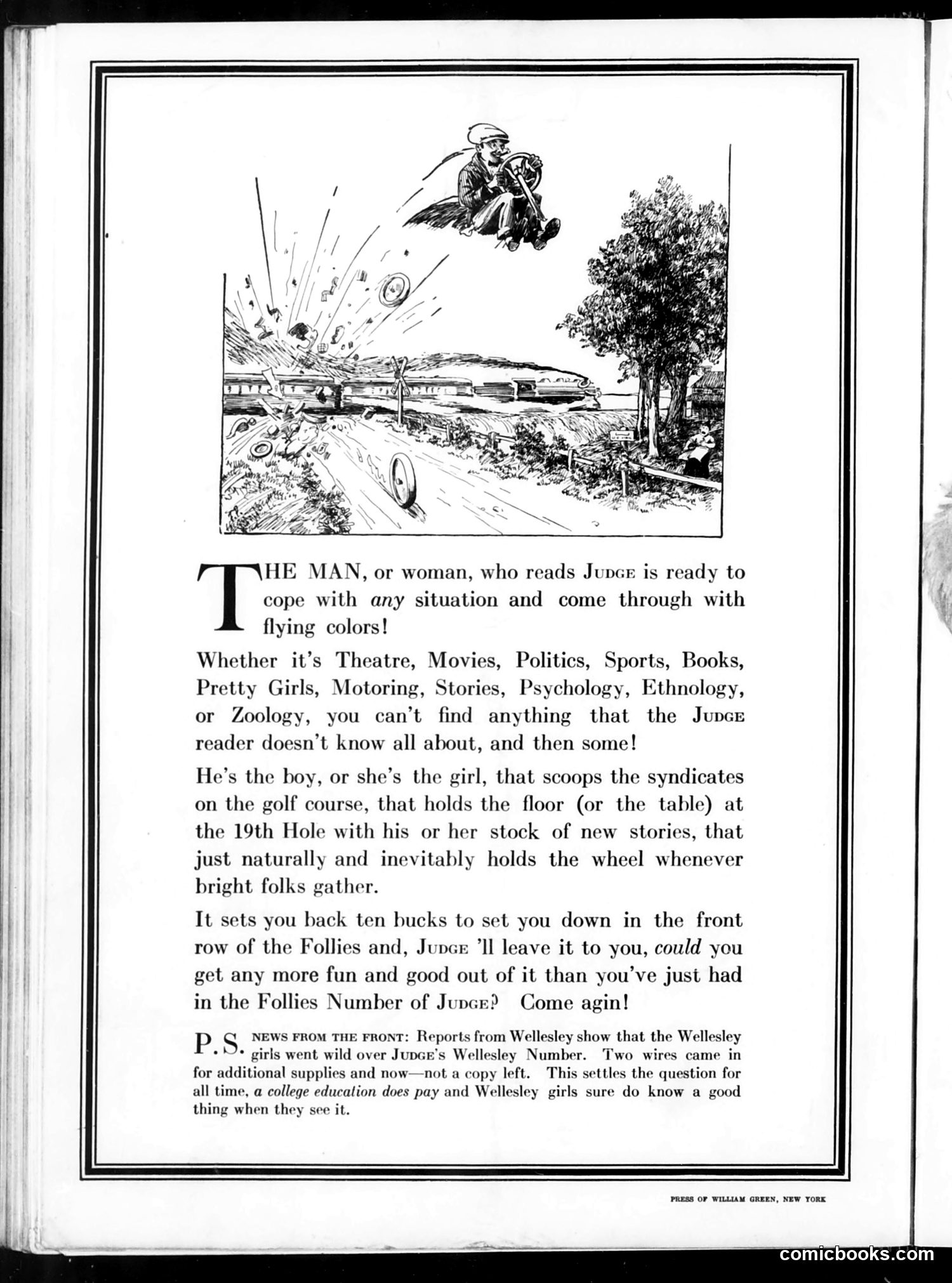
This is a **self-promotional advertisement** for *Judge* magazine itself, not political satire. The illustration shows a figure flying away from an exploding train wreck, symbolizing escape and triumph. The text claims that *Judge* readers are universally knowledgeable and socially accomplished—they dominate conversations at golf courses, theaters, and social gatherings with superior wit and insider knowledge. The ad positions reading *Judge* as essential to being well-informed and entertaining company. The postscript boasts that *Judge*'s "Wellesley Number" (an issue featuring content about Wellesley College) sold out so quickly that additional copies were needed, proof that "a college education does pay" and that educated women recognize quality. This appeals to aspirational readers and suggests the magazine has elite, educated readership, particularly among college women—a relatively modern demographic for 1920s magazine marketing.