
Judge, 1922-07-29 · page 8 of 36
Judge — July 29, 1922 — page 8: what you’re looking at
What you’re looking at
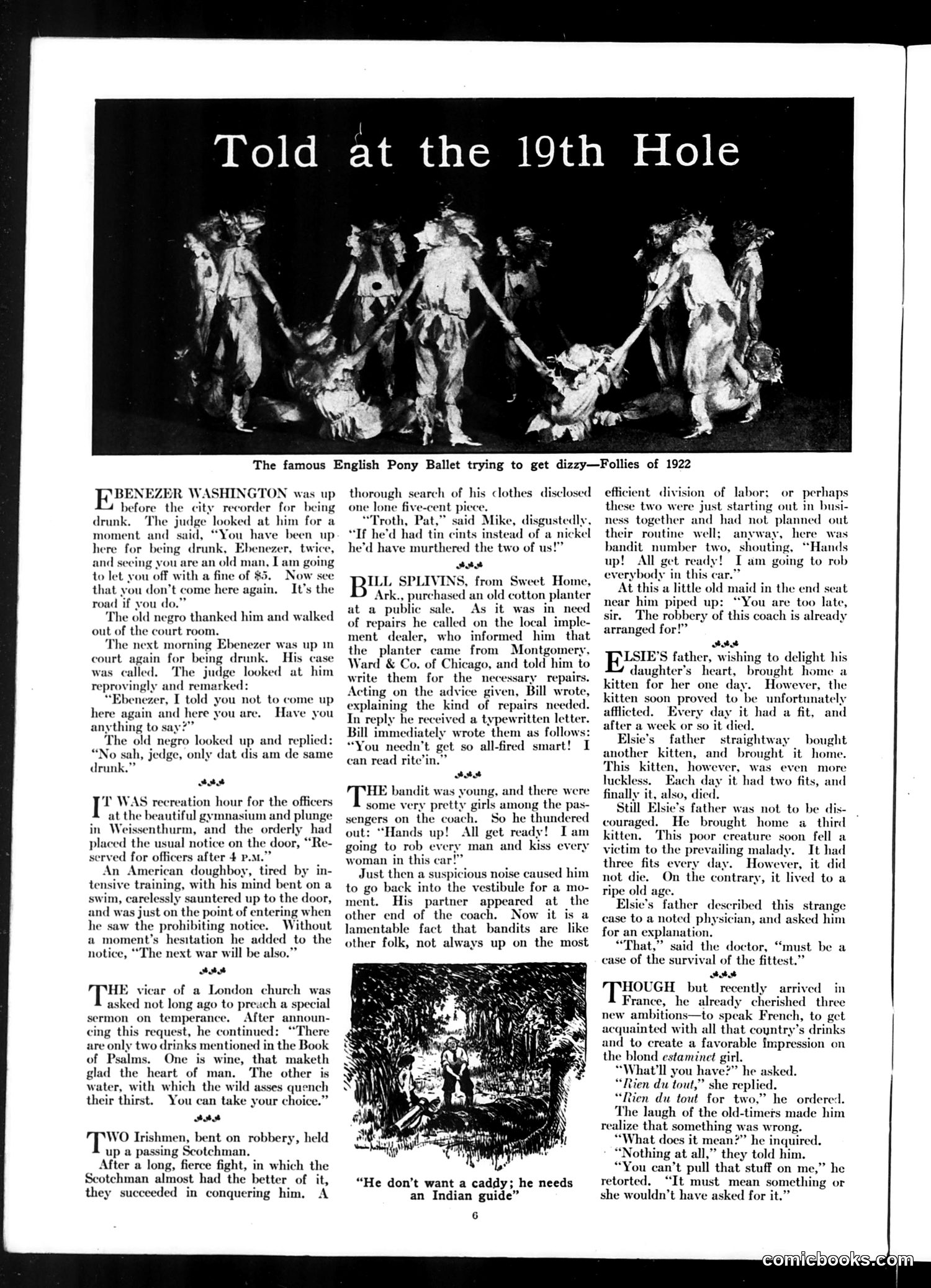
This page collects humorous anecdotes told in the informal setting of a golf club's 19th hole (the bar). The content includes: **Main stories:** - A repeat offender (named with a racial stereotype) claims he's the "same drunk" when arrested again - An American soldier adds sarcastic graffiti to an officers-only notice - A London vicar's temperance sermon offering wine or water as biblical choices - Irish robbers struggling with a Scotsman - A Southern farmer unable to communicate with Montgomery Ward about repairs - A young bandit's robbery interrupted by his partner's incompetence **The cartoon** shows performers in the "Follies of 1922" (a Broadway revue) dressed as ponies attempting choreography. The humor relies on wordplay, dialect jokes (particularly Irish and African American speech patterns), and situational comedy. These represent typical 1920s popular magazine humor—accessible, often relying on ethnic stereotypes now considered offensive, and focused on everyday mishaps and misunderstandings.
📄 Transcribed text from this page (OCR, searchable)
Machine-transcribed from the original scan — historical spelling and the odd misread are preserved.
Told at the 19th Hole BENEZER WASHINGTON was up before the city recorder for being drunk. ‘The judge looked at him for a moment and ‘said, “You have been up here for being drunk, Ebenezer, twice, and seeing you are an old man, I am going to let you off with a fine of Now see that you don’t come here aga’ It’s the road if you do.” The old negro thanked him and walked out of the court room. ‘The next morning Ebenezer was up m court in for being drunk. His case was called. The judge looked at him reprovingly and remarked: “Ebenezer, I told you not to come up here again and here you are. Have you anything to sa he old negro looked up and replied: sah, jedge, only dat dis am de same drunk.” te I" WAS recreation hour for the officers at the beautiful gymnasium and plunge in Weissenthurm, and the orderly had placed the usual notice on the door, “Re- served for officers after + An American doughboy, tired by in- tensive training, with his mind bei nt ona swim, carelessly sauntered up to the door, and was just on the point of entering when he saw the prohibiting notice. Without a moment’s hesitation he added to the notice, “The next war will be also.” Rd HE vicar of a London church w asked not long ago to preach a special sermon on temperance. After announ- cing this request, he continued: “There are only two drinks joned in the Book of Psalms. One is wine, that maketh glad the heart of man. The other is water, with which the wild asses quen their thirst. You can take your choice. ae WO Irishmen, bent on robbery, held up a passing Scotchman. After a long, fierce fight, in which the Scotchman almost had the better of it, they succeeded in conquering him. A The famous English Pony Ballet trying to get dizzy—Follies of 1922 thorough si one lone mCes “Troth, Pat,” said Mike, disgustedly, “If he'd had tin cints instead of a nickel he'd have murthered the two of us!” Fae ILL SPLIVINS, from Sweet Home, Ark., purchased an old cotton planter at a public sale. As it was in need of repairs he called on the local imple- ment dealer, who informed him that the planter came from Montgomery, Ward & Co. of Chicago, and told him to ch of his clothes disclosed write them for the 1 ary repairs. Acting on the advice given, Bill wrote, explaining the kind of rep: needed. In reply he received a typewritten letter Bill immediately wrote them as follows: “You needn’t get so all-fired smart! I can read rite’in.” Ree HE bandit was young, and there were some very pretty girls among the pas- sengers on the coach. So he thundered out: “Hands up! All get ready! Tam going to rob every man and kiss every woman in this car!” Just then a suspicious noise caused him to go back into the vestibule for a mo- ment. His partner appeared at the other end of the coach. Now it is a lamentable fact that bandits are like other folk, not always up on the most “He don’t want a caddy; he needs an Indian guide” 6 or perhaps these two were just starting out in busi- efficient division of labor: and had not planned out anyway, here was hout ness together routine well; bandit number two, up! All get ready! I am going to rob everybody in this ¢: At this a little old maid in the end seat near him piped up: “You are too late, sir. The robbery of this coach is already arranged for!” ste LSIE’S father, wishing to delight his daughter’s heart, brought home a kitten for her one day. However, the kitten soon proved to be unfortunately afflicted. Every day it had a fit, and after a week or so it died. Elsie’s father straightway — bought another kitten, and brought it home. This kitten, however, was even more luckless. Each day it had two fits, and finally it, also, died. Still Elsie’s father was not to be dis- couraged. He brought home a_ third kitten. This poor soon fell a victim to the prev It had three fits every day. it did not die. On the contrary, it lived to a ripe old age. Els father de case to a noted physi for an explanation. “That,” said the doctor, “must be a case of the survival of the fittest.” erry but recently ibed this strange 1, and asked him 'HOUGH arrived in France, he already cherished three nbitions—to speak French, to get ainted with all that country’s drinks and to create a favorable {mpression on the blond estaminet girl. “What'll you ha he asked. “Rien du tout,” she replied. “Rien du tout for two,” he orde! The laugh of the old-timers made him e that something was wrong. What does it mean?” he inquired. “Nothing at all,” they told him. “You can’t pull that stuff on me,” he retorted. “It must mean something or she wouldn’t have asked for it.”