
Judge, 1922-07-29 · page 10 of 36
Judge — July 29, 1922 — page 10: what you’re looking at
What you’re looking at
This page contains two satirical pieces from *Judge* magazine: **"Two Weeks—With Pay"** is a humorous Q&A that mocks American vacation culture. It ridicules the gap between vacation marketing and reality: beautiful scenery exists only in promotional brochures from chambers of commerce, while actual vacations involve uncomfortable accommodations ("private baths" shared by twenty people), insects, and costs double their actual worth. The humor targets both the tourism industry's deceptive advertising and vacationers' gullible expectations. **"A Funny Phase of Vanity"** satirizes men who boast about dietary restrictions they can't eat (cucumbers, onions) to appear unique or distinguished. Kelly mocks their vanity—they imagine these limitations make them peculiarly interesting, when actually most people have no such restrictions. The piece ridicules how people seek distinction through trivial personal quirks rather than genuine accomplishments. Both articles critique American social pretension and the gap between self-image and reality—common *Judge* themes targeting middle-class vanity.
📄 Transcribed text from this page (OCR, searchable)
Machine-transcribed from the original scan — historical spelling and the odd misread are preserved.
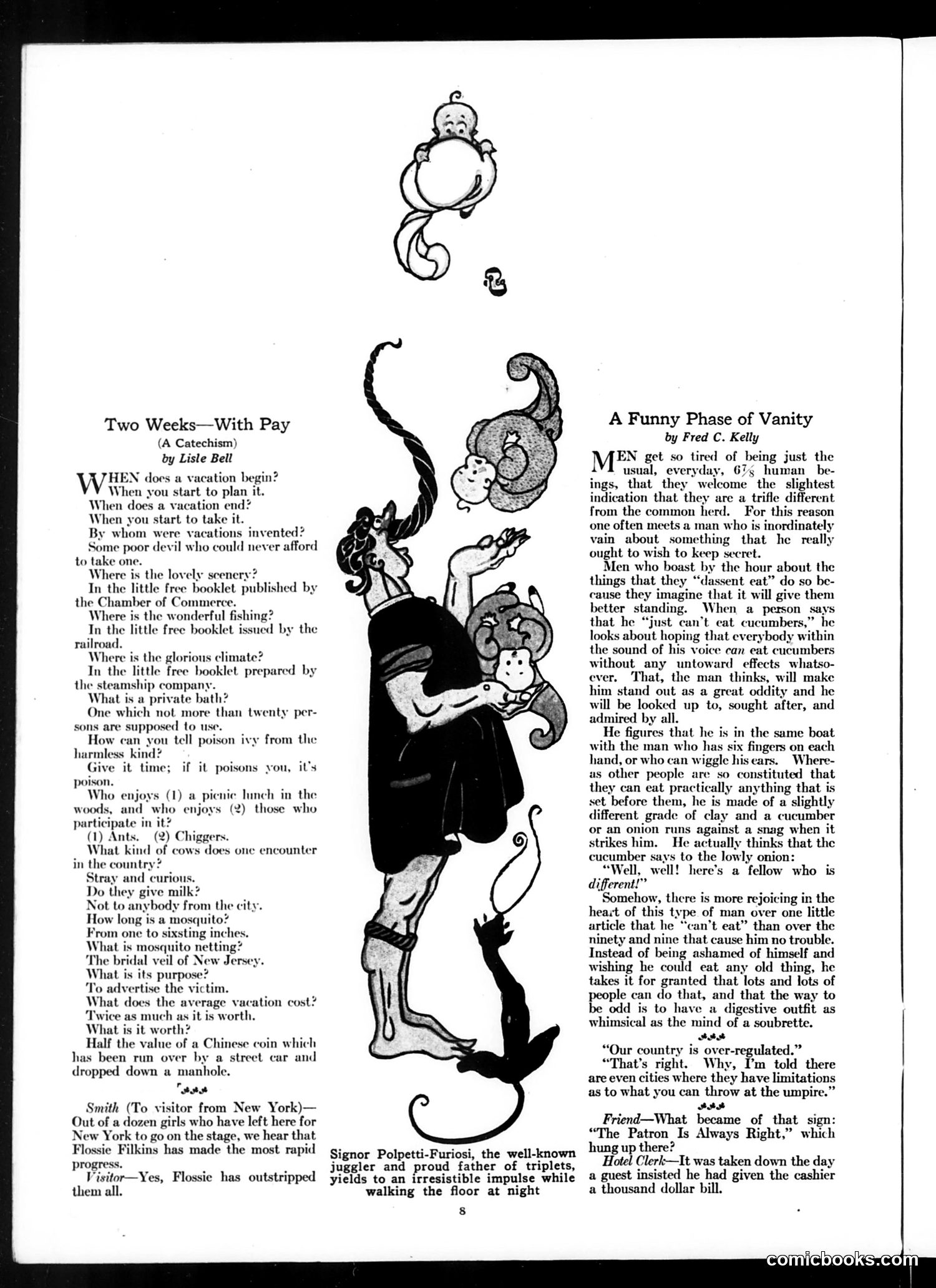
Two Weeks—With Pay (A Catechism) by Lisle Bell AV HEN does a vacation begin? When you start to plan it. When does a vacation end? When you start to take it. By whom were vacations invented? Some poor devil who could never afford to take one. Where is the lovely scenery? In the little free booklet published by the Chamber of Commerce. Where is the wonderful fishing? In the little free booklet issued by the railroad. Where is the glorious climate? In the little free booklet prepared by the steamship company. What is a private bath? One which not more than twenty per- sons are supposed to use. How can you tell poison ivy from the harmless kind . Give it time; if it poisons you, it’s poison. Who enjoys (1) a picnic lunch in the woods, and who enjoys (2) those who participate in it? (1) Ants. (2) Chiggers. What kind of cows does one encounter in the country? Stray and curious. Do they give milk? Not to anybody fr How long is a m to? From one to inches. What is mosquito netting? The bridal veil of New Jersey. What is its purpo: ‘To advertise the victim. What does the average vacation cost? Twice as much as it is worth. What is it worth? Half the value of a Chinese coin which has been run over by a street car and dropped down a manhole. "sae Smith (To visitor from New York)— Out of a dozen girls who have left here for New York to go on the stage, we hear that Flossie Filkins has made the most rapid the city. progre: Visitor—Yes, Flossie has outstripped them all. Signor Polpetti-Furiosi, the well-known juggler and proud father of triplets, yields to an irresistible impulse while walking the floor at night 8 A Funny Phase of Vanity by Fred C. Kelly MEX get so tired of being just the usual, every 67s human_be- ings, that they welcome the slightest indication that they are a trifle different from the common herd. For this reason one often meets a man who is inordinately vain about something that he really ought to wish to keep secret. Men who boast by the hour about the things that they ‘‘dassent eat” do so be- cause they imagine that it will give them better standing. When a person says that he “just can’t eat cucumbers,” he looks about hoping that everybody with the sound of his voice can eat cucumber without any untoward effects whatso- ever. That, the man thinks, will make him stand out as a great oddity and he will be looked up to, sought after, and admired by all. He figures that he is in the same boat with the man who has six fingers on each hand, or who can wiggle his ears. Where- as other people are so constituted that they can eat practically anything that is set before them, he is made of a slightly different grade of clay and a cucumber or an onion runs against a snag when it strikes him. He actually thinks that the cucumber says to the lowly onion: “Well, well! here’s a fellow who is different!” Somehow, there is more rejoicing in the heart of this type of man over one little article that he “can’t eat” than over the ninety and nine that cause him no trouble. Instead of being ashamed of himself and wishing he could eat any old thing, he takes it for granted that lots and lots of people can do that, and that the way to be odd is to have a digestive outfit as whimsical as the mind of a soubrette. te “Our country is over-regulated.” “That’s right. Why, I’m told there are even cities where they have limitations as to what you can throw at the umpire.” Sas Friend—What became of that sign: “The Patron Is Always Right,” which hung up there? Hotel Clerk—It was taken down the day a guest insisted he had given the cashier a thousand dollar bill.