
Judge, 1922-07-29 · page 16 of 36
Judge — July 29, 1922 — page 16: what you’re looking at
What you’re looking at
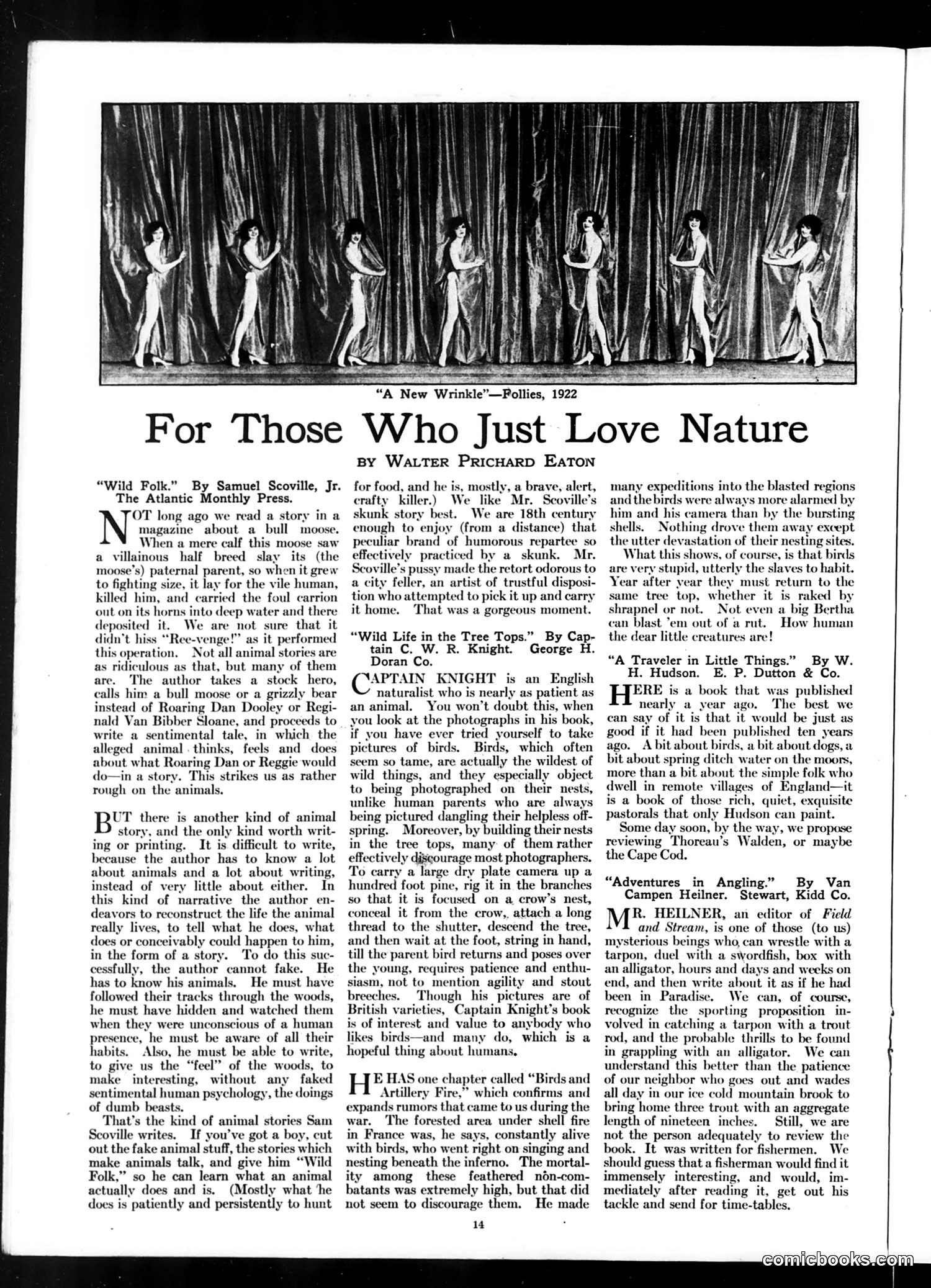
The image shows a chorus line of women in 1920s-style theatrical costumes and poses, representing a scene from the Follies production "A New Wrinkle." The text below is a book review section by Walter Prichard Eaton critiquing contemporary animal literature. Eaton distinguishes between two types of animal stories: 1. **Fake animal tales** that anthropomorphize creatures, giving them human thoughts and emotions (criticized as inauthentic) 2. **Authentic nature writing** by authors like Samuel Scoville Jr. and Captain C.W.R. Knight, who observe animals' actual behaviors through patient fieldwork The satire targets sentimental, dishonest animal fiction popular in the era—stories where moose or bears think and act like human protagonists. Eaton argues genuine animal stories require real knowledge of wildlife, not romantic projection. He particularly praises Scoville's unglamorous depiction of animals as "brave, alert, crafty killer[s]" focused on survival. The theatrical image likely illustrates the artificiality Eaton critiques—staged, choreographed nature versus authentic observation.
📄 Transcribed text from this page (OCR, searchable)
Machine-transcribed from the original scan — historical spelling and the odd misread are preserved.
“Wild Folk.” The Atlantic Monthly Press. OT long ago we read a story in a magazine about a bull moose. When a mere calf this moos a villainous half breed st: ernal parent, so v ize, it lay for the vile human, killed him, and carried the foul carrion out on its horns into deep water and there deposited sure that it didn’t hiss t performed this operation. Not all animal stories are as ridiculous as that, but many of them are. The author takes a stock hero, calls him a bull moose or a grizzly bear instead of Roaring Dan Dooley or Regi- nald Van Bibber Sloane, and proceeds to write a sentimental tale, in which the alleged animal. thinks, feels and does about what Roaring Dan or Reggie would do—in a story. This strikes us as rather rough on the animals. UT there is another kind of animal story, and the only kind worth v ing or printing. It is difficult to write, because the author has to know a lot about animals and a lot about writing, instead of very little about either. In this kind of narrative the author en- deavors to reconstruct the life the animal really lives, to tell what he does, what does or conceivably could happen to him, in the form of a story. To do this suc- cessfully, the author cannot fake. He has to know his animals. He must have followed their tracks through the woods, he must have hidden and watched them when they were unconscious of a human presence, he must be aware of all their habits. Also, he must be able to write, to giv the “feel” of the woods, to make interesting, without any faked sentimental human psychology, the doings of dumb beasts. That’s the kind of animal stories Sam Scoville writes. If you've got a boy, cut out the fake animal stuff, the storie: which make animals talk, and give him “Wild Folk,” so he can learn what an animal actually does and is. (Mostly what ‘he does is patiently and persistently to hunt By Samuel Scoville, Jr. “A New Wrinkle’ '—Follies, For Those Who Tust Love Nature BY WALTER PRICHARD EATON for food, and he is, mostly, a brave, ale crafty killer.) We like Mr. Scoville’s skunk story best. We are 18th century enough to enjoy (from a distance) that peculiar brand of humorous repartee so ly practiced by a skunk. Mr. Scoville’s pussy made the retort odorous to y feller, an artist of trustful disposi- tion who attempted to pick it up and carry it home. That was a gorgeous moment. “Wild Life in the Tree Tops.” By Cap- tain C. W. R. Knight. George H. Doran Co. NAPTAIN KNIGHT is an English naturalist who is nearly as patient as an animal. You won’t doubt this, when you look at the photographs in his book, if you have ever tried yourself to take pictures of birds. Birds, which often seem so tame, are actually the wildest of wild things, and they especially object to being photographed on their nests, unlike human parents who are alw being pictured dangling their helpless o! spring. Moreover, by building their nests in the tree tops, many of them rather effectively discourage most photographers. To carry a large dry plate camera up a hundred foot pine, rig it in the branches so that it is focused on a crow’s nest, conceal it from the crow,, attach a long thread to the shutter, descend the tree, and then wait at the foot, string in hand, till the parent bird returns and poses over the young, requires patience and enthu- siasm, not to mention. agil and stout breeches. Though pictures are of British varieties, Captain Knight’s book is of interest and value to anybody who likes birds—and many do, which is a hopeful thing about pans. E HAS one chapter called “Birds and Al ery Fire,” which confirms and expands rumors that came to us during the war. The forested area under shell fire in France was, he says, constantly alive with birds, who went right on singing and nesting beneath the inferno. The mortal- ity among these feathered ndn-com- batants was extremely high, but that did not seem to discourage them. He made 14 many expeditions into the blasted regions and the bird more alarmed by him and hi nera than by the bursting shells. Nothing drove them the utter d tion of their What this shows, of cours’ are very stupid, utterly th Year after year they must return to the same tree top, whether it is raked by shrapnel or not. Not even a big Bertha can blast ’em out of a rut. How human the dear little creatures are! that birds ves to habit. “A Traveler in Little Things.” By W. H. Hudson. E. P. Dutton & Co. ERE is a book that was published nearly year ago. The best we can say of it is that it would be just as good if it had been published ten years ago. A bit about birds, a bit about dogs, a bit about spring ditch water on the moors, more than a bit about the simple folk who dwell in remote villages of England—it is a book of those rich, quiet, exquisite pastorals that only Hudson can paint. Some day soon, by the way, we propose reviewing Thoreau’s Walden, or maybe the Cape Cod. “Adventures in Angling.” By Van Campen Heilner. Stewart, Kidd Co. R. HEILNER, an editor of Field and Stream, is one of those (to us) mysterious beings who, can wrestle with a tarpon, duel with a swordfish, box with an alligator, hours and days and weeks on end, and then write about it as if he had been in Paradise. We can, of course, recognize the sporting proposition in- volved in catching a tarpon with a trout rod, and the probable thrills to be found in grappling with an alligator. We can understand this better than the patience of our neighbor who goes out and wades all day in our ice cold mountain brook to bring home three trout with an aggregate length of nineteen. inche: Still, we are not the person adequately to review the book. It was written for fishermen. We should guess that a fisherman would find it immensely interesting, and would, im- mediately after reading it, get out his tackle and send for time-tables.