
Judge, 1922-07-29 · page 4 of 36
Judge — July 29, 1922 — page 4: what you’re looking at
What you’re looking at
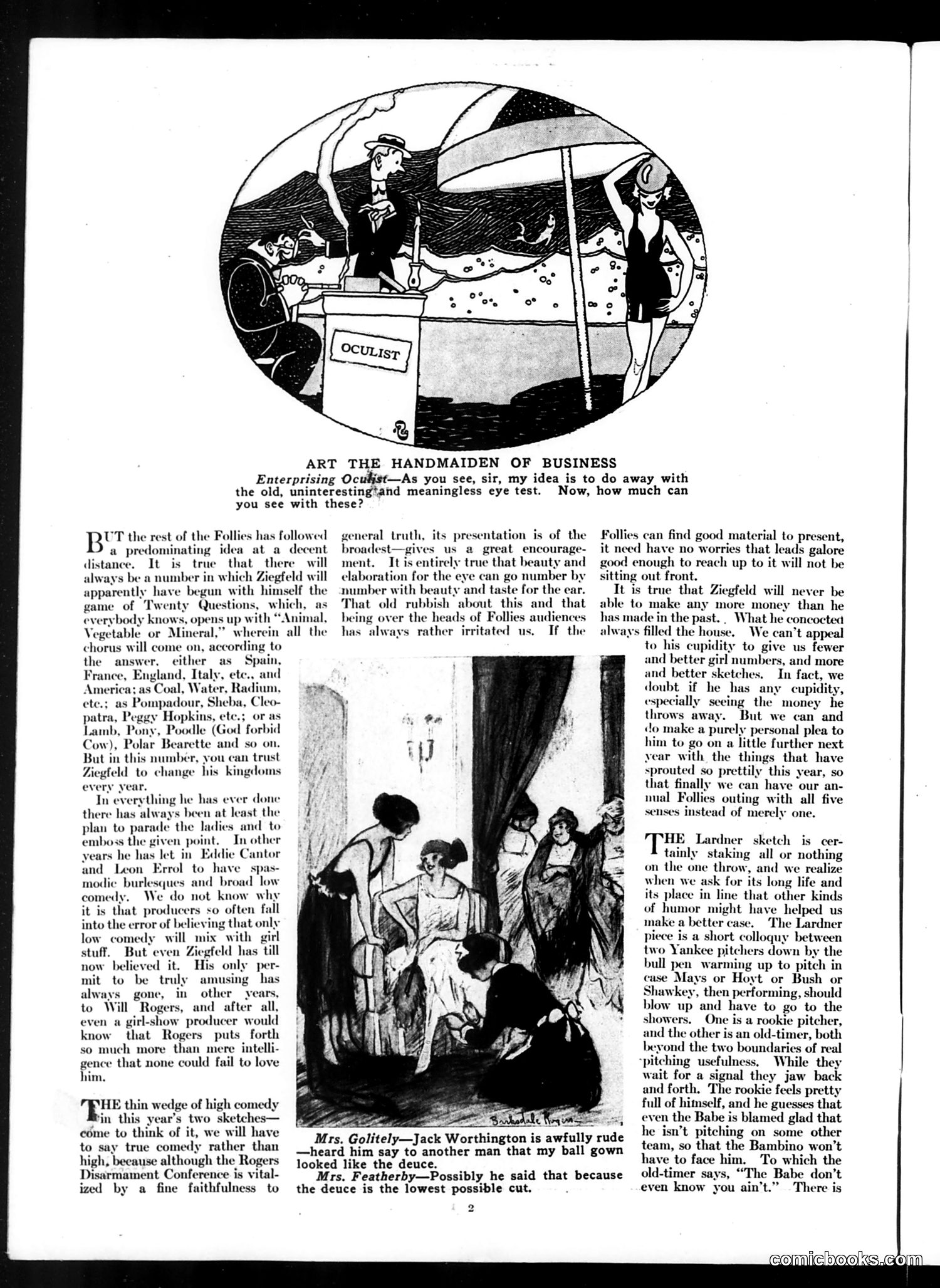
The top cartoon mocks a charlatan "oculist" (eye doctor) running a beach con-game, charging customers for fake eye tests using worthless spectacles—a dig at fraudulent medical practitioners exploiting the public. The lower illustration, captioned "Mrs. Galitely" and "Mrs. Featherby," shows two society women gossiping, with dialogue about a man's "ball gown" looking like "the deuce" and comments about a "deuce" being "the lowest possible card." This appears to satirize high-society women's shallow gossip and their tendency to demean men through catty remarks. The article criticizes Florenz Ziegfeld's theatrical productions, arguing his emphasis on visual spectacle over substance has corrupted artistic merit—a commentary on commercialism overtaking genuine art in entertainment.
📄 Transcribed text from this page (OCR, searchable)
Machine-transcribed from the original scan — historical spelling and the odd misread are preserved.
ART THE HANDMAIDEN OF BUSINESS Enterprising Ocudist—As you see, sir, my idea is to do away with the old, uninteresting*and meaningless eye test. you see with these? UT the rest of the Follies has followed ‘a predominating idea at a decent dista It is true that there will ber in which Ziegfeld will begun with himself the Questions, whic © s, opens up with “Animal, Vegetable or Mineral,” wherein all the chorus will come on, according to the answe ither as Spain, France, at, patra, Peggy Hopkin 63 OF AS Lamb, Pony, Poodle (God forbid Cow), Polar Bearette and so on. But in this number, you can t Ziegfeld to change his kingde every year. Tn everything he has ever done there has always been at least the plan to pai the ladies and to emboss the given point. In other years he has let in Eddie Cantor and Leon Errol to have spas- modic burlesques and broad low comedy. We do not know why it is that producers so often fall into the error of believing that only low comedy will mix with girl stuff. But e Ziegfeld has till now believed it. His only per- mit to be truly amusing has always gone, in other years, to Will Rogers, and after all, even a girl-show producer would know that Rogers puts forth so much more than mere intelli- gence that none could fail to love him, HE thin wedge of high comedy in this year’s two sketches— come to think of it, we will have to say true comedy rather than high, because although the Rogers Disarmament Conference is vital- ized by a fine faithfulness to general truth, its presentation is of the broadest—gi: us a great encourage- ment, It is entirely true that beauty and elaboration for the can go number by number with beauty and taste for the ear. That old rubbish about this and that being over the heads of Follies audiences has always rather irritated us. If the Me chub Mrs. Golitely—Jack Worthington is awfully rude —heard him say to another man that my ball gown looked like the deuce. Mrs. Featherby—Possibly he said that because the deuce is the lowest possible cut. 2 Now, how much can Follies can find good material to present, it need have no worries that leads galore good enough to reach up to it will not be sitting out front. It is true that Ziegfeld will never be able to make any more money than he has made in the past. always filled the hou: to his y to giv and better girl numbers, and more and better sketches. In fact, we doubt if he has any cupidity, especially seeing the money he throws away. But we can and do make a purely personal plea to him to go on a little further next year with the things that have sprouted so pret this year, so n have our an- outing with all five ad of merely one. that finally we ¢: nual Foll 'HE Lardner sketch is cer- tainly staking all or nothing on the one throw, and we realize when we ask for its long life and its place in line that other kinds of humor might have helped us make a better case. ~The Lardner piece is a short colloquy between two Yankee pitchers down by the bull pen warming up to pitch in case Mays or Hoyt or Bush or Shawkey, then performing, should blow up and have to go to the showers. One is a rookie pitcher, and the other is an old-timer, both beyond the two boundaries of real ‘pitching usefulness, While they wait for a signal they jaw back and forth. The rookie feels pretty full of himself, and he guesses that even the Babe is blamed glad that he isn’t pitching on some other team, so that the Bambino won’t have to face him. To which the old-timer says, “The Babe don’t even know you ain't.” There is