
Judge, 1922-07-29 · page 6 of 36
Judge — July 29, 1922 — page 6: what you’re looking at
What you’re looking at
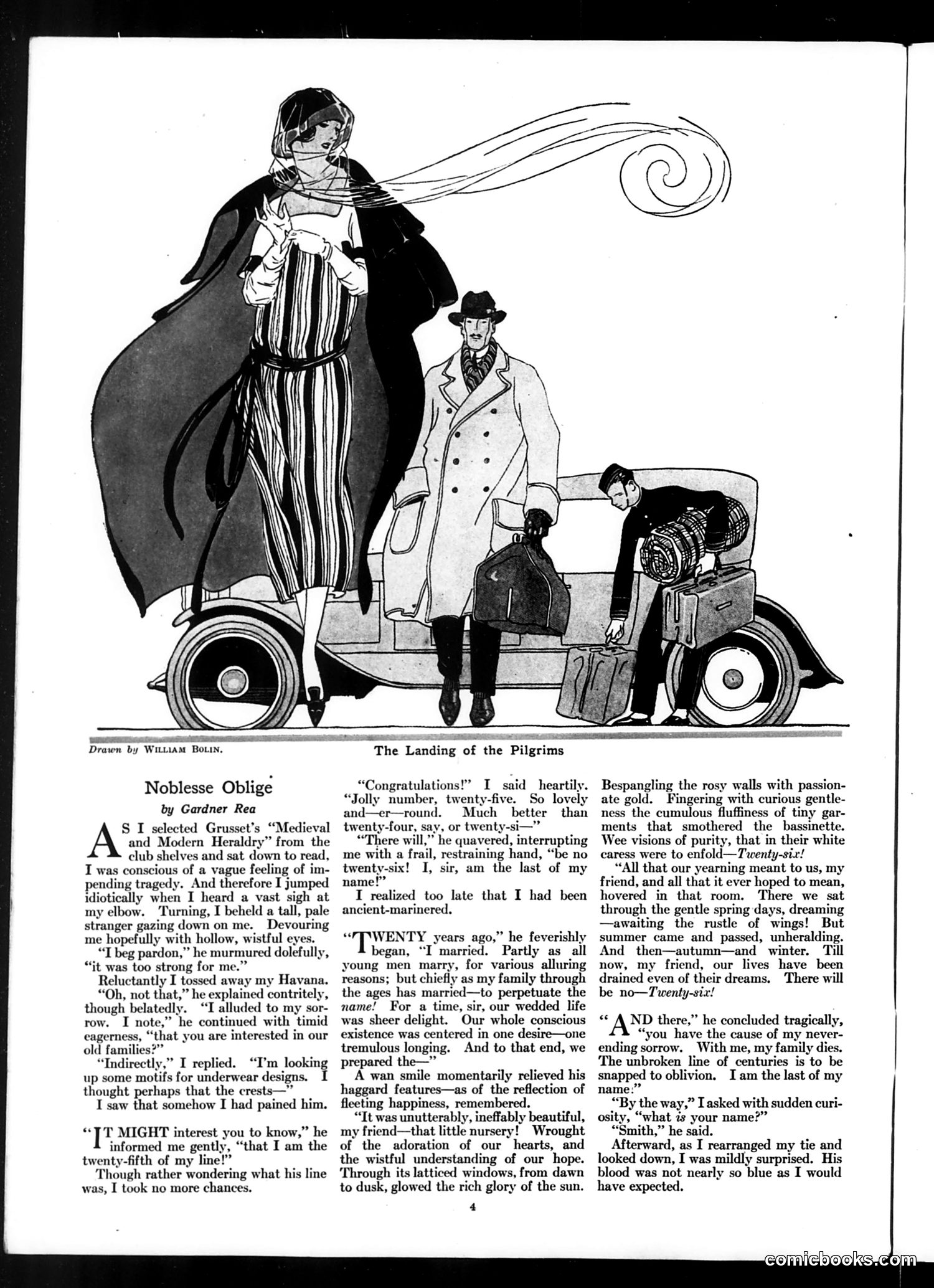
This page contains an illustration titled "The Landing of the Pilgrims" by William Bolin (top) and a short story called "Noblesse Oblige" by Gardner Rea (below). The cartoon appears to be a modernist reimagining of the Pilgrim landing, depicting a woman in classical robes standing atop an automobile filled with luggage and male passengers. The swirling decorative element suggests movement or arrival. This likely satirizes early 20th-century tourism or immigration—presenting the historical "Pilgrims" as contemporary travelers arriving by motorcar rather than ship, mocking either wealthy travelers' pretensions or contemporary attitudes toward newcomers. The juxtaposition of classical imagery with modern technology was a common satirical device in this era. The story text appears unrelated to the cartoon's apparent commentary.
📄 Transcribed text from this page (OCR, searchable)
Machine-transcribed from the original scan — historical spelling and the odd misread are preserved.
atrac Drawn by W Noblesse Oblige by Gardner Rea S I selected Grusset’s “Medieval and Modern Heraldry” from the club shelves and sat down to read, I was conscious of a vague feeling of im- pending tragedy. And therefore I jumped idiotically when I heard a vast sigh at my elbow. ‘Turning, I beheld a tall, pale stranger gazing down on me. Devouring me hopefully with hollow, wistful eyes. “TI beg pardon,” he murmured dolefully, “jt was too strong for me.” Reluctantly I tossed away my Havana. “Oh, not that,” he explained contritely, though belatedly. “I alluded to my sor- row. I note,” he continued with timid eagerness, “that you are interested in our old families?” “Indirectly,” I replied. “I’m looking up some motifs for underwear designs. I thought perhaps that the crests—” I saw that somehow I had pained him. ual Es: MIGHT interest you to know,” he informed me gen‘ “that I am the twenty-fifth of my line! Though rather wondering what his line was, I took no more chances. The Landing of the Pilgrims “Congratulations!” I said heartily. “Jolly number, twenty-five. So lovely and—er—round. Much better than twenty-four, say, or twenty-si—” “There will,” he quavered, interrupting me with a frail, restraining hand, “be no twenty-six! I, sir, am the last of my name!” I realized too late that I had been ancient-marinered. “TWENTY years ago,” he feverishly began, “I married. Partly as all young men marry, for various alluring reasons; but chiefly as my family through the ages has married—to perpetuate the name! For a time, sir, our wedded life was sheer delight. Our whole conscious existence was centered in one desire—one tremulous longing. And to that end, we prepared the—” A wan smile momentarily relieved his haggard features—as of the reflection of fleeting happiness, remembered. “It was unutterably, ineffably beautiful, my friend—that little nursery!’ Wrought of the adoration of our hearts, and the wistful understanding of our hope. Through its latticed windows, from dawn to dusk, glowed the rich glory of the sun. 4 Bespangling the rosy walls with passion- ate gold. Fingering with curious gentle- ness the cumulous fluffiness of tiny gar- ments that smothered the bassinette. Wee visions of purity, that in their white caress were to enfold—Twenty-six! “All that our yearning meant to us, my friend, and all that it ever hoped to mean, hovered in that room. There we sat through the gentle spring days, dreaming —awaiting the rustle of wings! But summer came and passed, unheralding. And then—autumn—and winter. Till now, my friend, our lives have been drained even of their dreams. There will be no—Twenty-six! «© A ND there,” he concluded tragically, “you have the cause of my never- ending sorrow. With me, my family dies. The unbroken line of centuries is to be snapped to oblivion. I am the last of my name:” “By the way,” I asked with sudden curi- osity, “what 7s your name?” “Smith,” he said. Afterward, as I rearranged my tie and looked down, I was mildly surprised. His blood was not nearly so blue as I would have expected.