
Judge, 1922-07-29 · page 3 of 36
Judge — July 29, 1922 — page 3: what you’re looking at
What you’re looking at
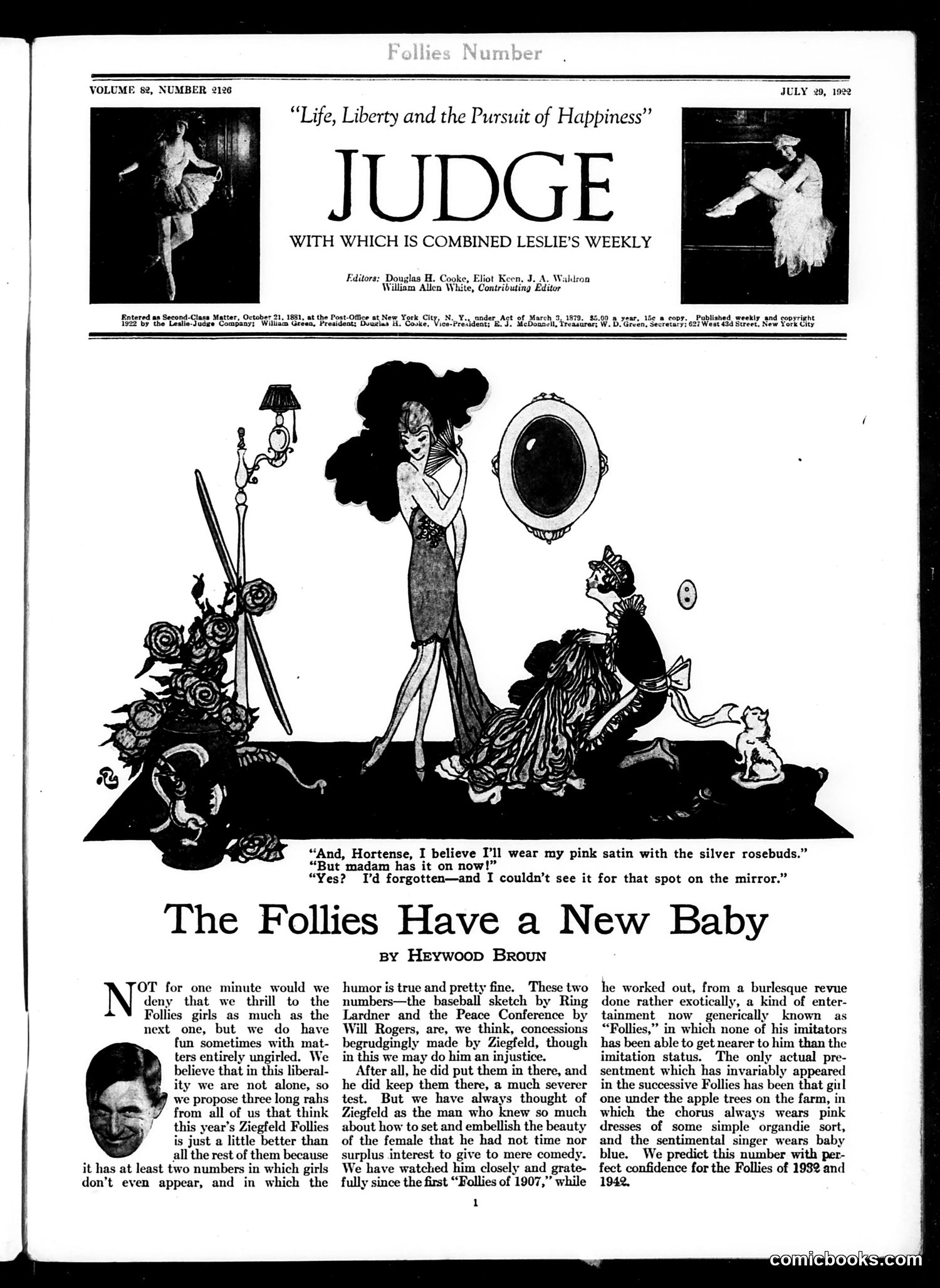
This satirical piece by Heywood Broun celebrates the Ziegfeld Follies theatrical revue. The illustration depicts glamorous showgirls in an art deco style, characteristic of 1920s entertainment publicity. The joke centers on vanity and the theatrical hierarchy: a young performer admires a pink satin dress with silver rosebuds, but an older actress (likely representing "Madame" Ziegfeld or an established star) already wears it. When the younger woman asks to see herself in the mirror, she discovers the established performer is blocking her view of the reflection—a visual metaphor for how established performers monopolize attention and opportunity. The article praises the Follies' artistic merit and production values under impresario Florenz Ziegfeld, suggesting even comedy numbers demonstrate sophistication. It references earlier Follies productions from 1907 onward, positioning 1932's edition as continuing that prestigious legacy.
📄 Transcribed text from this page (OCR, searchable)
Machine-transcribed from the original scan — historical spelling and the odd misread are preserved.
VOLUME 82, NUMBER 2126 tobe Wi P nd-Clasa Matter, Oct 1, 188 je Company; Williaa Ge y the 1, at the Post-Office at New York ‘dea, President; Douglas Hi. Goo “Life, Liberty and the Pursuit of Happiness” WITH WHICH IS COMBINED LESLIE’S WEEKLY Editors: Douglas H. Cooke, Eliot Keen, J. A. Waldron William Allen White, Contributing Editor ander Ast of March 9, 1879. £2.09 » ‘ff MeouaschPtreasarers W. B.% ly and copyright New York City “Yes? “And, Hortense, I believe I’ll wear my pink satin with the silver rosebuds.” “But madam has it on now!” I’d forgotten—and I couldn’t see it for that spot on the mirror.” The Follies Have a New Baby OT for one minute would we deny that we thrill to the Follies girls as much as the next one, but we do have fun sometimes with mat- ters entirely ungirled. We believe that in this liberal- ity we are not alone, so we propose three long rahs from all of us that think this year’s Ziegfeld Follies is just a little better than all the rest of them because it has at least two numbers in which girls don’t even appear, and in which the By Heywoop Broun humor is true and pretty fine. These two numbers—the baseball sketch by Ring Lardner and the Peace Conference by Will Rogers, are, we think, concessions begrudgingly made by Ziegfeld, though in this we may do him an injustice. After all, he did put them in there, and he did keep them there, a much severer test. But we have always thought of Ziegfeld as the man who knew so much about how to set and embellish the beauty of the female that he had not time nor surplus interest to give to mere comedy. We have watched him closely and grate- fully since the first “Follies of 1907,” while 1 he worked out, from a burlesque revue done rather exotically, a kind of enter- tainment now generically known as “Follies,” in which none of his imitators has been able to get nearer to him than the imitation status. The only actual pre- sentment which has invariably appeared in the successive Follies has been that gitl one under the apple trees on the farm, in which the chorus always wears pink dresses of some simple organdie sort, and the sentimental singer wears baby blue. We predict this number with per- fect confidence for the Follies of 1982 and 1942,