
Judge, 1922-07-29 · page 12 of 36
Judge — July 29, 1922 — page 12: what you’re looking at
What you’re looking at
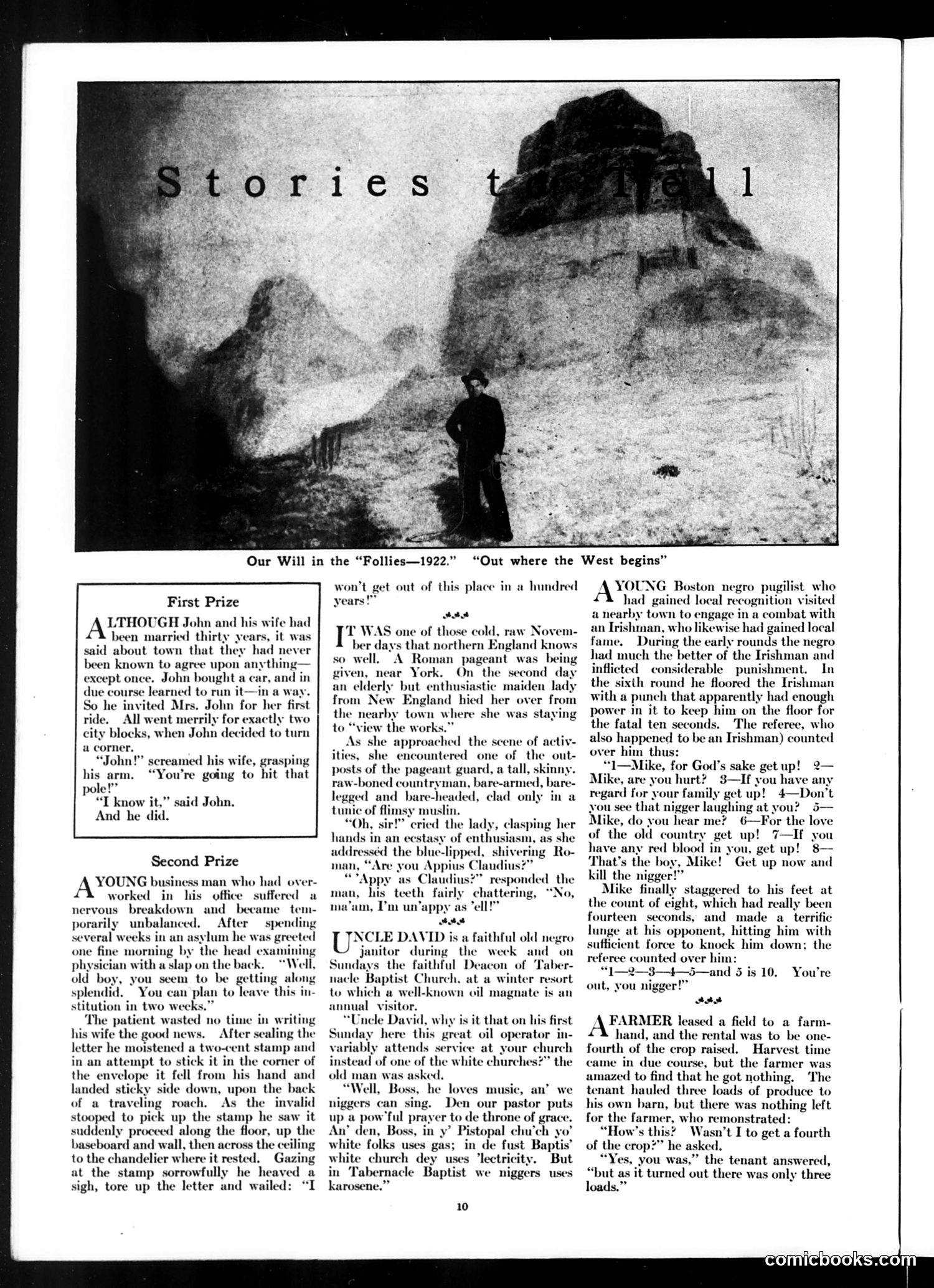
This page from *Judge* magazine contains three short humorous stories with racist and ethnic stereotypes typical of 1922 American satire. The "First Prize" and "Second Prize" sections are brief comic anecdotes: one about a husband deliberately hitting a pole despite his wife's warning; another about a mentally ill man whose escaped postage stamp ruins his chance at early discharge. The longer piece, "Our Will in the 'Follies—1922,'" depicts racist scenarios: a New England woman encounters a barely-clothed Roman pageant performer; a story contrasts Black and Irish characters in patronizing dialect; and a narrative describes a boxing match where an Irish referee deliberately miscounts to favor an Irish fighter over a Black opponent, using racial slurs throughout. The satire targets immigrant and minority groups through caricature and dehumanizing language. These pieces reflect *Judge*'s editorial stance: mocking marginalized populations was considered acceptable humor for the magazine's presumed white, educated audience. The content reveals deeply embedded prejudices of the era that would be considered offensive and unacceptable today.
📄 Transcribed text from this page (OCR, searchable)
Machine-transcribed from the original scan — historical spelling and the odd misread are preserved.
First Prize LTHOUGH John and his wife had been married thirty years. said about town that t been known to agree upon anything— except once. John bought a car, and in due course learned to run it—in a way. So he invited Mrs. John for her first ride, All went merrily for exactly two city blocks, when John decided to turn creamed his wife, grasping “You're going to hit that his arm, pole!” “T know it,” said John. And he did. Second Prize YOUNG bi worked in his man who had over- office suffered a nervous breakdown and became tem- porarily unbalanced. After pending several weeks in an asylum he was greeted one fi yrning by the head examining phys with a slap on the back. “Well, old boy, you seem to be getting along splendid. You can plan to leave this in- stitution in two wee! The patient wasted writing his wife the good news. aling the letter he moistened a two-cent stamp and in an attempt to stick it in the corner of the envelope it fell from hand and landed stic! Je down, upon the b: of a traveling roach. As the inve stooped to pick up the stamp he saw it suddenly proceed along the floor, up_ baseboard and wall, then across the ce to the chandelier where it rested. Gazing at the stamp sorrowfully he heaved a sigh, tore up the letter and wailed: “I Our Will in the “Follies—1922.” won't get out of this place in a hundred years!" ery T WAS one of those cold, raw Novem- ber days that northern England so well. A Roman pageant was teing given, near York. On the second day an elderly but enthusia: from New England hied her ov the nearby town where she was s to “view the works.” As she approached the scene of activ- ities, she encountered one of the out- posts of the pageant guard, a tall, skinny. raw-boned countryman, bare-armed, bare- legged and bare-headed, clad only in a tunic of flimsy muslin. “Oh, sir!” cried the lady, ¢ hands in an ecstasy of enthu addresséd the blu “Are you Appius ‘Appy ‘us Claudius? his teeth fai sas NCLE DAVID is a faithful old negro janitor during the week on Sundays the faithful Deacon of Taber- nacle Baptist Church, at a ter resort. to which a well-known oil magnate is an annual visitor. Uncle David, why is it that on his first Sunday here this great oil operator in- variably attends service at_your church instead of one of the white churches?” the old man was asked. , Be he loves music, an’ we ‘iigpers can ing. Den our pastor puts up & pow “ful prayer | to de throne of grace. Boss, in y’ Pistopal chu'ch yo white folks uses gas; in de fust Baptis’ white church dey uses ‘lectricity, But in Tabernacle Baptist we niggers use karosene. 10 “Out where the West begins” YOUNG Boston negro pugilist_ who had gained local recognition visited a nearby town to engage in a combat with an Irishman, who likewise had gained local fame. During the early rounds the negro had much the better of the Irishman and inflicted considerable punishment. In the sixth round he floored the Irishman with a punch that apparently had enough power in it to keep him on the floor for the fatal ten seconds. The referee, who also happened to be an Irishman) counted over him thus: “1—Mike, for God’: Mike, are you hurt? regard for your family you see that nigger laugh Mike, do you hear me? of the old country get up! have any red blood in you, get up! ‘That's the boy, Mike! kill the nigger Mike finally staggered to his feet at the count of eight, which had really been fourteen seconds, and made a_ terrific lunge at his opponent, hitting him with sufficient force to knock him down; the referee counted over him: “1—2—3—4—5—and 5 is 10. out, you nigger!” St FARMER leased a field to a farm- hand, and the rental was to be one- fourth of the crop raised. Harvest came in due course, but the farmer was amazed to find that he got nothing. The tenant hauled three loads of produce to his own barn, but there was nothing left for the farmer, who remonstrated: “How's this? Wasn’t I to get a fourth of the crop?” he asked, ‘8, you was,” the tenant answered, “but as it turned out there was only three loads.” ke get up! 2— —If you have any et up! 4—Don't ngat you? 5— 6—For the le e 7—If you 8— Get up now and You're